Novella a Day in May 2025: No.25

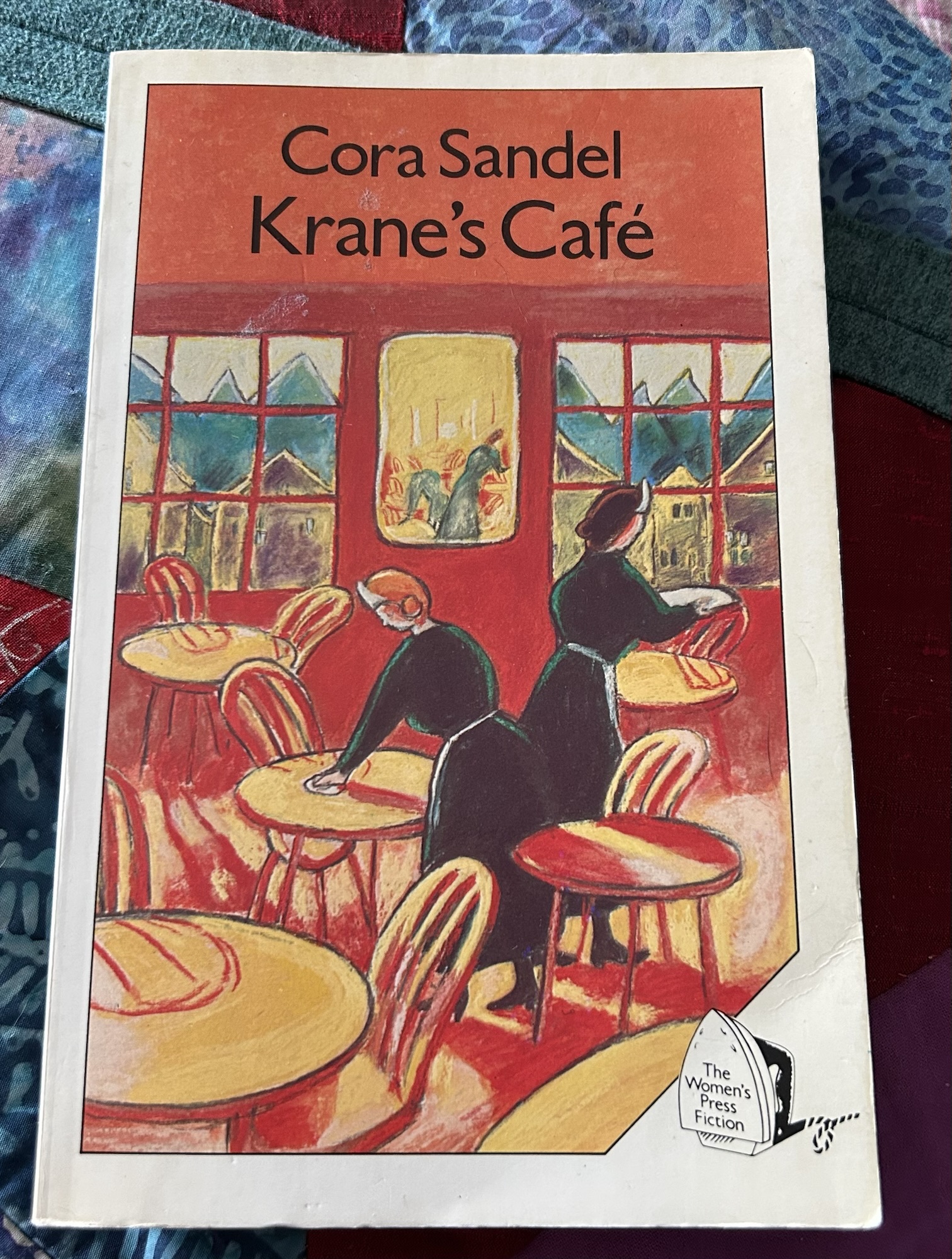
Krane’s Café – Cora Sandel (1946, transl. Elizabeth Rokkan 1968) 173 pages

Back in November Kaggsy reviewed some of Cora Sandel’s shorter writings and reminded me that I had Krane’s Café languishing in the TBR. I’m really pleased to have finally got to it, with its sly humour and incisive characterisation.

“There’s a lot to be heard before your ears drop off.”

Set just after the First World War, it opens with Katinka Stordal sitting in the titular café. She is the dressmaker in a small coastal town in northern Norway, and there is a big event coming up. Her orders are piling up, and Mrs Krane, the owner of the café with her husband, is trying to move Katinka on.

“’I’m going, I’m going,’ said Mrs Stordal. She looked up listlessly for a moment, and stayed where she was. It was one of those days when she looks much older than she really is.”

The narrative voice has this slightly bitchy, judgemental tone, which works so well. In implicitly proclaiming an alliance with the attitudes of the townsfolk, she draws attention to their pettiness and their lack of humane understanding.

People come in to try and chivvy Katinka along, with absolutely no interest as to why she is unable to move from the café or has her head in her hands. Their only concern is getting her back to work.

“As usual Mrs Brien was magnificently equal to the situation. ‘Now then, we mustn’t get hysterical, you know. We mustn’t give up. Everyone has worries. I don’t know anyone without worries. This really is naughty of you, Katinka.”

Then a man called Bowler Hat arrives…

“And he went over to Mrs Stordal and said in that low, one might almost be tempted to say melodious voice, if it were not so ridiculous, and offensive and bold into the bargain, ‘May I offer you something? Something you’d fancy? What about a little wine? The wine you’ve just been drinking? And then you can go on listening to me for a while? You mustn’t stop listening yet, you understand so well. I expect you know too how it feels to be lonely?’”

So the situation becomes scandalous. Katinka is in the back room of the café, drinking with a male stranger. She is complaining about her selfish family, her enduring fatigue with life, her lack of choices. Bowler Hat is an unnerving figure and I did wonder at times if he was a representation of the devil.

Mrs Krane feels overwhelmed without her husband to help her manage the situation, and her staff, Larsen and Sønstegård, are thoroughly enjoying the drama while pretending not to.

“Children and drunkards will tell you the truth. Both Larsen and Sønstegård admitted later that at that point they were almost afraid of more customers coming. For it was exciting to listen to Mrs Katinka, who scarcely ever gave you an answer in the normal run of affairs, sitting there giving rein to her tongue. Even though it was so dreadful to hear her gossiping like that about her own children. Throwing them to the wolves, you might almost call it.

And even though it was all a lot of nonsense.

What else could you call it?”

What emerges is a picture of real sadness. Katinka is lonely and disregarded by her family and by the town, while expected to fulfil their expectations of her. She is teased by the town’s children for her drinking, and in this small community no-one really truly acknowledges anyone else’s pain, despite how closely they all live together.

“And surely she couldn’t have thought of going and drowning herself, with all those orders, she the mother of two children besides? Nobody did that sort of thing in this town.

Suddenly it struck Mrs Krane that that sort of thing was just not written up in the paper about people in other places. Grieve the chemist had taken prussic acid in the cellar of his shop, though that had happened a long time ago and he was even scolded at his graveside by Mr Pio the curate […. ] and Iverson the tailor, who had such a spiteful wife, had walked out into the sea until it went over his head, and he never came up again, even though it was ebb tide and the sea was far out.”

In this way Sandel satirises society and its unthinking complacency towards others; the hypocrisy; and the self-interest. Yet unlike some satire, it doesn’t have a bitter edge. The characterisation is compassionate towards Katinka and Mrs Krane; and even Katinka’s daughter. The narrative voice is humorous and by aligning itself with the attitudes of the town, it avoids the superior tone of some satire.

I felt the ending was compassionate, though the town and its inhabitants remain largely unchanged…

“And all of a sudden Katinka shouted at the top of her voice, ‘Here comes the madness, the great, wonderful madness. The liberator from everything, who opens the gates and makes all spacious about you.’”
“It takes courage to grow up and become who you really are.” (e. e. cummings)

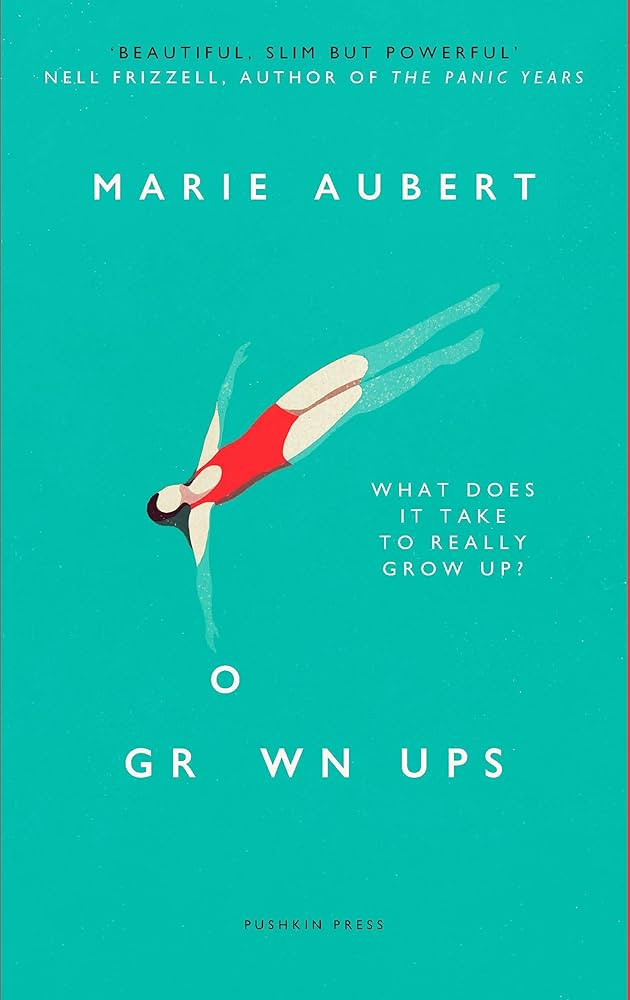
The blurb on the cover of my edition of Grown Ups by Marie Aubert (2019 transl. Rosie Hedger 2021) pushes it as ‘the perfect summer read’ and ‘pure escapism’ with which I couldn’t disagree more. Obviously we all have different reactions to books, but for me a novella (154 pages) about a woman coming to terms with her rapidly reducing choices regarding fertility, while at the summer house of her family with all its inherent tensions and rivalries, didn’t feel remotely escapist. Even when it’s darkly humorous and set in a log cabin in Norway 😉

Grown Ups features a very unlikable protagonist in Ida. She behaves really badly by anyone’s standards. But she was also recognisable and (somewhat) sympathetic.

At the start of the novel she is at a Swedish clinic having her eggs frozen:

“One day, I thought as I lay there in the gynaecology chair, one day things have to work out, one day, after a long line of married and otherwise committed and uninterested and uninteresting men, things have to work out, just lying there made me believe both men and child might materialise, just the fact that I was there and actually doing it was a promise that there was more to come, one day.”

I really felt for Ida. As the quote shows, she is feeling a bit desperate regarding the future as she turns forty, but pinning her hopes on a fantasy. As the story develops, the ambivalence she feels about what that future might look like is subtly portrayed. She doesn’t really seem to like children very much, but she doesn’t want that choice taken away from her. If she truly wants a committed relationship, why does she keep seeking out men who are already committed to someone else?

She travels to the family summerhouse in Norway for her mother’s birthday. Her sister Marthe is there with her husband Kristoffer and step-daughter Olea. The sisters relationship is full of long-held petty tensions, but it felt like they could actually be really close if they would just step outside of these entrenched behaviours. It doesn’t help that Marthe has redecorated the cabin without asking or even discussing it with Ida. She is also pregnant.

“‘I’m not as tough as you are,’ Marthe says, sounding a little sarcastic. It’s always the same, every summer, I’m quick to get into the water while Marthe takes her time, and then we each make digs about which approach is best.”

One of the hardest things to read in the book is Ida’s treatment of Olea. Recognising that Olea and Marthe don’t get on, Ida manipulates the child to increase her opposition to Marthe, just to prove something to Marthe and herself. She seems to have no fondness for Olea, and everything is performative rather than felt or understood.

“I’m the grown up now, I’m good at this. My tone is calm and kind, it feels familiar, like how things ought to be […] See, Marthe, I can do this, I’m the one who’s supposed to be doing this.”

Ida is destructive in her behaviour but only half-recognises this. I felt with Olea she didn’t really see the child as a person so didn’t fully recognise what she was doing. Flirting with Kristoffer on the other hand, she is fully aware of…

I’m making Ida sound more unlikable than she is and not doing justice to Aubert’s subtlety at all! The hurt Ida is experiencing is so clear, she is just seeking entirely flawed ways of managing that pain. Although she mentions friends, they are not named and she comes across as very isolated, particularly when her mother arrives with partner Stein.

“I feel the injustice, rampant and raging, there’s no one there to console me”

There’s also a passage where Ida describes dating and her hopes for more, where my heart just broke for her. It was filled with so much anger and loathing towards herself.

I looked on goodreads and yep, some readers really hated Ida 😀 But for me, while a lot of her behaviour was downright awful, I thought she was realistically portrayed as someone who has grown up thinking love is conditional and now doesn’t know who she is or what she really wants.

Grown Ups is well paced and things aren’t all tied up neatly at the end, which I liked as it didn’t undermine Ida’s situation or her feelings. I did have a sense Ida would carry on but maybe do a bit better. Unlike at the start of the story, there was hope for her grounded in something real.

To end, two sisters who seem to get on better than Ida and Marthe, singing about the struggles of trying to be grown up and a problem Ida has definitely experienced:

Novella a Day in May 2022 No.13

Love – Hanne Ørstavik (1997, trans. Martin Aitken, 2018) 136 pages

It’s been six years since I read Hanne Ørstavik’s powerful novella The Blue Room and I had high expectations when I picked up Love from one of my favourite publishers AndOtherStories.

Like The Blue Room, Love features a dysfunctional parent/child relationship, although not one as determinedly destructive as Johanne and her mother in The Blue Room. Whereas that was suffocating and controlling, Jon and his mother Vibeke are almost at the opposite extreme with a child at risk of neglect.

I don’t have kids but I would say that having your eight year-old son roam the snowy streets in northern Norway alone in the depths of the night with no gloves on, while you prevaricate over whether to sleep with a man who picked you up at a funfair, is probably not the best parenting style…

Jon is waiting for his mother Vibeke to return from work. Tomorrow is his birthday and he believes she is going to bake him a cake.

“And then she comes, and he recognises the sound in an instant; he hears it with his tummy, it’s my tummy that remembers the sound, not me, he thinks to himself.”

Although in the same house and having dinner together, they’re not overly communicative. Vibeke has a shower and makes herself look good should she bump into her attractive work colleague in town. Jon leaves the house, returns again, then leaves again, with Vibeke only vaguely conscious of his whereabouts.

The town is far north and it has been snowing. Jon wanders the dark streets:

“Sounds become weightless in the cold. Everything does. As if he were a bubble of air himself, ready at any moment to float into the sky and vanish into the firmament.”

Meanwhile Vibeke has found the library closed, so she wanders round the newly arrived fairground. An attractive fairground worker picks her up and takes her back to his caravan.

“She feels like they share something now. It feels like pushing a boat from the shore, the moment the boat comes free of the sand and floats, floats on the water.”

We know Vibeke had Jon when she was young and that it has been the two of them for a while. However, Vibeke seems pretty oblivious not only to the safety of her son but to the feelings and motivations of other people. Despite being attracted to one another, the situation between Vibeke and the man never really takes off. She keeps holding back because she thinks that talking too much has hampered previous relationships.

“My mistake is to think too much when I talk, it slows everything down, repartee just isn’t there for me.”

However, there comes a point where you do actually have to communicate in some way. When they go to a bar and he chats to the barmaid, then disappears back inside leaving Vibeke in the car outside, she thinks:

“Maybe he’s working on keeping a hold on himself, and the control he thereby achieves is something he needs to cling to.”

Um, no. He’s just lost interest and moved onto the next pretty and more available girl.

Meanwhile Jon has spent some time with a schoolfriend (whose parents are happy to have him leave and wander back home alone at midnight) and ends up getting into a stranger’s car, which at least offsets hypothermia for a while.

Although remarkably self-possessed and bright, Jon is clearly suffering from his mother’s lack of care. He is trying to stop himself blinking and people comment it.

“He wishes no one noticed and that what was wrong with him was under his clothes or inside him.”

Throughout, he clings to the idea that Vibeke is at home baking him a birthday cake which I found completely heart-breaking.

The narrative of Love alternates between Vibeke and Jon almost paragraph by paragraph. This isn’t nearly as confusing as it sounds, it works well as the two of them have evenings that echo and reflect each other in surprising ways. They also both put themselves in risky situations and the story is tense and very believable. It’s a novella that creeps under your skin and stays there.

“She wishes she could read all the time, sitting in bed with the duvet pulled up, with coffee, lots of cigarettes and a warm nightdress on.” 

“Where is Blitzen, baby?” (The Ramones)

Well, it’s been another difficult year for everyone, but I hope that the festive season sees you getting some restorative fun in whatever way you choose. For this Christmas post I’ve chosen two books that aren’t ostensibly about Christmas but which I can still proclaim as such for the purposes of this post 😀

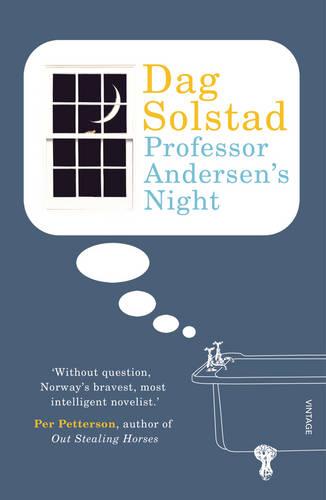
Firstly, Professor Andersen’s Night by Dag Solstad (1996, trans. Agnes Scott Langeland 2011). This novella (154 pages in my edition) is my first encounter with Solstad which is clearly a big omission, as he’s described as ‘Norway’s most distinguished living writer’ on the back cover. While I didn’t love this novella, I did find it a very readable exploration of complex themes and I’d be interested to read more by this author.

It begins with the titular academic enjoying Christmas Eve on his own:

“Professor Andersen felt at peace, tonight. He had this feeling of inner peace which was not of a religious but of a social kind. He liked to indulge these Christmas rituals, which in fact meant nothing to him.”

His tranquillity is disturbed when he witnesses a young woman being strangled in an apartment opposite. In response to this shocking violence, he does precisely nothing:

“He went over to the telephone, but didn’t lift the receiver. ‘What shall I say,’ he thought, ‘that I have seen a murder? Yes, that’s what I have say. And they will laugh at me, and tell me to go and lie down, and to call back when I have sobered up’”

But he doesn’t call back when he’s sobered up either.

”Something had happened, something he had witnessed. He couldn’t warn them about something irreversible.”

Instead he ties himself in existential knots, wondering about his life in middle age and what happened to his generation of self-appointed radicals (a dinner party includes discussion on whether to join the EC or not – plus ça change…) As an Ibsen scholar, he wonders if Ibsen (and by implication, his own work) has any relevance in the twentieth century.

Witnessing the murder seems to fix the professor irreversibly in the position of observer, or throw into sharp relief how this has always been the case. Having done nothing about the crime, his intellectual explorations demonstrate how little he is the protagonist of his own life. He is acted upon by various societal forces (such as the Christmas ritual that is meaningless to him) but enacts very little himself.

So despite starting with a murder, this is not a crime novel. Professor Andersen’s Night is a long dark night of the soul, rather than a whodunnit. How much you enjoy the novella might depend on your attitude to Hamlet. If you find yourself carried along with Hamlet’s crises to a heart-breaking denouement, you’ll probably have sympathy with the Professor. If you find Hamlet torturous rather than tortured, maybe give this a miss…

“Ever since the murderer had entered his life, he had had a tendency to get hung up on impossible abstractions, ones which quite simply made him feel a bit sick.”

Secondly, Small Pleasures by Clare Chambers (2020), another new-to-me author despite her six other novels. I’ve decided to claim this as a Christmas story because a virgin birth is a major plot point 😊

Jean is approaching middle-age and lives with her mother in south-east London. Her mother not an easy character and home can be a bit suffocating. Jean is able to escape to her job as a journalist on the North Kent Echo and takes her chances for reprieve where she finds them:

“Of all the various liberties available, her favourite was to unfasten her girdle and lie at full stretch on the couch with an ashtray on her stomach and smoke two cigarettes back to back. There was no reason why she couldn’t do this in her mother’s presence – lying down in the day might prompt an enquiry about her health, no more- but it wasn’t nearly so enjoyable in company. The summer variant of this practice was to walk barefoot down the garden and smoke her cigarettes lying on the cool grass.”

A woman called Gretchen Tilbury approaches the paper to explain that her ten-year-old daughter is the result of a virgin birth. The men on the team seem somewhat reluctant to investigate further, so the story is assigned to Jean as the only woman. For reasons of her own, Jean approaches the story with an open mind. Gretchen is glamorous, an accomplished seamstress and baker, and seems to Jean to have the perfect life.

“Jean felt the tug of friendship, but it would have to resisted. If it came to delivering unwelcome news in due course then it was essential to maintain a sensible, professional distance.”

It’s no great spoiler to say that Jean doesn’t manage to maintain that distance. She’s feels herself drawn into the lives of Gretchen, her husband Howard, and their daughter Margaret. Gretchen seems to have everything Jean barely admits to herself that she wants, but she senses a sadness in Gretchen that she can’t quite identify.

Jean has kept herself if not exactly happy, then ticking over, with her work and her small pleasures. Gradually her world begins to open up towards something broader.

“She wondered how many years – if ever – it would be before the monster of awakened longing was subdued and she could return to placid acceptance of a limited life.”

What I liked about Small Pleasures is that although there is a mystery and a romance to drive the plot along (although as with so many books, I would have preferred a more ruthless edit) it is fundamentally a story of friendship, of reaching out to people and of letting people in, thereby finding community and solace in unexpected places.

“It violated every code that she had been brought up to live by, but the urge to tell him was unstoppable. Decorum, secrecy, self-control were all blown away by the force of this need to confide.”

This is especially poignant given the 1957 setting, which is beautifully evoked. It’s a time after the war but before the rapid social changes of the 1960s. Things are shifting, but reticence and decorum inhibit authentic behaviour. People are forced to hide important aspects of their lives and experiences, and also hide the pain that these unspoken sacrifices cause.  

“She hated being aligned with the forces of narrow-mindedness and conservatism, even though that was where she felt most at home… As a touchstone, she imagined her mother’s opinion – and rejected it.”

“She would collapse later, she promised herself, between seven and seven-thirty, when she had got home from work and done her chores.”

Small Pleasures doesn’t shy away from pain, but it doesn’t shy away from the joys of life either. It shows that the latter can be fleeting, but finding the small pleasures – and friends – can help us survive.

Looking at Goodreads, it seems lots of people hated the ending of this novel. I didn’t mind it but I did realise what it would be about halfway through (there is some pretty hefty foreshadowing). So I wouldn’t say that Chambers plays unfairly with the reader, but I did want to mention it as many seem quite annoyed!

To end, despite my long-held love of terrible twentieth-century Christmas pop tunes, I’ve only just found out that The Kinks made a Christmas record:

Novella a Day in May 2019 #21

The Ice Palace – Tarjei Vesaas (1963, trans. Elizabeth Rokkan 1966) 176 pages

This novella is like the titular structure: impressive, delicate, beautiful and disturbing. It’s impossible to review without giving away plot points, so apologies in advance and do skip to just the quotes if you don’t want to know but still want an idea of the gorgeous writing!

The Ice Palace tells the story of two eleven-year-old girls, Siss and Unn. Siss is a leader among her peers, newcomer Unn is quiet and shy. She stands alone at break times, yet the popular Siss finds herself drawn to Unn.

The girls have a deep unspoken bond that they don’t understand themselves. The first time Siss goes to Unn’s house after school, they have an almost spiritual experience gazing into a mirror together. Unn wants to tell Siss something, but Siss feels overwhelmed and leaves, thinking:

“You can tell me more another time. Whenever you like another time. We couldn’t have gone further this evening. It had been a great deal as it was. But if they were to go further it would make things impossible. Home again as quickly as she could. Otherwise they might get involved in something that would shatter it for all of them. Instead they had shone into each other’s eyes.”

The next day, Unn feels too embarrassed to see Siss again, and decides to visit the local Ice Palace, a frozen waterfall.

“She lay flat on the ice, not yet feeling the cold. Her slim body was a shadow with distorted human form down on the bottom.

Then she changed her position on the shining glass mirror. The delicate bracken still stood in the block of ice in a blaze of light.”

The natural descriptions are stunning, but never overwhelm the narrative:

“Unn looked down into an enchanted world of small pinnacles, gables, frosted domes, soft curves and confused tracery. All of it was ice, and the water spurted between, building it up continually. Branches of the waterfall had been diverted and rushed into new channels, creating new forms. Everything shone. The sun had not yet come, but it shone ice-blue and green of itself, and deathly cold.”

Unn goes missing, and it doesn’t take much for the villagers to work out where she might be. Finding her proves impossible though:

“The men continued to search. They had life and light on their side. They were visiting an unknown fortress, and it looked like the fortress of death. If one of them struck the wall with his stick it proved to be as hard as rock. The blow recoiled and vibrated in his arm. Nothing opened up. They struck all the same.”

Siss is devasted. She makes Unn a promise that sees her withdraw from her family and friends, taking Unn’s place alone at the edge of the playground.

“I promise to think about no-one but you. To think about everything I know about you. To think about you at home and at school, and on the way to school. To think about you all day long, and if I wake up at night.”

The Ice Palace is a novel that doesn’t spell out its characters’ feelings but leaves you in no doubt as to how strong they are. It is a study of grief in pre-adolescents; Unn is an orphan and Siss is overwhelmed by her feelings when Unn goes missing. The atmosphere of a Norwegian village in winter is beautifully evoked and it is haunting without being creepy. The novella doesn’t give trite answers but instead asks how we learn to live with pain, with the things to which there are no answers.

“Slowly the palace changes colour. The shining green ice whitens in the warmth of the sun. The transparent chambers and domes grow dim as if filled with steam, concealing all they may possess, drawing a cover over themselves and concealing it. The whole palace draws the white colour over itself and starts to dissolve on the surface. Inside it is still ringing hard. The ice no longer sends out lightening among the fields. But shines, whiter than before, shines quietly.”