The blurb on the cover of my edition of Grown Ups by Marie Aubert (2019 transl. Rosie Hedger 2021) pushes it as ‘the perfect summer read’ and ‘pure escapism’ with which I couldn’t disagree more. Obviously we all have different reactions to books, but for me a novella (154 pages) about a woman coming to terms with her rapidly reducing choices regarding fertility, while at the summer house of her family with all its inherent tensions and rivalries, didn’t feel remotely escapist. Even when it’s darkly humorous and set in a log cabin in Norway 😉
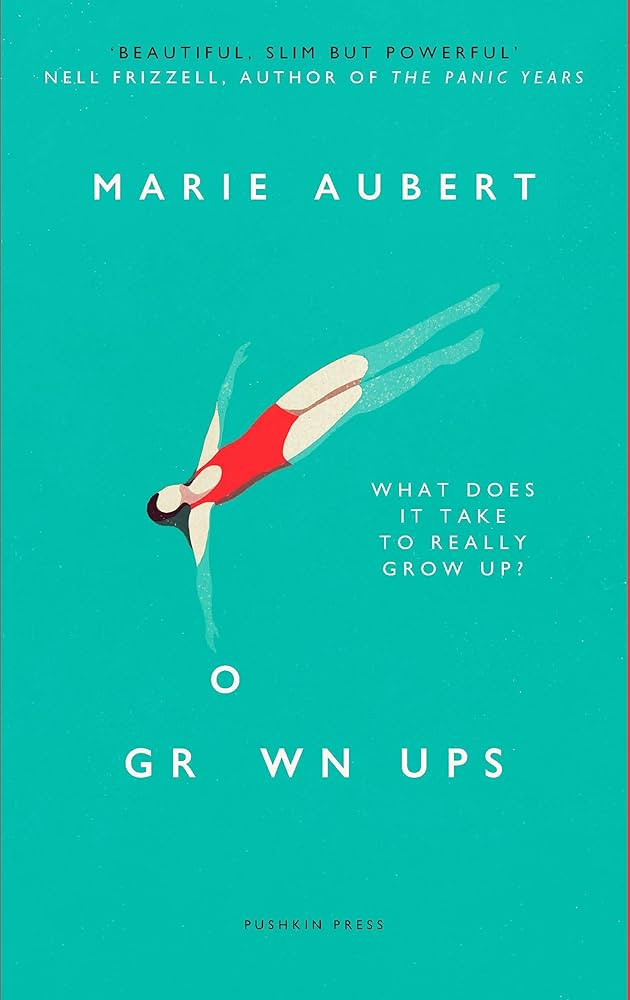
Grown Ups features a very unlikable protagonist in Ida. She behaves really badly by anyone’s standards. But she was also recognisable and (somewhat) sympathetic.
At the start of the novel she is at a Swedish clinic having her eggs frozen:
“One day, I thought as I lay there in the gynaecology chair, one day things have to work out, one day, after a long line of married and otherwise committed and uninterested and uninteresting men, things have to work out, just lying there made me believe both men and child might materialise, just the fact that I was there and actually doing it was a promise that there was more to come, one day.”
I really felt for Ida. As the quote shows, she is feeling a bit desperate regarding the future as she turns forty, but pinning her hopes on a fantasy. As the story develops, the ambivalence she feels about what that future might look like is subtly portrayed. She doesn’t really seem to like children very much, but she doesn’t want that choice taken away from her. If she truly wants a committed relationship, why does she keep seeking out men who are already committed to someone else?
She travels to the family summerhouse in Norway for her mother’s birthday. Her sister Marthe is there with her husband Kristoffer and step-daughter Olea. The sisters relationship is full of long-held petty tensions, but it felt like they could actually be really close if they would just step outside of these entrenched behaviours. It doesn’t help that Marthe has redecorated the cabin without asking or even discussing it with Ida. She is also pregnant.
“‘I’m not as tough as you are,’ Marthe says, sounding a little sarcastic. It’s always the same, every summer, I’m quick to get into the water while Marthe takes her time, and then we each make digs about which approach is best.”
One of the hardest things to read in the book is Ida’s treatment of Olea. Recognising that Olea and Marthe don’t get on, Ida manipulates the child to increase her opposition to Marthe, just to prove something to Marthe and herself. She seems to have no fondness for Olea, and everything is performative rather than felt or understood.
“I’m the grown up now, I’m good at this. My tone is calm and kind, it feels familiar, like how things ought to be […] See, Marthe, I can do this, I’m the one who’s supposed to be doing this.”
Ida is destructive in her behaviour but only half-recognises this. I felt with Olea she didn’t really see the child as a person so didn’t fully recognise what she was doing. Flirting with Kristoffer on the other hand, she is fully aware of…
I’m making Ida sound more unlikable than she is and not doing justice to Aubert’s subtlety at all! The hurt Ida is experiencing is so clear, she is just seeking entirely flawed ways of managing that pain. Although she mentions friends, they are not named and she comes across as very isolated, particularly when her mother arrives with partner Stein.
“I feel the injustice, rampant and raging, there’s no one there to console me”
There’s also a passage where Ida describes dating and her hopes for more, where my heart just broke for her. It was filled with so much anger and loathing towards herself.
I looked on goodreads and yep, some readers really hated Ida 😀 But for me, while a lot of her behaviour was downright awful, I thought she was realistically portrayed as someone who has grown up thinking love is conditional and now doesn’t know who she is or what she really wants.
Grown Ups is well paced and things aren’t all tied up neatly at the end, which I liked as it didn’t undermine Ida’s situation or her feelings. I did have a sense Ida would carry on but maybe do a bit better. Unlike at the start of the story, there was hope for her grounded in something real.
To end, two sisters who seem to get on better than Ida and Marthe, singing about the struggles of trying to be grown up and a problem Ida has definitely experienced:



 madame bibi lophile recommends