“I’ve always looked at myself from above, as pleased as an omniscient narrator.” (Empar Moliner, Beloved)

Trigger warning: mentions childhood sexual abuse

This is my contribution to the wonderful Novellas in November 2024 hosted by Cathy at 746 Books and Beck at Bookish Beck.

I heard about Beloved by Empar Moliner (transl. Laura McGloughlin 2024) through Stu at Winston’s Dad’s blog. I was immediately tempted and it seemed a good choice for my resolution to buy a book a month from an indie press/bookshop. The lovely 3TimesRebel Press even included a tote bag 😊

The striking cover illustration is by Anna Pont, a Catalan artist. She died from cancer earlier this year and all the proceeds from Beloved are being donated to cancer research.
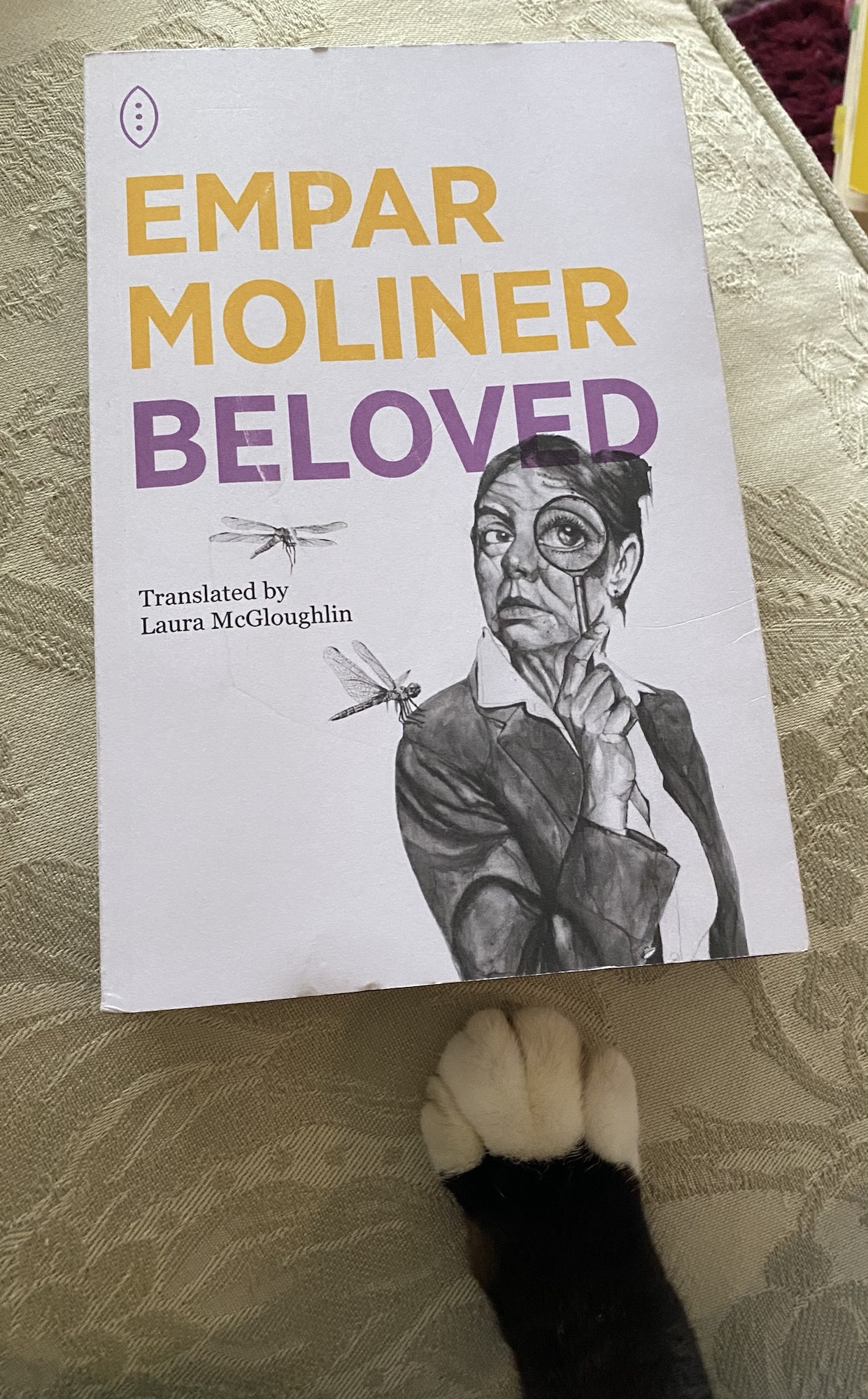
The paw is courtesy of Fred aka Horatio Velveteen aka Mike Woznicat (as like the comedian Mike Wozniak he has a handsome moustache). Anyway, enough of my blithering about my cat. On with novellas!

Remei is in her early 50s and going through menopause. She is married to a musician ten years younger and at the start of the novella she has a revelation:

“Falling oestrogen, combined with lactose intolerance and loss of near sight, makes me see the world through the light wings of a dragonfly. Because of this I can see, with utter clarity, that my man is going to fall in love with this other woman.”

The novella follows Remei as she works out how she will manage this, as she tries to cope with her bodily changes and memories of a traumatic past at the same time.

She is a witty, forthright, slightly sardonic narrator. I really enjoyed the distinctive voice of this resilient woman.

“I must point out I find modesty overrated: I’m still a good deal. What’s more, until now I’ve performed pre-feminist sexual positions with total dedication and delight.”

Her husband, whom she calls Neptune, is not as clearly drawn. But this is not his story: we are firmly in the first person narration of Remei. She and her husband don’t seem hugely well-suited:

“I like music much more than him and I’m an illustrator. But he likes comics much more than me and he’s a musician.”

“I like everyone, in one way or another. He likes hardly anyone, in one way or another.”

“That’s how we see life too, he and I. Me: everything and right now, so nothing is left over. Him: only what fits, even if what is discarded will rot.”

But she loves him and she loves being a mother to their daughter. Her career is successful, although not quite in the way she planned. However, she is not entirely happy. She self-medicates with alcohol:

“My whole life is a gallop between the pretentious and the epic, depending only on how many drinks I’ve had.”

As she goes for runs with her friends, she reflects on the sexual abuse of her childhood, sanctioned by her family. She is estranged from her brother, after she spoke about what was happening and they were taken into care. Remei seems very much alone, despite all the people that surround her.

She is blisteringly honest about her attitude to her husband and the confusion of feelings as she recognises future events:

“Do I want him to continue to love me as much as ever? Yes. No. I want to float along, no more. I want him to be frozen.”

There is a lot of humour too. Remei never demonises Cris, the young colleague of her husband, but wryly observes her behaviour:

“Punctual, efficient, her ovaries functioning at top speed.”

Beloved shows how control is only sustained through the lightest of ties. Remei is a functional alcoholic who could tip over at any time; she realises her relationship with her daughter is on the brink of change as the latter grows older and more aware; she attempts to control her body with running but aging is relentless; and she takes steps to manoeuvre her husband and Cris in a way that will allow her to cope with the affair, but where will this leave her?

Remei is so flawed, so honest, so tenderly vulnerable and spikily self-sufficient, I was really rooting for her to find a way through all the hurt.

To end, the ever wonderful Tracy Chapman singing about changes in life:

“Real conflict for me at least always turns out to be wordless, which is why I find drama and the theatre so unreal.” (Margaret Drabble, The Garrick Year)

Back in June I was inspired by heavenali’s a year with Margaret Drabble to read the author’s first novel, A Summer Bird-Cage (1963). I was really impressed by what she’d achieved when she was just 24, and so I was keen to pick up her second novel The Garrick Year (1964), which was written only a year later. Once again I found the sure style really striking.

“All that strange season, that Garrick year, as I should always think of it, which proved to me to be such a turning point, though from what to what I would hardly like to say.”

Emma is an ex-model and mother to toddler Flora and baby Joe. She’s a bit adrift as to what she wants to do with her life, but is keen when offered a newsreader’s job. Unfortunately her selfish, self-serving husband David also gets offered a job, which involves moving from London to Hereford for a year so he can act in the local theatre productions by acclaimed director Wyndham Farrar.

At first David seems an outright pig, telling Emma she has no choice and he’s already signed the contract. It turns out this isn’t true and Emma never thought it was. Still, they both know it might as well be. This is the early 1960s and while staying behind for a year might be theoretically possible for a married woman with small children, it’s not hugely likely even with a nanny.

“I could hardly believe that marriage was going to deprive me of this [job] too. It had already deprived me of so many things which I had childishly overvalued: my independence, my income, my twenty-two inch waist, my sleep, most of my friends who had deserted on account of David insults, a whole string of finite things, and many more indefinite attributes like hope and expectation.”

Drabble captures that compelling mid-twentieth century time where women are starting to have a sense of more possibilities and life choices opening up, but these options still don’t seem wholly obtainable.

So David isn’t quite as dreadful as he first appears, but neither is he particularly likable. And he’s about to get worse, as he brings his roles home with him:

“this time I was condemned to a whole season of Flamineo who happened to be a self-centred existentialist pimp.”

As in her first novel, The White Devil by John Webster is heavily referenced. I’d be interested to know why this slightly bonkers, bloody Jacobean play seems so significant for Margaret Drabble at the start of her career. (And I say that as someone whose MA was on ritualistic bloodshed on the early modern stage – bonkers and bloody theatre is right up my street 😀 )

But The Garrick Year isn’t a pity-fest for Emma in contrast to David. She’s young and self-centred too, an intellectual thinker but not personally reflective. She can be quite bitchy, describing ingenue Sophy “as stupid and as shiny as an apple”, but I don’t think we’re supposed to take pronouncements like: “The provinces have never appealed to me, except as curiosities.” entirely seriously. Emma knows she can be a snob, and contrary.

“I feel that I’m insulting something when I am bored… My tastes are shallow; My life is shallow; and I like anonymity, change and fame. In Hereford I could have none of these things: I was condemned to familiarity, which beyond anything I find hard to maintain with ease.”

Her insight is limited, so when she starts an affair with Wyndham, she doesn’t really understand why she would do such a thing. It’s not particularly passionate, and remains unconsummated for the majority of its frankly tedious duration (tedious in terms of events, not portrayal!)

Drabble balances really well the spiky, sharp observations of Emma with a degree of sympathy for her. I don’t think as readers we’re supposed to necessarily like her, but not despise her either. Rather we’re encouraged to recognise how incredibly thwarted and frustrated she is, at a time when she has agency and choices but not enough of either.

“I personally, I myself, the part of me that was not a function and a smile and a mother, had been curled up and rotten with grief and patience and pain.”

I’ve read somewhere that Drabble goes off the boil in later novels, but these early ones are really hitting the spot for me now. I find women’s lives in this period endlessly interesting, and she captures that time so well. She’s not afraid to make her characters recognisably real even when they are not particularly appealing, and she incorporates her intellectual considerations seamlessly so they never obscure characters or plot. I’m looking forward to exploring her further.

To end, I may be a fellow Londoner but I’m baffled as to Emma’s problem with lovely Hereford:

“The story of our lives still isn’t finished, and it never will be.” (Beatriz Bracher, Antonio)

Trigger warning: mentions mental illness and infant death.

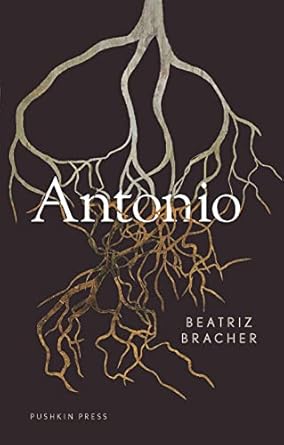
Stu over at WinstonsDad’s blog is hosting Spanish Portuguese Lit Month for the whole of July and so this was the perfect opportunity to get to a novella by Brazilian author Beatriz Bracher which had been languishing in the TBR: Antonio (2007, transl. Adam Morris 2021) published by the wonderful Pushkin Press.

I want to start with the disclaimer that I don’t think I’ve really got to grips with Antonio, so this post is just some initial impressions. Although only 187 pages long it is incredibly densely written and it took me a week to read. Admittedly work has been really demanding lately, but usually it still wouldn’t take me that long to read a book of that length.

Also looking online, there are many effusive reviews praising the socio-political commentary of Antonio, which I’m sure I didn’t fully comprehend. I did pick up some, but I’m certain I need to re-read Antonio at some point.

The novella is told through the alternating viewpoints of three people: Raul, Isabel and Haroldo. Their silent interlocutor is Benjamim, who is awaiting the birth of his first child, the titular Antonio. The imminent arrival of his son has prompted Benjamim to probe into his family history in more depth.

“I’d like to think your mother was also a free person, and maybe you can hold onto that thought, instead of clinging to fear and rage.”

Benjamim knows that his father was Teodoro and that his mother was  Elenir.  Elenir had a son with Benjamim’s grandfather Xavier first, who they also called Benjamim and who died very young. The second Benjamim was raised by his father after his mother died in childbirth.  

Raul is his father’s friend, Isabel is his paternal grandmother, and Haroldo was Benjamim’s grandfather’s friend. They all provide histories of Benjamim’s family that echo and contradict each other, and none seem any more reliable or authoritative than any other. Each has their own truth.

The family is well-off and privileged in São Paulo, but their history is a troubled one. Both Xavier and Teodoro had periods of intense mental illness.

For Xavier, this occurred after the death of Benjamim. As Haroldo recalls:

“[Elenir] looked like a bent piece of wood. She didn’t cry. She received each condolence with correct politeness. Xavier was the total opposite: he was in pieces […] I managed to gain entry to that hell three times. The last time, I brought a team of nurses, to drag my friend out of there and take him to a sanatorium.”

Later, Xavier meets and marries Isabel and they raise a family. They are the generation that came of age in the 1950s and 1960s, idealistic and, in Isabel’s case, driven:

“In a family we’re always a me or and I who’s scattered and complex. It’s only at work, especially work that has to do with ideas, but it’s possible to feel ourselves out and let the contours assume the shape.”

Their youngest son Teo rejects the urban privilege he is born into and goes to live in rural Minas. He throws himself into village life but ultimately becomes rudderless and unwell. Isabel reminds Benjamim of his early childhood:

“You’re from this family, so you are this family. Your father wanted to be rid of all that, and shed himself along with it. The history that he crafted for himself in Minas was a non-history. He went too deep. By the time I brought him back, there was nothing left to hold onto, no handle I could use to hoist him back out: only damaged pieces.”

This is one of central themes of Antonio: how to live an authentic and conscious life, but not be overwhelmed by the search for meaning. How to truly find who you are, alongside the demands of daily life. Isabel believes the answer is hard work, but only Big Work. Haroldo points out:

“She raised a bunch of irresponsible ingrates who are incapable of the most basic displays of solidarity, like visiting their dying mother. Isabel cultivated a true horror of responsibility in them, and at the same time overloaded them with the responsibility to be nothing but the best.”

Isabel recognises that privilege brings responsibility, but she also remains an elitist. When she observes: “I never understood any language that wasn’t well spoken Portuguese.” she is being both literal and metaphorical. The family’s wealth isn’t what it once was and she is unhappy at her children’s middle-class existence.

To me Isabel was the strongest of the three narrators and I got a real sense of her. But Raul, living an ordinary life and baffled by what happened to his childhood friend, and the somewhat reprehensible, colourful Haroldo were also distinct characters if not entirely differing voices, and Bracher balances the three viewpoints well.

I’ve focused on some of the ideas rather than the events of Antonio and that is partly because the novella has some graphic scenes in it – of extensive mental breakdown, one of pig-killing and one of caring for a dead body by someone who doesn’t know what they are doing. None of these are gratuitous but they mean Antonio can be very difficult to read in places.

Bracher avoids conclusions about the causes of Xavier and Teo’s ill health and whether there is a genetic component or whether it is the demands of society on the individual. She vividly, sometimes viscerally, evokes the pressures of family and the search for self in late twentieth-century Brazil.

“To live long and stay well, stay away from your relatives.”

“The cat is, above all things, a dramatist.” (Margaret Benson)

This is my contribution to Reading the Meow hosted by Mallika at Literary Potpourri, a fantastic week-long celebration of literature inspired by our feline friends!

A Cat, A Man and Two Women by Junichiro Tanizaki (1936, transl. Paul McCarthy 2015) is published by the ever-wonderful Daunt Books and I really liked the simple cover:

There seems to have been a flurry in recent years of slightly whimsical stories about cats and I thought ACAMATW would be one of these, I’m not sure why. The prospect was fine with me, I don’t mind whimsy if I’m in the right mood and I adore cats. But in fact this wasn’t whimsical at all. It was a psychological study – albeit a gentle one – of three people and the catalyst (no pun intended but I’m happy its there 😀 ) of their shared pet.

I would just like to pause (paws?) here to let you know that my typing is being severely hampered by my calico cat sitting on my lap, demanding attention – and my tuxedo cat (her brother) has just arrived and there’s a bit of a turf war ensuing…

The titular cat of this novella is Lily, adored companion of Shozo. The story opens with his ex-wife Shinako appealing to his new wife Fukuko to let her have Lily. Her letter emphasises Shozo’s adoration of Lily and Shinako deliberately sets a cat among the pigeons (ha! I’m only a little bit sorry for this 😀 ) of the new marriage,

Even Shozo, feckless in the extreme, notices the change.  

“Could Fukuko be jealous of Lily? He considered this possibility for a moment but then dismissed it as making no sense. After all, Fukuko herself was basically fond of cats. When Shozo was living with his former wife, Shinako, he had sometimes mentioned her occasional jealousy of the cat to Fukuko who had always made rather scornful fun of this silliness.”

Shozo requests his wife cook meals she doesn’t enjoy, so he can share them with Lily. I’m not surprised Fukuko is annoyed:

“Fukuko had been prepared to sacrifice her own taste for her husband’s sake, while in fact it was for the cat that she cooked; she had become a companion to the cat.”

(Update: turf war won by the tuxedo. Calico has stalked off in disgust. Tuxedo determined to rest on my dominant hand and impede my typing.)

The tensions in the marriage centre around Lily, but really have nothing to do with her. She merely highlights Shozo’s lack of drive and inability to engage fully in relationships, except with his cat.

“When he heard people with no knowledge of a cat’s character saying that cats were not as loving as dogs, that they were cold and selfish, he always thought to himself how impossible it was to understand the charm and lovableness of a cat if one had not, like him spent many years living alone with one.”

Shozo isn’t unsympathetic. His mother is manipulative and choosing Lily seems to be one of the rare independent choices Shozo has made. He has had a longer relationship with Lily than either of his wives and his bond with the cat is meaningful to him.

“It was Lily, with whom he’d lived so long, who was more intimately bound up with many memories of his; who formed, in fact, an important part of Shozo’s past.”

Tanizaki does a great job of portraying Lily as a very believable feline, without attributing human motivations or emotions to her. He leaves this to his three human protagonists, who fail to see she is not a strategist in these adult negotiations.

Shinako gets her wish, and the cat she was indifferent to arrives at her sister’s home, where Shinako now has a room. Gradually, she finds herself discovering new emotional territory, thanks to Lily:

“When she thought of the link that bound them together, her anger faded; and she felt, rather, that both of them were to be pitied.”

“Other people had told her so often that she was hard hearted, she had come to believe it herself. But when she considered how much trouble she had put herself to recently for Lily’s sake, she was surprised, wondering where these warm and gentle feelings had been hiding all this time.”

But will Shozo want his cat back? Will Shozo and Fukuko’s marriage survive without Lily to blame for the irritations and lack of understanding?

Tanizaki has a great understanding of cats and of people which makes this novella really shine. The humour is gentle and the psychological observations astute. The ending is left very open which didn’t wholly work for me but this is a minor quibble in regard to this engaging and insightful novella.

ACAMATW was adapted into the film A Cat, Shozo and Two Women in 1956. The summary on Wikipedia makes me think the filmmakers opted for a less open-ended conclusion to the story. From this clip the cat actor looks a lot more tolerant than my two would be 😀

“I want to ride my bicycle, I want to ride my bike.” (Queen)

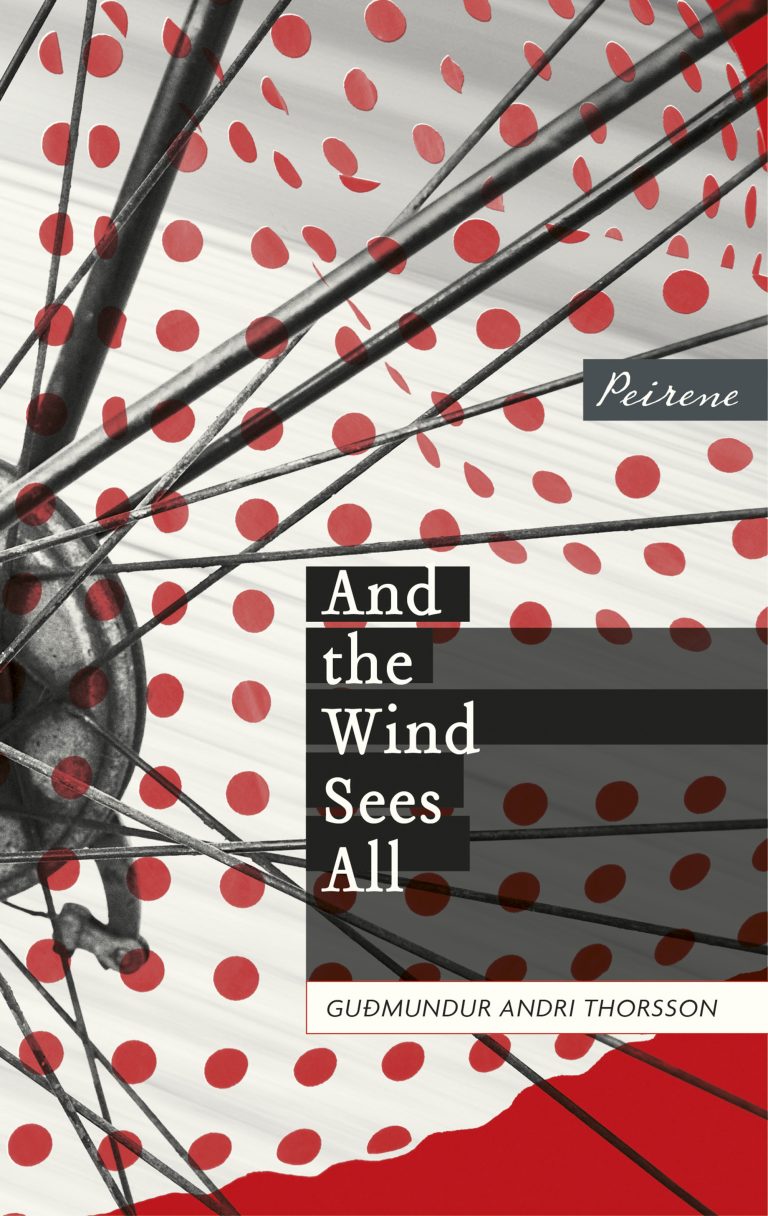
My final novella of May is And the Wind Sees All by Guðmundur Andri Thorsson (2011, transl. Björg Árnadóttir and Andrew Cauthery 2018), published by the ever-reliable Peirene Press.

The entire novel takes place within two minutes: the time it takes Kata, conductor of the village choir, to cycle down the main street of Valeryi in her polka dot dress.

“Everything is singing in the bright light. The sun sings, the sea, fish, telegraph poles, cows, flies, horses, dogs, the old red bicycle Kalli and Sidda gave her. She feels the day will come when her brown hair will once again have its red lustre. Once again her eyes will sparkle. Once again she’ll sing inside herself as she plays the clarinet. Once again there will be life in her existence. Once again she will be loved.”

We don’t find out why Kata has lost her sparkle until towards the end of the novella. In the meantime, as the residents of the northern Icelandic village see her go by, we get glimpses of their lives and a picture of the community.

The chapters are told from different people’s viewpoints but characters recur – as they would in such a small community – along with images and themes, weaving the fragmentary experiences into a whole.

One of the most harrowing stories belongs to Svenni, and yet his chapter begins quite lightly:

“Svenni lives in one of those houses that look like a man with his trousers hitched up far too high – a little house on big foundations.”

We learn that reticent “good bloke” Svenni, a surprise participant in the choir, has traumatic reasons for keeping himself to himself.

There are lighter moments too, such as Lalli the Puffin being so-called because he owns the Puffin restaurant, but also because “he struts and darts his eyes around like an inquisitive puffin. The villagers are all familiar with his distinctive waddle and smile to themselves when they see him.”

And there are moments in between, like the fragile reunion of two middle-aged people who had been teenage lovers back when they “presented their pain to each other” and are now taking a walk.

The coastal Icelandic setting of the fictional village is beautifully evoked throughout:

“The village is not just the movement of the surf and a life of work, the clattering of a motorboat, or dogs that lie in the sun with their heads on their paws. It’s not only the smell of the sea, oil, guano, life and death, the fish and the funny house names. It’s also a chronicle that moves softly through the streets, preserving in elemental image of the village created piece by piece over the course of centuries.”

The back of my copy refers to “relaxing Nordic hygge in a novel” – I disagree. And the Wind Sees All is not a harrowing novel but it’s not escapist either. There are villagers with traumatic pasts, there is self-medicating with alcohol, there is addiction and heartbreak.  There’s also love and friendship. Thorsson shows how these experiences sit amongst a beautiful village, where the community is coming together for a choir concert. It all exists simultaneously, within the two minutes of Kata’s bike ride.

“Santa Claus has the right idea – visit people only once a year.” (Victor Borge)

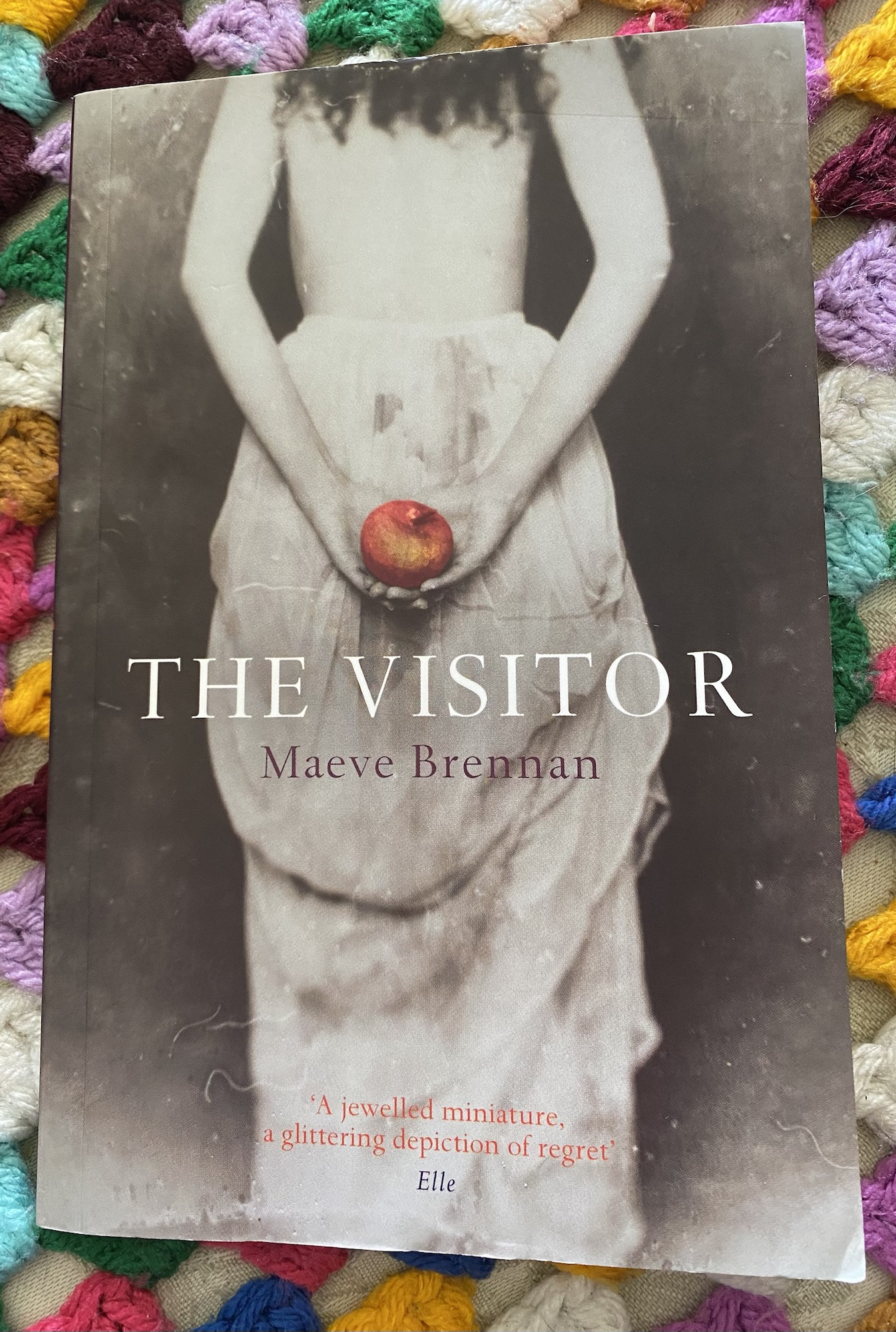
I received my copy of The Visitor by Maeve Brennan (written in the 1940s, published after her death in 2000) from lovely Karen at Kaggsy’s Bookish Ramblings, having read her wonderful review. I’d not read Brennan before and I was really keen to; having now read this 81 page novella I definitely want to explore her writing further.

Twenty-two year old Anastasia King returns to her grandmother’s house in Dublin, having spent six years in Paris with her mother who has now died.

“She was still the same, with her delicate and ruminative and ladylike face, and her hands clasped formerly in front of her. Anastasia thought, She is waiting for me to make some mistake.”

Little does Anastasia know she has already made the mistake by leaving with her mother. Her grandmother is entirely unforgiving and inflexible about the hurt caused to her son who has also died, and makes no allowances for Anastasia having been the child of the marriage.

Anastasia expects to be able to live with her grandmother as she has nowhere else to go, but her grandmother has other ideas. She does not view this house as Anastasia’s home any longer and is determined to keep her in the titular role. Her imperviousness and lack of welcome border on Gothic and I was reminded of Janet in O Caledonia by Elspeth Barker. The Visitor lacks the overt Gothic tones of that novel but they share the dislocation of a young adult in her own home and the almost eeriness that evokes.

“She turned and looked at the mirror, but it reflected only empty chairs, and the firelight played indifferently on polished furniture as it had once across her parents’ faces. There is the background, and it is exactly the same.”

Her grandmother’s elderly housekeeper Katharine does her best to welcome Anastasia, but her kindness is vastly outweighed by Mrs King’s seemingly endless bitterness. Brennan adds complexity to the tale with the introduction of old family friend Miss Kilbride. Anastasia’s actions towards Miss Kilbride stop the story becoming fairytale-like or straightforward. By portraying human beings in all their complexities Brennan doesn’t allow trite conclusions to be reached.

I don’t want to say too much about the novella as it’s so short, but its length doesn’t mean it lacks power. The loveless, withholding atmosphere that Mrs King creates is masterfully drawn and really gets under the reader’s skin. The ending is ambiguous and adds to the feeling of dislocation throughout the story. Brennan doesn’t waste a single word.

“Home is a place in the mind. When it is empty, it frets. It is fretful with memory, faces and places and times gone by. Beloved images rise up in disobedience and make a mirror for emptiness.”

“Being the owner of Dachshunds, to me a book on dog discipline becomes a volume of inspired humour.” (EB White)

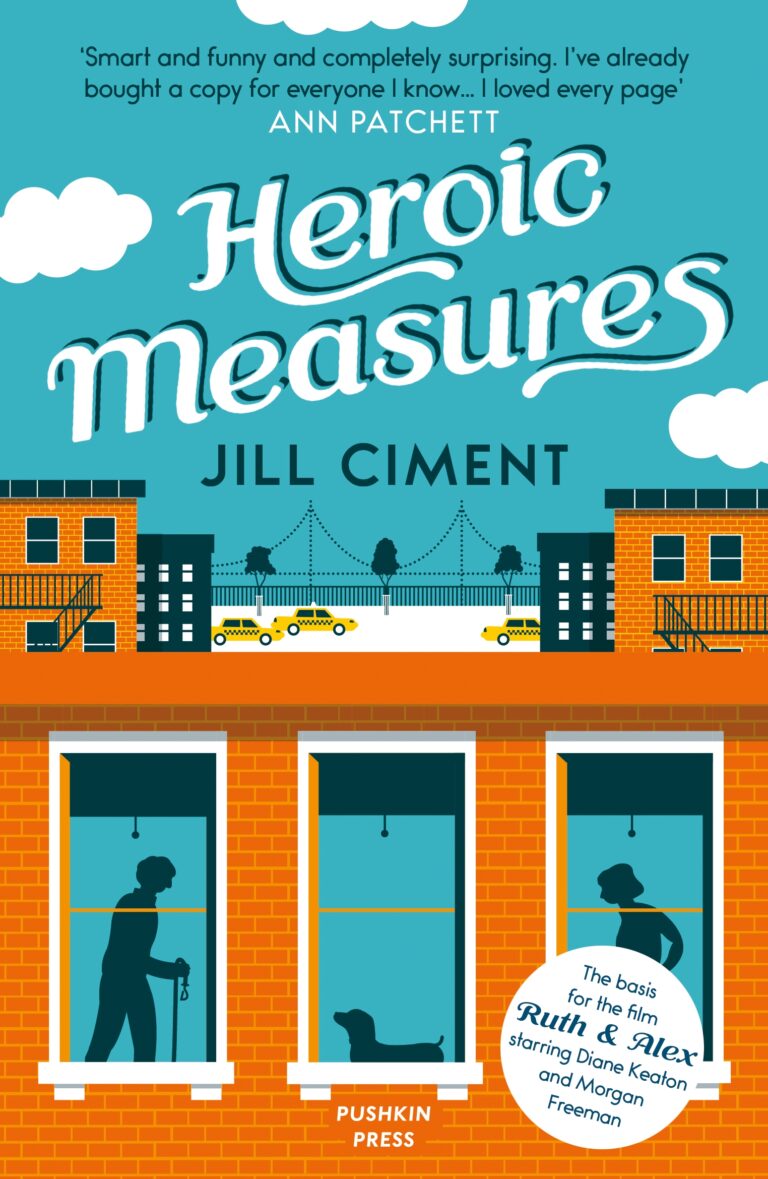
I might not have picked up Heroic Measures by Jill Ciment (2009) ordinarily, but it is published by the marvellous Pushkin Press and they’ve never done me wrong so far 😊 It turned out to be a nice book about nice people, gently humorous and engaging. It wasn’t overly sweet or sentimental, and I enjoyed it immensely. The right book at the right time.

Ruth and Alex Cohen are an older couple looking to sell their East Village apartment for a million dollars (I suspect the intervening fifteen years since publication have seen the relative price rocket even further). They can currently manage the five flights to their front door but they’re aware this is likely to change. Alex is an artist and Ruth a retired teacher; they live with their beloved dachshund Dorothy.

“Alex brought Dorothy home the day Ruth retired after three decades as a public school English teacher. Those first few nights tending to Dorothy’s mystifying needs and constant demands had reminded Ruth of a Victorian novel in which the husband acquires an orphan for his greying childless wife to raise.”

We follow their potential sale over a weekend where Dorothy is in the animal hospital. She is also advanced in years and she suddenly can’t move her back legs. We are privy to her thoughts as well as those of her humans.

The scenes where Alex and Ruth are managing a sick Dorothy were really moving. They weren’t over-the-top deliberately heartrending, but they were very affecting in portraying the deep upset when an animal is ill.

“Alex touches her sleeve: he’s found the source of the alarm, the metal buckle on Dorothy’s faux leopard collar. Ruth had bought the collar because she thought it gave Dorothy a risque, haughty look, an old dominatrix, say, whose specialty was biting. Ruth watches as Alex unclasps the buckle at the nape of Dorothy’s neck with an intimacy and caution, a husband removing his ill wife’s necklace.”

Over the weekend Ruth and Alex will have to deal with their ambivalence about the move – neither afraid of change, but unsure if this is a change they really want to push for:

“He’s been covering these walls with his imagery for almost half a century, as methodically as a clam secretes its essence to make its shell. When Lily had first peered into his studio during the appraisal, she proclaimed it would make a perfect nursery.”

“She can almost see the spines of her library arranged alphabetically, floor to ceiling. Finding a home for her books is no less important to Ruth than finding a museum for his paintings is to Alex.”

There is humour alongside these more melancholy aspects, making the novel seem very real. Lily the realtor and the various people who attend their open house provide some respite from their worries about Dorothy. In the background there is also the unease of a possible terrorist at large in the city, which Alex and Ruth are concerned will affect their apartment price. They also struggle with pushing buyers for more money. Neither of these considerations endear them to themselves.

They are deeply principled people, monitored during the McCarthy era, and their struggles with these materialist considerations lightens their characterisation and stops them seeming priggish.

“His wife – whose ethics has been his bedrock and his muse and his shackles, who wouldn’t lie about her beliefs to the house Un-American Activities Committee even when it cost them friends, passports, his first retrospective, almost her beloved teaching job”

I thought Ciment beautifully evoked the love between these two people in old age too. They have been together forever and they still like one another. Ruth compensates for Alex’s poor hearing, he compensates for her poor eyesight.

“He has loved her for so long that he can no longer distinguish between passion and familiarity. He slips off her glasses, puts away her book, douses the light, and returns to the living room.”

Heroic Measures is also about the love of a city, and New York is portrayed as fondly as the human and animal characters. A lovely read throughout.

To end, Heroic Measures was adapted as Five Flights Up in 2015. It looks a faithful adaptation, although the location of the apartment and Dorothy’s breed has changed. I guess EB White is right about dachshunds’ temperament and the filmmakers needed a more amenable doggy actor:

“The life of every man is a diary in which he means to write one story, and writes another.” (JM Barrie)

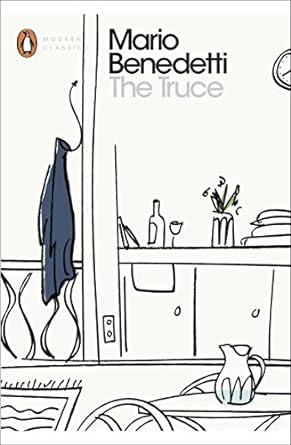
Continuing my endeavour to try and get some momentum back in my Around the World in 80 Books reading challenge, today I’m off to Uruguay, with Mario Benedetti’s The Truce: The Diary of Martín Santomé (1960, transl. Harry Morales 2015) which I was alerted to by Fiction Fan’s glowing review at the start of the year.

As the title suggests, the novella is in diary form, as Martín records his days in the run-up to his retirement, reflecting on how to live out his days. He is a quiet man in an administrative job; things are predictable.

“Today was a happy day; just routine.”

He is a widow of twenty years, and although he still has an eye for women (particularly their legs) he hasn’t had another relationship:

“The entire machinery of my emotions came to a halt twenty years ago when Isabel died. First there was pain, then indifference, then, much later, freedom, and then, finally, tedium. Long, lonely, constant tedium.”

His children Esteban, Jaime and Blanca are essentially unknown to him:

“At least Blanca and I have something in common: she, too, is a sad person with a calling for happiness.”

But although Martín is recording a lot of sadness, it’s not overly depressing. He has an acceptance of his life, and he makes quietly humorous observations, such as an old acquaintance learning of Isabel’s death:

“There is a sort of automatic reflex which makes one talk about death and then immediately look at one’s watch.”

Or his grief when his mother died:

“Only a fervent hatred of God, relatives and fellow man sustained me during that period.”

But things are about to change for Martín in ways he didn’t expect, when he falls in love with Laura Avellaneda, a work colleague half his age. While this would naturally raise questions about power dynamics and appropriateness, I felt it worked in The Truce, as Martín has been established as a gentle man, uninterested in wielding any sort of power or manipulation, and he is very respectful of Laura:

“I’m not going to demand anything. If you, now or tomorrow or whenever, tell me to stop, we won’t discuss the matter anymore and we’ll remain friends.”

In this short novel Benedetti perfectly evokes the gentle, slowly evolving love of Martín and Laura, and of Martín’s grief and acceptance of all he has lost in life alongside all that he still has. It suggests hope is still a realistic thing to hold onto, at any time.

The Truce isn’t sentimental, and although it depicts a romance it’s not rose-tinted. There is one point in particular where Martín behaves badly. He is not a perfect human-being and he causes hurt as well as joy to people.

But it is an empathetic tale, warmly clear-sighted towards ordinary people and all the foibles, weaknesses and strengths that we all carry.

The Truce is realistic, in a way that suggests even the most painful experiences can still be worthwhile. It explores how to not let pain overwhelm, and the importance of compassion for others and for the self:

They suffer from the most horrible variant of solitude: the solitude of someone who doesn’t even have himself.

This was my first experience of Benedetti and I’d be interested to read more by him. Apparently he wrote over ninety books so there’s plenty for me to choose from!

“It takes a village to raise a child.” (Proverb)

Well, as I predicted a significant part of my May was grim, but at least it was short-lived. So while I couldn’t commit to my novella a day in May project this year, I have managed to read a few novellas which I’m hoping to blog on before the end of the month. Here’s hoping June is a massive improvement!

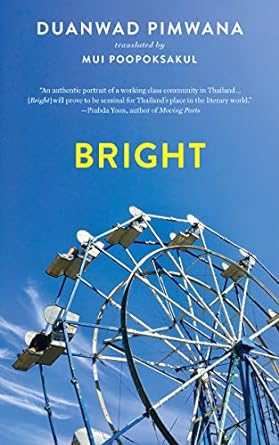
When I undertook the Around the World in 80 Books reading challenge, I wanted each book to be by an author from that country, not only set there. So the challenge has slowed as I try and locate appropriate translated fiction. Bright by Duanwad Pimwana (2002 transl. Mui Poopoksakul 2019) was apparently the first novel by a Thai woman to be translated into English. A volume of her short stories has also been translated, under the title Arid Dreams.

Bright almost reads like a series of short stories, except that the characters and setting are carried across the vignettes. It begins with a five-year-old boy, Kampol, being abandoned by his father who is taking his little brother Jon to live with his grandmother after their mother has left. But Bright isn’t unremittingly grim or a trip into poverty porn. The community of Mrs Tongan’s tenements rally round Kampol with varying degrees of willingness to ensure the boy is cared for.

“Kampol watched his father walk off until he disappeared. The flavour of the palo stew had grown distant, and the scent of detergent faint. He opened his hand: the blue action figure glinted in the dim light.”

We meet the various residents through Kampol’s eyes and we follow the events of the community alongside him. He plays with his best friend Oan, and is often cared for often by Oan’s hardworking mother Mon. But Pimwana never lets us forget that Kampol is carrying a lot of pain, just below the surface.

“He had found the best hiding place: you’d have to travel back in time to discover it. He skipped away joyfully. But then his melancholy caught up to him and his steps grew slow and measured – he didn’t know where to go.”

My heart sank when mobile caterer Dang offers Kampol a way to earn money if he keeps it quiet – but Dang only wants Kampol to walk on his back to relieve his aching muscles. Kampol also earns money running errands for soft-hearted Chong, the shopkeeper who finds it hard to refuse people credit. Bookish Chong was my favourite character, a man trying to convince the local kids of the joy of the printed word, without much success apart from Kampol.

“Chong was mournful as he watched the tree-cutting operation. The workers sawed off one section at a time, starting from the crown and working their way down. The pines disappeared, one top at a time, one tree at a time. Kampol stood next to Chong staring upward until the sky was empty. The notion of his mother, too, grew empty in his mind.”

The simple writing style worked really well in keeping the reader alongside Kampol while not claiming to be completely a child’s point of view. I found it direct and compelling in portraying a life with both hardships and joys in it.

Pimwana portrays a Thailand away from the tourist hotspots or glamourous settings. In doing so, she never patronises her characters or preaches of a life of either degrading poverty or sentimental saintly striving. The personalities in her pages are entirely believable, human and humane. It’s a fine balance that she achieves with the lightest touch. A hugely impressive and highly readable novella.

“He had felt lonesome before, many times in fact. But in those moments, even if he didn’t have anyone in the world, he had his familiar neighbourhood, with its familiar crevices and corners that he knew so well, which provided comfort. There was the wall outside Chong’s shop, where the jasmine bush stood, marked with dirt from where he leaned against it when he visited. Or there was the wedged fork of the poinciana. Or behind Mrs Tongjan’s house, his hideout beneath the shrub whose leafy branches bowed down and kissed the ground. When desolation struck, Kampol had these familiar nooks to embrace him.”

“Everything that mattered had happened already” (Natalia Ginzburg)

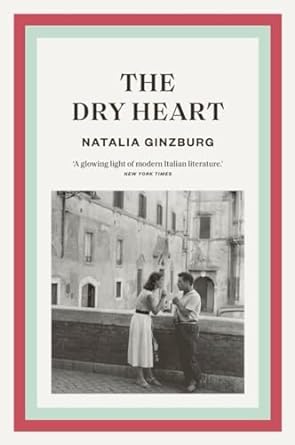
Last year I read All Our Yesterdays, which was my first experience of Natalia Ginzburg’s writing, and I absolutely loved her unfussy, direct style. The Dry Heart (1947 transl. Frances Frenaye 1952) is a much shorter work at just 108 pages but it packs a real punch.

On the first page, the unnamed narrator is with her husband in their home:

“I took the revolver out of his desk drawer and shot him between the eyes. But for a long time already I had known that sooner or later I should do something of the sort.”

And so this is a whydunit rather than a whodunit, as we are taken back to a time when a young, naïve girl marries a man who she knows does not love her:

“When a girl is very much alone and leads a tiresome and monotonous existence, with worn gloves and very little spending money, she may let her imagination run wild and find herself defenceless before all the errors and pitfalls which imagination has devised to deceive her.”

Initially her husband Alberto is interested in her, but not romantically. He reads Rilke to her and listens to all she has to say. But he is in love with Giovanna and he never pretends otherwise. They marry despite ambivalence on both sides.

She has friends, including Francesca who lives more independently and freely; and Augusto who is her husband’s friend but also kind and genuine towards her.  Yet the narrator still seems very isolated, and lonely within her marriage. Alberto obfuscates and disregards her feelings. Who she is and how his behaviour impacts on her is of no consequence to him.  

“I wanted to know a lot more about his feelings for me, but I couldn’t talk to him for long about anything important because it bored him to try and get to the bottom of things and turn them over and over the way I did.”

The simple, direct language lends itself to the length of the novella and also emphasises youth of narrator. The complexity of The Dry Heart lies in the characterisation and builds an intriguing portrait of a marriage.

Despite having undertaken such a violent act, the narrator doesn’t ask for sympathy, and doesn’t justify herself. She presents what happened without a trace of sentimentality or self-pity. Possibly she is detached and deeply traumatised, but as the reader comes to her at the point of the shooting, we don’t know if this voice is one of trauma or long-established.

By refusing to have the narrator engage in self-justification and avoiding any sense of authorial knowingness or psychological explanation, Ginzburg firmly places the why in the readers hands. It’s a masterstroke: she highlights patriarchal oppression, psychological warfare in marriage, the pitiable choices available for women and the danger of dismissing fellow human beings, without being remotely heavy-handed.    

The Dry Heart is hugely impressive and I’m looking forward to exploring Ginzburg further, thanks to the wonderful Daunt Books who are doing such a great job reissuing her work in translation.

It’s probably a mistake to follow every meandering of our feelings and waste time listening to every echo from within. That, in fact, is no way to live.”

To end, from a dry heart to a cold one: