“Everybody is a teenage idol.” (Barry Gibb)

Idol, Burning by Rin Usami (2020 transl. Asa Yoneda 2022) took me into a world I knew nothing about – that of having an oshi. It is a complex culture and there are lots of interesting articles online about it. For the sake of brevity in this post I’ll describe it as where fandom is taken to another level, with devotional idolatry of your oshi, with apologies for huge oversimplification.
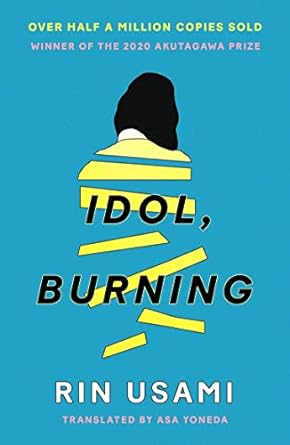
At the start of the novel, sixteen-year-old Akari is waking up to her social media DMs going into overdrive: her oshi, Masaki Ueno, part of boy band Maza Maza, has punched a fan. We follow her through the subsequent days as she struggles with the fallout of his behaviour.

Akari struggles even when things were going well with her oshi. She not academic, she doesn’t like her part-time job but she needs it to pay for all the merchandise associated with her oshi. (Without hammering it home, Usami makes it really clear the financial demands of having an oshi, and how this is exploited by merchandisers.) Her father is away overseas and she’s aware she frustrates her mother and studious sister.

Akari’s mind troubles her with a lack of focus outside her oshi, and her body troubles her too:

“Just being alive took a toll. To talk to someone you had to move the flesh on your face. You bathe to get rid of the grime that built upon your skin and clicked your nails because they kept growing. I exhausted myself trying to achieve the bare minimum, but it had never been enough. My will and my body would always disengage before I got there.”

What helps is her oshi:

“When my eyes met his, they reminded me how to really see. I felt an enormous swell of pure energy, neither positive nor negative, come rising up from my very foundation, and suddenly remembered what it felt like to be alive.”

Akari lives a substantial amount of her life online. Following her oshi’s accounts; blogging about her oshi; chatting with others who share her obsession and understand.

“Narumi sounded the same in person as she did online. I looked at her face, the round eyes and concerned brows overflowing with tragedy, and thought, There’s an emoji like that.

[…] Her facial expressions changed like she was switching out profile pictures.”

What was really clever in this novella (115 pages) and its translation is how Usami changed Akari’s tone and language depending on the medium she was using. The reader could see clearly how the person she created online through her blog and social media interactions wasn’t entirely authentic. It wasn’t entirely inauthentic either, and some of her closest relationships are with those she speaks to online – who of course, may not be entirely authentic either.

“When I pictured a world without Masaki, I thought about saying goodbye to the people here, too. It was our oshi that brought us together, and without him, we’d all go our separate ways. Some people moved over into different genres like Narumi had, but I knew I could never find another oshi. Masaki would always be my one and only. He alone moved me, spoke to me, accepted me.”

It’s a lonely world and there are hints Akari has been diagnosed with depression.

Through her devotion to Masaki we see all that Akari can do: she can be focussed, she can be insightful and she can be sensitive. It’s just that nothing other than her oshi prompts these behaviours.

We never learn the truth of Masaki’s actions and I was pleased about this. It is not his story, and while demonstrating the fallout of a celebrity flaming, Usami keeps the focus tightly on Akari. There is a Q&A with the author at the back of the novel and I wasn’t surprised to read that she has an oshi herself, because her portrayal of Akari is never patronising or pitying.

What Idol, Burning explores is how we all have to find a way to live, and that when this is focussed on something external and unpredictable – like a person and their constructed celebrity persona – then you can be in an incredibly vulnerable position. The novella ends on a tentatively positive note and I hoped Akari would learn to be the protagonist of her own life, rather than giving that power over so completely to someone else.

To end, I should definitely choose some J-pop, but I know absolutely nothing about it. So it’s back to 80s cheese, which I do know about 😀 Idol by name, Idol by nature…
“It takes courage to grow up and become who you really are.” (e. e. cummings)

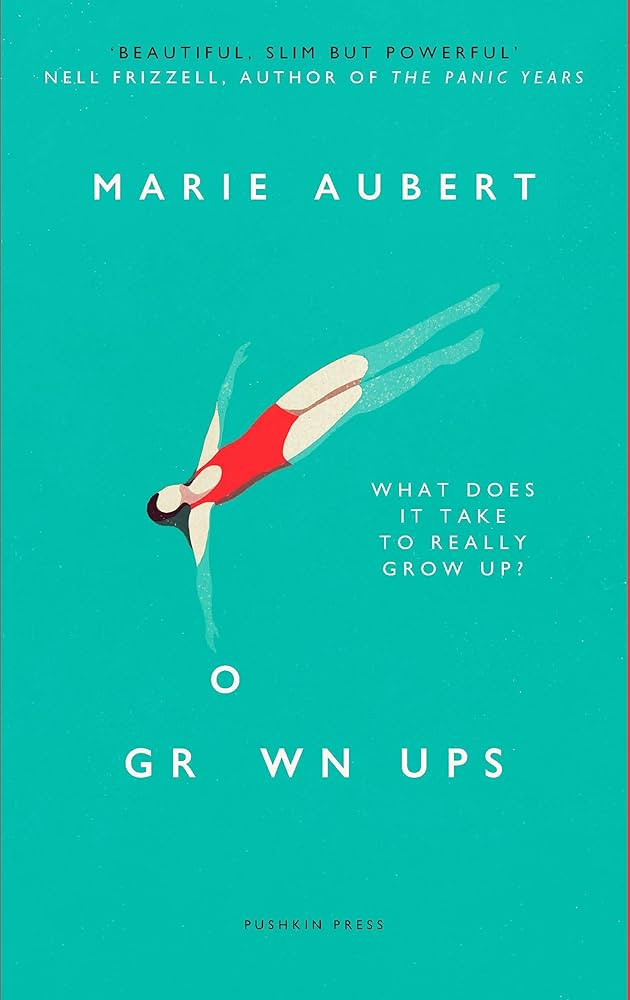
The blurb on the cover of my edition of Grown Ups by Marie Aubert (2019 transl. Rosie Hedger 2021) pushes it as ‘the perfect summer read’ and ‘pure escapism’ with which I couldn’t disagree more. Obviously we all have different reactions to books, but for me a novella (154 pages) about a woman coming to terms with her rapidly reducing choices regarding fertility, while at the summer house of her family with all its inherent tensions and rivalries, didn’t feel remotely escapist. Even when it’s darkly humorous and set in a log cabin in Norway 😉

Grown Ups features a very unlikable protagonist in Ida. She behaves really badly by anyone’s standards. But she was also recognisable and (somewhat) sympathetic.

At the start of the novel she is at a Swedish clinic having her eggs frozen:

“One day, I thought as I lay there in the gynaecology chair, one day things have to work out, one day, after a long line of married and otherwise committed and uninterested and uninteresting men, things have to work out, just lying there made me believe both men and child might materialise, just the fact that I was there and actually doing it was a promise that there was more to come, one day.”

I really felt for Ida. As the quote shows, she is feeling a bit desperate regarding the future as she turns forty, but pinning her hopes on a fantasy. As the story develops, the ambivalence she feels about what that future might look like is subtly portrayed. She doesn’t really seem to like children very much, but she doesn’t want that choice taken away from her. If she truly wants a committed relationship, why does she keep seeking out men who are already committed to someone else?

She travels to the family summerhouse in Norway for her mother’s birthday. Her sister Marthe is there with her husband Kristoffer and step-daughter Olea. The sisters relationship is full of long-held petty tensions, but it felt like they could actually be really close if they would just step outside of these entrenched behaviours. It doesn’t help that Marthe has redecorated the cabin without asking or even discussing it with Ida. She is also pregnant.

“‘I’m not as tough as you are,’ Marthe says, sounding a little sarcastic. It’s always the same, every summer, I’m quick to get into the water while Marthe takes her time, and then we each make digs about which approach is best.”

One of the hardest things to read in the book is Ida’s treatment of Olea. Recognising that Olea and Marthe don’t get on, Ida manipulates the child to increase her opposition to Marthe, just to prove something to Marthe and herself. She seems to have no fondness for Olea, and everything is performative rather than felt or understood.

“I’m the grown up now, I’m good at this. My tone is calm and kind, it feels familiar, like how things ought to be […] See, Marthe, I can do this, I’m the one who’s supposed to be doing this.”

Ida is destructive in her behaviour but only half-recognises this. I felt with Olea she didn’t really see the child as a person so didn’t fully recognise what she was doing. Flirting with Kristoffer on the other hand, she is fully aware of…

I’m making Ida sound more unlikable than she is and not doing justice to Aubert’s subtlety at all! The hurt Ida is experiencing is so clear, she is just seeking entirely flawed ways of managing that pain. Although she mentions friends, they are not named and she comes across as very isolated, particularly when her mother arrives with partner Stein.

“I feel the injustice, rampant and raging, there’s no one there to console me”

There’s also a passage where Ida describes dating and her hopes for more, where my heart just broke for her. It was filled with so much anger and loathing towards herself.

I looked on goodreads and yep, some readers really hated Ida 😀 But for me, while a lot of her behaviour was downright awful, I thought she was realistically portrayed as someone who has grown up thinking love is conditional and now doesn’t know who she is or what she really wants.

Grown Ups is well paced and things aren’t all tied up neatly at the end, which I liked as it didn’t undermine Ida’s situation or her feelings. I did have a sense Ida would carry on but maybe do a bit better. Unlike at the start of the story, there was hope for her grounded in something real.

To end, two sisters who seem to get on better than Ida and Marthe, singing about the struggles of trying to be grown up and a problem Ida has definitely experienced:

“All good stories are told with varying degrees of reluctance.” (Claire Keegan)

As I mentioned in my last post, I’m disappointed not to be doing my novella a day in May project this year, but for my sanity something had to give! Simon is undertaking a book a day for the month which I’m sure will give me many ideas for next year 😊

I still plan to focus on novellas this month though, and last year when I read Small Things Like These by Claire Keegan, a few people mentioned that I read needed to read Foster. How right they were, it’s an extraordinary novella.

Apparently it started life as a New Yorker short story (it has two copyright dates) and although I haven’t read that version, as a novella I would say it is completely realised in just 88 pages.

A young girl is taken to the west of Ireland to live with the Kinsellas, her aunt and uncle, as her mother is heavily pregnant and struggling with the number of children she has to care for.  Her father gambles away the family heifer and there isn’t enough food to go round, or time for adequate physical or emotional care.

At the place where she is to spend the summer, chores are achieved daily on the farm and within the home. There is enough food and enough care.

“Her hands are like my mother’s hands but there is something else in them too, something I had never felt before and have no name for. I feel at such a loss for words but this is a new place, and new words are needed.”

Although the time is never specified, it seems to be around the 1970s/early 1980s as there is a discussion of hunger strikers. The narrator is nameless and we’re not sure of her age, but I would say somewhere around nine to eleven years old.

“I am in a spot where I can neither be what I always am nor turn into what I could be.”

Keegan trusts the reader not to need everything spelled out. We get a sense of the wider family dynamics and the feelings of various family members without them being explicitly stated. The slowly building bonds of trust and affection between the young narrator and the Kinsellas are so delicately evoked and tenderly realised.

A stunning scene sees the narrator and Mr Kinsella walking along the beach. When they turn around to walk back, he can only see her footprints

“’You must have carried me there.’

[..]

We stand then, to pause and look back out at the water.

‘See, there’s three lights now where there was only two before.’

I look out across the sea. There, the two lights are blinking as before, but with another, steady light, shining in between.

‘Can you see it?’ he says.

‘I can,’ I say. ‘It’s there.’

 And that is when he puts his arms around me and gathers me into them as though I were his own.”

There is also the gradual understanding by the narrator that a life is possible, and exists, beyond that which she has always known.

“But this is a different type of house. Here there is room, and time to think. There may even be money to spare.”

Throughout, there is an awareness that this is a temporary time, with a defined end date. The situation cannot endure and the narrator and the Kinsellas will have to part.

Foster is a stunning novella. A deeply moving and perfectly crafted gem, complete in itself, down to the final devastating line.

I’ve not seen the film adaptation of Foster, but it looks faithful, and beautifully shot:

“Money is our madness, our vast collective madness.” (D. H. Lawrence)

For this final week of Kaggsy and Lizzy’s brilliant #ReadIndies event, I’m focusing on three books from Boiler House Press, and their Recovered Books series edited by Brad Bigelow, founder of www.neglectedbooks.com, which brings “forgotten and often difficult to find books back into print for a new generation to enjoy.”

Five years ago, I read Wish Her Safe at Home by Stephen Benatar and it’s a novel that really stayed with me. The portrait of an isolated woman’s descent into serious mental illness, told from her own perspective, was deeply unsettling. I was put very much in mind of it when reading William’s Wife by Gertrude Trevelyan (1938).

At the start of the novel Jane is in her twenties and marrying the older, widowed Mr William Chirp, a local business owner.

“Jane had worked for her money, she knew the value of it. Knew how to save, and knew how to spend, too. All good quality, all of the very best. Mr Chirp might have done worse for a manager.”

But this is near the turn of the last century, and women are not managers of shops, they are managers of homes which are not as easy to leave. Jane is not a pleasant manager; she is quick to judge her maids and condescending, such as this early interaction over a fire:

“‘Why isn’t it laid,’ she asked haughtily, ‘this time of year?’ All alike.

‘The master wouldn’t never have it laid, not unless someone come. Will I lay it now, mum?’

Jane turned round sharply. ‘And quite right too. Wasting coal. No, certainly not.’”

Jane soon learns that it doesn’t matter if she knows how to spend on quality items, her husband will not have her spending at all. He is a man who knows the price of everything and the value of nothing. His want of generosity is spiritual as well as financial: he has no hobbies, no interests and no friends. His inability to value anything beyond material wealth accumulation for its own sake is brought into shocking focus during World War I:

“What the war was costing, that was what upset him. All those millions they wrote down in the papers. Though what was that to the government? The same as a few shillings to people like them. His face getting longer and longer, while he read about it. You’d think he was paying for it himself.”

Told in the third person from Jane’s perspective, the novel brilliantly builds the oppression of her marriage to this appalling person. Having Jane as not likable but still very sympathetic is a masterstroke by Trevelyan. It stops the tale becoming sentimental or easily dismissed as unrealistic. Instead, it is horribly believable.

The portrait of William is comical at times too, and this is finely judged. It doesn’t detract from the horror of Jane’s life with him at all. His reported speech is so minimal and trite as to be almost nonsensical. But his ridiculousness adds to the oppression: she is stuck with this man whose ignorance is so extensive as to make him absurd.

“At the end of April they stopped having the fire laid; the grate was filled in with crinkly blue paper in a fan. William sat with his feet in the fender and his hands, when he forgot, cupped over the paper fan.”

We see Jane scrabble to accumulate her own wealth through various small deceptions, necessary as her husband controls all her money and monitors it minutely. After he retires, William extends his miserliness to the time Jane spends away, commenting on the time whenever she returns from town. There is no physical violence in the marriage and no suggestion of what he will do if she takes longer than he thinks appropriate, but the control is absolute.

SPOILERS ahead: But further horrors await Jane when William dies. Her feelings of oppression do not dissipate, nor does her tight hold of money.

“It wasn’t until she found her money in the bag at the bottom of the basket and tipped it out carefully, with a cushion under, on the table, so that it shouldn’t chink, that she remembered William wasn’t about to hear it. It did seem queer, not having to be careful. Though it was all for the best, taking care; you never knew who might be about outside, listening to what was going on.”

She has taken on William’s prejudice, paranoia, and inability to spend. This escalates steadily, resulting in Jane moving several times and living in more and more straightened circumstances:

“She was so happy, having got away to herself, away from all that peeking and tittle-tattling, you wouldn’t believe. It wasn’t likely she was going to give away where she was, and have them all coming round again, like flies around a honeypot.”

This is heartbreaking – there is no ‘all’. She has no friends, has alienated her step-daughter, and is entirely alone. As she stops washing herself and her clothes, she is far from a honeypot for anyone. We are kept inside Jane’s unhappy mind, recognising far more than she does about her behaviour and how she is viewed by others.

William’s Wife is a novel that really gets under your skin. The oppression that Jane suffers, firstly through her marriage and then through a mind traumatised by all the years she has endured within that institution, is subtly evoked but relentless. It is a novel of great compassion written with such clear-sightedness that its power – eighty-six years later when women in the UK have far greater financial rights – remains undeniable.

“Technological progress is like an axe in the hands of a pathological criminal.” (Albert Einstein)

For the final week of Kaggsy and Lizzy’s brilliant #ReadIndies event, I’m focusing on three books from Boiler House Press. Specifically their Recovered Books series edited by Brad Bigelow, founder of www.neglectedbooks.com, which brings “forgotten and often difficult to find books back into print for a new generation to enjoy.”

My second read from the series is Two-Thousand Million Man-Power by Gertrude Trevelyan (1937). The title is the only part of this novel that feels cumbersome; Trevelyan writes with fluency and deftness that is so readable.

She follows Katherine and Robert from 1919 to 1936, from their meeting as young idealists through the strains of their marriage and the economic pressures exerted by forces beyond their control.

They belong to “The half-generation between the war and the post war. They had been brought up in one world and jerked out into another” and the novel explores this notion of them being somewhat lost, even from each other. They both struggle to know what to cling to in a time of rapid change.

When they meet, Robert is working as a cosmetic scientist during the day, and on his own formula for the nature of time from his dingy lodgings in the evening:

“He ate quickly, with appetite, undiscriminating. Turning his back on the meal he lit the gas over a small table near the window and felt in his pocket for the scrap of paper with the dotted figures. As the gas came up, the roofs outside the window turned dark grey. The drawer of the table stuck, half open. He banged it back and wrenched at it and found a wad of notes and pulled in his chair. The roofs outside turn black against the sky and then the sky blacked out.”

Katherine believes in lots of things that need capital letters:

“Katherine believed in progress. She believed in the League of Nations and International Goodwill, in Gilbert Murray and Lord Robert Cecil and H.A.L. Fisher, and in the wonders of Science.”

And so she gifts Robert these capital letters, deciding he is “Working Something Out.”

But gradually the societal forces they both wish to resist make themselves felt. They decide to marry, despite Katherine’s disdain:

“She had, besides, a contempt for married women – content with homes and babies and indifferent to the things that mattered: happy, she thought with a slight sneer, in an emotional and humiliating bondage – which made her, illogically, despise even their efforts to escape.”

She is monumentally judgemental of people. Katherine is an intellectual snob, but her love of ideas doesn’t involve any examining of her own life. This means she can stay secure in her absolute belief that she is somehow better and different to those she looks down on, despite appearing remarkably similar to them externally:

“‘We didn’t marry for bourgeois conventional reasons. Our marriage isn’t bourgeois. We married because we wanted to, that’s quite different, not because we were afraid.’”

Katherine loses her teaching job because married women weren’t allowed to continue in posts. Robert then loses his job due to the world economic crisis. This puts immense strain on them both. Katherine takes a private teaching job she despises; Robert very nearly breaks down entirely.

Throughout, Trevelyan weaves in summaries of world events before returning to the tight focus on Robert and Katherine. I’m not entirely sure how she managed it, but somehow this never felt gimmicky or jarring.

“Agricultural machines in France were grading and marking eggs at the rate of a hundred and twenty a minute. Escalators were speeding up, the biggest building in the Empire was in course of construction at Olympia, Katherine and Robert were in their white-enamelled kitchen one Sunday afternoon, washing the tea things in instantaneous hot water and hanging them to dry in an electrically heated rack.”

The fault lines in Robert and Katherine’s marriage, exposed by the economic strain, only widen. Hilariously, Katherine believes herself to be a communist, when she is in fact a relentless materialist. Trevelyan doesn’t judge her too harshly for this:

“She wanted security and comfort and a Life Worth Living. She wanted Robert to get a sound, decent, progressive job.”

Nothing wrong with any of that, except it does also involve Katherine thinking the world owes them some sort of moral obligation – that they ought to have” things, and sustaining a consumerism that she entirely fails to see as such. Unable to see how her ideals of progress and modernity have become warped, she continues to position herself as intellectually and morally superior, when really it is only tastes in furnishings that separate her from those she is so condescending towards.

Robert meanwhile finds a way to survive in his work while his big idea amounts to very little, as the reader always knew it would. He has insight but no energy, Katherine the opposite. Two-Thousand Million Man-Power isn’t depressing, but I did find it sad. Ultimately Robert and Katherine seemed so isolated and stymied in very different ways.

I came away from this perceptive, clever and compassionate novel keen to read more by Trevelyan, so I was pleased I’d also ordered William’s Wife (1938). Of which more tomorrow!

“A gentleman is simply a patient wolf.” (Lana Turner)

During this final week of Kaggsy and Lizzy’s brilliant #ReadIndies event, I’m going to focus on three books from Boiler House Press, and their Recovered Books series, which brings “forgotten and often difficult to find books back into print for a new generation to enjoy.”

I bought these books last year after Brad Bigelow, founder of www.neglectedbooks.com and inspiration for the series, tweeted about how precarious things were. This is why #ReadIndies is such a great event for encouraging support and celebration of indie publishers, whose survival is never guaranteed.

 In this first post, I’m looking at a tragi-comic novella, Gentleman Overboard by Herbert Clyde Lewis (1937).

Henry Preston Standish, “one of the world’s most boring men”, is aboard the SS Arabella steamship en route from Hawaii to Panama. When he slips on some grease he finds himself plunged into the middle of the Pacific Ocean, with hopes of rescue looking pretty slim.

When he first falls overboard, he finds it hard to raise his voice to shout for help, so deeply ingrained is his social conditioning.

“Men of Henry Preston Standish’s class did not go around falling off ships in the middle of the ocean; it just was not done, that was all.”

As he treads water waiting for the Arabella to notice his absence, he reflects on a life where “He did all the proper things, but without enthusiasm.” It’s a real masterstroke that Lewis makes Standish so ordinary, and places him in a situation that is both extreme but also unchanging – a vast expanse of calm ocean. Rather than making the novella dull, it enables a tightly-focussed narrative with a protagonist that inspires sympathy precisely because he is an everyman.

“The whole world was so quiet that Standish felt mystified. The lone ship ploughing through the broad sea, the myriad of stars fading out of the wide heavens – these were all elemental things that both soothed and troubled Standish. It was as if he were learning for the first time that all the vexatious problems of his life were meaningless and unimportant; and yet he felt ashamed at having had them in the same world that could create such a scene as this.”

Poor Standish takes time to realise the hopelessness of his situation, veering from imagined conversations with his family – still framing his experience within his social milieu even when the nearest person is miles away –  to considering drowning as an abstract notion rather than an impending reality:  

“It would not be so terrible to drown if a man went about it sensibly, without losing his head.”

Back on the Arabella, the remaining eight passengers take time to realise Standish is missing. Once they do, they invent a trauma for him – his loyal wife has, in their minds, run off with a “gigolo” – and start rewriting their experience of him in this light.

The humour in Gentleman Overboard is finely balanced. Standish’s desperate holding onto behavioural norms which are gradually shed as the enormity of his situation dawns on him, and the entirely fictional life story the other passengers invent for him, poke fun at the ridiculousness of human behaviour. But Lewis never suggests it is funny that Standish is in mortal danger, or that his dullness should mean it’s any easier for the reader to bear witness to his imminent death.

Brad Bigelow’s Afterword explains reviewers thought Gentleman Overboard both too short (The Saturday Review) and too long (Evelyn Waugh). I agree with those who felt the length was just right. It was long enough to create a moving portrait of a man, but short enough that the tight narrative’s commentary on human existence was made with the lightest touch. Truly memorable.

“But now he saw clearly that life was precious; that everything else, love, money, fame, was a sham when compared with the simple goodness of just not dying.”

“January, month of empty pockets! Let us endure this evil month.” (Colette)

Happy Colette’s birthday! Regular readers will know how much I love Colette, and today I thought I’d look at two of her novellas which I had languishing in the TBR, La Vagabonde (The Vagabond) and L’Entrave (The Captive). Both follow periods in the life of Renée Néré, based on Colette’s experiences after her marriage to Willy ended.

In The Vagabond (1911, transl. © Martin Secker and Warburg 1954), Colette evokes beautifully her setting of Belle Époque music halls, and expertly weaves in her themes of aging, love and female freedom.

Renée has left her philandering husband Adolphe Taillandy and has no regrets about doing so. However, this has left her with no money, and so she has turned from her beloved writing to earn money on the stage.

“I had savoured the voluptuous pleasure of writing, the patient struggling with the phrase until it becomes supple and finally settles down, curled up like a tamed animal, the motionless lying in wait for a word by which in the end one ensnares it.”

She is in her early thirties, and painfully aware of aging in an industry that depends on appearance and artifice. Renée has a “face which is losing the habit of being looked at in daylight” and which poverty will not help. She enjoys the stage though, and the people in it.

“They swagger, tightly buttoned in a full-skirted overcoat of the fashion of two seasons ago; for the essential, the indispensable thing, is the possession not of a clean suit but of a ‘really classy’ overcoat which covers everything: threadbare waistcoat, shapeless jacket, trousers yellowed at the knees; a dashing, flashy overcoat, which makes an impression on the director or the agent, and which in the last resort enables one to throw off that ‘things aren’t shaping well’ in the jaunty tone of a man of means.”

Colette is not sentimental about the poverty or hardships of such a life. Early on she writes of the gradual but inevitable degradation of young chanteuse Jadin, in a way that is clear-sighted but heartbreaking.

Into Renée’s world comes Maxime Dufferein-Chautel, a rich feckless admirer. What follows is a love affair of sorts, one in which Renée never quite resolves her ambivalence.

“He does not want my well-being, this man, he merely wants me.”

“There are days when solitude, for someone of my age, is a heady wine which intoxicates you with freedom, others when it is a bitter tonic, and still others when it is a poison which makes you beat your head against the wall.”

Maxime is not unpleasant or abusive, but he is pretty dull:

“I forgive him all this ordinariness for the sake of a simplicity which has nothing humble about it, and because he finds nothing to say about himself.”

And Renée is painfully aware that getting into a relationship with him may require more than she is willing to give. As her friend Hamond points out:

“Be frank, Renée, be clear sighted, and tell me whether all your sacrifices [within marriage] haven’t only lost their value in your eyes since you recovered your free will? You assess them at their true worth now that you no longer love.”

Renée is offered a tour and vacillates about whether to go. Ultimately she does and her letters to Maxime form the latter part of the novella, although we never see Maxime’s replies. The Vagabond is determinedly Renée’s story and her voice.

“This evening I should not feel sleepy, and the spell of a book – even a brand new book with that smell of printers ink and paper fresh from the press that makes you think of coal and trains and departures! – even that spell will not be able to distract me from myself.”

Despite The Vagabond’s various urban settings, there is still plenty for fans of Colette’s depictions of the natural world to enjoy, such as this description of early Spring in Paris:  

“Towards the end of the afternoon, a mauve mist veils the avenues so that you do not know where they end, and the unexpected discovery of a wild hyacinth, with its three slender bells of artless blue swaying in the wind, has all the charm of a stolen joy.”

The Vagabond is slightly plotted with very little happening. It is not a slight tale though, but rather a distinctive plea for female independence alongside a consideration of how to reconcile this with romantic love and material necessity.

“Are you not he who, thinking he is giving, takes for himself? You came to share my life. To share, yes: to take your share!”

The Captive (1913, transl. Antonia White 1964) is set three years later. Renée is now financially solvent due to a legacy and whiling away her time in the south of France. She is still living the itinerant hotel-based life, unable to fully adjust to her new circumstances: “when a dog has been kept a long time on a lead, it does not go prancing off the moment you undo the catch of its chain”.

She finds herself with an unlikely trio of friends. There is young May, self-mythologising and fragile:

“Nature has drawn all the features of laughter itself in her round childish face; a Cupid’s bow mouth that tilts up at the corners like her mischievous eyes, a short little nose with quivering nostrils. But gaiety is not a perpetual fidgeting that betrays a lack of security, it is not chatter full of recriminations, nor is it a craving for everything that intoxicates. Gaiety, it seems to me, is something calmer, something healthier, something more serious.”

There is also May’s brutish lover Jean, and their friend, the opium-addicted Masseau.

“Yes, I’ve had enough of those people, it’s true. But, besides beginning to know myself, I’m also beginning to know the advantages and disadvantages of this extraordinary part of the world where mornings are enchanting and the nights, however starry, make one shiver in the discomfort of a double climate. Here cold nights are not invigorating and warm nights throb with fever rather than with passion.”

At the beginning of the novel Renée is determined to remain celibate. However, for reasons that entirely escaped this reader, she is attracted to Jean.

“A kiss, and everything becomes simple and enjoyable and superficial – and also a trifle coarse.”

She leaves Nice for Geneva to try and resist him, but they are eventually reunited. Their affair is wholly unsatisfactory for both of them. Colette explores the experience of a relationship based on sexual attraction without emotional intimacy, when the latter is also desired by both but remains elusive.

“I have insulted this lover, out there alone in the soft spring night, restoring his own identity; I have insulted him by giving him my body and supposing that this was enough. He has returned the insult.”

Like The Vagabond, it is Renée’s thoughts and experiences that the reader is privy to. We know very little about Jean and even less about what he thinks and feels. While he is not likeable, the portrayal of the affair is quite even-handed, as Renée acknowledges how little she is able to give of herself. What she does give may be as much a performance as any she made on the stage:

“You pretend to love me, you do love me. Every minute your love creates a woman better and more beautiful than myself whom you forced me to resemble.”

Somehow I didn’t find The Captive too depressing, although I’m not entirely sure why. There is something resilient about Renée even when she seems to be taking such sad decisions. Although she is adrift at this point in her life, I felt there was some hope she’d start to feel more anchored within herself soon.

“The darkness is ebbing. A faint wind stirs the trees, bringing a green smell of trampled grass. Behind the plane trees, the mound of the fortifications is emerging from the dusk and the sky is taking on the colour of a field of blue flax the subdued, slightly grey, slightly melancholy tint over summer dawn over Paris.”

To end, I was looking for archive footage from Folies Bergère to reflect Renée’s career, which led me to loads of cabaret footage, which led me to loads of Cabaret footage, which led me to this performance by Liza Minelli. Basically all roads lead to Liza 😀 I’ll never not be astonished by how the chair doesn’t move until she wants it to – the woman must have abs of steel:

“Some things I cannot see until I write about them.” (Yuko Tsushima)

I wasn’t planning on joining in Japanese Literature challenge 17 hosted by Meredith at Dolce Bellezza other than enjoying other bloggers wonderful posts. However this enthusiastic post by Marina Sofia on Tsushima Yūko’s Territory of Light meant I immediately started rooting through the TBR to find Child of Fortune (1978, transl. Geraldine Harcourt 1983), which I knew I had buried somewhere…

This is the first of her novels I’ve read and on the strength of this I definitely want to read more. Novella length, it tells the story of Kōko, a 36-year-old single mother to eleven-year-old Kayako. Told in the third person from Kōko’s perspective, it is a compelling examination of one woman’s inner world and her barely articulated resistance to the expectations placed on her.

Early in the novel, Kōko suspects she is pregnant. She is ambivalent about Osada, the father, as she is about most things. But gradually she realises that she wants to keep the child:

“Maybe she was reaching an age when it was senseless to want a fatherless child; but, precisely because of her age, she didn’t want to make a choice that she would regret till the day she died. Lately she was more convinced than ever that there was no point in worrying about what people thought. She would soon be thirty-seven. The only person watching Kōko at thirty-seven was Kōko. When this obvious fact finally came home to her it was still a surprise – what a very lonely fact it was!”

Geraldine Harcourt’s informative introduction explains that pregnancy at that age in Japan around this time could still be viewed as shameful even within marriage, so Kōko’s decision is doubly transgressive.

Kōko is an intriguing character, as she lives an unconventional life which places her in opposition to so many, by barely doing anything. Her lack of decision-making is an act of quiet but determined resistance.

Her sister Shoko is much more conventional and doesn’t approve; Kōko’s daughter Kayako much prefers to spend time with her more affluent, conformist aunt. Kōko tries to explain to Shoko:

“No, that’s not it – don’t think I’ve liked using choosing a different world from other people. I know I’ve been stubborn – but not about Kayako alone. All my life, though I often haven’t known which way to turn, I have managed to make choices of my own. I don’t know if they were right or wrong. I don’t think anyone can say that.”

But really she hasn’t made that many choices. She married because of pregnancy; husband Hatanaka organised the divorce years later, unsurprisingly as Kōko didn’t love him, still holding a candle for her lover Doi. She doesn’t enjoy her job teaching piano, but she also takes no steps to do anything else. She doesn’t take great care of herself and she doesn’t have many friends or interests.

Two driving forces in her life are her love for her brother, who died many years earlier, and sexual desire. The latter has led to her current predicament, the former suggests one reason that may be contributing to her lack of attachments.

“A little over a year ago, Kōko had understood something for the first time: the in the end she had let everything slip away from her, that in reality she hadn’t a single resource. It was an alarming discovery.”

Her lack of attachment includes reality – we are taken into Kōko’s dreams and daydreams, woven in seamlessly but disconcertingly.  As we move back and forth in time, learning about Kōko’s childhood, marriage, griefs and pains, Tsushima builds a picture of a woman who may not be completely likable but who is recognisably human and flawed, and muddling through the best way she knows how.

I was really rooting for Kōko to find a more articulate agency, and the penultimate scene was unbearably tense in this regard. Child of Fortune is never didactic yet absolutely achieves a compelling portrait of a woman fighting for her life, against immense societal pressure.   

“Kōko was shaken by the realisation that even now, more than twenty years later, she still lacked any compelling reason to go on living. And by the fact that the will to live was still there.”

To end, Kōko has fond memories of a visit to Karuizawa, which does look lovely:

PS When I was looking for a title quote for this post, I found this great conversation between Tsushima and Annie Ernaux.

“To die will be an awfully big adventure.” (Peter Pan)

Happy Birthday Beryl Bainbridge, who would have been 91 today! I thought I wouldn’t manage a post for Reading Beryl Week hosted by Annabookbel as I had a couple of false starts. I love Beryl but the two I had in the TBR didn’t work for me – probably the wrong time (I seem to be catching #AllTheWinterViruses).

Then I thought I’d let fate decide (admittedly I knew the odds were stacked in my favour, but I just like to pretend to myself that I’m not always going to buy a book 😀 ) and I went to the consistently wonderful charity bookshop across the road from me… of course they had plenty on their shelves, including one I keep meaning to read, An Awfully Big Adventure (1989).

I could just squeeze it in because Beryl generally wrote very short novels; this one comes in at 197 pages. So I’m counting it towards Novellas in November too, hosted by Cathy at 746 Books and BookishBeck.

Set just after the war, young Stella is encouraged to pursue dramatic interests by her Uncle Vernon, who feels she needs an outlet for all her feelings:

“Emotions weren’t like washing. There was no call to peg them out for all the world to see.”

But despite Stella’s emotional reactivity, she is also strangely detached. Uncle Vernon and Aunt Lily raised her, but she is not intimate with them. She never talks to them about what is happening for her or how she feels.

This theme of the distances between people continues when Stella joins an acting troupe at the local theatre, helping backstage and playing small parts. There are complex histories, resentments and intrigues between the players, which Stella only partly grasps.

“Bunny agreed with Meredith that there was nothing wrong with Dawn Allenby apart from her love of beauty, an affliction she was ill-equipped to fight. He put it in a nutshell when he said she was the sort of girl who, if there had been a meadow handy, would have been out there in a flash picking cowslips.”

Stella is naïve and self-focussed, which means the reader sees much more than she does. She can make sharp observations but lacks the sophistication to fully comprehend their meaning. She falls for Meredith, the nicotine-stained, spiky director:

“She suspected it was education and breeding that enabled him to keep his face and his feelings separate.”

But she is so wrapped up in her own feelings she barely registers how little she knows of him, or his lack of any interest in her:

“Endeavouring to be what she imagined was his ideal, she altered her demeanour several times a day.”

The reader knows Stella will never, ever be Meredith’s ideal. But Stella remains wilfully ignorant and intent on very shaky self-reinvention. I would say this seems to be a recurrent theme in Bainbridge – the psychological warfare people can wage on one another, though self-involved disregard of others, rather than outright mendacity.

Also typical of Bainbridge is the witty, pithy turn of phrase and humour threaded throughout the darkness.

“She plumped out my vowels. I tend to have flat ones. It’s to do with catarrh as much as region.”

Apparently An Awfully Big Adventure was partly biographical with Bainbridge drawing on her time working at the Liverpool Playhouse. It certainly felt very authentic, with lots of detail about the daily drudge of postwar life, such as when Stella wants a bath:

“It meant paraffin had to be fetched from Cairo Joe’s chandlers shop next door to the Greek Orthodox Church, and then the stove lugged two flights of up the stairs and the blanket nailed to the window with tacks. In the alleyway beyond the back wall stood a row of disused stables and a bombed house with the wallpaper hanging in shreds from the chimney breast, and sometimes women, no better than they ought to be, lured men into the ruined shadows.”

An Awfully Big Adventure is ultimately very dark. Stella’s seduction by seasoned actor PL O’Hara is treated by Stella with the same detachment with which she views nearly all her relationships. But the consequences will be tragic, and again, the reader is left to realise far more than Stella.

For newcomers to Bainbridge, this would be a good place to start. It covers many of the themes she returns to and is so tonally distinctive, in the way her novels are. For those who are already fans, she is at the height of her powers here. An Awfully Big Adventure was one of the five books that gained her a Booker nomination, which she never won.

“In the end everyone expected a return on love, demanded a rebate of gratitude or respect. It was no different from collecting the deposit on lemonade bottles.”

To end, An Awfully Big Adventure was adapted to film in 1995. I have a vague memory of seeing it in the cinema at the time. This trailer has reminded me how perfectly cast it was, and how much I miss Alan Rickman’s performances:

“Writing is not a profession but a vocation of unhappiness.” (Georges Simenon)

November is the month of many reading events, and I definitely won’t manage them all, but I’m starting with Novellas in November, hosted by Cathy at 746 Books and BookishBeck.

I’m taking this as a good opportunity to carry on with my much-neglected Le Monde’s 100 Books of the Century reading challenge, reading Pietr the Latvian by Georges Simenon (1930, transl. David Bellos 2013) which is No.84 in the list.

This was Maigret’s first outing and Simenon clearly had a very thorough understanding of his policeman from the start. Like many Maigret stories it is novella length, coming in at 162 pages in my English translation.

“Not that he looked like a cartoon policeman. He didn’t have a moustache and he didn’t wear heavy boots. His clothes were well cut and made of fairly light worsted. He shaved every day and looked after his hands.

But his frame was proletarian. He was a big, bony man. Iron muscle shaped his jacket sleeves and quickly wore through knew trousers. He had a way of imposing himself just by standing there. His assertive presence had often irked many of his own colleagues.”

In this first story, Maigret is in pursuit of a thief and conman, Pietr the Latvian, who may not even be from Latvia. (I was anticipating some xenophobia, which there wasn’t in the novel, but be warned there is Antisemitism at points.)

There is intelligence that Pietr has travelled to Paris from the Netherlands and Maigret is tasked with apprehending him. At the Gare du Nord he thinks he spots Pietr, but is then called to a train to identify the body of a man who also matches the description.

Following the first man takes Maigret into the world of well-heeled Parisian hotels:

“Maigret persisted in being a big black unmoving stain amidst the gilding, the chandeliers, the comings and goings of silk evening gowns, fur coats and perfumed, sparkling silhouettes.”

Things become more complex as Maigret follows various leads around the first man. His unshowy, procedural approach is evident from the start as he doggedly pursues evidence throughout Paris and to Fécamp at the coast. The conman knows Maigret is closing in and the danger grows.

I’ve not read all the Maigrets as there are at least eleventy million of them, but I would say from my limited knowledge that this isn’t the strongest. For such a short novel, it is repetitive at times and I wonder if this is because it was published firstly as a serial. In that format the repetitions would work well, but in the novel they weakened the story and it could have done with an edit with the new format in mind.

However, there is still so much to enjoy. The evocation of Paris, the character of Maigret and the novella length make this a quick, entertaining read. Simenon’s affection for his creation is evident and this makes his Detective Chief Inspector so appealing.

“The Latvian was on a tightrope and still putting on a show of balance. In response to Maigret’s pipe he lit a cigar.”