“The cup of tea on arrival at a country house is a thing which, as a rule, I particularly enjoy.” (PG Wodehouse)

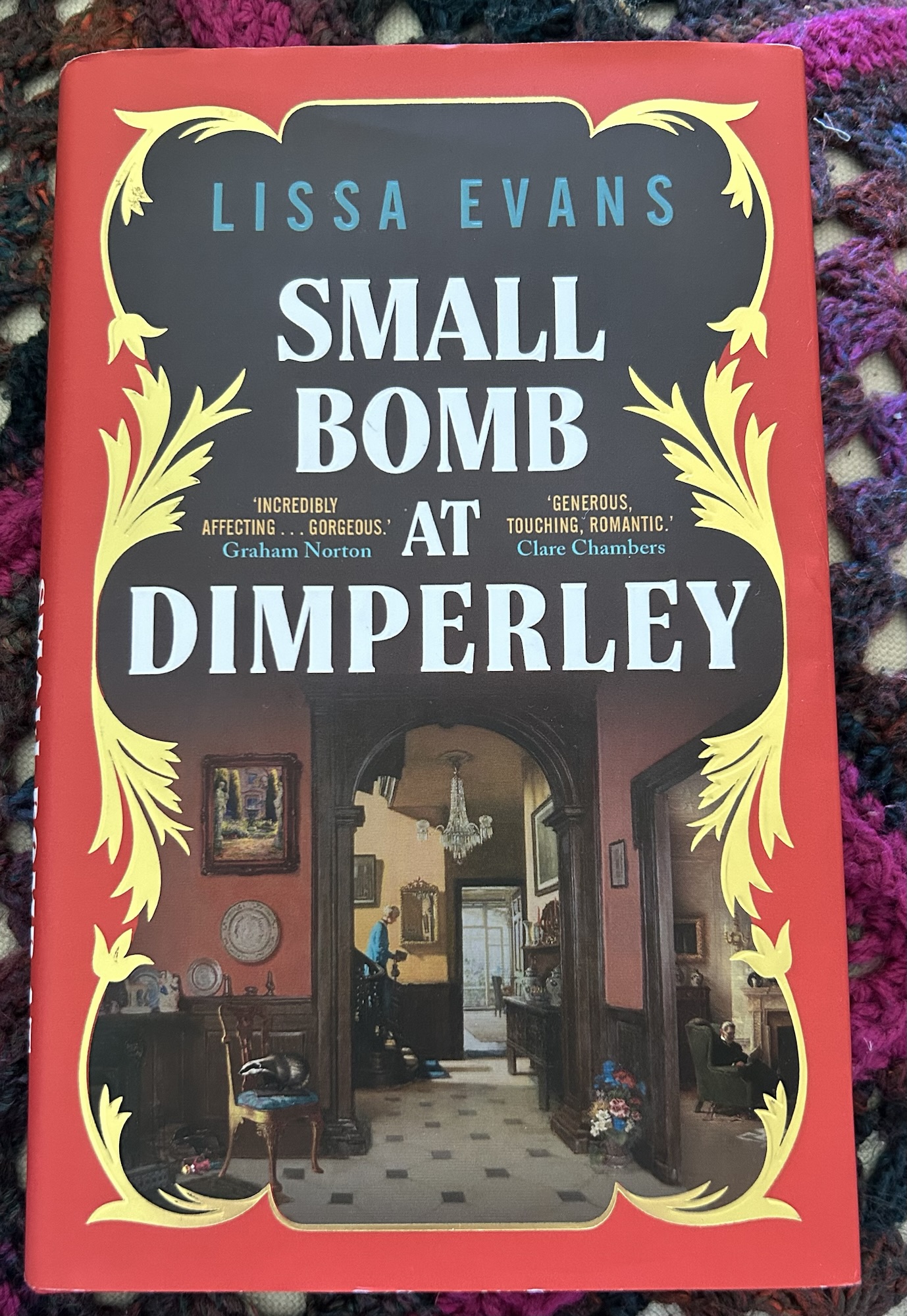
I feel like it wasn’t so long ago I read and enjoyed Old Baggage by Lissa Evans (2018), but as I blogged about it I can see it was six years ago! Where does the time go…? Anyway, it was Susan’s enticing review of Small Bomb at Dimperley (2024) which reminded me that I really should pick up Evans again, and as it turned out, now was exactly the right time.

Set immediately after World War II, the titular country pile is falling down around its much-reduced inhabitants’ ears. Home of the “lesser nobility” Vere-Thissets, their wastrel heir Felix has died in the war and they are awaiting the return of his diffident brother Valentine to take up the reins.

Dowager Lady Irene Vere-Thisset is struggling with post-war societal changes, including:

“A farmer named Jeffries who habitually spoke to Irene with familiarity which suggested they’d first met when queuing at a whelk stall and who had actually clapped her on the back last year when she had been presenting the trophy for best heifer at the county fair.”

During the war the house had been a maternity hospital, and Mrs Zena Baxter has stayed on, with her now two-year-old daughter Allison:

“It was quite galling to be forced to admire a piece of shrapnel that had somehow landed in Addenham churchyard and which was kept in a velvet-lined box as if it were a saint’s jawbone, when she herself had been dug out of the basement shelter of Hackney Young Women’s Hostel five hours after the building had suffered a direct hit.”

Zena is organised and capable, which is just what Dimperley needs, the only other remaining staff being Hersey who arrived at age fifteen and is now fighting off retirement. Zena has ended up as secretary to Alaric Vere-Thisset, as he writes an interminable history of the family despite the fact that:

“no Vere-Thisset had ever raised an army, or invented anything, or written a proper book, or endowed an institution, or even become a Member of Parliament.”

Meanwhile, Felix’s widow Barbara is struggling to get to know her daughters after they have been in the US for several years, escaping the conflict. Poor Barbara is physically defeated by much of everyday life, and has been left to undertake many of the noblesse oblige responsibilities without acknowledgement or thanks.

No-one thinks Valentine can make a go of running this money-pit, including Valentine:

“Lacking in either personal magnetism or the sort of skills that were needed for the forging and maintenance of useful connections. He was, as his father had noted, a poor rider, a below-average shot, an indifferent golfer and rather unfortunately ‘the image of my Uncle Fenwick’, though Irene had been unable to confirm the latter since every picture of Uncle Fenwick had been removed from the family album after the incident”

But what has been overlooked is that none of these attributes actually matter. Personal magnetism and charm are vastly overrated qualities, and what Valentine lacks in these he makes up for in decency, hard work and humility. He’s also likely dyslexic, and this alongside being forced to write with his non-dominant right hand at school means he is consistently underestimated.

We follow the family as Valentine and Zena try to take Dimperley by the scruff of the neck, and all of them attempt to work out a place for themselves in the ever-shifting new world of Labour governments, working women and – horror of horrors – an expanding National Trust (!)  

Small Bomb at Dimperley wears its research lightly, so you never get an info-dump but rather a believably evoked sense of the immediate postwar period. What is foregrounded is the characters, and they are all wonderful. The more eccentrically comic Alaric and Barbara are never condescended to – their behaviour is laughed at but never they themselves. They are treated with insight and compassion, as is Lady Irene despite her clinging to archaic attitudes. The depth of characterisation creates flawed, believable people who I really invested in.

Small Bomb at Dimperley demonstrates how everyone deserves to find their place of repose – somewhere to be cared for, to love and to be loved. It shows how this occurs in a variety of ways and is not the preserve of the glamorous or the charismatic. Evans is so good at creating engaging circumstances and people who she treats with such humanity, humour and warmth.

“You couldn’t give half the population a gun and send them away for five years and then expect their slippers still to fit when they came home.”

It’s been a while since I ended with an 80s tune, so here’s a song about a more modest abode than Dimperley:

“If thou wilt marry, marry a fool.” (Hamlet, Act III Sc.1)

Literary Wives is a quarterly online book club which considers the question: What does this book say about wives or about the experience of being a wife? You can read all about the club and its previous choices on whatmeread’s blog here. When I saw on Naomi’s blog that the December choice would be Hamnet by Maggie O’Farrell (2020) I thought this would be a great incentive to pick it off the TBR and join in!

Hamnet is historical fiction, taking the death of William Shakespeare’s only son at age 11 as its inspiration. It’s generally thought that this bereavement was the impetus behind Hamlet. But Hamnet Shakespeare had a mother too, and she is the focus of the novel:

“Every life has its kernel, its hub, its epicentre, from which everything flows out, to which everything returns. This moment is the absent mother’s: the boy, the empty house, the deserted yard, the unheard cry. […] It will lie at her very core, for the rest of her life.”

The plot moves back and forth between the present illness and then death of Hamnet, and the life of his mother Agnes Hathaway (as named in her father’s will although historical discussions usually refer to her as Anne). She is a misfit in late sixteenth-century Stratford society. She has a dowry, but her behaviour – flying hawks, understanding the healing powers of herbs, taking long walks – is problematic.

“She grows up feeling wrong, out of place, too dark, too tall, too unruly, too opinionated, too silent, too strange. She grows up with the awareness that she is merely tolerated, an irritant, useless, that she does not deserve love, that she will need to change herself substantially, crush herself down if she is to be married.”

She doesn’t have to crush herself down though, because the local Latin tutor finds her fascinating and doesn’t ask her to change.

“He is, he prides himself, adept at dissembling, at reading the thoughts of others, at guessing which way they will jump, what they will do next. Life with a quick-tempered parent will hone these skills at an early age.”

And Agnes marries into this unhappy home without quite knowing what she is getting into. She finds a way for her (never named) husband and her to survive her father-in-law’s temper and raise their three children. Like her husband, she sees and understands more than most people, although her skills come from a different source, an innate and psychic knowledge.

They are women, mostly, and she seats them by the fire, in the good chair, while she takes their hands and holds them in her own, while she grinds some roots, some plant leaves, a sprinkling of petals. They leave with a cloth parcel or a tiny bottle, stoppered with paper and beeswax, their face is easier, lightened.”

Reading Hamnet was an interesting experience for me. I kept thinking: ‘Is this overwritten? Am I enjoying this or not?’ and for quite a while I wasn’t sure. Ultimately I decided it was overwritten but that I was still enjoying it 😀 I think this was because the overwritten aspects seemed to be an enthusiasm by O’Farrell to immerse the reader in the historical setting, rather than prove how clever she was and delight in her own brilliance. The scenes after Hamnet dies I found truly moving.

Agnes is a wonderful character, strong and fully realised. Anne Hathaway tends to be somewhat disregarded – the wife who stayed at home while her brilliant husband gallivanted around the City writing poems to dark ladies and fair youths. Hamnet makes Agnes a formidable woman while not rewriting history.

I liked the portrayal of Shakespeare too – limited contemporary accounts suggest he was good fun when he did go to the tavern, but these occasions were rare. That he was quiet and gentle, and very frugal, focussed on setting up financial security in Stratford. This is who O’Farrell has portrayed here.

What does this book say about wives or about the experience of being a wife?

The marriage in Hamnet is not always happy but it is always grounded in a deep love for one another. It is a marriage between two strongly individual people who endure tragedy and their very different ways of managing it.

Agnes doesn’t lose herself when she becomes wife. She doesn’t lose her identity within that of being Mrs Shakespeare, even though she’s married to a writer whose wider adoration is so extensive it has its own noun. Agnes is definitely not one for Bardolatry, grounded as she is by the demands of domestic family life and her own work.

Agnes marries for love the man of her choosing. Within a society that restricts women’s roles and where her skills in particular could be quite a danger for her, she perseveres along her own path. She shows how wives can be the lynchpin of a family, and the importance of unconditional love.

“What she desires is for him to stay at her side, for his hand to remain in hers. For him to be there, in the house, when she brings this baby into the world. For them to be together. What she desires, though, does not matter. He is going. She is, however secretly, sending him away.”

To end, the RSC is currently staging an adaptation of Hamnet and I enjoyed seeing the posters all over the tube as I sat there reading the book:

“My library was dukedom large enough.” (Prospero, The Tempest)

For a few years now, despite my best intentions, I have entirely failed to take part in Margaret Atwood Reading Month (MARM) hosted by Buried in Print.  This year I was determined to do better and I’m delighted it meant that I finally plucked Hag-Seed (2016) from the TBR.

Hag-Seed is Margaret Atwood’s retelling of The Tempest as part of the Hogarth Shakespeare Project. It’s my favourite of Shakespeare’s plays and I can be a bit precious about such endeavours, but I thought if anyone is up to the task it would be Margaret Atwood. The Tempest is such a complex play, and really quite horrible in many ways, but with fairies and magic occurring too. It’s quite a balancing act.

I realise this is probably the least controversial position I could take, but here it is: Margaret Atwood is absolutely and completely brilliant at what she does. From the start of Hag-Seed I was drawn in because she knows how to tell a compelling story, and write it with such skill. In Hag-Seed, she never loses sight of her source and there are enough references to keep Shakespeare nerds like me happy; but at the same time you could read it not knowing The Tempest at all and the novel would stand entirely on its own.

Felix Phillips is the artistic director of the Makeshiweg Theatre festival. He runs it with the help of Tony:

“Finding the money had been Tony’s thing. A lesser thing: the money was only a means to an end, the end being transcendence: that had been understood by both of them. Felix the cloud-riding enchanter, Tony the earth-based factotum and gold-grubber. It had seemed an appropriate division of functions, considering their respective talents. As Tony himself would put it, each of them should do what he was good at.

Idiot, Felix berates himself.”

Felix is alone in the world, his wife having died in childbirth and his beloved daughter Miranda following her aged three. When Tony conspires to oust Felix, no-one stands in his way, least of all the Minister of Heritage, Sal O’Nally:

The Sound of Music, said Sal. Cats. Crazy for You. Tap dancing. Things the ordinary person could understand. But the ordinary person could understand Felix’s approach perfectly well! What was so difficult about Macbeth done with chainsaws? Topical. Direct.”

Atwood has a lot of fun with references to Felix’s outlandish productions, both those past and The Tempest he was planning to stage before Tony’s takeover. As someone who has sat through many … interesting … theatrical choices over the years I really enjoyed these brief asides.

Felix disappears to a rurally isolated shack to lick his wounds and prepare his revenge, with only the ghost of his daughter for company:

“She never asked him how they came to be there together, living in the shanty, apart from everyone else. He never told her. It would have been a shock to her, to learn that she did not exist. Or not in the usual way.”

His ‘most auspicious star’ arrives in the shape of Estelle – lover of sparkly earrings and someone who wields enough power to help Felix direct his fate. She gets him a job under the pseudonym of Mr Duke, putting on productions with a cast from Fletcher County Correctional Institute, using actors with stage names like 8Handz, WonderBoy, and Shiv. After a few years, Felix is ready to enact his revenge.

“We’re doing The Tempest, he said.

‘Oh,’ said Estelle, dismayed. He knew what she was thinking: way too gay.”

Like Prospero in The Tempest, Felix remains a problematic protagonist. He drives the action by using people, consumed by his own vision of revenge. The prisoners are not fully realised characters and I think this is deliberate. Although Hag-Seed is narrated in the third person, it’s all from Felix’s point of view and for him the prisoners are, in the main, a means to an end.

One aspect Atwood didn’t explore is the role of Caliban and post-colonial readings of The Tempest. Caliban can really dominate productions alongside Prospero, but in Hag-Seed his character – or equivalent  character – is not a focus. Ideas often explored in productions now around colonisation and slavery were not present. There is some racism from Felix in his casting notes, but the fact that the prisoners are a much more diverse group than the theatre world and politicians is pretty much left alone. Perhaps she felt there wasn’t space, and for the sake of a tight narrative she had to pick a focus.

Atwood brilliantly builds towards Felix’s vengeful denouement and I found it tense and perfectly executed. The ending of the novel follows that of the play by containing almost as many questions as it resolves, yet it was ultimately satisfying.  

“Fear can be very motivating. Sea-changing, you might say.”

Hag-Seed isn’t just a clever reworking of scenes and structure though, or word play and puns, as enjoyable as those are. I thought it captured the deep-rooted sadness in the play and the themes around the emptiness of revenge, the loneliness of humans, and the endurance of grief. It demonstrated how  people can imprison themselves, and was truly moving to the final line.

There’s an interesting article by Margaret Atwood on writing Hag-Seed here.

“It’s the words that should concern you, he thinks at them. That’s the real danger. Words don’t show up on scanners.”

To end, Prospero’s Act IV speech that I never make it through dry-eyed:

“Dogs are our link to paradise.” (Milan Kundera)

Trigger warning: mentions suicide

After a focus on cats last week, I thought this week I’d look at a book with dog, The Friend by Sigrid Nunez (2018).

The novel is addressed to ‘you’ throughout: a friend and mentor of the narrator who has died by suicide. They were friends for many years and her grief is deep.

“The dead dwell in the conditional, tense of the unreal. But there is also the extraordinary sense that you have become omniscient, that nothing we do or think or feel can be kept from you. The extraordinary sense that you are reading these words, that you know what they’ll say even before I write them.”

The person was a writer and teacher, as is the narrator. What I thought worked well was that the dead person didn’t sound particularly likeable – a vain, slightly arrogant man who used his moderate fame and academic position to sleep with lots of women, and became angry and bitter when his looks faded and the world moved on. The narrator doesn’t seek to excuse or validate this behaviour. She didn’t approve of it, but she valued her friend and the relationship they had for many years. She is grieving an imperfect person and she is wise enough not to try and make him anything other than who he was.

Wife Three visits her and pulls a guilt trip about the man’s Great Dane dog, who is pining.

“You can’t explain death.

And love deserves better than that.”

And so Apollo, the only named being in the story, moves into her tiny apartment, where her lease forbids dogs. And he is a lot of dog:

“Thirty-four inches from shoulder to paw. A hundred and eighty pounds. Attached was a photograph of the two of you, cheek to jowl, the massive head at first glance looking like a pony’s.”

The descriptions of the grieving dog, of his subdued, baffled silence are heartbreaking, and an effective display of grief alongside a human who is expected to get up, go to work, smile and be polite, do her shopping, clean her home. Apollo can behave more honestly:

“He walks with his head lowered, like a beast of burden.”

As the narrator talks to her friend, we get a sense of her emerging relationship with Apollo, his learning to trust her, and their deepening bond. There is no doubt the relationship is bound up in her deep grief and Apollo becomes a focus for her feelings.

Unlike the narrator’s friends though, I didn’t think it was particularly unhealthy or dysfunctional. There is a sense of the narrator as a writer trying to work through her feelings, sometimes intellectually by falling back on the writers and books she has spent her entire working life with, (including JR Ackerley’s My Dog Tulip, which I thought documented a much stranger relationship with a dog) and at other times by physically massaging the enormous canine.

“The friend who is most sympathetic about my situation calls to ask how I am. I tell him about trying music and massage to treat Apollo’s depression, and he asks if I’ve considered a therapist. I tell him I’m sceptical about pet shrinks, and he says, That’s not what I meant.”

This gentle humour runs throughout The Friend and stops it becoming mawkish. As the story is one writer talking to another, there are some spiky observations about the literary scene, such as at his funeral:

“It was not very different from other literary gatherings. People mingling at the reception were heard talking about money, literary prizes as reparations, and the latest die, author, die review.”

And also a repeated motif of the relief of writers who have found Something Else to do:

“Are you kidding? says a friend who raises goats on a farm upstate and makes award-winning chèvre. Writers block was the best thing that ever happened to me.”

I’ve seen The Friend described as stream of consciousness. It is a conversation with a silent interlocutor (apart from one section, the only part that felt a bit clunky to me) but it has a structure, if not a plot. To me this was an effective portrayal of grief, which isn’t linear or logical.

“Is this the madness at the heart of it? Do I believe that if I am good to him, if I act selflessly and make sacrifices for him, do I believe that if I love Apollo – beautiful, ageing, melancholy Apollo – I will wake one morning to find him gone and you in his place, back from the land of the dead?”

Nunez mentions more than once: “There’s a certain kind of person who, having read this far, is anxiously wondering: Does something bad happen to the dog?” I am definitely that kind of person. If you are too, I don’t want to give spoilers but what I will say is that The Friend is a book about grief, and so it is a sad read, but it’s not a traumatic one.

The Friend isn’t a book to read for plot, or even for story. It is a reflection on friendship, writing, reading, aging; and a meditation on grief and grieving, and joys and pains of sharing our lives with humans and with animals. There is sadness and there is humour, and there is never a sense that grief is a price not worth paying, however painful.

“Your whole house smells of dog, says someone who comes to visit. I say I’ll take care of it. Which I do by never inviting that person to visit again.”

To end, a total legend:

Novella a Day in May 2020 #26

First Love – Gwendoline Riley (2017) 167 pages

Trigger warning: discussions of an abusive marriage and strong language

First Love is told from the point of view of Neve, a youngish writer married to the significantly older Edwyn. Their marriage is horrific; a battleground of manipulations, gaslighting, verbal abuse, withholding, blaming and bitterness. The blurb quotes on my paperback edition mention tenderness, humour and bittersweet truth. I can’t say I really saw these elements in the story…

“When we cuddle in bed at night, he says ‘I love you so much!’ or ‘You’re such a lovely little person!’ There are pet names too. I’m ‘little smelly puss’ before a bath, and ‘little cleany puss’ in my towel on the landing after one [….]

There have been other names, of course.

‘Just so you know,’ he told me last year, ‘I have no plans to spend my life with a shrew. Just so you know that. A fishwife shrew with a face like a fucking arsehole that’s had…green acid shoved up it.”

Yes, Edwyn is an outright misogynist who clearly despises women, blames them for his own extensive inadequacies, and seems to take his insults from the early seventeenth century.

Even when he’s not explicitly abusive, he’s monumentally detached, such as when Neve’s father dies:

“ ‘I don’t understand,’ he said. ‘You’re an intelligent woman. Did you imagine he was going to live for ever?’

‘No.’

‘We all feel guilt honey. Guilt is just what you feel when this happens.’

‘OK. Fine.’

‘He’s dead, you’re alive, you’re guilty, it’s desolate,’ Edwyn said. ‘Sooner or later you’re going to have to get over this.’

We then go back in time as Neve considers her upbringing and romantic past. Her father was a horrible bully, her mother given to attachments to grim men with no real reflection to prevent her from repeatedly following the same pattern. Neve moves from place to place – Liverpool, Manchester, Glasgow and London – and keeps her family at a distance. Eventually her mother visits after leaving her second husband:

“I stood by the door as she stepped into the flat, as she bared her teeth and crept forward. This was my home, and I was letting her into it. I’d never done that before. I haven’t since. It gave me a strange feeling. Revulsion, I suppose you’d have to call it.”

For all the emotional desperation in First Love, there is no self-pity or victimhood. Neve has a complex family, narcissistic ex-boyfriends and self-involved friends, but she never sees herself as any better than them, or any more put upon than they are.

“When I least expect it, my instincts are squalid, vengeful. And for what? What am I so outraged by? … My parents were hopeless. And? Helpless, as we all are. Life is appalling.”

First Love is definitely the strongest of Riley’s novels that I’ve read. She’s intelligent, uncompromising and incisive: 

“Considering one’s life requires a horribly delicate determination, doesn’t it? To get to the truth, the heart of the trouble. You wake and your dreams disband, other shadows crowd in: dim thugs (they are everywhere) who’d like you never to work anything out.”

I’ve probably given a very skewed impression of  First Love because I thought the central relationship so horrible and Edwyn so repulsive. It’s not relentlessly bleak or brutal; the sense I was left with after reading made me think that the ambiguous title isn’t scathing, more highly sceptical.

“People we’ve loved, or tried to: how to characterise the forms they assume?”

Novella a Day in May 2020 #3

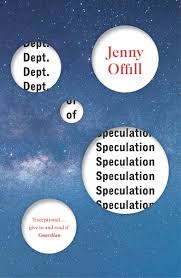
Dept. of Speculation – Jenny Offill (2014) 177 pages

Dept. of Speculation chronicles the breakdown of a marriage from a wife’s perspective. It’s fragmentary, made up of short paragraphs and chapters, but still makes for a satisfying read. The structure effectively captures a sense of thoughts and memories, without someone trying to work everything out and explain it all in a clear narrative, because who thinks like that?

The narrator is a writer who somehow finds themselves subject to domestic demands and teaching rather than working on her own art:

“For years I kept a Post-it note above my desk. WORK NOT LOVE! was what it said. It seemed a sturdier kind of happiness.”

“My plan was to never get married. I was going to be an art monster instead. Women almost never become art monsters because art monsters only concern themselves with art, never mundane things. Nabokov didn’t even fold his own umbrella. Vera licked his stamps for him.”

Her husband is never demonised. He’s Nice.

“He’s from Ohio. This means he never forgets to thank the bus driver or pushes in front at the baggage claim. Nor does he keep a list of those who infuriate him on a given day. People mean well. That is what he believes. How then is he married to me? I hate often and easily.”

He’s not a fully realised character, and I think this is quite deliberate. The focus is on the narrator, her thoughts, feelings and needs. Possibly its her frustration and disappointment in her life that contributes to the relationship breakdown, but we don’t know, because she can’t have that distance or perspective on it yet.

We do know that she is struggling. How she refers to herself changes from ‘I’ to ‘the wife’. Her sense of self seems as fragmented as the narrative. She loves her husband and child, but is acutely aware of her distance from them too.

“Soon everyone is asleep but me. I lie in our bed and listen to the hum of the air conditioner and the soft sound of their breathing. Amazing. Out of dark waters, this.”

Her husband’s Ohio courtesy only extends so far: he has an affair. As the couple try and pick up the pieces – and work out if they even want those pieces any more – the rage and bewilderment of the narrator is palpable. Yet there is humour in this book too:

“At night they lie in bed holding hands. It is possible if she is stealthy enough that the wife can do this while secretly giving the husband the finger.”

Uncompromising but compassionate, hopeful but real, Dept. of Speculation is a compelling short read.

“It’s as much fun to scare as to be scared.” (Vincent Price)

Happy Hallowe’en Everyone! I’m not really one for scary fiction as I’m far too easily spooked, but I have managed to find two books in the TBR that were perfect Hallowe’en reading and not too much for my delicate sensibilities.

Firstly, I finished The Bloody Chamber by Angela Carter (1979), her collection of short stories which rework the classic tropes of fairytales into Carter’s own disturbing, sexual, feminist, Gothic stories. I’ve written about The Snow Child, The Werewolf and The Tiger’s Bride before, but somehow not got round to finishing the collection. This year of the book-buying ban (nearly finished!) is all about ploughing through the TBR pile so this was a good opportunity to get the collection dusted off and finished.

Angela Carter is a writer people have strong feelings about, so I’ll start with a disclaimer: I am firmly in the ‘for’ camp. I think she’s brilliantly inventive, political, funny and deeply unnerving. I never find her comfortable read, and I love that. So if you’re in the ‘agin’ camp you might want to skip through to my second choice of David Mitchell 😊

If you’re a fan like me, The Bloody Chamber will give you all you desire. The titular story is a heady mix of sexual awakening and mortal danger as a young woman marries an older French Marquis (natch):

“For the opera, I wore a sinuous shift of white muslin tied with a silk string under the breasts. And everyone stared at me. And at his wedding gift.

His wedding gift, clasped around my throat. A choker of rubies, two inches wide, like an extraordinarily precious slit throat.”

The story is a retelling of Bluebeard, but as the woman is a Carter heroine, she is not a naïve virgin wandering blindly into a danger but someone who understands more than she knows, and she knows that there is something very wrong with her husband:

“I felt a strange, impersonal arousal at the thought of love  and at the same time a repugnance I could not stifle for his white, heavy flesh that had too much in common with the armfuls of arum lilies that filled my bedroom in great glass jars, those undertakers lilies with the heavy pollen that powders your fingers as if you dipped them in turmeric. The lilies I always associate with him; that are white. And stain you.”

I don’t think it’s too much of a spoiler to say Bluebeard doesn’t quite have things work out for him the way he hoped. Carter uses the retelling of familiar tales to give women agency: they are not there to be eaten by wolves, seduced by royalty when unconscious, or rescued by a heterosexual love interest. Neither are they the pure-as-snow heroines who survive to enter marriage; when they survive it is as women with complex motives and strategic means of never relinquishing control. They are to be reckoned with.

If this sounds didactic, it really isn’t. Carter never loses sight of spinning a good yarn, and she does so with humour. This is most apparent in Puss in Boots, a first person narrative voiced by the eponymous feline, a cheeky servant who does his master’s bidding while never losing sight of his own ends:

“So Puss got his post at the same time as his boots and I dare say the Master and I have much in common for he’s proud as the devil, touchy as tin-tacks, lecherous as liquorice and, though I say it as loves him, as quick-witted a rascal as ever put on clean linen.”

Puss also recalls The Barber of Seville, in comic exuberance, machinations, and names:

“Figaro here; Figaro, there, I tell you! Figaro upstairs, Figaro downstairs and–oh, my goodness me, this little Figaro can slip into my lady’s chamber smart as you like at any time whatsoever that he takes the fancy for, don’t you know, he’s a cat of the world, cosmopolitan, sophisticated; he can tell when a furry friend is the Missus’ best company. For what lady in all the world could say ‘no’ to the passionate yet toujours discret advances of a fine marmalade cat?”

While she’s undoubtedly burlesque, Carter is a writer with serious concerns, and plenty to say about the position of women, both in the fairytale tradition and society as a whole. It’s far from all she has to say, but for me at this time, it was the main message I took away. For this reason I’ll finish with a quote from The Erl-King:

 “When I realized what the Erl-King meant to do to me, I was shaken with a terrible fear and I did not know what to do for I loved him with all my heart and yet I had no wish to join the whistling congregation he kept in his cages although he looked after them very affectionately, gave them fresh water every day and fed them well. His embraces were his enticements and yet, oh yet! they were the branches of which the trap itself was woven.

Secondly, Slade House by David Mitchell (2015); it was Cathy’s recent review which prompted me to get my copy down from the shelf. Like Carter, Mitchell is clearly having fun with this work. It’s not typical of him – for one thing, at 233 pages its about a third the size of his usual tomes – but it does still have many of his trademarks: references to his other works, interconnected stories, time shifts. It’s a companion piece to The Bone Clocks; that novel remains buried in my TBR somewhere but I didn’t find that not having read it affected my enjoyment of Slade House at all. You’ll be pleased to hear this is a short review as I desperately try and avoid spoilers…

The first story, The Right Sort (which began life as a Twitter story, which you can read here) is set in 1979 and is told by Nathan Bishop, who is accompanying his mother to Slade House. Nathan is lonely and isolated: his father has left and he doesn’t really have friends. He may be on the autistic spectrum:

“Mum lets go of my wrist. That’s better.

I don’t know what her face is saying.”

Once they arrive at Slade House, Nathan’s mum goes into the vast pile with Lady Grayer, while Nathan spends time with her son Jonah. The experience has a blurry, unreal quality, possibly due to the fact that Nathan has taken one of his mother’s Valium:

“A dragonfly settles on a bulrush an inch from my nose. It’s wings are like cellophane and Jonah says ‘Its wings are like cellophane’ and I say, ‘I was just thinking that,’ but Jonah says ‘Just thinking what?’ so maybe I just thought he’d said it. Valium rubs out speech marks and pops thought-bubbles. I’ve noticed it before.”

In the following story, Shining Armour, corrupt copper Gordon Edmonds is half-heartedly investigating the disappearance of Nathan and his mum, as a man has awakened from a coma and was the last person to speak to them, nine years earlier. Another nine years later and a student paranormal society are interested in Slade House:

“Todd the mathematician works it out first. ‘Christ, I’ve got it. The Bishops vanished on the last Saturday in October 1979; fast-forward nine years and Gordon Edmonds vanishes on the last Saturday in October 1988; fast-forward another nine years and you get…’ He glances at Axel, who nods. ‘Today.’

I can’t help feeling things are not going to work out well for the curious students…

What is going on at Slade House? Why can’t it be found on maps? What happens every nine years? Who is responsible? And is anyone going to stop them?

“ ‘That’s the only prize worth hunting. And what we want, what we dream of. The stage props change down the ages, but the dream stays the same: philosophers’ stones, magic fountains in lost Tibetan valleys, lichens that slow the decay of our cells, tanks of liquid that’ll freeze us for a few centuries; computers that’ll store our personalities as ones and zeroes for the rest of time. To call a spade a spade: immortality.’”

The wackometer needle is stuck on 11. ‘I see.’”

Mitchell’s legions of fans might be a bit disappointed with Slade House; as I mentioned, it’s definitely not typical of him. I really enjoyed it though. As a quick, fun, slightly spooky read for autumn, it was spot-on.

To end, a song which I only found out this week was once banned by the BBC, who hilariously thought dancing monsters were ‘too morbid’ for impressionable young minds:

“No man is an island.” (John Donne)

I live on a tiny grey island. This year Spring has been even greyer than usual and it felt like winter had gone on for eleventy million years. Now the weather is overcompensating by being unseasonably warm for a few days (just in time for the London marathon – kudos to those hardy runners), and so I’ve decided to celebrate by looking at two novels set on warm islands. They are two more stops on my Around the World in 80 Books Reading challenge, hosted by Hard Book Habit, and I’m sure by the time I’ve posted this my home will be back to service-as-usual grey and we’ll all know where we stand.

Firstly, Salt by Earl Lovelace (1996), set in Trinidad where Lovelace was born and still lives. I read The Dragon Can’t Dance years ago and really liked it, but for some reason I hadn’t picked up a Lovelace since. Salt is primarily the story of Alford George, but it is also a story about Trinidad.

“Maybe that madness seized Columbus and the first set of conquerors when they land here and wanted the Carib people to believe that they was gods; but, afterwards. After they settle in the island and decide that, yes, is here we are going to live now, they begin to discover how hard it was to be gods.

The heat, the diseases, the weight of the armour they had to carry in the hot sun, the imperial poses they had to strike, the powdered wigs to wear, the churches to build, the heathen to baptise, the illiterates to educate, the animals to tame, the numerous species of plants to name, history to write, flags to plant, parades to make, the militia to assemble, letters to write home. And all around them, this rousing greenness bursting in the wet season and another quieter shade perspiring in the dry.”

Alford dreams of leaving the island and decides the way to do this is to speak ‘English’. Lovelace shows the legacy of colonialism and how the language of the colonisers is still associated with power and accomplishment.

“His thinking was in another language and he had to translate. He began to speak more and more slowly to make sure that his verbs agreed with his subjects, to cull out words of unsure origin and replace them with ones more familiarly English. Caribbean words like jook, mamaguy and obzocky all had to be substituted. He felt his meanings slipping away as he surrendered his vocabulary.”

However, as time goes on, Alford stays on the island, becomes a teacher, fights for his students rights and becomes embroiled in politics. His identity becomes more bound with contemporary Trinidad, and it’s then that he realises that emancipation has been a false promise:

“manoeuvre them into accepting not freedom but the promise of being set at liberty, with no more attention given to their years if degradation and captivity and abuse than if they had been dogs”

There is a plethora of other characters in Salt and I can barely scratch the surface here. They are drawn vividly and with affection, a cacophony of voices that pick up Lovelace’s themes of identity, home and meaning. They exist within a beautifully evoked Trinidad whereby Lovelace is able to explore his weighty themes without becoming overly didactic.

This post is ridiculously long and I don’t have time to explore Salt properly, but I did just want to mention this beautiful portrait of the elderly Miss May:

“And with the laborious delicacy choreographed by her pains eased herself down unto the step where the sun was brightest and rested there, her eyes shut, her breath inhaled, the metronome of her mind keeping time to the rhythm of her distress, trying to find within the music of her pain a space in which to breathe.”

I think that’s a stunning piece of writing. Lovelace writes with clarity and a unique voice, and he has important things to say:

“The tragedy of our time is to have lost the ability to feel loss, the inability of power to rise to its responsibility for human decency.”

Secondly, By Night the Mountain Burns by Juan Tomas Avila Laurel (2008, trans. Jethro Soutar 2014) who is from Equatorial Guinea, and whose parents are from Annobon Island. The island in the novel is unnamed but shares a location and a history of Spanish colonialism with Annobon.

“We were on our own out in the middle of the Atlantic Ocean. People had given up hope of the boat ever coming back – the boat from the place where our fathers were.”

The narrator recounts his experience of childhood on the island. He lives with his silent, remote grandfather.

“I can’t say for sure whether my grandfather was or wasn’t mad. I saw him through a child’s eyes and through such eyes it’s impossible to tell whether an adult man, who lives in your house and who you’ve been told is your grandfather, is mad or not.”

“The house was close to the beach. And not any old beach either but the big village beach. Yet despite being so close to the shore, grandfather had built the house with its back to the sea…everything faced the mountain.”

Women on the island own the land, while the men undertake the fishing. Things are not easy on the island – there is poverty at times, white people arrive and trade sex with women for cigarettes and kerosene – but things deteriorate significantly during the period the narrator is recalling. There is a bush fire, then cholera wipes out a huge proportion of the population, and there is a horribly violent instance of scapegoating.

 “Today, looking back, I see, or understand, that the incident and the cholera were part of the same sickness. And the cure for that sickness was beyond the reach of our adults for it was a sickness that was greater than them, and so it was able to dominate them. And on that island out in the middle of the Atlantic Ocean, nasty episodes unfortunately had to be explained somehow; something to satisfy people’s need for a cause.”

The island may be out in the middle of the Atlantic Ocean, and the faith of the people may be a mix of their traditional beliefs and Catholicism, but I felt what the narrator is speaking about was far from remote from me as a UK-based reader:

“For I know now that all people are not treated equally when it comes to apportioning blame for bad things that happen in communities. I know that, in this world of ours, how facts are judged depends on who’s doing the judging.”

I’m making this novel sound depressing, and it isn’t. The point of view of a child enables the story to be told but with a degree of distance that enables the reader to keep reading. This is not to suggest that Laurel obfuscates or pulls his punches. The brutal scapegoating is repeatedly returned to and described in detail. It is horrific. The repetitions of the story enable it to effectively capture the sense of reminiscences, and also how defining moments are those we return to time and again, informing our understanding of the past and who we are.

Towards the end we learn how this story is embedded within colonialism, and how what we are reading exists within this history. The narrator learned Spanish at school, a language that existed detached from meaning for him:

“We learned everything by heart, and I think that’s why we did it singing. In fact, although we sometimes saw books with the letters and pictures, I didn’t know that amapola, burro, cochino and dado were Spanish words for poppy, donkey, hog and dice, or that poppy, donkey, hog and dice were things we were supposed to have heard of. I didn’t know what any of them were, so I didn’t know the words were supposed to represent the letters and I didn’t associate the letters with the pictures in the books.”

As a result of this, he is able to tell his story to Spanish-speaking researchers who have come to the island:

“If this story becomes known, it will be because of some white people.”

Laurel writes with unrelenting power in beautiful prose about huge issues: society, colonialism, legacy, blame, belief. His writing is stunning and his anger palpable without overwhelming the narrative. Another great edition from And Other Stories, who are rapidly becoming one of my favourite publishers.

To end, following on from a post a few weeks back that led to Victoria, Lucy and I sharing our love of Dolly Parton, here is the legend herself singing about islands:

“Would you like a little cheesy-pineapple one?” (Beverly, Abigail’s Party, 1977)

Trigger warning: This post mentions rape

Here’s my contribution to the 1977 Club, hosted by Kaggsy at Kaggsy’s Bookish Ramblings and Simon at Stuck in a Book. It’s running all week, do join in!

Firstly, Penelope Fitzgerald’s first novel, The Golden Child, which she published aged 60 (it’s never too late, budding writers!) This is a typically slim Fitzgerald novel, just 189 pages, and while I didn’t love it as much as the others by her which I’ve read (The Bookshop; At Freddies) there’s still a lot to enjoy.

The title refers to an exhibit that is on loan to a London museum. It is hugely popular with people queueing for hours on end to see the tiny dead Garamatian king covered in gold, and his ball of gold twine. The story concentrates on behind the scenes: the relationships and internal politics of the museum.

“At the sight of his tiresomely energetic subordinate, Hawthorne-Mannering felt his thin blood rise, like faint green sap, with distaste. He closed his eyes, so as not to see Waring Smith.”

It is from the energetic Waring Smith’s viewpoint that the story unfolds. He realises that certain deals have been done, certain backs have been scratched, in order for the museum to gain the exhibit.

“He had a glimpse for the first time of the murky origins of the great golden attraction: hostilities in the Middle East, North African politics, the ill-coordinated activities of the Hopeforth-Best tobacco company. Perhaps similar forces and similar shoddy undertakings controlled every area of his life. Was it his duty to think about the report more deeply and, in that case, do something about it?”

Things take a sinister turn when someone tries to strangle him with the golden twine, and two of his colleagues end up dead in highly suspicious circumstances. Waring Smith is sent on a farcical trip to the USSR (as it then was) to consult with an expert regarding the exhibit. On his return, he becomes embroiled with Special Branch, and has to decipher a code on a clay tablet which might hold a clue as to what on earth is going on.

“The Museum, slumberous by day, sleepless by night, began to seem to him a place of dread. Apart from the two recent deaths, how many violent ways there were in the myriad of rooms of getting rid of a human being! The dizzy stairs, the plaster-grinders in the cast room, the poisons of conservation, the vast incinerators underground!”

There’s a great deal to enjoy in The Golden Child but it doesn’t quite work as a mystery – some of the solving takes place ‘off-screen’ and Waring Smith is then told about it, so it doesn’t quite match what it sets itself up to be. Its strengths are Fitzgerald’s wit and her satire of politics big (The Cold War) and small (workplace); it’s a quick, fun read.

Image from here

Disclaimer, and a note for those of you who, like me, were born around the time of this Club: I’m aware that part of my enjoyment of this novel came about because of a very specific reason, which may have coloured my view somewhat. As a child one of my favourite TV programmes was The Baker Street Boys, which showed what the Baker Street Irregulars got up to when they weren’t helping out a certain world-famous detective. My favourite episode was The Adventure of the Winged Scarab, involving mystery, museums and mummies. Anyone else who remembers this series fondly can indulge in a nostalgia-fest because I’ve just discovered some kind soul has uploaded the whole lot to YouTube.

Image from here

Secondly, Injury Time by Beryl Bainbridge, which is set over the course of one evening. Edward has agreed that his mistress Binny can give a dinner party and he will invite his colleague Simpson and Simpson’s wife Muriel along.

“He gave her so little, he denied her the simple pleasures a wife took for granted – that business of cooking his meals, remembering his sister’s birthday, putting intricate little bundles of socks into his drawer.”

I loved that line which comes early in the novel and so I settled into what I fully expected to be full of the joys of Bainbridge: acerbic wit, idiosyncratic characters, acute social observation. For much of the novel, this is exactly what Injury Time provided. None of the characters seem to know exactly what they want and the changes taking place in 1970s Britain leave them all slightly baffled.

“It was astonishing how fashionable it was to be unfaithful. He often wondered if it had anything to do with going without a hat. No sooner had the homburgs and the bowlers disappeared from the City than everyone grew their hair longer, and after that nothing was sacred.”

The dinner party never really takes place. Binny is an appalling housekeeper and her home is filthy (Bainbridge based Binny on herself and Edward on a lawyer she had an affair with). Before anyone arrives she’s thrown the hoover into the backyard and stuffed the pudding behind the fridge.

“Though most of her life she had rushed headlong into danger and excitement, she had travelled first-class, so to speak, with a carriage attendant within call. The world was less predictable now…in her day dreams, usually accompanied by a panic-stricken Edward, she was always being blown up in aeroplanes or going down in ships.”

The less predictable world erupts violently into the evening of Binny, Edward, Simpson, Muriel and Binny’s inebriated friend Alma. It’s here that I have a bit of trouble with Injury Time. A character is raped. For me, this jarred uncomfortably in what until that point had been a funny, sharp novel puncturing 1970s social mores and pretensions. The rape itself is dealt with oddly: it’s part of a section that verges on surreal and is filled with non-sequiturs; the character it happens to is weirdly detached, which may be shock but this is never made clear. Looking at reviews online, I was really surprised that so few reviewers even mentioned this event. For many Injury Time remains an unproblematic comic novel. So I wouldn’t want to put anyone off reading it; I adore Bainbridge and still do, but for me how the rape was portrayed and contextualised was a problem.

I don’t want to end on a downer when so much of Injury Time is funny, so I’ll end with this quote which is pure Bainbridge. I wonder how far Binny was based on her and whether she actually did this?

“There had been too that incident when he couldn’t see Binny because he wanted to prune his roses, and she’d threatened to come round in the night and set fire to his garden, Later, a small corner of the lawn had been found mysteriously singed, but nothing had been proved.”

To end, the UK number one from this week in 1977. AHA!

“I ransack public libraries, and find them full of sunk treasure.” (Virginia Woolf)

When I was searching for quotes about libraries I really liked this quote by Libba Bray but it was too long to use for a title:

“The library card is a passport to wonders and miracles, glimpses into other lives, religions, experiences, the hopes and dreams and strivings of ALL human beings, and it is this passport that opens our eyes and hearts to the world beyond our front doors, that is one of our best hopes against tyranny, xenophobia, hopelessness, despair, anarchy, and ignorance.”

This week’s theme is libraries, because one of the unforeseen benefits of my 2018 book buying ban is that I have rediscovered the joy of the library. You may well be wondering what kind of moron I am not to foresee this, but I really didn’t. The purpose of the book-buying ban is to get through the piles of unread books I own. It’s working, but not quite as well as I hoped because I’ve realised my library has novels. Up until this point I’d mainly used it for non-fiction books. It’s taken the ban for me to realise I can get in the library queue for new releases and get hold of rare books I’ll never be able to afford. Libraries are amazing!

Firstly, I finally reached the top of the queue for Reservoir 13 by Jon McGregor, which was published before my book buying ban last year, but I hadn’t got a copy. McGregor is one of my favourite authors and I didn’t want to wait another year before reading this, so I got on a long waiting list at the library.

Disclaimer: McGregor is never going to get anything but gushing reviews from me. I’ve loved his writing since his first novel If Nobody Speaks of Remarkable Things and as far as I’m concerned he can do no wrong. I understand this novel has divided people and I think its because the premise sets up certain expectations. A 13 year old girl, Becky Shaw, disappears from a village where she and her parents are holidaying for new year. However, this isn’t a thriller. It isn’t about the search for the girl, or what happened to her, or who may have taken her. What it is about is a community, the people in it, how their stories touch on one another. If like me, you’re a fan of McGregor, this won’t greatly surprise you. Although the rural setting is unusual for him, the themes are not. But if you come to it expecting a missing person puzzle to be solved, you’ll be sorely disappointed.

There are many recurring phrases and details in the book. Becky is 13, the village has 13 reservoirs, the story is set over 13 years and divided into 13 chapters. The chapters begin “At midnight when the year turned…” At intervals we are reminded “The missing girl’s name was Rebecca, or Becky, or Bex”. The effect is to show how things move on within the familiar; village lives continue but they also change. Meanwhile, Rebecca/Becky/Bex is held in a stasis, forever 13, the questions around what happened to her left hanging.

I associate McGregor with urban settings, but he writes beautifully of rural life. Old traditions are dying out: only one of the residents bothers collecting nettles for tea or elderflowers for cordial. The butchers – like so many local shops – closes due to lack of demand. Yet the seasons in their distinct beauty are there:

“On Bonfire Night there was a heavy fog, thick with woodsmoke, the fireworks seen briefly like camera flashes overhead. In the beech wood the foxes prepared their dens. The vixens dug down into old earths and reclaimed them, lining them out with grasses and leaves. In the eaves of the church the bats settled plumply into hibernation. By the river the willows shook off the last of their leaves. At night the freight trains came more often a single white leading and the wagons shadowing heavily behind. The widower asked Clive for advice over pruning his fruit trees and Clive was surprised to see the state things were in.”

McGregor does this throughout the novel, going straight from describing the natural world into a detail about the lives of one of the villagers without a paragraph break. In doing so he weaves the lives into the world that surrounds them and shows how one cannot be understood without the other.

I thought Reservoir 13 was absolutely stunning. It reminded me of Virginia Woolf in the use of repeated phrases and the focus small but significant details. In his usual unshowy style, McGregor captures the beauty and fragility of everyday life.

After I finished Reservoir 13 I went straight to the library to see if they had a copy of Reservoir Tapes, the sequel of sorts, and I didn’t even have to put my name in the queue for it. Reservoir Tapes is a series of short stories connected to Reservoir 13, originally broadcast on the radio. You can listen to them here.

Secondly, I found my library had a copy of Rhododendron Pie, Margery Sharp’s first novel from 1930, which is practically impossible to find and which you pay hundreds of pounds for online. There was a copy just sitting there – I couldn’t believe I hadn’t checked before.

13Enthusiast--articleLarge-v2

Image from here

Rhododendron Pie tells the story of Ann Laventie, whose natural leanings towards conservatism mark her out as different from the rest of her family. Her sister Elizabeth begins the birthday tradition of inedible floral birthday pies of the title, while little Ann would prefer an apple pie.

“It had once been said of Mr Laventie that he was a traditionalist in wine and a revolutionary in morals; and indeed, this capacity for making the best of both worlds was an outstanding characteristic of the family. They combined the extremes of old-world elegance and modern freedom, tempering a belief in free verse and free love with an equal feeling for societal decorum.”

As the children grow up, Elizabeth becomes an intellectual forever having essays published in journals while her brother Dick becomes a sculptor. Ann is at a bit of a loss. She is good at admiring what the others do and she is well-liked, but she flounders in working out what she wants and where she fits in. Sharp captures how society is changing for the interwar generation; one of Ann’s friends is perfectly open about the men she lives with on occasion. While there is discussion around this which seems remarkably forward-thinking and would sit well with readers today, Ann does not want a bohemian lifestyle.

“ ‘What I want,’ continued Ann recklessly, ‘is a nice wedding in the village church, with a white frock and orange blossom and lots of flowers and ‘The Voice that Breathed’ and two bridesmaids in cyclamen pink and rose petals afterwards  and a reception in the drawing-room with a string quartet playing selections from Gilbert and Sullivan. In June. And a honeymoon in the Italian Lakes.

‘Where does Gilbert come in?’

‘He doesn’t. And I want to live in a house, not a flat, even if it’s only a little one in a suburb where there’s no-one amusing, with a back garden to dig in. And have bird pattern chintzes in the drawing-room and cold supper on Sundays because the maid’s out. I shall probably,’ finished Ann defiantly, ‘take a stall at the church bazaar.’”

Ann doesn’t come across as remotely priggish or boring though. She is authentic and truthful, and struggles with her knowing, arch, ironic family

“ ‘One of your family methods. Every now and then you do something deliberately ordinary, but in inverted commas so to speak, just to see what it feels like.”

What Rhododendron Pie is about is working out who you are and what you want from the world, and how tricky this can be when you seem to be at odds with your family and the section of society you live within. Without any didacticism, Sharp captures how this is especially hard for women. New freedoms are opening up, but women are still judged more harshly by society and have their actions further circumscribed by law.

“These were the things they understood, patient hope and quiet brave endurance: these were the woman’s part.”

Rhododendron Pie is remarkably accomplished for a first novel. Sharp would hone her skills further in future novels – particularly characterisation, which is a bit weak here – but her wit is here, her warmth, and her wisdom.

 “‘That’s what you clever people never understand. You talk about life as though it were something rare and surprising that one had to be careful of. It’s nothing of the sort. It’s ordinary. And it’s only when you’ve accepted it as ordinary that you begin to see the wonder of it. That a swallow or a green field should be beautiful is nothing, but that they should be common as dirt is a miracle. I am continually amazed…at the casual beauty of things.’”

To end, a woman whose name helpfully rhymes with her profession, and an annoying man who won’t shut up and let people read in peace: