“Oh Rio, Rio hear them shout across the land/From mountains in the north down to the Rio Grande” (Duran Duran)

The 2016 Olympics have come to an end (boo!) but we still have the Paralympics to come (hooray!) There have been astonishing achievements by those who seem to have been made from very different stuff to us mere mortals. When they seem doused in more than their fair share of charisma as well, you can’t even make yourself feel better by thinking that they’re probably horrible people, because they’re just so funny and charming about it all. Who could I be thinking of….?

Usain_Bolt_after_4_×_100_m_Rio_2016

Human being 2.0

To celebrate the Olympics, I thought I’d take up triathlon sit on my backside reading, of course. It’s Women In Translation Month (head over to Meytal’s blog to read all about WITmonth) so I’m looking at two novellas by Brazilian women writers. This will also be one more stop on my Around the World in 80 Books Reading Challenge, hosted by Hard Book Habit.

Brazil_topo

Firstly, Agua Viva by Clarice Lispector (1973, tr. Stefan Tobler 2012). Although I’ve called this a novella, I’m not sure that’s really what it is. It’s a series of impressions and observations, plotless but definitely not artless.

“This is life seen by life. I may not have meaning but it is the same lack of meaning that the pulsing vein has.”

I say it’s not artless, because although Agua Viva can give the impression of randomness, it’s carefully constructed to carry you through, the different passages building on and echoing one another.

“So writing is the method of using the word as bait: the word fishing for whatever is not word. When this non-word – between the lines – takes the bait, something has been written…so what saves you is writing absentmindedly.

I don’t want to have the terrible limitation of those who live merely from what can make sense. Not I: I want an invented truth.”

“I notice that I’m writing as if I were between sleep and wakefulness.”

Agua Viva quite a difficult work to talk about, because it resists being pinned down.  I could attach various labels to it: impressionistic, modernist, stream-of-consciousness, but none of these are quite right. On this reading – for I suspect it changes every time you read it – I felt it was about trying to capture the immediate present, to pin down moments knowing that they are gone forever just as you recognise them.  The style lends itself to this theme, as it jumps and disorientates, on occasions tipping over into surrealism:

“I am feeling the martyrdom of an untimely sensuality. In the early hours I awake full of fruit. Who will come to gather the fruit of my life? If not you and I myself? Why is it that things an instant before they happen already seem to have happened? It’s because of the simultaneity of time. And so I ask you questions and these will be many. Because I am a question.”

I read Agua Viva cover to cover, and I do wonder if this was the wrong approach. While the kaleidoscopic style and images build towards an overall impression, Agua Viva would equally lend itself to being dipped into, reading a single passage and ruminating on it. Apparently the Brazilian singer Cazuza read Agua Viva 111 times. I suspect it’s that sort of book: either you hurl it against the wall within minutes of opening it, or it becomes a mercurial companion for life.

I can’t sum myself up because you can’t add a chair and two apples. I am a chair and two apples. And I cannot be added up.”

82873390_Two_Apples_On_A_Chair_By_The_Window

Secondly, With My Dog-Eyes by Hilda Hilst (1986 tr. Adam Morris 2014). This is also a disorienting , unsettling work, non-linear and impressionistic. Hilst uses this style to create a highly effective portrait of Professor Amos Keres, who is having some sort of breakdown or psychotic episode. The fractured story-telling serves to take the reader inside the mind of someone who is extremely unwell.

“Poetry and mathematics. The black stone structure breaks and you see yourself in a saturation of lights, a clear-cut unhoped-for. A clear-cut unhoped-for was what he felt and understood at the top of that small hill. But he didn’t see shapes or lines, didn’t see contours or lights, he was invaded by colours, life, flashless, dazzling, dense, comely, a sunburst that was not fire. He was invaded by incommensurable meaning. He could only say that. Invaded by incommensurable meaning.”

The narrative shifts from third to first person as Keres copes with his boss suggesting he take a break, and then spends the day thinking over his life since boyhood, his career and his marriage. This makes it sound more linear and contained than it is, and does With My Dog-Eyes a great disservice. Its power comes from its layering of ideas and images with such rapidity as to almost assault the reader – never incoherent but an effective immersion in an unravelling mind.

“And everything begins anew, the patience of these animals infinitely digging a hole, until one day (I hoped, why not?) transparence inundates body and heart, body and heart of mine, Amos, animal infinitely digging a hole. In mathematics, the old world of catastrophes and syllables, of imprecision and pain was cracking up. I no longer saw hard faces twisting into questions, in tears so many times, I didn’t see the gaze of the other on mine, what a thing it can be to have eyes on your eyes, eyes on your mouth. Waiting for what kind of word? Such formidable cruelties occurring every day, humans meeting and in the good-mornings and good-afternoons such secrets, such crimes, such chalice of lies…”

It’s a good job this was a novella (59 pages in my edition) as I don’t think I could have taken much more of it (that’s a recommendation, not a criticism). With My Dog-Eyes is a short, sharp, shock: a plunge into madness.

To end, I was very excited that Caetano Veloso was performing at the Olympic opening ceremony, but I don’t think the acoustics did him any favours in capturing his wonderfully sensitive voice.  Here he is as part of the Pedro Almodovar film Hable Con Ella (Talk to Her):

“Without translation, we would be living in provinces bordering on silence.” (George Steiner)

Last week I looked at a Nordic mystery as part of Women in Translation month, and this week I thought I’d make it the central theme – head over to Meytal’s blog to read all about WITmonth. The need for Women in Translation month was brought home to me when I went to my TBR shelves thinking “No problem! I have loads of translated literature waiting to be read.” Well, yes, I do, but looking at the titles I suddenly realised it was very much dominated by male writers.

tumblr_inline_mozjjfa9bR1qz4rgp

I’m glad you asked, Mads. Firstly, The Vegetarian by Korean writer Han Kang (2007, tr. Deborah Smith 2015) and one more stop on my Around the World in 80 Books Reading Challenge, hosted by Hard Book Habit. You probably don’t need me to tell you how good The Vegetarian is; it was the glowing reviews and enthusiasm from bloggers that led me to pick up this novel in the first place. The hype was well deserved – The Vegetarian is an unsettling, brutal and beautifully written tale which has stayed with me long after I finished it.

It is the story of Yeong-hye, the titular herbivore, told from three points of view: her husband, her brother-in-law and her sister, over the course of a few years, from the point she starts refusing to eat meat. Her husband can’t believe that his wife – whose main appeal was that she impinges on his life in no way whatsoever – would do something so antisocial.

“As far as I was concerned, the only reasonable grounds for altering one’s eating habits were the desire to lose weight, an attempt to alleviate certain physical ailments, being possessed by an evil spirit or having your sleep disturbed by indigestion. In any other case, it was nothing but sheer obstinacy for a wife to go against her husband’s wishes as mine had done.”

Yeong-hye’s behaviour is not rooted in any of these ‘reasonable grounds’ but in a deep disturbance at thought of eating meat, something which is not easy to cope with or explain:

“Something is lodged in my solar plexus. I don’t know what it might be. It’s lodged there permanently these days. Even though I stopped wearing a bra, I can feel this lump all the time. No matter how deeply I inhale, it doesn’t go away. Yells and howls, threaded together layer upon layer, are enmeshed to form that lump. Because of meat. I ate too much meat. The lives of all the animals I ate are lodged there. Blood and flesh, all those butchered bodies are scattered in every nook and cranny, and though the physical remnants were excreted, their lives stick stubbornly to my insides.”

Yeong-hye’s behaviour exposes the fractures in her family: the tensions, hidden desires, and loyalties which on one occasion spills over into physical violence. She can’t be what her husband wants her to be. Subject to her brother-in-law’s sexual fetishes, she cannot answer all of his needs either. Nor can she start eating to please her sister who sees her wasting away. Her deterioration – mental and physical – is painful but her determination is relentless.

“Her voice had no weight to it, like feathers. It was neither gloomy nor absent minded, as might be expected of someone who was ill. But it wasn’t bright or light-hearted either. It was the quiet tone of a person who didn’t belong anywhere, someone who had passed into a border area between states of being.”

The Vegetarian is a short novel, 183 pages in my edition, but it punches far above its weight. Kang’s voice is strong and unique, her writing all the more dramatic for its concise understatement, and she refuses to offer any easy answers. Disturbing and brilliant.

Images from here and here

Secondly, a classic of Spanish literature, Nada by Carmen Laforet (1945 tr. Edith Grossman 2007). Andrea, a young student, leaves her rural home to attend university and moves in her with grandmother, aunt, two uncles, her uncle’s wife, a green-toothed maid and a dog. Although filled with youthful hope for opportunities and change, the atmosphere is unsettling from the start:

“We rode down Calle Aribau, where my relatives lived, its plane trees full of dense green that October, and its silence vivid with the respiration of a thousand souls behind darkened balconies.”

Once inside the house, things worsen. The house is cluttered, dirty, filled with layers of past glories.

“That bathroom seemed like a witches house, the stained walls had traces of hook-shaped hands, of screams of despair. Everywhere the scaling walls opened their toothless mouths oozing dampness. Over the mirror, because it didn’t fit anywhere else, they’d hung a macabre still-life of pale bream and onions against a black background. Madness smiled from the bent taps.”

The Spanish Civil War – over six years previously – is mentioned in passing but never dwelt upon, though there is the sense that this is a family and a city, possibly a nation, dealing with the aftershocks of trauma. The family are entirely dysfunctional, locked in abusive, sado-masochistic, manipulative relationships to a greater or lesser extent. Andrea’s uncle Juan savagely beats his wife Gloria; her aunt Angustias tries to control Andrea through a  mix of overbearing affection and oppressive boundary-setting; her uncle Roman plays  cat-and-mouse with just about everyone he encounters. Andrea’s friend Ena offers a possibility of escape:

“Ena never resembled on weekdays the rash girl, almost childish in her high spirits, that she turned into on Sundays. As for me – and I came from the countryside – she made me see a new meaning in nature that I’d never thought of before. She made me understand the pulsing of damp mud heavy with vital juices, the mysterious emotion of buds that were still closed, the melancholy charm of algae listless on the sand, the potency, the ardour, the splendid appeal of the sea.”

Nada is a gothic tale without a doubt, but never quite spills over into the camp that gothic often skirts along. The novel had to pass through Franco’s censors, and while its not overtly a political tale, I think the Gothicism helps disguise the fact that it is a tale of a society in shock; of resistance to oppression; of survival and escape.

“The memory of nights on Calle de Aribau comes to me now. Those nights that ran like a black river beneath the bridges of the days, nights when stagnant odours gave off the breath of ghosts.”

To end, an example of gothic that doesn’t skirt around camp but rather dives straight in – quite the maddest film I’ve ever seen:

“He that loves reading has everything within his reach.” (William Godwin)

Let’s ignore the sexism of the title quote and focus on the sentiment (especially as Godwin was married to Mary Wollstonecraft who I like to think told him off for any gender assumptions) 🙂  I was prompted to think along these lines a few weeks ago when I watched the moving and joyous BBC4 documentary B is for Book.

I don’t generally write about children’s or YA fiction, but I felt quite inspired by the documentary showing the jubilant discovery and magic of the written word.  My Le Monde’s 100 Books of the Century Reading Challenge has some kids books on it, so this week I’m channelling my inner child (not that difficult, tbh)

You-hear-screaming-crying-next-room-brace-yourself-whats-come

Firstly, The Little Prince by Antoine de Saint-Exupéry (1943), ranked number 4 on Le Monde’s list; it is the most translated French book and the fourth most translated book worldwide. And how is this for a CV: Wiki describes Antoine de Saint-Exupéry  as “writer, poet, aristocrat, journalist, and pioneering aviator”. I feel so inadequate.

The Little Prince is narrated by an aviator who crashes in the desert, where he meets a visiting alien prince. The prince is from a planet where he lives alone, and which is so small that the sun is always setting:

“For as everyone knows, when it is noon in the United States the sun is setting over France. If you could get to France in a twinkling, you could watch the sunset right now. Unfortunately France is rather too far away. But on your tiny planet, little prince, you only had to move your chair a few steps. You could watch night fall whenever you liked.

‘One day,’ you said, ‘I watched the sunset forty-three times!’

And a little later you added:

‘You know, when one is that sad, one can get to love the sunset.’

‘Were you that sad, then, on the day of forty-three sunsets?’

But the prince made no answer.”

This melancholy tinge continues throughout the tale. The prince is a sad character and remains mysterious to the aviator.  It is a children’s book though, and has some lovely touches to stir the imagination:

“On the morning of his departure he set his planet in good order. He carefully swept out his active volcanoes. He had two active volcanoes – which were very useful for heating up breakfast in the morning.”

The prince describes his travels, in which he has met six adults, also living alone on isolated tiny planets: a king (who rules over no-one), a vain man, an alcoholic, a businessman (who wants to own the stars), a lamplighter (who constantly lights a lamp for no purpose) and a cartographer (who has never been anywhere). Thus the story is a critique of adults placing meaning in acquisition and status rather than in emotional connection and adventure. The aviator is an adult himself but does not hold adults in high regard:

“Grownups love figures. When you describe a new friend to them, they never ask about important things. They never say: ‘What’s his voice like? What are his favourite games? Does he collect butterflies?’ Instead they demand ‘How old is he? How many brothers has he? How much does he weigh? How much does his father earn?’ Only then do they feel he know him.”

The Little Prince is a sweet, sad tale, one which will appeal to children for the  adventure and imaginative leaps, but also has a great deal to offer adults, as a fable regarding a search for meaning in the world.

“You can only see things clearly with your heart. What is essential is invisible to the eye.”

It is also illustrated with gorgeous watercolours by the author (yet another string to his bow):

the-little-prince-best-quotes-cover-800x469

Image from here

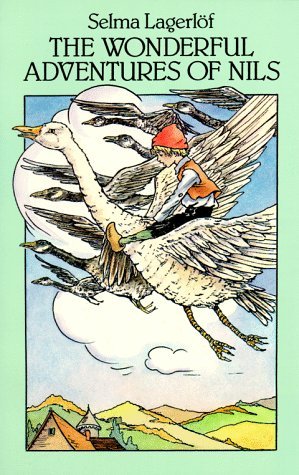
Secondly, The Wonderful Adventures of Nils by Selma Lagerlöf (1906–1907), number 68 on Le Monde’s list. This classic of Swedish literature has been immortalised on stamps, on currency, and Lagerlöf won the Nobel Prize for Literature.

771287

Nils is a self-centred, lazy, cruel ungrateful boy. Bunking off church to stay at home, he gets on the wrong side of an elf. Everyone knows you don’t mess with elves, Nils.  Of course the elf wreaks his revenge:

“For in the glass he saw plainly a little, little creature who was dressed in a hood and leather breeches.

“Why, that one is dressed exactly like me!” said the boy, clasping his hands in astonishment. And then he saw that the thing in the mirror did the same thing. Thereupon he began to pull his hair and pinch his arms and swing round; and instantly he did the same thing after him; he, who was seen in the mirror.

The boy ran around the glass several times, to see if there wasn’t a little man hidden behind it, but he found no one there, and then he began to shake with terror. For now he understood that the elf had bewitched him, and that the creature whose image he saw in the glass was – himself.”

Nils’ family goose, who has the excellent appellation of Morten Goosey-Gander, decides to follow a flock of wild geese on their migration to Lapland and Nils tags along, riding on Goosey-Gander’s back. As an elf, Nils finds he can understand animals’ speech, and learns to be kind rather than torture them.

“The wild geese challenged the white goosey-gander to take part in all kinds of sports. They had swimming races, running races, and flying races with him. The big tame one did his level best to hold his own, but the clever wild geese beat him every time. All the while, the boy sat on the goosey-gander’s back and encouraged him, and he had as much fun as the rest.”

Lagerlöf was commissioned to write this by the National Teachers Association, so in the course of reading about Nils’ journey, you learn about wildlife and Swedish geography: win/win.

“Just as the first spring showers pattered against the ground, there arose such shouts of joy from all the small birds in groves and pastures that the whole air rang with them, and the boy leaped high where he sat. ‘Now we’ll have rain. Rain gives us spring; spring gives us flowers and green leaves; green leaves and flowers give us worms and insects; worms and insects give us food; and plentiful, and good food is the best thing there is,’ sang the birds.”

He didn’t know exactly where on earth he was: if he was in Skåne, in Småland, or in Blekinge. But just before reaching the swamp, he had glimpsed a large village, and thither he directed his steps. Nor was it long before he discovered a road. Soon he was in the village street, which was long, and had trees on both sides, and was bordered with garden after garden. The boy had come to one of the big cathedral towns, which are so common on the uplands, but can hardly be seen at all down in the plain.”

Nils’ wonderful adventures also include seeing off his arch-nemesis Smirre Fox and learning to think of others rather than being such a deeply unpleasant person.  For a book with such a didactic purpose, it really doesn’t read as instructive and moralistic. The Wonderful Adventures of Nils is written with a real lightness of touch and is great fun.

To end, a taster of my favourite book from when I was a child:

“It’s the final countdown.” (Europe (the band))

This isn’t a political blog, but it is one where I try and relate books to what’s going on in my life/the wider world, and this is the week when Britain votes on whether to stay in or leave the EU. So in this post I’m looking at two books by European writers, and in order to maintain the blog’s thin veneer of impartiality, I’ve picked one by a writer from a country inside the EU, and one from outside.  Between them they are two more stops on my Around the World in 80 Books reading challenge hosted by Hard Book Habit– with none of the attendant worries of which passport queue to join, should major changes ensue…

Firstly, The Blue Fox by Icelandic by poet/novelist/songwriter for Bjork/all round Renaissance man Sjon (trans.Victoria Cribb).  This short novel (112 pages in my edition) is stunning: lyrical, sparse and truly magical. I can’t remember whose blog first introduced me to this, so if it was you please leave a comment 🙂

The story begins in 1883, with the priest Baldur Skuggason hunting a rare blue vixen:

“Snow covered the land up to the roots of the glacier, not a bare patch of earth to be seen; the vixen would write the tale of her travels on the blank sheet as soon as she embarked on them.

Grasping the weapon in both hands, he set off.”

Not a word is wasted, as Sjon creates characters and atmosphere with the minimum needed. This style is highly effective as it evokes the quiet focus of the hunt and the frozen expanse of the winter landscape.

“The sun warms the man’s white body, and the snow, melting with a diffident creaking, passes for birdsong.”

The second part of the novel goes back 16 years to explore the relationship between naturalist Fridrik B Fridriksson and his ward Abba, who has Down’s Syndrome. This section is more densely written but still beautifully constrained.

“Ghost-sun is a name given by poets to their friend the moon, and it is fitting tonight when its ashen light bathes the grove of trees that stand in the dip above the farmhouse at Brekka. This little copse was the loving creation of Abba and Fridrik, and few things made them more of a laughing stock in the Dale than its cultivation, though most of their endevours met with ridicule.”

Back in 1883, the stories intertwine and move towards an eerie, unsettling conclusion. The Blue Fox occupies a space between poetry, prose, myth, mystery and fable. Highly recommended.

Secondly, Berlin Stories by Robert Walser (tr. Susan Bernofsky), which also occupies a space between genres, this time autobiography and fiction. Walser moved to Berlin in 1905 as a young man, and Berlin Stories collects together his impressions of the city, the people he meets, the experiences he has.

I had no idea what to expect, not having read any Walser before. Picture the scene, reader: It is early morning. You hate your job. You are on a crowded platform waiting for a delayed train. You are surrounded by other commuters, who by their disregard for even the most basic social niceties are telling you that they too hate their job, and they hate you only marginally less.  Then you read this:

“Onward, onward.  That blue-eyed marvel, the early morning, has no time to waste on drunkards. It has a thousand shimmering threads with which it draws you on; it pushes you from behind and smiles coaxingly from the front. You glance up to where a whitish, veiled sky is letting a few scraps of blue peek out; behind you, to gaze after a person who interests you; beside you, at an opulent portal behind which a regal palace morosely, elegantly towers up. Statues beckon you from gardens and parks; still you keep on walking, giving everything a passing glance: things in motion and things fixed in place”

Needless to say, by page 4 of Berlin Stories, where that passage appears, I knew I was in for a beautiful journey around Berlin in Walser’s company. His style is brilliantly evocative of a city: short sketches of whatever interests him creates a series of impressions of Berlin, rather than a fixed, focused depiction. He is funny and sad, he has an eye for the minutiae and the broader picture. It is a love letter to the city, and you are left in no doubt as to why Berlin has such a culturally rich history.

“Berlin by comparison – how splendid! A city like Berlin is an ill-mannered, impertinent, intelligent scoundrel, constantly affirming the things that suit him and tossing aside everything he tires of. Here in the big city you can definitely feel the waves of intellect washing over the life of Berlin society like a sort of bath. An artist here has no choice but to pay attention.”

Like The Blue Fox, this is a short volume (139 pages) and therein lies its power. Walser creates concise, delicate yet richly vivid portraits of Berlin. Just gorgeous.

To end, I want a badge. A badge to commend my enormous self-restraint in not going on a 1980s cheese-fest (which is something I rarely restrain from) by capturing either the titular song or the band Berlin in embedded video form. Instead I’m going for a guaranteed earworm clip from a musical inspired by the Berlin stories of another writer, Christopher Isherwood.  Take it away, Liza:

“Trains, like time and tide, stop for no one” (Jules Verne)

Despite not thinking of myself as a remotely patriotic person, there was a 3 part programme on TV recently that was probably the most British thing ever, and I am so sorry it’s ended. Paul Merton travelling around the island by train (is it me or is he turning into Ian Hislop?), only getting off at request stops and chatting to those he meets. That’s it. Result: pure brilliance.

I share Mr Merton’s love of trains, and so this week I thought I would look at novels where they feature heavily.  This also enables me to fulfil the requirement of the Around the World in 80 Books reading challenge hosted by Hard Book Habit, to include a book about travel.

Firstly, Compartment No.6 by Rosa Liksom (2011, tr. Lola Rogers) which I was alerted to by Sarah’s review at Hard Book Habit and also by bookarino, where I was sure I had read a review but now I can’t find it on her blog – bookarino, if you reviewed please leave a link below!

The novel details the journey on the Trans-Siberian railway from Moscow to Mongolia undertaken by the two inhabitants of the titular compartment. Liksom describes the landscapes they pass through simply but evocatively, and succeeds in capturing a sense of place and of travel:

“An unknown Russia frozen in ice opens up ahead, the train speeds onward, shining stars etched against a tired sky, the train plunging into nature, into oppressive darkness lit by a cloudy, starless sky. Everything is in motion: snow, water, air, trees, clouds, wind, cities, villages, people, thoughts. The train throbs across the snowy land.”

The atmosphere in the compartment is intimate and oppressive:

“All of Siberia slowly brightened. The man in his blue tracksuit bottoms and white shirt did push-ups between the bunks, sleep in his eyes, his mouth dry and smelly, the mucousy smell of sleep in the compartment, no breath from the window, tea glasses quietly on the table, crumbs silent on the floor.”

The man Vadim is repugnant: misogynistic, violent, anti-semitic, anti anyone who isn’t him. His attitudes and behaviour are repellent. Yet as they are forced together, a comradeship builds between him and the female traveller. She is presented a step removed: we never know her name, her direct speech is given only once and then she is quoting. Yet this works brilliantly at evoking the girl’s slightly numb, detached state as she runs away from her troubles and works her way back to facing them, with the help of the dreadful Vadim.

 “The girl looked out of the window at an entirely new landscape…she thought of that July day when she came back from her summer vacation in Finland and Mitka was at the station to meet her. She thought about how they had gone to the boarding house, run up the nine flights of stairs hand in hand, how the hallway had been filled knee-high with the fluffy heads of dandelions, how they’d run up and down the hallway like children, the dandelion fluff drifting in and out of the windows.”

Compartment No.6 is a short but haunting novel which will undoubtedly linger long in my memory.

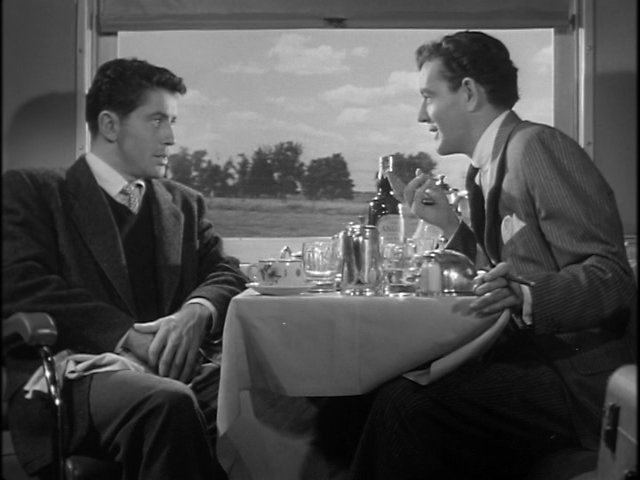
Secondly, Strangers on a Train by Patricia Highsmith (1950), which was adapted only a year later into the famous Alfred Hitchcock film of the same name, albeit with several changes.

Strangers_on_a_Train_-_In_the_dining_car

Sadly my commuter train doesn’t look like this, despite being full of people hatching murderous plots

Successful architect Guy Haines meets bored, spoilt alcoholic Charley Bruno on a long haul train journey. He is reluctant to engage in chat, but Bruno is insistent, and Guy ends up telling him that he is travelling to meet his wife to ask for a divorce. Bruno meanwhile, hates his father and wants his inheritance.

“Bruno could be violent. He could be insane, too. Despair, Guy thought, not insanity. The desperate boredom of the wealthy…it tended to destroy rather than create. And it could lead to crime as easily as privation.”

It is Bruno who comes up with the idea that they swop murders, Bruno killing Guy’s estranged wife for Guy killing his father. Guy doesn’t agree, but Bruno goes ahead anyway. Needless to say, he is a sociopath:

“whether Guy came through with his part of the deal or not, if he was successful with Miriam he would have proved a point. A perfect murder.”

“So long had he been frustrated in his hunger for a meaning of his life, and in his amorphous desire to perform an act that would give it meaning, that he had come to prefer frustration, like some habitually unrequited lovers.”

Bruno ends up stalking Guy, entirely obsessed with him, and it is this, rather than the murders or closing net of the investigation that provides the thriller element of the novel. Bruno is completely unstable and there is no telling what he might do as he exerts increasing pressure on Guy. Yet Bruno is vulnerable too, childlike and confused, and never admitting that it is sexual desire which draws him to Guy.

“Guy! Guy and himself! Who else was like them? Who else was their equal? He longed for Guy to be with him now. He would clasp Guy’s hand and to hell with the rest of the world! Their feats were unparalleled! Like a sweep across the sky! Like two streaks of red fire that came and disappeared so fast, everybody stood wondering if they had really seen them.”

There are definite overlaps with Tom Ripley, the sociopathic protagonist of several Highsmith novels. Bruno is a much less attractive character than Ripley, but there is the desperation and loneliness of the sociopath, the thwarted gay desire, and the doubling between characters, which Guy realises, much as he is reluctant to admit it:

“And Bruno, he and Bruno. Each was what the other had not chosen to be, the cast-off self, what he thought he hated but perhaps in reality loved.”

Strangers on a Train worked well for me as a thriller, but without any glorification of murder or murderers.  Like The Talented Mr Ripley, what I was mainly left with was a sense of sadness at the destruction that desperate human beings can wreak on one another.

To end, a quick clip to shamelessly indulge my love of Buster Keaton:

“Outside of a dog, a book is man’s best friend. Inside of a dog it’s too dark to read.” (Groucho Marx)

Last week I mentioned the indulgence of good friends, so this week I thought I would look at novels capturing female friendships. I’ll try and redress the balance at some point by looking at male friendships, but this week, in the words of Lesley Knope, its ovaries before brovaries 😀

Fox-News

My future – I sincerely hope

Image from here

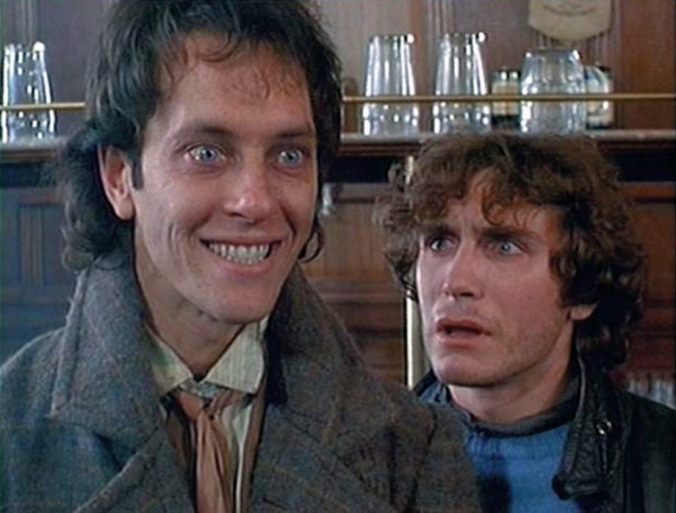
Firstly, Animals, the second novel from Emma Jane Unsworth, described on the cover by Caitlin Moran as “Withnail with girls”, which pretty much sums it up. Laura lives with her friend Tyler, a one-woman tornado:

“She didn’t just change the temperature of rooms, she changed their entire chemical make-up so that anyone in the room would only be aware that the room was an extension of her and she was the thrumming nucleus.”

Tyler is indulgent, defensive, funny, clever – a total nightmare with whom Laura feels an immediate bond:

“Someone who sees right to your backbone and simultaneously feels their backbone acknowledged.”

But Laura is in love with Jim and is planning to get married, introducing a tension into the women’s friendship.  Tyler wants life to continue as it is, Laura is not so sure. It’s not plot-heavy, as Tyler and Laura ricochet from one substance-fuelled experience to another, it’s funny and sad and so very believable:

“And there it was, as always, swinging my way: The Night. With its deals, promises and gauntlets, by turns many things: nemesis, ally, co-conspirator, master of persuasion. It tosses its promises before you like scraps on the road, crumbs leading into the forest: pubs, parties, booze, drugs, dancing, karaoke…”

Amongst all this eventful partying, there is an elegiac quality to Animals: both the women are in their thirties and there’s a sense that their life together cannot continue for much longer, and that it might not be so entertaining if it did:

“Next to the sink, two folded banknotes balanced on a rung of the towel rail, drying. I stood and looked into the bowl before I flushed, recalling the adage of a girl I’d once worked with: White piss good; amber piss bad. Orwellian in its visceral simplicity. Meanwhile the liquid I had dispatched into the toilet bowl was almost ochre.”

1987WithnailandIArrow-920x699

A great film, but not a wise lifestyle choice, kids

Image from here

The bawdy chaos of Animals is presented through considered, inventive storytelling; Unsworth’s voice is compelling and like Laura on a night out with Tyler, I found myself carried along for the ride.

Secondly, the publishing phenomenon that is Elena’s Ferrante’s My Brilliant Friend (tr. Ann Goldstein, Europa editions 2012) and one more stop on my Around the World in 80 Books reading challenge, hosted by Hard Book Habit. This is the first in a quartet known as the Neapolitan novels which have sold millions worldwide, no doubt to the chagrin of authors everywhere stuck on a PR treadmill, as Ferrante remains determinedly anonymous. The novels detail the friendship between Elena and Lila from the 1950s onwards.

“She stopped to wait for me, and when I reached her she gave me her hand. This gesture changed everything between us forever.”

I’m grateful to Kate’s recent review which tempered my expectations somewhat. While I did like the novel, I think had I gone in with the astronomical expectations created by all the hype I would have been disappointed. As it was, I went in with moderate expectations and enjoyed being pulled into the poor Neapolitan neighbourhood Ferrante so vividly evokes. Elena summarises: “I feel no nostalgia for our childhood: it was full of violence.” She’s not wrong. Violence between strangers, friends and families seems to be constant. The poverty and accompanying lack of horizons takes its toll:

“At the Bar Solara, in the heat, between gambling losses and troublesome drunkenness, people often reached the point of disperazione – a word that in dialect meant having lost all hope but also being broke – and hence of fights.”

Within this environment, Lila and Elena form a friendship that is full of the unspoken. Elena is mesmerised by Lila, who is tough, independent, and highly intelligent. Despite the time they spend together, the core of Lila – what she really wants, her hopes and dreams – remain mysterious to Elena.

“Would she always do the things I was supposed to do, before and better than me? She eluded me when I followed her and meanwhile stayed close on my heels in order to pass me by?”

It is this competitiveness, this desire to be like Lila, which spurs Elena on, to the point where this motivation becomes indistinguishable from her own preferences. She continues at school long after Lila leaves, her academic commitment a mixture of wanting to outstrip Lila, wanting to do well because it is what Lila wants, and wanting to do well for herself. Ferrante has an excellent understanding of how these early friendships are so vitally important, how they form us in ways we barely understand and how quickly it is impossible to say what feels intrinsic to us and what is the influence of others. She captures the ambivalence of friendships that are formed out of deep love and conflict:

“When school started again, on the one hand I suffered because I knew I wouldn’t have time for Lila anymore, on the other I hoped to detach myself from the sum of the misdeeds and compliances and cowardly acts of the people we knew, whom we loved, whom we carried – she, Pasquale, Rino, I, all of us – in or blood.”

While I’m not quite ready to proclaim myself a fully paid-up Ferrante acolyte, the quartet supposedly gets better as it goes along, so by book four I could well be (Marina Sofia has written a really interesting review of the quartet here).

To end, two celebrities (one of whom plays the aforementioned Lesley Knope) who claim to be BFFs and I actually believe them:

“Mothers are all slightly insane.” (JD Salinger)

You’re not wrong, JD. Mine is in definite box-of-frogs territory. It’s the thing I like most about her. I’ve been extraordinarily lucky, but a relationship such as ours will never be immortalised in literature given that we get on well and it would be inexorably dull. So for mother’s day (which it is today in the UK) I’m looking at two portrayals of mothers that are nothing like my own but which make for great reads. This post is dedicated not only to my own mother, but also to my sister-in-law, for whom today is her first mother’s day as a mother 🙂

My mother and I have never been this adorable

My mother and I have never been this adorable

Image from here

My first literary mother is Mrs Ramsay from To the Lighthouse by Virginia Woolf. I chose this because Virginia Woolf is one of my mother’s favourite writers, and like the homebrew peach schnapps I once allowed past my lips, I deeply regret this now. How on earth do you write about anything by Virginia Woolf? Her writing is so rich, so multi-layered, so dense and yet so subtle that I don’t feel adequate to the task – which I’m sure the following discussion will prove beyond a doubt 😉

In To the Lighthouse, the Ramsay family descend on their holiday home in the Isle of Skye. Woolf’s stream-of-consciousness technique is perfect at capturing everything that occurs beneath the surface of an ordinary day, the deep significance below the seemingly insignificant:

“the monotonous fall of the waves on the beach, which for the most part beat a measured and soothing tattoo on her thoughts and seemed consolingly to repeat over and over again as she sat with the children the words of some old cradle song, murmured by nature, ‘I am guarding you – I am your support’, but at other times suddenly and unexpectedly, especially when her mind raised itself slightly from the task in hand, had no such kindly meaning, but like a ghostly roll of drums remorselessly beat the measure of life, made one think of the destruction of the island and its engulfment in the sea and warned her whose day had slipped past in one quick doing after another that it was all as ephemeral as a rainbow – this sound which had been obscured and concealed under the other sounds suddenly thundered hollow in her ears and made her look up with an impulse of terror.”

Mrs Ramsay is a nurturing and dedicated mother but here Woolf exposes the fractures that threaten a seemingly harmonious exterior.  I think this passage is just brilliant – the setting up of the monotonous background noise that lulls yet twists in a moment, the mind rebelling against the self, the pure terror that we can be overwhelmed by our own feelings – all while domesticity continues undisturbed.

The family are surrounded by Mrs Ramsay’s nuturing love and the sea, and as the passage  above shows, these are bound together in their constancy being mistaken for predictability. To the Lighthouse uses water imagery to great effect, the sustaining essence that can imperil and kill:

“how life, from being made up of little separate incidents which one lived one by one, became curled and whole like a wave which bore one up with it and threw one down with it, there, with a dash on the beach”

This is my experience of reading Woolf: small incidents, layered up into writing of such power that you surface from her novels feeling dashed by a powerful force.

If you’d like to read some proper reviews of this wonderful novel, there have been insightful and interesting posts written lately by bloggers including Lady Fancifull and Simon at Stuck in a Book. If you’d like to know more about the man Mrs Ramsay married, a man given to views such as: “He wondered if she understood what she was reading. Probably not, he thought. She was astonishingly beautiful.” Sarah has written a typically witty and entertaining post over at Hard Book Habit.

Secondly, The Blue Room by Norwegian author Hanne Orstavik (trans. Deborah Dawkin) one more stop on my Around the World in 80 Books Reading Challenge, hosted by Hard Book Habit. I can’t remember which blogger made me aware of this so if it was you please leave a comment! Peirene Press publish contemporary European novellas, and group them in sets of three, linked by theme. The Blue Room is part of the Coming-of-Age series, and concerns Johanne’s intense relationship with her mother; they live together while Johanne trains to be a psychologist. Her career choice is deeply ironic, given that she has no insight into the manipulative, controlling behaviour her mother directs towards her, or her own victimhood.

“She’s right, I thought, we belong together like two clasped hands.”

Well, two clasped hands can be affectionate, reassuring, but also restraining and restrictive. The novel takes place over the course of a day, when Johanne was due to leave to spend six weeks in the States with her boyfriend, yet wakes to find herself locked in the titular space and unable to leave. As she thinks back over recent events, relationships with her mother, boyfriend and God emerge and the reader is left to piece together what is going on beyond what Johanne doesn’t say. She is an unreliable narrator of her own life as we all are, because her perspective is limited by what she cannot see.

Her mother is deeply controlling and Johanne has the victim’s hypersensitivity to her abuser’s every need and whim. At no point does she articulate that it is her mother who has locked her in, unwilling to let her leave.

“Perhaps I’m locked in here as part of an experiment. Perhaps somebody’s pumping gases in and changing my consciousness.”

Johanne’s sexual fantasies abruptly break into the narrative, filled with violence,  with herself as the dominated party in BDSM scenarios. Again, despite her training, she cannot see how this is bound up in her relationship with her mother:

“And what exactly, I asked, is the meaning of this pain? Don’t we grow when we’re happy? Mum looked at me: she seemed angry and said nothing.”

Johanne is young and naïve, lacking insight, both sweet and shocking. The Blue Room is a powerful novella about our closest relationships and how they influence us in ways we barely comprehend.

To end, a little treat for my mother and any other LDP fans out there – enjoy!

“The inspector sat down on a stair, fired up a cigarette, and entered an immobility contest with a lizard.” (The Snack Thief, Andrea Camilleri)

Reader, I’ve been abandoned by a man.  He just left, with no word of when he will return and how I miss him.  He’s gorgeous, he lives in a place of outstanding beauty, he shares my food obsession and always brings the sunshine with him.

Apparently possession of a Y chromosome is necessary to become a police officer in Vigata

Apparently possession of a Y chromosome is prerequisite to becoming a police officer in Vigata

Image from here

Always a sucker for the BBC4 Saturday night foreign detective dramas, I am deeply traumatised by the ending of Young Montalbano, whose Sicilian sunshine was no end of help in getting me through these grey February days.  The deli across the road sells great arancini but carb-loading on the Inspector’s favourite food is not quite compensating for my loss.

The BBC tried to make up for the series ending by screening an interview with the author of the Montalbano books, 88 year -old Andrea Camilleri. The man is charm personified so if you have a chance to watch this interview in the next few weeks I definitely recommend it.  In the opening scene Camilleri pays tribute to Spanish crime writer Manuel Vazquez Montalban, after whom he named his creation.  So off I trot to Barcelona in the company of Pepe Carvalho, Montalban’s private detective, in the hope that Spanish sunshine will help keep my vicarious vitamin D levels up. For this post I’ve paired it with another Spanish crime novel, The Invisible Guardian by Dolores Redondo (tr. Isabelle Kaufeler), which I was delighted to win in a giveaway on Elena’s lovely blog, Books and Reviews.  Do head over to B&R for Elena’s insightful review of The Invisible Guardian and interview with the author. These two books are also one more stop on my Around the World in 80 Books Reading Challenge, hosted by Hard Book Habit.

In Tattoo (tr. Nick Caistor), Pepe Carvalho “an ex-cop, an ex-Marxist and a gourmet” is hired by a local hairdresser to identify a body that has been pulled out of the sea, badly disfigured but with the legend “Born to Raise Hell in Hell” tattooed on his back.  It’s a shame Montalban has died, because a cross-over novel penned by him and Camilleri would have been something to behold; their two protagonists are so similar that they’d either become bosom buddies or detest each other on sight:

“Strolling aimlessly around the market was one of the few ways that this tall, dark-haired man in his thirties, who somehow contrived to look slightly dishevelled despite wearing expensive suits from tailors in the smartest part of town, allowed himself some spiritual relaxation whenever he left Charo’s neighbourhood and headed back to his lair on the slopes of the mountain overlooking Barcelona.”

Carvalho’s investigation takes him from Barcelona to Amsterdam where he becomes embroiled in the drugs trade, gets badly beaten, and engages sex workers as informers. He is tough and cynical and in that sense very much in the line of familiar hard-boiled detectives, but Montalban has self-referential fun with this:

 “Carvalho did not want to seem too smart, or behave like a Chandler character facing a stupid, brutal LAPD cop.” 

This is Tattoo’s main appeal for me – a European sensibility brought to a Chandler-esque tale. I wasn’t keen on the violence towards women, particularly when one of them sleeps with Carvalho straight afterwards, but Montalban redeems himself slightly by having sex worker who is strong, independent, and not punished by rape and/or being killed off, which I didn’t entirely expect for a novel written in the 1970s. The tale is told with dry humour through some remarkable images: “the man had the mental recall of a great masturbator”. Quite.

This is the second Carvalho mystery and I didn’t feel I had to have read the first. Apparently the series becomes more politically engaged as it goes along, the ‘ex-Marxist’ element of the detective satirising Spanish politics, which is an interesting turn to take – for this reason I definitely plan on spending more time in Pepe’s company.

I do love me some Gaudi

Barcelona – I do love me some Gaudi

Image from here

From Barcelona to Basque country, and The Invisible Guardian by Dolores Redondo. I am not a big reader of contemporary crime fiction, but I was intrigued by Elena’s review, which described how the Basque setting of Elizondo brought its own unique atmosphere to the novel:

“The Baztan forest is enchanting, with a serene, ancient beauty that effortlessly brings out people’s most human side; a childlike part of them that believes in fairies with webbed ducks’ feet that used to live in the forest… Amaia felt the presence of such beings in that forest so tangibly that it seemed easy to believe in a druid culture, the power of trees over men, and to imagine a time when communion between magical beings and humans was a religion throughout the valley”

basque-spain

Image from here

Amaia is Inspector Salazar, deployed from Pamplona back to her home town to investigate a series of murders: young girls, strangled and laid out ritualistically. While the details of the dead are disturbing, I didn’t feel it was overly gory, and certainly not voyeuristically gruesome. We are never allowed to forget that these are young people, on the cusp of womanhood, robbed of their lives:

 “the girl’s small, pale face with tiny drops of water still trapped in her eyelashes acted like clamorous cries to which she could not help but respond”

As Amaia investigates the murders she also has to face the ghosts of her past, and although she is deeply troubled, she’s not the stereotype of a tortured, isolated, renegade detective. She is happily married (although the relationship is under strain), she has family around her including a loving, strong aunt,  and she follows procedure.

“This was her hometown, a place in which she had lived for most of her life. It was part of her, like a genetic trace, it was where she returned to in her dreams when she wasn’t dreaming about the dead bodies, assailants, killers and suicides which mingled obscenely in her nightmares”

What I thought Redondo did exceptionally well was mixing a recogniseable contemporary reality with the old religion, mysticism and mythology of the past; the investigation progresses through a combination of procedural police work with intuition and precognition. This never jars and adds to the eerie, unnerving quality evoked by the Baztan forest without losing the tension of the investigation. It’s an extraordinary achievement. My one reservation is that the dialogue occasionally felt a bit clunky, but I suspect this may be a translation issue as I imagine trying to capture natural speech is extremely difficult. The Invisible Guardian is the first in a trilogy and I’m really looking forward to the next two installments.

To end, a glimpse of where BBC4 is taking me after Sicily. I haven’t watched last week’s episodes yet, and although it looks great, I think I’ll need to get my vicarious sunshine elsewhere:

“We’ve all heard that a million monkeys banging on a million typewriters will eventually reproduce the entire works of Shakespeare. Now, thanks to the Internet, we know this is not true.” (Robert Wilensky)

Gong Hei Fat Choi! Happy New Year of the Fire Monkey! To celebrate the start of the Lunar New Year I thought I would look at writers from cultures and countries outside of China that also widely celebrate this event: a Hong-Kong born writer’s Philippines-set novel, and a Japanese writer, as the interwebs tell me Japan celebrates both the Gregorian and Lunar new years.  These will also be two more stops on my Around the World in 80 Books Reading Challenge, hosted by Hard Book Habit.

Fire Monkey - this is going to be your year, my simian friend

Fire Monkey – this is going to be your year, my simian friend

Image from here

Firstly, Brownout on Breadfruit Boulevard by Timothy Mo (1995). I picked this up because it was enthusiastically recommended  in a lecture I attended on post-colonial literature. Brownout is set primarily in the Philippines, in the fictional city of Gobernador de Leon, where Victoria Init, admirer of Imelda Marcos, strives to extend her congressman husband’s power.

“Rubbish carts too dilapidated to carry the neat and frugal household wastes of Osaka had come from Japan; schoolbuses no longer fit to carry Korean children from Seoul; traffic lights , too laconic to blink longer at the soldierly traffic in Wellington would glare defeasance implacably red-eyed at the escaped lunatics behind the steering wheels of the Gobernador de Leon jeepneys. Traffic was absurdly heavy…you would stay in the same place a maximum of five minute before creeping on again…So what if it was only inches? Advance was cumulative; the achievement slow but palpable. In short, at the end of it you had made progress. Progress was Victoria Init’s idol. She would sacrifice everything and everyone at the feet of that stern shibboleth”

The second part of the novel deals with a conference of academics coming to the city, through which Mo is able to extend the portrait of corruption flourishing in the face of lazy indifference and self-interest far beyond the politicking Inits and a toothless journalist named Boyet. The visiting intellectuals have no understanding, wrapped up as they are in their own tiny worlds. Some are overtly derogatory to other cultures, others restraining themselves to sweeping racism:

“Filipinos don’t actually have a colonial chip on their shoulder…The ordinary pinoy likes America and Americans, in fact there’s nothing he’d like better than to be one. And as for the language of the oppressor issue, Holy Moses, they grow up speaking English. It’s as natural to them as…”

I think it speaks volumes that the sentence is unfinished by the speaker. As a satire Brownout doesn’t entirely work – there’s not really a character to care about, to anchor the narrative to or throw the corruption into sharp relief.  It’s a novel filled with characters, a broad portrait that for me could have done with being a little deeper.  However, Mo is a highly skilled writer and, as my lecturer suggested, Brownout is certainly interesting from a post-colonial point of view. It didn’t wholly capture me but I enjoyed it enough that it makes it onto this blog, where I only write about books I recommend.

Ph_regions_and_provinces

Image from here

Secondly, The Diving Pool by prolific Japanese writer Yoko Ogawa (trans. Stephen Snyder), a collection of three stories written in a beautiful, spare style. In the deeply unsettling titular story a young girl falls in love with her foster brother:

“Sometimes I wish I could describe how wonderful I feel in those few seconds from time he spreads his arms above his head, as if trying to grab hold of something, to the instant he vanishes into the water. But I never can find the right words. Perhaps it’s because he’s falling through time, to a place where words can never reach.”

The narrator lives with a large extended family where she is the only biological child.

“I can never hear the words ‘family’ and ‘home’ without feeling that they sound strange, never simply hear them and let them go. When I stop to examine them, though, the words seem hollow, seem to rattle at my feet like empty cans.”

It’s quite a feat that for a precise, beautifully eloquent writer such as Ogawa, she makes what is left unsaid and unacknowledged the dominant theme of the collection. The girl in The Diving Pool carries out horrible acts of cruelty without really knowing why; in Pregnancy Diary, a young woman is mesmerised and yet alienated by her sister’s pregnancy:

“I wonder how she broke the news to her husband. I don’t really know what they talk about when I’m not around. In fact, I don’t really understand couples at all. They seem like some sort inexplicable gaseous body to me – a shapeless, colourless, unintelligible thing trapped in a laboratory beaker.”

Again, the narrator does not behave well, indeed, behaves in a shocking way, with quiet malice. The inarticulate nature of the narrators makes their behaviour all the more unsettling, as it is presented through simple statements of fact, unadorned and unjustified.

In the final story, Dormitory, a young woman returns to the dorm building she stayed in as a student:

“I would hear it for the briefest moment whenever my thoughts returned to the dormitory. The world in my head would become white, like a wide, snow-covered plain, and from somewhere high up in the sky, the faint vibration began…I never knew how to describe it. Still, from time to time I attempted analogies: the icy murmur of a fountain in winter when a coin sinks to the bottom; the quaking of the fluid in the inner ear as you get off a merry-go-round; the sound of night passing through the palm of your hand still gripping the phone after your lover hangs up…”

Ogawa is a stunning writer, and in this final story, rather than a psychologically disturbed protagonist, she unsettles the reader by leading them down a well-worn narrative route, before abruptly destabilising it with a surreal and astonishing final image. Highly recommended.

“The weather is like the government, always in the wrong.” (Jerome K. Jerome)

What, in the name of Tomasz Schafernaker, is going on with the weather? (For those of you in countries where this legend doesn’t broadcast, he became my favourite –and I didn’t even know I needed one – when he ended a forecast with: “So, in summary…” then blew a raspberry and gave the thumbs-down. Succinct and accurate, Tomasz.)

DBEd6C7XkAArbJ4

Image from here

Here in the UK we’ve had a weirdly mild winter, with the exception of 3 days this week which were the seasonal norm, and now we’re back to disconcertingly warm.  Meanwhile the east coast of the US has had the worst snow storm in 100 years. This has now passed and apparently skies have brightened, but please stay safe if you are there, reader. To give myself the sense of winter which is lacking here, I thought I would look at 2 snowbound novels. Inevitably, these will not be set in Britain, and so they also represent two more stops on the Around the World in 80 books reading challenge – hoorah! Coincidentally, they are also both collected short stories which do form a sort of narrative, so don’t be put off, short-story-phobes.

_65866840_rogerbruce

Image from here

Firstly, A Winter Book by Tove Jansson, who I’ve written about before, a Finnish writer who wrote in Swedish, best known for the Moomins but a wonderful writer for adults too.  If you’re a fan of Jansson and have read her semi-autobiographical The Sculptor’s Daughter, then you might find this repetitive as the vast number of stories are taken from there. However, if you want to dip a toe into Jansson to see how you get on with her, this is as good a place to start as any.

Much is written from a child’s perspective and Jansson’s independent, stubborn and wonderfully inventive nature shines through. In the story Snow (I’m being resolutely obvious in my choices) she finds herself snowbound with her mother in an unfamiliar house.

“But I said nothing because I didn’t like this strange house. I stood in the window and watched snow falling, and it was all wrong. It wasn’t the same as in town. There it blows black and white over the roof or falls gently as if from heaven, and forms beautiful arches over the sitting-room window. The landscape looked dangerous too. It was bare and open and swallowed up the snow, and the trees stood in black rows that ended in nothing. At the edge of the world there was a narrow fringe of forest. Everything was wrong.”

Jansson’s world is small, yet enormous.  Much is set on her beloved island of Klovharu, and in Snow this is narrowed down to a single house, yet with her child’s imagination, it becomes a fairytale, in the Grimm sense, with a feeling of unreality and menace.

“Next morning the daylight was green, underwater lighting throughout the room. Mummy was asleep. I got up and opened the door and saw that the lamps were on in all the rooms although it was morning and the green light came through the snow which covered the windows all the way up. Now it had happened. The house was single enormous snowdrift, and the surface of the ground was somewhere high up above the roof.”

Jansson’s style is simple and pared back, which I think makes it all the more wonderful. It captures a child’s voice without artifice and is dramatic in its directness.

There is a similar sense of surreal wonder in The Iceberg, a delightful story where the young girl spots an iceberg floating nearby with a grotto hollowed out of it:

“My hands and my tummy began to feel icy-cold and I sat up. The grotto was the same size as me, but I didn’t dare to jump. And if one doesn’t dare to do something immediately, then one never does it.

I switched on the torch and threw it into the grotto. It fell on its side and lit up the whole grotto, making it just as beautiful as I had imagined it would be. …it was so unbearably beautiful that I had to get away from the whole thing as quickly as possible, send it away, do something! So I sat down firmly and placed both feet on the iceberg and pushed it as hard as I could It didn’t move.

‘Go away!’ I shouted. ‘Clear off!’”

This magical, humorous tale is pure Jansson: a truly memorable delight.

Secondly, A Country Doctor’s Notebook by Mikhail Bulgakov, a collection of his stories about being a newly-qualified doctor in an isolated practice, serving poverty-stricken rural Russian workers.

“The nearest street lamps are thirty-two miles away in the district town. Life there is sweet: it has a cinema, shops. While the snow is whirling and howling out here in the open country, there on the screen no doubt, the cane-brake is bending to the breeze and palm trees sway as a tropical island comes into view….”

He is the only doctor in the practice and finds himself woefully underprepared, his distinction in exams teaching him nothing about how to do his job.

“I tried to talk evenly and gravely, and to repress impulsive movements as far as possible, to walk and not run as twenty-four-year-olds do who have just left university. Looking back, I now realise that the attempt did not come off at all…I had been shown round the hospital and was left in no doubt whatever that it was generously equipped. With equal certainty I was forced to admit (inwardly of course) that I had no idea what many of these shiny, unsullied instruments were for.”

Jon Hamm and Daniel Radcliffe in the 2012 TV adaptation

Jon Hamm and Daniel Radcliffe in the 2012 TV adaptation

Image from here

Living in fear of a patient presenting with a strangulated hernia, Bulgakov somehow manages to muddle through, and actually seems to make a fairly decent doctor despite his own fear and misgivings: “I thought to myself: ‘What am I doing? I shall only kill the child.’ But I said: ‘Come on, come on – you’ve got to agree! You must! Look, her nails are already turning blue.”

Bulgakov’s writing throughout these stories might surprise fans of his surrealist masterpiece The Master and Margarita, as it is a determinedly realistic and linear narrative. However, it is bleak, funny, highly readable, and there are a few hints of what was to come once Bulgkov gave up his medical practice and turned all his attention to writing…

“Outside was a sight I had never seen before. There was no sky and no earth – only twisting, swirling whiteness, sideways and aslant, up and down, as though the devil had gone mad with a packet of tooth powder.”

To end, unapologetically cute footage of Japanese snow monkeys warming up in hot springs: