“I don’t know where I’m going from here but I promise it won’t be boring.” (David Bowie)

David Bowie died on 11 January (and then Alan Rickman 3 days later – 2016 is rubbish so far).  Although I have never been personally moved by a celebrity death, shocking and sad as they are, on Monday I found myself weeping in the middle of King’s Road (lesson: don’t look at the BBC News app in public).  In common with his worldwide legions of fans, Bowie had a special place in my heart and it’s a horrible shock that our hero has gone.

Consoling myself through the internet, I discovered he had listed his 100 Must Read books, so I thought I would look at two in this post. Sarah over at Hard Book Habit also wrote about this list, do pop over and read her lovely post. One of my choices is also my first stop on Hard Book Habit’s Around the World in 80 Books Reading Challenge, which you can read all about here.

Firstly, The Prime of Miss Jean Brodie by Muriel Spark (1961), probably her most famous novel.  Miss Brodie is a romantic teacher in a conservative girl’s school in Edinburgh in the 1930s. Eschewing the curriculum, she educates her girls in the ways of art, love… and fascism. Boasting “Give me a girl at an impressionable age and she is mine for life.” Miss Brodie has a group of girls who form the ‘Brodie set’, and the novel, slipping back and forth in time, is told mainly from their points of view, despite a third person narrator.

“Miss Brodie had already selected her favourites, or rather those whom she could trust; or rather those whose parents she could trust not to lodge complaints about the more advanced and seditious aspects of her educational policy.”

Miss Brodie repeatedly insists that she is in her prime; she is silly and vain, and the school are out to get her. But Spark does not judge her harshly, suggesting she is just in the wrong place at the wrong time:

 “It is not to be supposed that Miss Brodie was unique at this point of her prime…there were legions of her kind during the nineteen-thirties, women from the age of thirty and upward, who crowded their war-bereaved spinsterhood with voyages of discovery into new ideas and energetic practices in art or social welfare, education or religion.”

We learn quite early on that she is betrayed, and that it one of her set who betray her, forcing her into early retirement.  Miss Brodie is a complex character: charismatic; aspirational for herself and others; entirely inappropriate towards her pupils and with truly hideous politics.  She is an independent spirit who vastly underestimates her own vulnerability.

“It was then that Miss Brodie looked beautiful and fragile, just as dark heavy Edinburgh itself could suddenly be changed into a floating city when the light was a special pearly white and fell upon one of the gracefully fashioned streets. In the same way Miss Brodie’s masterful features became clear and sweet to Sandy when viewed in the curious light of the woman’s folly”
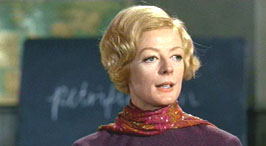
Dame Maggie Smith as Miss Brodie in the 1969 film

Dame Maggie Smith as Miss Brodie in the 1969 film

The Prime of Miss Jean Brodie is a short novel – 128 pages in my edition – which shows just how much a brilliant writer can say in a short space. Spark has created one of the legendary characters of modern fiction who truly stays with you: like her or loathe her, its almost impossible not to be drawn in, becoming one of the ‘Brodie set’.

Secondly, The Leopard by Giuseppe Tomasi di Lampedusa, set during the nineteenth century Risorgimento, whereby the different states of the Italian peninsula unified into a single state. Telling the story of the aristocratic Sicilian Salina family, particularly Fabrizio, the Prince, the novel has an elegiac quality as it documents the decline of the family and change of a way of life.

“Between the pride and intellectuality of his mother and the sensuality and irresponsibility of his father, poor Prince Fabrizio lived in perpetual discontent under his Jove-like frown, watching the ruin of his own class and his own inheritance without ever making, still less wanting to make, any move toward saving it.”

The Prince is surrounded by people, between political responsibilities and social engagements, yet he is an isolated figure, partly due to his “contempt for all his own relatives and friends, all of whom seemed to him mere driftwood in the languid meandering stream of Sicilian pragmatism”.

But the Prince cannot resist the forces of all that surrounds him, and while the military action of the Risorgimento takes place only by report, he and his family are dragged towards modernisation, such as having his aristocratic gene pool diluted by the daughter of a clerical man who:

 “moved through the forest of life with the confidence of an elephant which advances in a straight line, rooting up trees and trampling down lairs , without even noticing scratches of thorns and moans from the crushed”

The domestic is resolutely tied with the political and historical, even during the intimacy of seduction:

“he felt as if by those kisses he were taking possession of Sicily once more, of the lovely faithless land which now, after a vain revolt, had surrendered to him again, as always to his family, its carnal delights and golden crops.”

Sicily_Map

Yet while the people are tied to the land and its history, a recurring theme is of human insignificance, of the transitory nature of humans and their constructs, of all around us falling away. This isn’t depressing, and indeed there is a subtle humour in The Leopard, but it is sad and there is a sense of existential crisis. This wider theme is distilled into the Prince’s relationship with his beloved stars:

“As always, seeing them revived him; they were distant, they were omnipotent and at the same time they were docile to his calculations; just the contrary to humans, always so near, so weak and yet so quarellsome”

The Leopard is a short novel but it took me a while to read it as it so densely written, not a word is wasted. Lampedusa’s use of imagery is strikingly beautiful and he is not afraid to tackle huge ideas.

“the real problem is how to go on living this life of the spirit in its most sublimated moments, those moments that are most like death”

To end, a memory from last summer.  I accompanied my friend’s children – aged 4 and 7 – to an open-air showing of Labyrinth.  There are contradictory reports about Bowie’s feelings towards this film, but for me it has a special place in my heart because it was the point at which, aged nine, I first fell in love with him.

Prior to the showing, there were many jokes about indoctrination and my brainwashing of children, but on arrival I found my flash cards on The Life and Times of David Bowie were not needed.  There were a number of avid Labyrinth-watchers dressed up in oversized mullet wigs and inappropriately large codpieces, a la Jareth the Goblin King.  The kids squealed with delight and ran around to greet them all, crying “David Bowie! David Bowie!” When my friend’s son arrived back where we were sitting, he flopped down, breathless with joy, and simply said “David Bowie.”

“I know just how you feel.” I told him.

 

“Summer, summer, summertime.” (Jazzy Jeff and The Fresh Prince)

On Monday this week the weather forecasters seemed fixated on the fact that it was the start of something they called ‘meteorological summer’.  If you live in the UK & looked out of the window at that point, there was only one sane reaction to such news:

531

Because frankly, even by British standards, the weather’s been a total washout. (btw, this week’s GIFs are dedicated to fellow book blogger Lady Fancifull 🙂 )  However, it has brightened up considerably throughout the week and as I write this I can smell my neighbour’s barbeque, so it looks like maybe the weather forecasters’ optimism wasn’t so misplaced after all. I like to imagine the meteorologists are now running round the studio thusly:

tumblr_inline_n3h730aMNJ1s5jo86

So here is a post to celebrate the start of the meteorological summer. Which in the UK should be good for at least, ooh, another 5 days or so 😉

Firstly, The Summer Book by Tove Jansson (1972, my edition 2003 Sort Of books trans.Thomas Teal) which I won from a giveaway hosted by the lovely bookarino at Dawn of Books.  Apparently this was Jansson’s favourite of her novels for adults (she is best known for the Moomin series) and it’s a wonderful read.  The premise is simple: a series of vignettes detailing how a grandmother and her granddaughter Sophia spend a summer together on an island in the gulf of Finland.

“When the southwest wind was blowing, the days seemed to follow one another without any kind of change or occurrence; day and night, there was the same even, peaceful rush of wind.. ..They all moved about the island doing their own chores, which were so natural and obvious that no one mentioned them, neither for praise nor sympathy.  It was just the same long summer, always, and everything lived and grew at its own pace.”

Nothing hugely dramatic happens, but Jansson evokes real meaning through the layering of small moments to create fully realised portraits of two complex, stubborn, loving, life-embracing women.

““Listen,” Sophia said. “I don’t have time to stay here with you – I’ve only been swimming twice today.  You won’t be sad now, will you?”

“I want to go too,” Grandmother said.

…They helped each other climb out of the canyon, and then they circled around the hill…off to one side of the channel marker, there was a large, deep pool.

“Is this alright?” Sophia sked.

“It’s fine,” Grandmother said.  She bared her legs and stuck them in the pool.  The water was warm and pleasant.”

There is a wonderful gentle humour running through the book, and also sadness  – Sophia’s mother has died, the elderly grandmother is aware her time is short.

““What are you doing?” asked little Sophia.

“Nothing,” her grandmother answered.  “That is to say,” she added angrily, “I’m looking for my false teeth.”

The child came down from the veranda.  “Where did you lose them?” she asked.

“Here,” said her grandmother.  “I was standing right there and they fell somewhere in the peonies.”  They looked together.

“Let me,” Sophia said. “You can hardly walk, Move over.””

Bookarino’s enthusiasm for Jansson is infectious, as is Kaggsy’s, and I definitely plan on reading all her books for adults (and maybe a Moomin or two too…)

If, like me, you live in a city, summer may not immediately bring to mind the heady waft of night blooming jasmine and the soothing chirp of crickets.  So I’m eschewing pastoral evocations of summer in favour of a short poem about London in summer, ‘August’ by Tobias Hill (from Nocturne in Chrome and Sunset Yellow, 2007):

when pigeons like dei ex machina

descend improbably out of the air


wobble like airships skimming through the tops

of trees which sink under their tea-pink weights


until each grandee bungee-jumps or bellyflops

downwards in great soap-operatic terrifying swoops


into the sweet dark shining feather-bedness of the fruits

When the first sunny days appear, those of us used to greyer climes seem to behave with the mania of the pigeons in this poem.  It’s a glorious sight to behold, as city-dwellers sunbathe on patchy grass verges next to dual carriageways, pale blue skin gradually glowing vermilion; lager and sausage rolls sweating in plastic carrier bags beside them. Ah, the summer idyll….

I got my hair cut today (moulting in the warm weather) and the titular song from this post started to play on the radio.  My hairdresser pronounced it a classic but said her favourite summer song was this:

“Brevity is the soul of lingerie.” (Dorothy Parker)

Apparently you can have too much of a good thing.  This is not something I’ve experienced myself, but as it seems to be a truth universally acknowledged, I’ll go with it.  So even if you are an inveterate bibliophile there can be times when humungous, bicep-busting books can be off-putting, particularly if like me, you’re a non-Kindle using commuter.  You don’t want to be lugging The Count of Monte Cristo onto the train (or so my osteopath insists).  This week I thought I’d look at books that are small and perfectly formed: 1 novella and 1 short story collection that are little gems.

Firstly, Fair Play by Tove Jansson (1989 my edition trans. Thomas Teal 2007, 127 pages). Jansson is most famous for creating those weird hippo/mouse hybrid creatures the Moomins:

Recently I kept reading about how good her writing for adults is, so when I saw Fair Play in a bookshop I decided it was A Sign.  A Sign for me to spend money, which admittedly is what every bookshop says to me.  But Fair Play was worth every penny.  It is a beautifully observed, delicate portrait of two artistic women sharing a life together.  Jonna is a visual artist, Mari a writer:

“They never asked, “Were you able to work today?” Maybe they had, twenty or thirty years earlier, but they’d gradually learned not to.  There are empty spaces that must be respected  – those often long periods when a person can’t see the pictures or find the words and needs to be left alone.”

This is what Fair Play captures so well, the unspoken subtleties that exist in a long-term relationship, with the person you know better than anyone.  With a restrained lightness of touch, Jansson presents moments in time between the two women,  detailing events that seem simultaneously fleeting yet loaded with meaning.

“They hadn’t noticed the fog moving off….suddenly the sea was open and blue and they found themselves a long way out toward Estonia.  Jonna started the motor.  They came back to the island from a totally new direction, and it didn’t look the same.”

The novel has no ostensible plot, and there is no sense of time – each chapter could occur chronologically, or could be moving back and forth across the trajectory of their long relationship.  It doesn’t matter.  You finish the novel with the feeling of being allowed glimpses into two unique, intertwined lives, while understanding how we all essentially remain unknown.

“It’s gone so quiet,” Jonna said. “What did you think? Wasn’t that a good storm?”

“Very good,” Mari said. “The best we’ve had.”

Jansson’s writing is stark, yet beautiful. I will definitely be seeking out more by this writer.

Secondly, The Madman of Freedom Square by Hassan Blasim (2009, Comma Press, trans. Jonathan Wright, 90 pages). The cover of this collection includes a quote from The Guardian, proclaiming Blasim “perhaps the best writer of Arabic fiction alive”. Like Fair Play, this was the first time I’d read this author, and it seems like such an oversight as he has so much to say that is important.  Blasim is a deeply political writer, by which I mean not that he is polemical, but that he is engaged with how literature works within a wider society:

“Because literature in this country is literature that goes through phases. Since the fall of Saddam Hussein there have been incessant calls for writing to be intelligible, realistic, factual and pragmatic.  They are lamenting readers that don’t exist. They claim the writers of the past made the readers defect, whereas in fact for hundreds of years there were no readers in the broad sense of the word.  There were only hungry people, killers, illiterates, soldiers, villagers, people who prayed, people who were lost and people who were oppressed. Our writers seem to have grown tired of writing for each other.” (‘The Market of Stories’)

Blasim’s stories detail lives caught up in war: illegal immigrants, hostage experiences, propaganda- makers, asylum-seekers.  He is acutely aware of how stories are manipulated in this media-saturated world, and how there can be many truths held within the one story:

“This story took place in darkness and if I were destined to write it again, I would record only the cries of terror which rang out at the time and the other mysterious noises that accompanied the massacre. A major part of the story would make a good experimental radio piece.” (‘The Truck to Berlin’)

The short stories in The Madman of Freedom Square are all the more powerful for their brevity: there is a sense that in such unstable times, words are a luxury, and every one must count.  Certainly Blasim’s words count; his stories are powerful, extraordinary, bleakly funny on occasion, and deeply moving.

Back to frivolity: to end, a reminder that smaller is sometimes better (although frankly, when it comes to cookies, I’m still not entirely convinced…)

“The clever men at Oxford/Know all that there is to be knowed./But they none of them know one half as much/As intelligent Mr. Toad!” (Kenneth Grahame, The Wind in the Willows)

I’m in Oxford at the moment, a city I love.  I thought I would look this week at novels set in Oxford, and although there are lots to choose from (I guess lots of writers chose to evoke their alma mater) I’ve picked two crime novels, as Oxford seems to encourage this type of story.  I’m not sure why this occurs, but maybe it’s because it’s seen as such a respectable institution and it’s fun to think of a seething mass of violence and intrigue below the calm façade.  Here’s a picture of Oxford’s most famous fictional detective, to compensate for the fact that I’m not looking at any Colin Dexter novels:

Image

Image from (http://www.dailymail.co.uk/femail/article-1101952/So-did-Morse-lie-love-In-final-seasonal-serial-young-Morses-secret-admirer-reveals-identity–learn-truth-mysterious-car-crash.html)

Firstly, The Case of the Gilded Fly by Edmund Crispin.  This was the first in a series of novels featuring the sleuthing Oxford don Gervase Fen, and is from the Golden Age of Detective fiction, written in 1944.  The opening paragraph struck a chord with me:

“To the unwary traveller, Didcot signifies the imminence of his arrival at Oxford; to the more experienced, another half-hour at least of frustration.  And travellers in general are divided into these two classes; the first apologetically haul down their luggage from the racks on to the seats, where it remains until the end of the journey, an encumbrance and a mass of sharp, unexpected edges; the second continue to stare gloomily out of the window at the woods and fields into which, by some witless godling, the station has been inexplicably dumped”

Well, the woods and fields may be much less evident, but otherwise… seventy years on and nothing changes.  Travelling on this train are Gervase Fen, his friend Sir Richard Freeman who is Chief Constable of Oxfordshire and wishes he was a don (while Fen wishes he was police officer) and various members of a drama group, who will return to London with their numbers somewhat diminished. Fen is a likeable, eccentric don, whose “normal overplus of energy …led him to undertake all manner of commitments and then gloomily to complain that he was overburdened with work and that nobody seemed to care”; he distracts himself on the train by wishing for “’A crime! …A really splendidly complicated crime!’ And he began to invent imaginary crimes and solve them with unbelievable rapidity.”

The first murder, of uber-bitch Yseult Haskell, takes place in a room in college close to Fen’s office, and so much to his delight he is distracted from his work on minor eighteenth-century satirists to investigate:

“His usually slightly fantastic naivety had completely disappeared, and its place was taken by a rather formidable , ice-cold concentration. Sir Richard, who knew the signs, looked up from his conference with the Inspector and sighed.  At the opening of the investigation, the mood was invariable, as always when Fen was concentrating particularly hard; when he was not interested in what was going on, he relapsed into a particularly irritating form of boisterous gaiety; when he had discovered anything of importance he quickly became melancholy […] and when an investigation was finally concluded, he became sunk in such a state of profound gloom it was days before he could be aroused from it.  Moreover these perverse and chameleon-like habits tended not unnaturally to get on people’s nerves.”

I’m not going to say too much about the plot as its nearly impossible not to give spoilers.  But if you think the eccentric Fen is someone you’d like to spend time with do look at The Case of the Gilded Fly.  I loved the dry, yet gentle humour in the writing, and it was a well-paced, easy read.  My favourite character however, was one of the minor players; unlike a lot of detectives, Fen does not have a complicated romantic life filled with encounters with unsuitable lovers, but is married to the brilliantly indulgent Mrs Fen:

“After she had greeted the Inspector with a slow, pleasant smile, Fen seized up the gun and handed it to her, saying:

‘Dolly, would you mind committing suicide for a moment?’

‘Certainly,’ Mrs Fen remained unperturbed at this alarming request, and took the gun in her right hand, with her forefinger on the trigger; then she pointed it at her right temple.

‘There!’ said Fen triumphantly.

‘Shall I pull the trigger?’ asked Mrs Fen.

‘By all means,’ he said absently, but Sir Richard surged up from his chair crying hoarsely: ‘Don’t! It’s loaded!’ and snatched the gun away from her.  She smiled at him. ‘Thank you, Sir Richard,” she said benignly, ‘but Gervase is hopelessly forgetful, and I shouldn’t have dreamed of doing such a thing.  Is that all I can do for you gentlemen?’”

What a woman. Next, a much more recent tale (2005) whose title tells you exactly what to expect: The Oxford Murders by Guillermo Martinez (trans. Sonia Soto). The novel is narrated by a postgraduate mathematics student, who shortly after arriving in England finds his landlady murdered, discovering the body at the same time as his hero, Professor Arthur Seldom “a rare case of mathematical genius”. The Professor is there because he received a note telling him that something would happen “the first of the series” followed with a mathematical symbol, a circle.  As more people die, Seldom continues to receive notes ending with symbols, and believes the murderer is taunting him specifically as he wrote a book on mathematics where he argues that “except in crime novels and films, the logic behind serial murders…is generally very rudimentary…the patterns are very crude, typified by monotony, repetition, and the overwhelming majority are based on some traumatic experience or childhood fixation”. Some serial killers may take that as a challenge…

The two start working together, using their academic approaches to try and decipher the logic of the murders.  There’s a lot of maths talk, but it’s not overwhelming even for someone like me whose dealings with numbers is limited entirely to their monthly budget.  The combination works well and doesn’t feel forced:

“There is a theoretical parallel between mathematics and criminology; as Inspector Petersen said, we both make conjectures.  But when you set out a hypothesis about the real world, you inevitably introduce an irreversible element of action, which always has consequences.”

Can they make their hypotheses apply in the real world and solve the symbolic series in time to prevent more murders?  What do the symbols really represent?  The Oxford Murders is a short novel and not particularly complex despite the setting in elite mathematics; it’s well written but if you’re a crime aficionado you may find it a bit too straightforward.

The Oxford Murders was made into a film a few years back; from this trailer I would say it’s a fairly faithful adaptation:

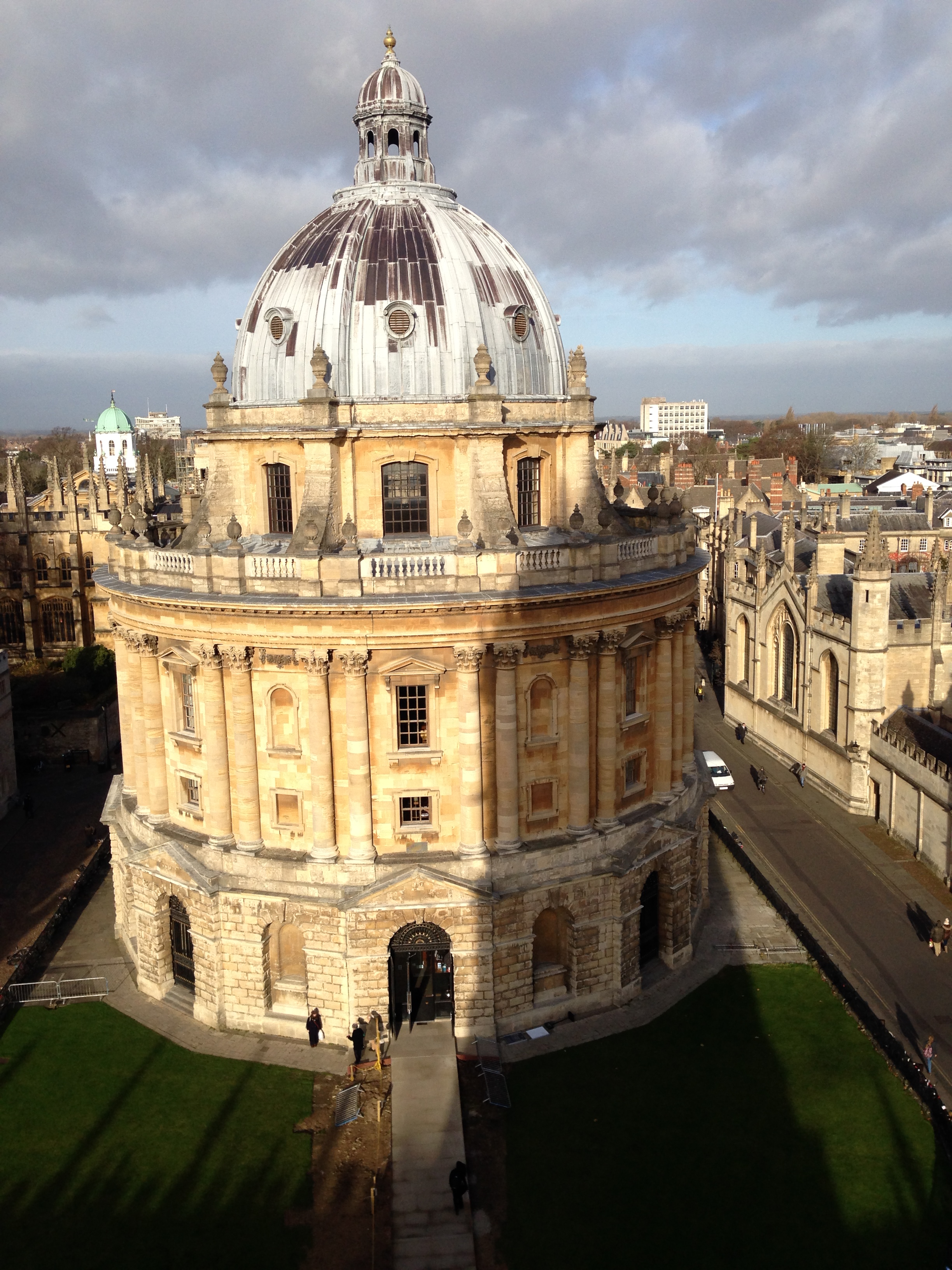
Here’s my attempt at a vaguely mathematical end: from the shaded area of a Venn diagram of Oxford and books, here is a picture of one of the most beautiful libraries you’ll ever see – the Radcliffe Camera in central Oxford.  The picture’s wonky because it was blowing a gale and I was up the top of the tower of St Mary the Virgin, where the wind was so strong I thought I, or at the very least my phone, was about to get whipped off the viewing balcony into the square below.  Thankfully we both made it back intact.

Image

“Everyone talks about the weather, but no one does anything about it.” (Mark Twain)

Being a Brit, I love talking about the weather.  Seriously.  I love the fact that it’s the usual conversation opener for the stranger next to you in the queue (another great British past time). I never tire of it.  There’s always something to say.  At the moment, that thing is: “Will this never end?  I’m melting. I’m honestly melting.  Look, my feet are fusing with the tarmac.  Look.” Yes, we are having a heat wave.  And my usual refrain in hot weather of “At least it’s not as bad as 2006” won’t work, because it is as bad as 2006. It’s too hot.  I live in London.  Over 30C is fine by the coast, but in a city that is ill-equipped to deal with it (there’s not exactly an abundance of air-conditioning; the Tube is like some sort of medieval torture oven masquerading as public transport; the shops are selling out of water, and people are leaving huge chunks of their own scorched skin in their wake) it’s truly revolting.  We had respite of one blissfully grey day and then that blistering ball of fire was back in the sky.  So I’m afraid there was only one choice for a theme for this week’s post, and it has to reflect my current obsession with all things meteorological (I’m checking the BBC weather pages every few hours in the delusional hope the forecast changes to gale-force winds and squally showers.  Not that I know what squally showers are but I’m pretty sure I’d welcome them right now. Although last night there was a thunderstorm & all that’s done is make the humidity worse.) I’ve chosen two novels that use stifling hot weather to further the oppression felt by their protagonists. For those of you suffering a heat wave, I hope it helps in the way CS Lewis identified: “We read to know we are not alone.”  For those of you in colder climes, I hope you feel a reflected warmth from the stories, you lucky, chilly people.

Firstly, A Crime in the Neighbourhood by Suzanne Berne (Penguin,1997).  This was Suzanne Berne’s first book and was pretty well-hyped, winning the Orange Prize and being compared to To Kill a Mockingbird. I’m sure the comparisons were well-intentioned, but who can live up to that?  To Kill a Mockingbird is about as perfect a piece of writing as you’ll come across.  It’s hardly a major criticism if I say this isn’t as good; few books are.  But A Crime in the Neighbourhood is still a well-written, atmospheric and insightful novel with plenty to say.

Set in 1972 with the Watergate scandal playing out in the background, 10-year-old Marsha tells the story of her suburban neighbourhood, where the  body of a 12-year-old boy has been found, raped and strangled.  Marsha has broken her ankle and so is somewhat confined, and her father has left the family for his wife’s sister.  As both her family and the wider community try to deal with the acts of violence that have been perpetrated, Marsha watches and tries to make sense of it all.

“It had been wet in March and early April, then suddenly it got very hot.  In just a few days, our big front yard went from a brown mat to a seething tangle of colour […] Blooming saturated the air, seeping in through open windows and under doors and into the sofa’s upholstery […] A kind of lawlessness infected everything.  Next door, eight-year-old Luann Lauder decorated herself with toothpaste one Sunday morning and ran across the lawn in only her underpants.  Boyd Ellison appeared on the playground one afternoon with a ten-speed bicycle he said was a birthday present but which looked just like our neighbour David Bridgeman’s bicycle, which had recently been stolen.  Blue jays screamed all day long. Even the grass looked unearthly green, as it does right before an electrical storm, when the air starts to hum and your hair stands on end.  And yet our neighbourhood was anything but lawless.”

The atmosphere in the neighbourhood becomes stifling both physically and psychologically.  Berne creates a sense of things quietly building towards a denouement, but not an outcome that can be trusted to bring resolution (we know from the start that the boy’s killer is never found).  When Marsha’s mother says “I sometimes think the suburbs are a distortion.” she picks up on the way human beings can warp what they see when emotions are heightened, and how dangerous this can be when it happens as a group.  Within this atmosphere, Marsha builds her notebook of Evidence:

“Among the details I overheard from my post on the porch, all of which I printed in my notebook with Julie’s Bic pen, are the following: Boyd Ellison was alive and had told the police everything. A man on a motorcycle had attacked him. A man with a beard attacked him. It was a bearded man with a foreign accent, maybe Dutch or Turkish. It was a hippie on drugs. Boyd was in a coma. Boyd had called out his mother’s name. He didn’t know who his parents were.  He was dead. He was alive. He was alive but just barely. He was dead.”

Marsha’s distortions will have a cataclysmic effect when she decides to voice them.  Although taking a single crime in the neighbourhood as its starting point, the novel actually concerns itself with many types of violence human beings can enact on each other, almost with indifference. However, the tone is realistic rather than downbeat, and so the novel is thought-provoking without being depressing.

A very different tale takes place within the sultry weather of The Mango Season by Amulya Malladi.  Now, this is a slight departure for me because generally I’ll only write about books I really rate, whereas I think The Mango Season is…OK.  It’s not a terrible book by any stretch, but it’s quite pedestrian in its language and the story is somewhat slight. However, I decided I would write about it as generally “summer reads” are usually something light by definition, nothing too taxing while you’re roasting your body by the pool.  And as a summer read The Mango Season fits the bill fine. Priya is living in the US, engaged to an American.  She returns home to India to meet her family for the first time in seven years, to try and deal with the fact that they want to arrange a marriage for her.  She returns in mango season, the hottest time of year:

“It was overpowering, the smell of mangoes – some fresh, some old, some rotten.  With a large empty coconut straw basket, I followed my mother as she stopped at every stall in the massive mango bazaar.  They had to taste a certain way; they had to be sour and they had to be mangoes that would not turn sweet when ripened. The mangoes that went into making mango pickle were special mangoes. It was important to use your senses to pick the right batch.”

The story plays out as you’d expect – Priya struggles to adjust to being back at home and the differences between America and India, and between her and her family. This is a light book and the dramas play out comfortably, The Mango Season is a comforting read. Malladi writes about India evocatively and with affection:

“Yellow and black auto rickshaws drove noisily on the thin, broken, asphalt road as I walked on the dirty roadside, sidestepping around rotten banana peels and other unidentified trash.  […] I stopped in front of a small paan and bidi shop where they sold soda, cigarettes, bidis, paan, chewing gum and black market porn magazines, the covers of which you could only see through shiny plastic wrappers. They were hidden, but not completely; you could once in a while catch a naked thigh or dark nipple thrusting against the plastic wrap. A man sat in a hole in the wall and looked at me questioningly.

Goli soda hai?” I asked.”

The Mango Season is a pleasant read, and when it’s this hot, that’s enough.

Here are the books basking:

Image

“There are two types of women in the world: those who like chocolate and complete bitches” (Dawn French)

Happy New Year! (for those of you using the Gregorian calendar).  It is one of life’s small cruelties that if you live in the Northern hemisphere, a grey, dark, cold time of year is also inexorably bound with resolutions to lose weight.  It’s entirely illogical: your body is bound up in layer upon chunky layer of clothing, and all you want to eat is comforting, stodgy carbs.  Far better to start a diet in March – its brighter, starts getting warmer, the prospect of salad is less likely to send you howling in despair from the room (unless that’s your modus operandi all year round, and you are not alone).  There’s a sense of approaching summer and the associated disrobing to act as an incentive to lose those extra layers you’ve acquired that you can’t hang in the wardrobe.  But right now its January. So, until those spring-like days, let us glory in girth, fellow book-lovers, and embrace loose baggy monsters.  This was Henry James’ term for those long Victorian novels, and they are perfect for this time of year.  If the holiday season has left you feeling like a baggy monster yourself, settle down with a huge book: you can wallow, a verb that suits your newly enormous body, in its vastness & lose yourself and the dark days that surround you; you can claim it’s a novella and make your body look smaller by comparison, optical illusion being so much easier than giving up all the fun stuff; and if you go for a paper version rather than an e-book the weight itself will act equally as well as a gym workout for your biceps (er, maybe). ‘Tis the season of the baggy monster!

I’ve gone for an obvious choice of baggy monster, George Eliot’s Middlemarch (published 1871-2. My copy: Penguin Classics 1965). Writing about Middlemarch is really difficult for me as it’s my favourite novel ever.  Ever.  And I find when things are that close to me, I can’t really explain them or talk about them objectively.  Lots of people can’t bear George Eliot and find her too intellectual and moralising.  Fine – I have no come back.  She’s both of those things.  But if you give Middlemarch a chance, the rewards can be huge.  The characterisations of the inhabitants of this middle-England town are fully drawn, as the length of the novel allows for such scope.  There is no reliance on stereotypes (Mr Dickens, take note), and even the unlikeable characters are understandable.  Eliot can be as witty and incisive as Jane Austen (“plain women he regarded as he did the other severe facts of life, to be faced with philosophy  and investigated by science”/ “she held it still more natural that Mr Lydgate should have fallen in love at first sight of her.  These things happened so often at balls, and why not by morning light, when the complexion  showed all the better for it?”), but for those of you who share my brother’s view that Austen is just “full of silly girls giggling behind fans” rest assured she’s also very different.  Virginia Woolf called Middlemarch “one of the few English novels written for grown up people”, by which I think she means that the story continues beyond marriage – the ultimate purpose of the plot is not achievement of a socially acceptable breeding arrangement but more a study of how people work, individually and within society.  There are big themes tackled: politics, education, professional fulfilment, religion…If that sounds dry, I promise there’s enough plot to keep you going, with the various stories of the ambitious Dr Lydgate, idealistic Dorothea, vacuous Rosamond, immature Fred Vincy… and now I’ll stop reducing Eliot’s great characters to a single adjective.  It’s also got Will Ladislaw in it, a Byronic hero who can easily equal Darcy in the “pouting air of discontent” love-god stakes, it’s just that the latter’s PR is so much more tenacious.  One of my tutors once told me he re-read Middlemarch regularly, and the final few paragraphs always made him cry (not that it’s  a tragic ending, just realistic).  I hope if you give Middlemarch a go, that it truly moves you.

In the course of writing the above paragraph I’ve realised that this post will turn into a baggy monster itself if I continue to attempt to capture these vast panoramic books in any sort of meaningful description.  So, like so many New Year’s resolutions, I’m going abandon my good intentions and instead write about a book that (in my copy) runs to a comparatively succinct 222 pages. Like Water for Chocolate by Laura Esquivel (published 1989. My copy: Black Swan, 1994), unlike the baggy monsters, keeps the plot fairly simple – Tita and Pedro love each other, tradition dictates they can’t be together, so he marries her sister to be around her.  You may not get a wallow in the depths of 800+ pages but it’s still a great choice for this time of year.    Firstly, its set in Mexico (and I should admit I read it in translation, if you can read it in the original Spanish so much the better) so if you can’t afford a warm holiday away from all the grey you can at least travel between the pages of a book.  Secondly, each chapter has a month title and an associated recipe and is hugely evocative around food: vicarious calories are delicious and also involve no cheating from your diet if you are insane enough to try and lose weight in January.  Amongst quail in rose petal sauce (March) and northern style chorizo (May) there is also a recipe for making matches (June), just in case you wondered. Finally, it is magic-realist in style: the female protagonist’s birth sees the kitchen awash in tears “When the uproar had subsided and the water had been dried up by the sun, Nacha swept up the residue the tears had left on the red stone floor. There was enough salt to fill a ten-pound sack – it was used for cooking and lasted a long time.” A bit of unreality – just what you need to help face the harsh realities of a northern winter.

So settle down with a great (in terms of both literary value and/or size) book and enough provisions to see you through (e.g. Kendal mint cake, or a family bar of chocolate.  With the latter you can always claim to be striking a blow against sociocultural constructions as a method of control (or something) by eating it all yourself.  This also works for family bags of crisps) and enjoy! I was planning to picture the books alongside some mojito cupcakes that I’d made for a friend’s birthday, but they went totally wrong – possibly due to the fact that my scales broke and so I guessed all the ingredients weights.  Hmmn, thinking about it, that’s almost definitely where my error lay. This succeeded in putting me in a cranky mood and incapable of thinking of another picture so instead here is a baggy monster who lives with me.  Proof, if proof were needed, that the world is a better place for having baggy monsters in it.

Image