Novella a Day in May 2023 – No.28

La Bastarda – Trifonia Melibea Obono (2016 trans. Lawrence Schimel 2018) 88 pages

My Around the World in 80 Books reading challenge is getting more difficult – but definitely possible – the closer I get to finishing, because I decided I’d only count books written by a person from that country, rather than just set there. This means I’m dependent on what is available in translation. So I was excited to come across La Bastarda, written by an author from Equatorial Guinea, and grateful to The Feminist Press for publishing it.

I didn’t realise until I’d finished it and googled further, that it’s a famous novella, banned in Equatorial Guinea and with its own Wikipedia page. It’s a wonderful read, so evocative and with a clear and compelling narrative voice. (The English translation also has a really interesting afterword by the historian Abosede George.)

The story is told by Okomo, who lives with her grandparents in a village close to the border with Gabon. The family is polygamous which makes the home crowded and busy, but she is isolated due to the circumstances of her birth:

“My mother got pregnant when she was nineteen and died while giving birth, her death brought about by witchcraft. From that moment I was declared a bastarda – a bastard daughter. I had been born before my father paid dowry in exchange for my mother. That’s why society looked at me with contempt and people called me ‘the daughter of an unmarried Fang woman’ or ‘the daughter of no man’.”

As an older teenager she is beginning to question the life mapped out for her and what she wants. She is keen to locate her father but this is absolutely forbidden by her grandfather Osá who lectures her on the history of the Fang people and her responsibilities:

“[My grandmother] told me to ask Osá if there were any women in our tribe since he had failed to mention any in his collection of heroes, but I didn’t obey.”

Okomo isn’t interested in her appearance or in marrying a man, running a home and having children, all of which are expected of her. She knows she may have an ally in her mother’s brother, the only person who has ever shown her any affection. But he is somewhat ostracised too:

“Uncle Marcelo was an isolated man who lived outside of society because he was a fam e mina or a ‘man-woman’ the men of the tribe accused him of this both in public and in private.”

While Okomo is trying to work all this out, she is drawn into the sphere of three older girls, and discovers her sexuality. She falls in love with Dina, who reciprocates her feelings. But in a small village, where same-sex relationships are taboo, theirs is a love with great risk attached to it.

La Bastarda is a tense narrative where the dangers for the girls and for Marcelo are made very clear. But it is also a story of first love, coming of age, self-discovery and the nurturing of chosen families. It addresses huge issues in such a short space without ever losing sight of the individual characters. A finely balanced story of defiance and resilience.

Novella a Day in May 2023 – No.25

Ms Ice Sandwich – Mieko Kawakami (2013 trans. Louise Heal Kawai 2017) 92 pages

A nine-year old boy tells the story of a short period of time where he has a crush on the young woman who works at the sandwich shop in the local shopping centre. He never speaks to her but lines up to stare at her and buy a sandwich.

“‘Ms Ice Sandwich’ is a name I made-up, of course. I thought of it minute I first saw her. Ms Ice Sandwich’s eyelids are always painted with a thick layer of a kind of electric blue, exactly the same colour as those hard ice lollies that have been sitting in our freezer since last summer. There’s one more awesome thing about her – if you watch when she looks down, there’s a sharp dark line above her eyes, as if when she closed her eyes, someone started to draw on two extra eyes with a felt-tip pen but stopped halfway. It’s the coolest thing.”

The story could so easily be creepy or at least unnerving but it really isn’t. He’s young, quite lonely, and navigating that period of older childhood as friends change and he tries to work out who he is. His mother is distracted, his elderly grandmother is extremely frail, and his father has died.

Child narrators are so difficult to get right, but I really thought Kawakami pulled it off. The boy uses the striking imagery that children sometimes access “Bicycles are lined up like mechanical goats.” without it feeling too knowing for someone of his age. I thought this was done especially well when he is trying to describe his feelings for Ms Ice Sandwich:

“Like when you’re holding a cat and you touch it soft belly. Or sticking your finger in a jar of jam and stirring, then slowly sinking in all the rest of your fingers. Or licking the sweet condensed milk at the bottom of your bowl of strawberries. Or when a blanket brushes the top of your feet. Or when butter turns transparent when it melts over your pancakes. As I stand gazing at Ms Ice Sandwich, all of these things are happening to me, one on top of the other, right there.”

The boy doesn’t try to build a relationship with Ms Ice Sandwich and I think it would have lessened the story if he did. Instead we see his gently burgeoning friendship with classmate Tutti, who is also bereaved for a parent, and some very touching scenes between him and his grandma, so delicately realised.

“The little bit of golden sun that shines through the shoji screens on the window lights up the white areas of Grandma’s quilt, making a faint shadow of leaves, and each time the wind blows outside, the shadow pattern of leaves shakes a little bit. I go over to Grandma and I hold my breath for a moment. The room goes very quiet.”

Ms Ice Sandwich captures a particular time in a young boy’s life with sensitivity and compassion. By capturing ordinary moments between people so precisely it demonstrates something universal that carries far beyond childhood.

Novella a Day in May 2023 – No.23

Marie – Madeleine Bourdouxhe (1943 trans. Faith Evans 1997) 141 pages

The striking cover of Marie and the fact that it is published by Daunt Books was enough to convince me to pick up this novella, and I’m so glad I did. I’m not familiar with Belgian writer Madeleine Bourdouxhe’s work but the afterword explained she was a friend of Simone de Beauvoir and Victor Serge, among others, and she was part of the resistance during the war, so I’m glad to have finally discovered her.

Marie was published in 1943 and details the sexual awakening of a young married housewife (the original title was A La Recherche de Marie, maybe it was felt Anglophone readers wouldn’t get the reference to Proust?) It has an elegiac tone at times – not only for Marie but for everyone she encounters and for the city of Paris – and I felt the spectre of war was certainly present.

It begins with Marie and her husband Jean on holiday in the south of France, away from their Parisian home:

“It wasn’t as hot as earlier on, but as the afternoon came to an end, everything remained steeped in torpor, retaining the heat of the whole day. There is something ineffable around Marie that was making her happy. Jean was next to her, serving her coffee, giving her a cigarette: and intimate little scene, on the balcony of a hotel, overlooking the sea.”

Marie seems very devoted to her husband, but the authorial voice – which shifts between tenses –  suggests he not entirely worthy:

“There was definitely strength in his character – or rather, there were bouts of strength. Jean had a way of claiming his due, or more than his due: a somewhat egotistical way of deciding, of drinking, of eating, of sitting, of occupying his place.”

During this holiday Marie finds herself strongly sexually attracted to a man around ten years younger than her. Their affair continues beyond the holiday season and Bourdouxhe is wonderful at minutely analysing unspoken moments between people:

“They mutually accept this great silence, and the richness, the sincerity that lies within it. They also know that in that moment they are seeing everything from the same point of view and that, for both of them, that red sail on the sea stands out as clearly, as harshly, as cruelly, as the thing that is deep inside them.”

There is a lot to this seemingly straightforward tale. The lover remains nameless and none of the characters are as fully drawn as Marie. She is absolutely Bourdouxhe’s focus, through which she explores the roles of women, sexuality, agency, choice.

The war also creates a sense of foreboding for everyone the story touches. Having googled, I know the town that Marie and Jean find themselves in at one point was 90% destroyed in 1940.

Marie is a woman with a rich inner life and a sensual response to her surroundings. As she starts to externalise some of this, Bourdouxhe shows how unknown people can be even to those closest to them, the pressure of societal forces for women, and the challenge in making an inner and outer life congruous with one another.

Marie is a powerful novella and I’m looking forward to exploring this author further.

“She weeps the strange, bitter tears of an exhausted woman who is gradually letting herself be worn out by a symbol.”

Novella a Day in May 2023 – No.20

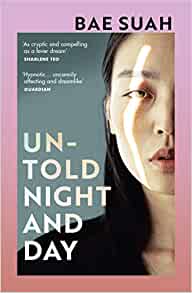
Untold Night and Day – Bae Suah (2013 trans. Deborah Smith 2020) 152 pages

When I see writing described as dreamlike, I often think of highly metaphorical language, perhaps with a heavy emphasis on sensory experience, and with an unreal quality. Untold Night and Day is definitely dreamlike, but not quite in the ways I’ve described.

It initially seems very much grounded in everyday experiences. Where it becomes dreamlike is that it follows its own logic, jumping about with recurring motifs, in a way that makes sense within itself but becomes more disconcerting the more you consider it.

“A man carrying a kitten in a birdcage pressed himself against the opposite wall of the alley to avoid her car. He was a preacher, a well-known figure in this alley; he went around surreptitiously stuffing pieces of paper bearing Bible verses into people’s pockets, so he’d been mistaken for a pickpocket and arrested more than once. While she waited for the lights to change at the end of the alley, the woman driving the green car took her hand off the wheel and raised a bottle of water to her lips. Still with the phone to her ear. Against the regular growl of the engine, the hum of the air conditioning.”

These images and characters recur throughout the novella, each time with their context slightly shifted. There are other repeated motifs, including to The Blind Owl, a deeply disturbing novella which I read back in 2019. The shifting repetitions unsettle the story but also ground it in its own world.

Ayami is a former actor who works at an audio theatre. We join her at the end of her last shift, in the oppressive heat of Seoul, where through the night she and her boss search for their missing friend Yeoni. The following day, she shows round a German writer who never wanted to be in Korea in the first place.

The two times echo each other and almost merge, but whenever the narrative almost seems on the verge of entirely disintegrating, it holds on to that interior logic and somehow pulls you along, trying to work out what is happening and where Yeoni could be.

“That was the secret of night and day existing simultaneously. Ayami discovered this through a single movement, bending down to pick up the pebble. And, remembering this simultaneous existence more vividly than she remembered herself, became unable to remember anything else.”

I realise this may be an entirely unhelpful review as I’ve not really said very much! But hopefully I’ve given a sense of why this novella is hard to describe and hard to review. I enjoyed it, but definitely not one to read when you’re in the mood for a linear plot and all questions answered at the end…

“I have to record whatever comes into my head in the same place it happens. Things occur to me as images, and as forms, not as words arranged into sentences. The images quickly dissipate after the moment’s passed, and once that happens there’s no way for me to capture them in language.”

Novella a Day in May 2023 – No.17

Count d’Orgel’s Ball – Raymond Radiguet (1924, trans. 1989 Annapaola Cancogni) 160 pages

Raymond Radiguet was only twenty when he died, having published two novels, of which Count d’Orgel’s Ball was the second, some poetry and a play. He had led a life that brought him into contact with the foremost artists of the day, including Picasso and his lover Jean Cocteau, who wrote the foreword to the NYRB Classics edition I read.

This made me a bit trepidatious in approaching this novella, wondering if it was a piece of juvenilia that wouldn’t have otherwise garnered much attention. But I shouldn’t be so ageist, because I really found a lot to enjoy in Count d’Orgel’s Ball.

It tells the story of a love triangle amongst the beautiful and privileged in the 1920s. Mahaut is from an old family, and desperate for love when she marries young:

“She recovered some of the freshness of her early childhood when, at eighteen, she married Count Anne d’Orgel, one of our country’s best names. She fell madly in love with her husband who, in return showed her much gratitude and the warmest friendship, which he himself took for love.”

She adores her sociable and brilliant husband, who is fairly harmless but entirely vacuous:

“Nobody knew the reason for his prestige or, at least, for his brilliant reputation. His name had little to do with it since talent comes first even amongst those who worship names.”

Into their world comes François de Séryeuse, a young man not entirely enthralled by the Count’s charm and prestige. This works in his favour and the three spend more and more time together.

“He [the Count] adopted people more than he made friends with them. In return, he demanded a lot. He wanted to lead the way, to be in control.”

The Count doesn’t sustain control though, as François and Mahaut fall in love. For me this was the weakest point of the novella. Radiguet is excellent at observing people and social situations; he is incisive regarding pretention and social mores. Where the story falters for me is in creating fully rounded characters and the emotional ties between them. But perhaps I’m being unfair, as Radiguet is describing a world filled with shallow and/or naïve people. He doesn’t view them as having great emotional depth:

“It would be safe to say that François’ ideas on love were ready made. But since he had made them himself, he believed they were cut to size. He did not realise he had cut them out of limp feelings.”

The writing style is fluid and often scathing. It’s so readable and entirely unflinching in its view of a particular part of society at a particular time.

I thought there were a few rough edges at points in Count D’Orgel’s Ball; a tendency to tell rather than show, and characters as vehicles for social satire rather than fully recognisable people. But these are little quibbles and having written this novella at nineteen, I can only wonder what Radiguet would have achieved had he lived longer.

“Happiness is like good health: one is not aware of it.”

Novella a Day in May 2023 – No.14

Moonstone: the boy who never was – Sjón (2013 trans. Vicotoria Cribb 2016) 144 pages

I really loved Sjón’s novella The Blue Fox when I read it back in 2016, and since then I’ve failed to pick up anything by him at all. Moonstone was good choice for a return as I found this novella lyrical and involving.  

(I should warn anyone picking up this novella that it opens with a very explicit scene, and given that one of the characters is referred to as ‘the boy’ I thought I’d been plunged straight into the details of a sexual assault. Thankfully that was not the case.)

Máni Steinn Karlsson is living in Iceland in 1918, a time of profound change. The Katla volcano erupts:

The volcano is painting the night sky every shade of red, from scarlet through violet to crimson, before exploding the canvas with flares of bonfire yellow and gaseous blue.

The influenza epidemic takes hold:

“The young people glance around, and only now does it dawn on them how many members of the audience have been taken ill: every other face is chalk-white; lips are blue, foreheads glazed with sweat, nostrils red, eyes sunken and wet. Silence falls on the gathering.”

and Iceland votes to be independent from Denmark.

Máni is an outsider, raised by a foster mother, isolated at school and gay at a time when this was illegal in Iceland. He escapes to the cinema, and through this new medium become fixated with Sóla G, a young girl around his own age:

“It was when the girl stood up to leave that it happened. The instant her shadow fell on the screen they merged – she and the character in the film. She looked around and the beam of light projected Musidora’s features onto her own.

The boy froze in his seat. They were identical.”

As Máni carries on with his life through these extraordinary circumstances, he is brought closer to Sóla G and to the dangers of living in ways that society deems unacceptable, the least of which is his love of cinema.

Sjón’s writing is crystal clear and beautifully evocative. He balances reality and fantasy with delicate precision, each blending into the other, without ever losing his characters or the impact of his story. [Slight spoiler in the next sentence, please skip if you prefer!] The metaphysical ending may not be to everyone’s taste but I thought it worked perfectly and found it truly moving.

“He’d had no inkling that when the pestilence took hold Reykjavík would empty and convey the impression that nothing was happening at all; that the town would become an abandoned set that he Máni Steinn could envisage as the backdrop for whatever sensational plot he cared to devise, or, more accurately, for the kind of sinister events that in a film would be staged in this sort of village of the damned – for these days the real stories of being acted out behind closed doors. And they are darker than a youthful mind can begin to imagine.”

Novella a Day in May 2023 – No.13

Lost Profile – Françoise Sagan (1974 trans. Joanna Kilmartin 1976) 142 pages

This novella follows a young woman, Josée, as she leaves her abusive husband Alan and is drawn into the orbit of the controlling Julius A.Cram, all within the social sphere of incredibly rich Parisian socialites.  

Sagan has very little time for this echelon of society:

“We talked of this and that, in other words nothing, with the tact that characterises well-bred people once they are at table. It seems that it only takes a knife, a fork, a plate and the appearance of the first course to induce a kind of discretion.”

Josée does very little at the start of the novel and seems to drift around, content to be entirely idle, which makes her vulnerable. She blames herself for her husband’s abuse and then in leaving him finds herself controlled by another man, albeit in a very different way. Julius is an enigmatic character who also seems to operate on the periphery of their social set. Both are lonely in their way, and the people they pass time with are entirely self-involved, so with the exception of her friend Didier, there is no-one to warn Josée of the danger she is in.

“It was an idiosyncrasy common to each individual member of that little set to refer to all the rest as ‘the others’, as though he or she were a paragon of virtue and a superior intelligence who had strayed into a bunch of contemptible socialites.”

As Josée tries to get her life together, the reader has greater awareness than she does herself. We can what is happening in her circumstances that she remains blissfully unaware of, and we can see how these circumstances will play out. She is incisive and clearsighted regarding others, but not remotely self-reflective:

“They were an amiable couple, great friends of Irène Debout, who, having exiled themselves far from Paris out of a grotesque affectation for the simple life, spent their time when they came to the capital, roughly 100 times a year, extolling the charms of solitude. They lived for their weekend house parties.”

Lost Profile is a slight tale, but I always enjoy Sagan’s writing. This was mainly enjoyable for the bitchy portraits of the rich and idle – a quick read, just the right length for the subject matter.

“Perhaps, one day, I too would reach the point of being able to tolerate only a sort of carbon copy of myself, black and white, colourless and spineless. Ah yes, the time would come when I would bicycle without ever leaving my bathroom, chewing pills the while to send my feelings to sleep. Muscled legs and flabby heart, a serene face and a dead soul.”

I’ve mentioned before the terrible 1970s/early 80s Penguin covers for Sagan’s work, and this one is no exception:

Novella a Day in May 2023 – No.11

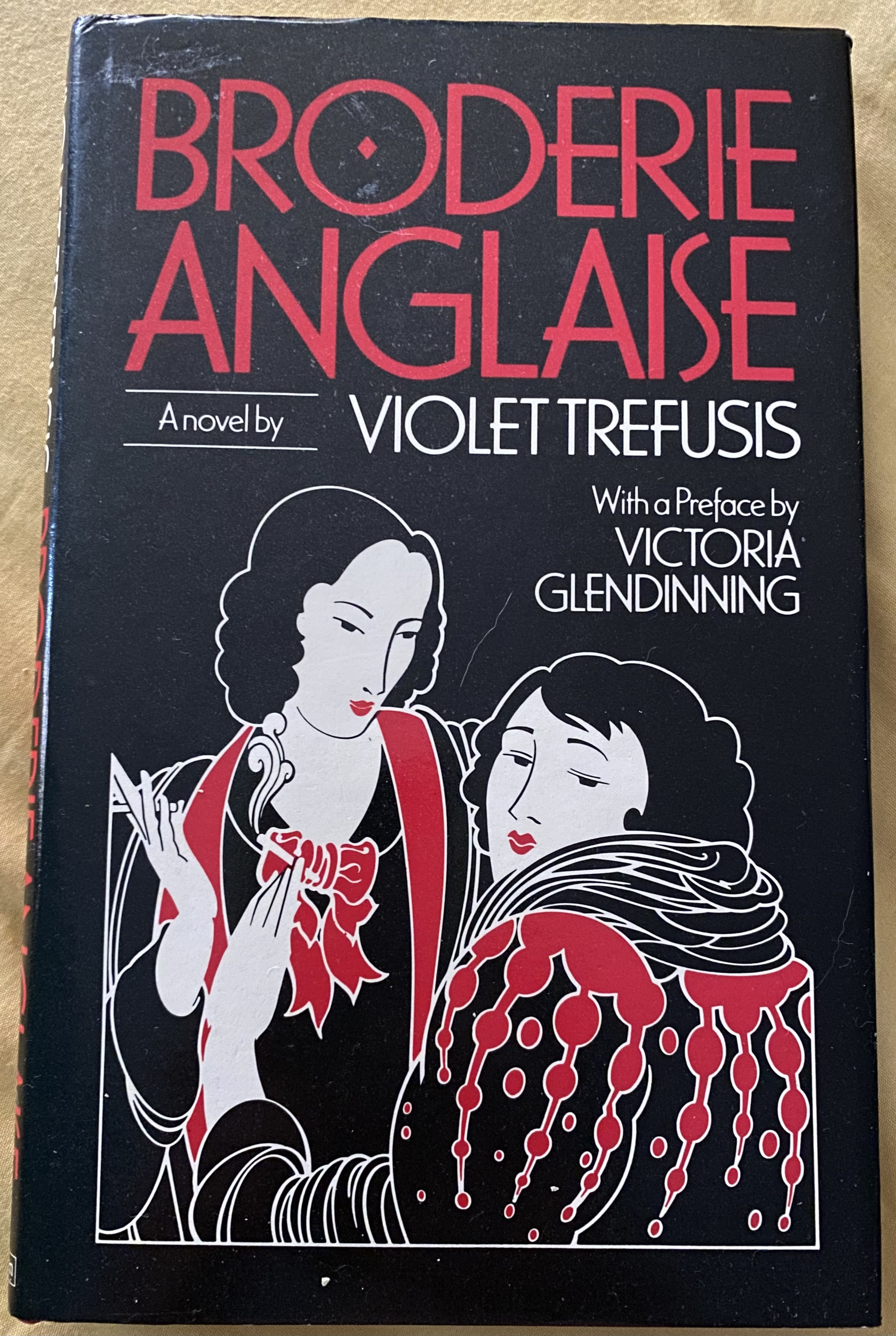
Broderie Anglaise – Violet Trefusis (1935 trans. Harcourt Brace Jovanovich Inc. 1985) 120 pages

My main reason for picking up Broderie Anglaise was an interest in Violet Trefusis because of her links to Vita Sackville-West, and through her, Virginia Woolf, rather than the novella itself. Although I did enjoy Hunt the Slipper when I read it a few years ago, I was primarily interested to see the characters of Vita and Virginia as conjured in this novella, and the portrait of Knole, Vita’s ancestral home.

Alexa is a celebrated English writer (no prizes for guessing who she represents) who is having an affair with Lord Shorne (Vita). Casting a long shadow over their liaison is his broken heart from a relationship with Anne, a distant cousin (Violet).

“He said to himself that this was exactly the companion he needed – humane and sympathetic and at the same time rather sexless.”

It’s worth noting that Broderie Anglaise was published in French and only translated for the Anglophone market in 1985. Victoria Glendinning says in her preface to this edition that she doesn’t think Vita or Virginia were aware of the novella’s existence. So although the portraits can be quite acidic at times, it’s definitely an easier read knowing that no-one they represented ever read them.

It’s difficult to convey the mind of a genius when you are not a genius. Trefusis wisely glosses over Alexa’s writing and sticks to her anxieties around her affair, and more mundane concerns:

“Alexa went and sat by the window, at the mercy of the light, now no one else was there. A sluggish drizzle was falling. She looked up at the sky. Its full, baroque clouds were like a gathering of Marlborough’s contemporaries – all scrolls and whorls, from their wigs to their shoes. The sky’s not very imaginative, she thought, it always reminds me of something.”

The first part of the novella is Alexa’s anticipation of meeting Anne, when a mutual (oblivious) friend arranges a meeting. She reflects on her affair with John and what little she knows of Anne. The affair is not romanticised; it’s treated with some degree of irony and humour.

“Arm in arm they went up the slippery staircase that led to the state apartments. Alexa supported him. He was the Lord, the ravisher. She was about to become his mistress. They had to go through eight drawing rooms in all – a long way for a couple who had been drinking.”

Violet definitely doesn’t idolise either Vita or herself in the character of Anne. I felt she treated all three as flawed people, struggling to understand the circumstances they found themselves in.

Where she did portray a monstrous person was in the character of Lady Shorne (Lady Sackville). Controlling, intrusive, inappropriate, surrounding herself with trappings – she was truly malevolent.

“The tiny room, cluttered with carefully illuminated pieces of amber, each one lit up from within by its own mocking flame; her hostess, sitting motionless like a big spider in the middle of her web – all combined to make Alexa ill at ease.”

Broderie Anglaise is slight, but it’s definitely worth a read, particularly for those with an interest in Woolf/VSW. The portrait of Lord Shorne’s home Otterways has echoes of Orlando’s estate, being as they are both portraits of Knole. It’s also interesting to see how the Russian Princess of Orlando (Violet) chose to portray herself given a chance. She can be a witty and precise observer:

“‘I use up all my vital force in my books. There’s nothing left over for life,’ she suggested, with the famous touching smile which was so admired in the literary world but which John found exasperating because it was to be seen in all her photographs.”

Ultimately I felt Violet wasn’t overly settling scores here, but rather making a plea for not idolising lovers, even when they are from glamorous families, or are the foremost writer of their generation. She suggests that truly seeing people and situations may be painful, but it is really the only way towards enduring and authentic relationships.

Although she does use a play on words at the end to give herself the final say. And why not, it’s her novella after all 😀

“This was just the sort of thing that irritated him most. She was sentimental when she should have been satirical, obstinate when she should have been amenable.”

Novella a Day in May 2023 – No.7

A Sunday in Ville-d’Avray – Dominique Barbéris (2019, trans. John Cullen 2021) 152 pages

For the first Sunday of this month of novella reading, a novella set on a Sunday! I was alerted to A Sunday in Ville-d’Avray by Jacqui’s excellent review and so I was delighted when I came across a copy in my local marvellous charity bookshop.

“On Sundays, you think about life.”

The narrator (referred to as Jane on the French flap blurb although I don’t remember her being named in the text) goes to visit her sister in the Parisian suburb of Ville d’Avray for the afternoon. The sisters have intermittent contact and Jane’s urbanite boyfriend Luc seems to have an ambiguous relationship with both his in-laws and the suburbs. For this visit she is alone:

“And so I was full of memories, I was in the melancholy state of mind that often comes over me when I go to see my sister, and I think I started by getting a little lost in Ville d’Avray, by driving through the provincial, peaceful streets of my sister’s neighbourhood, past private houses their gleaming bay windows, their porches, their phony airs (Art Deco villa, Norman country house), their gardens planted with rosebushes and cedars.”

Nothing really happens, and yet the afternoon is full of significance. The sisters sit out in the autumn afternoon and Claire Marie recounts a chaste affair with a man called Marc Hermann. He has both a mysterious past and present:

“She was almost sure that he was lying to her about a great many things, but she felt certain that he was alone and that his solitude was complete, so dense that she could perceive the space it occupied around him, and that solitude touched her heart.”

It is the atmosphere rather than the plot that gives this novella its power. It captures perfectly that quiet, subdued feeling of a Sunday afternoon, anticipating the activity of the week ahead. There is also an unsettling quality to it: the fading light as the sisters sit, the repeated references to the forests that surround the suburb where Claire Marie and Marc would walk; the fear of burglars and invasion.

Jane is at once the first-person narrator and the silent interlocutor. This is a novella of liminal spaces: temporal, geographical and psychological. Barbéris expertly holds the reader between these spaces in the story, destabilising the narrative.  Nothing overt is said or done, but gradually there is a sense of not trusting what we are being told. But should Jane not trust Claire Marie or should the reader not trust the narrator?

I’m sure the atmosphere of this novella will stay with me. A perfect Sunday afternoon read.

“Ever since the neighbour had mowed his lawn, the whole street smelled of cut grass. I don’t know why the smell of cut grass can give you such a feeling of sadness, and also such a violent desire to keep on living.”

Novella a Day in May 2023 – No.3

Lemon – Kwon Yeo-sun (2019 trans. Janet Hong Higgins  2021) 147 pages

I thought the cover of Lemon was absolutely perfect. The simple image of an absent woman suspended in sky strikingly captures the unsettling quality of this story about a murdered young woman.

Lemon is not a whodunit, although I think that central question is answered obliquely. There is no satisfying resolution with all the ends tide up neatly – that is not what this novella is about. Rather, it is about people struggling to find a way through life when it has been touched by a violent crime. It is about how to try and find peace when there are no easy answers.

The murder of 19-year-old Kim Hae-on in 2002 shocks the local community. The killer is not found, despite two local boys being suspected. Predictable tabloid sensationalism means it becomes known as the High School Beauty Murder, as Kim Hae-on was strikingly beautiful and somewhat unknowable. Yet beyond the cliches lies a life taken and a grieving family.

The various chapters in Lemon have different narrators between 2002 and 2019. It begins with Hae-on’s younger sister Da-on, struggling to understand who she is in the wake of her sister’s killing.

“Does this mean I’m still not free? That I’m not free, not one iota, from those smooth, fair, irrelevant details from 16 years ago, those endless memories of my sister’s loveliness, which had made me undergo plastic surgery, turning my own face into a crude patchwork of her features?”

We gain perspective on Da-on from the memories of a classmate, Sanghui:

“Da-on, the younger sister, was the one who looked after Hae-on, as one would after a little sister. She’d stop her big sister on the street before they reached the school gate and then circle her examining the front and back of her uniform to make sure nothing was out of place.”

[..]

“Then you could witness the older sister fleeing gracefully down the hall or across the school field with her long lithe limbs, while the younger one raced shrieking after her, like some wild animal. They seem never failed to give both teachers and students a good laugh. That was Da-on’s gift. She had a lively, bubbly kind of warmth that could pull Hae-ons devastating, otherworldly, even glacial, beauty into our reality, dissolving it in laughter.”

We learn later on that there was a clear reason for this protectiveness. Hae-on seemed unaware of the modesty expected in society and could forget to wear underwear, sitting in a way that exposed this. Da-on would try to ensure this didn’t happen but the external misreading of this behaviour probably played a part in her sister’s disappearance. There is never any sense of victim-blaming from any of the narrators in Lemon, with one exception and the reader is clearly not expected to align with those views.

More details of the day of the murder emerge through the shifting views, bound up in the lives that continued beyond. There is real sadness here, particularly in the grief of Hae-on’s immediate family and also for Han Manu, one of the suspects.

There is a haunting quality in Lemon. It is never so crass as to make the murder of a young woman anything other than it is; it is not gory entertainment nor is it made easier through a suggestion of any sort of metaphysicality. But by capturing the  fallout of the violence onto the everyday lives of those who knew Hae-on, Kwon Yeo-sun expertly demonstrates the ongoing destructiveness of a life taken.

“It will go on endlessly, until the end of Da-on’s life, or maybe beyond that. Not being able to put an end to an incident so horrific – I couldn’t begin to imagine that kind of weight on her life.”