10 Most Influential Books – Part 1

This is a bit of a departure from my usual sort of post, but it seemed like such a pleasant thing to do that I thought I would ring the changes.   I was tagged by Emma over at A Wordless Blogger  to take part in writing about the 10 Most Influential Books in your life, which was started by Leah at The Perks of Being a Bookworm.  Having never been tagged before I found myself ridiculously excited at the prospect.  It also seemed like a good fit, as I think it’s a positive thing to look at books that have shaped you; hence it’s in keeping with the ethos of this blog, which is to write (mostly) positive things.  It’s also inadvertently become the ethos of this blog to never use one word where ten will do, so I’m splitting this challenge into 2 posts. So here we go: The first 5 of 10 books that have influenced me, as I thought of them today.  I’m sure if I wrote this post tomorrow I’d come up with a different 10, but onwards we go!

Middlemarch – George Eliot

middlemarch_eliot

(Image: http://earlywomenmasters.net/dickinson/a_garden_tis/imaginings/slides/middlemarch_eliot.html)

I’ve blogged about this before – badly.  Middlemarch is my favourite novel ever (it’s the one I’m holding in my gravatar image) and as result I find it nigh on impossible to discuss, because I can’t get any distance.  I just adore it, and to me it has everything – love, death, humour, tragedy.  Eliot captures life by looking at a small Victorian town and its inhabitants.  It can be an intimidating read: a massive Victorian tome, but if it speaks to you, you’ll love it.  Don’t just take my word for it, Rebecca Mead’s The Road to Middlemarch: My Life with George Eliot documents her changing relationship with the novel throughout her life, how it offers different things to readers at different times.  Which reminds me, it’s about time I re-read it….

“the growing good of the world is partly dependent on unhistoric acts; and that things are not so ill with you and me as they might have been, is half owing to the number who lived faithfully a hidden life, and rest in unvisited tombs”

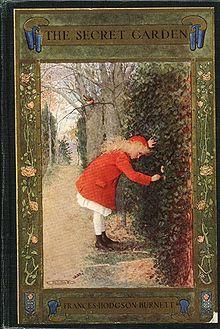
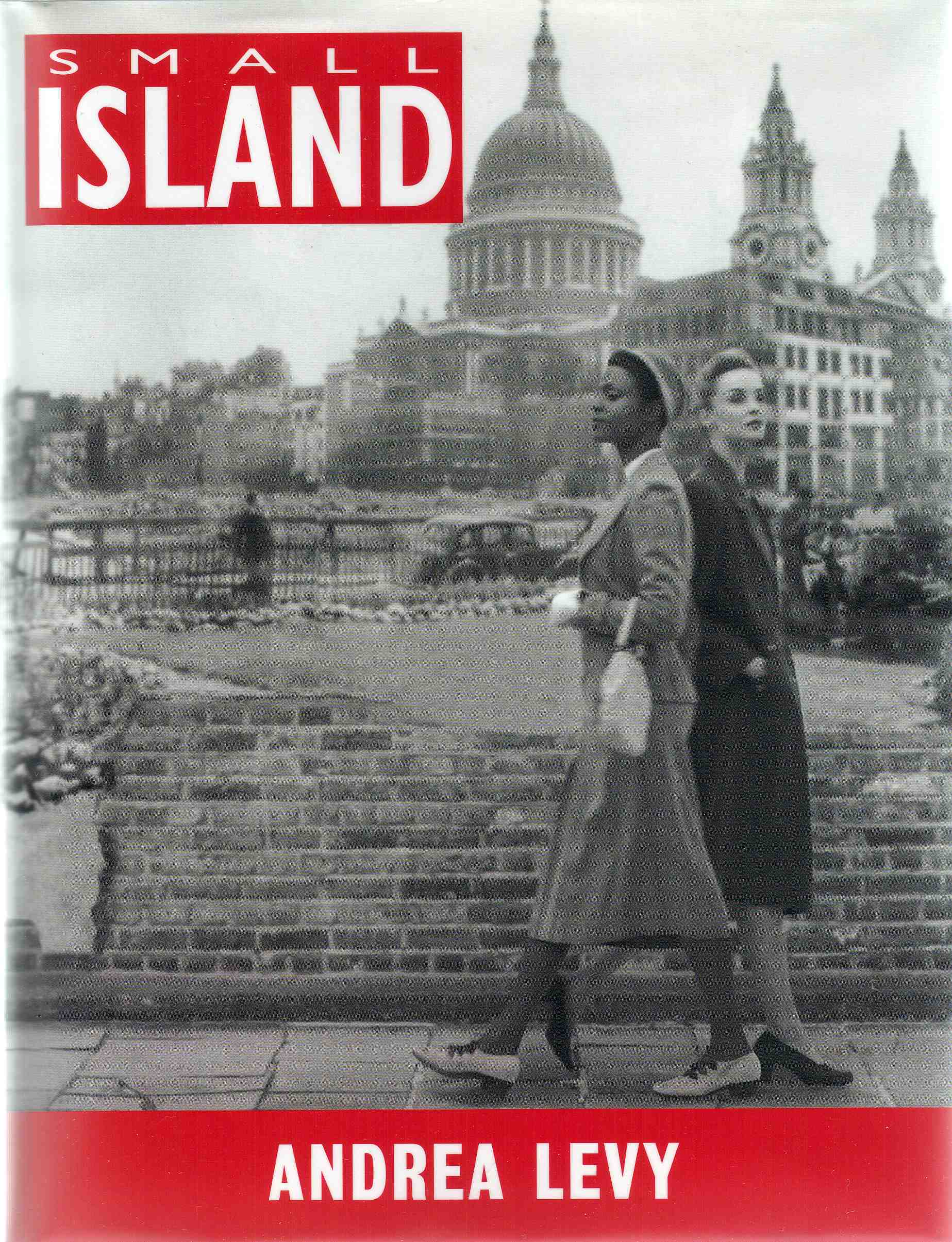
Small Island – Andrea Levy

8116

(Image from: http://100books.co.uk/andrea-levy-discusses-her-novel-small-island-for-bbcs-world-book-club)

I’ve blogged about this novel before, too.  It changed the way I view my world, so it has to be on this list.  I grew up in London, decades after the Windrush generation had arrived.   I knew there had been a massive wave of immigration to the UK after World War II.  I knew that the UK had begged these workers to come, and then crapped all over them from a great height.  I grew up in a multi-cultural city that I loved, and went to school with kids whose parents and grandparents came from all over the world.  As the Windrush generation ages, I cared for some of them in my capacity as a healthcare professional.  I thought I had a fairly good understanding of what happened, but Small Island made me feel it like never before.  To leave your family and friends and come to a cold grey country which has promised you a grand welcome and instead treats you appallingly because of the colour of your skin.  To live in this country all these years and for it never to feel like home.  The Windrush generation are dying – talk to them now while you still can.

 “You wan’ know what your white skin make you man?  It make you white.  That is all, man.  White.  No better, no worse than me – just white.”

 Complete Works of Shakespeare

Shakespeare-Othello-16x9-1

(Image from (http://www.sky.com/tv/show/othello)

OK, so I’m cheating.  This is 39 plays (or so, debate continues), sonnet sequences, longer poems, and so on.  But he’s the love of my life, you can’t expect me to be objective about the love of my life, surely?  I survived the terrible teaching methods that cause most people to despise Shakespeare, and he’s been alongside me ever since.  If I could only have one book for the rest of my life, this is the one.  It’s all I need.  Here is Prospero’s speech from Act 4 Scene 1 of The Tempest, which many interpret as Shakespeare’s farewell to the stage.  Read it and weep, people:

Our revels now are ended. These our actors,
As I foretold you, were all spirits, and
Are melted into air, into thin air:
And like the baseless fabric of this vision,
The cloud-capp’d tow’rs, the gorgeous palaces,
The solemn temples, the great globe itself,
Yea, all which it inherit, shall dissolve,
And, like this insubstantial pageant faded,
Leave not a rack behind. We are such stuff
As dreams are made on; and our little life
Is rounded with a sleep.

The Weir – Conor McPherson

This play was revived recently in the West End, but the tyranny of finals meant I couldn’t go.

I was so disappointed not to see it again, as it’s no exaggeration to say this play changed my life.  Until I saw The Weir, I liked theatre, but I didn’t love it.  So many people love theatre that I knew I was missing something, but I didn’t know what or how to get it.  The Weir gave it to me.  It was magical.  It held me suspended, as great drama does, in that space that the audience occupy when you’re trying to remember to breathe.  It showed me how intimate and enchanting theatre can be.  And once my eyes were opened, there was no going back.  Being in the audience of a theatre is one of my favourite places in the world.  I’m hoping to do postgraduate study from September, looking at dramatic literature and the theatre.  I’ve forgotten to breathe many times in the theatre since that night, but it was The Weir that started it all.

“He took two big slices off a fresh loaf and buttered them carefully, spreading it all around. I’ll never forget it. And then he sliced some cheese and cooked ham and an onion out of a jar, and put it all on a plate and sliced it down the middle. And, just someone doing this for me. And putting it down in front of me. ‘Get that down you, now,’ he said. […] And I took this sandwich up and I could hardly swallow it, because of the lump in my throat. But I ate it all down because someone I didn’t know had done this for me. Such a small thing. But a huge thing.” 

Complete Cookery Course – Delia Smith

Delia is not my favourite cookery writer.  She’s not even close.  Her stuff is not inspirational, or even particularly interesting.  But her Complete Cookery Course is a bible for a secular foodie like me.  It’s got all the basic recipes, and it’s still the one I go to if I want to remember the right proportions for Yorkshire pudding, or pancakes.  I still use her Christmas Cake recipe (with a few tweaks) every year.  For the basics, she’s reliable.  There are no gimmicks: you know where you are with Delia.  I love cooking, and a lot of my “first goes” were from this book when I was growing up.  Here she is telling you how to make an all-in-one sponge cake.  This is why we need Delia (although I’d use butter, never margarine):

Part 2 of my 10 Most Influential Books to follow soon!

“I like to try new things.” (Rufus Wainwright)

This post contains strong language and adult content.  If you’re not an adult, or if you are and you find such things offensive, please don’t read on.  Now to the post!

FINALS ARE OVER!  FINALS ARE OVER!  Oh, the sweet, sweet relief.  I feel like this:

Image

The week before I felt like this:

Image

Unfortunately, during exams I felt like this:

Image

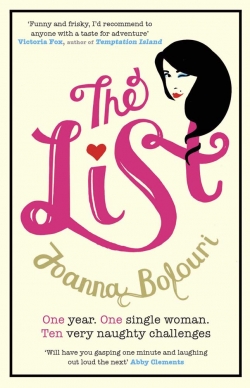
Six exams in eight days is not the worst finals schedule, but it was more than enough for me.  Well-meaning souls kept telling me it was a marathon, not a sprint.  I don’t run marathons.  I don’t sprint. I prefer to lie on my bed with some drool coming out of my mouth as I read books & watch films.  That drool is liquid contentment, people.  Anyway, as this wittering and reliance on GIFs is ably demonstrating, I think my brain has now dribbled out of my ears, possibly never to return.  And now FINALS ARE OVER (sorry, but I can never say that phrase enough) what is a bibliophile to do?  Well, I decided to read a book highly recommended by Charl over at Miscrawl, The List by Joanna Bolouri.

Image

(Image from: http://www.quercusbooks.co.uk/book/The-List-by-Joanna-Bolouri-ISBN_9781848663084#.U4DLzvldWSo )

I don’t normally read light comic novels, they’re generally not my cup of tea.  However, after weeks, nay months, of ploughing through some seriously heavy literature, I wanted something fun.  And The List certainly delivered on that, but that’s not why I decided to write about it here.  The reason was that I think The List offers something unfortunately all-too-rare in fiction: a recogniseably authentic female voice.  And that voice is sweary:

“Back to work today, and I had a mountain of emails to go through…Two of the emails were from Alex, who obviously didn’t know I was on holiday, and I deleted them without reading, otherwise I’d be tempted to reply ‘GET IT RIGHT UP YOU FUCKFACE’ in 72pt comic sans.”

We’ve all had emails like that.

Phoebe Henderson breaks up with her horrible boyfriend (the aforementioned Alex), and eschewing the usual New Year’s resolutions to get fit/lose weight blah blah she makes a list of 10 things she’d like to do in bed but has never had the nerve to try.  The novel takes the form of her diary over the year as she tries out these activities, some successful, some not, with a variety of people, some nice and gorgeous, some most definitely not.

Bolouri achieves quite something with Phoebe: a slightly messed up, slightly neurotic character who, rather than getting frustrated with and wanting to shake vigorously by the shoulders, I wholly recognised and wanted to take for a drink.  She’s good company.  She hates her job, hates her flat, loves her friends, is in her 30s and hasn’t quite got it all figured out yet.  Who the hell has?  Oh Phoebe, let’s get smashed on cheap cocktails, buy a dirty burger from a botulism-on-wheels van on the way home and wake up the next morning with mouths that feel like Satan’s armpit, wondering why we’re still doing this after all these years.  I love you.

Some of the list opens Phoebe’s eyes to sexual adventure, some of it leaves her feeling a bit meh.  None of it leaves her feeling worthless or degraded.  This is a woman embracing her sexuality and feeling empowered by it.  In that way the novel has something to say, and it’s made more powerful by the fact that it’s funny and entertaining, yet not entirely escapist.  Phoebe doesn’t have a perfect body & a perfect life, and not everything goes to plan, like her first attempt at talking dirty:

“I walked out of my room, naked, to get some water and he followed me in to the kitchen where we did it over the worktops.  I was unsettled for a second when I found myself face down in toast crumbs, but then he started whispering delicious obscenities in my ear.  I tried to return the favour but failed miserably: “Fucking prick.”

“What?”

“Erm, nothing. Carry on.””

I love this: the banal detail of the toast crumbs, the epic fail on dirty talk.  It’s funny, and oh-so-believeable. Balouri shows how fantasy and reality don’t match up, and it’s OK because reality can be funnier and more exciting than fantasy anyway.

Joanna Bolouri blogs on WordPress here.

I normally write on two books per post, but I’m only doing one this week, because FINALS ARE OVER (I don’t know if I’ve mentioned that?) and my stamina for rational thought and writing in continuous prose is severely depleted.  I’m off to replenish with rioja and a bag of chips.  I don’t care if it is 10am – don’t judge me.  All rules are off because FINALS ARE OVER!

yay

“If I became a philosopher, if I have so keenly sought this fame for which I’m still waiting, it’s all been to seduce women basically.” (Jean-Paul Sartre)

Last week I watched When Corden Met Barlow, which had James Corden interviewing Gary Barlow. For those of you who don’t know these people, the former is a comedy writer and performer, the latter is a member of pop group Take That.  When Take That split, Barlow was vilified in the press, for reasons that aren’t entirely clear, as he seems an all-round good bloke. Take That have since reformed, and Gary Barlow is now proclaimed a national treasure by the very same press that tore him apart (update: see comments below for why this might have changed somewhat!)  This got me thinking about how fame is constructed, and how it seems almost entirely arbitrary, not based on the person themselves but the image that is created, sometimes not even that.  To this end, I thought I’d look this week at novels that feature a famous person as one of the characters.

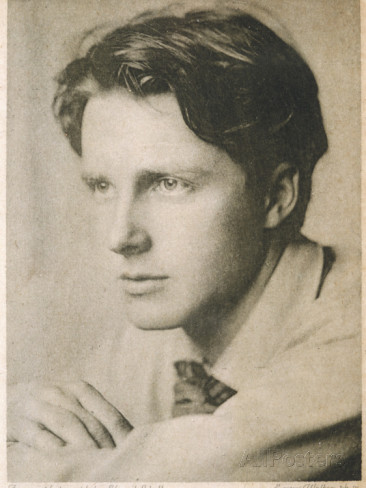
Firstly, The Great Lover by Jill Dawson (Sceptre, 2009), which concerns the poet Rupert Brooke.  I went into this novel with some degree of trepidation because I think Brooke was a fairly mediocre poet, whose fame was elevated because he was posh, pretty and patriotic; exactly the type of person the establishment wanted to represent its lost youth in World War One.

Image

(Image from: http://www.allposters.com/-sp/Rupert-Brooke-English-Writer-in-1913-Posters_i6856357_.htm )

Rather him than Wilfred Owen, who was middle-class, ordinary looking, gay, and whose verse took an uncompromising look at trench warfare.  Of course, since then the quality of Owen’s poetry has seen his reputation far outstrip that of Brooke.  But I will now climb down off my soapbox, and say that my concerns were unfounded, as this whole issue of  image construction is precisely what Dawson is analysing in her novel. For example, with the rumour that Brooke fathered a child in Tahiti:

 “perhaps people find it difficult to square the idea of the golden Apollo, the intellectual gentleman-soldier, finding peace not in an English meadow but on a tropical island far away.”

The novel is alternately narrated by Brooke and a maid where he boards in Granchester, the spunky and (mostly) wise Nell Golightly.  In the present day, she is trying to convey the man she knew in a letter to the possible daughter of Brooke, who is now an elderly lady in Tahiti.  In this way, Dawson draws attention to how biographies are as much about the biographers as their ostensible subject:

“I believe your mother wrote: “I get fat all the time.” Well, any woman would understand the meaning in that sentence.  Unfortunately, your father’s biographers have all been men.”

The novel also shows the burden of fame, of being proclaimed “the handsomest young man in England” by WB Yeats. “I have the strongest feeling of foreboding.  Something beyond my worst fears is about to happen […] And I think I know what it might be, but what I cannot tell is whether it is coming from inside my head or outside.  Whatever it is, it is here at last. The construction, the Rupert Brooke, cannot hold me any longer.”

Through the first-person narrative, Dawson doesn’t give us a perfect golden-child Brooke, but the wholly subjective experience of a flawed, troubled man who is just so young, and given to unintentionally funny insights:

“The Great Lover, that’s me, not the beloved.  The beloved is despicable. That’s the role of a girl.”

“I have resolved that Sodomy can only ever be for me a hobby, not a full-time occupation.”

This callow, aggrandising way could irritate some readers, but for me it just brought home how beyond all the image, Brooke was just a young man, as human as the rest of us, and how tragic it was that he and so many like him had their lives cut short: “the war was only the last eight months of his life, and yet that’s what he’s remembered for”.

What Dawson gives us through Nell’s voice is a fond but clear-eyed portrait of Brooke. “All that he was to me was gathered into that look I cast, but I don’t know if he saw it, or knew.” It made me feel that a well-researched (as this novel clearly is) fictional interpretation is probably just as valid as a “factual” biography.

 “he was a difficult man to pin down, and he was in the habit of saying things playfully that he did not mean at all, or were quite the opposite of his meaning, so maybe it’s true that he was a little more of a slippery fish than some.”

So what are we left with?  The answer is, the same as with any artist we admire: “Rupert’s true heart beats only on paper”.  Their works are what speak most eloquently for them.

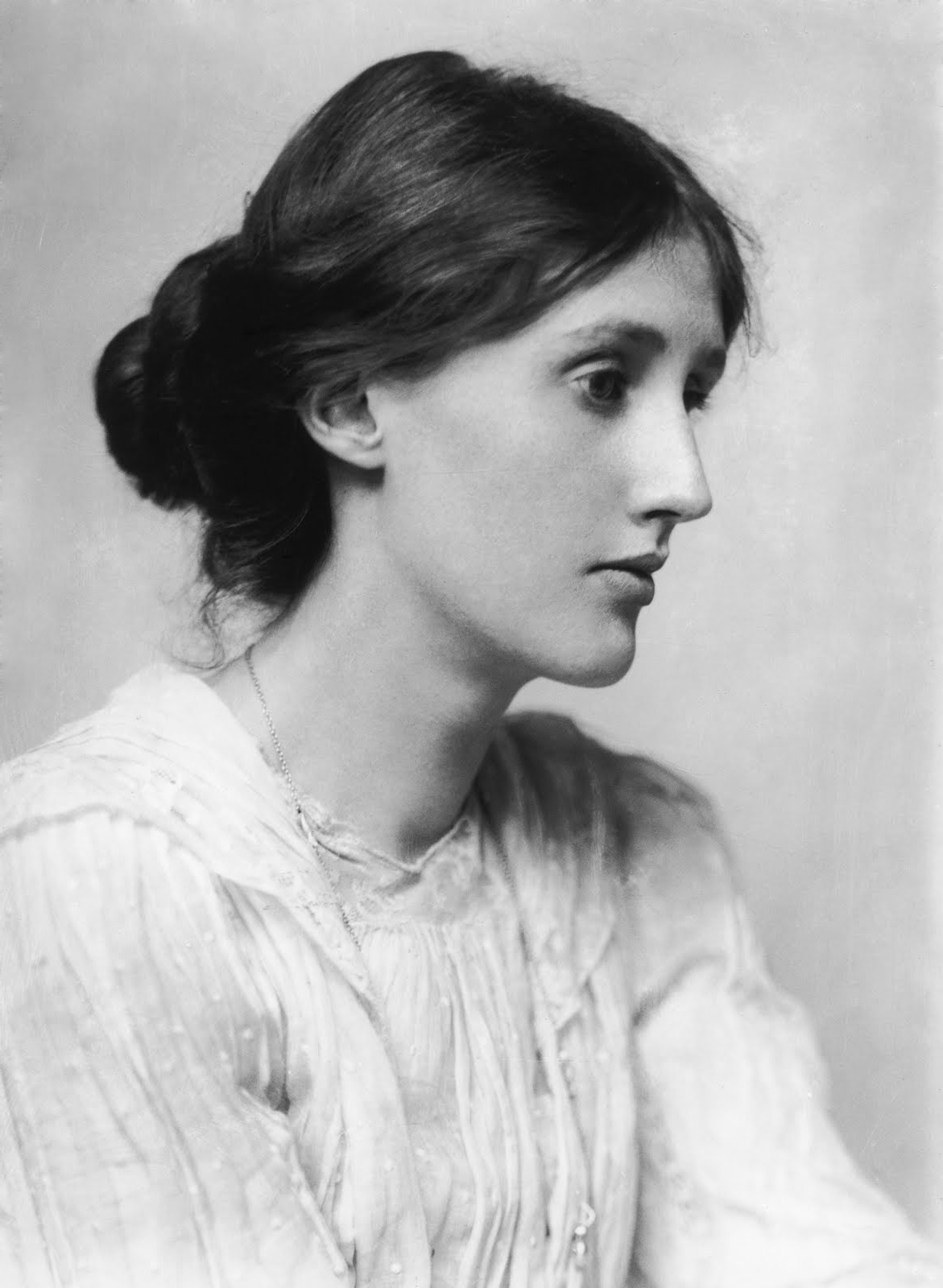
Secondly, someone who allegedly went skinny-dipping with Rupert Brooke, Virginia Woolf.

Image

(Image from: http://www.4thestate.co.uk/?attachment_id=10089 )

The Hours by Michael Cunningham (4th Estate, 1999) is Pulitzer-winning novel which tells the story of three women linked by Woolf’s novel Mrs Dalloway.

One is Woolf herself, writing the novel in 1923; the others are Laura Brown, a housewife reading the novel in Los Angeles 1949; and Clarissa Vaughan, planning a party for a friend who calls her Mrs Dalloway, in New York at the end of twentieth century.  The Hours is proof that a book doesn’t have to be long to be brilliant. At just 226 pages in my edition, it is so beautifully written that I had trouble pulling out individual quotes for this post.  Each of the women lives a single day, both ordinary and extraordinary:

“Here is the brilliant spirit, the woman of sorrows, the woman of transcendent joys, who would rather be elsewhere, who has consented to perform simple and essentially foolish tasks, to examine tomatoes, to sit under a hairdryer because it is her art and her duty.”

Virginia Woolf’s fragile mental state is handled with great sensitivity, showing how she struggles to remain sane, and how the desires of those around her to keep her so may not be the best thing for her life:

“She is better, she is safer, if she rests in Richmond; if she does not speak too much, write too much, feel too much; if she does not travel impetuously to London and walk through its streets; and yet she is dying this way, she is gently dying on a bed of roses.”

The novel brilliantly captures the small, transient moments that make up life, and how they can all add up to great meaning, whilst seeming to signify nothing:

““You can’t possibly have too many roses” Clarissa says.

Sally hands the flowers to her and for a moment they are both simply and entirely happy.  They are present, right now, and they have managed, somehow, over the course of eighteen years, to continue loving each other.  It is enough.  At this moment, it is enough.”

Astonishingly, the echoes across the three women’s lives from Mrs Dalloway and between each other never feels contrived.  It is a brilliant evocation of lives led more or less quietly, and each character is strongly drawn enough to stand alone as well as alongside the other two.

I loved The Hours.  The individual plots were well-paced, sensitive and insightful, in a style that used language delicately but was never pretentious. Highly recommended.

A film was made of The Hours in 2002.  It’s quite good if you can get past the distraction of Nicole Kidman’s prosthetic nose (it took me a while):

“Everything being a constant carnival, there is no carnival left.” (Victor Hugo)

Today is May Day, and I was thinking about the traditions of this time: celebration, revelry, pastoral fertility.  Please note I said thinking about, not participating in.  Confession time, reader: even though I’m in Oxford I didn’t want to do an all-night pub crawl/ball or get up at ridiculous o’clock to go to Magdalen Bridge for May Morning.  I lay in bed, and because Oxford is so quiet I could hear the choir and bells anyway, and it was beautiful.  Better warm in bed than in an inebriated crowd, I told myself.  Before I seem too virtuous, I should tell you that I’m really just lazy, because an hour or so later I got up for a champagne breakfast.  If this post seems even more waffly and incoherent than usual, you know why.

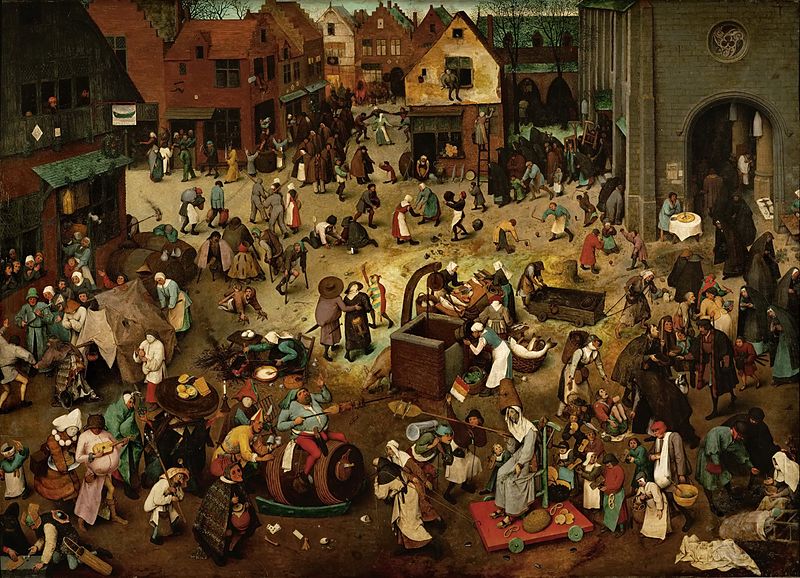
So, the traditions of May Day, and choosing books for this post made me think about the carnivalesque in novels.  Mikhail Bakhtin said that the carnivalesque (this is a shockingly rough paraphrase) is a time when social hierarchies are overthrown in energetic riot: as norms are disregarded, reversed and subverted, anything can happen.  Sounds like the spirit of May Day to me. Hence, for this post I’ve picked two novels that are carnivalesque/subversive in some way.

Image

The Battle Between Carnival and Lent – Pieter Bruegel the Elder 1599 (Image from http://en.wikipedia.org/wiki/File:Pieter_Bruegel_d._%C3%84._066.jpg )

My first choice is Nights at the Circus by Angela Carter (1984, Chatto & Windus).  The minute I started to think about carnivalesque, this is what sprang to mind. I thought the summary on the dust jacket was spot-on, so here it is:

Fevvers: the toast of Europe’s capitals, courted by princes, painted by Toulouse Lautrec, the greatest aerialiste of her time. Fevvers: somersaulting lazily through the air, hovering in the moment between the nineteenth century and the twentieth, between old dreams and new beginnings, born up by the spread of wings that can’t be real! Or- can they? Fevvers: the Cockney Venus, six foot two in her stockings, the coarsely lively and lovely heroine…Obsessed with Fevvers, constantly bamboozled by the anarchist sorcery of her dresser and confidante, Lizzie, the dashing young journalist Jack Walser stumbles into a journey which takes him from London to Siberia via legendary St Petersburg and out of his male certainties, into a transforming world of danger and joy, the world of Colonel Kearney’s circus…Featuring a cast of thousands, including : the clown’s requiem, the tigers’ waltz, the educated apes, the bashful brigands, the structuralist wizard. Not forgetting Sybil, the Mystic Pig.”

Just brilliant. I’ve said before that there’s no-one like Angela Carter, and Nights at the Circus is her writing at her very best.  Fevvers voice leaps of the page at you in the first paragraph:

“Lor’ love you sir!” Fevvers sang out in a voice that clanged like dustbin lids. “As to my place of birth, why, I first saw the light of day right here in smoky old London, didn’t I! Not billed the ‘Cockney Venus’ for nothing…Hatched out of a bloody great egg while Bow Bells rang, as ever is!”

If that all sounds a bit “cor-blimey-luvvaduck-rent-a-cockney”, don’t worry.  With Angela Carter you are never in the land of the stereotype, but in an exuberant world of characters the like of which you will never have met before, or since.  She is master of the original and evocative image (“like dustbin lids”) and while her work is carnivalesque and destabilising, it’s also great fun.  The circus is Carter’s world, which means anything can happen.  But beneath all the sparkle and pizzazz, she creates a world of substance.  Buffo the clown reflects:

“We are the whores of mirth, for, like a whore, we know what we are; we know we are mere hirelings hard at work yet those who hire us see us as beings perpetually at play. Our work is their pleasure and so they think our work must be our pleasure, too, so there is always and abyss between their notion of our work as play, and ours, of their leisure as our labour.”

Carter uses magic realism to explore how we construct reality, and how easily it can be deconstructed.  Where better to do that than the circus? She plays with notions of gender and sexuality, challenging the idea that they are fixed entities, and explores how identity can be constantly created and recreated.  Jack falls in love with Fevvers, unsure of who, or what, it is he loves: if he gets behind the image of the Cockney Venus, who will be there?  Is she part bird?  And who will he be in response?:

“When Walser first put on his make-up, he looked in the mirror and did not recognise himself. As he contemplated the stranger peering interrogatively back at him out of the glass, he felt the beginnings of a vertiginous sense of freedom , that, during all the time he spent with the Colonel, never quite evaporated; until that last moment where they parted company and Walser’s very self, as he had known it, departed from him, he experienced the freedom that lies behind the mask, with dissimulation, the freedom to juggle with being, and, indeed, with the language which is vital to our being, that lies at the heart of burlesque.”

Angela Carter clearly had a fierce intellect and something interesting to say about how we make our worlds.  But she also didn’t let that get in the way of a good story.  Nights at the Circus is a fantastic read, in all the senses of the word.

Secondly, Gulliver’s Travels by Jonathan Swift (1726, full text available online).  Obviously, this novel is hugely famous (even if you haven’t read it I bet you know what physical feature distinguishes a Lilliputian).  Lemuel Gulliver relates fantastical tales of his travels, and in the process Swift offers a satire on travel narratives (which were hugely popular in the eighteenth century as people travelled further and wider) and on the human condition.  I chose it for this theme as it is full of inversions and reversals; Gulliver travels to Lilliput, where he is a giant, then to Brobdingnag where he is minute; to Laputa which he considers crude and unenlightened, then to the Houyhnhnms who consider him a “yahoo”.  Gulliver’s Travels is episodic, so I’m just going to pick out a couple of events.  Firstly, one of the most famous ones: many writers at the time were obsessed by bodily functions, and Swift is no different, though thankfully not nearly as scatological as some of his contemporaries.  Here is Gulliver putting his urine to good use in Lilliput:

I was alarmed at midnight with the cries of many hundred people at my door; by which, being suddenly awaked, I was in some kind of terror….her imperial majesty’s apartment was on fire, by the carelessness of a maid of honour, who fell asleep while she was reading a romance.  I got up in an instant; and orders being given to clear the way before me, and it being likewise a moonshine night, I made a shift to get to the palace without trampling on any of the people.  I found they had already applied ladders to the walls of the apartment, and were well provided with buckets, but the water was at some distance.  These buckets were about the size of large thimbles, and the poor people supplied me with them as fast as they could: but the flame was so violent that they did little good… this magnificent palace would have infallibly been burnt down to the ground, if, by a presence of mind unusual to me, I had not suddenly thought of an expedient.  I had, the evening before, drunk plentifully of a most delicious wine called glimigrim, (the Blefuscudians call it flunec, but ours is esteemed the better sort,) which is very diuretic.  By the luckiest chance in the world, I had not discharged myself of any part of it.  The heat I had contracted by coming very near the flames, and by labouring to quench them, made the wine begin to operate by urine; which I voided in such a quantity, and applied so well to the proper places, that in three minutes the fire was wholly extinguished, and the rest of that noble pile, which had cost so many ages in erecting, preserved from destruction.

And just to finish, here is a bit of the more heavy-handed satire for you, when the king of Brobdingnag responds to a summary of British politics:

“He was perfectly astonished with the historical account gave him of our affairs during the last century; protesting “it was only a heap of conspiracies, rebellions, murders, massacres, revolutions, banishments, the very worst effects that avarice, faction, hypocrisy, perfidiousness, cruelty, rage, madness, hatred, envy, lust, malice, and ambition, could produce.”

I’ll leave it to you to decide if such motivations have left politics these days…

Gulliver’s Travels is a complex book, and one that is very hard to pin down: it is funny, it is sad, it can be read to children, it is baffling to adults.  It shifts meaning and genre according to who is reading it: truly carnivalesque.

I was hoping to end with a clip of Bellowhead performing One May Morning Early: apt, no?  But YouTube failed me.  So here they are singing about a carnival romance instead:

“I’ve met a lot of hardboiled eggs in my time, but you’re twenty minutes.” (Billy Wilder)

Happy Easter!  For those of you who don’t celebrate this festival, I hope you’re enjoying the long weekend (and possibly an abundance of chocolate).

Image

(Image from: http://www.sproutcontent.com/ )

For a theme for this post I was thinking about Easter, about sacrifice and redemption, and also about Spring, the season of renewal and regeneration that it coincides with.  I’ve opted for a novel with a self-sacrificing main character, and a poem that starts in April. They’re both quite odd texts: here’s to a weird Bank Holiday!

Firstly, A Prayer for Owen Meany by John Irving (1989, Black Swan).  Irving is an enormously popular author and Owen Meany is one of his most-loved protagonists: a boy “with a wrecked voice” who is so tiny people can’t resist picking him up, his skin “the colour of a gravestone; the light was both absorbed and reflected by his skin, as with a pearl, so that he appeared translucent at times”.  The story is narrated by his best friend Johnny Wheelwright, who is trying to come to terms with the role Owen has played in his life.  When they are 11, Owen hits a foul ball that kills Johnny’s mother immediately.  The boys reconcile by swopping their most treasured possessions: “He gave me his baseball cards, but he really wanted them back, and I gave him my stuffed armadillo, which I certainly hoped he’d give back to me – all because it was impossible for us to say to each other how we really felt.” 

When he returns the armadillo, Owen has taken its claws, which Johnny comes to realise is Owen’s way of telling him:  “GOD HAS TAKEN YOUR MOTHER. MY HANDS WERE THE INSTRUMENT. GOD HAS TAKEN MY HANDS. I AM GOD’S INSTRUMENT.” Owen’s speech is always in capitals to represent his bizarre voice, and as a device it really works, marking him out not only against the other characters but also in the book itself – you can flick through and find Owen immediately.  So, Owen is already unusual, but is even more extraordinary than people realise.  He thinks he is God’s instrument, and certainly Johnny agrees: “I now believe that Owen Meany always knew; he knew everything.” The events of their lives mean not only that “Owen Meany rescued me” and gave Johnny Christian faith, but that Owen’s absolute conviction in a greater scheme of things and his capacity for self-sacrifice are tested to the extreme. It’s so hard to say any more without giving away spoilers, but I urge you to read it.  A Prayer for Owen Meany is a novel as truly original as its protagonist, funny and sad, elegiac and uplifting.

Secondly, The Waste Land by TS Eliot, a hugely famous and notoriously difficult poem.  For what it’s worth, I would say don’t let the reputation it put you off.  If you fancy giving it a go, read it and let the “heap of broken images” wash over you, see what it brings.  You can always re-read using the footnotes (which will be copious – and Eliot’s own notes add more confusion rather than explication) to translate the Latin, Greek etc  and find out about the plethora of allusions.  The poem begins:

April is the cruellest month, breeding  

Lilacs out of the dead land, mixing         

Memory and desire, stirring      

Dull roots with spring rain.

These lines are an allusion to the start of The Canterbury Tales:

Whan that Aprill, with his shoures soote

The droghte of March hath perced to the roote

And bathed every veyne in swich licour,

Of which vertu engendred is the flour;

Whan Zephirus eek with his sweete breeth

Inspired hath in every holt and heeth

The tendre croppes…

As you can see, Eliot takes the same premise but where Chaucer sees pastoral idyll (admittedly evoked a little ironically) Eliot sees something bleaker, death amongst the renewal, cruelty amongst the desire.  The Waste Land is an odd, unsettling poem; its original title was going to be He Do the Police in Different Voices (a line from Our Mutual Friend) and The Waste Land is certainly a cacophony of voices, evoking different times, places and stories.  As an embittered commuter who used to cross London Bridge every day, the following passage always sticks in my mind:

Unreal City,         

Under the brown fog of a winter dawn,               

A crowd flowed over London Bridge, so many, 

I had not thought death had undone so many.  

Sighs, short and infrequent, were exhaled,       

And each man fixed his eyes before his feet.    

Flowed up the hill and down King William Street,          

To where Saint Mary Woolnoth kept the hours

With a dead sound on the final stroke of nine.

The Waste Land does this frequently, takes images that almost seem commonplace, like commuters walking over a bridge, and then undermines it, in this instance when you realise they are all ghosts, their movement seemingly without purpose. The Waste Land is a poem that defies easy explanation and raises far more questions than it answers.  It can be a frustrating read, but also a hugely rewarding one that benefits from multiple readings.

Who is the third who walks always beside you?              

When I count, there are only you and I together             

But when I look ahead up the white road            

There is always another one walking beside you             

Gliding wrapt in a brown mantle, hooded          

I do not know whether a man or a woman          

—But who is that on the other side of you?

For a very interesting discussion on The Waste Land and how we read, head over to Necromancy Never Pays.

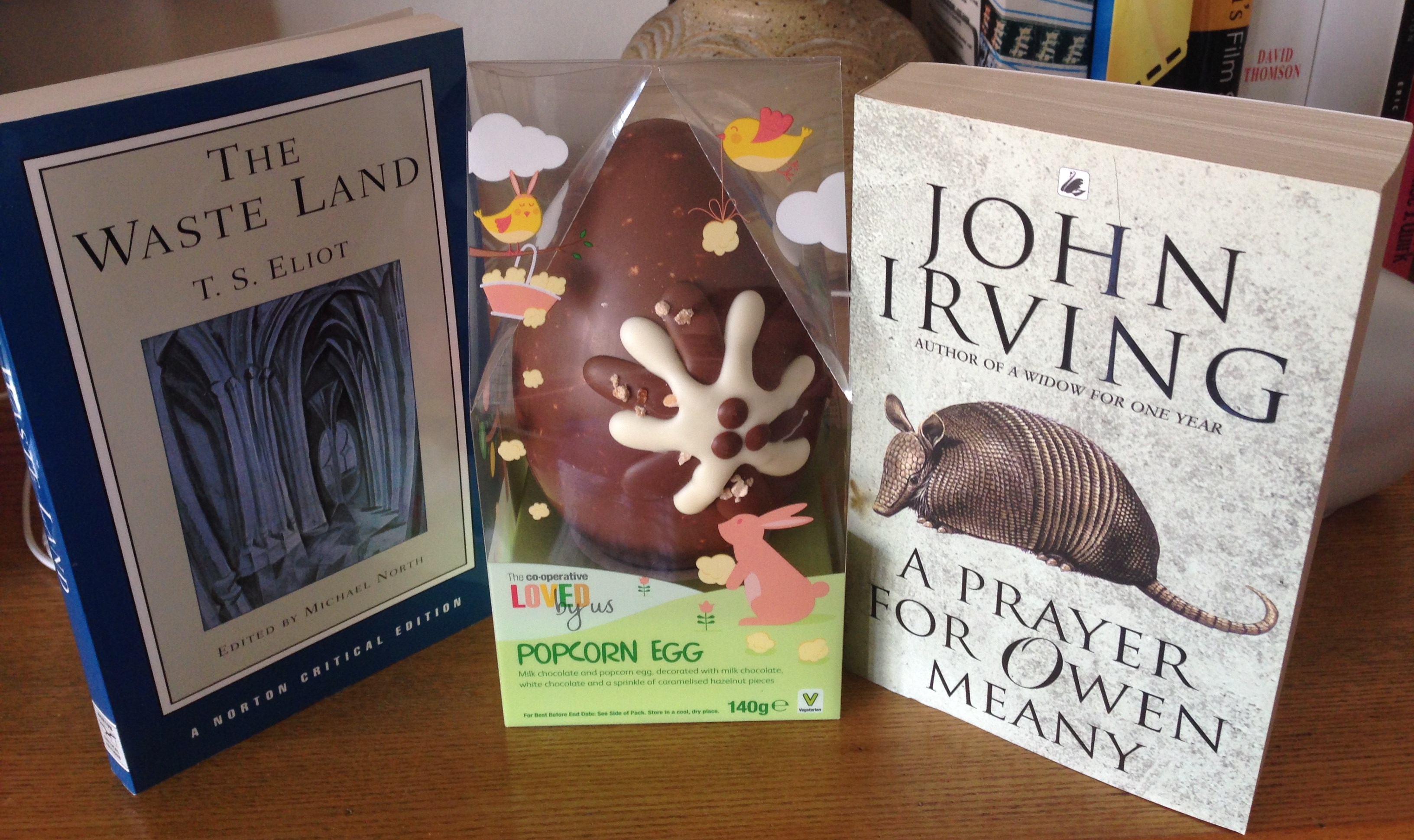
I feel like I should picture the books with an egg as odd and unsettling as the books themselves, a dinosaur egg or something.  (Or an armadillo egg?  But I’m feeling too lazy to make them, it is a Bank Holiday after all…) So here they are instead with a reassuringly chocolatey easter egg, a present from my brother:

Image

Bonjour Tristesse – Francoise Sagan (Le Monde’s 100 Books of the Century #41)

This is part of a series of occasional posts where I look at works from Le Monde’s 100 Books of the Century.  Please see the separate page (link at the top) for the full list of books and an explanation of why I would do such a thing.

Bonjour Tristesse by Francoise Sagan is a short novel (108 pages in my edition, the Penguin translation by Irene Ash), published in 1954 when the author was 18.  Yes, 18.  Apparently she failed to pass her exams for the Sorbonne and so decided to write a novel instead. As you do. And it’s a modern classic. I’m pretty sure I hate this woman.  Rest assured it’s jealousy plain and simple, not xenophobia – there’s a lot of nonsense talked about British attitudes to our neighbours across Le Manche, but despite the fact that I would be at least 5kg lighter if France wasn’t there (je t’aime fromage bleu)I for one am a true Francophile.  They are a great nation that has provided the world with at least two things guaranteed to cause uncontrollable dribbling in this blogger:

Image

Almond croissants (or croissants aux amandes if you will) (Image from www.belleepooque.co.uk)

Image

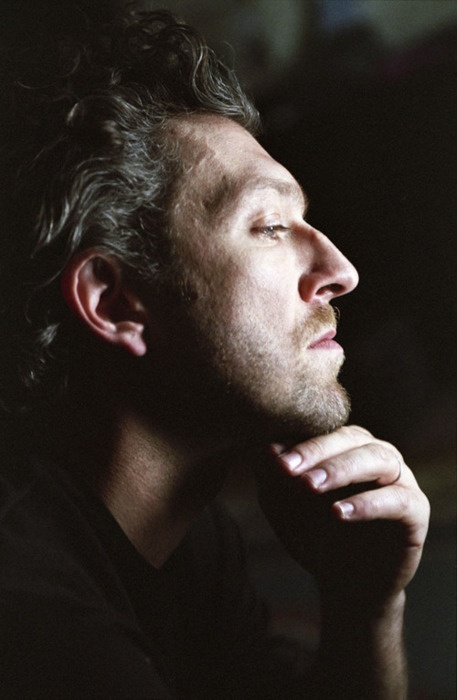
Vincent Cassel (Image from: https://www.pinterest.com/pin/277745501994347016/)

To those of you concerned that I am objectifying Mr Cassel, I would just like to reassure you that I’m objectifying the croissant so much more, believe me.

Now, where was I?  Oh yes, the extraordinary talent of Francoise Sagan.  While the protagonist is a precocious 17 year old, Cecile, (so far, so thinly disguised autobiography) the psychological insights into the characters are sophisticated and you don’t feel like you’re reading someone’s juvenilia.  Cecile is holidaying in the south of France with her father, an entirely vacuous widower whose temperament she shares:

“I soon noticed that he lived with a woman.  It took me rather longer to realise that it was a different one every six months.  But gradually his charm, my new easy life, and my own disposition led me to accept it.  He was a frivolous man, clever at business, always curious, quickly bored, and attractive to women.  It was easy to love him, for he was kind, generous, gay, and full of affection for me.  I cannot imagine a better or more amusing friend.”

And that is just the problem – he is a friend, not a parent.  He treats Cecile as a co-conspirator in life, buying her inappropriate dresses and taking her to casinos, talking to her as an equal:

 “He refused categorically all notions of fidelity and serious commitments.  He explained that they were arbitrary and sterile…I knew in his case they did not exclude either tenderness or devotion; feelings which came all the more easily to him since he was determined they should be transient…I was not at the age where fidelity was attractive.  I knew very little about love.”

Into this self-serving world comes Anne, a friend of Cecile’s dead mother.  She is cool and controlled:

“I think she rather despised us for our love of diversion and frivolity, as she despised all extremes.”

Yet, despite their differences, Cecile admires Anne and her father decides to marry this woman so different from himself.   The decision does not sit well with Cecile:

 “I thought of the lunch I had endured with clenched teeth, tortured by a feeling of resentment for which I despised and ridiculed myself.  Yes, it was for this I reproached Anne: she prevented me from liking myself.  I, who was so naturally meant for happiness and gaiety, had been forced into a world of self-criticism and guilty conscience, where, unaccustomed to introspection, I was completely lost.”

I don’t want to seem ageist, but clearly I am, as this self-ironising tone was not what I expected from such a young author.  Cecile is spoilt and self-focused, and decides to split up her father and Anne so that her life can continue how she wants it to.  She constantly vacillates, changing her mind and feelings with each moment, but her machinations regarding Anne move inexorably forward. The consequences are dramatic and will force Cecile to leave her childhood behind forever:

“Then gradually I begin to think of something else. But I do not like to take refuge in forgetfulness and frivolity instead of facing my memories and fighting them.”

Bonjour Tristesse is a melancholic novel (the title means Hello Sadness) about the prices we pay for the things we think we want.  Francoise Sagan creates a memorable protagonist in Cecile and an affecting story within remarkably few words.

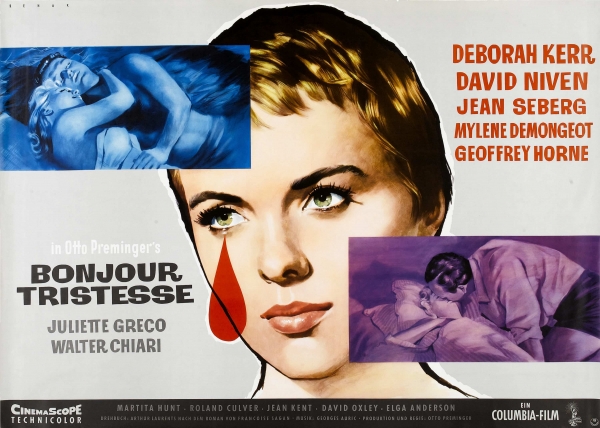
To end, the poster of the film adaptation made just four years after publication:

Image

(Image from: http://docublogger.typepad.com/seberg/page/2/ )

“They laugh at me because I’m different; I laugh at them because they’re all the same.” (Kurt Cobain)

Dear reader, it’s been so long.  I’ve missed you, but the preparation for finals and my last piece of coursework took over.  Now I have finished writing the definitive essay on Cary Grant’s performance of gender ambiguity (OK, I’ve written an essay on Cary Grant’s performance of gender ambiguity) I have a brief respite which I choose to spend blogging. Away we go:

The Bridge concluded almost two months ago and I’m still bereft.  In my day off between coursework and revision I’ve been watching BBC4’s replacement foreign-language thriller Salamander, and although excellent, it’s not The Bridge:

Image

(Image from http://www.noblepr.co.uk/Press_Releases/arrowfilms/thebridge.htm )

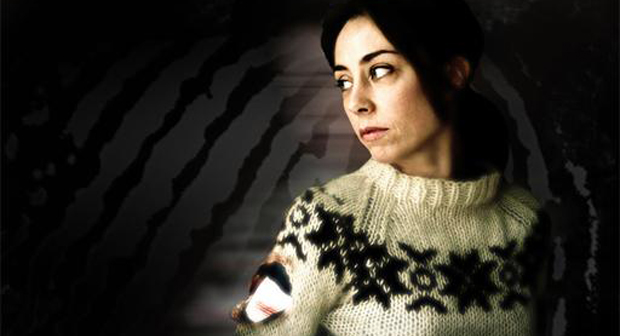
I love Saga, I love Martin, I love the way their relationship developed in the second season, I love Saga.  I know I’ve said I love Saga twice, but this is because I have a girl-crush, the like of which I haven’t experienced since The Killing’s Sarah Lund:

Image

(Image from http://www.krishk.com/2014/01/top-socially-challenged-detectives/ )

How I wish I was effortlessly cool and Nordic, with scrappy long hair, Faroe Isle jumpers, leather trousers and emotional reticence.  Unfortunately I’m perennially uncool, I’m British, my hair is an inch long, I look terrible in chunky jumpers and leather trousers and I’m emotionally incontinent.  Otherwise the similarities between me and these two women are really quite remarkable.

Now, I know the socially inept detective is becoming something of a cliché, but I’m a huge fan of many of them (see here for how I excited I became over Sherlock) and I miss Saga.  It was this which prompted me to start reading The Rosie Project by Graeme Simsion (Penguin, 2013) the day after The Bridge finished.  It’s not a detective novel, but it does have a main protagonist who is highly intelligent, socially awkward, inflexible, unable to read social cues and has a tendency to respond to things that are said literally.  Perfect, just what I needed to fill the Saga-shaped hole in my life. Don Tillman is a geneticist who wants to get married.  Having tried dating and found that “the probability of success did not justify the effort and negative experiences” (how many single people out there can relate to that statement?)Don devises a questionnaire “a purpose-built, scientifically valid instrument incorporating current best practice to filter out the time wasters, the disorganised, the ice-cream discriminators, the visual-harassment complainers, the crystal gazers, the horoscope readers, the fashion obsessives, the religious fanatics, the vegans, the sports watchers, the creationists, the smokers, the scientifically illiterate, the homeopaths, leaving, ideally, the perfect partner, or, realistically, a manageable shortlist of candidates”.  Into Don’s life breezes Rosie, who it’s safe to say, does not fit his criteria for the ideal mate. She is chaotic, confrontational, encourages him to drink, watches sport and is a smoker. They are perfect for one another.

““Where do you hide the corkscrew?” she asked.

“Wine is not scheduled for Tuesdays.”

“Fuck that,” said Rosie.

There was a certain logic underlying Rosie’s response.

[…]I announced the change. “Time has been redefined. Previous rules no longer apply.  Alcohol is hereby declared mandatory in the Rosie Time Zone.””

Although Don is unusual, in many ways his situation is ordinary: so many people spend time constructing their ideal mate they forget to think about the relationship they want, missing what’s actually in their lives, and who it’s worth compromising a bit of ourselves for. Simsion looks at this aspect of oh-so-human folly with a comic eye, and there are some hugely funny scenes as Don tries to get to grips with situations where he is hopelessly out of his depth: attending a “formal” function in top hat and tails, practising sex positions with his teaching skeleton and being walked in on by his boss.  Because Don is aware of the humour but doesn’t quite get it, the scenes are told in an utterly deadpan style that is hilarious, but you’re never laughing at Don, just the situations he finds himself in. This is because you are completely rooting for the character. Simsion manages quite a feat with Don: a resolutely pragmatic, measured voice that still manages to create a person that you really feel for, and a novel of real warmth and humanity. Simultaneously, Don exposes the fakery that goes along with social skills and fitting in – the office politics, the lies and infidelities – that he is incapable of, making you question what is of real value, rather than what just makes life easier.   If you’d told me I’d like a book I would describe as “sweet and romantic” I’d tell you (with a raised eyebrow of scepticism, reader) that it really wasn’t my taste.  But, just like Don, I stepped outside my comfort zone, tried something new, and was completely won over.

For my second social outcast I’ve chosen the Pulitzer Prize winning novel The Brief Wondrous Life of Oscar Wao by Junot Diaz (Faber, 2008). Poor Oscar: he’s massively nerdy and all he wants is to love and be loved.  “Oscar showed the genius his grandmother insisted was part of the family patrimony.  Could write in Elvish, …knew more about the Marvel Universe than Stan Lee, was a role-playing game fanatic….Perhaps if like me he’d been able to hide his otakuness maybe shit would have been easier for him, but he couldn’t.  Dude wore his nerdiness like a Jedi wore his light sabre or a Lensman her lens.  Couldn’t have passed for Normal if he’d wanted to.” An incurable romantic who dreams of becoming the “Dominican Tolkien”, Oscar’s life will never play out how he wants it to.

He lives with his mother Beli and rebellious sister Lola, and as we learn about all three of them, we learn about the recent history of the Dominican Republic and its impact on a family.  The novel makes frequent use of footnotes, which generally I dislike but which worked well here, detailing political history in the distinctly non-academic (though learned) voice of Yuniour, Lola’s boyfriend, serial womaniser and narrator.  The family are thought to be under the sway of a fuku “the Curse and Doom of the New World”, and certainly all are subject to violence and hardship, Beli in Dominica and her son and daughter in the United States.

There is a touch of magic realism as the family are also protected by a guardian animal that appears to them in times of extreme distress: “there appeared at her side a creature that would have been an amiable mongoose if not for its golden lion eyes and the absolute black of its pelt.  This one was quite large for its species and placed its intelligent little paws on her chest and stared down at her.  You have to rise.”  The Brief Wondrous Life of Oscar Wao has plenty to say about the immigrant experience, the price of assimilation and the inability to assimilate to the societies we find ourselves in, and the self-definition we express through the language we use. The novel has references I didn’t get: Spanish phrases and nerd-allusions, but it didn’t matter.  The refusal to be sentimental and the triumph of human spirit in the face of violence and tragedy meant this novel really spoke to me even if I didn’t grasp all the intricacies. It was funny and tragic, and truly moving.

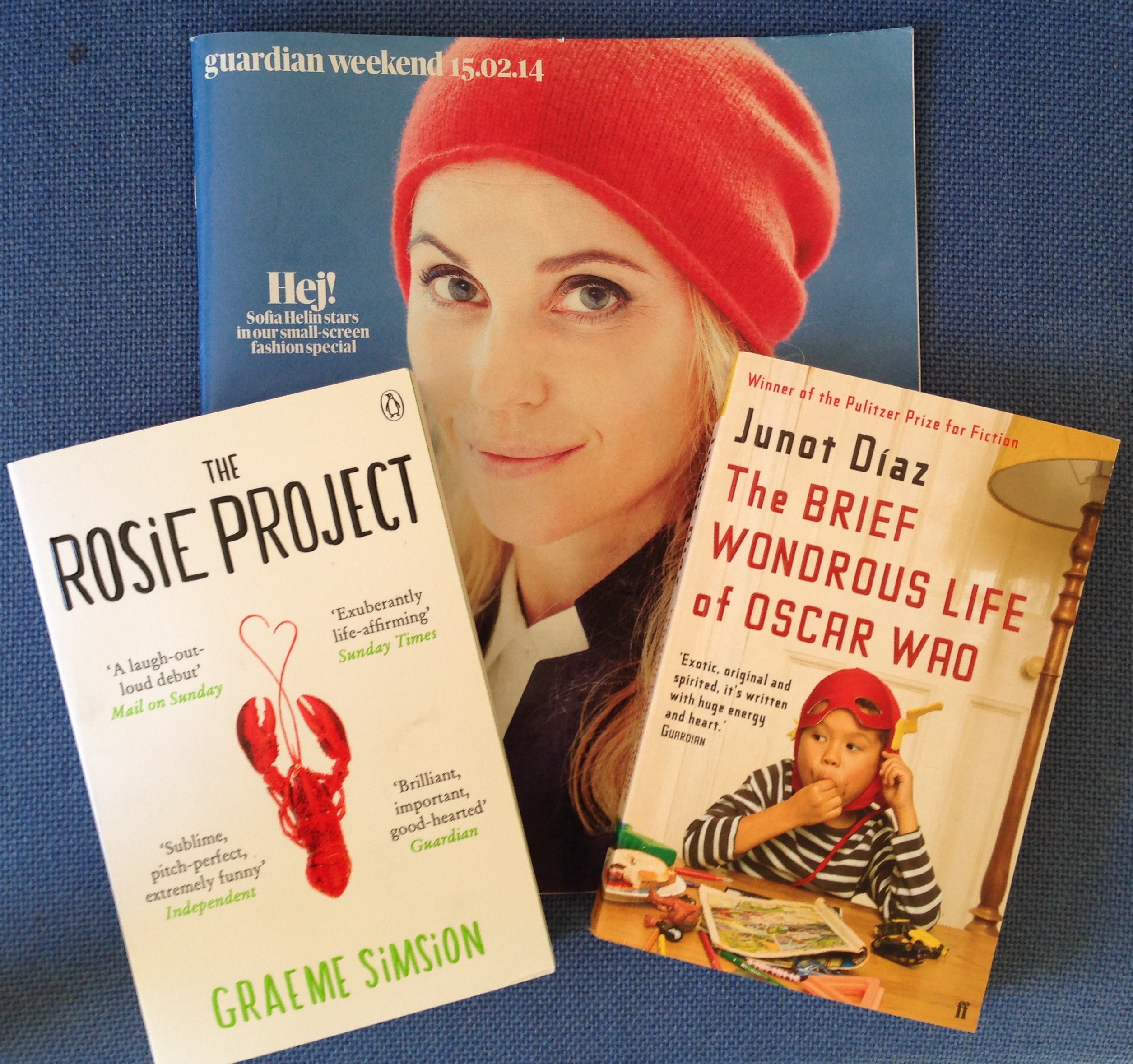
Here are the books with the lovely Sofia Helin who plays Saga (you can tell it’s the actor & not the character because she’s smiling):

Image

“Everyone wants to be Cary Grant. Even I want to be Cary Grant.” (Cary Grant)

Happy (belated) Valentine’s Day!  In my post for Valentine’s Day last year (which was also late…) I pointed out that St Valentine is the patron saint for bee keepers, plague, epilepsy and against fainting, as well as for lovers.  Last year I wrote on bee-keeping and plague  but this year I’m going to be more romantic and tell you about the man in my life.  He’s always been there, but these last few weeks it’s like I’m seeing him with new eyes; now I’m obsessed and we spend hours together every day.  The title quote may have given it away: he’s Cary Grant.

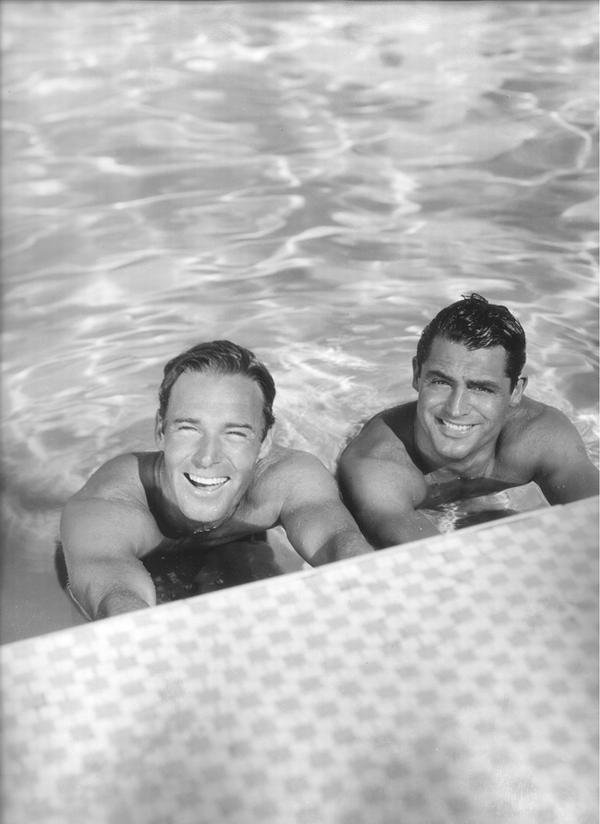
Let me explain.  For my last paper before finals (FINALS!  I’ve just broken out in a cold sweat….) we were given some optional papers to choose from, and I chose Film Criticism.  We’ve been looking at Hollywood Golden Age, a genre Cary Grant sits astride like a tanned, debonair, mid-Atlantic-accented colossus.  Having watched soooooo many of films again (and again, and again) I have a new-found appreciation for this actor with his exquisite comic timing.  It’s not that I didn’t like him before, I just took him for (ahem) granted.  This is how good he is: I had to analyse a scene from a film, and I chose something from Bringing Up Baby.  It was 3 minutes 39 seconds long.  I spent an entire day watching and re-watching the scene.  Think about how many 3 minutes and 39 seconds there are in a day.  That’s how many times I watched it. At the end of  the day I was still laughing at his performance.  The man is a genius.  In the spirit of Valentine’s Day here he is with long-term boyfriend totally-platonic-friend-who-he-just-happened-to-live-with-for-twelve-years, Randolph Scott.

Image

(Image from http://blogs.villagevoice.com/dailymusto/2010/09/cary_grant_and.php)

What a ridiculously good looking pair.  Anyway, I thought for this post I would look at two of his favourite novels.  According to IMDB he was a voracious reader.  Do you think I can find out what he liked to read?  Google, thou hast failed me.  (Probably now I’ll be told that it’s really well-known that he loved Moby Dick or something, but I couldn’t find it). So instead I’ve chosen a James Bond novel as apparently the character was partly modelled on him and he was considered for the role in Dr No, and a short story by a writer who like Archie Leach was famous under a pseudonym.

Firstly, Casino Royale by Ian Fleming (1953).  I’ll be honest, I went into this novel with very low expectations.  Even the most avid Fleming fan will tell you that some of the novels are absolute bilge; apparently the quality of the Bond novels varies widely.  This was the first Bond novel written and the first one I’d read, and I was pleasantly surprised.  OK, Fleming isn’t a grand literary genius, but I doubt he ever proclaimed himself as such.  Casino Royale is a decently written spy story.  It’s quite different to the film, although similarities remain.   I was expecting a flashy, superficial story but it’s a bit more reflective than that.  It opens:

“The scent and smoke and sweat of a casino are nauseating at three in the morning.  Then the soul-erosion produced by high gambling – a compost of greed and fear and nervous tension – becomes unbearable and the senses awake and revolt from it.”

Bond has been sent to Royale-le-Eaux to take down a Russian spy, Le Chiffre, by bankrupting him at gambling.  This being the Cold War, of course the baddies are Russian, and there’s also the rather sinister SMERSH, a Russian covert group whose name means “death to spies” lurking in the background.  That’s the very simple premise of the story.  Along the way there are lingering descriptions of clothes, cars and food (Fleming was clearly something of a gourmand), but the presentation of Bond is more complex than I was expecting.  I don’t think the reader is supposed to wholly like him or trust him:

“His last action was to slip his right hand under the pillow until it rested under the butt of the .38 Colt […] Then he slept, with the warmth and humour of his eyes extinguished, his features relapsed into a taciturn mask, ironical, brutal and cold.”

Bond is more human than in the films (he vomits in the gory aftermath of an explosion). He’s also damaged and flawed, more in keeping with the later filmic representations.  Very much of its time, however, is the misogyny:

“These blithering women who thought they could do a man’s work.  Why the hell couldn’t they stay at home and mind their pots and pans and stick to their frocks and gossip and leave men’s work to the men.”

As well as this general sexism, there’s also a worryingly easy conflation of sex with violence:

“Bond saw luck as a woman, to be softly wooed or brutally ravaged, never pandered to or pursued.”

Truly obnoxious and offensive. But in Fleming’s defence I would say that he seems more emotionally intelligent than his protagonist and we’re not supposed to see Bond as a role model in this sense.  There’s also a good dose of humour in the novel which encourages us not to take Bond entirely as seriously as he takes himself:

 “Englishmen are so odd.  They are like a nest of Chinese boxes.  It takes a very long time to get to the centre of them.  When one gets there the result is unrewarding, but the process is instructive and entertaining.”

So, Casino Royale was better than I expected.  It’s attitudes to women and Eastern Europeans are dated and offensive but as I said, I don’t get the sense the novel fully endorsed the attitude of its protagonist.  It’s a quick, light read (although the descriptions of gambling dragged a bit in places) and for me it was good introduction to the Bond novels.

Secondly, The Celebrated Jumping Frog of Calaveras County (1867) by Mark Twain. What an irresistible title.  Twain was a fairly prolific short story writer, but this was only the second one he wrote.  You can read the full text of it here. It really is a very short tale, and shows how much can be done in so limited a space by an accomplished writer.  It opens:

In compliance with the request of a friend of mine, who wrote me from the East, I called on good-natured, garrulous old Simon Wheeler, and inquired after my friend’s friend, Leonidas W. Smiley, as requested to do, and I hereunto append the result. I have a lurking suspicion that Leonidas W. Smiley is a myth; that my friend never knew such a personage; and that he only conjectured that, if I asked old Wheeler about him, it would remind him of his infamous Jim Smiley, and he would go to work and bore me nearly to death with some infernal reminiscence of him as long and tedious as it should be useless to me. If that was the design, it certainly succeeded.

As you can see, Twain’s humour is at the forefront (if you hadn’t already guessed by the title) and the mix of the ridiculous (“Leonidas W Smiley is a myth”) and the dry (“as long and tedious as it should be useless”) makes the story hugely entertaining.  It’s certainly a confident writer who tells a tale he says will be tedious, and Twain does this not once but twice: “Simon Wheeler backed me into a corner and blockaded me there with his chair, and then sat me down and reeled off the monotonous narrative which follows this paragraph.”  Simon Wheeler’s story of a gambling addict (Jim Smiley) who will bet on anything is directly reported, and he has one of the distinctive Southern voices Twain is so famed for, such as when he’s recounting how Jim trains the titular frog:

“He ketched a frog one day, and took him home, and said he cal’klated to edercate him; and so he never done nothing for three months but set in his back yard and learn that frog to jump. And you bet you he did learn him, too. He’d give him a little punch behind, and the next minute you’d see that frog whirling in the air like a doughnut see him turn one summerset, or may be a couple, if he got a good start, and come down flat-footed and all right, like a cat.”

There are some lovely touches in this story.  I particularly liked the line: “Smiley said all a frog wanted was education” and the fact that the frog is endowed with the decidedly un-froggy full name of “Dan’l Webster”. A quick read that children and adults will enjoy.

To end, here is a clip from The Philadelphia Story, and just possibly the most charming 3 minutes and 46 seconds ever committed to celluloid.  Apparently the bit where Cary Grant says “excuse me” was ad-libbed & that’s why he & James Stewart are trying not to laugh. Enjoy!

“The clever men at Oxford/Know all that there is to be knowed./But they none of them know one half as much/As intelligent Mr. Toad!” (Kenneth Grahame, The Wind in the Willows)

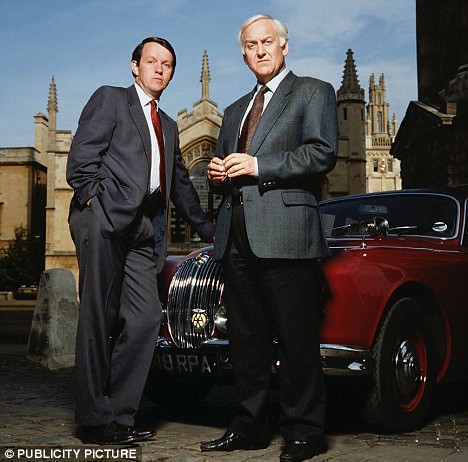
I’m in Oxford at the moment, a city I love.  I thought I would look this week at novels set in Oxford, and although there are lots to choose from (I guess lots of writers chose to evoke their alma mater) I’ve picked two crime novels, as Oxford seems to encourage this type of story.  I’m not sure why this occurs, but maybe it’s because it’s seen as such a respectable institution and it’s fun to think of a seething mass of violence and intrigue below the calm façade.  Here’s a picture of Oxford’s most famous fictional detective, to compensate for the fact that I’m not looking at any Colin Dexter novels:

Image

Image from (http://www.dailymail.co.uk/femail/article-1101952/So-did-Morse-lie-love-In-final-seasonal-serial-young-Morses-secret-admirer-reveals-identity–learn-truth-mysterious-car-crash.html)

Firstly, The Case of the Gilded Fly by Edmund Crispin.  This was the first in a series of novels featuring the sleuthing Oxford don Gervase Fen, and is from the Golden Age of Detective fiction, written in 1944.  The opening paragraph struck a chord with me:

“To the unwary traveller, Didcot signifies the imminence of his arrival at Oxford; to the more experienced, another half-hour at least of frustration.  And travellers in general are divided into these two classes; the first apologetically haul down their luggage from the racks on to the seats, where it remains until the end of the journey, an encumbrance and a mass of sharp, unexpected edges; the second continue to stare gloomily out of the window at the woods and fields into which, by some witless godling, the station has been inexplicably dumped”

Well, the woods and fields may be much less evident, but otherwise… seventy years on and nothing changes.  Travelling on this train are Gervase Fen, his friend Sir Richard Freeman who is Chief Constable of Oxfordshire and wishes he was a don (while Fen wishes he was police officer) and various members of a drama group, who will return to London with their numbers somewhat diminished. Fen is a likeable, eccentric don, whose “normal overplus of energy …led him to undertake all manner of commitments and then gloomily to complain that he was overburdened with work and that nobody seemed to care”; he distracts himself on the train by wishing for “’A crime! …A really splendidly complicated crime!’ And he began to invent imaginary crimes and solve them with unbelievable rapidity.”

The first murder, of uber-bitch Yseult Haskell, takes place in a room in college close to Fen’s office, and so much to his delight he is distracted from his work on minor eighteenth-century satirists to investigate:

“His usually slightly fantastic naivety had completely disappeared, and its place was taken by a rather formidable , ice-cold concentration. Sir Richard, who knew the signs, looked up from his conference with the Inspector and sighed.  At the opening of the investigation, the mood was invariable, as always when Fen was concentrating particularly hard; when he was not interested in what was going on, he relapsed into a particularly irritating form of boisterous gaiety; when he had discovered anything of importance he quickly became melancholy […] and when an investigation was finally concluded, he became sunk in such a state of profound gloom it was days before he could be aroused from it.  Moreover these perverse and chameleon-like habits tended not unnaturally to get on people’s nerves.”

I’m not going to say too much about the plot as its nearly impossible not to give spoilers.  But if you think the eccentric Fen is someone you’d like to spend time with do look at The Case of the Gilded Fly.  I loved the dry, yet gentle humour in the writing, and it was a well-paced, easy read.  My favourite character however, was one of the minor players; unlike a lot of detectives, Fen does not have a complicated romantic life filled with encounters with unsuitable lovers, but is married to the brilliantly indulgent Mrs Fen:

“After she had greeted the Inspector with a slow, pleasant smile, Fen seized up the gun and handed it to her, saying:

‘Dolly, would you mind committing suicide for a moment?’

‘Certainly,’ Mrs Fen remained unperturbed at this alarming request, and took the gun in her right hand, with her forefinger on the trigger; then she pointed it at her right temple.

‘There!’ said Fen triumphantly.

‘Shall I pull the trigger?’ asked Mrs Fen.

‘By all means,’ he said absently, but Sir Richard surged up from his chair crying hoarsely: ‘Don’t! It’s loaded!’ and snatched the gun away from her.  She smiled at him. ‘Thank you, Sir Richard,” she said benignly, ‘but Gervase is hopelessly forgetful, and I shouldn’t have dreamed of doing such a thing.  Is that all I can do for you gentlemen?’”

What a woman. Next, a much more recent tale (2005) whose title tells you exactly what to expect: The Oxford Murders by Guillermo Martinez (trans. Sonia Soto). The novel is narrated by a postgraduate mathematics student, who shortly after arriving in England finds his landlady murdered, discovering the body at the same time as his hero, Professor Arthur Seldom “a rare case of mathematical genius”. The Professor is there because he received a note telling him that something would happen “the first of the series” followed with a mathematical symbol, a circle.  As more people die, Seldom continues to receive notes ending with symbols, and believes the murderer is taunting him specifically as he wrote a book on mathematics where he argues that “except in crime novels and films, the logic behind serial murders…is generally very rudimentary…the patterns are very crude, typified by monotony, repetition, and the overwhelming majority are based on some traumatic experience or childhood fixation”. Some serial killers may take that as a challenge…

The two start working together, using their academic approaches to try and decipher the logic of the murders.  There’s a lot of maths talk, but it’s not overwhelming even for someone like me whose dealings with numbers is limited entirely to their monthly budget.  The combination works well and doesn’t feel forced:

“There is a theoretical parallel between mathematics and criminology; as Inspector Petersen said, we both make conjectures.  But when you set out a hypothesis about the real world, you inevitably introduce an irreversible element of action, which always has consequences.”

Can they make their hypotheses apply in the real world and solve the symbolic series in time to prevent more murders?  What do the symbols really represent?  The Oxford Murders is a short novel and not particularly complex despite the setting in elite mathematics; it’s well written but if you’re a crime aficionado you may find it a bit too straightforward.

The Oxford Murders was made into a film a few years back; from this trailer I would say it’s a fairly faithful adaptation:

http://www.youtube.com/watch?v=V8edqqoXcg4

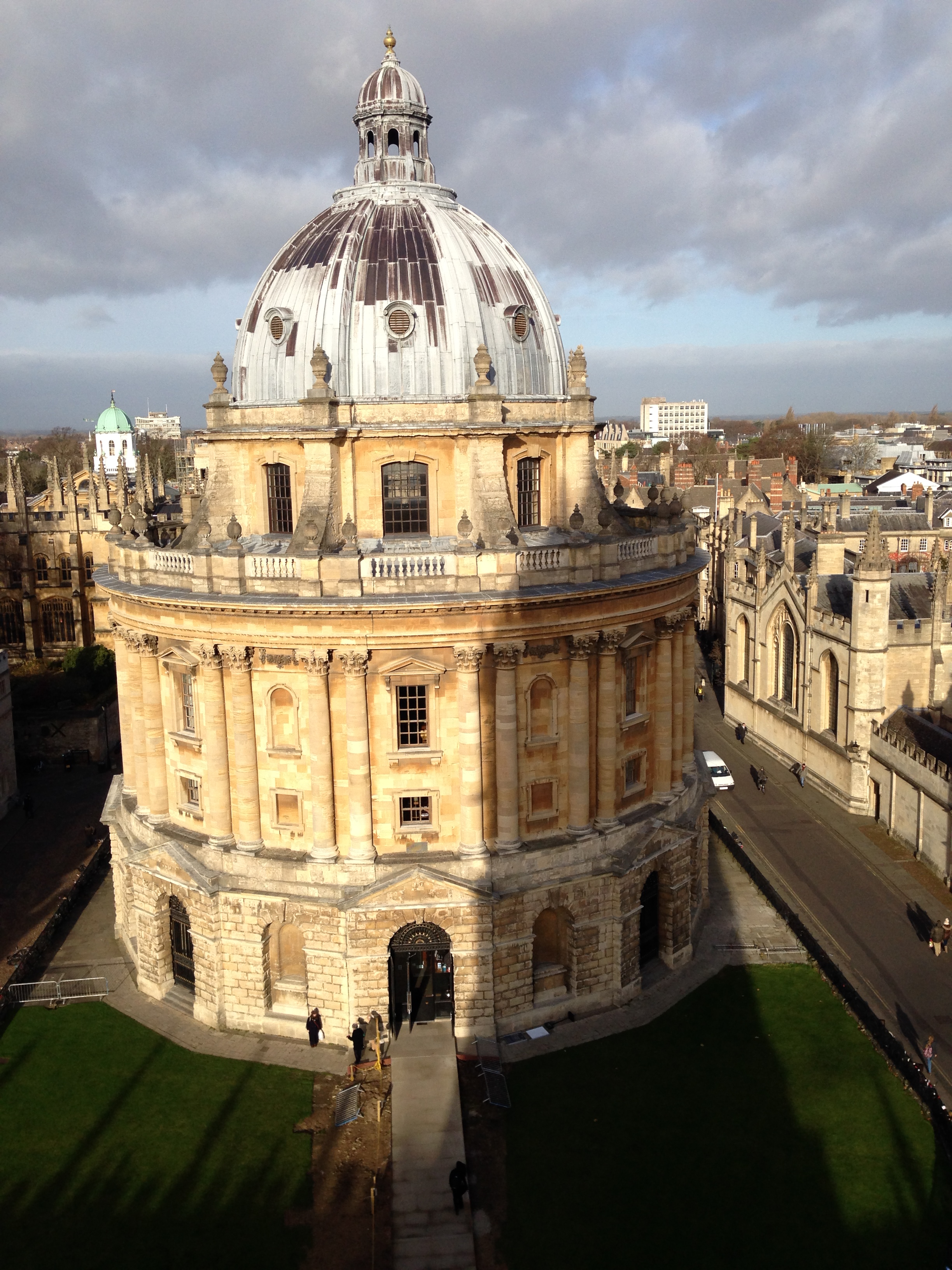
Here’s my attempt at a vaguely mathematical end: from the shaded area of a Venn diagram of Oxford and books, here is a picture of one of the most beautiful libraries you’ll ever see – the Radcliffe Camera in central Oxford.  The picture’s wonky because it was blowing a gale and I was up the top of the tower of St Mary the Virgin, where the wind was so strong I thought I, or at the very least my phone, was about to get whipped off the viewing balcony into the square below.  Thankfully we both made it back intact.

Image

“By working faithfully eight hours a day you may eventually get to be boss and work twelve hours a day.” (Robert Frost)

Oh, the joys of mid-January.  The seemingly never-ending greyness of it all.  The lights of Christmas and resolutions of New Year have long faded and you’re back at work.  Work: the daily commute wedged into someone’s armpit, steam rising off everyone’s drizzle-soaked clothes; arriving at your office to realise your colleague has stolen your favourite coffee mug and still hasn’t eaten the unidentifiable gelatinous foodstuff they brought in from home 3 weeks ago; faux-friendly emails from your work-shy boss asking you for fourteen completed reports before the end of the day, signed off with an inappropriate and frankly borderline-sarcastic emoticon. If this is your experience take comfort from the fact that you are far from alone.  This week I’m looking at novels that deal with the daily grind of our work lives.

Firstly, Post Office by Charles Bukowski (1971). Bukowski is one of the best-known beat generation authors, and Post Office was his first novel.  It’s a short work (160 pages in my edition) and details the insanity of working for the titular organisation with its impossible targets and low pay. Henry Chinaski (Bukowski’s alter-ego) suffers at the hands of his bullying supervisors, indifferent colleagues and the unpredictable public.  His hard-living ways do not anaesthetise the situation:

“Each route had its traps and only the regular carriers knew of them.  Each day it was another god damned thing, and you were ready for a rape, murder, dogs, or insanity of some sort.  The regulars wouldn’t tell you their little secrets.  That was the only advantage they had – except knowing their case by heart.  It was gung ho for a new man, especially one who drank all night, went to bed at 2am, rose at 4.30am after screwing and singing all night long, and, almost, getting away with it.

One day I was out on the street and the route was going well, though it was a new one, and I thought, Jesus Christ, maybe for the first time in two years I’ll be able to eat lunch.”

Needless to say, he doesn’t get lunch.  Bukowski is great at describing the tedium of a job that holds no meaning (for him, my particular postie has been doing the job for 30 years this year and tells me he loves it for the most part), and the seediness of the life he lives and those who surround him.  But he tempers the tale with humour which stops the portrait being too relentlessly bleak:

“I picked my cap up out of the street, put it on my head.  Put the sack back onto the left side of my spine, started out again. 100 degrees.

I walked past one house and a woman ran out after me.

‘Mailman! Mailman!  Don’t you have a letter for me?’

‘Lady, if I didn’t put one in your box, that means you don’t have any mail.’

‘But I know you have a letter for me!’

‘What makes you say that?’

‘Because my sister phoned and said she was going to write me.’

‘Lady, I don’t have a letter for you.’

‘I know you have! I know you have! I know it’s there!’

She started to reach for a handful of letters.

‘DON’T TOUCH THE UNITED STATES MAILS, LADY!  THERE’S NOTHING THERE FOR YOU TODAY!’

I turned and walked off.

“I KNOW YOU HAVE MY LETTER!”

Another woman stood on her porch.

‘You’re late today.’

‘Yes, mam.’

‘Where’s my regular man today?’

‘He’s dying of cancer.’

‘Dying of cancer? Harold is dying of cancer?’

‘That’s right,’ I said.

I handed her mail to her.

‘BILLS!BILLS! BILLS!’ she screamed. ‘IS THAT ALL YOU CAN BRING ME? THESE BILLS?’

‘Yes, mam, that’s all I can bring you.’

I turned and walked on.”

Post Office is unrelenting in the cynical gaze it casts over tragi-comedy of the working day.  If you’re sick of your job, this is the novel for you.

Secondly, Year of the King by Antony Sher.  I’m going a bit off-piste here because this is a diary and not fiction, but Jeanette Winterson says there’s no such thing as autobiography, only art and lies, so I think this allows for admission into a blog about fiction.  (Confession: when I first thought of this blog post I was going to write about Then We Came to the End by Joshua Ferris as the second book, but I started it 3 weeks ago and I’m only 100 pages in.  It had cracking reviews so I’m surprised I’m not getting on with it.  If you’ve read it can you tell me, should I persevere or give up?) So, I chose Year of the King for this theme as it details a year in a working life, in this case one of the finest actors of his generation as he grapples with the eponymous role in Richard III.  If you love your work but worry constantly that you’re not good enough, this is the book for you.  It’s so reassuring to read how this incredible actor feels he struggles with the language of Shakespeare, and messes up his first reading in front of the rest of the cast.  Having admired so many of his accomplished performances, I found myself thinking really? Well, if Antony Sher struggles maybe I’m not doing so badly after all…

“‘Just read it,’ says Bill grinning.

‘ “Now is the winter of our discontent…”’

I read badly, rather monotonously or else I over-stress.  Mercifully Bill stops me after about ten lines and starts to pick at words and discuss meanings.

We have begun.”

Sher is a great writer (it’s something he’s done more and more of) and his style is easy to read yet vivid.

“Bill suggests running the scene ‘trying to be more bestial’.  The result is a disaster.  Behaviour not from the animal world but the world of pantomime.  Cackling laughter, food being thrown around, sinewy ‘wicked’ acting. Although I’m participating and probably responsible for some of the worst excesses, I can hardly bear to watch the others.  Have to bury my head on the crutches for much of the scene.”

Ah yes, the crutches.  If you don’t know, Sher performed the “bottled spider” role in crutches.  What’s so interesting is amongst all the self-doubt and creative process, are vacillations over the use of the crutches, which for the reader 30 years on is a source of amusement.  The play went down a storm, Sher’s performance was showered with praise, and the crutches became stuff of theatrical legend:

The book holds all the things you would expect in an actor’s diary: taking us though the research process, details of the politics of rehearsal, fond (and discreet) portraits of his fellow actors and theatre professionals (Michael Gambon in particular seems a large, hilarious personality).  But Sher offers much more, such as beautiful images of the surrounding environment:

“An oil slick on the river today, from the long weekend’s abuse.  In the morning sunshine it’s as if a rainbow has fallen in the water and is being gently rubbed against the bank, washed and cleaned until its transparent again.”

The diary is also filled with his brilliant drawings, such as this one of Olivier, whose filmed performance of Richard casts a long shadow:

Image

Year of the King has a lot to offer the great variety of readers (little – very little – joke there for any Shakespeare fans): if you’re interested in the acting process, in approaches to Shakespeare, in the realities of theatrical production, or in Antony Sher himself, you’ll find Year of the King a rewarding read.

To end, here is a clip to bring some joy & colour into these grey January days spent in dreary magnolia offices: