“Happiness is a very fragile thing.” (Barbara Comyns)

It was JacquiWine’s review of The Juniper Tree by Barbara Comyns (1985) last month that encouraged me pick this from the TBR in time for Novellas in November, hosted by hosted by Cathy and Bookish Beck.

I really enjoy Comyns’ individual voice. She can give a sharp edge to stories presented seemingly without guile which works well within the premise here, taking as a starting point the Grimm Brothers fairytale of the same name:

My mother she killed me,
My father he ate me,
My sister, little Marlinchen,


Gathered together all my bones
Tied them in a silken handkerchief,


Laid them beneath the juniper-tree,
Kywitt, kywitt, what a beautiful bird I am.

Thankfully Comyns writes a less cannibalistic/abusive version but there are fairytale motifs from the story scattered throughout. This gives the novella a somewhat unreal, atemporal quality, although references are made to the 1980s.

The striking opening scene directly draws on the Grimm tale, as Bella Winter (physically similar to Snow White, although she feels highly self-conscious of a facial scar) travels to Richmond in search of a job:

“I noticed a beautiful fair woman standing in the courtyard outside her house like a statute, standing there so still. As I drew nearer I saw that her hands were moving. She was paring an apple out there in the snow and as I passed, looking at her out of the sides of my eyes, the knife slipped, and suddenly there was blood on the snow.”

The affluent woman is Gertrude, married to Bernard.  Bella ultimately gets a job over the river in Twickenham with Mary:

“Her teeth were small and pointed rather as an animal’s, indeed she resembled an animal with her delicate boned face with its merry expression, perhaps a squirrel.”

But this doesn’t prevent Bella becoming more and more entwined in Gertrude and Bernard’s life. It’s not surprising that she is in search of a family. Her mother is cold and judgemental:

“There was one shadow that I kept in the back of my mind as much as possible, and that was my mother. To me she was almost like a wicked fairy, poor woman.”

Bella also left behind a selfish lover Stephen, who was driving when the accident occurred which left her with the scar on her face, for which he blames her.

But Bella has a young daughter Marline, also known as Tommy, who she loves dearly. Tommy is biracial and both she and her mother face racism throughout. However, they build a happy life, living above Mary’s antique/junk shop and transforming a “gritty” back yard into a pretty walled garden.

They regularly cross the river to Gertrude and Bernard’s abundant, if carefully curated, home. Bella enjoys sitting with Gertrude under the titular tree, where territorial magpies build their nest and watch the comings and goings.

It’s hard to say more without venturing into spoilers, but if this is sounding a bit contrived and fey, there are enough prosaic details to ground the story, and humour too:

“I was glad to return to the freedom of the shop and to be queen of my own home—eat cornflakes or baked beans for supper, wear a dressing gown for breakfast and read books that did not improve the mind in bed.”

I also thought there was scepticism regarding relationships between the sexes here, no guarantee of happy-ever-afters. As well as positive portrayals, both Stephen and Bella’s mother are abusive to partners, and Bernard is in an ambiguous Pygmalion role. Families are shown as places of anger and destruction as well as nurturing, and Bella has to chose her people to create a happy life.

The undercurrent of death also stops the story feeling whimsical, and there is a very upsetting death which takes place, precipitating Bella needing inpatient mental health care. Although not gratuitous or gruesome, it is something some readers would want to avoid so if you want to know, DM me!

The introduction to my NYRB edition mentions the ending being abrupt, but I have to disagree. The ending ties up everything as much as it can and I can’t see anywhere further the story could go, having fulfilled its fairytale basis and continued into a pragmatic 1980s conclusion.

To end, a very young Björk making her film debut in an adaptation of the Grimm Tale:

“I have looked for life, but I can’t find it.” (Vicki Baum, Grand Hotel)

November is the month of sooooo many reading events, and I’m hoping to take part in Margaret Atwood Reading Month and Novellas in November, but I thought I’d start with German Literature Month XIV, hosted by Caroline at Beauty is a Sleeping Cat and Lizzy Siddal at Lizzy’s Literary Life.

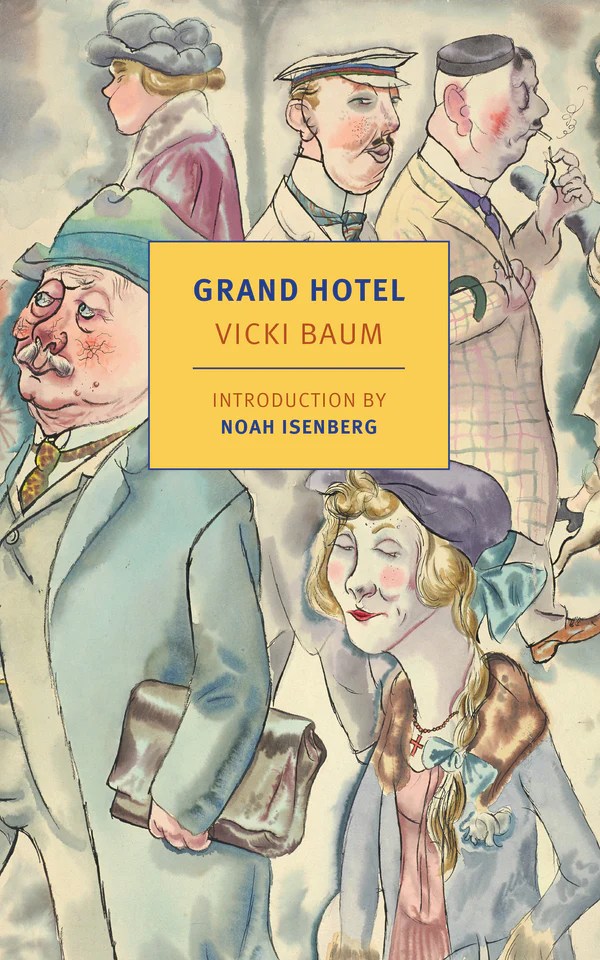
Grand Hotel by Vicki Baum (1929, transl. Basil Creighton 1930-1 revised by Margot Bettauer Dembo 2016) is a novel I’ve been meaning to get to for some time, republished by the wonderful New York Review of Books Classics.

I find a Weimar Republic setting always so enticing, and this novel was a bestseller in it’s day, originally serialised in a magazine. Sometimes with serials you can really see the joins when they are placed in novel form, but the episodic nature of hotel stays by various guests works well and Grand Hotel felt entirely coherent.

The titular building is opulent and glamorous:

“The music of the jazz band from the Tearoom encountered that of the violins from the Winter Garden, and mingled with the thin murmur of the illuminated fountain as it fell into its imitation Venetian basin, the ring of glasses on tables, the creaking of wicker chairs and, lastly, the soft rustle of the furs and silks in which women were moving to and fro.”

As readers we know that momentum for World War Two is building, but for the guests at this time it is the shadow of World War I which still looms large. Doctor Otternschlag’s face has been severely damaged by a shell. Every day he asks if a letter has arrived for him which it never has. We don’t know what this quiet, traumatised man is waiting for.

“Doctor Otternschlag lived in the utmost loneliness – although the earth is full of people like him…”

Glamour is brought by Grusinskaya, a prima ballerina desperately trying to hang on to physical vigour against the forces of aging. She is somewhat ambivalent, feeling driven to be as she has always been, and exhausted by it all:

“Perhaps the world would have loved her as she really was, as she looked now, for example, sitting in her dressing room – a poor, delicate, tired old woman with worn out eyes, and a small careworn human face.”

The most pathos occurs in the guest who doesn’t fit in: Kringelein, a clerk from Fredersdorf, given a terminal prognosis and determined to squeeze the pips from life before it’s too late. He chooses the Grand Hotel as his boss, Herr Preysing, stays there when in Berlin.

“He felt again, here in the bar of Berlin’s most expensive hotel, the same intoxication, a sense of exuberant plenty as well as of anxiety and alarm, the faint threat haunting the wicked joy of wrongdoing, the excitement of an escapade.”

Kringlein’s difficulty is, he is unsure of how to achieve his somewhat nebulous aim. Doctor Otternschlag tries to help but fails, unsurprising given his jaded, damaged view of the world. More successful is gentleman thief Gaigern, a dashing young nobleman who charms everyone:

“I am quite without character an unspeakably inquisitive. I can’t live an orderly life and I’m good for nothing. At home I learned to ride and play the gentleman. At school, to say my prayers and lie. In the war, to shoot and take cover. And beyond that I can do nothing. I am a gypsy, an outsider, an adventurer.”

He kits out Kringelein in fine clothes and takes him for fast drives in cars and up in a plane, but what are his motives? As Kringelein throws his hard-earned but limited money around, what will Gaigern do?

“Human kindness and warmth was so much a part of his nature that his victims always received their due share of them.”

Baum weaves together these disparate lives expertly, as they bump against each other within the Grand Hotel to a greater or lesser extent. There are overarching plots that draw characters together but Baum demonstrates that while hotels are places where change may occur, they do not lend themselves to resolution so easily. Hotels are by nature transitory and lives must be continued, consequences dealt with, once the guests pass through the revolving doors and back into the world.

Perhaps there is no such thing as a whole, completed destiny in the world, but only approximations, beginnings that come to no conclusion or conclusions that have no beginnings.

The tone is so well-balanced, with moments of light humour, almost slapstick, alongside darker elements. I did feel a constant undercurrent of sadness, but this highlighted the resilience of the characters who keep on keeping on during this interwar period, rather than being depressing.

Grand Hotel provides a compelling evocation of the Weimar era too, with glamour, seediness, riches and poverty all bound together in a vibrant, intoxicating, overwhelming Berlin. I’m so pleased to have finally read this novel.

“The room had taken on that utterly strange and enchanted appearance often encountered in hotel bedrooms.”

Grand Hotel was adapted by Hollywood in 1932, which despite my love of Garbo I’ve never seen. Time to remedy the situation!

Novella a Day in May 2020 #16

Speedboat – Renata Adler (1971) 170 pages

Speedboat is only a novel (or novella) in the loosest sense of the word. There’s no plot, no sense of linear time, no developing characterisation. Rather it is a series of observations, scenes, notes and stories that build a picture of late twentieth century life for a young female journalist living primarily in New York.

Jen Fain can be silly, shallow, detached; she is also insightful, witty, caring. She observes her life and the people in it with wry humour. There is the day she sees two rats:

“the second rat, of course, may have been the first rat farther up town, in which case I am being followed or the rat keeps the same rounds and hours I do. I think sanity, however, is the most profound moral option of our time.”

Her attitude to her profession:

“That ‘writer’s write’ is meant to be self-evident. People like to say it. I find it hardly ever true. Writers drink. Writers rant. Writers phone. Writers sleep. I have met very few writers who write at all.”

Her young friends and their self-defeating endeavours:

“In the bar of his father’s hotel, with the leather chairs that give one the feeling of sitting in a wallet, Dommy has introduced a new drink, Last Mango in Paris. A steep decline.”

Amongst silly cocktail puns there is also a sense of a serious young woman, trying to work out the world amongst a hectic, intellectual life that offers few certainties:

“When I wonder what it is that we are doing – in this brownstone, on this block, with this paper – the truth is probably that we are fighting for our lives.”

At the moment I’m finding it hard to concentrate on reading and I wondered if I could sustain reading a plotless novel, but I found the humour and sharp observations of Adler’s writing pulled me along.

Speedboat reminded me a bit of Flights by Olga Tokarczuk so if you enjoyed the fractured, plotless style of that, you might enjoy this.

“Hardly anyone about whom I deeply care about at all resembles anyone else I have ever met, or heard of, or read about in literature.”

Novella a Day in May 2019 #29

Pinocchio – Carlo Collodi (1883, trans. Geoffrey Beck 2009) 160 pages

Pinocchio, like a lot of classic children’s literature, is deeply weird and dark. I didn’t read it at all as a child, despite seeing the Disney cartoon which is very different. I picked it up as an adult because its published by the ever reliable NYRB Classics, and it turned out to be an intriguing read.

The basic premise I think everyone knows: a wooden puppet comes to life, wants to be a real boy, misbehaves and every lie he tells has a very obvious effect on his physiognomy.

“ ‘Lies, my boy, are immediately recognizable, for there are two kinds: lies that have short legs and lies that have long noses. Yours happen to be the long-nosed variety.’

Pinocchio, wanting to hide his face in shame, tried to run from the room – but he couldn’t. His nose was so long that it wouldn’t fit through the doorway.”

Pinocchio isn’t very likeable. He’s totally idle and only interested in himself.

“ ‘Of all the trades in the world, there’s only one that really suits me.’

‘And what trade would that be?’

‘That of eating, drinking, sleeping, playing, and wandering wherever I like from sunup to sundown.’

‘For your information,’ said the Talking Cricket, with his usual calm, ‘everyone who plies that trade ends up either in a poorhouse or a prison.’

‘Watch out, you doom-and-gloom Cricket! If I snap, you’ll be sorry!’”

Pinocchio does snap, and kills the Cricket stone dead. A short-lived relationship with an insect, who is nothing like the top hat and frock coat wearing, enduring friend of the cartoon.

The story is episodic, with Pinocchio going on several adventures, invariably taking the wrong decision, and failing to learn from his mistakes. It has the feel of folk tales rather than fairy tales, being grounded in an earthy reality of poverty and banditry, even when the bandits are a fox and cat double act. Pinocchio is always appealing even though he is selfish and unheeding, but there is never any sentimentality in the tale.

However, there is the strong didactic element associated with fairy tales, and Pinocchio is constantly lectured, by the cricket, by adults, and by the fairy with sky blue hair who crops up in various guises.

“ ‘Dear boy,’ said the Fairy, ‘people who talk that way almost always end up either in a prison or a poorhouse. For your information, everyone, whether they’re born rich or poor, is obliged to do something – to keep busy, to work. Woe to anyone who yields to idleness! Idleness is a dreadful disease and must be treated at once, starting in childhood. If not, it will be too late by the time we grow up.’”

Pinocchio does eventually learn and does become a real boy, but there’s something irrepressible about him. The feeling at the end is not of conservative integration where all is right with the world, but rather that the subversive elements that have been present all along are still there, waiting to spill out at any minute.

It’s a tale that can be enjoyed by children and adults. My edition included contributions from intellectual heavyweights to say the least: an Introduction by Umberto Eco, an Afterword by Rebecca West and a quote on the back by Italo Calvino. This shows how Pinocchio has been so widely recognised and why it endures; deceptively simple, hiding its complexities in an engaging children’s tale, it can be read differently each time.

I really didn’t like the cover of the NYRB Classics edition, finding it creepy, but it captures the unsettling quality of the tale of an animated puppet perfectly:

Novella a Day in May 2019 #7

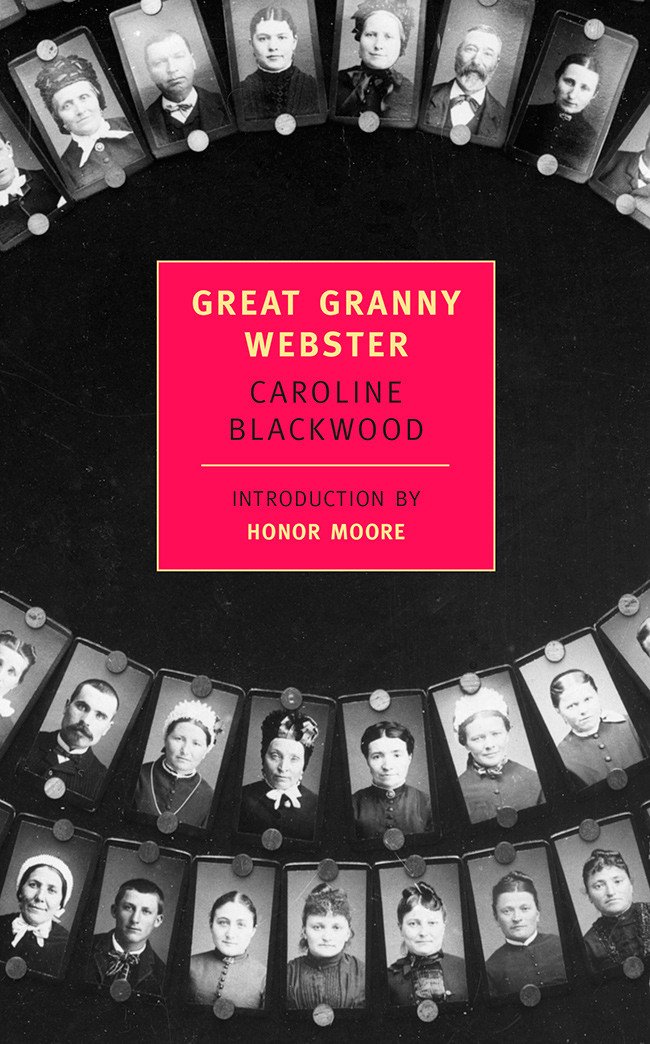
Great Granny Webster – Caroline Blackwood (1977, 96 pages)

My blogging slump meant I completely failed to take part in Cathy and Niall’s Reading Ireland 2019 (#Begorrathon) in March, and so I’m including a few Irish novellas this month. The first of these is by an author I’ve never heard of, which seems extraordinary given her quite astonishing life story.

The titular matriarch of this novel is a wonderfully Gothic creation:

“She had arranged her hair in two grey tufts that lay on her forehead like a couple of curly horns, so that what with the exaggerated narrowness of her elongated face, and her uniquely over-long upper lip, she often reminded me of a melancholy and aged ram.”

The narrator is sent to Hove to recuperate with her great-grandmother in 1947 when she is 14, as it’s thought the sea air will help her recuperate from an operation.  It’s totally bizarre that her family would think this a good idea, as Great Granny Webster lives in severe austerity in a damp and gloomy house, alone except for her aged and devoted retainer, Richards.

“All she wanted from each new day that broke was the knowledge that she was still defiantly there – that against all odds she had still managed to survive in the lonely, loveless vacuum she had created for herself.”

Unsurprisingly, this is not a warm and affectionate portrait of the generations of a family. It is however, witty, astute, sad, and incisive. Great Granny Webster is entirely uncompromising:

 “ ‘There really is nothing more unattractive than the sight of a young woman displaying a repulsive amount of arm. I am not going to mention this subject again.’

Great Granny Webster always told the truth. She never once referred to my sleeves or my arms again.”

We later learn that her daughter (the narrator’s grandmother) completely lost all sense of reality, trapped in the family castle at Dunmartin. The echoes of previous generations are heard down the years. As an adult, the narrator is contacted by her fragile, enchanting Aunt Lavinia who is having similar problems:

“One day Aunt Lavinia rang me up to say it was too maddening, she was in prison. When I sounded astonished she admitted that it wasn’t exactly a prison, but it was just as bad, for she was being detained in a hospital where she had been put by the police.”

What Blackwood captures brilliantly is how in families, people can be superficially polar opposites but underneath it all, so very alike, much to their own alarm:

“Aunt Lavinia’s house was very warm. She liked to have log-fires burning and her central heating turned on even in the summer. Although her bedroom was rather like a hot-house and fragrant with the smell of her lillies, I had exactly the same feeling of chill I had experienced in the bleak, cold, flowerless drawing room of Great-Granny Webster when that old lady had predicted that eventually I would be very like her.”

In such a short space, Blackwood achieves fully-rounded portraits of three generations of women in an idiosyncratic noble family. Great Granny Webster is, like its anti-heroine, bleak, funny and unique.

I read this in an old Picador edition, but I’m delighted to say the wonderful NYRB Classics have re-issued it.