“Short stories consume you faster.” (Ali Smith)

‘Tis the season of gluttony and excess, but how about some amuse-bouche in the form of festive short stories, before settling down with a chunkster tome to while away the long winter evenings?

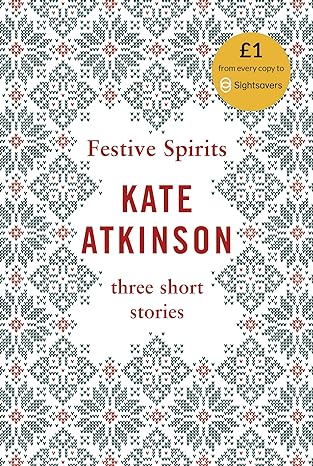
Festive Spirits by Kate Atkinson (2019) features three very short stories. It’s a small hardback which is sold in aid of Sightsavers.

Given their very concise length, I can’t say too much except they’re all as inventive and witty as you would expect from Atkinson.

In Lucy’s Day, a busy, exhausted mother attends her children’s nativity play.

“The Nativity was a dishevelled construct made mostly, as far as Lucy could tell, from lollipop sticks, cotton wool and hamster bedding. And lentils. The school used lentils a lot in its artwork, as well as pasta and beans. You could have made soup from some of the collages Beatrice and Maude brought home.”

In Festive Spirit, a woman reflects on her unhappy marriage to her successful husband and takes metaphysical steps in keeping with the time of year:

“When he was a boy he didn’t know anyone who got their hands dirty for a living. Now he was an MP everyone he knew had dirty hands.”

The final story, Small Mercies, returns to familiar domesticity and captures the sadness and loneliness experienced by so many at this time of year. But there is a glimmer of hope for middle-aged Gerald.

“It was difficult to make out his mother’s words, laced as they were with emotion and free alcohol.”

Festive Spirits is a quick but very worthwhile read. Kate Atkinson is great at short stories and these capture the time of year without sentimentality but also without any bitter irony. Highly enjoyable.
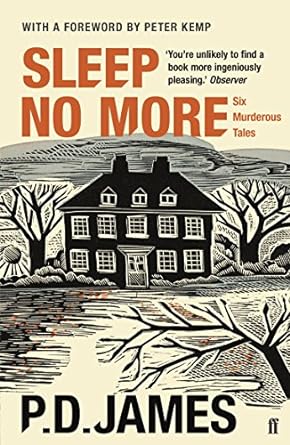
PD James’ collection Sleep No More: Six Murderous Tales (2017) features two stories set at this time of year. The Murder of Santa Claus is the longest in the collection and probably the weakest (the denouement is someone explaining to the murderer how they know they did it) but still so much to enjoy.

It begins with Charles Mickledore, an author of cosy crimes, (“I’m no HRF Keating, no Dick Francis, not even a PD James.”) looking back on Christmas 1939 when he was 16. He goes to stay with a distant relative, Victor Mickledore, in a country house, with other guests who don’t know each other that well.

There’s a faithful secretary, an aging starlet, the couple Victor booted out of their home, and a dashing pilot. There are long-held resentments regarding Victor possibly killing someone in his car and paying off his valet as an alibi.

“The paper tore apart without a bang and a small of object fell out and rolled over the carpet. I bent down and picked it up. Wrapped neatly in an oblong of paper was a small metal charm in the shape of a skull attached to a key ring; I had seen similar ones in gift shops. I opened the paper folded round it and saw a verse hand printed in capitals.”

The verse is a death threat of course, which Victor disregards and insists the Christmas traditions will go ahead as usual, including his routine of dressing up as Santa and delivering presents. The title tells us all will not end well…

It’s hard to write a satisfying whodunit in a short story form and as I mentioned, this was a bit clunky. But PD James is such a brilliant crime writer it was still highly readable, and she clearly had a lot of fun with the cosy crime tropes and characters. The Christmas setting made for a real treat too.

The first story in the collection, The Yo-Yo, also features an older man looking back on his youth and remembering a murder. The difference here being there is no mystery, as he witnessed the event directly.

“I found the yo-yo the day before Christmas Eve, in the way one does come across these long-forgotten relics of the past, while I was tidying up some of the unexamined papers which clutter my elderly life. It was my seventy-third birthday and I suppose I was overtaken by a fit of momento mori.”

It was Christmas years earlier in 1936 when he was being driven from his boarding school to spend the festive period with his indifferent grandmother, that the story takes place.

James expertly paces the story to the climax of the murder, and then demonstrates the fallout with equal precision. A recurring theme through all six stories is of people getting away with murder (no Commander Dalgliesh here to find the culprits!) and whether justice occurs only within the law, despite it, or not at all.

“We walked back to the car together, almost companionably, as if nothing had happened, as if that third person was walking by our side.”

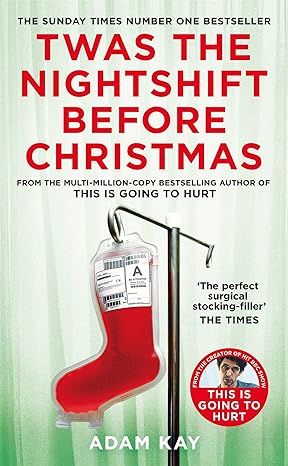
Finally, not short stories but an honourable mention to Adam Kay’s ‘Twas the Night Shift Before Christmas (2019) detailing his experiences working as a doctor over the Christmas period for several years. I haven’t read his hugely successful book This is Going to Hurt or watched the tv series with Ben Whishaw – having worked in the NHS for several years I find portrayals either inaccurate and infuriating or authentic and stress-inducing. I feared Kay’s would be the latter. But for some reason I was tempted by this little stocking filler, and he managed to take me right back, but entertain me rather than induce vicarious trauma. Highly recommended, as long as you don’t mind a lot of swearing 😀

“Sunday 26 December 2004

Full marks to the anaesthetist wearing a badge that says: ‘He sees you when you’re sleeping, he knows when you’re awake.’”

I really enjoyed my festive reads. Brona from This Reading Life has suggested we use the hashtag #ALiteraryChristmas for festive posts, so do join in if you’d like to!

To end, I’m never ahead of the game on anything, but this year I snapped up on pre-order the Christmas album by these two titans of contemporary folk music:
“We look before and after, and pine for what is not” (Percy Bysshe Shelley)

My lovely friend H feels I take life too seriously & this is reflected in my choice of reading matter.  As such, she keeps lending me light reads in the hope that I’ll chill out & stop living my life like I’m a some sort of doomed Hardy heroine (which I dispute: I harbour no plans to start bedding down at Stonehenge.  Far too cold, I prefer central heating. Probably just as well as they’ve restricted access to the monument now.) But because she is a good friend & I love her (and she’s probably right in general), I read the books she gives me.  This week it was Death Comes to Pemberley by PD James (Faber & Faber, 2011), so I decided to write about it here, making the theme of the post prequels and sequels.

Death Comes to Pemberley is a sequel to Pride and Prejudice, set 6 years after the end of Austen’s novel, where Darcy & Elizabeth are happily married with 2 sons. I’m not a big crime reader, so I hadn’t read any PD James before, but I know crime aficionados who highly rate her.  To me the crime element of this novel was its weakest link – the plot was very slight and there’s no detective work as such, the crime is solved as the murderer confesses.  But I never wanted to blog about books in a critiquing way, so I’ll stop and look at what is to celebrate, as I planned.  James has great fun with the concept of a sequel to Pride and Prejudice, with comments on the backstory like: “If this were fiction, could even the most brilliant novelist contrive to make credible so short a period in which pride had been subdued and prejudice overcome?” (Answer: Yes).  She also explains potential problems in the original, like why Darcy’s first proposal and following letter were so rude (he was trying to make Elizabeth hate him so he wouldn’t have to deal with his attraction to her).  Whether or not you like this explanation depends on how you’ve read the original, and while it’s a shame to pad out the room for interpretation which helps readers feel a sense of ownership over a novel, James is as entitled to her view as anyone else. She is obviously a huge fan of Austen and characters from Emma also make an appearance thorough a verbal report: a child is adopted by Mrs Harriet Martin nee Smith, friend of Mrs Knightley.

Part of modern scholarship on Austen is to look at what is hidden in her work: the slavery hinted at in Mansfield Park, for example. Writing from a 21st century perspective, James can make explicit certain factors like feminism and the Napoleonic War which readers today may pick up on but are only shadows in Austen’s works:

“We have entered the nineteenth century; we do not need to be a disciple of Mrs Wollstonecraft to feel that women should not be denied a voice in matters that concern them.  It is some centuries since we accepted that a woman has a soul. Is it not time that we accepted that she also has a mind?”

“The war with France, declared the previous May, was already producing unrest and poverty; the cost of bread had risen and the harvest was poor. Darcy was much engaged in the relief of his tenants ..”

In this way James’ novel offers a chance to view well-known characters in more well-rounded way, taking into account their social and political circumstances in a wider perspective, beyond that of the Regency marriage market.  However, and I realise this is an obvious point so I won’t linger on it, PD James is not Jane Austen, and as such the novel reads a bit flat.  The effervescent wit is gone and there’s not really anything to replace it.

It was a brave decision that James made with Death Comes to Pemberley, as writing a sequel to Pride and Prejudice is really a thankless task.  Austen and her characters are so greatly loved I doubt any author other than Austen herself could do them justice.  While placing them in genre fiction like crime is probably a good idea so that its clear you’re working within conventions other than those of the original novel, I can’t help feeling that Death Comes to Pemberley may prove disappointing for both crime fans and Austen fans.

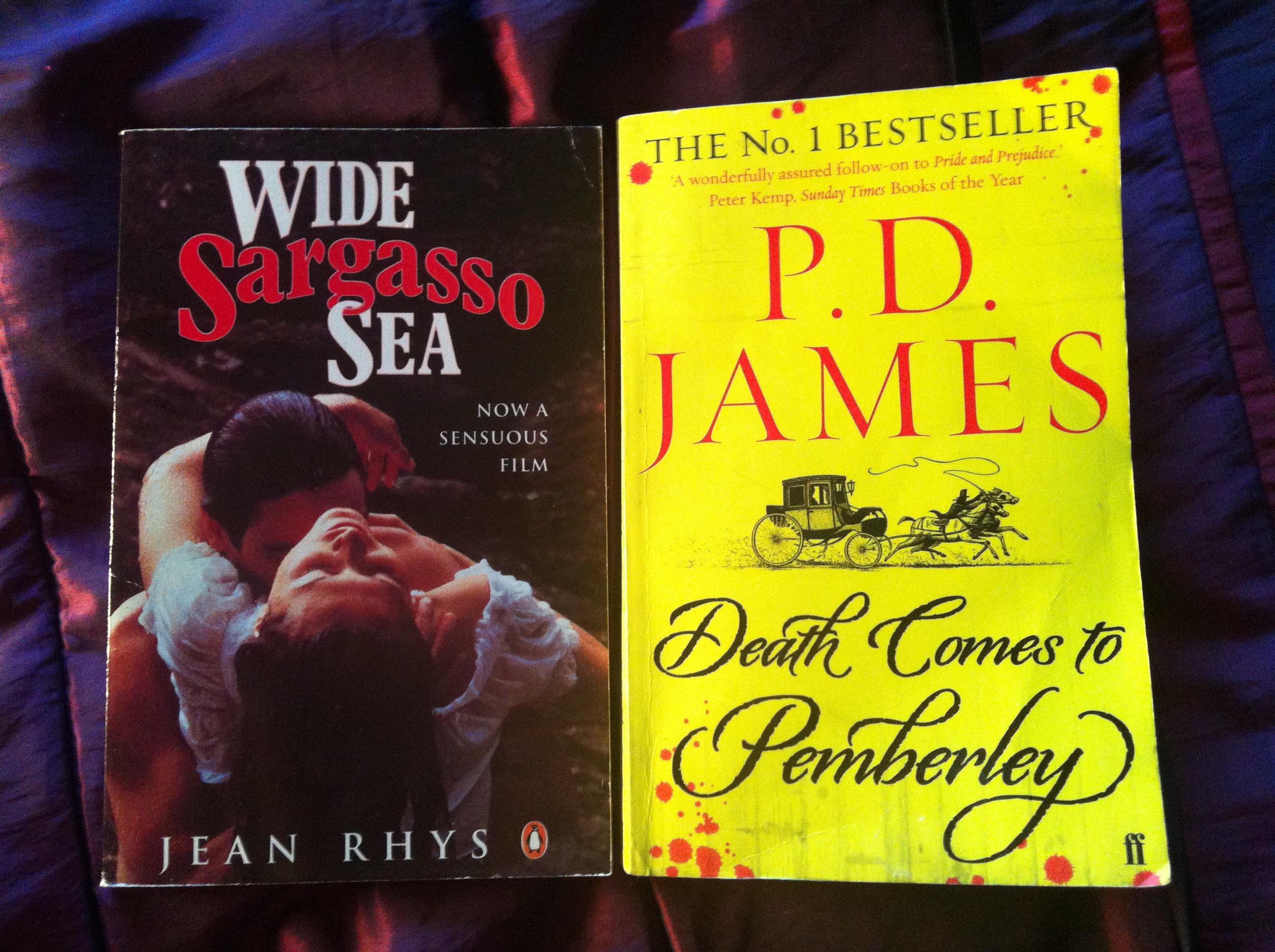
For the prequel part of this post I’ve chosen probably the most well-known of all prequels: Wide Sargasso Sea by Jean Rhys (1966, my copy Penguin 1993). Wide Sargasso Sea looks at the events that occurred prior to Jane Eyre, and how Rochester’s first wife became the madwoman in the attic. Rochester marries the Creole heiress Antoinette Cosway in the Carribean.  There is a strong sexual attraction between them as Rochester describes:

“Only the sun was there to keep us company. We shut him out. And why not? Very soon she was as eager for what’s called loving as I was – more lost and drowned afterwards.”

But this is not enough to cover the differences between them “It was all very brightly coloured, very strange, but it meant nothing to me. Nor did she, the girl I was to marry.” and the cracks in their marriage soon start to appear, with distrust, jealousy and violence on both sides.  The result of this we already know…

What happens to Antoinette is a commentary on both men’s exertion of power over women, and the coloniser’s power over the colonised.  Rhys takes the “other” of Jane Eyre and gives her a voice, placing us alongside Antoinette and showed how flawed and racist notions of “other” are.  Rochester, the rich white Englishman, seeks to control Antoinette and does so by renaming her and confining her – the parallels with slavery are clear.  As a woman, she is also subjugated by a society that is on Rochester’s side:

“When a man don’t love you, more you try, more he hate you, man like that…”

“I cannot go…I am not rich now, I have no money of my own at all, everything I had belongs to him…that is English law”

However, by giving the narrative voice to Rochester as well as Antoinette, Rhys ensures a balance to Wide Sargasso Sea that means you can’t write it off as limited perspective polemic. It has had a huge influence on how Jane Eyre is read, and I think this is because it is so sensitive and subtle a reading and portrayal of the characters.  Rhys succeeds in creating a backstory that is wholly believable and recasts the frames of reference through which Jane Eyre is viewed, without ever undermining the original work.  This can be seen in interpretations such as the BBC’s 2006 version of Jane Eyre which emphasised Bertha’s (as she is then named) sexuality, associated her with the colour red as in Wide Sargasso Sea, and had her played by the beautiful Claudia Coulter to make Rochester’s physical attraction to her easy to understand (the BBC also filmed a version of Wide Sargasso Sea the same year). The fact that Sandra Gilbert and Susan Gubar’s behemoth of feminist literary criticism took the title The Madwoman in the Attic (1979, Yale University Press) shows how the character of Bertha (and characters like her) are being reassessed, and I think it’s reasonable to assume Wide Sargasso Sea played no small part in that.  Unlike Death Comes to Pemberley, Wide Sargasso Sea stands alone as a great novel, and simultaneously hugely enhances reading the source work.  I recommend the latter unreservedly, and the former as a point of interest and a quick, throwaway read.

I was wondering how to photograph the books in a way that represented the theme, then as I looked at the covers I realised they sort of represented a before and after already – la petite mort followed, inevitably, by le grande mort.  What a depressing note to end on – I think H has got her work cut out…….

Image