“When a Welsh person loves you, you’ll finally know how it feels to belong to poetry.” (Kamand Kojouri)

This is a contribution to Reading Wales 2022 aka the Dewithon, hosted by the lovely Paula over at Book Jotter. My VMC pile is reaching ridiculous proportions so I googled “Wales Virago” and was delighted to find that there were two authors I could take off the TBR for this year’s Dewithon.

Firstly, I chose Penelope Mortimer, as I’d enjoyed Daddy’s Gone A-Hunting and The Pumpkin Eater a great deal, finding her writing spiky and incisive. Mortimer was born in Rhyl, Flintshire and My Friend Says It’s Bullet-Proof (1967) was her sixth novel.

Muriel Rowbridge is a journalist on a trip to Canada, the only woman in a group of men, warned by her editor:

“Don’t go wandering off in one of your Virginia Woolf fits.”

She is very much the outsider, wanting to focus on her writing while the rest of her group view it as a bit of a jolly:

“they were pleased with themselves, thawing toward each other, throwing out remarks about wives, children, secretaries, which were immediately understood, as though they were giving a particular handshake or flicking back their lapels for identification.”

This is the working world of the 1960s, which we’re all familiar with from Mad Men at least. Her colleagues think it’s totally acceptable to comment on what she’s wearing and the attractiveness of her legs. Thankfully Muriel doesn’t spend much time with them, or indeed much time working. The trip is a time of reflection and recuperation for her, as she recovers from a mastectomy for breast cancer.

“How to deal with it, except with vague attempts at courage and acceptance, she had no idea.”

Although Penelope Mortimer did have lung cancer later in life, I’m not sure she had personal experience of breast cancer at this point. But I thought this was a sensitive exploration of a woman working out who she is after a life-changing experience. Muriel isn’t remotely self-pitying, but she does need to find self-compassion.

”the anger against herself raged brightly, a clear fire. She had never felt this anger before; she could never remember feeling it before. It was enlivening, making her very defined and sharp, as though she had become a weapon.”

She had left her married lover Ramsey when she was diagnosed, and he is back with his wife Flora, a situation neither Ramsey and Flora are sure they want. This led to some of the pithy observations on relationships between the sexes that I expect from Mortimer:

“Between us, he said, he was being eaten alive. If this was so, I don’t know why we were both starving.”

While in Canada, she meets Robert: “what had been an indeterminate distance between their hands, knees, faces, was now measured exactly: they were accessible to each other.”

While she feels ambivalent about their relationship, the sex does lead her towards a new acceptance of her changed body.

“She leant against the lift wall and slowly remembered the night; then realised that this was the first time she had woken, and dressed, without any sense of mourning.”

Amongst the sexist or paternalistic colleagues; the self-centred married lover; and the surgeon who possibly took an entire breast when a lumpectomy would suffice without considering what it would mean for Muriel, Robert is a reminder of what can be positive in male/female relationships. This doesn’t necessarily mean that its happily ever after either… Mortimer is determinedly realistic.  

I didn’t think My Friend Says Its Bullet-Proof was quite as strong as the other two Mortimers I’ve read, but it was an interesting examination of the choices available to women in the late 1960s. It questions how to navigate independence in a world that marginalises and objectifies you both professionally and personally.

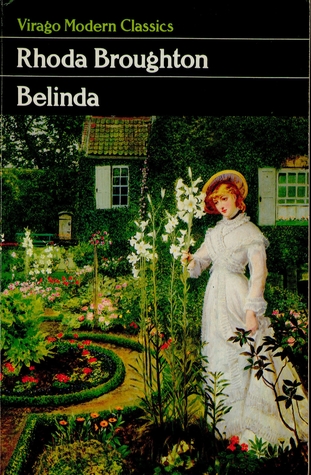
Secondly, a new-to-me author despite the vast number of novels she wrote; Rhoda Broughton, who was born in Denbighshire. Belinda (1883) was written roughly in the middle of her career, and my edition tells me she was alongside Mary Braddon as ‘Queen of the Circulating Library’.

Belinda is a satire, but that double-edged royal appellation did make me wonder if it was always read as such. Maybe I’m doing the fare of circulating libraries down, but I would have thought a tale of simpering Victorian virgin lovers was more typical of their stock than a satire of such stories. Regardless, if you read it straightforwardly as a romance because that’s what you were looking for, or as a satire because you were sick of such stories, Belinda would deliver.

The titular heroine is in Germany with her feckless, charming sister Sarah at the start of the novel:

“Away they go to Moritzburg, when the noon sun is warm and high; away they go, handsome, gay, and chaperoneless. There is no reason why their grandmother, who is a perfectly able-bodied old lady, should not escort them; but as she is sixty-five years of age, has no expectation of meeting a lover, and is quite indifferent to spring tints and German Schlosses, she wisely chooses to stay at home.”

Sarah is hugely popular with young men and is on her seventh fiancée. Belinda is unpopular, except with student David Rivers (aptly named, as he’s totally wet). The sisters wonder if Belinda’s nose is behind her lack of societal success:

“It is not case of measurement,’ says Sarah gravely; ‘I have seen noses several hands higher that were not nearly so alarming. It is a case of feeling; somehow yours makes them feel small. Take my word for it,’ with a shrewd look, ‘the one thing that they never can either forgive or forget is to feel small’”

It isn’t Belinda’s nose, unsurprisingly; it’s her fairly dull personality and her social awkwardness, matched only by that of her love interest:

“Is it her fault that all strong emotion with her translates itself into a cold, hard voice, and a chill set face? With other women it translates itself into dimples and pink blushes and lowered eyes. Ah!  but do they feel as she does? Sarah, for instance. When do men ever leave Sarah’s company with the down- faced, baffled, white look with which Rivers has more than once quitted hers? Preening themselves rather; with sleeked feathers and cosseted vanity.”

As you can see from the quote above, Broughton uses Belinda to poke fun at romantic mores, the silliness of them and the uselessness of them. She demonstrates how those who cannot master the light-hearted conventions end up tied in knots.

“‘And you were — and you were — one of the heavenly host up there!’  ends the young man, baldly and stammering.    But love is no brightener of the wits.

One of the heavenly host?’  repeats she, justly infuriated at this stale comparison.  ‘An angel, in short!  Must I always be an angel, or a goddess?  If anyone knew how sick I am of being a goddess!  I declare I should be thankful to be called a Fury or even a Ghoul, for a change!’

So saying, she turns her shoulder peevishly to him; and leaving the garden, begins to walk quickly along the road by the water, as if to make up for her late loitering.  He keeps pace with her, dumb in snubbed contrition, stupefied by love and, unhappily for himself, fully conscious of it; burningly aware of the hopeless flatness of his last simile, and rendered by his situation quite incapable of redeeming it by any brighter sally.”

The course of true love inevitably does not run smooth for the young lovers – ‘twas ever thus. However, Belinda’s understandable frustration with Victorian female conventions leads her to make some very questionable choices. For those of you who have read Middlemarch, these questionable choices will be most familiar. I don’t know what Oxford Rector Mark Pattison did to the women writers of late Victorian society but whatever it was, he really, really annoyed them. He provided the model for Casaubon in Middlemarch and here he is rendered as Professor Forth:

“She had known that she did not love him, but she had not known that he wore carpet slippers in the drawing-room.”

Belinda is well-paced and witty, but I think I would have like the satire to be slightly more explicitly evoked. At one point there seemed a never-ending round of cheeks blushing, lips whitening, words stumbling… and a pretty major suspension of my disbelief that Belinda and Rivers could really be in love, given they had barely spoken to each other but only mumbled vaguely while experiencing various body temperature changes.

I would have liked a slightly sharper authorial voice, or more scenes with witty, pragmatic Sarah and the frankly reprehensible grandmother, with whom I could only agree when she observed:

“Belinda is too everything, except amusing.”

I did enjoy Belinda though, and there was broad comedy too, including some nice scenes with pug dogs, and with social bull-in-a-china-shop Miss Watson:

“I shall certainly mention it to his mother. Lady Marion, when next I meet her,’ says Miss Watson resolutely; I do not think it would be acting a friend’s part not to do so.  I do not actually know her, but there is a sort of connection between us; I was at school for six months once at Brussels with a cousin of hers, and there is no doubt that there is something uncommonly louche about it.’”

To end, the BAFTAs earlier this month featured a performance from an 85 year-old Welsh singer/legend:

“A Persephone cover is a guarantee of good reading.” (Nicola Beauman, founder of Persephone Books)

After a month of daily posting about novellas I was planning at least a week’s break from blogging, but I couldn’t resist joining in with Jessie at Dwell in Possibility’s Persephone Readathon. Here are two short Persephones that just missed out on being part of Novella in Day in May as they were over 200 pages (but not by much).

Firstly, Lady Rose and Mrs Memmary by Ruby Ferguson (1937) which is Persephone No.53.

This is the story of a young Scottish heiress from childhood to young adulthood, framed by the visit of three tourists to the estate of Keepsfield.

“This transition to the atmosphere of another world is bewildering to modern personalities. The three strangers were conscious of a nakedness of spirit that made them uneasy spectators of a grandeur which was more than material. The old caretaker had slipped into the background, as caretakers do.”

The caretaker, Mrs Memmary, has been on the estate since she was a girl, and she tells one of the Tourists, Mrs Dacre, the story of Lady Rose. Rose is a child filled with joy, and a passionate attachment to her homeland, so far so that she names her kitten after a mighty clansman:

“Rose went out onto the sun-drenched west terrace, cuddling Rob Roy, who by now wore a small pink silk handkerchief round his head to protect him from the sun.”

She is a debutante and presented to the Queen, who takes a shine to her. It is at this moment, stepping into society for the first time, that she realises what her wealth and position truly mean:

“She was important? She, Rose Targenet aged eighteen, who had done so little but rejoice in the beauty and happiness of life. Of course her importance was not her own quality; it was because of her Papa.”

However, while she is important, she has no power. This is Victorian Scotland, and she must make a good match, securing the future of her lands and providing a male heir. We know that she managed this, as Mrs Memmary tells the tourists early on that all the splendour they see in the home is entailed to the heir, and Lady Rose is seeking a rich tenant to help pay for the upkeep of the estate.

The Victorian marriage market is poked gentle fun at during this overheard conversation between Rose’s mother and a family friend, regarding the Poet Laureate:

“If poor Alfred must write about what he calls love, he might at least explain that it is an emotion to be openly enjoyed by the middle classes.”

Although Lady Rose and Mrs Memmary could be seen as a light novel, it actually has serious points to make about the role and rights of women in the period. (It was written in in the 1930s and was apparently a great favourite of the Queen Mother, which I find fascinating. Makes me see her in a whole new light.)

Rose ends up in a loveless marriage to someone who is not horrible, but just completely cold and repressed:

“She had cried on her bed all the afternoon, realizing bitterly that in 1874 married women had no rights, even if they were countesses. She didn’t cry now, for she had the children, and in any case crying did no good after 10 years.”

Meanwhile, her friend Susan is in no better position having avoided marriage altogether:

“But what have I got? Just a piece of needlework and two disappointed elderly minded parents, and all the time in the world on my hands. If I had my way women would be free to do the same things as men; come and go as they wished, and read and talk, and be doctors and lawyers and financiers, and Members of Parliament, and newspaper writers, Wouldn’t that be wonderful?”

So what happens? We know Lady Rose is a strong character who at times is willing to defy authority, and we know she has been abroad for a long time. Mrs Dacre isn’t at all happy with what Mrs Memmary tells her:

 “ ‘You mean – that was the end of Lady Rose’s story? It seems a vague, disappointing ending.’

‘Vague?’ The old woman thought for a moment and said, ‘But in real life things go like that. Our stories have no ending. We come into the light for a little while, and then we move away into the shadows and nobody sees us anymore. It is better that way.’”

A good point, but Mrs Memmary has held something back. I don’t think I’m a great genius in guessing what it was in Chapter 2, but this didn’t spoil my enjoyment of the novel at all. I promise you it’s not a vague, disappointing ending.

Lady Rose and Mrs Memmary is in some ways a romantic novel: the country house and Scotland are both described with ravishing beauty, and it is a novel about being true to yourself and following your heart. But Ferguson also doesn’t shy away from portraying the price that is paid for these things, suggesting the price may be worth it but it can also be a high one.

Secondly, Daddy’s Gone A-Hunting by Penelope Mortimer (1958) which is Persephone No.77. Ruth Whiting lives in a commuter town with her husband Rex. Their two sons are away at boarding school and their daughter – whose conception necessitated their marriage – is studying at Oxford. Ruth is not happy:

“In all the years of her marriage, a long war in which attack, if not happening, was always imminent, she had learned an expert cunning. The way to avoid being hurt, to dodge unhappiness, was to run away. Feelings of guilt and cowardice presented no problems that couldn’t be overcome by dreams, by games, by the gentle sound of her own voice advising and rebuking her as she went about the house.”

Rex and Ruth aren’t together very much – he has a flat in London during the week and comes home at weekends.

“For Rex and herself there was no longer any hope or possibility of change; there was no longer any choice to be made. They lay, fully grown, capable of every crime and every greatness, paralysed by triviality.”

Mortimer’s unflinching eye and scathing attitude is cast wider than the intricacies of marriage; it also takes in the other couples in the area:

“The relationships between the men are based on an understanding of success. Admiration is general, affection not uncommon. Even pity is known. The women have no such understanding. Like little icebergs, each keeps a bright and shining face above water; below the surface, submerged in fathoms of leisure, each keeps her own isolated personality. Some are happy, some poisoned with boredom; some drink too much and below the demarcation line are slightly crazy; some love their husbands and some are dying from a lack of love; a few have talent, useless to them as a paralysed limb.”

Ruth seems on the verge, if not in the midst of, a breakdown. She is struggling to get out of bed and Rex engages a housekeeper/nurse.  However, what begins as a dissection of suburban 1950s marriage develops into something more political when Ruth’s daughter Angela tells her she is pregnant. The father, fellow student Tony, is selfish and callow:

“It was obviously not going to be necessary to impress on him the seriousness of the situation. He looked like a curate settling down to discuss dry rot in the organ loft.”

So Angela, unlike her mother, does not want to tie herself into marriage to an unsuitable man for the sake of an unwanted baby. The rest of the novel follows the hoops both Ruth and Angela have to jump through in order to secure an abortion. (This  particularly resonated at the time I read it given the recent vote in Ireland). What Mortimer demonstrates is the ways in which women’s lives are circumscribed and the huge fallout this can have: on mental health, physical health, participation in society, participation in our own lives.  Although she is acerbic, and undoubtedly it is a resounding cry for women’s rights to be acknowledged and given their due importance, I think above all, Daddy’s Gone A-Hunting is a plea for kindness.

“He would probably go through his entire life imagining that he was real; but not one person would owe him gratitude, remember his comfort.”

To end, I said when Novella a Day in May was over I’d go back to shoehorning late 20th century pop tunes into posts at every opportunity. So here we go, a 1980s celebration of those beautiful Persephone covers:

Novella a Day in May #19

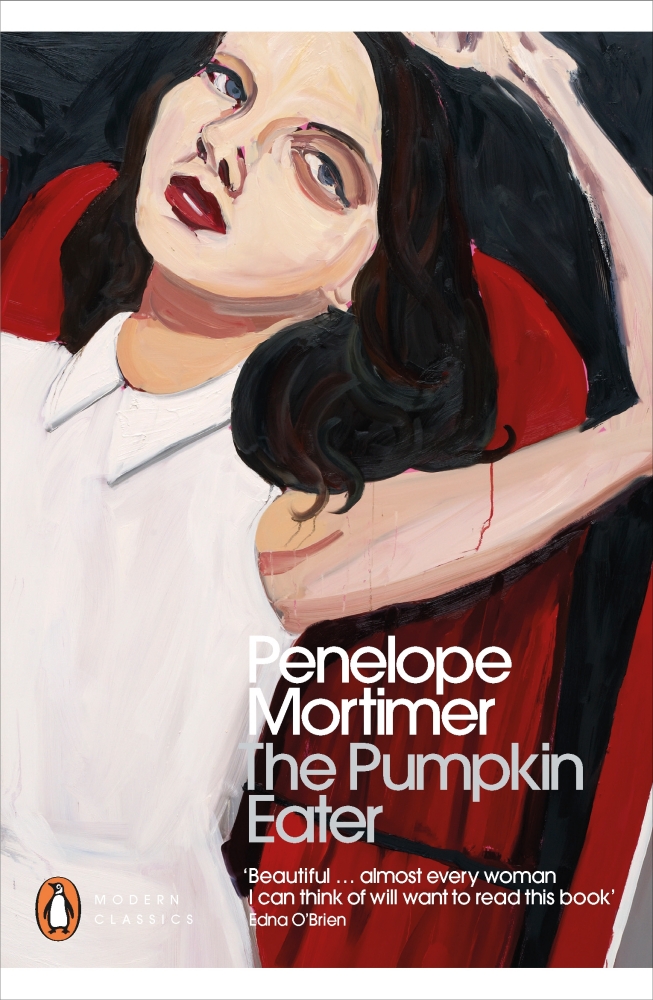
The Pumpkin Eater – Penelope Mortimer (1962) 144 pages

The Pumpkin Eater begins with a woman speaking to her psychiatrist, a silent interlocutor with whom she reflects on the pressures her unhappy marriage exerted on her mental health. We come to know her as Mrs Armitage, wife of a successful screen writer, Jake Armitage, who is selfish and unfaithful. Although Mrs Armitage has been married before, she feels as trapped in this marriage as any 1960s wife who would be reluctant to ask for a divorce.

“It must have been then, I think, that Jake and life became confused in my mind, and inseparable. The sleeping man was no longer accessible, no longer lovable. He increased monstrously, became the sky, the earth, the enemy, the unknown. It was Jake I was frightened of; Jake who terrified me; Jake who in the end would survive. He rolled over, his mouth slightly open, and began to snore.”

Mrs Armitage lives in London while they are building a big glass tower of a family home in the countryside. Jake frequently travels, leaving her with their ever-increasing number of children.  As tensions between them increase, Mortimer brilliantly portrays  “the complex, subtle and occasionally tragic conversations which are the last resort of communication between men and women.”

It is thought that this novel was semi-autobiographical, detailing the disintegration of the author’s marriage to John Mortimer, and it is absolutely scathing in its treatment of the male protagonist:

“His eyes were still quite empty, and I realised now that they never changed, even in love.”

However, Mortimer does not just tear Jake/John apart, The Pumpkin Eater is better than that. She is interested in the destructiveness of human relationships, with those we claim to love.

“We should have been locked up while it lasted, or allowed to kill each other physically. But if the choice had been given, it would not have been each other we would have killed, it would have been ourselves.”

I’ve made this sound heavier than it is; I think Mortimer writes this unflinching dissection of a marriage with a heavy dose of bone-dry humour. Ultimately, The Pumpkin Eater is, if not exactly optimistic, about how we survive such pain and how it possible to endure.

 “I began, very tentatively, to believe in myself. It was as though I were feeling my own face with my fingertips in the dark.”