“I feel I’m only going to write short stories and novellas from now on. Chekhov said, toward the end of his life, “Everything I read strikes me as not short enough.” And I agree.”Martin Amis
A Pelican at Blandings – PG Wodehouse (1969) 192 pages
After the destabilised plots, shifting characterisation and unanswered questions of Untold Night and Day yesterday, a very silly, plot-driven novella today, where everything is tied up neatly at the end.
PG Wodehouse needs no introduction and while I would say A Pelican at Blandings is not him on top form, spending a few hours with a middling Wodehouse is still an absolute joy and time well spent.
Poor Lord Emsworth just wants to be left alone with his pig, the Empress. She has refused a potato which is causing her doting owner a great deal of distress. Unfortunately people always seem to be insisting on joining him at Blandings Castle.
“She left the room, and Lord Emsworth sank back in his chair looking like the good old man in some melodrama of Victorian days whose mortgage the villain has just foreclosed. He felt none of the gentle glow he was accustomed to feel when one of his sisters removed herself from his presence.”
Lady Constance is back at Blandings Castle with a woman named Vanessa Polk in tow. What’s more, she has invited horrible Lord Alaric and his niece Linda Gilpin to stay there too. She has plans to marry Vanessa to Alaric. Lord Emsworth decides this is a bridge too far, and this is before he knows Alaric has invited Wilbur Trout to stay. He calls on his aptly named brother Galahad, the Pelican Club member of the title, to rescue him.
Galahad wastes no time in telling Constance what he thinks of avaricious Alaric:
“’Are you telling me that that human walrus has fallen in love at first sight with Vanessa Polk?’
‘Alaric is not a human walrus.’
‘You criticise my use of the word human?’
Lady Constance swallowed twice, and was thus able to overcome a momentary urge to hit her brother over the head with the glass vase containing gladioli. It is one of the tragedies of advancing age that the simple reactions of childhood have to be curbed.”
Meanwhile one of Galahad’s numerous godsons, bestowed on him by Pelican Club members, Johnny Halliday, is in love with Linda Gilpin but they are currently estranged.
There are also some shenanigans with a plan to steal a picture:
“It’s a thing that must be done at dead of night, the deader the better. We must arrange a rendezvous. Where can we meet? Not in the ruined chapel, because there isn’t a ruined chapel.”
Lacking a Jeeves (although I’m very fond of the butler Beach), thank goodness Lord Emsworth has Galahad! Will he stop Constance’s terrible matchmaking, sort out the picture theft, reunite his godson with his betrothed, and bring some peace to his benighted brother’s life?
Of course he will.
“’Clarence has an amazing story to relate. Relate your amazing story, Clarence.’
‘Er,’ said Lord Emsworth.
‘That’s not all there is of it.’ Gally assured the Duke. ‘There’s a lot more, and the dramatic interest mounts steadily as it goes on.’”
Today is the longest day of the year for those of us in the Northern hemisphere, so I thought I’d celebrate with a couple of light reads (haha – sorry.) It’s also my beloved and much-missed great aunt’s birthday, so I’ve chosen two novels I think she would have approved of – she wasn’t a great reader but I hope she’d enjoy these.
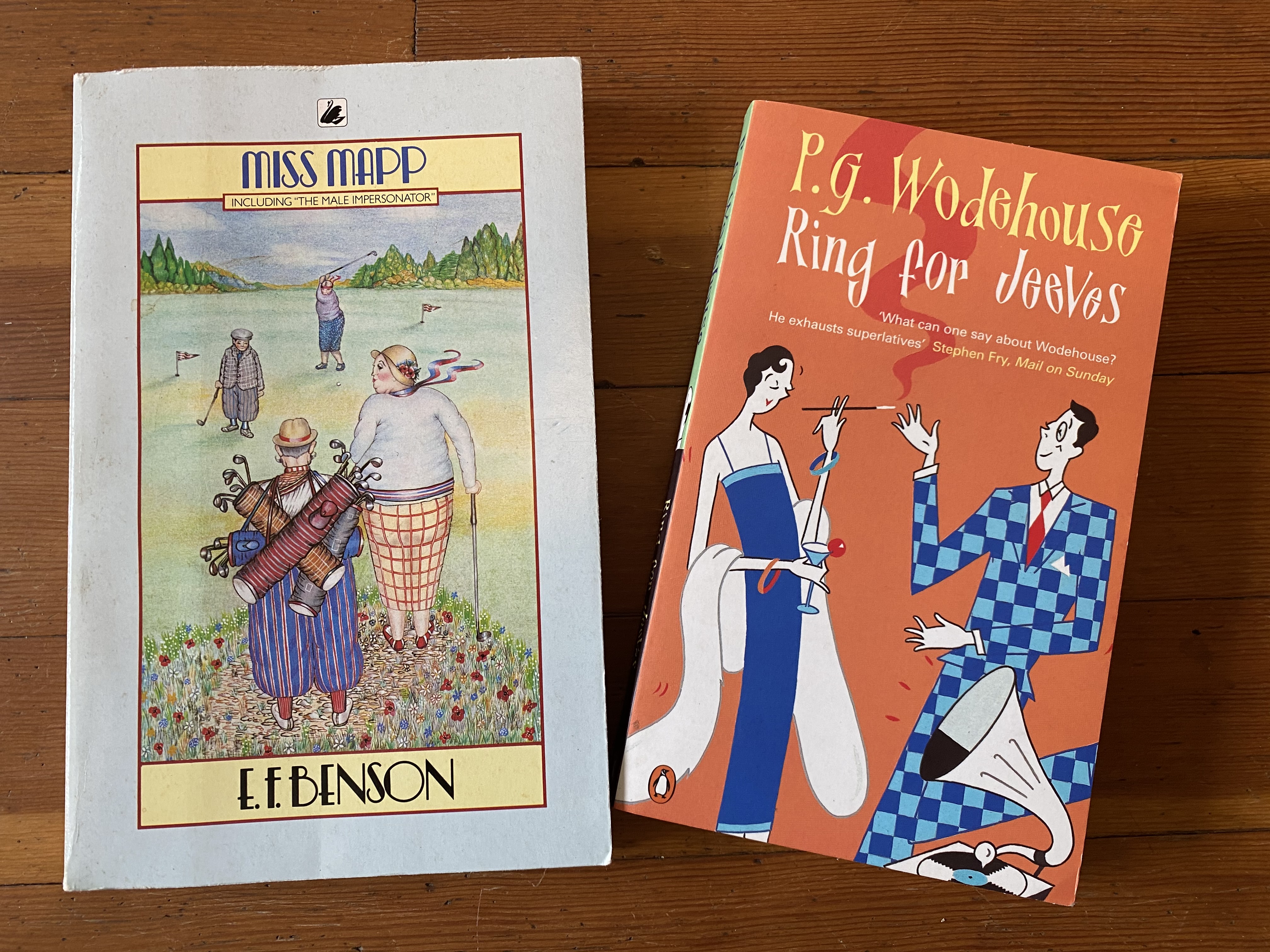
Firstly, Miss Mapp by EF Benson (1922). This is the second in the Mapp and Lucia series and so far I’ve really enjoyed Queen Lucia and Lucia in London, (unintentionally I read them out of order but I don’t think it matters) although fans of the series tell me things really take off once the two meet one another. Those of you who follow me on twitter will know I managed to bag the next two titles from the charity shop just at the weekend, but for now the much anticipated meeting will have to wait, as Lucia’s dominion of Riseholme is only given a passing mention in Miss Mapp. The titular character is far more concerned with the comings and goings of her home town:
“There was little that concerned the social movements of Tilling that could not be proved, or at least reasonably conjectured, from Miss Mapp’s eyrie.”
Her house is perfectly positioned in order to view all her neighbours as they go about their business. She is only interested in the genteel society in which she circulates, so we hear very little about the working classes of Tilling. Rather the focus is on the delightfully-named retired military men Captain Puffin and Major Flint; Isabel Poppit who lives “with a flashy and condescending mother” named Godiva; and Mrs. Plaistow with her troublesome teeth.
Eventually Miss Mapp leaves her eyrie and goes shopping:
“All these quarrelsome errands were meat and drink to Miss Mapp: Tuesday morning, the day on which she paid and disputed her weekly bills, was as enjoyable as Sunday mornings when, sitting close under the pulpit, she noted the glaring inconsistencies and grammatical errors in the discourse.”
This is a brilliant piece of scene-setting by Benson. Miss Mapp, poised at her window before launching herself onto the High Street, tells us all we need to know about Tilling and those who populate it – including their weak in-jokes, feeble and yet guarded fiercely by those who aim to be the first to reference it in conversation:
“Au reservoir, Diva dear,” she said with extreme acerbity, and Diva’s feet began swiftly revolving again.
Sadly, we don’t linger long with the Tillingite who appealed to me most, as Miss Mapp does not share my interest:
“For on emerging, flushed with triumph, leaving the baffled butcher to try his tricks on somebody else if he chose but not on Miss Mapp, she ran straight into the Disgrace of Tilling and her sex, the suffragette, post-impressionist artist (who painted from the nude, both male and female), the socialist and the Germanophil, all incarnate in one frame. In spite of these execrable antecedents, it was quite in vain that Miss Mapp had tried to poison the collective mind of Tilling against this Creature. If she hated anybody, and she undoubtedly did, she hated Irene Coles. The bitterest part of it all was that if Miss Coles was amused at anybody, and she undoubtedly was, she was amused at Miss Mapp.”
Absolutely nothing of any importance happens in Tilling. There are machinations over dresses; worry over food-hoarding which affects no-one; an argument between Puffin and Flint that neither really understand; a refusal to acknowledge daylight saving time. It’s all very silly and none the worse for it.
“Naturally any permanent quarrel was not contemplated by either of them, for if quarrels were permanent in Tilling, nobody would be on speaking terms any more with anyone else in a day or two, and (hardly less disastrous) there could be no fresh quarrels with anybody, since you could not quarrel without words.”
Miss Mapp is greatly enjoyable when you want an escapist read. You can lose yourself in the petty concerns and schemes of Tilling for a few hours, wondering about nothing more serious than the ripeness of redcurrants for making a fool.
My only reservation on finishing it was whether Miss Mapp was too scheming – was she in fact a lonely character? Although she knew everyone’s business, did she really have any intimacy in her life? But my edition also had the short story The Male Impersonator, which features this exchange about Miss Mapp at the end, between Miss Mapp’s frenemy Godiva Poppit and a new arrival to Tilling:
“ ‘Oh but she mustn’t be hurt,’ said Miss Mackintosh. ‘She’s too precious, I adore her.’
‘So do we,’ said Diva. ‘But we like her to be found out occasionally. You will too, when you know her.’”
So then my soft heart felt a lot better 😊
Secondly, Ring for Jeeves by PG Wodehouse (1953). The nonsensical shenanigans of Wodehouse are a go-to comfort read for me, but in recent years I’ve struggled. Living through a succession of overprivileged self-serving, corrupt toffs determined to govern this country into absolute ruin with a total disregard for anyone who doesn’t share their enormous inherited advantages means laughing at the upper classes has somewhat lost its appeal. *climbs down off soapbox and getting back to talking about books*
However, I thought I’d give Ring for Jeeves a go, and I did enjoy it so maybe I’m mellowing. Wodehouse’s characters are so completely bonkers that no-one would suggest they should be in charge of a single thing. In fact, as the title suggests, if anything the novel suggests handing over all power to the lower orders.
Ring for Jeeves sees the titular valet without Wooster (*faints from shock*) as Bertie is away on some sort of retreat, learning – much to Jeeves’ consternation – to darn his own socks. Thus we find Jeeves looking after Bill, a man “in the normal state of destitution of the upper class Englishman” who is desperate for money:
“Rowcester Abbey – pronounced Roaster – was about a mile from the Goose and Gherkin. It stood- such portions of it as had not fallen down – just beyond Southmolton in the midst of smiling country. Though if you had asked William Egerton Bamfylde Ossingham Belfry, ninth earl of Rowcester, its proprietor, what the English countryside had to smile about these days, he would have been unable to tell you. Its architecture was thirteenth-century, fifteenth-century and Tudor, and its dilapidation twentieth-century post-World War Two.”
Bill has begun making some money posing as bookmaker Honest Patch Perkins at the races. The start of the novel sees him and Jeeves tearing back to Rowcester Abbey because they owe Captain Biggar £3000 for a winning bet. The furious Captain is in hot pursuit.
At the country pile, Bill’s infinitely more capable sister has arrived with her husband Rory. This being Wodehouse the fond couple have conversations along the following lines:
“ ‘Now would I be likely to drop a brick of that sort, old egg?’
‘Extremely likely, old crumpet. The trouble with you is that, though a king among men, you have no tact.’”
Monica thinks she can flog Rowcester to Rosalinda Spottsworth, who is obscenely rich and interested in various esoteric matters including ghosts, which surely the abbey must have. Soon everyone – including Captain Biggar who is in love with Mrs Spottsworth – are all under the same leaking roof:
“Jeeves had entered, bearing coffee. His deportment was, as ever, serene. Like Bill, he found Captain Biggar’s presence in the home disturbing, but where Bill quaked and quivered, Jeeves continued to resemble a well-bred statue.”
Will Bill solve his financial difficulties and marry the lovely vet who lives nearby? Will Captain Biggar confess his feelings for Mrs Spottsworth and manage not to kill Bill and Jeeves? Will Rory manage not to put his foot in it several times over? Will it all work out OK in the end?
Of course it will.
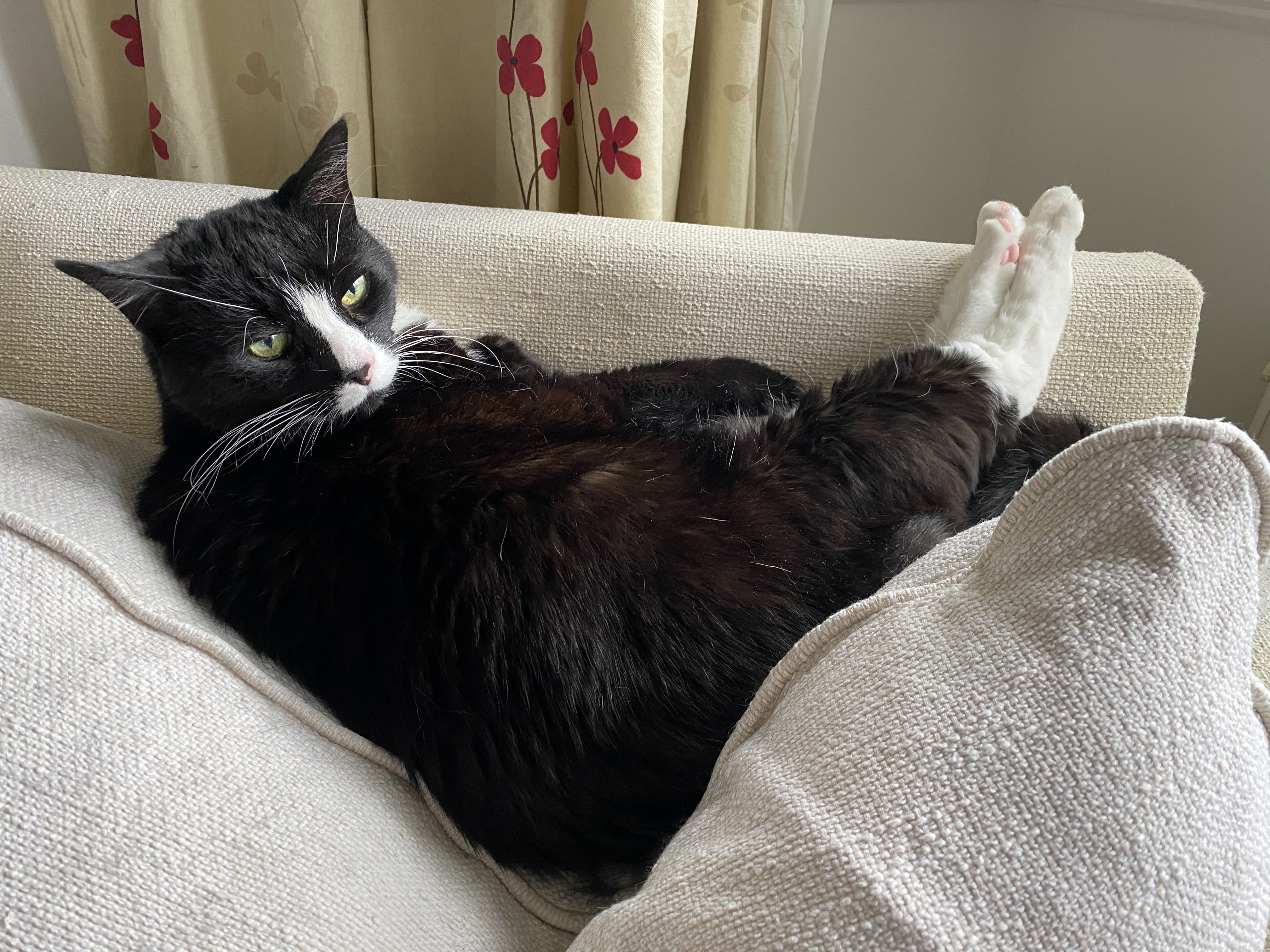
To end, I’ve mentioned before how Bruce Springsteen is proving himself a support to me, especially when my cat died last June. Sadly, his buddy decided to join him this February, and I’m finding it very hard. Here he is in a self-fashioned hammock, the crazy kid:
Anyway, along with stalwart David Bowie, Bruce continues to provide solace, so here he is singing about light (there are credits running over it which is a bit annoying but I really like this version):

 madame bibi lophile recommends