“An artist is someone who should raise questions rather than give answers. I have no message.” (Michael Haneke)

Today is National Poetry Day in the UK and the theme is Messages. I fully endorse this choice, primarily because I didn’t have to think twice about which retro pop video I could shoehorn into this post:

Arguably any poem is a message, but I’m lazy don’t believe in shying away from the obvious so I’ve chosen two poems that are titled as messages. Nothing kills a poem like analysing it to death, hence not one of my typically waffling posts this week 🙂

Firstly, back to the 8th century and prolific poet Wang Wei (I’m not sure who translated the poem, but I took the version from here). I chose it because it also references autumn, which is apt right now for those of us in the northern hemisphere.

Message to P’ai Ti

Cold and blue now are the mountains
From autumn-rain that beat all day.
By my thatch door, leaning on my staff,
I listen to cicadas in the evening wind.
Sunset lingers at the ferry,
Cooking-smoke floats up from the houses…
Oh, when shall I pledge Cheih-yu [the great hermit] again
And sing a wild poem at Five Willows?

I love the simplicity of the poem, and how evocative it is of a slightly melancholic moment taken to reflect at the end of the day.

Secondly I chose Message by Dorothy Richardson, because it echoes Wang Wei as it also picks up on autumn, and ends with a question, this time to a silent interlocutor rather than the self. I also chose it because I’m really enjoying reading about Jane and Sarah’s experiences reading her Pilgrimage series, but I haven’t yet got round to these novels…

Seeing in flight along the lifting wind,
Like sudden birds peopling an empty sky,
Those last crisped leaves so long you had passed by –
Where dark they hung that had been fire behind
The pasture whose scant blossoms kept in mind
Our summer now grown gold for memory –
Did you remember as you saw them pass,
Flutter and sink, sully the silvered grass,
That each forsaken stem bears, fast asleep,
An eager bud to tell the tale of spring?
Will you forget, hearing darkness weep,
How each hour moves toward their awakening?

I liked how this poem concentrates on one action, a leaf in the air, and yet weaves a wide experience around it, structured in quite a complex way. The iambic pentameter (more or less, Richardson plays with rhythm a bit) echoes Shakespeare’s sonnets, which I just adore. The message of this poem is one I need to remember – I find the dark days of winter hard-going, so I will remind myself how each forsaken stem contains an eager spring bud in those seemingly never-ending grey days of January and February…

To counteract my comparative reticence in this post, some indulgence to finish. A second – yes, second! – 1979 pop video. Happy Thursday 🙂

“In the Bible, God made it rain for 40 days and 40 nights. That’s a pretty good summer for Wales…I was eight before I realised you could take a cagoule off.” (Rhod Gilbert)

As a companion piece to my post on Scottish writers, I thought this week I would look at Welsh writers.  Had I been even vaguely organised, I would have posted this 2 days ago to coincide with Dylan Thomas’ centenary, but better late than never….Firstly, a poem by Dannie Abse, a prolific poet who died in September this year.

download

(Image from: http://www.poetryarchive.org/poet/dannie-abse)

It’s so hard to describe Abse’s writing without resorting to clichés about Welsh writing; adjectives like lyrical force themselves to the fore.  Judge for yourself: in Poem and Message (1955), Abse uses the idea of a loved one “Out on the tormented midnight sea” finding solace in words, and the poem of love those words createYou can read the whole poem here.

“so from this shore of cold I write

tiny flashes in the Night.


Words of safety, words of love

a beacon in the dark”

[…]

one small luminous truth

of which our usual love was proof.

It reminds me of Shakespeare’s sonnet 116 whereby love “is the star to every wand’ring bark”. Abse uses simple language, and a familiar trope of love as a guiding light, to create a sense of love’s unquestionable power; it doesn’t need complex metaphors and obscure polysyllabic words to heighten it.  It ends with a beautifully direct couplet:

And I call your name as loud I can

and give you all the light I am.”

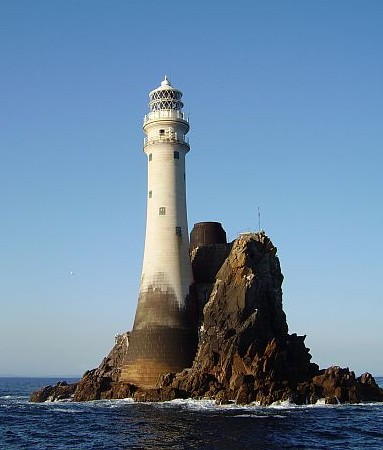
FastnetIRLE

(Image from: http://www.unc.edu/~rowlett/lighthouse/irlsw.htm)

Secondly, and in direct contrast to Abse’s refined feeling, Submarine by Joe Dunthorne (Penguin, 2008).  Oliver Tait is 15 and lives with his parents in Swansea.  His father is depressed and his mother:

“I have not established the correct word for my mother’s condition.  She is lucky because her mental health problems can be mistaken for character traits: neighbourliness, charm and placidity.  I’ve learnt more about human nature from watching ITV’s weekday morning chat shows than she has in her whole life.  I tell her ‘You are unwilling to address the vacuum in your interpersonal experiences,’ but she does not listen.”

Oliver is entirely typical and entirely untypical of a teenager.  He is convinced of his own superiority, passively observes the bullying of his classmates, is desperate to lose his virginity to the pyromaniac Jordana, and makes up stories about his neighbours:

“‘I know Mr Sheridan quite well, Oliver. He’s a painter decorator,’ he says…..

‘Andrew, he has the eyes and overalls of a killer,’ I say.”

Oliver is an outsider in his own life, and his voice is detached while seeking to belong.  The teenage conundrum – wanting to be entirely different and entirely the same as everyone else.  Even Oliver’s beloved Jordana lets him down:

“She’s been sensitised, turned gooey in the middle.

“I saw it happening and I didn’t do anything to stop it.  From now on, she’ll be writing diaries and sometimes including little poems and she’ll buy gifts for her favourite teachers and she’ll admire scenery and she’ll watch the news and she’ll buy soup for homeless people and she’ll never burn my leg hair again.”

Submarine is hilarious and yet still achieves a sensitive evocation of the torturous time of adolescence.  I could have picked almost any page at random and found a quotable line. Yes, it’s that good.  Just one proviso: don’t read it on the train unless you want to be one of those annoying people trying to muffle snorts of laughter between the pages, which I totally was…

There was a film adaptation of Submarine (dir. Richard Ayoade) in 2011: