“Women are most fascinating between the ages of 35 and 40 … Since few women ever pass 40, maximum fascination can continue indefinitely.” (Christian Dior)

On Saturday I had a BIG birthday.
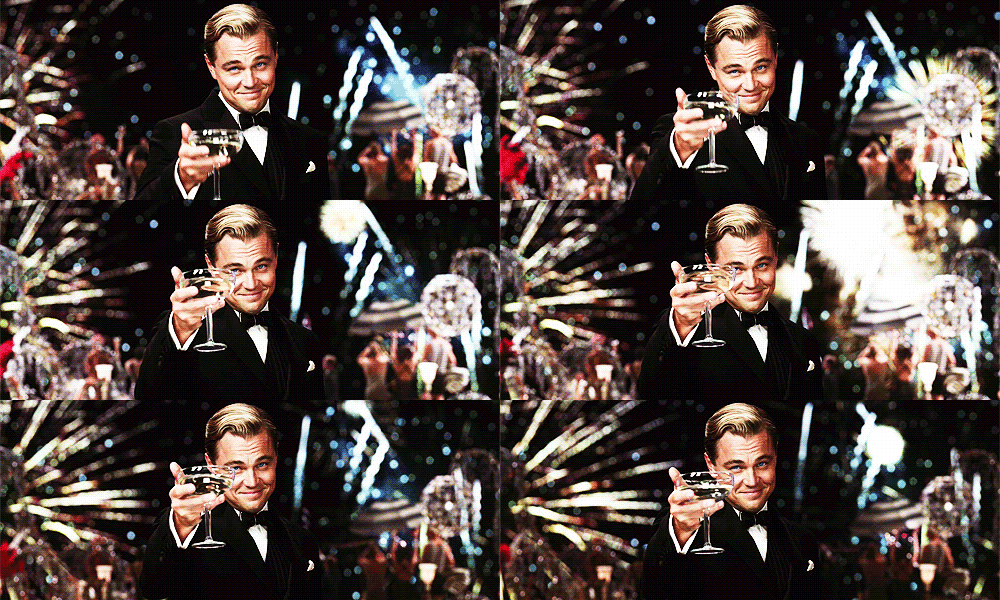
Why thank you, Mr DiCaprio. Yes, ‘twas the big 4-0 for me so this week I’m looking at one book written in 1977 and one book set in 1977. What they’ve taught me about the year of my birth is that much as nostalgia-fest programmes will try and convince me I was born into a glittery glam-rock utopia:

In fact I was born into a post-colonial nightmare of racism and corruption. 1977 was rubbish.

1977: a year so bad even Christoph Waltz looked like this

Firstly, the novel written in 1977, Petals of Blood by Ngugi wa Thiong’o, a damning indictment of the legacy of colonialism and political corruption. Set in Kenya not long after independence from the British in 1964, it is one more stop on my Around the World in 80 Books Reading Challenge, hosted by Hard Book Habit. It tells the story of Munira, a teacher; his friend Abdulla, a shopkeeper; Wanja, a barmaid and object of Munira’s affection; and Karega, a young man who wants to know about Munira’s history of school strikes and acts as the voice of communist ideals in the novel. All have moved to the remote village of Ilmorog to try and come to terms with the fallout from the Mau Mau war and build a life for themselves in the new republic.  The title image recurs throughout the story. At its earliest point it is voiced by a child in Munira’s class:

“ ‘Look. A flower with petals of blood.’

It was a solitary red beanflower in a field dominated by white, blue and violet flowers. No matter how you looked at it, it gave you the impression of a flow of blood. Munira bent over it and with a trembling hand plucked it. It had probably been the light playing upon it, for now it was just a red flower.

‘There is no colour called blood. What you mean is that it is red.’ “

What emerges throughout the novel is that of course, there are literally petals of blood. Kenyans have fought and died on their land and their blood is in the earth. Stories of Munira’s school strikes show how indoctrination under empire was a mix of politics, religion and outright racism:

“We saluted the British flag every morning and every evening to the martial sound from the bugles and drums of our school band. Then we would all march in orderly military lines to the chapel to raise choral voices to the Maker: Wash me Redeemer, and I shall be whiter than snow. We would then pray for the continuation of the Empire that had defeated the satanic evil which had erupted in Europe to try the children of God.”

Following severe drought, the residents of Ilmorog travel to Nairobi to speak with their MP. They encounter indifference at best and outright hypocrisy and corruption at worst from businessmen, their MP, a reverend, which allows wa Thiong’o to explore what and who a new society is built on.

“And suddenly it was not her that he was looking at, seeing, but countless other faces in many other places all over the republic. You eat or you are eaten. You fatten on another, or you are fattened upon.”

If this sounds unremittingly bleak, the residents do also encounter a principled lawyer who helps them. If it sounds polemical and more of a treatise than a novel, it isn’t. wa Thiong’o is furious at the injustice and corruption he portrays, but the power of Petals of Blood is that it is never at the expense of believable characters. Munira, Abdulla, Wanja and Karega bring home the human cost of political decision-making and large-scale corruption.

“She had carried dreams in a broken vessel.”

Petals of Blood is an incredible novel. Angry and urgent, ultimately optimistic and with a belief that human beings can make better lives for themselves and for one another, but with a clear-sighted view of the damage we can wreak.

“It was really very beautiful. But at the end of the evening Karega felt very sad. It was like beholding a relic of beauty that had suddenly surfaced, or like listening to a solitary beautiful tune straying, for a time, from a dying world.”

Looking for the name of the translator of this novel, I was surprised to discover that wa Thiong’o wrote in the language of his country’s colonisers. Apparently Petals of Blood was the last time he did so, and he has since written in Gikuyu and Swahili.  He has led a fascinating life, including time as a prisoner of conscience, which you can get a taste of on Wiki.

Ngugi wa Thiong’o

Image from here

Secondly, Jubilee by Shelley Harris (2011), set on the day of a street party to celebrate the Queen’s Silver Jubilee, and also in 2007, where a 30 year reunion of the people captured in a famous photo of that day is planned. The photo featured Satish, the son of Ugandan refugees fleeing Idi Amin, sat amidst his white neighbours:

“Here he was after all, an Asian boy happy in his white-majority Buckinghamshire village, and posing only a minimal threat to house prices.”

For reasons of his own, Satish has no desire to recreate that day. In 2007 he is married to a woman he loves, has two children and a successful career as a paediatric cardiologist. He also has an escalating addiction to diazepam.  We know something awful happened to him on the day of the Jubilee, and by moving back and forth in time, Harris is able to show how the celebration built to crisis, and the fallout thirty years later. This is handled deftly, and didn’t get tiresome. Similarly, the period details are in abundance but not too heavily rammed home, possibly because the author is drawing on her lived experience as the daughter of 1970s immigrants to Britain, fleeing apartheid in South Africa.

“mushy peas; scampi; egg-and-bacon sandwiches; chips and mash and roasties – every iteration of the glorious potato; faggots; fry-ups; fish and chips; jelly and rice pudding; apple pie and Artic roll….He wondered what might happen if these were the only things he ate. Would it build up Britishness in him, all this English food? Would it drain his colour, sharpen his soccer skills, send him rushing into church?”

Satish encounters both casual ignorance and outright racist prejudice from his neighbours, and this is not shied away from but also not dwelt on, as young Satish does not dwell on these things. As adult readers, we know where the hatred can lead and its enduring effect on Satish, which lends the novel an underlying sense of menace.

 “What were they exactly? Indian? Ugandan? He had never been clear. But this was neither their country nor their culture, and no matter how many Union Jacks they raised, they would always be waving someone else’s flag.”

Depressingly, these attitudes do  not make the novel a period piece. There is a still need anti-racism marches, with Stand Up to Racism taking place this Saturday, on UN Anti-Racism Day.

Jubilee builds carefully towards its denouement, and shows the long-term damage that blind prejudice can inflict. It also shows how an act of hatred does not define either the perpetrator or the victim, and the power of forgiveness and reconciliation towards the events of our lives and the choices we make. I don’t know what it was about Jubilee that stopped me totally loving it, but it is a good read and effective evocation of a moment in time.

They look this happy because they’re yet to taste the Coronation chicken

Image from here

To end, the cheesy earworm that was number one the week I was born. I’ve always thought my enduring love of sax solos came from Careless Whisper, but maybe this made an impact at a very impressionable age. All together now: ya-da-da-da-da….

“I’m the greatest thing that ever lived! I’m the king of the world! I’m a bad man. I’m the prettiest thing that ever lived.” (Muhammad Ali)

As usual, I’m a bit behind the times: here is my post to commemorate the death of Olympian/activist/philanthropist/iconic legend Muhammad Ali on 3 June, whose memorial was last Friday.

c8c7ccdd-25ee-454b-bd57-8cd8566212a8-1630x2040

Image from here

I thought I would therefore theme this post around ‘greatest’.  Just over a week ago Lisa McInerney won this year’s Bailey’s Prize for her debut novel The Glorious Heresies, so I’ve decided to look at Half of a Yellow Sun by Chimamanda Ngozi Adichie which won the Baileys (then the Orange) in 1997 and was chosen as the prize’s Best of the Best in 2015. I’ve paired it with Midnight’s Children by Salman Rushdie which won the 1981 Booker, and then in 1993 (25 years of the Booker) and 2008 (40 years of the Booker),  it won the Best of the Bookers (the latter by public vote). They are also two more stops on my Around the World in 80 Books Reading Challenge, hosted by Hard Book Habit– away we go!

Half of a Yellow Sun is set in Nigeria during the civil war of the 1960s, when there was an attempt to establish Biafra as an independent nation. Focusing on two sisters, Olanna and Kainene, their partners Odenigbo and Richard, and Olanna and Odenigbo’s houseboy Ugwu, the war is explored through its varied but monumental impact on all their lives.

Before the war, Olanna and Odenigbo live a privileged middle class life in the university town of Nsukka, entertaining in the evenings with friends who debate issues of post-colonial identity:

“‘I am Nigerian because a white man created Nigeria and gave me that identity. I am black because the white man constructed black to be as different from as possible from his white. But I was Igbo before the white man came.’”

Ugwu joins them and is mesmerised by their sophistication, and the worlds they open for him through the books they provide. However, Adichie shows that the legacy of colonialism is deep-rooted:

“Master’s English was music, but what Ugwu was hearing now, from this woman, was magic. Hers was a superior language, a luminous language, the kind her heard on Master’s radio, rolling out with clipped precision. It reminded him of slicing a yam with a newly sharpened knife, the easy perfection in every slice.”

As the Igbo people try to establish Biafra and civil war escalates, Olanna, Odenigbo and Ugwu’s lives are ripped apart and Adichie does not pull her punches. There is forced conscription, rape as a weapon, starvation and mutilation. However, there is also reconciliation between the estranged sisters, and Adichie’s focus is not on horrors but on how the human spirit survives against overwhelming odds:

“The war would continue without them. Olanna exhaled, filled with frothy rage. It was the very sense of being inconsequential that pushed her from extreme fear to extreme fury. She had to matter. She would no longer exist limply, waiting to die.”

Adichie is a hugely popular and successful author, and I feel the hype is fully deserved: she’s a brilliant writer. I whizzed through this book – she manages to write a compelling, political, angry, compassionate and highly moving page-turner. What a feat.

Half of a Yellow Sun was adapted into a film in 2013, apparently not that successfully despite a seemingly perfect cast including smoking hot eye candy hugely talented actor Chiwetel Ejiofor:

On to Midnight’s Children by Salman Rushdie (1981) which like Half of a Yellow Sun was the author’s second novel: so much for the ‘difficult second novel’ theory. It’s taken me about twenty years to read Midnight’s Children, which works out as 6% of a page per day. It’s been quite a ride.

rhpsf

I jest of course, but it did take me 3 goes spread over 20 years to get into this novel.  Normally I would have resigned it to the DNF pile (which is tiny, my TBR aspires to be that size one day – never going to happen) but I kept persevering because people who loved it really loved it and it always cropped up on various book lists (including Le Monde’s , which forms one of my reading challenges).

Now that I’ve read it, I can’t say I loved it – something about Rushdie’s style meant this was always a tough read for me – but I did find it impressive. Midnight’s Children is hugely ambitious, tackling themes around nation-making, history writing, colonialism and culture. Seemingly impossible within one novel, but Rushdie and his massive brain are clearly equal to the task. The story is narrated by Saleem Sinai who is born on the stroke of midnight on 15 August 1947, the exact moment that India gained independence from Britain.

“Thanks to the occult tyrannies if those blandly saluting clocks I had been mysteriously handcuffed to history, my destinies indissolubly chained to those of my country. For the next three decades, there was to be no escape.”

Saleem’s story, and that of his family, becomes the story of the nation of India. The novel makes heavy use of magical realism, and I think this is Rushdie’s masterstroke. It would be impossible to explore such enormous themes and multiple events if the novel were entirely grounded in a recognisable reality. By allowing for magic realism, Rushdie can take the story in any direction he needs to.

Saleem discovers that all the children born into India between midnight and 1am on the day of Independence have special powers – his own being telepathy, powered by his enormous nose and blocked sinuses (told you there was magic realism).

“the children of midnight were also the children of the time: fathered, you understand, by history. It can happen. Especially in a country which is itself a sort of dream.”

“Midnight has many children; the offspring of Independence were not all human, Violence, corruption, poverty, generals, chaos, greed and pepperpots…I had to go into exile to learn that the children of midnight were more varied than I – even I – had dreamed.”

Saleem is a self-acknowledged unreliable narrator. His memory fails him at times, regarding both events in his own life and those in the wider political history of India. What Rushdie is questioning is the narratives we are all within – family, nation, history, culture – and how there is no one reality for any of us.

“Family history, of course, has its proper dietary laws. One is supposed to swallow and digest only the permitted parts of it, the halal portions of the past, drained of their redness, their blood. Unfortunately this makes the story less juicy, so I am about to become the first and only member of my family to flout the laws of halal. Letting no blood escape from the body of the tale, I arrive at the unspeakable part; and, undaunted, press on.”

I realise I may have made Midnight’s Children sound like a heavy read, and in some ways it is, but it also has a gentle humour running through it to lighten the tone.  I’ve certainly never read anything else like it.

“One day, perhaps, the world may taste the pickles of history. They may be too strong for some palates, their smell is overpowering, tears may rise to eyes; I hope nevertheless that it will be possible to say of them that they possess the authentic taste of truth”

To end, I can’t help wishing the dress code for book award ceremonies was monochrome cat suits and that winners collected their awards by emerging from a fog of dry ice: