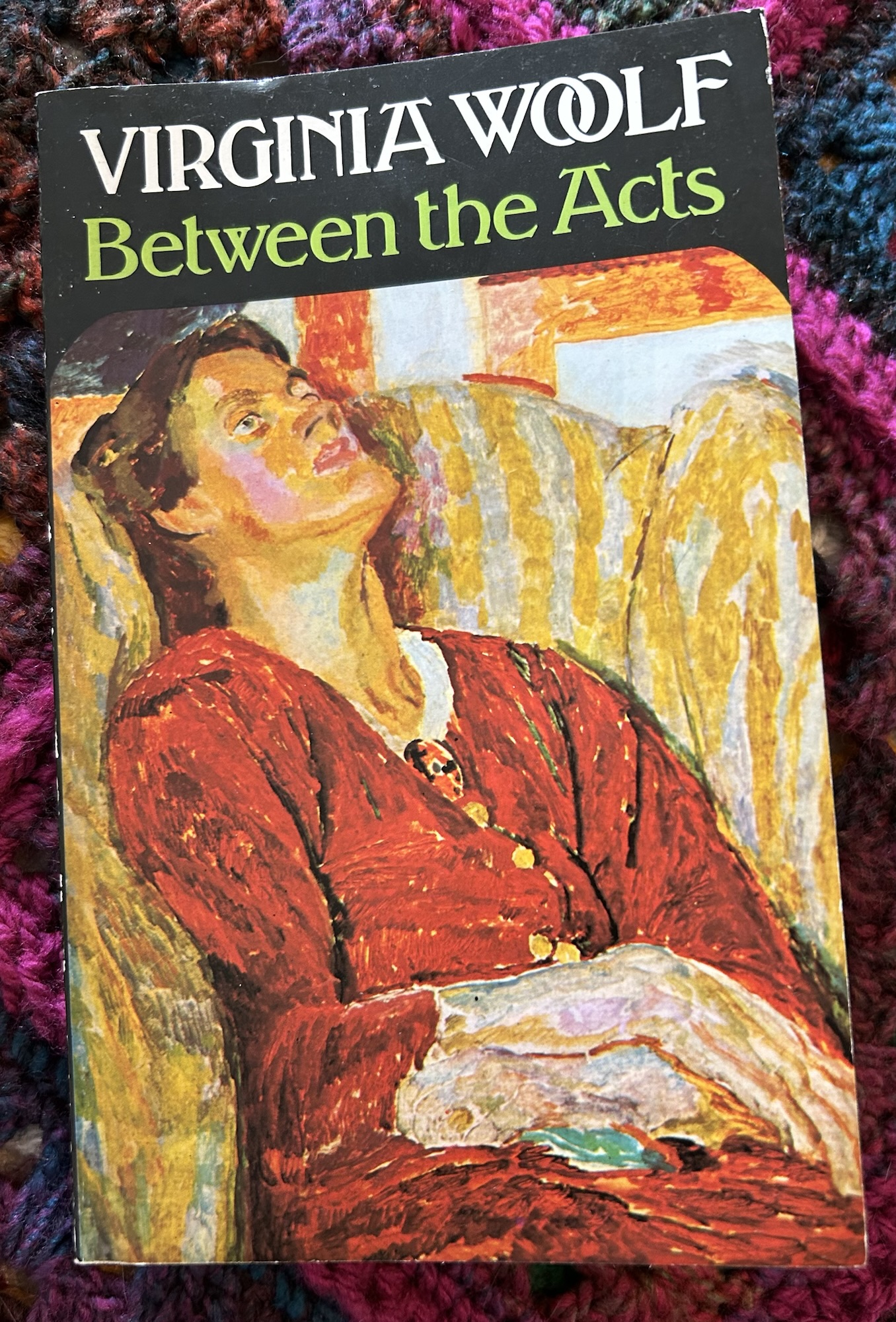
Between the Acts – Virginia Woolf (1941) 159 pages
Between the Acts is Virgina Woolf’s last novel and was published after her death. I’m a bit wary of posthumous novels; a note at the beginning from Leonard Woolf suggests it was pretty much as Virginia intended and only small corrections would have been made had she lived. This is somewhat contradicted by a letter she wrote to her publisher, so it’s impossible to know.
It is set over one day in 1939, before the war starts. It’s summertime, and at Pointz House somewhere in the middle of England, a pageant is taking place as it does every year.
The manor house belongs to the Oliver family: retired Bartholomew Oliver; his endearing, somewhat flaky widowed sister Lucy Swithin, his son Giles and Giles’ wife Isa.
A thread that pulls through the story is Isa’s attraction to gentleman farmer Rupert Haines. Woolf introduces this with startling synaesthetic imagery:
“Isa raised her head. The words made two rings, perfect rings, that floated them, herself and Haines, like two swans downstream. But his snow-white breast was circled with a tangle of dirty duckweed; and she too, in her webbed feet was entangled, by her husband, the stockbroker. Sitting on her three-cornered chair she swayed, with her dark pigtails hanging, and her body like a bolster in its faded dressing-gown.”
I so enjoy Woolf’s inventiveness, and this early passage also stood out, as she sets this tranquil, middle-class, midsummer scene:
“The nurses after breakfast were trundling the perambulator up and down the terrace; and as they trundled they were talking—not shaping pellets of information or handing ideas from one to another, but rolling words, like sweets on their tongues; which, as they thinned to transparency, gave off pink, green, and sweetness.”
But beneath the tranquillity, big emotions are brewing:
“”He is my husband,” Isabella thought, as they nodded across the bunch of many-coloured flowers. “The father of my children.” It worked, that old cliché; she felt pride; and affection; then pride again in herself, whom he had chosen. It was a shock to find, after the morning’s look in the glass, and the arrow of desire shot through her last night by the gentleman farmer, how much she felt when he came in, not a dapper city gent, but a cricketer, of love; and of hate.”
In true British stiff-upper-lipped style, love and hatred are subsumed by social convention and the need to host the pageant. The director Miss La Trobe arrives. My edition has a quote on the back suggesting this is self-portrait by Woolf, which if true is pretty startling:
“Rumour said that she had kept a tea shop at Winchester; that had failed. She had been an actress. That had failed. She had bought a four-roomed cottage and shared it with an actress. They had quarrelled. Very little was actually known about her. Outwardly she was swarthy, sturdy and thick set; strode about the fields in a smock frock; sometimes with a cigarette in her mouth; often with a whip in her hand; and used rather strong language—perhaps, then, she wasn’t altogether a lady? At any rate, she had a passion for getting things up.”
The pageant dramatises scenes from English history, and Elizabeth I is a sight to behold:
“Everyone was clapping and laughing. From behind the bushes issued Queen Elizabeth—Eliza Clark, licensed to sell tobacco. Could she be Mrs. Clark of the village shop? She was splendidly made up. Her head, pearl-hung, rose from a vast ruff. Shiny satins draped her. Sixpenny brooches glared like cats’ eyes and tigers’ eyes; pearls looked down; her cape was made of cloth of silver—in fact swabs used to scour saucepans. She looked the age in person. And when she mounted the soap box in the centre, representing perhaps a rock in the ocean, her size made her appear gigantic. She could reach a flitch of bacon or haul a tub of oil with one sweep of her arm in the shop. For a moment she stood there, eminent, dominant, on the soap box with the blue and sailing clouds behind her. The breeze had risen.”
Large portions of the novel are given over to the script of the pageant, written in verse. Yet astonishingly, Woolf still manages complex characterisation between the acts. There’s a small scene between two characters dismissed by those around them which I found so touching. Lucy Swithin is seen as something of an elderly fusspot; William Doge is a visitor subject to homophobia from Giles, in thought if not in deed but still recognised. At one point Lucy notices William is struggling with the company and takes him off for a tour of the house:
“Mrs. Swithin put her hands to her hair, for the breeze had ruffled it.
“Mr…” she began.
“I’m William,” he interrupted.
At that she smiled a ravishing girl’s smile, as if the wind had warmed the wintry blue in her eyes to amber.”
As always with Woolf, the text is so rich and multilayered and these are really just initial impressions. I’m sure I’d pick up so many other elements on a re-read, or even writing this post again. I just hope that however Woolf felt about Between the Acts, she judged her work more kindly than Miss La Trobe’s view of her pageant:
“She hadn’t made them see. It was a failure, another damned failure! As usual. Her vision escaped her.”

 madame bibi lophile recommends