Our Spoons Came From Woolworths – Barbara Comyns (1950, 195 pages)
Our Spoons Came From Woolworths is the first Barbara Comyns I’ve read, attracted by the whimsical title and it being a Virago. I’m so glad I picked this up. Our Spoons Came From Woolworths was a compelling read, and not nearly as whimsical as I had assumed.
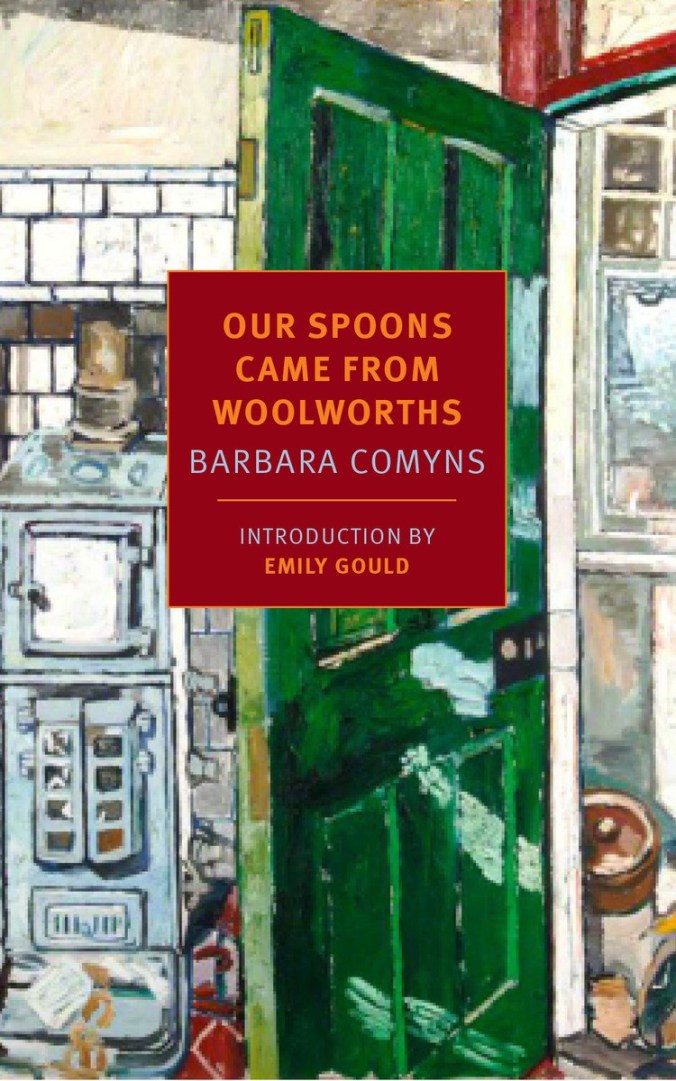
The NYRB edition
It tells the story of Sophia’s marriage at a young age to Charles, an artist, in the 1930s. They are painfully naïve, and Charles especially has no idea about money:
“He said Eva had told all her relations about the coming baby, and they had asked him masses of questions about how he was going to support a wife and family. They had given him some money, though, four pounds in all. I was glad to hear this as we only had one golden guinea left in the dresser drawer, but my gladness did not last long, because it turned out he had already spent the money on some paints, brushes, books and an enormous walnut cake from Fullers.”
With the arrival of the baby, the poverty becomes even more pressing. Charles is monumentally selfish and self-absorbed, but not quite despicable. He’s just clueless and self-centred, and this means his actions are inadvertently cruel. Although the situation is quite desperate, Comyns’ voice is matter-of-fact and never asks for sympathy. There is a light, almost surreal humour present:
“Charles said he had borrowed some money to send telegrams to his relations saying we had a boy of six ounces. I told him it was six pounds not ounces, but he said a few pounds either way wouldn’t make any difference. But Charles’ telegrams caused a huge sensation, and his family was most disappointed when in due course they discovered we had quite a normal baby.”
But the humour always highlights the bigger picture, such as Charles’ disregard and disinterest in his children. While Comyns is unsentimental, this does not mean she is unaware of the power of her story. She has plenty to say about the role of women in interwar Britain and the hypocrisies that meant they were expected to marry and then make the best of it, with little means of support beyond their husbands. She also shows how this is bound up in sexual politics, with male infidelity so much more accepted than female, yet women deserving an equal right to happiness:
“Some time later, when I realised I had been unfaithful, I didn’t feel guilty or sad, I just felt awfully happy I had had this experience, which if I had remained ‘a good wife’ I would have missed, although, of course, I wouldn’t have known what I was missing. I felt quite bewildered. I had …been a kind of virgin all the time. I wondered if there were other women like this, but I knew so few women intimately it was difficult to tell.”
The story is also an indirect plea for a welfare state. What Sophia and her children endure would not be life-threatening after the end of the Second World War, with a social safety net established to protect them from absolute destitution and starvation.
But I worry now I’ve made Our Spoons Came From Woolworths sound very heavy, which it isn’t. Comyns knows how to say serious things with a lightness of touch that is quite remarkable. You’re not left in any doubt as to Sophia’s desperation, but it remains a hopeful novel about human resilience. It’s generally thought to be thinly-disguised biography (Comyns was married to the painter John Pemberton between 1931-5 and had two children with him) and Comyns makes her point about these types of stories – concerning women and poverty – desperately needing to be heard at a time when no-one really wanted to listen, in deadpan comic style:
“This book does not seem to be growing very large although I have got to Chapter Nine. I think this is partly because there isn’t any conversation. I could just fill pages like this:
‘I am sure it is true,’ said Phyllida.
‘I cannot agree with you,’ answered Norman.
‘Oh, but I know I am right,’ she replied.
‘I beg to differ,’ said Norman sternly. That is the kind of stuff that appears in real people’s books. I know this will never be a real book that business men in trains will read, the kind of business men that wear stiff hats with curly brims and little breathing holes in the side. I wish I knew more about words.”
Although I understand from other bloggers that Comyns’ other novels are very different, I am now officially an ardent fan.

Image from here
 madame bibi lophile recommends