Novella a Day in May 2025: No.23

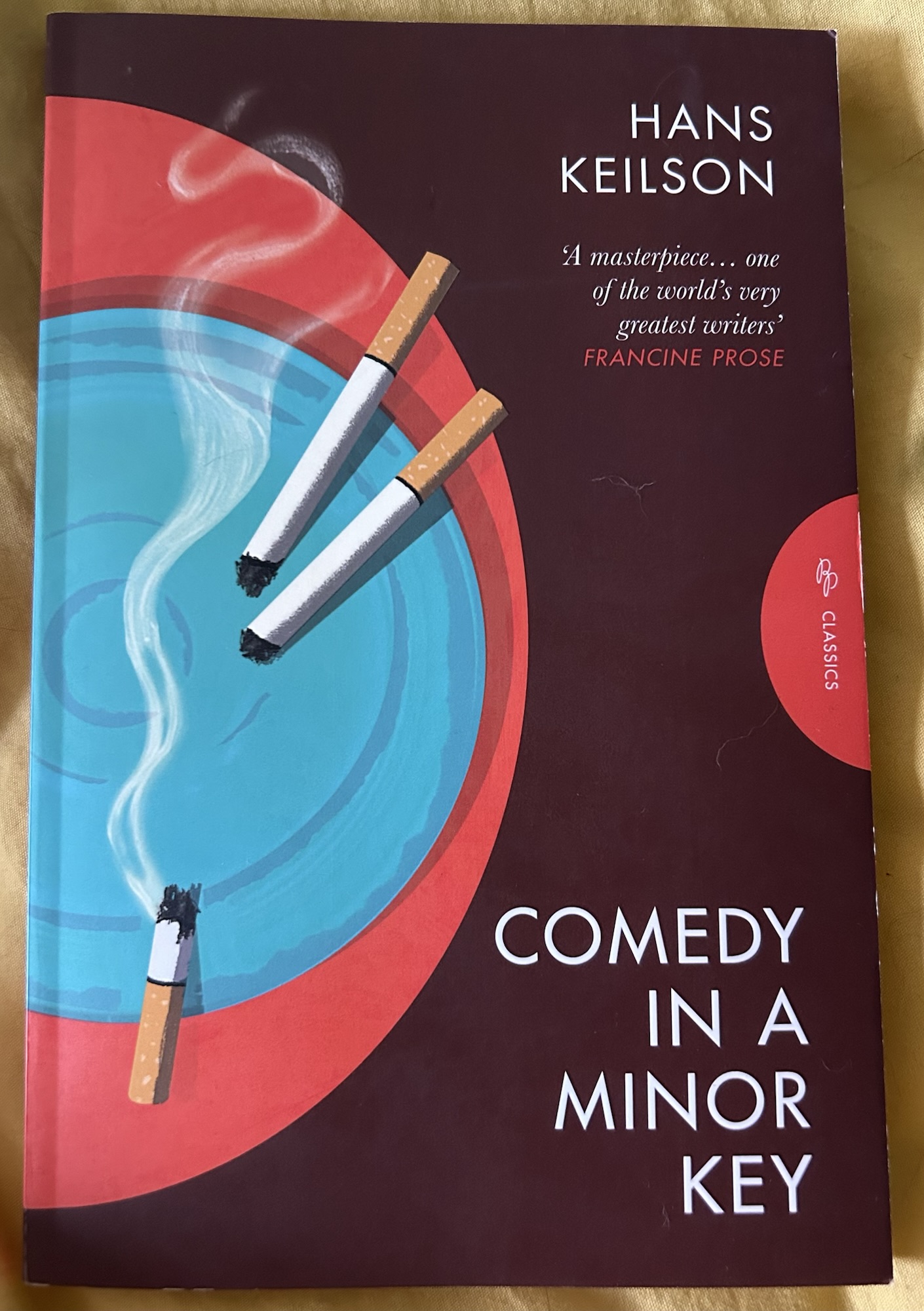
Comedy in a Minor Key – Hans Keilson (1947, transl. Damion Searls, 2024) 108 pages

Yesterday I posted on a German novella written just before the war, and today I’m looking a novella written just after the war but set during those years.

Hans Keilson was a remarkable man. His wiki page opens:

“German-Dutch novelist, poet, psychoanalyst and child psychologist. He was best known for his novels set during the Second World War, during which he was an active member of the Dutch resistance.

Keilson, having worked with traumatized orphans, mainly wrote about traumas induced by the war.”

Both his parents died in Auschwitz and Keilson had to go into hiding with a married couple for part of the war. In Comedy in a Minor Key, he explores this set-up, albeit primarily from the point of view of the couple.

Wim and Marie are a young Dutch couple who are approached to take someone into hiding in their house. Nico is older than them and the three of them live in restricted secrecy.

“The beginning was always exciting, no matter how many times a person had already lived through it.”

Wim and Marie are determined that no-one else will know about Nico. This doesn’t last long as they tell people, and others know already. For almost a year, the three of them live together in awkward domesticity.

What Keilson captures so well is the complexity of feelings around this living arrangement. So Nico isn’t unreservedly grateful; he’s also angry and scared and frustrated:

“Safe? Protected? Since they had taken him in? No, no, he was being unfair. But their house, their home, there things – their world – how it all had attracted him and soothed him at first. And now: how vain, how inflated, how worthless! For he measured things now with the cosmic measure, which gripped him tight and shook him back and forth. What trust in each other? What danger? And what a gulf between people! Consolation! Consolation?… was there any such thing?”

And for Wim and Marie there is bravery and kindness and also some vanity:

“You don’t get the chance to save someone every day. This unacknowledged thought had often helped them carry on when, a little depressed and full of doubt, they thought they couldn’t bear this complicated situation any longer and their courage failed them.”

The three of them muddle along together, and I found this description of their nightly snack and coffee very touching:

“There was gratitude in this habit, and a little tiredness, from the night to come that they were about to enter alone or as a pair, and a furtive, sad happiness in the smiling, incomprehensible futility.

But these scenes occur in flashback, as the novella opens with Nico having died of pneumonia, and Wim and Marie faced with what on earth to do now.

“How the neighbours and everyone on the street would look when he suddenly walked out of their house and strolled up and down the street with them. It would give them a little sense of satisfaction, and everyone who makes a sacrifice needs a little sense of satisfaction. And then you’d feel that you, you personally, even only just a little bit, had won the war.

It had all gone up in smoke. It wasn’t even a dream anymore. None of the three of them had any luck. But really, him least of all.

Poor Nico!”

Keilson never laughs at Nico’s death. What Comedy in a Minor Key shows is the enormity wartime in a domestic setting and how the mundane and silly can endure in the worst of circumstances. It shows how ordinary people can be so brave and also a little bit self-serving. It shows how the inbuilt hopes of a large gesture towards saving a life are entirely undermined when the person dies anyway.

I didn’t find this novella laugh-out-loud funny and I don’t think that’s what the title refers to. Rather I think the comedy refers to the ultimately comedic undermining of best intentions being a resistance in itself, as the war fails to destroy the ridiculous.

“Behind her curiosity there was a burning pain that cried out for more consolation than it was possible to give.”

Novella a Day in May 2025: No.5

Minna Needs Rehearsal Space – Dorthe Nors (2013, transl. Misha Hoekstra 2014) 89 pages

I really enjoyed Dorthe Nors’ Mirror, Shoulder, Signal as the final novella when I first undertook this month-long challenge back in 2018. Since then I’ve read her short story collection Karate Chop, and was delighted to find Minna Needs Rehearsal Space in my beloved charity bookshop. I think it has been published in editions with Karate Chop, but this Pushkin Press edition was standalone.

This is definitely a novella where the style will alienate some readers. It’s written entirely in a series of short sentences.

“Minna walks around in bare feet.

The flat is full of notes.

Bach stands in the window.

Brahms stands on the coffee table.

The flat’s too small for a piano, but

A woman should have room for a flute.”

At first I wasn’t sure I could read a whole novella like this, but then I suddenly clicked with the rhythm and it seemed a lot less jarring.

Minna is a musician living in Copenhagen, trying to write a “paper sonata” and struggling to find a place to work. She is struggling more widely too: with ambivalence towards potential motherhood; with her tightly-wound sister; with her boyfriend who has just dumped her by text.

This spurs Minna to do some dumping of her own, as she unfriends people on social media.

“Minna eats a cracker.

Karin’s missive awaits.

Karin wants to be nasty.

Karin wants to upset her applecart, but

Minna’s cart has no apples.”

She ends up packing Ingmar Bergman’s Billeder as the director becomes almost a Greek chorus/silent interlocutor, when Minna heads for Bornholm and the sea.

The short sentences act as constant present-tense status updates, a commentary on our online living. Yet by piling on the banal observations, gradually a more subtle picture emerges between the sentences. Minna’s frustrations and vulnerabilities shine through.  It’s a brave approach which for me worked well, but I already knew I liked Nors’ observations, characterisation and humour.

Minna Needs Rehearsal Space is a reminder to look beyond what is immediate to a whole picture; one that is always changing in the present and is much more complex than the surface would have us believe.

“Minna’s broken heart dwells in the breast of an optimist.”

Novella a Day in May 2025: No.4

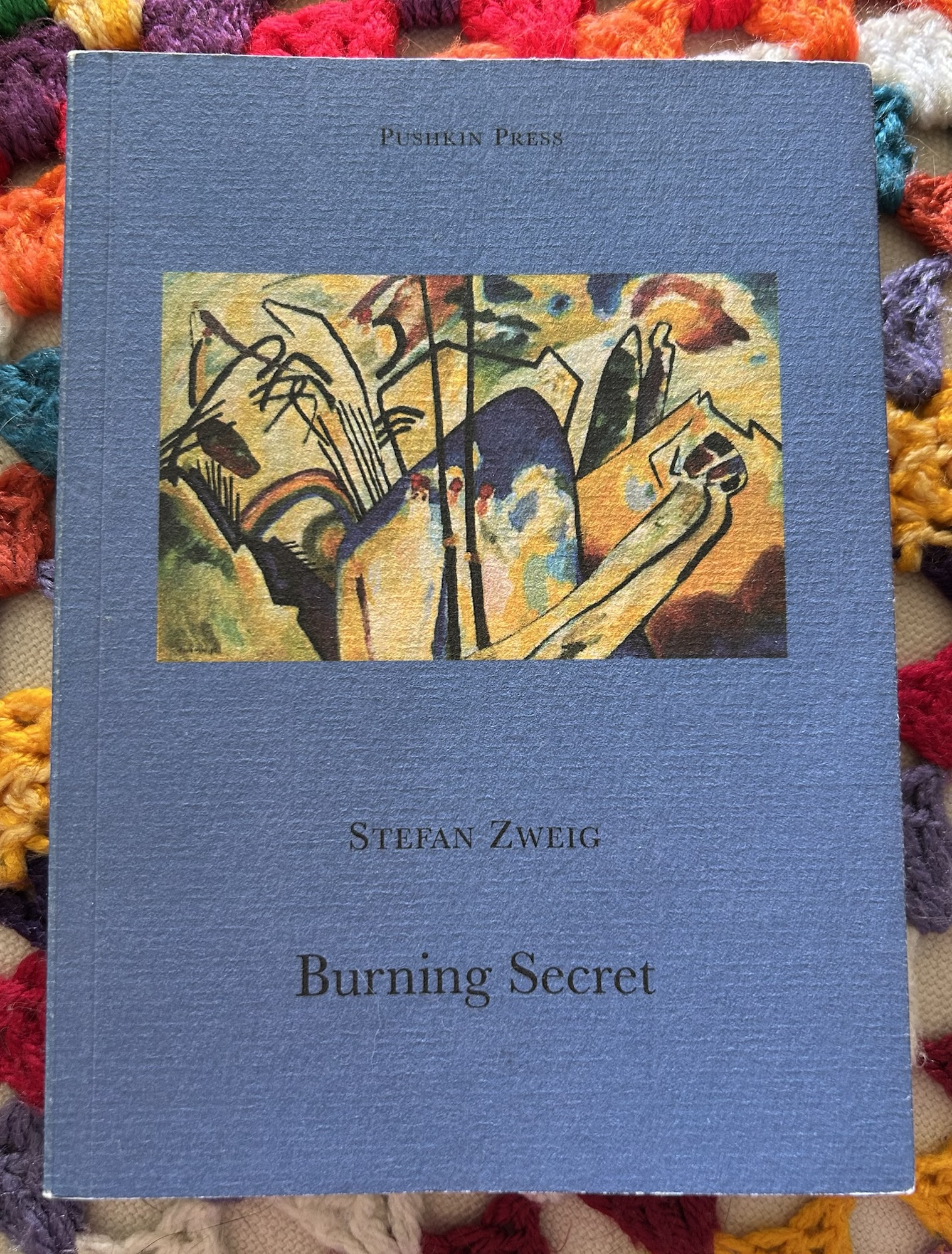
Burning Secret – Stefan Zweig (1913, transl. Anthea Bell 2008) 117 pages

Stefan Zweig is such an exquisitely tender writer. His precise, compassionate observations are deep with humane understanding. It makes him a perfect novella writer.

Burning Secret has a very simple structure. Edgar is twelve years old and recuperating from an illness in the spa town of Semmering. He is lonely and disregarded, bored and unnurtured.

“His face was not unattractive, but still unformed; The struggle between man and boy seemed only just about to begin, and his features were not yet kneaded into shape, no distinct lines had emerged, it was merely a face of mingled pallor and uncertainty.”

Unfortunately for Edgar, the Baron, an irredeemable cad and bounder, arrives in Semmering.

 “He felt no inclination to be alone and avoided it as far as possible; he didn’t really want to become any better acquainted with himself. He knew that, if he was to show his talents to best advantage, he needed to strike sparks off other people to fan the flames of warmth and exuberance in his heart. On his own he was frosty, no use to himself at all, like a match left lying in its box.”

This vacuous young man plans on whiling away his time in a meaningless love affair, and his sights soon settle on Edgar’s mother. As she is initially resistant to his charms, he callously decides to leverage Edgar in order to win favour.

“The Baron easily won his confidence. Just half-an-hour, and he had that hot and restless heart in his hands. It is so extraordinarily easy to deceive children, unsuspecting creatures whose affections are so seldom sought.”

Poor Edgar. He falls hook, line and sinker.

“A great, unused capacity for emotion had been lying in wait, and now it raced with outstretched arms towards the first person who seemed to deserve it. Edgar lay in the dark, happy and bewildered, he wanted to laugh and couldn’t help crying.”

For the Baron it is all a game. He has no feelings for Edgar or his mother, the latter only prey with which to amuse himself. He views her ruthlessly, identifying her snobbery and pretentions and knowing how to exploit these by emphasising his nobility. He gives no consideration to her marriage or vulnerabilities as a woman who will be judged much more harshly than he if they have an affair.

What he doesn’t reckon on is Edgar’s dawning, imperfect realisation, and the fury of a hurt child. What follows is a coming-of-age story where the lessons are learned through emotional brutality.

And yet, the resolution is hopeful, and without bitterness. It feels realistic and reflective, not undermining what has gone before but demonstrating human endurance too.

In less subtle hands Burning Secret could be sentimental and mawkish. With Stefan Zweig, it is emotionally devastating.

“He didn’t understand anything at all about life, not now he knew that the words which he thought had reality behind them were just bright bubbles, swelling with air and then bursting, leaving nothing behind.”

“People were capable of being many things at once.” (Sarah Gilmartin, Service)

I was a bit wary approaching Service by Sarah Gilmartin (2023) as I’d not long finished an issue-driven novel which I thought never quite managed to create characters who existed believably beyond the issue itself. Service has been described as a #MeToo novel, looking as it does at sexual assault and the structures that enable predators to not only get away with it, but thrive. However, when I saw it in my much-beloved charity bookshop during Cathy’s Reading Ireland Month it seemed perfect timing, and I also remembered that Susan had rated it.

The story is told from the point of view of three characters in alternating chapters.

Hannah, now in her thirties and selling her home as she and her husband divorce, looking back on time when she was a student and a waitress at T, a swanky restaurant reaping the rewards of boomtime Dublin;

“And there was Daniel, of course, we all loved Daniel. The skill, the swagger, the hair, even the naff red bandana that he sometimes wore during prep. We were in awe of him, of the fact that he didn’t seem to care about anything except the food. Serious cooking and good times, that was the dream we sold at T, over and over again.”

Daniel, the celebrity chef who oversaw T, now accused on Facebook of rape by an employee and facing criminal trial;

“Tomorrow the farce begins in earnest. Tomorrow I’ll see that ungrateful wench in person for the first time since she sat at her computer and pressed destroy.”

And his wife Julie, there throughout it all and trying to keep a home running for their teenage sons.

“I knew that you were not the kind of man who would come in the door of an evening and ask about your family. You were too full of your own stories, your voice set to megaphone inside your head, while the rest of us whispered asides. I knew this and I still said yes.”

This isn’t a he said/she said thriller – the way the stories and voices are presented it’s clear that Daniel did it. I thought this was a clever decision, as it frees Gilmartin instead to really focus on the characters’ lives within the various systems of enablement surrounding Daniel. He doesn’t see himself as a predator: why would he, when he is venerated – his toxic, controlling behaviour lauded?

“In that long, hot room that was fuelled by aggression and banter and occasional lines of speed, everything was sexualized.”

Daniel’s narrative is unreliable of course, and Gilmartin cleverly presents it in a way that the reader isn’t sure if he believes it himself. Is he consciously lying, or does he not recognise his actions as rape? He’s deluded enough to think all women want him really, and whether they say ‘no’ to him is a matter of indifference – like everything else they say. In a misogynistic culture where women are commodified and discardable the minute they reach thirty, their careers in front-of-house dependent not on skills or talent but on the approval of the straight-male gaze, where his own wife refers to ‘sluts’, he probably sees what he does as his entitlement.

I’ve seen some readers saying they vacillated with regard to the characters, but this wasn’t my experience with Hannah or Daniel. Where I did change somewhat was with Julie. I found her internalised misogyny infuriating, along with her astounding naivete that somehow a man who has plenty of women willing to sleep with him would therefore not assault anyone.

“How did I not know my husband was a predator? Somehow, I have no answer, beyond some ferocious thought, that all these years have meant nothing, marriage to mirage.”

“How do you weigh up the infinite exhibits of a decades-long marriage?”

But ultimately I saw her as a victim in the situation too, and it is Julie who pinpoints a fundamental societal attitude, so long ingrained, which silences women:

“I always had that ability, learned at such a young age – not to make a scene, not to dramatise, not to look for attention. Only the wrong kind of girls looked for attention.”

There is real tension in Hannah’s narrative as you know what is going to happen while desperately wishing it wouldn’t, and I thought the scene was handled sensitively and entirely non-gratuitously. The immediate fallout and enduring trauma are both believably portrayed.

When I initially read Service, I wondered if a limitation was the voices not being overly distinct from one another, but now, a few days on, I find Daniel’s voice has really stayed with me, the insidious toad (except I quite like toads). So unfortunately through not being able to shake him off I’ve realised my mini-criticism was mistaken!

The ending offered some hope while not being entirely unrealistic which I appreciated, not needing unrelenting bleak narratives right now. In an Author’s Note, Gilmartin explains that the barriers in the current legal system mean that the trial in the book would be unlikely to even occur in real life.

A girl like you.

It could be said in many different ways.”

“Two English meals a day would have done for me.” (Antal Szerb, The Pendragon Legend)

This month I started off my reading for Kaggsy and Lizzy’s #ReadIndies event with an author that the event had led me to discover last year: Gertrude Trevelyan. So it seemed apt to end this month’s reading with another author #ReadIndies had introduced me to last year: Antal Szerb. In 2024 reading Love in Bottle in February led to Journey by Moonlight for the 1937 Club in April. This time I’m looking at The Pendragon Legend (1934, transl. Len Rix 2006) which is published by the always reliable Pushkin Press.

The Pendragon Legend is Szerb’s first novel, and utterly bonkers. As I was reading it I remembered why I had enjoyed my previous Szerb reads so much: his wit, fun, intelligence without superiority, gentle ribbing without malice, make him such a joy.

The narrator Janos Bátky is a young scholar who spends his time hanging around the British Library Reading Room. Luckily for him, he has no need for money:

“My nature is to spend years amassing the material for a great work and, when everything is at last ready, I lock it away in a desk drawer and start something new.”

His current interest is Rosicrucians: “Nothing interests me more than the way people relate emotionally to the abstract.”  This ancient secretive organisation’s interests include: “Changing base metals into gold, deliberately prolonging the life of the body, the ability to see things at a distance, and a kabbalistic system for solving all mysteries.”

This leads to him being introduced to the Earl of Gwynedd who invites Janos to stay at Pendragon Castle and make use of his library. Janos heads off to Wales with some acquaintances in tow, unheeding the warnings of a mysterious telephone call… (why do people never heed mysterious telephonic warnings??)

Shortly into his stay there are both earthly concerns when bullets are stolen from his gun and metaphysical concerns where he seems to be haunted:

“Just to be clear on this: not for a moment did I think it could be any sort of ghostly apparition. While it is a fact that English castles are swarming with ghosts, they are visible only to natives – certainly not to anyone from Budapest.”

(This isn’t the only time Janos confuses England and Wales, despite the fact he encounters similar ignorance when people insist he must be German and that Hungary doesn’t exist: “’Come off it. Those places were made up by Shakespeare.’”)

There are femme fatales, reluctant heroes, knowing castle staff… my favourite character was the capable and blunt Lene Kretsch:

“This was how our friendship began: I set myself on fire and she put me out. I’d been sitting by the hearth with The Times. I’ve never been able to handle English newspapers – apparently one has to be born with the knack of folding these productions into the microscopic dimensions achieved by the natives – and, as I flicked a page over, the entire room filled with newsprint.”

And so The Pendragon Legend is a mystery, a thriller, a Gothic ghost story, a fable, and with the arrival of the Earl’s niece Cynthia, a romance, despite Janos’ callowness:

“I can never feel much attraction to a woman whom I consider clever – it feels too much like courting a man.”  

Maybe Cynthia has more tolerance for him as she comes from a family where: “At most, the Pendragons tolerate women within the limits of marriage, and even then without much enthusiasm.”

Szerb satirises romance along with all the other tropes and genres he employs, but always with affection and never with any disdain. Somehow Janos and assorted friends bumble their way through the mystery, despite the poisonings, blackmail and hauntings which dog their steps.

My one reservation is that it became a bit too esoteric towards the end, but this is a matter of personal taste and feels a bit mean-spirited in the face of such an affectionate and fun tale.

If you fancy a pacy, ridiculous, learned adventure, The Pendragon Legend is for you.

“I was filled with the tenderness I always feel – and which nothing can match – when I encounter so many books together. At moments like these I long to wallow, to bathe in them, to savour their wonderful, dusty, old-book odours, to inhale them through my very pores.”

“The story of our lives still isn’t finished, and it never will be.” (Beatriz Bracher, Antonio)

Trigger warning: mentions mental illness and infant death.

Stu over at WinstonsDad’s blog is hosting Spanish Portuguese Lit Month for the whole of July and so this was the perfect opportunity to get to a novella by Brazilian author Beatriz Bracher which had been languishing in the TBR: Antonio (2007, transl. Adam Morris 2021) published by the wonderful Pushkin Press.

I want to start with the disclaimer that I don’t think I’ve really got to grips with Antonio, so this post is just some initial impressions. Although only 187 pages long it is incredibly densely written and it took me a week to read. Admittedly work has been really demanding lately, but usually it still wouldn’t take me that long to read a book of that length.

Also looking online, there are many effusive reviews praising the socio-political commentary of Antonio, which I’m sure I didn’t fully comprehend. I did pick up some, but I’m certain I need to re-read Antonio at some point.

The novella is told through the alternating viewpoints of three people: Raul, Isabel and Haroldo. Their silent interlocutor is Benjamim, who is awaiting the birth of his first child, the titular Antonio. The imminent arrival of his son has prompted Benjamim to probe into his family history in more depth.

“I’d like to think your mother was also a free person, and maybe you can hold onto that thought, instead of clinging to fear and rage.”

Benjamim knows that his father was Teodoro and that his mother was  Elenir.  Elenir had a son with Benjamim’s grandfather Xavier first, who they also called Benjamim and who died very young. The second Benjamim was raised by his father after his mother died in childbirth.  

Raul is his father’s friend, Isabel is his paternal grandmother, and Haroldo was Benjamim’s grandfather’s friend. They all provide histories of Benjamim’s family that echo and contradict each other, and none seem any more reliable or authoritative than any other. Each has their own truth.

The family is well-off and privileged in São Paulo, but their history is a troubled one. Both Xavier and Teodoro had periods of intense mental illness.

For Xavier, this occurred after the death of Benjamim. As Haroldo recalls:

“[Elenir] looked like a bent piece of wood. She didn’t cry. She received each condolence with correct politeness. Xavier was the total opposite: he was in pieces […] I managed to gain entry to that hell three times. The last time, I brought a team of nurses, to drag my friend out of there and take him to a sanatorium.”

Later, Xavier meets and marries Isabel and they raise a family. They are the generation that came of age in the 1950s and 1960s, idealistic and, in Isabel’s case, driven:

“In a family we’re always a me or and I who’s scattered and complex. It’s only at work, especially work that has to do with ideas, but it’s possible to feel ourselves out and let the contours assume the shape.”

Their youngest son Teo rejects the urban privilege he is born into and goes to live in rural Minas. He throws himself into village life but ultimately becomes rudderless and unwell. Isabel reminds Benjamim of his early childhood:

“You’re from this family, so you are this family. Your father wanted to be rid of all that, and shed himself along with it. The history that he crafted for himself in Minas was a non-history. He went too deep. By the time I brought him back, there was nothing left to hold onto, no handle I could use to hoist him back out: only damaged pieces.”

This is one of central themes of Antonio: how to live an authentic and conscious life, but not be overwhelmed by the search for meaning. How to truly find who you are, alongside the demands of daily life. Isabel believes the answer is hard work, but only Big Work. Haroldo points out:

“She raised a bunch of irresponsible ingrates who are incapable of the most basic displays of solidarity, like visiting their dying mother. Isabel cultivated a true horror of responsibility in them, and at the same time overloaded them with the responsibility to be nothing but the best.”

Isabel recognises that privilege brings responsibility, but she also remains an elitist. When she observes: “I never understood any language that wasn’t well spoken Portuguese.” she is being both literal and metaphorical. The family’s wealth isn’t what it once was and she is unhappy at her children’s middle-class existence.

To me Isabel was the strongest of the three narrators and I got a real sense of her. But Raul, living an ordinary life and baffled by what happened to his childhood friend, and the somewhat reprehensible, colourful Haroldo were also distinct characters if not entirely differing voices, and Bracher balances the three viewpoints well.

I’ve focused on some of the ideas rather than the events of Antonio and that is partly because the novella has some graphic scenes in it – of extensive mental breakdown, one of pig-killing and one of caring for a dead body by someone who doesn’t know what they are doing. None of these are gratuitous but they mean Antonio can be very difficult to read in places.

Bracher avoids conclusions about the causes of Xavier and Teo’s ill health and whether there is a genetic component or whether it is the demands of society on the individual. She vividly, sometimes viscerally, evokes the pressures of family and the search for self in late twentieth-century Brazil.

“To live long and stay well, stay away from your relatives.”

“Being the owner of Dachshunds, to me a book on dog discipline becomes a volume of inspired humour.” (EB White)

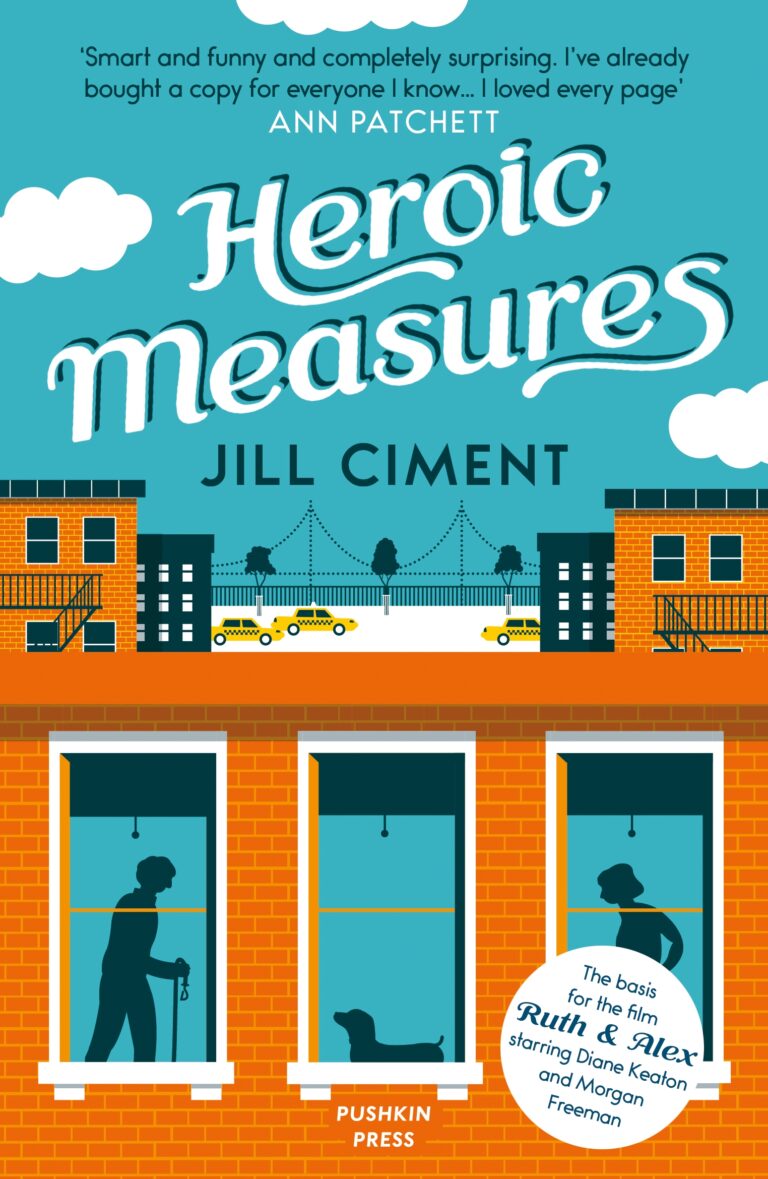
I might not have picked up Heroic Measures by Jill Ciment (2009) ordinarily, but it is published by the marvellous Pushkin Press and they’ve never done me wrong so far 😊 It turned out to be a nice book about nice people, gently humorous and engaging. It wasn’t overly sweet or sentimental, and I enjoyed it immensely. The right book at the right time.

Ruth and Alex Cohen are an older couple looking to sell their East Village apartment for a million dollars (I suspect the intervening fifteen years since publication have seen the relative price rocket even further). They can currently manage the five flights to their front door but they’re aware this is likely to change. Alex is an artist and Ruth a retired teacher; they live with their beloved dachshund Dorothy.

“Alex brought Dorothy home the day Ruth retired after three decades as a public school English teacher. Those first few nights tending to Dorothy’s mystifying needs and constant demands had reminded Ruth of a Victorian novel in which the husband acquires an orphan for his greying childless wife to raise.”

We follow their potential sale over a weekend where Dorothy is in the animal hospital. She is also advanced in years and she suddenly can’t move her back legs. We are privy to her thoughts as well as those of her humans.

The scenes where Alex and Ruth are managing a sick Dorothy were really moving. They weren’t over-the-top deliberately heartrending, but they were very affecting in portraying the deep upset when an animal is ill.

“Alex touches her sleeve: he’s found the source of the alarm, the metal buckle on Dorothy’s faux leopard collar. Ruth had bought the collar because she thought it gave Dorothy a risque, haughty look, an old dominatrix, say, whose specialty was biting. Ruth watches as Alex unclasps the buckle at the nape of Dorothy’s neck with an intimacy and caution, a husband removing his ill wife’s necklace.”

Over the weekend Ruth and Alex will have to deal with their ambivalence about the move – neither afraid of change, but unsure if this is a change they really want to push for:

“He’s been covering these walls with his imagery for almost half a century, as methodically as a clam secretes its essence to make its shell. When Lily had first peered into his studio during the appraisal, she proclaimed it would make a perfect nursery.”

“She can almost see the spines of her library arranged alphabetically, floor to ceiling. Finding a home for her books is no less important to Ruth than finding a museum for his paintings is to Alex.”

There is humour alongside these more melancholy aspects, making the novel seem very real. Lily the realtor and the various people who attend their open house provide some respite from their worries about Dorothy. In the background there is also the unease of a possible terrorist at large in the city, which Alex and Ruth are concerned will affect their apartment price. They also struggle with pushing buyers for more money. Neither of these considerations endear them to themselves.

They are deeply principled people, monitored during the McCarthy era, and their struggles with these materialist considerations lightens their characterisation and stops them seeming priggish.

“His wife – whose ethics has been his bedrock and his muse and his shackles, who wouldn’t lie about her beliefs to the house Un-American Activities Committee even when it cost them friends, passports, his first retrospective, almost her beloved teaching job”

I thought Ciment beautifully evoked the love between these two people in old age too. They have been together forever and they still like one another. Ruth compensates for Alex’s poor hearing, he compensates for her poor eyesight.

“He has loved her for so long that he can no longer distinguish between passion and familiarity. He slips off her glasses, puts away her book, douses the light, and returns to the living room.”

Heroic Measures is also about the love of a city, and New York is portrayed as fondly as the human and animal characters. A lovely read throughout.

To end, Heroic Measures was adapted as Five Flights Up in 2015. It looks a faithful adaptation, although the location of the apartment and Dorothy’s breed has changed. I guess EB White is right about dachshunds’ temperament and the filmmakers needed a more amenable doggy actor:

“It takes courage to grow up and become who you really are.” (e. e. cummings)

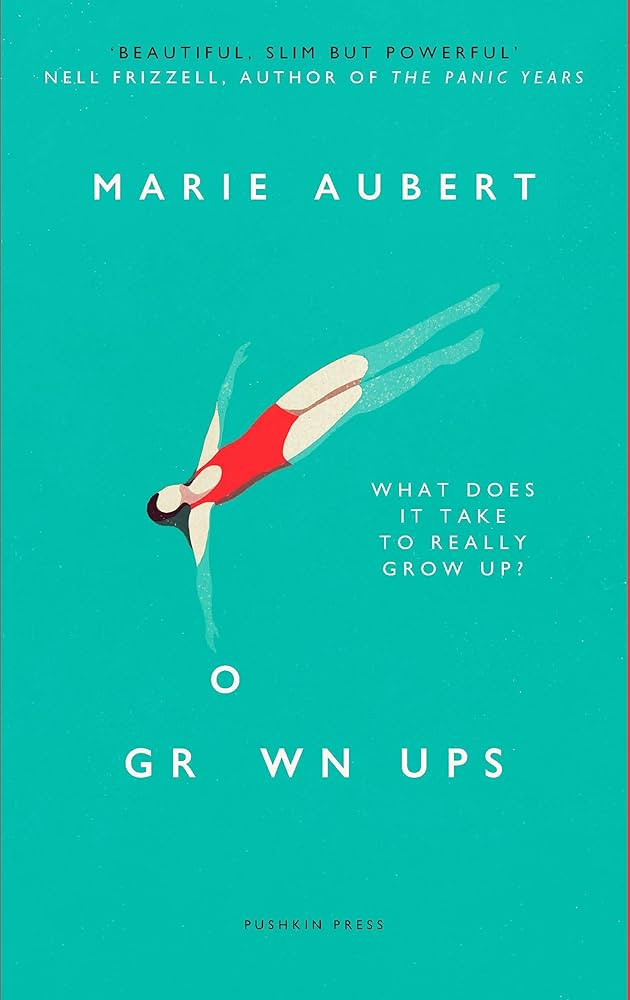
The blurb on the cover of my edition of Grown Ups by Marie Aubert (2019 transl. Rosie Hedger 2021) pushes it as ‘the perfect summer read’ and ‘pure escapism’ with which I couldn’t disagree more. Obviously we all have different reactions to books, but for me a novella (154 pages) about a woman coming to terms with her rapidly reducing choices regarding fertility, while at the summer house of her family with all its inherent tensions and rivalries, didn’t feel remotely escapist. Even when it’s darkly humorous and set in a log cabin in Norway 😉

Grown Ups features a very unlikable protagonist in Ida. She behaves really badly by anyone’s standards. But she was also recognisable and (somewhat) sympathetic.

At the start of the novel she is at a Swedish clinic having her eggs frozen:

“One day, I thought as I lay there in the gynaecology chair, one day things have to work out, one day, after a long line of married and otherwise committed and uninterested and uninteresting men, things have to work out, just lying there made me believe both men and child might materialise, just the fact that I was there and actually doing it was a promise that there was more to come, one day.”

I really felt for Ida. As the quote shows, she is feeling a bit desperate regarding the future as she turns forty, but pinning her hopes on a fantasy. As the story develops, the ambivalence she feels about what that future might look like is subtly portrayed. She doesn’t really seem to like children very much, but she doesn’t want that choice taken away from her. If she truly wants a committed relationship, why does she keep seeking out men who are already committed to someone else?

She travels to the family summerhouse in Norway for her mother’s birthday. Her sister Marthe is there with her husband Kristoffer and step-daughter Olea. The sisters relationship is full of long-held petty tensions, but it felt like they could actually be really close if they would just step outside of these entrenched behaviours. It doesn’t help that Marthe has redecorated the cabin without asking or even discussing it with Ida. She is also pregnant.

“‘I’m not as tough as you are,’ Marthe says, sounding a little sarcastic. It’s always the same, every summer, I’m quick to get into the water while Marthe takes her time, and then we each make digs about which approach is best.”

One of the hardest things to read in the book is Ida’s treatment of Olea. Recognising that Olea and Marthe don’t get on, Ida manipulates the child to increase her opposition to Marthe, just to prove something to Marthe and herself. She seems to have no fondness for Olea, and everything is performative rather than felt or understood.

“I’m the grown up now, I’m good at this. My tone is calm and kind, it feels familiar, like how things ought to be […] See, Marthe, I can do this, I’m the one who’s supposed to be doing this.”

Ida is destructive in her behaviour but only half-recognises this. I felt with Olea she didn’t really see the child as a person so didn’t fully recognise what she was doing. Flirting with Kristoffer on the other hand, she is fully aware of…

I’m making Ida sound more unlikable than she is and not doing justice to Aubert’s subtlety at all! The hurt Ida is experiencing is so clear, she is just seeking entirely flawed ways of managing that pain. Although she mentions friends, they are not named and she comes across as very isolated, particularly when her mother arrives with partner Stein.

“I feel the injustice, rampant and raging, there’s no one there to console me”

There’s also a passage where Ida describes dating and her hopes for more, where my heart just broke for her. It was filled with so much anger and loathing towards herself.

I looked on goodreads and yep, some readers really hated Ida 😀 But for me, while a lot of her behaviour was downright awful, I thought she was realistically portrayed as someone who has grown up thinking love is conditional and now doesn’t know who she is or what she really wants.

Grown Ups is well paced and things aren’t all tied up neatly at the end, which I liked as it didn’t undermine Ida’s situation or her feelings. I did have a sense Ida would carry on but maybe do a bit better. Unlike at the start of the story, there was hope for her grounded in something real.

To end, two sisters who seem to get on better than Ida and Marthe, singing about the struggles of trying to be grown up and a problem Ida has definitely experienced:

“Life was not an art-form, or rather, it was an extremely mixed genre.” (Antal Szerb)

Back in February, I read a collection of Antal Szerb’s short stories for the #ReadIndies event: Love in a Bottle published by Pushkin Press. I really enjoyed his writing and had his novel Journey by Moonlight (transl. Len Rix 2000) in the TBR too, which I decided to save for this week’s 1937 Club hosted by Kaggsy at Kaggsy’s Bookish Ramblings and Simon at Stuck in a Book.

When I think of farce, I tend to think of very broad-strokes comedy. Yet Journey by Moonlight manages to portray farcical circumstances with light humour and characterisation of great subtlety.

It begins with Mihály and Erzsi on honeymoon, having decided to formalise their relationship after an affair behind the back of Erzsi’s husband Zoltan.

“It was not exactly new or surprising to her that Mihály could say and do things she failed to understand. For a time she had successfully concealed her lack of comprehension, wisely asking no questions and acting as if eternally familiar with everything to do with him. She knew that this wordless assumption of authority, which he thought of as her ancestral, intuitive woman’s wisdom, was her strongest means of holding on to him.

[..]

And yet they had married because he had decided they understood each other perfectly, and that, for both, the marriage rested on purely rational foundations and not fleeting passion. For just how long could that fiction be sustained?”

Well, in answer to that question, not very long at all. Mihály loses Erzsi on a train in Italy and makes very little effort to reunite with her. Hardly surprising, given that even when they were physically together she was an abstract concept to him more than an actual living, breathing woman, his wife.

“[Erzsi] had become for him a sort of beautiful memory. He drank heavily to sustain this mood, to make himself believe that he wasn’t with Erzsi but with the memory of Erzsi. With Erzsi as history.”

Mihály is a drifter. To all appearances he has lived a life of bourgeois predictability, but inwardly he has drifted into it. Now he creates an outward life which reflects his inner life.

“At home and abroad he had been schooled in mastery. Not self-mastery, but the mastery of his family, his father, the profession which did not interest him. Then he had taken his place in the firm.

[…]

He had forced himself to become something other than what he was, to live never after his own inclination but as he was expected to. The latest and not least heroic of these exertions had been his marriage.”

The difficulty for Mihály seems to be recognising what his own inclinations are. He hasn’t supressed any great yearning or talent to take the path he has.

His overwhelming preoccupation is with the past. Acknowledging “there’s no cure for nostalgia”, he finds it impossible to live in the now or to take meaningful action in the present. As Erzsi’s ex-husband observes, Mihály is a man “so utterly withdrawn and abstracted that you have no real relationship with anybody or anything”.

At the start of his honeymoon he runs into a childhood friend, conman and thief, János Szepetneki. This sends Mihály into a protracted reverie, thinking about his other friends from that time, the elusive and compelling siblings Éva and Tamás Ulpius, and the religiously-minded Ervin. They will recur throughout the narrative, both absent and present as memories, symbols and occasionally like János, actual people. 

What stops this being completely tedious and self-indulgent is the strong vein of humour running through Journey by Moonlight. It is not overtly comic but it is consistently ironic. Mihály is both serious and faintly ridiculous and his most dramatic moments are consistently undermined.

There are entertaining interludes with the various people he encounters. My favourite occurs when the one decisive act he plans for himself is halted by an almost stranger insisting he become a godfather to a child he has never met. This request for lifelong duty occurs for no apparent reason and is one which Mihály greets with extreme reluctance. And yet, he is drawn in and distracted from his course:

“How distressing that the most sublime moments and stages of our lives can be approached only with the most banal expressions; and that, probably, these are indeed our most banal moments. At such times we are no different from anyone else.”

Yet Szerb doesn’t let the humour undermine the message of Journey by Moonlight. He is exploring how, as human beings, we recognise and live a meaningful, worthwhile life for ourselves. It’s a fine balance which he achieves expertly (the only clunky part for me was a long exposition by an academic friend of Mihály’s on dying as erotic act).

“And again he had the feeling that the really important things were happening elsewhere, where he was not; that he had missed the secret signal. His road led absolutely nowhere and his nostalgia now would gnaw him eternally, remain eternally unquenched, until he too departed.”

Szerb portrays the despair of human beings alongside our ridiculousness, and he does it all with great compassion.

“And sublime and terrible things always happened to him when life was stupid and precious.”

Marina Sofia also reviewed Journey by Moonlight this week, and you can read her wonderful post here.

To end, of the many songs about the moon, I chose this one from björk, because I thought it fitted the tone of Journey by Moonlight well. She takes her art seriously but she’s not afraid to be silly too:

“While there is life there is always the chance that something might happen.” (Antal Szerb)

This week I’m focussing on Pushkin Press as part of Kaggsy and Lizzy’s #ReadIndies event in order to read four books that have long been in the TBR. For this final post, my read is Love in a Bottle by Antal Szerb (1922-1943, transl. Len Rix 2013)

This was a really interesting collection, because the stories are presented chronologically and there’s a big gap whereby Szerb’s style changes considerably.

The first three stories are from 1922-23. Ajandok’s Betrothal, The White Magus, and The Tyrant all have a fable-like quality. Told in the third person, they are set in a timeless period and within realities that verge on mythical. While they were very well written, and diverting enough, I didn’t find them hugely interesting.

The rest of the stories are from 1932-1943 and these I found much more original and compelling. The first is Cynthia, a fragment which Pushkin Press omitted in a previous edition as Szerb probably didn’t intend it for publication. It begins:

“When they threw me out of Cambridge for my poor taste in neckties and generally immoral conduct, I enrolled at University College London, whose chief claim to fame (though they kept this private) was that its Dean was obliged, as a matter of principle, to see off any clergymen who dared set foot on the premises.”

I immediately felt hopeful that this change in tone and setting would be much more to my liking 😀

The tale itself is told from the point of view of an unpleasant but believable lothario who doesn’t seem to like women very much. This persona recurs through some of the other stories. In A Dog Called Madelon, a man laments that he has never been able to sleep with aristocratic women, despising the shop assistant he is with:

“He had been reflecting on the way his whole life had been frittered away on a procession of frightful little Jennys, when ever since boyhood he had yearned for a Lady Rothesay. History held the sort of erotic charge for him that others found in actresses’ dressing rooms – a truly great passion required three or four centuries historical background at the very least.”

In Musings in the Library, an “anti-Don Juan” who finds “women rarely please me” manages to completely fumble a fledgling love affair.

What stops these characters from being completely alienating to the reader is firstly, the wry humour that runs through the stories, and secondly the deep inadequacy of the protagonists. They are not meant to be heroic in any way, but rather deluded and sad. The stories all end in their failure, often with ironic circumstances.

In the titular tale, Szerb returns to mythology with Sir Lancelot and his love for Guinevere, but this is markedly different to the previous myth-like stories. Love in a Bottle has a more individual, authentic voice to the narration, and the humour of the contemporary-set tales is evident here too.

Szerb seems to view romantic love in these stories with some scepticism, but not disdain. It is the flawed characters which mean love is never fully realised, rather than problems with the idea itself. In fact, there is a feeling of hope towards love in the way Szerb consistently returns to the theme, but it is the humans involved who make it become ridiculous.

His tone is never bitter though, and he doesn’t judge his characters too harshly. To me Szerb seemed to be highlighting foibles while suggesting no-one was above them.

I also enjoyed Fin de Siècle where Szerb seemed to be having a lot of fun satirising writers. Thus Dr Johnson is noted for his “immortal banalities” and a group of writers who gather together include:

“Lionel Johnson, who would deliver his observations about the weather in the manner of a revelation: ‘There was a thick fog in Chelsea this morning.’ he would regularly announce, and glare balefully around the room, his hand clapped on some invisible sword.”

The humour, intelligence and readable style of the stories in Love in a Bottle has made me keen to explore Szerb more. Fortuitously I have Journey by Moonlight lined up for Kaggsy and Simon’s 1937 Club which is running 15-22 April – can’t wait!

“Looking back on the blissful days of my youth, as they begin to slip away from me, I can see now the best of them were those spent in the Bibliothèque Nationale in Paris.”