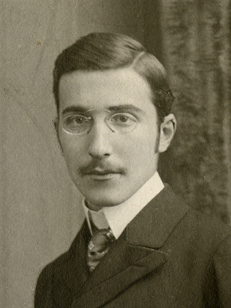
“My world was small and terrible.” (Isaac Babel)

This week I’m focussing on Pushkin Press as part of Kaggsy and Lizzy’s #ReadIndies event to finally read four books that have long been in the TBR. For this third post today my read is Odessa Stories by Isaac Babel (1916-1937 transl. Boris Dralyuk 2016).

The Introduction to this volume by translator Boris Dralyuk is really informative and provides some fascinating context to Babel’s writing. Odessa was a booming port when Babel was born in 1894; in 1900 around 140,000 of its 400,000 population was Jewish. Babel was part of a well-to-do family but was drawn to Odessa’s underbelly, writing stories about the legendary gangsters of the city.

Dralyuk also explains about translating the melting-pot language of Odessa, so I highly recommend reading the Introduction before you start on the stories (I often read Introductions at the end). Babel was only 45 when he was killed in Stalin’s purges.

The volume is divided into three parts: Gangsters and Other Old Odessans; Childhood and Youth; and Love Letters and Apocrypha. I always struggle to write about short story collections and generally Babel’s stories are so short that I don’t want to give spoilers. Here I just want to give a flavour and you can see if you might want to seek out these stunning stories for yourself.

The first part is mainly told in the third person and weaves together tales of violence and corruption, with recurring characters including “Benya Krik, gangster and King of the gangsters”. The tales are colourful and carnivalesque, but Babel never allows the broader strokes to obscure the unlawful methods that so many live by:

“At this wedding they served turkey, roast chicken, goose, gefilte fish and fish soup in which lakes of lemon glimmered like mother-of-pearl. Flowers swayed above the dead goose heads like lush plumage. Does the foamy surf of Odessa’s sea wash roast chickens ashore?”

At the same time, he doesn’t position the reader above the gangsters or way of life. Babel suggests that this side of Odessa is as it is because this the logical way to be, and it has emerged as part of the society, laws and political structures that surround it:

“Let’s not throw dust in each other’s eyes. There’s no one else in the world like Benya the King. He cuts through lies and looks for justice, be it justice in quotes or without them. While everyone else, they’re as calm as clams. They can’t be bothered with justice, won’t go looking for it – and that’s worse.”

The second part of the stories in Childhood and Youth becomes more personal, with first-person tales that follow on from one another in some instances. I understand The Story of My Dovecote is the most famous, and rightly so. Within this brilliant collection, it still stands out. (Skip the next two paragraphs if you don’t want to know any details in advance.)

A young boy has spent five of his ten years coveting a dovecote. He manages to find ways around the anti-Semitism at his school to do well academically and get the reward of finally being able to buy his doves. He sets out to the market with his money and gets his beloved birds, tucking them into his jacket. If your heart is sinking at this description, you are absolutely right…

The story is fifteen pages in this edition and completely devastating. I would urge anyone to read it, but it will absolutely stay with you. It will rip your heart out and stamp all over it. The final word of this story is “pogrom”.

There are lighter stories in this section too, such as The Awakening, about a precocious young man:

“Writing was a hereditary occupation in our family. Levi Yitzchak, who went mad in his old age, had spent his whole life composing a tale titled A Man With No Head. I took after him.”

Odessa Stories was my first experience of reading Babel and I was blown away. Babel clearly enjoyed the almost fabulist tales of Benya the King, but somehow never glamorised him. His writing is hugely entertaining but also truthful – the violence towards people and animals suddenly appears in the midst of the stories and jolts the reader to remember the visceral realities of what is being described.

In evoking the worst of human behaviour in Dovecote, Babel is restrained and absolutely drives home the tragedy.

Babel’s writing is intensely human, marrying together humour, violence, pathos and beauty seamlessly. I will definitely seek out more by him on the strength of Odessa Stories. Sadly, there isn’t much as his life was cut short. However, Pushkin Press publish Red Cavalry, another short story collection.

“For the first time I saw my surroundings as they actually were – hushed and unspeakably beautiful.”

“I had a lion inside me that wouldn’t shut up!” (Ingrid Bergman)

This week I’m focussing on Pushkin Press as part of Kaggsy and Lizzy’s #ReadIndies event to finally read four books that have long been in the TBR. Today it is a book of two essays, City of Lions by Józef Wittlin and Philippe Sands.

Pushkin Press’ website describes the volume: “Lviv, Lwów, Lvov, Lemberg. Known by a variety of names, the City of Lions is now in western Ukraine. Situated in different countries during its history, it is a city located along the fault-lines of Europe’s history. City of Lions presents two essays, written more than half a century apart – but united by one city.”

The book comes with maps of Lwów and Lviv within the French flaps and photographs throughout which are both useful and illustrative, making a really lovely edition. It also forms another stop on my Around the World in 80 Books reading challenge.

Józef Wittlin was a poet and novelist and his essay My Lwów (1946, transl. Antonia Lloyd-Jones 2016) beautifully evokes his longing for a city he knows has gone forever, with his writing full of nostalgia and loss.

Wittlin is completely aware of his skewed view of the city, having left in 1922 and writing his essay sat in New York so many years later:

“Nostalgia even likes to falsify flavours too, telling us to taste nothing but the sweetness of Lwów today. But I know people for whom Lwów was a cup of gall.”

Yet still he longs for city of his past.

“Alright, so Lwów hasn’t got a decent river, or a legend. What would it need a river for? The urban planners and tourists say that if Lwów were graced with a river, it would be a second Florence. In my view Lwów has more greenery than Florence, though less of the Renaissance. Moreover, it resembles Rome…”

But as Wittlin evokes the cityscape, its smells, food and people with great artistry and passion, world events – recent at the time of his writing – do filter through. In his evocation of a culturally mixed European city in the early twentieth century, he would have been aware that the Jewish population which had made up around a third of Lwów’s inhabitants had been almost entirely wiped out.

“It is not Lwów that we yearn after all these years apart, but for ourselves in Lwów.”

Philippe Sands essay My Lviv (2016) is written in conversation with My Lwów and views the city through the eyes of someone who never lived there, but whose family history – and the reason they had to leave –  is firmly rooted there.

“I could have chosen to turn away from the stories stuffed into the cracks of each building, or what was hidden behind freshly plastered walls. I could have averted my gaze, but I didn’t want to. Observing with care was part of the reason for being there, seeking out what was left, traces of what came before.”

Sands essay is deeply personal as he revisits his grandfather Leon’s home city. It is an experience he feels deep in his bones:

“I understood it to be part of my hinterland, one that was buried deep because Leon would never speak of that past. His long silence hid the wounds of a family that was left and then lost, but from the moment I set foot in the place it felt familiar, a part of me, a place I had missed and where I felt comfortable.”

At the same time, Sands is visiting with broader knowledge of devastation wreaked by the Holocaust, and he sees these layers within Lviv, even when they aren’t overtly commemorated:

“The first time I stood in the courtyard behind the school, in the autumn of 2012, I had no idea what that yard had been used for. Now armed with that knowledge, that this vast and empty place was a gathering point for thousands of final journeys […] it was a place of terrible silences, the expression of a conscious desire not to remember.”

I found City of Lions a deeply moving read. It is an elegy for a lost time, a eulogy for those lost, and a stark reminder that history is lived and died through by ordinary people. Cities grow and change, but they build upon and contain all that has gone before. It is all there if we take the time and care to look.

At the same time, what these two very different evocations of the same city demonstrate so well is that we experience our surroundings through ourselves. Wittlin and Sands are writing as much about themselves as they are about the city, but the essays are no less fascinating for that.

“Never despise the translator. He’s the mailman of human civilization.”(Alexander Pushkin)

This week I thought I’d use Kaggsy and Lizzy’s #ReadIndies event to focus on one indie publisher, and finally get to four books that have long been languishing in the TBR. Pushkin Press “publish some of the twentieth century’s most widely acclaimed and brilliant authors” and they are one of my favourite indies, ever-reliable. Which hasn’t stopped four from their Collection series remaining unread by me for far too long!

Today I’m starting with The Buddha’s Return by Gaito Gazdanov (1949-50, transl. Bryan Karetnyk 2014). Gazdanov was a Russian writer exiled in France and this short novel, described by the publishers as “part detective novel, part philosophical thriller, and part love story” is set in Paris, as much as it is set anywhere – reality is not a consistent concept in this story at all.

The narrator is a student who is experiencing prolonged periods of hallucinations. He tells us from the start that he is an unreliable storyteller:

“Nowhere was there any logical pattern in this, and the shifting chaos clearly failed to present even a remote semblance of any harmonious order. And so, accordingly, at that point in my life, which was marked by the constant attendance of chaos, my inner existence acquired an equally false unwavering character.”

We slide back and forth between a recognisable reality of his poverty-stricken life in Paris and his disturbing, disorienting visions, without always knowing which is which. Early on in the novel he falls to his death from a sheer mountainside, later he is arrested and interrogated by the Central State. The government’s accusations of treason are entirely surreal and illogical, yet this is also what makes them horribly believable.

There is political commentary running through the novel, but the kaleidoscopic nature of the narrative means it is not a sustained satire on any particular country, ruler or party, but rather a wider condemnation:

“The ignorant, villainous tyrants who so often ruled the world, and the inevitable and loathsome apocalyptic devastation apparently inherent in every era of human history.”

Around halfway through, more of a plot emerges as Pavel Alexandrovich, an older man whom the student befriended, is murdered and his golden statuette of Buddha stolen. As the last person to see Alexandrovich alive, the student falls under suspicion. The real-life interrogation by the investigators has shades of the surreal fantasy interrogation by the Central State:

“If we can find the statuette, you’ll be free to return home and continue your research on the Thirty Years War, the notes on which we found in your room. I must say, however, that I completely disagree with your conclusions, and in particular your appraisal of Richelieu.”

As that quote shows, there is humour in The Buddha’s Return and this lightens a tale which has a lot of dark elements: visceral war scenes, squalor, and of course murder.

Apparently, The Buddha’s Return was originally published in instalments and I can see it would work well in this format. I enjoyed it but for me the more plot-driven second half arrived at just the right time, when I’d started to feel it was losing momentum. As it was I enjoyed this consistently surprising tale which still had enough recognisable humanity in it to be involving, and I’d be keen to read more by Gazdanov.

“I have a suspicion that you just dreamt the whole thing up. It’s because you read too much, eat too little and spare hardly any thought for the most important thing at your age: love.”

“Our house, in the middle of our street.” (Madness)

This my second contribution to the wonderful #ReadIndies2 events hosted by Kaggsy and Lizzy.

This time I’ve chosen two novels linked by the theme of communities.

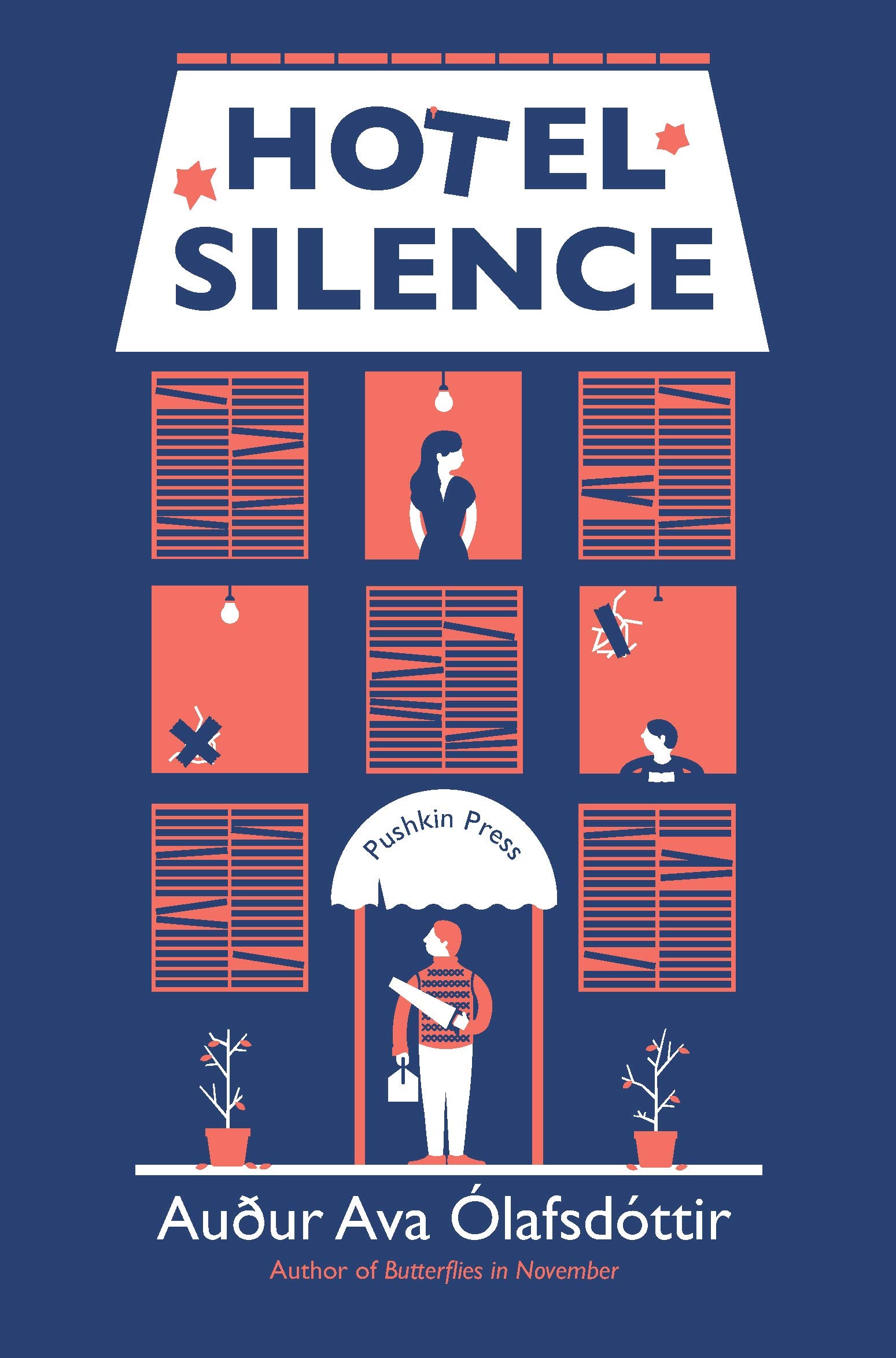
Firstly, Hotel Silence by Auður Ava Ólafsdóttir (2016 trans. Brian FitzGibbon 2018) published by Pushkin Press. I wrote about Butterflies in Novemberby this author in my previous post, explaining that I’d also enjoyed Miss Iceland. Unlike both these novels, Hotel Silence features a male narrator and is set away from Iceland.

Jónas Ebeneser is just shy of 50 and his wife has left him, telling him that his daughter, Gudrun Waterlily, is not his. His elderly mother has dementia and is fixated on war. All this has prompted a significant crisis:

“Will the world miss me? No. Will the world be any poorer without me? No. Will the world survive without me? Yes. Is the world a better place than when I came into it? No. What have I done to improve it? Nothing.”

So he decides to end his life. But because he doesn’t want Gudrun Waterlily to find his body, he decides to do so in another country. He flies to an unnamed country that has just seen the end of conflict:

“The situation is said to be precarious, and it is unclear whether the ceasefire will hold. It seems ideal”

The first section, Flesh ends with his arrival at the titular hotel. The second part, Scars, forms the rest of the book, in which Jónas finds his skills as a handyman in great demand as an entire generation of men has been wiped out.

He helps May and Fifi, the young siblings who run the hotel, and gets roped in to making western saloon doors for the nearby Restaurant Limbo where he takes his meals. Word spreads, and Jónas begins to heal, albeit with scar tissue – not a return to what was before.

“My unhappiness is at best inane when compared to the ruins and dust that lie outside my window.”

He also assists with healing in others, as he helps May and Fifi rebuild their hotel. There is a mosaic of cultural significance somewhere in the building, but also more prosaically rooms that need rewiring and painting. The brother and sister hope to see tourists back soon, although to a very different hotel than before the war, as the uncovered shop postcards attest:

“What strikes me are the bright colours, the vibrant blue sky and golden sand; the world was still in colour back then and people didn’t know what was in store, they’re alive, both their legs are of the same length, they have plans for the future, maybe they’re going to change cars or kitchen units or take a trip abroad.”

Hotel Silence shows the power of community to heal both collectively and for the individuals within it. It is about how hope doesn’t mean a diminishment of pain, but a way to live alongside it. And it’s about how both hope and healing can be found in the most unexpected places, if we can find the strength to stay open to such possibilities.

Secondly, Esperanza Street by Niyati Keni (2015) published by AndOtherStories, a not-for-profit publisher whose website explains: “And Other Stories publishes some of the best in contemporary writing, including many translations. We aim to push people’s reading limits and help them discover authors of adventurous and inspiring writing.”

They are a publisher I really enjoy, one where I’ll pick up a novel simply because it’s one of theirs, which is exactly what I did with Esperanza Street. The story is one of a community in a port town in the Philippines, told by Joseph, an eight-year old houseboy: “Esperanza, one of the oldest streets in Puerto, its heartbeat made up of a thousand smaller pulses, lulled us with its apparent constancy.”

Joseph’s mother has died, and shortly before this his father takes him to Mary Morelos’ house to work. Mary is kind but exacting, and Joseph gets to know her sons, good-looking mechanic Dub and artistic Benny as well as the cook America.

We follow Joseph and the inhabitants of the street through the next few years, beginning in 1981 with the Marcos’ in power. It’s a poor but busy area with food stalls, coffee shops and beauty parlours, and I thought Keni achieved a good balance of evoking the environment without indulging in poverty porn:

“from the gate, I watched the street turn to velvet and everything become rich, convivial. In a line stretching from the brow of the hill down to the jetty, the lamps came on in clusters, their yellow light seeping through the smoke that layered upwards from the braziers.”

The threat of redevelopment hangs over Esperanza Street. Local gangster Eddie Casama has left the area behind through his accumulation of wealth – though his mistress lives in the area – and he has an interest in seeing the area change. “he looked like the kind of man who’d let his kids ride on his back at weekends.” Yet his potential for violence and disregard for others is never in doubt.

There isn’t a huge amount of plot to Esperanza Street, though there several strands that we watch unfold. The inhabitants of the street are subject to their own passions and also to external forces of politics and money, all of which determine their fates. Joseph is an intelligent boy and both Mary and his father are anxious that he finishes school, but there will be events that loom large in his life along the way.

“I read with the hope something would finally arrive that would illuminate everything, a single piece of knowledge that would show how my life would unfold.”

Keni grew up in London though she has travelled a lot in the Philippines, so I would be interested to know how accurate her portrayal of the area is. It’s certainly a fully realised fictional portrait, which I found very evocative.

To end, a song named after a street near where I live:

“Sometimes me think, ‘What is friend?’ Then me say, ‘Friend is someone to share the last cookie with.’” (Cookie Monster)

This is a contribution to the wonderful #ReadIndies2 events hosted by Kaggsy and Lizzy.

The two books for this post were buried in my TBR, so I’ve put them together as they are linked by the theme of friendship.

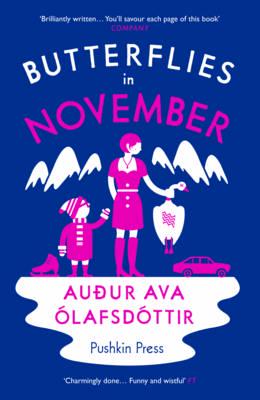
Firstly, Butterflies in November by Auður Ava Ólafsdóttir (2004 trans. Brian FitzGibbon 2013) published by Pushkin Press (which I thought was an indie, then panicked that it had been bought by Penguin, but which Lizzy has helpfully reassured me is definitely an indie!)

I really enjoyed Miss Iceland by this author so I was looking forward to this. Like Miss Iceland, this novel has a central female protagonist whose voice is bone dry, determinedly going her own way.

At the start of the novel, the unnamed narrator returns home to her husband after a meeting with her lover, one of her translation clients as she speaks 11 languages. She doesn’t seem especially attached to either man:

“After we had slept together for the first time, he looked surprised when I handed him the bill with the VAT clearly highlighted.”

Her husband announces he is leaving, to be with his pregnant girlfriend. This doesn’t seem like any great loss, given that as he’s going, he details her failure to live up to his ideals of womanhood:

“‘The amount of times I’ve prayed to God to ask him to make you buy a skirt suit.’

‘Wouldn’t it have been simpler just to ask me?’”

She moves to a new apartment but her wet blanket husband keeps turning up, so she starts daydreaming of foreign travel somewhere warm. However, her best friend Auður is pregnant with twins, and needs to stay in hospital for the late stages of the pregnancy. This means she finds herself driving round the Icelandic ring road which circles the whole island, with Auður’s son Tumi:

“a deaf four-year-old clairvoyant boy with poor eyesight and one leg three centimetres shorter than the other, which makes him limp when he is only wearing his socks.” 

There seems little worry that Tumi will miss any education, as his teacher demonstrates ableism, gender stereotyping and racism, all within a remarkably short conversation.

The plan is to travel east to a prefab cottage that she won in a lottery for the Association for the Deaf. This involves her returning homewards, and we get glimpses of her past which may explain some of her detachment, although things are never fully explained.

What follows is a road trip story – funded by her and Tumi winning another lottery, which they split 50/50 –  whereby the two meet a variety of characters. My personal favourite was the Estonian choir who kept turning up. There are also some lovers, as predicted by a clairvoyant at the start of the novel:

“three men in your life over a distance of 300 kilometres, three dead animals, three minor accidents or mishaps, although you aren’t necessarily directly involved in them, animals will be maimed, but the men and women will survive. However, it is clear three animals will die before you meet the man of your life.”

The animals: suffice to say there were passages I had to skip. But skipping those didn’t detract from the overall story at all so I would still recommend this novel, even if you share my sensitivities.

Tumi is a sweet, self-possessed boy “He always stands at the back of the group, avoiding conflict.” and I thought his relationship with the narrator was nicely evoked without sentimentalism.

Looking on goodreads, the reviews for this are a very mixed bag. My tolerance from whimsy is pretty high and I don’t mind things left unexplained, so I enjoyed this novel, and I do really like Ólafsdóttir’s detached female voices.

“A relationship for me is all about the right body and the right smell, the home is a shell for the body, not a place for exchanging existential views and having discussions. Even though you still have to load the washing machine and cook for the body.”

Secondly, Leonard and Hungry Paul by Rónán Hession published by Bluemoose Books, an independent publisher based in Hebden Bridge, whose manifesto explains “At Bluemoose our aim is to publish cracking stories that engage and inspire.”

I tried to read L&HP back in the summer and totally failed, but it had a lot of positive reviews in the blogosphere and so I gave it another shot. Now my reading is recovering somewhat I zipped through it with ease, so I’m sure my earlier troubles were indicative of my reading slump and not Hession’s writing.

The titular friends are men around their mid-thirties, who are easily overlooked. Leonard is grieving his mother, who he lived with in the family home until she died, never moving out because they got on well and there was no reason to. I found this relationship very touching. So often parent/child relationships are dramatized as being full of unspoken judgements and resentments, and it was a pleasant change to see someone who loved his parent, but also liked and respected them.

“Had he the courage, Leonard would have spoken up and said that his mother looked after everyone in her life as though they were her garden birds: that is to say, with unconditional pleasure and generosity.”

Leonard’s grief is of the quiet, ordinary kind where you still get up and go to work every day, carrying a deep sadness with you. In other words, the type pretty much everyone experiences.

“Leonard took off his noise-cancelling society-repelling headphones and went to the kitchenette for a mid-morning cup, even though he always disliked the awkward wait for the water to boil and the prospect of kettle-related time-killing small talk.”

I am with you Leonard.

Hungry Paul – whose attributive adjective is never explained – still lives at home with his parents, happy to bumble along, working as a casual postman and seeing Leonard regularly for their boardgame nights.

“He had no interest in, or capacity for, mental chatter. He had no internal narrator. When he saw a dog he just saw a dog, without his mind adding that it should be on a lead or that its tongue was hanging out like a rasher.”

Paul’s quiet stillness comes into its own when his mother insists he join her as a volunteer hospital visitor. While his extrovert mother chats away happily with one patient, Paul becomes the only one another patient will tolerate “He sat there calmly, simply sharing the moment with the woman.”

Not very much happens in L&HP but there is enough plot to pull the reader along. Paul’s sister Grace is getting married; Leonard begins a tentative romance; Hungry Paul enters a competition at the Chamber of Commerce. Really though, the novel isn’t so much about what happens as providing a glimpse into ordinary, quiet lives, and showing how they are worthy of attention:

“Their friendship was not just one of convenience between two quiet, solitary men with few other options, it was a pact. A pact to resist the vortex of busyness and insensitivity that had engulfed the rest of the world. It was a pact of simplicity, which stood against the forces of competitiveness and noise.”

I found L&HP to be a paean to the kindness and the gentleness found in the everyday small gesture:

“She was a person for whom kindness was a very ordinary thing, who believed that the only acceptable excuse for not having a bird feeder in the back garden was that you had one in the front garden”

(Or in my case, because you live in a London flat and the management company have banned them because the rats feast on them ☹)

It’s not an overly worthy novel though, there is plenty of humour. No-one is put down, but the absurdities of people are gently ribbed, such as Leonard’s colleague “Okey dokey. This will take just one minutiae. Take a load off, compadre,’ said Greg, unable to complete one conventional sentence.”

As an introvert who despairs at the relentless noise of modern life (why do shops think blaring out music will entice you to spend more time and money there? Why are cinema volumes now kept at ear-bleeding decibel levels?!) and who firmly believes in the meaning of the everyday, I was definitely the target audience for L&HP. If this sounds like you too, then I think you’ll enjoy this novel.

“We live in an age of cacophony.  Everyone talking and thinking out loud, with no space or oxygen left for quiet statements and silence.”

To end, one of the best TV theme songs ever, all about being a friend:

“Vienna is just the best place to be.” (Conchita Wurst)

It’s November, so ‘tis the season of many wonderful reading events. Margaret Atwood Reading Month is being hosted by Buried in Print; What’s Nonfiction is hosting Nonfiction November; AusReading Month is being hosted by Brona at This Reading Life. I’m hoping to join in with them all, but I doubt I’ll be able to because my reading and blog writing is still positively sloth-like.

However, with this post I’m managing to contribute to Novellas in November, hosted by Cathy at 746 Books and BookishBeck; and German Literature Month, hosted by Lizzy  Siddal, and Caroline at Beauty is a Sleeping Cat. And I’m only cheating slightly by counting the same book for both 😀

Week 1 for German Literature Month is focussed on writing from or set in Austria, so I’ve picked two novels by Austrian authors who have also set their stories in Austria.

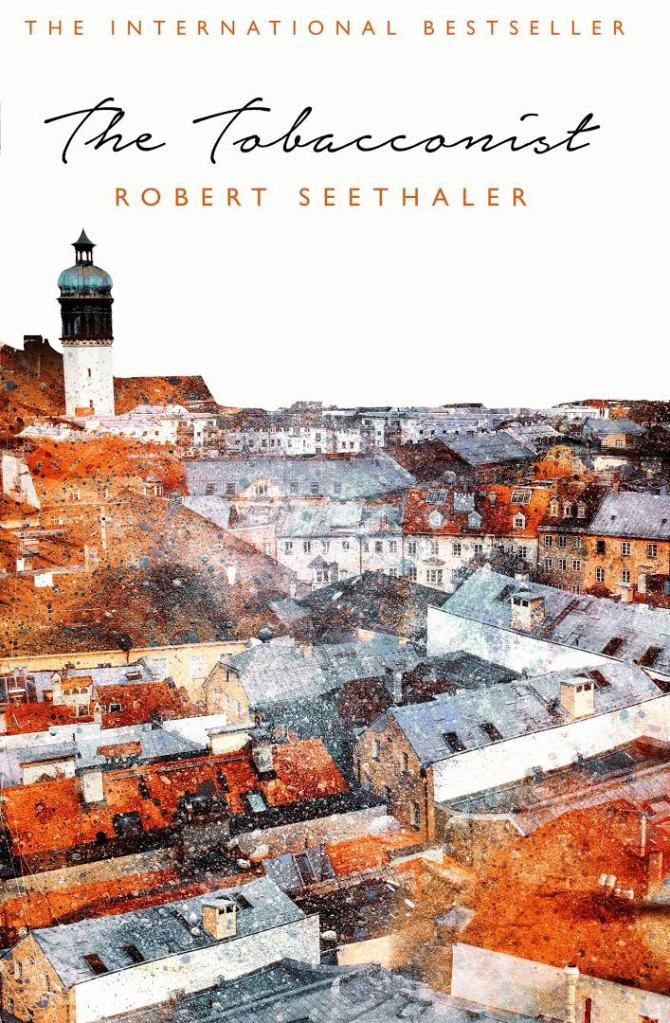
Firstly, The Tobacconist by Robert Seethaler (2012, trans. Charlotte Collins 2016) which at 234 pages is a short novel but a wee bit long to count for #NovNov. Set in 1937, teenage Franz leaves his lakeside home for the hustle and bustle of Vienna:

“the noise – there was an incessant roaring in the air, an incomprehensible jumble of sounds, tones and rhythms that peeled away, flowed into each other, drowned each other out, shouted, bellowed over each other. And the light. Everywhere a flickering, a sparkling, flashing and shining: windows, mirrors, advertising signs, flagpoles, belt buckles, spectacle lenses.”

He has a job as an assistant to old friend of his mother’s, working in the tobacconist’s shop. His boss Otto is non-smoker with a rather unique approach to his job:

“Reading newspapers was the only important, the only meaningful and relevant part of being a tobacconist; furthermore if you didn’t read newspapers it meant the you weren’t a tobacconist”

Despite this unpromising start, Franz’s horizons begin to widen. The newspapers give him a burgeoning political awareness, and the vibrant city offers opportunities for romance. Even the shop stock suggests vistas unknown:

“Each brand had its own particular smell, yet they all had this in common: they bore within them the aroma of a world beyond the tobacconist’s, Währingerstrasse, the city of Vienna, beyond even this country and the whole wide continent.”

Franz is a sweet and endearing character, but not sentimentalised or idealised. His earnestness and energy can be somewhat tiresome, if entirely believable. He even tests the patience of his most famous customer:

“Freud sighed. For a fraction of a second he considered yielding to the sense of anger that was welling up deep inside, and stubbing out his Hoyo on the brow of this impertinent country lad. He decided against it and puffed smoke rings into the air instead.”

I’m not usually a fan of fictionalised real people, but the friendship between the eminent psychoanalyst and the young Franz is subtly evoked and not remotely heavy-handed. Seethaler doesn’t try and shoehorn in loads of Freudian references to demonstrate how much research he’s done; Freud is shown as an aging man and very vulnerable as a Jewish person amongst the escalating political situation in Austria.

“the colossal difference between their ages automatically established the distance Freud found agreeable and which was, indeed, the thing that made close contact with the majority of his fellow humans tolerable”

The focus is primarily on Franz as he ricochets around the city, falling in and out of love, writing to his mother and growing up, all while Nazism tightens its hold. The insidious nature of this is brilliantly done through incidental details:

“In front of the town hall, children and youths were gathering in small groups. They were hanging around on corners, standing arm in arm, blocking the pavements or running across the square, laughing and shouting, waving hats and swastika flags.”

Until suddenly it’s not incidental anymore. Violence explodes, Franz has to deal with the Gestapo, people disappear, and Freud is persuaded to leave his home forever…

The Tobacconist is a tragedy that never portrays itself as such. It tells a deeply ordinary story – despite the famous person in its midst – and uses the reader’s knowledge of history to fill in the gaps. It’s a brilliant technique, because it takes a protagonist we all recognise, having all been teenagers discovering a wider world at some point, and places him inescapably within the brutality of a genocide, making historical events resonate on a personal level.

There is an ambiguity to the ending of The Tobacconist which rather than being frustrating I thought entirely apt. Under a brutal regime, so often people have to live with not knowing.

“For it was well known that waiting and seeing was always the best, perhaps even the only way to let various troubles of the times flow past and leave you unscathed.

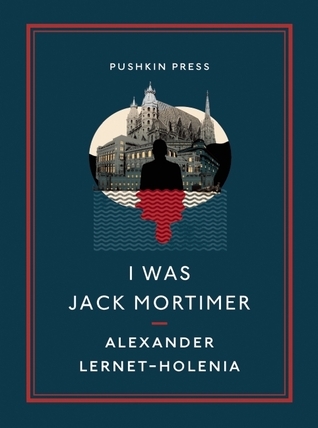
Secondly, I Was Jack Mortimer by Alexander Lernet-Holenia, (1933, trans. Ignat Avsey 2013) which in my Pushkin Press edition is 203 pages but they are not standard size, and when it was published in a Pushkin Vertigo edition it was 160 pages, so counts for Novellas in November – hooray!

A disclaimer to start, because although I enjoyed I Was Jack Mortimer a great deal, I thought the fundamental premise was completely silly.

Spooner is a young cab driver who at the start of the novel is stalking a young woman – so far, so yuck. Then a man gets into his cab, but by the end of the journey the passenger has been shot dead, without Spooner hearing or seeing a single thing.

“Spooner stood in the middle of the room, and the events of the past minutes raced through his mind, like short, randomly edited film clips; the dead man, the speeding cars, the news stand, the dead man, the carriageway, the blood, the dead man, the streets, the dead man.”

What would you do? I think almost entirely everyone would go to the police. But this wouldn’t make much of a thriller, as the police would take the story out of your hands and you’d have to go back to smoking with the other cabbies, boring them with the story, and being creepy towards women.

So instead, for reasons best known to himself, Spooner disposes of the body and starts to inveigle himself into the man’s life.

“he was pretty sure that as soon as the crime was discovered it’d be put at his door, so that in the end he began to feel as though he had in fact perpetrated it himself. And had he really been the murderer, in all probability he wouldn’t have been behaving any differently from the way he was now.”

I Was Jack Mortimer is a really enjoyable thriller, if you can get past the unbelievable set-up of Spooner’s decision-making. I just put that element to one side and allowed the pacy writing to carry me along as Spooner gets increasingly out of his depth. The 1930s and the city of Vienna are beautifully evoked with a wonderful sense of time and place.

The trouble with writing about thrillers is that you can say practically nothing for fear of spoilers. What I will say is that towards the end Spooner has the following epiphany:

“All I needed to do was go to the police and report I had a dead person in the car and didn’t know who shot him, and in the end they’d have had to believe me and I’d have been released. Instead, I’ve done just the opposite and have landed myself in no end of a mess.”

Well, quite.

“One doesn’t step into anyone’s life, not even a dead man’s, without having to live it to the end.”

To end, I tried to find a trailer for one of the film adaptations of I Was Jack Mortimer, but failed. So instead a chance for me to totally indulge myself with the trailer for my most favouritest-ever film, which is set in post-war Vienna:  

Two @PushkinPress reads for #WITMonth

After a somewhat harrowing start to my WITMonth reading, this week I have two novels from Pushkin Press which I found much easier-going. That’s not to say they are the lightest of reads though, as they deal with serious themes: trying to carve a space as a female artist in a patriarchal society, and bereavement.

Firstly, Miss Iceland by Auður Ava Ólafsdóttir (2018, trans. Brian FitzGibbon 2019). Set in the 1960s, Hekla is young woman named after a volcano, who leaves her remote town to move to Reykjavík in the hope of realising her dream of becoming a writer.

The story begins with her coach journey to the city as she attempts to read Ulysses in its original language (quite an undertaking even when it’s written in your first language):

“How many pages would it take to overtake the tractor if James Joyce were a passenger on the road to Reykjavík?”

This witty and serious woman also has to fend off the attentions of an older man who says he can get a place in the Miss Iceland contest:

“We’re looking for unattached maidens, sublimely endowed with both clean-limbedness and comeliness”

Bleugh. Hekla is not remotely interested. She goes to stay with her schoolfriend Ísey who is married and has started a family, a situation about which she seems conflicted:

“I didn’t know it would be so wonderful to be a mother. Having a baby has been the best experience of my life. I’m so happy. There’s nothing missing in my life. Your letters have kept me alive. I’m so lonely. Sometimes I feel like I’m a terrible mother.”

Ísey wanted to write too and her sections have a lovely phrasing and style. There’s no doubt she has talent but her choices have been made and at this moment in time they preclude writing. Hekla is much more single-minded, but she may struggle to get her voice heard as much as Ísey, because their society does not favour independent-minded female writers.

To pay the bills Hekla takes a job as a waitress at the Hotel Borg. The more experienced staff tell her tales of female staff getting fired because of the attention of male customers, and which stores have backdoor exits she can use to escape if she is followed.

Ólafsdóttir effectively demonstrates how the patriarchy supresses men too. Hekla’s best friend is Jón John, who is gay and sees his prospects for a happy life as being fairly hopeless. He is used by men for sex before they return home to their wives, and while he wants to be a costume designer the lack of opportunity means he fishes on trawlers:

“The most handsome boy in Dalir told me he that he loved boys.

We kept each other’s secrets.

We were equals.”

Miss Iceland isn’t a bleak tale because Hekla is so resilient, and I’ve probably made it sound much sadder than it is. Jón John is a very forlorn character who really moved me, but Hekla is pragmatic to the point of detachment. She is entirely honest with her boyfriend, failed poet Starkadur (a reference to Cold Comfort Farm?) that her interest in him is purely physical. In this way she reminded me of another fictional artist, Margery Sharp’s Martha.

Despite Miss Iceland being told from Hekla’s point of view, in some ways I finished it in a similar position to Starkadur, feeling quite distant from her as a character. Ísey and Jón John are much more engaging. However, I think that is clever writing on the part of Ólafsdóttir rather than a flaw in the novel. Hekla is a writer, she has that slight detachment when she is with people of only wanting to get back to her typewriter.

“In my dream world the most important things would be: a sheet of paper, fountain pen and a male body. When we’ve finished making love, he’s welcome to ask if he can refill the fountain pen with ink for me.”

Miss Iceland ends with a two major pragmatic decisions about how to navigate a society which will not allow free expression of who you are. It’s not optimistic but nor is it defeatist. It is frustrating though, which I think was exactly the point.

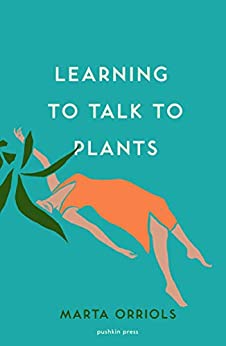
Secondly, Learning to Talk to Plants by Catalan writer Marta Orriols (2018, trans. Mara Faye Lethem 2020). I spend a lot of my working life talking about and dealing with grief, and I thought this was an excellent exploration of one woman’s first year grieving for her partner.

Paula Cid is a neonatologist who loves her job. Her partner Mauro has been killed in road traffic collision.

“I often think and speak of Mauro using the adverbs before and after, to avoid past tense.”

What no-one knows is that Paula and Mauro had been going through a tough time in their relationship, and the day he died he had told her he was leaving her for a younger woman.

“You liked to buy me shoes. I never told you but I wasn’t crazy about the ones you chose for me….They were shoes for a woman who didn’t have my feet, or my style that wasn’t really a style. They were shoes for a woman who wasn’t me.”

Paula was such a well-realised character, I really liked her and I really liked the fact that she didn’t always behave well, even though she was a fundamentally decent person. She throws herself into her work, which is not entirely commendable despite how vital her work is. She is a bit of a pain to her colleagues. She is not always easy with her father and her friends. She resents any suggestion that her grief is similar to anyone else’s:

“My pain is mine and the only possible unit for measuring or calibrating it is the intimacy of everything that compromised the how. How I loved him, how he loved me. How we were, uniquely, no longer us and, therefore, how I could uniquely grieve him.”

Reasonable, I think.

What I also liked is how Learning to Talk to Plants didn’t skirt round the issue of sex. Paula is in early middle-age, she is not ready to renounce her sex life, even though society thinks it an unseemly way for a grieving woman to behave:

“Pleasure that appears just four weeks after losing your partner forever feels too bold”

However, Learning to Talk to Plants is not about Paula’s relationship with men, or even with Mauro. It is about her relationship with herself, about taking the time to nuture herself, and rediscovering hope, however abstract:

“You said talking to plants was a private, transformative act, an act of faith for those who don’t believe in miracles. I get up, take a breath, and add to my list: Learn to talk to plants.”

Learning to Talk to Plants skilfully avoids cliché, mawkishness or sentimentality. I did feel sorry for those plants though…

To end, one of the younger members of my family has been channelling Axl Rose in her attire this week, despite having no idea who he is (probably for the best). Here is the Postmodern Jukebox version of Sweet Child O’Mine:

Novella a Day in May 2019 #10

The Hunting Gun – Yasushi Inoue (1949, trans. Michael Emmerich 2013) Pushkin Press 106 pages

Published by the wonderful Pushkin Press, The Hunting Gun tells of the fallout from an extramarital affair via three letters, from the daughter of the woman involved, the betrayed wife, and finally the woman herself when she knows she is going to soon die.

The letters are sent to a poet who has published the titular poem about a man he once saw.

“He had simply struck me, as he came along the path with his shotgun over his shoulder and a pipe in his mouth, as having a sort of pensiveness about him that one did not ordinarily see in hunters- an atmosphere that seemed, in the crisp early-winter morning air, so extraordinarily clean that after we had passed each other I couldn’t help turning back.”

The man, Misugi Josuke, recognised himself in poem and has sent three letters he received to the poet, in order to explain why he had that atmosphere about him.

The first letter is from Shoko, the daughter of Saiko, with whom Misugi had an affair. Shoko only learns about the affair from reading her mother’s diary.

“And then I heard, very distinctly, the sound of that stack of words I had seen in her diary the night before SIN SIN SIN, piled as high as the Eiffel Tower – crashing down on top of her. The whole weight of the building she had erected from her sins in the course of the past thirteen years, all those floors, was crushing her exhausted body, carrying it off.”

Shoko’s letter is full of anger and betrayal, at both her mother and Misugi, the family friend. In contrast, Misugi’s wife, Midori, is surprisingly measured and even funny. But she acknowledges she has known for many years, and the hurt is not as fresh as that first day.

“I am sure you have had the experience of going for a swim in the ocean in early autumn and discovering that each little movement you make causes you to feel the water’s chillness more intensely, and so you stand there without moving. That was precisely how I felt then: too frightened to move. Only later did I arrive at the happy conclusion that it was only right to deceive you the way you had deceived me.”

Finally we hear from Shaiko, mother to Shoko, best friend to Midori and lover of Misugi, writing a letter to be opened after her death.

“Even after I die, my life will still be waiting here hidden in this letter until it is time for you to read it, and the second you cut the seal and lower your eyes to read its first words, my life will flare up again and burn with all its former vigour, and then for fifteen or twenty minutes, until you read the very last word, my life will flow as it did when I was alive into every limb, every little corner of your body, and fill your heart with various emotions. A posthumous letter is an astonishing thing, don’t you think?”

The Hunting Gun is a short, simply constructed novel that manages to convey emotions and characterisation of real complexity. The affair is shown to involve so many more people than just the immediate couple, and how the fallout and hurt from such a betrayal cannot be anticipated. Inoue shows the capacity human beings have for causing deep, irreparable sadness in one another, but the tone is never judgemental. A beautifully observed novella.

“Why, when we had just formed a united front, so to speak, to battle for our love, why, at a moment that should have been the most fulfilling, did I tumble into that helpless solitude?”

“Isn’t it confoundedly easy to think you’re a great man if you aren’t burdened with the slightest idea that Rembrandt, Beethoven, Dante or Napoleon ever lived?” (Stefan Zweig, Chess Story)

Yet again I’m posting late for a readathon. I hope Caroline at Beauty is a Sleeping Cat and Lizzy at Lizzy’s Literary Life I will allow for my tardiness with this late entry for German Literature Month 2018.  I really need to get a grip on my blogging!

I had a couple of DNFs in my reading for GLM 2018, which really isn’t like me. One novel I suspect will never be for me, the other I think just the timing was wrong. Either way, it was with some relief that I turned to the safest of hands, Stefan Zweig, to finish my GLM reading on a high.

Image from here

In Fantastic Night and Other Stories (1906-1929 trans. Anthea Bell 2004) the wonderful Pushkin Press have collected together five of Zweig’s short stories which are compulsively readable. I don’t want to say too much as Zweig is such a subtle writer that the joy, I think, is going into his writing without an idea of plot or subject, to just see how he unfurls a story of such beauty and psychological insight before you. So I’ll just give a flavour of the first two, the longest in the collection.

In the titular story, a series of events in one evening sees a nihilistic playboy learn the value of living beyond one’s own pleasures:

“Those yearnings that then stirred unconsciously in me at many moments of half-realisation were not really wishes, but only the wish for wishes, a craving for desires that would be stronger, wilder, more ambitious, less easily satisfied, a wish to live more and perhaps suffer more as well.”

Such is the skill of Zweig’s writing that this spoilt and vacuous man undergoes a transformative experience without it seeming rushed or contrived.

“Life is a great and mighty phenomenon and can never be hailed with too much delight. It is something only love grasps, only devotion comprehends.”

Letter From an Unknown Woman I knew from the Max Ophuls 1948 film, starring the luminous Joan Fontaine (some kind soul has uploaded the whole thing to YouTube here); I had no idea it was based on a Zweig short story.

The premise is as simple as the title suggests: a man receives a letter from a woman he has no memory of, proclaiming her enduring love for him. Her young son has died from influenza and she is writing a letter to him to be sent after she has also succumbed to the virus.

Once again, Zweig manages a feat of characterisation. A woman spends her life devoted to a man who does not know of her existence: how is she not a doormat, the tale ridiculous and sentimental? Primarily because the woman is determined and unapologetic. She has a strength that comes through so clearly and is undeniable.

“I know that what I am writing here is a record of grotesque absurdities, of a girl’s extravagant fantasies. I ought to be ashamed of them, but I am not ashamed, for never was my love purer and more passionate than at this time. I could spend hours, days, in telling you how I lived with you though you hardly knew me by sight.”

She never makes excuses, for her life spent in this unrequited state or for her work as a prostitute, which she views as reasonable and profitable for her. She also does not make excuses for the object of her affection, who she sees clear-sightedly:

“You did not recognise me, either then or later. How can I describe my disappointment? This was the first of such disappointments: the first time I had to endure what has always been my fate; that you have never recognised me. I must die, unrecognised […] I understand now, (you have taught me!) that a girl’s or woman’s face must be for man something extraordinarily mutable. It is usually nothing more than the reflection of moods which pass as swiftly as an image vanishes from a mirror.”

She is also never bitter. There is no regret or rancour in her words. She chose her love, and lived it as fulfilled as it could be, given the man it was for:

“You care only for what comes and goes easily, for that which is light of touch, is imponderable. You dread being involved in anyone else’s destiny. You like to give yourself freely to the world – but not to make any sacrifices.”

These words are not angry, but just stating fact. Zweig demonstrates why she loves him, what makes him compelling to her, and why these same traits mean he can never love her back.

Zweig’s short stories are masterful. How he manages to get so much telling detail, such beauty and such insight into such economical writing is truly astonishing.

Secondly, Beware of Pity (1939) which was Zweig’s longest work, telling the story of the soldier Anton Hofmiller, who asks a young girl to dance at a party in the second decade of the twentieth century, unaware that she has a spinal cord injury which means she walks with braces and crutches.

“I had never been deeply moved by anything…Now, all of a sudden, something had happened to change me – nothing outwardly visible, nothing of any apparent importance. But that one angry look, when I had seen hitherto unsuspected depths of human suffering in a lame girl’s eyes, had split something apart in me, and now a sudden warmth was streaming through me, causing mysterious fever that seemed to me inexplicable…All I understood of it at first was that I had broken out of the charmed circle within which I had lived at my ease until now, and I was on new ground which, like everything new, was both exciting and disturbing.”

Out of pity, he repeatedly visits Edith Kekesfalva and is drawn into her life, and that of her father, a rich man driven to distraction over the fate served to his daughter:

“His obstinacy, his egocentric obsession, as if nothing in this world, which is full to the brim of unhappiness anyway, exists but his own and his child’s misfortune”

Hofmiller is callow; he doesn’t know what to do with the situation he finds himself in. The family doctor, Dr Condor, tries to warn him:

“pity is a double-edged weapon. If you don’t know how to handle it you had better not touch it, and above all you must steel your heart against it.”

But Hofmiller blunders onwards into more than one “compassionate lie” which will see all their lives unravel. How he behaves is completely believable, completely understandable, and completely devastating. For the modern reader who may not make such ableist assumptions as Hofmiller, certain situations that he crashes into seem to a certain extent avoidable, but he is naïve and well-meaning and completely oblivious.

Beware of Pity is a devastating read. The title warns of impending tragedy, but Zweig takes it a step further, by framing the story as a man looking back over what happened to a time before World War I, when World War II is just about to start. He shows how such notions of pity, honour and tragedy become swallowed whole under the terror and mass devastation of mechanised warfare. Ultimately though, Zweig suggests the need to keep hold of our humanity in such circumstances, however painful it may be.

“There are two kinds of pity. One, the weak and sentimental kind, which is really no more than the heart’s impatience to be rid as quickly as possible of the painful emotion aroused by the sight of another’s unhappiness, that pity which is not compassion, but only an instinctive desire to fortify one’s own soul against the sufferings of another; and the other, the only one at counts, the unsentimental but creative kind, which knows what it is about and is determined to hold out, in patience and forbearance, to the very limit of its strength and even beyond.” 

To end, an Anglophone artist who was hugely influenced by German culture, singing one of his most famous songs in German:

Novella a Day in May #31

The final post of Novella a Day in May! It’s time for dancing Brad:

No-one is more surprised than me to be here. I never thought I’d manage to post every day for a month. Massive thanks to everyone who has read, liked, commented and shared these posts, you are all fab! I never expected people to read this blog on such a regular basis.

I’ve really enjoyed my month of novellas and I hope I’ve managed to spread some novella love along the way.

I’ve never done a summary post before but then I’ve never posted every day for 31 days before, so here’s an attempt to squeeze all those novellas into a few stats before I go on to my final choice for the month.

The gender split in authors was fairly even: 15 female authors and 16 male. Pointless pie chart time:

The novellas ranged across 3 centuries, from 1860 to 2017.

The shortest novella was Journey into the Past at 84 pages and the longest was After Claude at 206, because I cheated my own criteria by 6 pages. The average number of pages of the novellas was 142. None of them were actually this long, which goes to show there’s no such thing as average 🙂

It was a good opportunity to read some of my favourite publishers: I read 9 by Virago, 5 by Pushkin Press, and 2 by Peirene, as well as novellas published by AndOtherStories, and New York Review of Books.

I visited 13 countries including France 3 times (4 times if I count Jean Rhys) and Denmark twice. Two countries were new stops on my Around the World in 80 Books Reading challenge, hosted by Hard Book Habit: Libya and Kyrgystan. Thirteen novellas were in translation and the rest were by English, Irish and American authors. The southern hemisphere was sadly neglected, but this does give me a reason to justify even more novella reading 😉

And now the bit I found hardest: trying to pick out favourites. I planned to try and pick out a top 5 but it’s proved impossible. However, special mention has to go to William Maxwell, who I wrote about yesterday. I thought They Came Like Swallows was a work of restrained beauty. He had a perfect understanding of the novella and used sparse words to convey a story at its absolute essence. Not a word was wasted and no further words were needed. It’s made me keen to hunt down the rest of his work.

And now, onto my final choice! A novella that the blogosphere told me was great last year and then I forgot about until Susan’s post reminded me of the paperback release, so off to the library I went…

Mirror, Shoulder, Signal by Dorthe Nors (2016, trans. Misha Hoekstra 2017,188 pages)

Sonja is single, in her 40s, a translator of thrillers she finds gruesome and misogynistic. She is trying to build bridges with her distant sister, manage her massage therapist’s more esoteric suggestions, and learn to drive.

Sonja’s driving instructor Jytte screams instructions at her and won’t let her change gear, so she goes to see Folke, the head of the school,

“Sonja’s on the verge of tears. It happens unexpectedly; the sob sits in her throat and wants to come out. Folke’s hands move efficiently from side to side across the desk, and she longs to grasp one of them. Squeeze it, say ‘Thank you,’ from the heart. It doesn’t escape Sonja’s notice that she gets red in the face, because this sort of thing rarely happens. It almost never happens anymore – that someone wishes Sonja the best. She’s used to dealing with everything herself, and she’s reasonably good at it too.”

This captures much about Mirror, Shoulder, Signal: Sonja is muddling through life and doing it more or less competently, but she feels awkward and displaced. She’s from Jutland (Folke observes “All the Jutlander’s I’ve met are a bit quirky” and a Danish friend tells me this is a common stereotype ) but has lived in Copenhagen for years, long enough to not feel at home in either the countryside or the city. She’s doing OK but she could be doing better, struggling with “the things she cannot find the language to say and the people she most wants to say them to.”

Sonja’s a strong character and immensely likeable with all her idiosyncrasies. She goes her own way and always has, but reflects that this may cause more harm than good:

“Mom did me a disservice believing I could just be myself. If I hadn’t been allowed to, then I’d be sitting right now with the whole package, but that train’s left the station. And if anyone does, Mom should know that you have to adapt if you’re going to entangle yourself in an intimate relationship. Kate knows that too. And Dad.”

There’s plenty of humour in Mirror, Shoulder, Signal. Not only at Sonja’s slightly blundering way through life, but also at the madness of Jytte screaming out her driving lessons; the awkwardness between Sonja and Folke; the flaky assertions of Ellen, the masseuse. But it’s not a whimsical novel and much of the humour is pretty sharp:

 “while Sonja does miss her sister, at the same time it ignites in her a yearning for fire”

I really enjoyed the short time I spent with Sonja. Nothing much happens, as in much of life, but there is a believable character arc for Sonja whereby things remain unresolved but improving – a happyish, unsentimental ending which made me smile.

To end, normal service will now be resumed on this blog: intermittent, unnecessarily verbose posts on two books linked by a theme, most likely with a cheesy late 20th century pop song shoehorned in. Here’s one such video to ease us in, chosen in honour of the fact that while Novella a Day in May is now over, I’ve enjoyed it so much I’m wondering if I’ve got it in me to do it again next year… what better way to express this than through song, while dressed in a flared satin and spangles jumpsuit twinset? Take it away, Gloria…