Novella a Day in May #11

Journey into the Past – Stefan Zweig (1976 German publication; trans. Anthea Bell, 2009) 84 pages

Although I’ve since read and blogged about The Post Office Girl, this was the first Stefan Zweig I’d read and at first I wondered why everyone rated him so highly as a writer. Then I realised what he was doing in Journey into the Past was immensely clever.

It tells the story of a love affair between a student, Ludwig, and the wife of his employer, who is not named. The story begins with them on a train in the 1920s, and with Ludwig’s thoughts travelling back into the past to remember how they first met before the First World War separated them.

At first, I thought the description of the affair overblown and naïve.

“From that first meeting he had loved this woman, but passionately as his feeling surged over him, following him even into his dreams, the crucial factor that would shake him to the core was still lacking – his conscious realisation that what, denying his true feelings, he still called admiration, respect and devotion was in fact love  – a burning, unbounded, absolute and passionate love.”

At this point I was thinking Zweig perhaps wasn’t for me 😉

But as the story developed – they admit their love but it remains unconsummated, he goes abroad and then war breaks out, separating them for longer than they ever anticipated – it dawned on me that this style choice was entirely deliberate and conscious.  What Zweig shows us is a world before modern technological warfare, a world that was brutally torn apart. These naïve young lovers are part of a society, a life, that was utterly destroyed.

So although we know they are reunited, it is not with the same youthful self-obsession or indulgent love that they had previously.

“‘Everything is just as it used to be, don’t you think?’ she began, determined to say something innocent and casual, although her voice was husky and shook a little.  However he did not echo her friendly, conversational tone, but gritted his teeth.

‘Oh yes, everything.’ Sudden inner rage forced the words abruptly and bitterly out of his mouth. ‘Everything is as it used to be except for us, except for us!’”

Journey into the Past is not a depressing book despite portraying losses that are glimpsed and barely articulated. It is about the impact of international conflict on the lives of individuals in the smallest, most profound ways. Zweig questions whether those loses can be overcome, and I still don’t know what I think.

I feel foolish for my initial impression of this novella: I hadn’t realised I was in the hands of a master.

Novella a Day in May #8

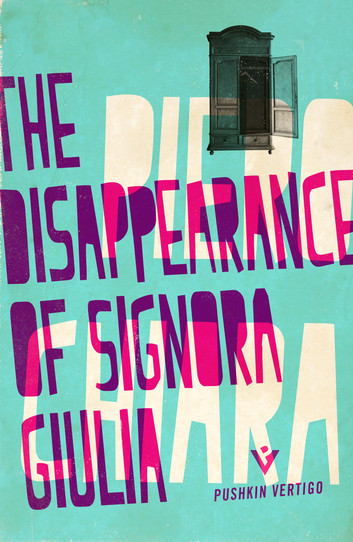
The Disappearance of Signora Giulia – Piero Chiara (1970, trans. Jill Foulston 2015) 122 pages

The Disappearance of Signora Giulia was initially published in an Italian newspaper as a serial and is now available in English translation thanks to Pushkin, as part of their Vertigo imprint. It is a quick, snappy crime thriller that does not aim for trite resolution but rather an exploration beneath the surface of a life to the murky depths.

Corrado Sciancalelpre is “blessed with a special form of intuition, that peculiar mental agility that enables great policemen to delve into the minds of criminals.”

Thankfully, he is also happy married and liked in the town in northern Lombardy where he works – no tortured alcoholic with a secret past here.

A powerful lawyer, Esengrini, asks Sciancalelpre to investigate the titular vanishing of his wife. Every Thursday, Guilia has been going to Milan to visit their daughter at boarding school, but now she has failed to return and two bags of her things are missing too. Sciancalelpre agrees and what follows is essentially a police procedural, but the short length of the story ensures the pacing remains tight.

Sciancalelpre is resolutely unsentimental but not without sympathy. The more he investigates, the more he feels for the missing woman:

“He didn’t say ‘Poor Signora Giulia to Esengrini when he visited him in his office every few days towards evening. With Esengrini, he spoke only of the undeniably disappointing results of a search conducted throughout the whole of Italy with Signora Giulia’s photo.”

It’s impossible to say much more about a crime novella without including spoilers. Suffice to say there are plenty of red herrings, people and relationships who are not what they seem. The Disappearance of Signora Giulia is a diverting read, when you’re in the mood for a crime novel you’ll finish quickly. It is not a simple tale though, and the resolution is a complex one that leaves questions unanswered. This wasn’t a source of frustration but rather felt realistic.

I really enjoyed this, Chiara’s first novel to be translated into English despite his huge popularity in Italy, and I hope there will be many more translations to follow.

Novella a Day in May #5

Cliffs – Olivier Adam (2005, trans. Sue Rose, 2009) 147 pages

Set over the course of a single night, Cliffs shows the enduring damage caused to the child – now a grown man – of a parent who dies by suicide.

The narrator is sitting on a balcony on the Normandy coast in the middle of the night, gazing at the cliffs where his mother died, while his partner and child lie sleeping in the room behind him. As he sits and smokes, he reflects on his life with his abusive father and his traumatised brother:

“We weren’t supposed to breathe move speak feel. We weren’t supposed to need anything, pocket money or comfort or affection or smiles or advice, we weren’t supposed to expect anything except the slaps, smacks or wallops he dealt out”

Later he meets other damaged souls, drawn together by a mutual recognition:

 “We’ve grown up in fear of our fathers, the troubled silence of our mothers, the empty space formed by abstract, imaginary places, without edge or centre.”

Cliffs isn’t a depressing book; it is a story of survival, of endurance even when we are irrevocably damaged by experience.

 “This way of life didn’t cure me of anything, it was merely possible when I couldn’t cope with any other kind of life, particularly the one I’d just left behind. It was a life of silence, space and absence, of maintaining an acute presence within objects, the shifting play of light, the still motion of water, the perfumes, the texture of the air. It was a life in which I finally found a niche, quiet but peaceful, a body filled with air and fog, a mind completely given over to the noise of the sea and the wind, the company of birds.”

Cliffs is beautifully written, but the beauty in no way detracts from the raw hurt experienced by narrator. It is an intense read, haunting and memorable.

Novella a Day in May #1

For a while now I’ve been enamoured of the novella. I enjoy sparse writing styles (not so good at this myself 😉) and at its best a novella gives us a narrative distilled to its essence for maximum impact. To spread novella love I’ve decided to post about a novella each day for the whole month. There’s no fixed definition of a novella so for my purposes I’ve decided its longer than 70 pages and shorter than 200. This will definitely work! It won’t peter out and die in a heap by 5 May at all! Onwards…

The Game of Cards – Adolf Schroder (trans. Andrew Brown, 2008) 143 pages

The Game of Cards  is not ostensibly gothic or a thriller, and yet it is both these things. The story of how student Markus Hauser is employed by Selma Bruhns for a week to put several trunks worth of letters into chronological order is truly creepy and suspense-filled.

Selma is a terse, uncommunicative employer, who lives in an old house with a vast number of cats at varying stages of disease. Markus is constantly at the point of leaving, unable to stomach the “stench” of the house, the feral occupants, his awkward employer and the seemingly pointless nature of his repetitive task:

“He squatted down between the piles of letters lying on the floor, but when her resumed his work…looking for the pile in which he was putting the letters from 1943, laying the pages of the letter on it and reaching out for the next one, he paused, as if he’d only just realised that he had absolutely no idea what he was doing”

Gradually however, Markus is drawn into the letters, all written to a woman named Almut.  Very little is given away, but Markus finds himself compelled to continue, without really understanding why.

 “Words from the letters that he had read came alive. He found himself in streets where he had never been, heard the shrieking and whistling of creatures that he could not see but whose presence he surmised, felt on his skin the burning sun whose strength he had never yet felt, saw a woman coming up to him who spoke in a language that he did not understand.”

This chronology is interspersed with the investigation being conducted by Superintendent Berger, who suspects Markus of having strangled Selma with her own scarf on his last day of work. Thus we are drawn into not only the mystery of who Almut is and why Selma is obsessively writing to her, but also who killed Selma and why. Schroder jumps between the two timelines without preamble and so the reader is drawn into the disorienting, imperfectly understood situation of the all the characters.

 “With a sudden move that took Markus by surprise, she threw the animal towards him, it crashed into his chest, and only because Markus reacted quickly and caught the animal could he prevent I from falling onto the ground.

‘You are working slowly and without much concentration,’ said Selma Bruhns, turning round and stepping into the house.”

There is also the question of what happened – and what the stake was – in the titular match between Markus and Selma…

The Game of Cards is a deeply disturbing read, and a powerful portrait of enduring psychological trauma. It will stay with me for a long time.

“I go six of one and half a dozen of the other, but no-one remembers me saying that when I did, back in 2003.” (Richard Ayoade)

August is Women in Translation month, hosted by Meytal at Biblibio. I’ve been faithfully reading translated fiction throughout the month but I have failed miserably at blogging about any of it. Usually when bloggers disappear for a bit they’ve gone on holiday/fallen in love/started a new job. I have no such exciting excuses – I’m at the same job, feeling bitter about a lack of holiday & the nearest I’ve got to romance is shamelessly objectifying Tom Burke in the new Cormoran Strike adaptations on the BBC:

In a bid to catch up, here is a quick summary of the 6 novels I’ve read in translation, all quite short but all punching well above their weight in terms of powerful, affecting stories. They also include 2 more stops (France & Greece) on my much neglected Around the World in 80 Books Reading Challenge hosted by Hard Book Habit.

Colette – The Other One (1929, trans. from French by Elizabeth Tait & Roger Senhouse 1960)

Given I’m such a Francophile, it came as a great surprise to me that I hadn’t yet visited France as part of #AW80Books so I’ve rectified the situation with Colette’s tale of infidelity and complex family dynamics over the course of a summer in a villa in France.

Fanny is married to Farou, and awaits his return in a villa where she lives with her stepson Jean and companion Jane, with whom Jean is in love. Fanny subsequently comes to realise that Jane is one of Farou’s many extra-marital dalliances.

It’s a slim novel (157 pages in my edition) and in a sense very little happens. What The Other One offers is a beautifully written, subtle exploration of the psychological complexities that exist between people who are inextricably bound up in one another’s lives, with all the love and pain that can entail.

“Fanny turned on Jane her Paris smile, well made-up and full-lipped, and Jane, whose fair hair lit up a corner of the room, was instantly extinguished.”

Marguerite Duras – La Douleur (1985, trans. from French by Barbara Bray 1986)

I’m overcompensating now by staying France, with Duras’ typical mix of autobiography and fiction, regarding her war experiences. At the start of La Douleur she writes that the work is based on diaries she discovered which she doesn’t remember writing. The six stories/diaries move back and forth across the period of the war and create the sense of a fragmented narrative which explores the desolation and destruction of war and the impossibility of telling a tale of such insurmountable human loss in only one way. I found it incredibly powerful.

“Suddenly freedom is bitter. I’ve just come to know the total loss of hope and the emptiness that follows; you don’t remember, it creates no memory. I think I feel a slight regret at having failed to die while still living. But go on walking, I move from the street to the sidewalk, then back into the street. I walk, my feet walk.”

Sun-Mi Hwang – The Hen Who Dreamed She Could Fly (2000, trans. from Korean Chi-Young Kim 2013)

This is the story of a hen named Sprout. She decides she wants more from life than laying eggs to be taken away: she wants to live in the wild and raise a chick.

This fable is incredibly clever, in that you can read it to a child but there is plenty for adults here too. It’s a story written with great lightness of touch, and as such the lessons it teaches are various, depending on what you find in it. It could be about (for starters): going your own way in life, questioning authority, facing fears, attitudes to immigrants, the value of empathy, adoptive families, familial love, finding freedom…

“Sprout was the best name in the world. A sprout grew into a leaf and embraced the wind and the sun before falling and rotting and turning into mulch for bringing fragrant flowers into bloom. Sprout wanted to do something with her life, just like the sprouts on the acacia tree. That was why she’d named herself after them. Nobody called her Sprout, and she knew her life wasn’t like a sprout’s, but still the name made her feel good. It was her secret.”

The edition by Oneworld books also features lovely illustrations by Nomoco, worth seeking out.

Penelope S Delta – A Tale Without a Name (1911, trans. from Greek by Mika Provata-Carlone 2013)

Another fable, and another lovely edition from Pushkin Press whose description explains that this is ‘one of Greece’s best loved stories.’ It tells of an indulgent arrogant king who takes his nation into ruin and the son and daughter who bring it back to prosperity under a policy of meaningful employment for the greater good.

“Time always passes. But if you consume yourself in idle things you waste it; whereas if you do work that has a purpose, you make good use of time.”

It’s also a militaristic tale – much emphasis on vanquishing enemies and building armies – but ultimately it is about social responsibility. I don’t think it’s a stretch to see it as deeply political: Delta’s father was a mayor who narrowly avoided execution, her diplomat lover was assassinated and she killed herself the day the Nazis reached Athens. A Tale Without a Name presents complex political ideas in a deceptively simple style.

Han Kang – Human Acts (2014, trans. Deborah Smith 2016)

This novel caused me to deviate from a wholly WITMonth August, as I was so upset by it that I had to read a British Library Crime Classic to recover. I approached it wholly ignorant of the political turmoil that South Korea had experienced in the 1980s. Kang pitches us into the student uprising in Gwangju in 1980. It begins with a boy searching for the body of his friend amongst the piles of corpses that a brutal regime creates.

“Why would you sing the national anthem for people who’d been killed by soldiers? Why cover the coffin in the Taegukgi? As though it wasn’t the nation itself that murdered them.”

Human Acts follows various people all connected to the uprising, and Kang absolutely does not pull her punches. What the piles of bodies mean in human terms is explored fully both in terms of the emotional ramifications and the hard reality of how to deal with so many bodies. It’s a novel that deals with extreme brutality in sensitive, subtle prose.

“Their faces had been covered in white paint, erased. I swiftly shrank back. Necks tipped back, those dazzling white faces were angled towards the thicket. Staring out into the empty air, their features a perfect blank.”

The novel contains scenes of torture that are hard to bear, but never gratuitous. In the final part of the novel, Kang explains her own links to the story, and how this is not quite fiction. It’s astonishing that someone personally affected by the tragedy can write something so carefully constructed, but this is what she has achieved. The story is crafted but absolutely unflinching in looking at atrocities inflicted by governments and their devastating fallout.

“She had no faith in humanity. The look in someone’s eyes, the beliefs they espoused, the eloquence with which they did so, were, she knew, no guarantee of anything. She knew the only life left to her was one hemmed in by niggling doubts and cold questions.”

Elena Ferrante – The Lost Daughter (2006, trans. from Italian Ann Goldstein 2007)

Finally, I’m a bit undecided about the Neapolitan quartet and feel slightly baffled as to why its garnered quite so much praise, but I did enjoy this novella from Ferrante and those who love the quartet will find much that is familiar here: a flawed female narrator, conflicts with loved ones, a sense of violence close to the surface.

Leda takes a holiday alone in southern Italy. She is disturbed by a loud extended Neapolitan family and a certain event draws her into their sphere. During the course of the holiday she reflects on her life and the repercussions of the choices she has taken, on herself, her marriage and her daughters.

“My daughters make a constant effort to be the reverse of me. They are clever, they are competent, their father is starting them out on his path. Determined and terrified, they advance like whirlwinds through the world, they will manage better than us, their parents.”

Leda isn’t likeable but the narrative is compelling and pulls you along to deliver a short sharp shock.

As regular readers will know, I need no encouragement to indulge in an 80s pop video. Here’s one that was a massive hit in the original German and in English translation. It’s about nuclear war; of course we have no worries about such an event now…

https://www.youtube.com/watch?v=Lur-SGl3uw8