“The simpler the words, the more significant their meaning.” (Narine Abgaryan, Three Apples Fell From the Sky)

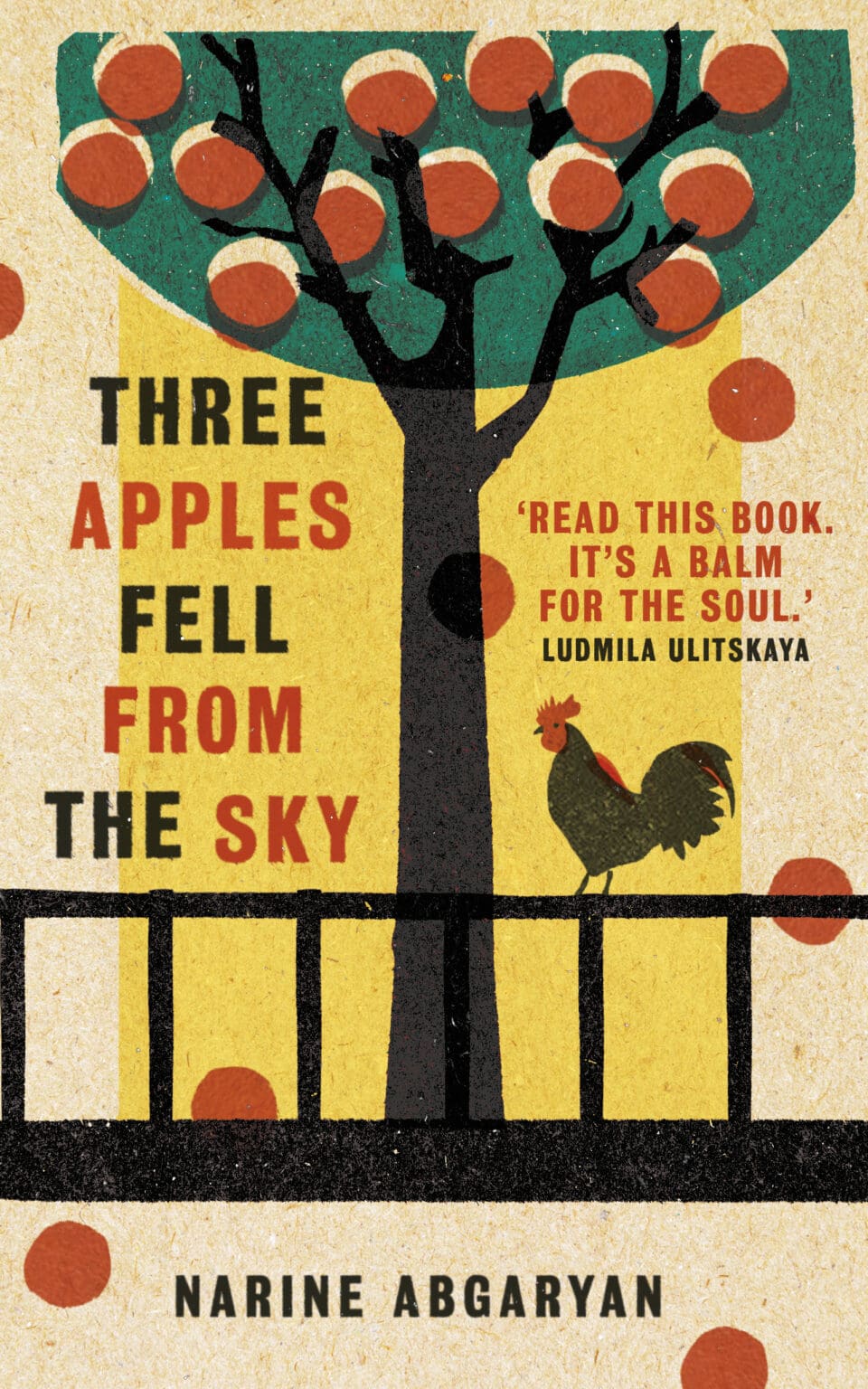
After The Glass Pearls I needed a comfort read, and so I turned to Three Apples Fell From the Sky by Narine Abgaryan (2014, transl. Lisa C Hayden 2020). I had originally picked it up for my Around the World in 80 Books reading challenge as it is by an Armenian author and set in a small village in that country, but happily it also works for #ReadIndies hosted by Kaggsy all this month, as it is published by Oneworld.

The story opens with Anatolia Sevoyants, a lifelong resident of the remote clifftop village of Maran, experiencing significant post-menopausal bleeding and deciding her time is up.

“She had decided to die with her dignity and tranquillity intact, in peace and quiet, within the walls of the home where she’d lived her difficult, futile life.”

So rather than see her neighbour and friend Yasaman who is something of a naturopath and healer, Anatolia takes to her bed.

We are alongside as she lays reminiscing about her life. My favourite of these (unsurprisingly) is how Anatolia beautified the library, caring for books, plants, birds and the building in her own unique way:

“After assessing the intolerable heartlessness and arrogance in his treatment of his heroines, she classified Count Tolstoy with other petty tyrants and despots, and stored his fat tomes out of sight to make herself feel better.”

Although Three Apples… is a gentle tale, it is not without violence. Anatolia had an extremely violent and abusive husband, and some animals are treated badly at times, which I skipped.

But this all occurs towards the first third of the book, and soon it settles into its tale of Anatolia’s unexpected recovery and even more unexpected life events, amongst the fellow older inhabitants of the  village and the drama and domesticity of their lives.

“The village was meekly living out its last years as if condemned, Anatolia along with it.”

There is a fairytale quality to the story as the village is entirely cutoff, the residents grow older with no new generation, white peacocks make an appearance, and this pastoral world is touched at moments by magical realism.

But any magical occurrences or whimsy is tempered by what the villagers have to face; mudslides, war and famine. These are evocatively described and devastating. The stoicism of the villagers is never undermined by a sense that these events are not very real in their destruction.

“And that was how she aged, slowly and steadily, alone but contented, surrounded by ghosts dear to her heart.”

Three Apples… expertly balances fabulism with a grounded reality. Lives are tough, but also filled with love and friendship. Among despair is the surprise of new hope.

It’s also worth mentioning that part of the resilience is food, prepared with love for friends, family and neighbours. There were so many delicious dishes described in this novel! It’s definitely not one to read when you’re hungry – it had me googling ‘local Armenian restaurants’ 😀

“That’s probably how things are supposed to be because that’s just the way it is.”

“Every night he tried himself and every night he acquitted himself.” (Emeric Pressburger, The Glass Pearls)

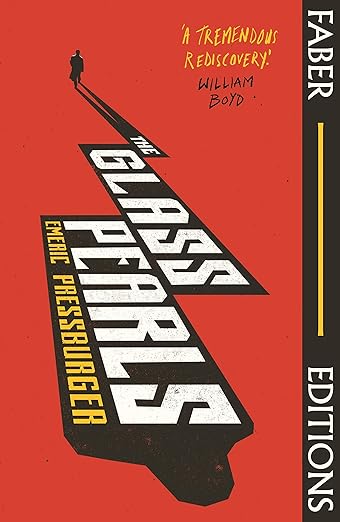
Well, it’s only February but I already think that I’ve read one of the most extraordinary books of my year: The Glass Pearls by Emeric Pressburger (1966).  Most pleasingly, it was a twofer for reading events this month, #ReadIndies hosted by Kaggsy as it is published by Faber as one of their Faber Editions series; and Hungarian Literature Month hosted by Winston’s Dad as Emeric Pressburger was born in Miskolc, Hungary.

Pressburger studied in Prague, moving to Weimar-era Berlin and then escaping the Nazis by moving first to Paris then London. It was there he met Michael Powell, and the powerhouse filmmaking duo was formed. I’m a big fan of Powell and Pressburger films, and it was this that led me to read The Glass Pearls (and a nice chat with the bookseller who is also a P&P fan.) But it absolutely stands on its own terms, not simply as curio for cinephiles.

At the start of the novel, Karl Braun is moving into a lodging house in Pimlico, unloading a few items from a piano tuner’s van. His neighbours are curious, but mild-mannered Karl soon fits in. His fellow lodgers, Strohmayer who always has a deal on the go, and Kolm, a concert-loving chemist, are also European émigrés who escaped Hitler’s regime and assume Braun is the same. But the reader soon knows something the characters don’t: Braun is a Nazi escaping justice from the trials.

“I have lived for twenty years according to self-imposed rules; it wasn’t easy and I’m not going to change my ways now. I denied myself everything I used to enjoy most.”

Pressburger’s mother died at Auschwitz, as did many members of his extended family. In this astonishing novel he writes from the point of view of a Nazi doctor who carried out atrocities at Wittau concentration camp.  It is so brilliantly done. The third-person narrative means it is presented as this is the man, this is what he did and how he now lives, which means as a reader you can stick with it where a first-person narrative would be too much to ask. But in writing from Braun’s point of view, it is also made personal, and you are asked to spend time alongside someone who has repeatedly taken unforgivable actions, for which he feels no remorse.

Braun frequently has nightmares about pursuit and capture, and justifies himself at imagined trials thusly:

“He would never do anything to serve only his own purpose unless it served the common purpose as well. He would go to any length to help others, disregarding his own interest. He loved his work; he was a good family man; adored his wife and child; he was religious, prayed to God and respected his laws. He was a romantic and romantics were the salt of this earth.”

And in this way Pressburger consistently shows us the man, his complete and utter delusion, his cruelty and vanity, and also makes him recognisable.

Braun leads an ordinary life in post-war London. He has a love interest who he takes to concerts in a sedate courtship; he has to navigate his workplace politics; he chats to his fellow lodgers. No-one knows he is Dr Otto Reitmüller.

“He made enough money for his needs, he even had a little in the bank. He enjoyed a good book, a good play, a good concert, a good talk. What else does a man want from life?”

We know one thing he wants: his wife and child back, killed in Hamburg bombings. Braun wasn’t with them, called back to camp to continue his horrors, which are portrayed clearly, sickeningly, but not sensationally.

Braun isn’t pretending to be cultured, or bereaved. He is both those things and an unrepentant torturer. It is powerful portrait that demands responsibility from those who enact war crimes, but also from those who witness, to acknowledge how it could happen again when the people who did it were ordinary – friends and neighbours.

His paranoia steadily grows as the newspapers report on the trials, the deadlines are extended, and a fellow fugitive urges him to get the money they stashed in Swiss bank account and join ‘the Brotherhood’ to live out their days in Argentina.

“He knew he could never have stuck it out in prison. His strong sense of justice would have reared up against petty persecutions by his warders.”

Braun becomes more fearful and restless. Two men seem to be watching him, the tension mounts, and while I didn’t want him to escape, The Glass Pearls absolutely worked on the level of a thriller where you are speeding through it to know the outcome.

“One had to be careful about the deductive powers of a fertile brain. Once trained for critical examination and to present the fullest picture of possible dangers to its master, the brain tended to overdo things were not watched too closely.”

It felt Hitchcockian in many ways, but a reversal of the innocent man pursued by shady forces.

“Suddenly he knew that all he was yearning for was peace.”

There’s a very interesting Afterword in this edition from filmmaker Kevin Macdonald, who is also Pressburger’s grandson. He movingly describes Pressburger’s survivors guilt and how when he developed dementia, he had delusions of being chased by Nazis. Astonishingly, he also says:

“Emeric went so far as to imbue the Braun character with certain traits of his own; such that, to some degree, Braun is a self-portrait.”

To end, a trailer for a delightful Powell and Pressburger film that is slightly less well-known than some of their big hitters. I’m not the biggest fan of romance but it would take a heart of stone to resist the charm of I Know Where I’m Going!

“It’s not a brandy sour if it doesn’t make you bitter.” (Constantia Soteriou, Brandy Sour)

I first heard about Brandy Sour by Constantia Soteriou (2022, transl. Lina Protopara 2024) on Winston’s Dad’s blog – I thought quite recently but I can see it was August 2024! I get there eventually…

This is a contribution to the marvellous #ReadIndies event hosted by Kaggsy, and it also means Cyprus is the next stop on my Around the World in 80 Books reading challenge (3 stops to go!)

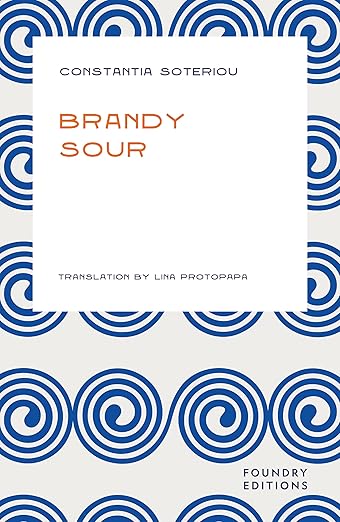
Brandy Sour published by Foundry Editions, an independent publisher focussed on Mediterranean authors who are new to Anglophone readers.  I love their styling, where their (French flap!) covers are “designed to capture the visual heritage of the Mediterranean”. This one is based on a third century BCE Hellenic vessel.

This short novella builds the stories of a cast of characters around two central constructs: their relationship to the Ledra Palace Hotel, and the drinks they have (with one colourful exception – I was relieved the chapter’s titular fluid was not imbibed!) The 22 vignettes work brilliantly, as Soteriou charts the history of Cyprus in the latter part of the twentieth century with the lightest of touches.

It begins with the bartender who takes the recipe for the titular drink to the new hotel, having first made it for King Farouk of Egypt:

“It’s a Cypriot drink, with ingredients from our island, that you serve in a tall glass after you sugar its rim, a drink full of cognac and lemonade that seems and tastes innocent but is not. It’s a drink worthy of kings who want to deceive people, a drink that isn’t what it seems to be, that looks like iced tea and that you can drink publicly without anyone knowing what it contains. It’s a drink full of secrets — that’s why it was made here.”

We meet the staff of the hotel and the guests, as it offers luxury and glamour through the 1950s and 1960s, from colonialism to independence. But as we know from ‘The Guerilla Fighter’ and his VSOP brandy straight from the bottle, discontent is brewing.

When the coup occurs ‘The Turk’ can no longer move freely past the hotel and the street vendor for his salted yogurt drink:

“The last time he attempts to walk past the big hotel, they stop him and tell him he needs to go back. He needs to find another way to work, another way to get his ayran; or maybe he needs to stop drinking it altogether—or find another place to buy it from. In a matter of days, everything will change.”

The upheaval of the war is evoked dramatically but not sensationally, through the individuals. The hotel is the site of a terrible battle, and the chapter ‘Water: The Mother’ demonstrates this with direct, effective simplicity.

The hotel ends up in the UN buffer zone, housing officials and falling to ruin.

But Soteriou also weaves in the flora of Cyprus, showing the natural beauty of the island. There is the lavender tea beloved of the architect of the hotel; jasmine tea drunk by ‘The Poet’ guest; elderflower used by ‘The Fiancee’ who bathes her eyes after her betrothed – and dreams of a wedding in the hotel – are snatched during the coup. The two mayors of the split city of Nicosia try and find common ground over spearmint tea, an old lady reminisces about Seville orange liqueur which she made and sold as a young woman.

My favourite of these was the melancholy ‘Doorman’ and his rosebud tea.

“You can have your rose tea hot or iced, you can have it in the winter and in the summer too, and it’s also good for your stomach, it helps digest the indigestible. It’s a little sweet and a little spicy – it reminds you of the village and of your mother.”

He sneaks the hundred petal Cypriot damask rose into the English rose garden in the grounds and plants it there. Later the garden is razed to build a pool, bar and tennis courts. He manages to save a few roses, but the infusion is bitter.

In just 104 pages I thought Brandy Sour was a brilliant achievement. Ambitious but never weighed down by its ambition; exploring seismic events without losing sight of the human cost; both sad and funny and always intensely readable. It consistently demonstrates the importance of small rituals shared by ordinary people as moments of resistance and resilience.  

And now my TBR will spiral as I explore Foundry Editions further… 😀