“The cat is, above all things, a dramatist.” (Margaret Benson)

This is my contribution to Reading the Meow hosted by Mallika at Literary Potpourri, a fantastic week-long celebration of literature inspired by our feline friends!

A Cat, A Man and Two Women by Junichiro Tanizaki (1936, transl. Paul McCarthy 2015) is published by the ever-wonderful Daunt Books and I really liked the simple cover:

There seems to have been a flurry in recent years of slightly whimsical stories about cats and I thought ACAMATW would be one of these, I’m not sure why. The prospect was fine with me, I don’t mind whimsy if I’m in the right mood and I adore cats. But in fact this wasn’t whimsical at all. It was a psychological study – albeit a gentle one – of three people and the catalyst (no pun intended but I’m happy its there 😀 ) of their shared pet.

I would just like to pause (paws?) here to let you know that my typing is being severely hampered by my calico cat sitting on my lap, demanding attention – and my tuxedo cat (her brother) has just arrived and there’s a bit of a turf war ensuing…

The titular cat of this novella is Lily, adored companion of Shozo. The story opens with his ex-wife Shinako appealing to his new wife Fukuko to let her have Lily. Her letter emphasises Shozo’s adoration of Lily and Shinako deliberately sets a cat among the pigeons (ha! I’m only a little bit sorry for this 😀 ) of the new marriage,

Even Shozo, feckless in the extreme, notices the change.  

“Could Fukuko be jealous of Lily? He considered this possibility for a moment but then dismissed it as making no sense. After all, Fukuko herself was basically fond of cats. When Shozo was living with his former wife, Shinako, he had sometimes mentioned her occasional jealousy of the cat to Fukuko who had always made rather scornful fun of this silliness.”

Shozo requests his wife cook meals she doesn’t enjoy, so he can share them with Lily. I’m not surprised Fukuko is annoyed:

“Fukuko had been prepared to sacrifice her own taste for her husband’s sake, while in fact it was for the cat that she cooked; she had become a companion to the cat.”

(Update: turf war won by the tuxedo. Calico has stalked off in disgust. Tuxedo determined to rest on my dominant hand and impede my typing.)

The tensions in the marriage centre around Lily, but really have nothing to do with her. She merely highlights Shozo’s lack of drive and inability to engage fully in relationships, except with his cat.

“When he heard people with no knowledge of a cat’s character saying that cats were not as loving as dogs, that they were cold and selfish, he always thought to himself how impossible it was to understand the charm and lovableness of a cat if one had not, like him spent many years living alone with one.”

Shozo isn’t unsympathetic. His mother is manipulative and choosing Lily seems to be one of the rare independent choices Shozo has made. He has had a longer relationship with Lily than either of his wives and his bond with the cat is meaningful to him.

“It was Lily, with whom he’d lived so long, who was more intimately bound up with many memories of his; who formed, in fact, an important part of Shozo’s past.”

Tanizaki does a great job of portraying Lily as a very believable feline, without attributing human motivations or emotions to her. He leaves this to his three human protagonists, who fail to see she is not a strategist in these adult negotiations.

Shinako gets her wish, and the cat she was indifferent to arrives at her sister’s home, where Shinako now has a room. Gradually, she finds herself discovering new emotional territory, thanks to Lily:

“When she thought of the link that bound them together, her anger faded; and she felt, rather, that both of them were to be pitied.”

“Other people had told her so often that she was hard hearted, she had come to believe it herself. But when she considered how much trouble she had put herself to recently for Lily’s sake, she was surprised, wondering where these warm and gentle feelings had been hiding all this time.”

But will Shozo want his cat back? Will Shozo and Fukuko’s marriage survive without Lily to blame for the irritations and lack of understanding?

Tanizaki has a great understanding of cats and of people which makes this novella really shine. The humour is gentle and the psychological observations astute. The ending is left very open which didn’t wholly work for me but this is a minor quibble in regard to this engaging and insightful novella.

ACAMATW was adapted into the film A Cat, Shozo and Two Women in 1956. The summary on Wikipedia makes me think the filmmakers opted for a less open-ended conclusion to the story. From this clip the cat actor looks a lot more tolerant than my two would be 😀
“There are no ordinary cats.” (Colette)

Mallika at Literary Potpourri’s wonderful event  Reading the Meow has been running all week, do check out all the great posts prompted by our feline friends! Here is my post just in time…

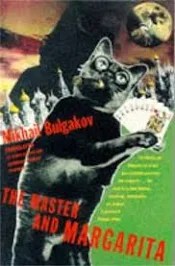
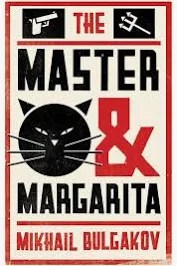
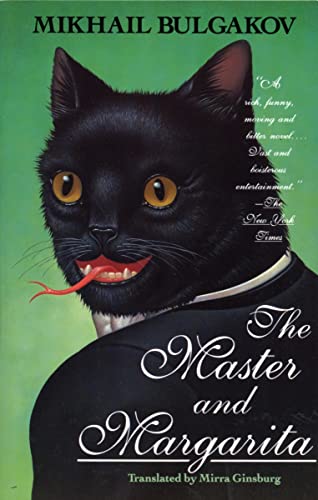
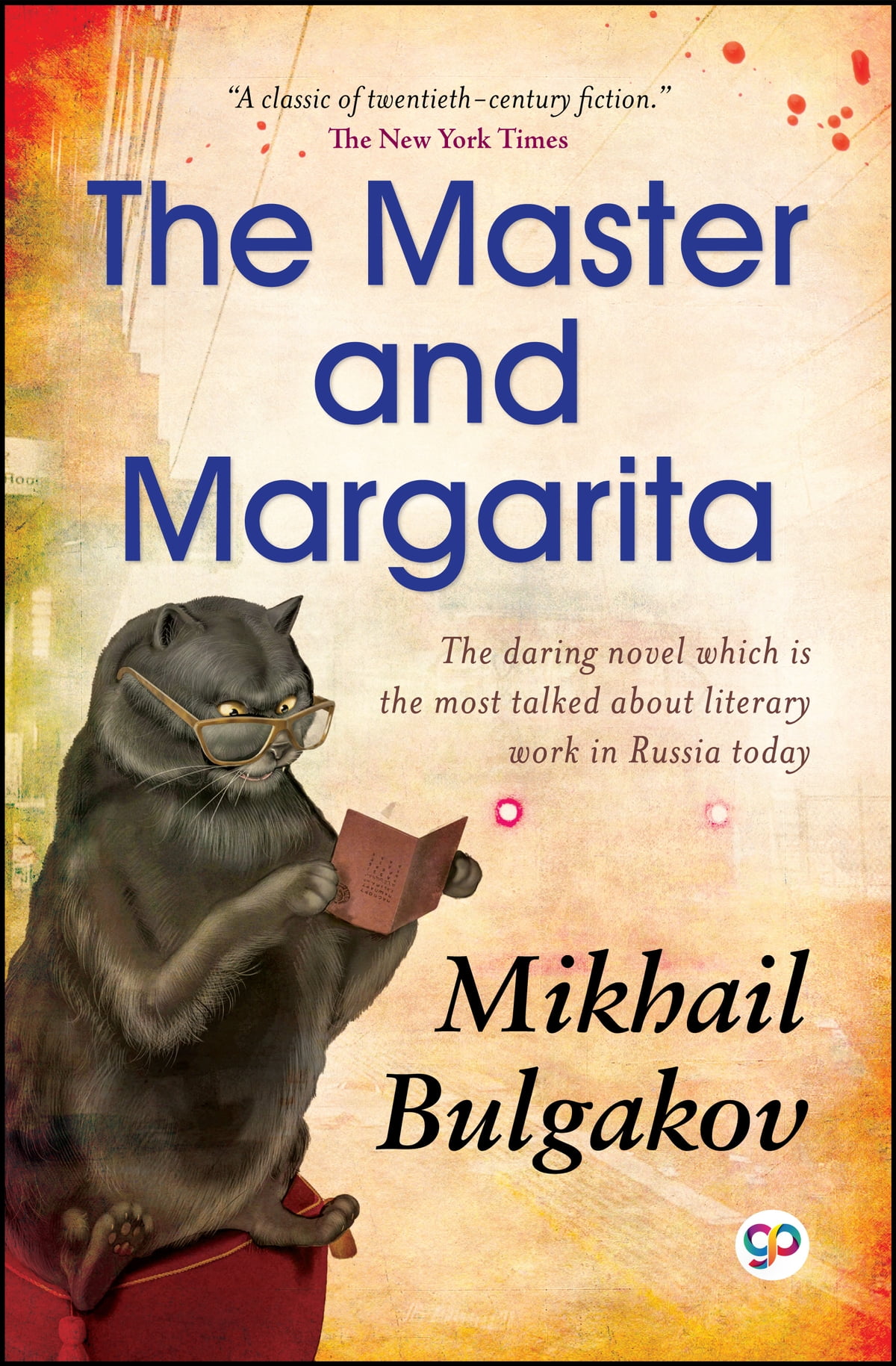
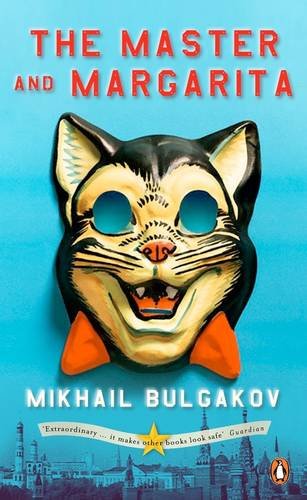
I’m grateful to Reading the Meow for finally getting me to pick up The Master and Margarita by Mikhail Bulgakov (finished in 1940, published in 1966) which is part of my Le Monde’s 100 Books of the Century Reading Challenge and has been languishing in my TBR for years. Although not ostensibly a book about cats, one does feature prominently as these various edition covers will attest:

The reason it had lain unread for so long was because I’m (aptly) a big scaredy-cat. I was really intimidated by this classic of twentieth-century fiction and I thought it would be far too complex and clever for me to understand. Which as it turned out, was broadly correct. I’m sure I didn’t pick up all the allusions and references, even with the notes in the back of my edition to help me (Alma Classics, trans. Hugh Aplin 2020 – I definitely recommend this edition and translation).  However, I still found it very readable and a lot to enjoy, especially regarding Behemoth, the character that meant I was reading it this week particularly.

The Devil arrives in 1930s Moscow as a Professor Woland, along with his entourage: red headed, bizarrely dressed Korovyev; sinister vampiric Azazello; beautiful Hella; and Behemoth, an enormous cat that walks on his hindlegs, talks, drinks vodka and plays chess.

The proceed to wreak havoc for three days in a series of carnivalesque scenes, using the greed and corruption of people against them.  It’s absolute chaos and carnage, but brilliantly Bulgakov shows that the devil doesn’t have to push very hard for all this to occur.

At the start of the novel, Woland predicts the shocking and absurd death of Berlioz, head of Massolit, a literary organisation. Once people hear of his death, this description of a barrage of statements in order to get Berlioz’s apartment is a good example of how Bulgakov balances social realism, satire, the comic and the desperate throughout:

“In them were included entreaties, threats, slanders, denunciations, promises to carry out refurbishment at people’s own expense, references to unbearably crowded conditions and the impossibility of living in the same apartment as villains. Among other things, there was a description, stunning in its artistic power, of the theft of some ravioli, which had been stuffed directly into a jacket pocket, in apartment No.31, two vows to commit suicide and one confession to a secret pregnancy.”

Meanwhile, Margarita, beautiful and unhappily married, is distressed because her lover, The Master, has committed himself to an institution and renounced his writing.

This is interspersed with the story of Pontius Pilate and Yeshua (Jesus), with the two stories echoing one another, and it emerges that this was the novel The Master was writing.

It is through the titular characters that Bulgakov prevents his satire becoming too bitter and alienating. Their devotion to each other and Margarita’s belief in The Master’s work is truly touching.

I don’t really want to say too much more as The Master and Margarita is such a complex, riotous piece of work that I think the more I try and pin it down the more I’ll tie myself in knots! It tackles the biggest of big themes; religion, state oppression, the role of art, love, faith, good and evil, how to live… It is a deeply serious work that isn’t afraid to be comical too.

But as this post is prompted by Behemoth, here is my favourite scene with him, getting ready for Satan’s Grand Ball on Good Friday and trying to distract from the fact that he is losing at chess:

“Standing on his hind legs and covered in dust, the cat was meanwhile bowing in greeting before Margarita. Around the cat’s neck there was now a white dress tie, done up in a bow, and on his chest a ladies mother-of-pearl opera glass on a strap. In addition, the cat’s whiskers were gilt.

‘Now what’s all this?’ exclaimed Woland. ‘Why have you gilded your whiskers? And why the devil do you need a tie if you’ve got no trousers on?’

‘A cat isn’t meant to wear trousers, Messire,’ replied the cat with great dignity. ‘Perhaps you’ll require me to don boots as well? Only in fairy tales is there a puss in boots, Messire. But have you ever seen anyone at a ball without a tie? I don’t intend to find myself in a comical situation and risk being thrown out on my ear! Everyone adorns himself in whatever way he can. Consider what has been said to apply to the opera glasses too, Messire!’

‘But the whiskers?’

‘I don’t understand why,’ retorted the cat drily, ‘When shaving today Azazello and Korovyev could sprinkle themselves with white powder – and in what way it’s better than the gold? I’ve powdered my whiskers, that’s all!’

[…]

‘Oh, the rogue, the rogue,’ said Woland shaking his head, ‘every time he’s in a hopeless position in the game he starts talking to distract you, like the very worst charlatan on the bridge. Sit down immediately and stop this verbal diarrhoea.’

‘I will sit down,’ replied the cat sitting down, ‘but I must object with regards your final point. My speeches are by no means diarrhoea, and you’re so good as to express yourself in the presence of a lady, but a series of soundly packaged syllogisms which would be appreciated on their merits by such connoisseurs as Sextus Empiricus, Martianus Capella even, who knows, Aristotle himself.’

‘The kings in check,’ said Woland.

‘As you will, as you will,’ responded the cat, and began looking at the board through the opera glass.”

I think overall I probably admire The Master and Margarita more than love it, and I enjoyed Bulgakov’s A Country Doctor’s Notebook more. But there is so much in this extraordinary, unique novel that will stay with me, and I’m sure it will reward repeat readings too.

To end, I tried to get my two moggies to pose with the book. With typical cattitude, they flatly refused 😀  So it’s back to 80s pop videos: