A Room of One’s Own – Virginia Woolf (Le Monde’s 100 Books of the Century #69)

Today’s post is  the latest in a series of occasional posts where I look at works from Le Monde’s 100 Books of the Century.  Please see the separate page (link at the top) for the full list of books and an explanation of why I would do such a thing.

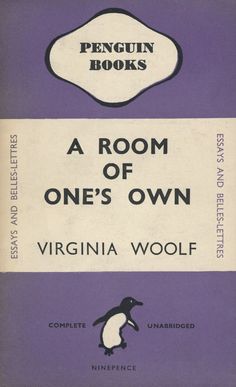
A Room of One’s Own grew out of lectures Virginia Woolf was asked to give at Newnham and Girton Colleges, Cambridge, in 1928. You can read the full essay in various places online. Women were only officially admitted to the university in 1948, and the fact that these talks were given 20 years previously shows just how ground-breaking Woolf was.  A Room of One’s Own is a vital proto-feminist text that remains relevant today.  The fact that you can buy bags, pillows, tea towels, deckchairs, mugs, notebooks ad infinitum with the book cover on is an indicator of how much the central image continues to speak to people, as well as the arguments themselves.
Image

(Image from: https://www.pinterest.com/particularbooks/postcards-from/)

The central image is: “a woman must have money and a room of her own if she is to write fiction.”  In other words, she needs a means to support herself, and space to reflect and think; she needs liberty, and these things have been traditionally denied to women.  They have been dependent on the men in their family for financial support, and not supposed to concern their pretty little heads with intellectual endeavour.  Woolf argues her points forcefully but wittily, you never feel you are being bludgeoned by polemic.  Take for example the opening paragraph:

“But, you may say, we asked you to speak about women and fiction – what, has that got to do with a room of one’s own? I will try to explain. When you asked me to speak about women and fiction I sat down on the banks of a river and began to wonder what the words meant. They might mean simply a few remarks about Fanny Burney; a few more about Jane Austen; a tribute to the Brontës and a sketch of Haworth Parsonage under snow; some witticisms if possible about Miss Mitford; a respectful allusion to George Eliot; a reference to Mrs Gaskell and one would have done.”

The paucity of women writers Woolf has at her disposal to refer to speaks volumes about the male dominance of writing up to this point, and the reliance on male point of view for literary portrayals of women:

“women have burnt like beacons in all the works of all the poets from the beginning of time — Clytemnestra, Antigone, Cleopatra, Lady Macbeth, Phedre, Cressida, Rosalind, Desdemona, the Duchess of Malfi, among the dramatists; then among the prose writers: Millamant, Clarissa, Becky Sharp, Anna Karenina, Emma Bovary, Madame de Guermantes … Indeed, if woman had no existence save in the fiction written by men, one would imagine her a person of the utmost importance; very various; heroic and mean; splendid and sordid; infinitely beautiful and hideous in the extreme; as great as a man, some think even greater.”

Of course, Woolf was a highly accomplished and inventive writer herself, and this is reflected in the lecture which is not traditionally academic but instead illustrated with fictional characters such as Judith Shakespeare, sister of the more famous William:

 “his extraordinarily gifted sister, let us suppose, remained at home. She was as adventurous, as imaginative, as agog to see the world as he was. But she was not sent to school. She had no chance of learning grammar and logic, let alone of reading Horace and Virgil. She picked up a book now and then, one of her brother’s perhaps, and read a few pages. But then her parents came in and told her to mend the stockings or mind the stew and not moon about with books and papers. […]She had the quickest fancy, a gift like her brother’s, for the tune of words. Like him, she had a taste for the theatre. She stood at the stage door; she wanted to act, she said. Men laughed in her face […]who shall measure the heat and violence of the poet’s heart when caught and tangled in a woman’s body? [She] killed herself one winter’s night and lies buried at some cross-roads where the omnibuses now stop outside the Elephant and Castle.”

As my extensive quoting shows, I think this is a fantastic essay, well worth reading. It isn’t flawless, it’s culturally biased towards the speaker and her audience: middle-class, white, Western women.  But Woolf never claims to have all the answers: “women and fiction remain, so far as I am concerned, unsolved problems.” (I think the idea of women as an unresolved problem is ironic and assertive, not derogatory?) A Room of One’s Own highlights enduring problems, relevant to both genders, of how to claim societal freedom that will permit individual voices to be heard. It also makes me very glad that I am a woman in this day and age; I may be embarrassed at how ridiculously over-educated I am (a perennial student) but at least I had the choice to become so.

To end, a picture of a room I wish was my own – it could do with a few more books, though…

Image

(Image from http://pawilson.ca/are-there-some-books-you-keep-reading-over-and-over/ )
“Everything being a constant carnival, there is no carnival left.” (Victor Hugo)

Today is May Day, and I was thinking about the traditions of this time: celebration, revelry, pastoral fertility.  Please note I said thinking about, not participating in.  Confession time, reader: even though I’m in Oxford I didn’t want to do an all-night pub crawl/ball or get up at ridiculous o’clock to go to Magdalen Bridge for May Morning.  I lay in bed, and because Oxford is so quiet I could hear the choir and bells anyway, and it was beautiful.  Better warm in bed than in an inebriated crowd, I told myself.  Before I seem too virtuous, I should tell you that I’m really just lazy, because an hour or so later I got up for a champagne breakfast.  If this post seems even more waffly and incoherent than usual, you know why.

So, the traditions of May Day, and choosing books for this post made me think about the carnivalesque in novels.  Mikhail Bakhtin said that the carnivalesque (this is a shockingly rough paraphrase) is a time when social hierarchies are overthrown in energetic riot: as norms are disregarded, reversed and subverted, anything can happen.  Sounds like the spirit of May Day to me. Hence, for this post I’ve picked two novels that are carnivalesque/subversive in some way.

Image

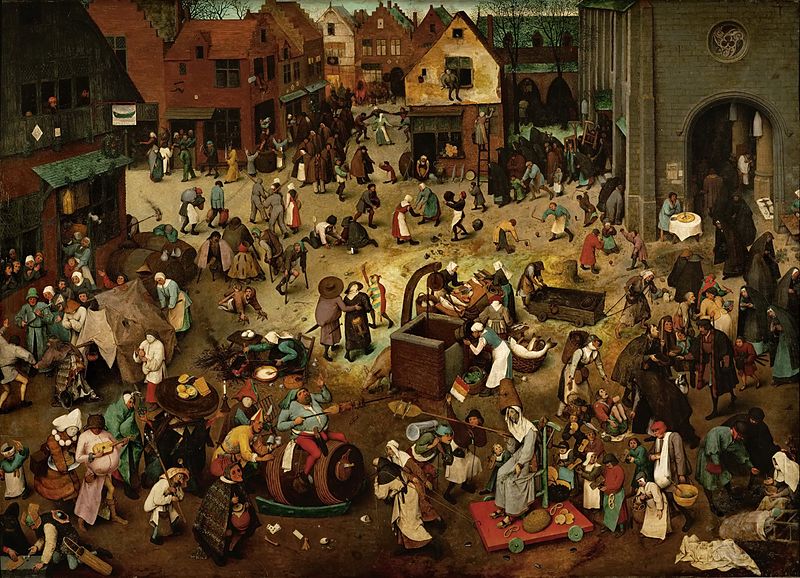
The Battle Between Carnival and Lent – Pieter Bruegel the Elder 1599 (Image from http://en.wikipedia.org/wiki/File:Pieter_Bruegel_d._%C3%84._066.jpg )

My first choice is Nights at the Circus by Angela Carter (1984, Chatto & Windus).  The minute I started to think about carnivalesque, this is what sprang to mind. I thought the summary on the dust jacket was spot-on, so here it is:

Fevvers: the toast of Europe’s capitals, courted by princes, painted by Toulouse Lautrec, the greatest aerialiste of her time. Fevvers: somersaulting lazily through the air, hovering in the moment between the nineteenth century and the twentieth, between old dreams and new beginnings, born up by the spread of wings that can’t be real! Or- can they? Fevvers: the Cockney Venus, six foot two in her stockings, the coarsely lively and lovely heroine…Obsessed with Fevvers, constantly bamboozled by the anarchist sorcery of her dresser and confidante, Lizzie, the dashing young journalist Jack Walser stumbles into a journey which takes him from London to Siberia via legendary St Petersburg and out of his male certainties, into a transforming world of danger and joy, the world of Colonel Kearney’s circus…Featuring a cast of thousands, including : the clown’s requiem, the tigers’ waltz, the educated apes, the bashful brigands, the structuralist wizard. Not forgetting Sybil, the Mystic Pig.”

Just brilliant. I’ve said before that there’s no-one like Angela Carter, and Nights at the Circus is her writing at her very best.  Fevvers voice leaps of the page at you in the first paragraph:

“Lor’ love you sir!” Fevvers sang out in a voice that clanged like dustbin lids. “As to my place of birth, why, I first saw the light of day right here in smoky old London, didn’t I! Not billed the ‘Cockney Venus’ for nothing…Hatched out of a bloody great egg while Bow Bells rang, as ever is!”

If that all sounds a bit “cor-blimey-luvvaduck-rent-a-cockney”, don’t worry.  With Angela Carter you are never in the land of the stereotype, but in an exuberant world of characters the like of which you will never have met before, or since.  She is master of the original and evocative image (“like dustbin lids”) and while her work is carnivalesque and destabilising, it’s also great fun.  The circus is Carter’s world, which means anything can happen.  But beneath all the sparkle and pizzazz, she creates a world of substance.  Buffo the clown reflects:

“We are the whores of mirth, for, like a whore, we know what we are; we know we are mere hirelings hard at work yet those who hire us see us as beings perpetually at play. Our work is their pleasure and so they think our work must be our pleasure, too, so there is always and abyss between their notion of our work as play, and ours, of their leisure as our labour.”

Carter uses magic realism to explore how we construct reality, and how easily it can be deconstructed.  Where better to do that than the circus? She plays with notions of gender and sexuality, challenging the idea that they are fixed entities, and explores how identity can be constantly created and recreated.  Jack falls in love with Fevvers, unsure of who, or what, it is he loves: if he gets behind the image of the Cockney Venus, who will be there?  Is she part bird?  And who will he be in response?:

“When Walser first put on his make-up, he looked in the mirror and did not recognise himself. As he contemplated the stranger peering interrogatively back at him out of the glass, he felt the beginnings of a vertiginous sense of freedom , that, during all the time he spent with the Colonel, never quite evaporated; until that last moment where they parted company and Walser’s very self, as he had known it, departed from him, he experienced the freedom that lies behind the mask, with dissimulation, the freedom to juggle with being, and, indeed, with the language which is vital to our being, that lies at the heart of burlesque.”

Angela Carter clearly had a fierce intellect and something interesting to say about how we make our worlds.  But she also didn’t let that get in the way of a good story.  Nights at the Circus is a fantastic read, in all the senses of the word.

Secondly, Gulliver’s Travels by Jonathan Swift (1726, full text available online).  Obviously, this novel is hugely famous (even if you haven’t read it I bet you know what physical feature distinguishes a Lilliputian).  Lemuel Gulliver relates fantastical tales of his travels, and in the process Swift offers a satire on travel narratives (which were hugely popular in the eighteenth century as people travelled further and wider) and on the human condition.  I chose it for this theme as it is full of inversions and reversals; Gulliver travels to Lilliput, where he is a giant, then to Brobdingnag where he is minute; to Laputa which he considers crude and unenlightened, then to the Houyhnhnms who consider him a “yahoo”.  Gulliver’s Travels is episodic, so I’m just going to pick out a couple of events.  Firstly, one of the most famous ones: many writers at the time were obsessed by bodily functions, and Swift is no different, though thankfully not nearly as scatological as some of his contemporaries.  Here is Gulliver putting his urine to good use in Lilliput:

I was alarmed at midnight with the cries of many hundred people at my door; by which, being suddenly awaked, I was in some kind of terror….her imperial majesty’s apartment was on fire, by the carelessness of a maid of honour, who fell asleep while she was reading a romance.  I got up in an instant; and orders being given to clear the way before me, and it being likewise a moonshine night, I made a shift to get to the palace without trampling on any of the people.  I found they had already applied ladders to the walls of the apartment, and were well provided with buckets, but the water was at some distance.  These buckets were about the size of large thimbles, and the poor people supplied me with them as fast as they could: but the flame was so violent that they did little good… this magnificent palace would have infallibly been burnt down to the ground, if, by a presence of mind unusual to me, I had not suddenly thought of an expedient.  I had, the evening before, drunk plentifully of a most delicious wine called glimigrim, (the Blefuscudians call it flunec, but ours is esteemed the better sort,) which is very diuretic.  By the luckiest chance in the world, I had not discharged myself of any part of it.  The heat I had contracted by coming very near the flames, and by labouring to quench them, made the wine begin to operate by urine; which I voided in such a quantity, and applied so well to the proper places, that in three minutes the fire was wholly extinguished, and the rest of that noble pile, which had cost so many ages in erecting, preserved from destruction.

And just to finish, here is a bit of the more heavy-handed satire for you, when the king of Brobdingnag responds to a summary of British politics:

“He was perfectly astonished with the historical account gave him of our affairs during the last century; protesting “it was only a heap of conspiracies, rebellions, murders, massacres, revolutions, banishments, the very worst effects that avarice, faction, hypocrisy, perfidiousness, cruelty, rage, madness, hatred, envy, lust, malice, and ambition, could produce.”

I’ll leave it to you to decide if such motivations have left politics these days…

Gulliver’s Travels is a complex book, and one that is very hard to pin down: it is funny, it is sad, it can be read to children, it is baffling to adults.  It shifts meaning and genre according to who is reading it: truly carnivalesque.

I was hoping to end with a clip of Bellowhead performing One May Morning Early: apt, no?  But YouTube failed me.  So here they are singing about a carnival romance instead:

“With mirth and laughter let old wrinkles come” (Gratiano, The Merchant of Venice, William Shakespeare)

Today is Shakespeare’s birthday (probably).  It’s almost definitely his death day, but that has a less festive feel to it, so let’s go with birthday.  Happy Birthday, Bard!

Image

(Image from http://tudorhistory.org/people/shakespeare/ )

I love Shakespeare.  I was lucky enough to fall in love with him at school and I love him still.  I know he’s not for everyone, so I’m only going to discuss one play. But firstly, I thought I’d try and convince you of what I firmly believe, that he is for everyone.  This has probably been done before, so if it has and it was you, please accept my sincere apologies and let me know and I’ll credit you.  I promise I haven’t stolen this from anyone as far as I know.  I thought I’d try one of those “if you liked…” lists that are so annoying  when used by retailers to try & get you to buy more stuff, only in this case I’m using (mainly) Hollywood films (the modern equivalent of a Shakespeare play) to try and get you to buy into the drama.  In no order at all, just how they occurred to me:

If you liked…. Then you may like to try… Because…
The Godfather Julius Caesar/Coriolanus There are power struggles, machinations & murder
Rom coms Much Ado about Nothing/As You Like It Bit obvious, this one
 
Indecent Proposal Measure for Measure Sexual bribery abounds
   
Lord of the Rings The Tempest It’s magic
   
Hansel & Gretel/Snow White Macbeth Witches & violence
   
   
The Simpsons’ Movie Henry IV parts 1&2 I’ve totally stolen this idea from Dr Emma Smith, who convincingly draws parallels between Homer & Falstaff
   
Scarface Titus Andronicus It’s a bloodbath
   
Grease Love’s Labour’s Lost There are boys, there are girls, they all get together
   
War films Henry V Battles & bloodshed
 
   
Trading Places Comedy Of Errors Mistaken identities, a focus on money, it all works out in the end
   
John Grisham adaptations Merchant of Venice Features the greatest courtroom speech ever, even better than “You can’t handle the truth!” (seriously)
   
In the Loop/Political thrillers Richard III Power corrupts…
   
Game of Thrones King Lear A kingdom is divided, power struggles and torture ensue (no incest or wedding massacres though)
   
Fear and Loathing in Las Vegas Midsummer Night’s Dream It’s trippy…
The Wolf of Wall Street Timon of Athens Money is the root of all evil
   
Romeo + Juliet   Um, ….Romeo and Juliet Take a guess…

Any further or different suggestions are very welcome!

For the second part of this post I thought I’d discuss one of the plays that isn’t that well-known (for a Shakespeare play) or frequently performed, but I really like it, and I’m a bit baffled as to why it’s ignored: King John. King John is one of Shakespeare’s earliest plays, a history play that looks at arguments around royal succession. If that sounds yawnsome, the arguments involve battles, betrayals and murder, as so often in the medieval history plays.

What makes this play so interesting is the central character, who arguably isn’t King John, but his half-brother Phillip Falconbridge (who has more lines than anyone else).  However, no-one calls him by this rather dashing name, or the new one he is given at the start of the play, Richard Plantagenet; he is consistently referred to in the text as The Bastard.  As the illegitimate son of Richard the Lionheart, he is of royal lineage, but legitimacy being of huge significance at the time, he is not an heir.  Other illegitimate children in Shakespeare are somewhat troublesome: Edmund in King Lear and Don John in Much Ado both cause no end of grief.  The Bastard however, is one of the more appealing characters in a play filled with dark, devious, self-serving manipulators.  He has a way with words, and his own morality is uninfluenced by society.  His response to his mother about Richard the Lionheart being his father does not berate her for stigmatizing him:

He that perforce robs lions of their hearts
May easily win a woman’s. Ay, my mother,
With all my heart I thank thee for my father!
…Come, lady, I will show thee to my kin;
And they shall say, when Richard me begot,
If thou hadst said him nay, it had been sin:
Who says it was, he lies; I say ’twas not.

Pretty liberal for the time.  He goes on to fight for King John, and prove himself brave, clever, and more humane than others in what is quite a bleak play:

But as I travell’d hither through the land,
I find the people strangely fantasied;
Possess’d with rumours, full of idle dreams,
Not knowing what they fear, but full of fear: 

Cheeky and irreverent when he’s in court, The Bastard is a man of action who is actually a more accomplished leader than any of the courtly power-wielders. His illegitimacy places him outside of things, and as such he is able to cast a wry and sardonic glance at the action. “Mad world! mad kings! mad composition!” King John is weak, and the play demonstrates that rather than a god-given right to rule, kings are as flawed and human as the rest.   The Bastard gets the last lines of the play, and in his mouth the words:

Now these her princes are come home again,
Come the three corners of the world in arms,
And we shall shock them. Nought shall make us rue,
If England to itself do rest but true.

become not an assertion of England’s strength, but an ironic observation on the weakness and hypocrisy of rulers. The Bastard isn’t a historical figure or in any of Shakespeare’s sources.  He is entirely invented, and one of the many reasons that Shakespeare is still as Ben Jonson described him: “The applause, delight, the wonder of our stage”.  Happy Birthday William Shakespeare – “Shine forth, thou star of poets!”

To end, one of the most famous portrayals of King John, back in the days when he was still a prince:

“I’ve met a lot of hardboiled eggs in my time, but you’re twenty minutes.” (Billy Wilder)

Happy Easter!  For those of you who don’t celebrate this festival, I hope you’re enjoying the long weekend (and possibly an abundance of chocolate).

Image

(Image from: http://www.sproutcontent.com/ )

For a theme for this post I was thinking about Easter, about sacrifice and redemption, and also about Spring, the season of renewal and regeneration that it coincides with.  I’ve opted for a novel with a self-sacrificing main character, and a poem that starts in April. They’re both quite odd texts: here’s to a weird Bank Holiday!

Firstly, A Prayer for Owen Meany by John Irving (1989, Black Swan).  Irving is an enormously popular author and Owen Meany is one of his most-loved protagonists: a boy “with a wrecked voice” who is so tiny people can’t resist picking him up, his skin “the colour of a gravestone; the light was both absorbed and reflected by his skin, as with a pearl, so that he appeared translucent at times”.  The story is narrated by his best friend Johnny Wheelwright, who is trying to come to terms with the role Owen has played in his life.  When they are 11, Owen hits a foul ball that kills Johnny’s mother immediately.  The boys reconcile by swopping their most treasured possessions: “He gave me his baseball cards, but he really wanted them back, and I gave him my stuffed armadillo, which I certainly hoped he’d give back to me – all because it was impossible for us to say to each other how we really felt.” 

When he returns the armadillo, Owen has taken its claws, which Johnny comes to realise is Owen’s way of telling him:  “GOD HAS TAKEN YOUR MOTHER. MY HANDS WERE THE INSTRUMENT. GOD HAS TAKEN MY HANDS. I AM GOD’S INSTRUMENT.” Owen’s speech is always in capitals to represent his bizarre voice, and as a device it really works, marking him out not only against the other characters but also in the book itself – you can flick through and find Owen immediately.  So, Owen is already unusual, but is even more extraordinary than people realise.  He thinks he is God’s instrument, and certainly Johnny agrees: “I now believe that Owen Meany always knew; he knew everything.” The events of their lives mean not only that “Owen Meany rescued me” and gave Johnny Christian faith, but that Owen’s absolute conviction in a greater scheme of things and his capacity for self-sacrifice are tested to the extreme. It’s so hard to say any more without giving away spoilers, but I urge you to read it.  A Prayer for Owen Meany is a novel as truly original as its protagonist, funny and sad, elegiac and uplifting.

Secondly, The Waste Land by TS Eliot, a hugely famous and notoriously difficult poem.  For what it’s worth, I would say don’t let the reputation it put you off.  If you fancy giving it a go, read it and let the “heap of broken images” wash over you, see what it brings.  You can always re-read using the footnotes (which will be copious – and Eliot’s own notes add more confusion rather than explication) to translate the Latin, Greek etc  and find out about the plethora of allusions.  The poem begins:

April is the cruellest month, breeding  

Lilacs out of the dead land, mixing         

Memory and desire, stirring      

Dull roots with spring rain.

These lines are an allusion to the start of The Canterbury Tales:

Whan that Aprill, with his shoures soote

The droghte of March hath perced to the roote

And bathed every veyne in swich licour,

Of which vertu engendred is the flour;

Whan Zephirus eek with his sweete breeth

Inspired hath in every holt and heeth

The tendre croppes…

As you can see, Eliot takes the same premise but where Chaucer sees pastoral idyll (admittedly evoked a little ironically) Eliot sees something bleaker, death amongst the renewal, cruelty amongst the desire.  The Waste Land is an odd, unsettling poem; its original title was going to be He Do the Police in Different Voices (a line from Our Mutual Friend) and The Waste Land is certainly a cacophony of voices, evoking different times, places and stories.  As an embittered commuter who used to cross London Bridge every day, the following passage always sticks in my mind:

Unreal City,         

Under the brown fog of a winter dawn,               

A crowd flowed over London Bridge, so many, 

I had not thought death had undone so many.  

Sighs, short and infrequent, were exhaled,       

And each man fixed his eyes before his feet.    

Flowed up the hill and down King William Street,          

To where Saint Mary Woolnoth kept the hours

With a dead sound on the final stroke of nine.

The Waste Land does this frequently, takes images that almost seem commonplace, like commuters walking over a bridge, and then undermines it, in this instance when you realise they are all ghosts, their movement seemingly without purpose. The Waste Land is a poem that defies easy explanation and raises far more questions than it answers.  It can be a frustrating read, but also a hugely rewarding one that benefits from multiple readings.

Who is the third who walks always beside you?              

When I count, there are only you and I together             

But when I look ahead up the white road            

There is always another one walking beside you             

Gliding wrapt in a brown mantle, hooded          

I do not know whether a man or a woman          

—But who is that on the other side of you?

For a very interesting discussion on The Waste Land and how we read, head over to Necromancy Never Pays.

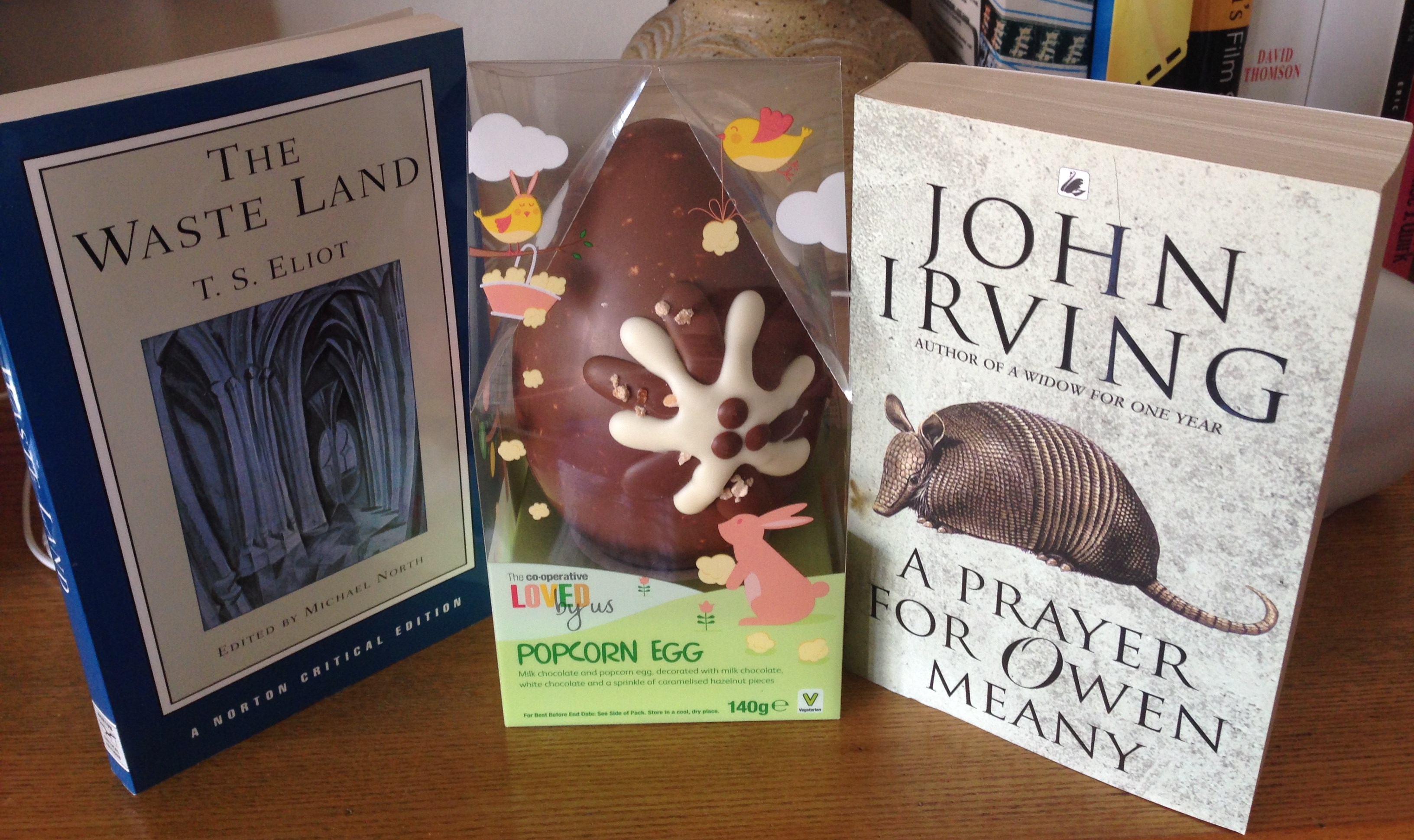
I feel like I should picture the books with an egg as odd and unsettling as the books themselves, a dinosaur egg or something.  (Or an armadillo egg?  But I’m feeling too lazy to make them, it is a Bank Holiday after all…) So here they are instead with a reassuringly chocolatey easter egg, a present from my brother:

Image

“One should sympathise with the colour, the beauty, the joy of life.” (Oscar Wilde)

Happy Mother’s Day (for those of you in the UK)!  My finals are seriously impacting on my blogging capacity, and although I had a plan for two novels to look at for Mother’s Day, I didn’t have time.  So instead I’m going to share a poem in its entirety with you.  It’s a poem my mother introduced me to, and it’s one of our favourites.  No matter how many times I read it the last line always makes me cry.  It’s by Peter Dixon and in my edition it’s called Rotten Reader, but I notice in lots of editions it’s now called The Colour of My Dreams.  Happy Mother’s Day Maman!

I’m a really rotten reader
the worst in all the class,
the sort of rotten reader
that makes you want to laugh.

I’m last in all the readin’ tests,
my score’s not on the page
and when I read to teacher
she gets in such a rage.

She says I cannot form my words
she says I can’t build up
and that I don’t know phonics
and don’t know a c-a-t from k-u-p.

They say that I’m dyxlectic
(that’s a word they’ve just found out)
but when I get some plasticine
I know what that’s about.

I make these scary monsters
I draw these secret lands
and get my hair all sticky
and paint on all me hands.

I make these super models,
I build these smashing towers
that reach up to the ceiling
and take me hours and hours.

I paint these lovely pictures
in thick green drippy paint
that gets all on the carpet
and makes the cleaners faint.

I build great magic forests
weave bushes out of string
and paint pink panderellos
and birds that really sing.

I play my world of real believe
I play it every day
and teachers stand and watch me
but don’t know what to say.

They give me diagnostic tests,
they try out reading schemes,
but none of them will ever know
the colour of my dreams.

Just wonderful. I hope you liked it.

To end, here is a picture from Holi celebrations (this year it was 17 March), an annual explosion of colour which I thought suited the poem:

Image

(Image from: http://www.boloji.com/index.cfm?md=Content&sd=Articles&ArticleID=14222 )

“Everyone wants to be Cary Grant. Even I want to be Cary Grant.” (Cary Grant)

Happy (belated) Valentine’s Day!  In my post for Valentine’s Day last year (which was also late…) I pointed out that St Valentine is the patron saint for bee keepers, plague, epilepsy and against fainting, as well as for lovers.  Last year I wrote on bee-keeping and plague  but this year I’m going to be more romantic and tell you about the man in my life.  He’s always been there, but these last few weeks it’s like I’m seeing him with new eyes; now I’m obsessed and we spend hours together every day.  The title quote may have given it away: he’s Cary Grant.

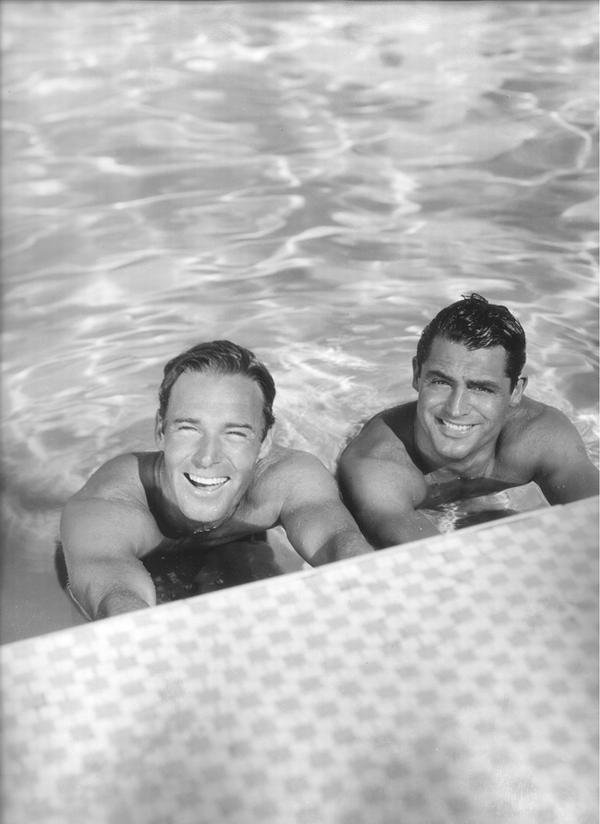
Let me explain.  For my last paper before finals (FINALS!  I’ve just broken out in a cold sweat….) we were given some optional papers to choose from, and I chose Film Criticism.  We’ve been looking at Hollywood Golden Age, a genre Cary Grant sits astride like a tanned, debonair, mid-Atlantic-accented colossus.  Having watched soooooo many of films again (and again, and again) I have a new-found appreciation for this actor with his exquisite comic timing.  It’s not that I didn’t like him before, I just took him for (ahem) granted.  This is how good he is: I had to analyse a scene from a film, and I chose something from Bringing Up Baby.  It was 3 minutes 39 seconds long.  I spent an entire day watching and re-watching the scene.  Think about how many 3 minutes and 39 seconds there are in a day.  That’s how many times I watched it. At the end of  the day I was still laughing at his performance.  The man is a genius.  In the spirit of Valentine’s Day here he is with long-term boyfriend totally-platonic-friend-who-he-just-happened-to-live-with-for-twelve-years, Randolph Scott.

Image

(Image from http://blogs.villagevoice.com/dailymusto/2010/09/cary_grant_and.php)

What a ridiculously good looking pair.  Anyway, I thought for this post I would look at two of his favourite novels.  According to IMDB he was a voracious reader.  Do you think I can find out what he liked to read?  Google, thou hast failed me.  (Probably now I’ll be told that it’s really well-known that he loved Moby Dick or something, but I couldn’t find it). So instead I’ve chosen a James Bond novel as apparently the character was partly modelled on him and he was considered for the role in Dr No, and a short story by a writer who like Archie Leach was famous under a pseudonym.

Firstly, Casino Royale by Ian Fleming (1953).  I’ll be honest, I went into this novel with very low expectations.  Even the most avid Fleming fan will tell you that some of the novels are absolute bilge; apparently the quality of the Bond novels varies widely.  This was the first Bond novel written and the first one I’d read, and I was pleasantly surprised.  OK, Fleming isn’t a grand literary genius, but I doubt he ever proclaimed himself as such.  Casino Royale is a decently written spy story.  It’s quite different to the film, although similarities remain.   I was expecting a flashy, superficial story but it’s a bit more reflective than that.  It opens:

“The scent and smoke and sweat of a casino are nauseating at three in the morning.  Then the soul-erosion produced by high gambling – a compost of greed and fear and nervous tension – becomes unbearable and the senses awake and revolt from it.”

Bond has been sent to Royale-le-Eaux to take down a Russian spy, Le Chiffre, by bankrupting him at gambling.  This being the Cold War, of course the baddies are Russian, and there’s also the rather sinister SMERSH, a Russian covert group whose name means “death to spies” lurking in the background.  That’s the very simple premise of the story.  Along the way there are lingering descriptions of clothes, cars and food (Fleming was clearly something of a gourmand), but the presentation of Bond is more complex than I was expecting.  I don’t think the reader is supposed to wholly like him or trust him:

“His last action was to slip his right hand under the pillow until it rested under the butt of the .38 Colt […] Then he slept, with the warmth and humour of his eyes extinguished, his features relapsed into a taciturn mask, ironical, brutal and cold.”

Bond is more human than in the films (he vomits in the gory aftermath of an explosion). He’s also damaged and flawed, more in keeping with the later filmic representations.  Very much of its time, however, is the misogyny:

“These blithering women who thought they could do a man’s work.  Why the hell couldn’t they stay at home and mind their pots and pans and stick to their frocks and gossip and leave men’s work to the men.”

As well as this general sexism, there’s also a worryingly easy conflation of sex with violence:

“Bond saw luck as a woman, to be softly wooed or brutally ravaged, never pandered to or pursued.”

Truly obnoxious and offensive. But in Fleming’s defence I would say that he seems more emotionally intelligent than his protagonist and we’re not supposed to see Bond as a role model in this sense.  There’s also a good dose of humour in the novel which encourages us not to take Bond entirely as seriously as he takes himself:

 “Englishmen are so odd.  They are like a nest of Chinese boxes.  It takes a very long time to get to the centre of them.  When one gets there the result is unrewarding, but the process is instructive and entertaining.”

So, Casino Royale was better than I expected.  It’s attitudes to women and Eastern Europeans are dated and offensive but as I said, I don’t get the sense the novel fully endorsed the attitude of its protagonist.  It’s a quick, light read (although the descriptions of gambling dragged a bit in places) and for me it was good introduction to the Bond novels.

Secondly, The Celebrated Jumping Frog of Calaveras County (1867) by Mark Twain. What an irresistible title.  Twain was a fairly prolific short story writer, but this was only the second one he wrote.  You can read the full text of it here. It really is a very short tale, and shows how much can be done in so limited a space by an accomplished writer.  It opens:

In compliance with the request of a friend of mine, who wrote me from the East, I called on good-natured, garrulous old Simon Wheeler, and inquired after my friend’s friend, Leonidas W. Smiley, as requested to do, and I hereunto append the result. I have a lurking suspicion that Leonidas W. Smiley is a myth; that my friend never knew such a personage; and that he only conjectured that, if I asked old Wheeler about him, it would remind him of his infamous Jim Smiley, and he would go to work and bore me nearly to death with some infernal reminiscence of him as long and tedious as it should be useless to me. If that was the design, it certainly succeeded.

As you can see, Twain’s humour is at the forefront (if you hadn’t already guessed by the title) and the mix of the ridiculous (“Leonidas W Smiley is a myth”) and the dry (“as long and tedious as it should be useless”) makes the story hugely entertaining.  It’s certainly a confident writer who tells a tale he says will be tedious, and Twain does this not once but twice: “Simon Wheeler backed me into a corner and blockaded me there with his chair, and then sat me down and reeled off the monotonous narrative which follows this paragraph.”  Simon Wheeler’s story of a gambling addict (Jim Smiley) who will bet on anything is directly reported, and he has one of the distinctive Southern voices Twain is so famed for, such as when he’s recounting how Jim trains the titular frog:

“He ketched a frog one day, and took him home, and said he cal’klated to edercate him; and so he never done nothing for three months but set in his back yard and learn that frog to jump. And you bet you he did learn him, too. He’d give him a little punch behind, and the next minute you’d see that frog whirling in the air like a doughnut see him turn one summerset, or may be a couple, if he got a good start, and come down flat-footed and all right, like a cat.”

There are some lovely touches in this story.  I particularly liked the line: “Smiley said all a frog wanted was education” and the fact that the frog is endowed with the decidedly un-froggy full name of “Dan’l Webster”. A quick read that children and adults will enjoy.

To end, here is a clip from The Philadelphia Story, and just possibly the most charming 3 minutes and 46 seconds ever committed to celluloid.  Apparently the bit where Cary Grant says “excuse me” was ad-libbed & that’s why he & James Stewart are trying not to laugh. Enjoy!

“The book is a film that takes place in the mind of the reader.” (Paulo Coelho)

It is a truth universally acknowledged, that the film version of a book is never as good as the original text.  Except I don’t think that’s true.  This week I’m going to look at two books where I think the film was better, but the novels are still worth reading.  Slightly odd tack for a book blog to take, and I may end up regretting this, but let’s crash ever onwards!

Firstly, The Commitments by Roddy Doyle (1987).  Here’s the trailer for the 1991 film, with a brilliant script by the author, in collaboration with the long-term writing partnership of Dick Clement and Ian La Frenais.

The Commitments is Roddy Doyle’s first novel, detailing how a group of white, working class Dubliners set up a soul band together.  I think in this novel Doyle is really learning his craft, and his writing gets progressively stronger as he goes along.  The Commitments is a far from terrible book, but it’s a bit slight, and filled with so much dialogue it reads more like a script than a novel for much of it.  Still, if you’re going to have a novel filled with dialogue it may as well be written by Roddy Doyle, who has a great ear for how people speak and seems to take real joy in capturing it on the page:

“-Grow a pair o’ tits, pal, an’ then yeh can sing with them, said Billy.

– Are you startin’ somethin’?

-Don’t annoy me.

– Here! Said Jimmy. –None o’ tha’.

The time was right for a bit of laying down the law.

-No rows or scraps, righ’.

-Well said, Jim.

– An’ annyway, said Jimmy. –The girls are the best lookin’ part o’ the group.

– Dirty bastard, said Natalie.

-Thanks very much, Jimmy, said Imelda.

-No sweat ‘melda, said Jimmy.

-What’ll we sing? Bernie asked Joey The Lips.

-You know Walking in the Rain?

-Lovely.

– I WANT HIM, Imelda sang.

– It doesn’t exactly have a strong feminist lyric, does it? said James.

– Soul isn’t words, Brother, said Joey The Lips. – Soul is feeling. Soul is getting out of yourself.”

You can see that this is writing really stripped back: minimal punctuation, not always clear who is speaking.  The style suits the tale of a bunch of people with very little creating music with only their voices and few instruments.  It makes The Commitments a quick read, and the characters are evoked with warmth through minimal authorial intervention. By writing in such a sparse way, Doyle allows the characters to speak for themselves. At other times he uses scant detail, rarely embellished with imagery, to portray the lives of the band:

“’Joey The Lips got one of his dress suits dry-cleaned. Dean crawled in under his bed and found the one he’d flung under there. He soaked the jacket till the muck was nearly all gone. Then he brought it down to the cleaners.

Black shoes were polished or bought or borrowed.”

The Commitments is a well-observed story, evocative and humorous. However, a novel about music will always have much to gain from being filmed; hearing the talented cast of the film give their voice to soul classics brings the characters into being in a way that is nearly impossible in print.

Secondly, The Princess Bride by William Goldman (1973).  Here’s the trailer for the 1987 film adaptation, screenplay by the author:

http://www.youtube.com/watch?v=njZBYfNpWoE

One of my favourite films from childhood that I still love to watch today – a definite winner on a rainy Sunday afternoon.  Again, it’s not that the book is bad (the film is scripted by Goldman after all so you wouldn’t expect a great deal of difference) but the film is better.  It takes all the best bits of the book and distils them into a fast-paced, funny narrative; the book can be a bit flabby at times by comparison.  The film also offers some of the best cameos ever: Billy Crystal as Miracle Max, Mel Smith as the torturer, comic genius Peter Cook as the Impressive Clergyman, as well as a perfectly cast set of main characters.  But if you like the film, you’ll like the book.  The same dry, silly humour runs through it, and who wouldn’t love a tale of: “Fencing. Fighting. Torture. Poison. True love. Hate. Revenge. Giants. Hunters. Bad men. Good men. Beautifulest ladies. Snakes. Spiders. Beasts of all natures and descriptions. Pain. Death. Brave men. Coward men. Strongest men. Chases. Escapes. Lies. Truths. Passion. Miracles.”

The tale is one of Princess Buttercup, who falls in love with the stable boy Westley.  He goes off to seek his fortune, and is captured by the Dread Pirate Roberts, who famously leaves no survivors.  Believing her One True Love to be dead, Buttercup agrees to marry the hunting-obsessed Prince Humperdink.  Before they can marry she is kidnapped by a gang comprising the cunning Vizzini (“never start a land war in Asia, [… and] never go against a Sicilian when death is on the line”), the giant Fezzik , and genius-swordsman-with-a-vendetta Montoya (“my name is Inigo Montoya, you killed my father, prepare to die!”) They are followed by the mysterious Man in Black, who seeks to foil their plans… Will goodness triumph? Will true love conquer all? Yes, of course, to both.  This is a lovely escapist fantasy, but at the same time it is a  satire on established rule and its abuses, which gives the story a more serious dimension. Prince Humperdink has arranged the kidnap of Buttercup in order to blame a neighbouring country and start a war.  (Fill in your own contemporary analogy here.)  He tells his henchmen to seek the “villains” in the thieves quarter:

““My men are not always too happy at the thought of entering the Thieves Quarter.  Many of the thieves resist change.”

“Root them out. Form a brute squad.  But get it done.”

“It takes at least a week to get a decent brute squad going,” Yellin said. “But that is time enough.

[…]

The conquest of the Thieves Quarter began immediately.  Yellin worked long and hard each day […] Most of the criminals had been through illegal roundups before, so they offered little resistance.””

Goldman is also able to extend his humour in the novel towards the processes around writing, which he couldn’t do in the film; for example his editor querying his translation of the “original” story by S. Morgenstern:

“this chapter is totally intact. My intrusion here is because of the way Morgenstern uses parentheses.  The copy editor at Harcourt kept filling the margins of the galley proofs with questions: […] “I am going crazy. What am I to make of these parentheses? When does this book take place? I don’t understand anything. Hellllppppp!!!” Denise, the copy editor, has done all my books since Boys and Girls and she had never been as emotional in the margins with me before.”

So there we go: two film recommendations as well as two book recommendations in the same post – call it a late Hogmany present from me to you, dear reader. Enjoy!

Image

Feminist Sundays: The Woman Who Walked into Doors – Roddy Doyle

Feminist Sundays is a meme created by Elena over at Books and Reviews. Here’s what she says about it: “Feminist Sundays is a weekly meme created at Books and Reviews. The aim is simply to have a place and a time to talk about feminism and women’s issues. This is a place of tolerance, creativity, discussion, criticism and praise. Remember to keep in mind that everyone is entitled to their own opinion, although healthy discussion is encouraged.” Do head over to Books and Reviews to read the excellent posts for this meme so far.

This week for Feminist Sundays I thought I’d put a downer on Christmas – if you’re full of festive cheer you may want to stop reading now.  I love Christmas, and I’ve had a great time this week decorating my flat (OK, so I’m a bit behind), wrapping presents and icing Christmas cakes.  I do this in anticipation of the day itself which for me will be fun, silly, relaxed, full of food, and getting slightly tipsy (OK, fairly drunk – when else do you drink alcohol at breakfast?  Why does the birth of Jesus make early morning Bucks Fizz acceptable? Whatever – it’s a fine tradition) in the company of my lovely family. I can confidently state in advance that there will be no weird atmospheres, no aggression, no physical assaults.  But this is not the case for everyone.  Unfortunately, the Christmas period consistently sees a rise in domestic violence compared with the rest of the year.  And although I’m looking at this topic as part of Feminist Sundays, (as the majority of domestic violence cases are male violence towards women) domestic violence can happen to anyone: any gender, any sexuality. It’s a subject Roddy Doyle explored in his 1996 novel, The Woman Who Walked into Doors.

The novel is narrated by Paula Spencer, a woman who is beaten regularly by her violent husband Charlo.  Paula works as a domestic cleaner, and self-medicates with alcohol.  Hers is a voice rarely heard in fiction; Doyle does a brilliant job creating the character and all that surrounds her through a narrative that intertwines the present with reminiscences of the past:

“Where I grew up – and probably everywhere else – you were a slut or a tight bitch, one or the other, if you were a girl – and usually before you were thirteen. You didn’t have to do anything to be a slut. If you were good-looking; if you grew up fast. If you had a sexy walk; if you had clean hair, if you had dirty hair. If you wore platform shoes, and if you didn’t. Anything could get you called a slut. My father called me a slut the first time I put on mascara. I had to go back up to the bathroom and take it off. My tears had ruined it anyway.”

Into this world comes Charlo Spencer, a sexy man who literally takes Paula’s breath away: “I suddenly knew that I had lungs because they were empty and collapsing.”  The romance of their first meeting contains a horrible irony in the soundtrack:

“His timing was perfect.  The Rubettes stopped and Frankie Valli started singing My Eyes Adored You.[…] He’d been drinking.  I could smell it but it didn’t matter.  He wasn’t drunk.  His arms rested on my hips and he brought me round and round.

-But I never laid a hand on you-

My eyes adored you-

I put my head on his shoulder.  He had me.”

This is immediately followed by a description of the aftermath of an assault:

“I knew nothing for a while, where I was, how come I was on the floor.  Then I saw Charlo’s feet, then his legs, making a triangle with the floor.  He seemed way up over me.  […] his face was full of worry and love.  He skipped my eyes. – You fell, he said.”

Charlo’s violence escalates, and Paula gradually comes to realise that he will not change, and that she is not alone in this experience. Doyle achieves the extraordinary balance of writing responsibly about a serious subject and still providing hope:

“For seventeen years.  There wasn’t one minute when I wasn’t afraid, wasn’t waiting. Waiting to go, waiting for him to come.  Waiting for the fist, waiting for the smile.  I was brainwashed and braindead, a zombie for hours, afraid to think, afraid to stop, completely alone. I sat at home and waited. I mopped up my own blood.  I lost all my friends, and most of my teeth.”

Ultimately Paula is a survivor: Doyle returned to her in the sequel Paula Spencer, ten years later.  I haven’t read the sequel (one of many on my TBR pile) but I highly recommend TWWWID. Roddy Doyle is hugely talented at capturing authentic voices in his writing, and TWWWID is no exception.

If you are affected by domestic violence, please, please contact Refuge (UK) or the equivalent service in your country.  They are there to help, not to judge.   Here’s a powerful video make-up artist Lauren Luke made on behalf of Refuge:

“You have a grand gift for silence, Watson. It makes you quite invaluable as a companion.” (Sherlock Holmes/Sir Arthur Conan Doyle)

Yesterday I was vegging out in front of the TV, when I saw something that got me very excited:

Sherlock’s back!  Sherlock’s back!  Sherlock’s back!

OK, now I’ve composed myself, let’s have a discussion about books.  Sherlock’s back!

I’ve gone the obvious route for my first choice, one of the original Sherlock Holmes stories, The Hound of the Baskervilles by Sir Arthur Conan Doyle.  I chose it because I think this was the first story that made me aware of Sherlock Holmes, watching an old black and white film version starring Basil Rathbone on TV (my mother told me the books were much better and the portrayal of Watson was rubbish – how right she was).  The story is not long, but it crams a great deal in, and is a fast-paced, creepily gothic read.  The story is narrated by Holmes’ loyal companion Dr Watson, who remains loyal despite being on the receiving end of such back-handed compliments from Holmes as: “It may be that you are not yourself luminous, but you are a conductor of light. Some people without possessing genius have a remarkable power of stimulating it. I confess, my dear fellow, that I am very much in your debt.” Charming.  The two are employed by Dr Mortimer to investigate the death of Sir Charles Baskerville, and potential danger to his heir, Sir Henry Baskerville.  Henry has inherited a huge pile in the middle of Dartmoor, and rumours of a supernatural, vicious hound that roams the moor abound.  The eerie atmosphere is beautifully evoked, such as Watson’s first view of Baskerville Hall:

“We had left the fertile country behind and beneath us. We looked back on it now, the slanting rays of a low sun turning the streams to threads of gold and glowing on the red earth new turned by the plough and the broad tangle of the woodlands. The road in front of us grew bleaker and wilder over huge russet and olive slopes, sprinkled with giant boulders. Now and then we passed a moorland cottage, walled and roofed with stone, with no creeper to break its harsh outline. Suddenly we looked down into a cuplike depression, patched with stunted oaks and firs which had been twisted and bent by the fury of years of storm. Two high, narrow towers rose over the trees. The driver pointed with his whip.

“Baskerville Hall,” said he.

[…]

The avenue opened into a broad expanse of turf, and the house lay before us. In the fading light I could see that the centre was a heavy block of building from which a porch projected. The whole front was draped in ivy, with a patch clipped bare here and there where a window or a coat of arms broke through the dark veil. From this central block rose the twin towers, ancient, crenelated, and pierced with many loopholes. To right and left of the turrets were more modern wings of black granite. A dull light shone through heavy mullioned windows, and from the high chimneys which rose from the steep, high-angled roof there sprang a single black column of smoke.

“Welcome, Sir Henry! Welcome to Baskerville Hall!””

The story really is expertly crafted, and it’s understandable why Sherlock Holmes endures.  Doyle succeeds in writing pacey, interesting, atmospheric tales that keep you hooked until the end.  And of course, at the centre of it all is one of the most intriguing characters ever created: a brilliant mind for whom no detail is insignificant, and whose genius means he is stimulated in ways that the rest of us may not fully comprehend: “He burst into one of his rare fits of laughter as he turned away from the picture. I have not heard him laugh often, and it has always boded ill to somebody.”

I’ll stop right there before I give away any spoilers as to the mystery.  On to my second choice, Whose Body? by Dorothy L Sayers (1923, my copy 2003, Hodder & Stoughton).  Sayers is one of the authors identified with the Golden Age of Detective Fiction, and this novel is the first to feature Lord Peter Wimsey, an aristocratic amateur detective, who likes to “go off Sherlocking” and went on to feature in many more novels and short stories by Sayers.

I found this novel hugely enjoyable.  It was well-paced (maybe flagging a little towards the end, but maybe I’m just used to Hollywood-style rapid denouements) it was witty, and didn’t take itself too seriously, with a few meta-comedy moments at the expense of detective fiction: “Sugg’s a beautiful, braying ass,” said Lord Peter.  “he’s like a detective in a novel…”; “Its  only in Sherlock Holmes and stories like that , that people think things out logically.”

As the meta moments suggest, Sayers is a clever novelist.  But I never felt she was trying to prove how clever she was.  The story, of a body found in a bathtub and a missing family friend (events Lord Peter believes are connected), remains believable and accessible. Sayers has a confident voice in her first novel, and an interesting turn of phrase: “His long, amiable face looked as if it had generated spontaneously from his top hat, as white maggots breed from Gorgonzola.”

I have one proviso to this recommendation: I found offensive the anti-Semitic remarks made by some characters in Whose Body? . The inter-war period was obviously a time that saw a growth in fascism throughout Europe with devastating consequences, and Sayers is probably just putting in her characters’ mouths the repugnant views that were expressed at the time.  According the Wikipedia page on Sayers, she was surprised at accusations of anti-Semitism in Whose Body?, stating the only characters “treated in a favourable light were the Jews!”  Certainly those who express anti-Jewish views are generally portrayed as old-fashioned and/or stupid, but it still makes for uncomfortable reading in this day and age.

I don’t want to end on a negative, so for all you fellow bibliophiles out there, here is a description of Lord Peter’s favourite room:

“Lord Peter’s library was one of the most delightful bachelor rooms in London. Its scheme was black and primrose; its walls were lined with rare editions, and its chairs and Chesterfield sofa suggested the embraces of the houris.  In one corner stood a black baby-grand, a wood fire leaped on a wide old-fashioned hearth, and the Sevres vases on the chimney-piece were filled with ruddy and gold chrysanthemums.”

I for one could spend hours in that room.

Normally I finish with a picture of the books, but they have disappeared, nowhere to be found.  ‘Tis truly a mystery: who could I call on, that is up to the task of solving this curious case…..?

Image

(Image from http://www.bbc.co.uk/programmes/b018ttws )

“Writing about music is like dancing about architecture.” (Variously attributed)

I was thinking about how this blog is supposed to be themes that relate books to life and how there are gaping holes in what I’ve covered so far.  This week I attempt to redress the balance by picking something that is a huge part of most people’s lives: music.  However, as the title quote shows, I may be digging myself the most enormous hole here, as trying to capture an aural experience through words is nigh on impossible.  Let’s take a breath and have some music so if nothing else this post does make some sort of melodic offering.  One of my favourite bands, and one of my mother’s favourite songs, Frogs Legs and Dragon’s Teeth by Bellowhead:

That was for you Maman!  Right, back to books, and two brave writers who’ve made music a big part of their novels.

Firstly The Courage Consort by Michel Faber (Canongate, 2002).  I’m fan of Michel Faber’s writing – I love his sparse style and unpredictability.  Anything can happen his books, there’s no “typical Faber”.  The Courage Consort is a novella (121 pages in my edition) told from the point of view of Catherine, one of five members of the titular a capella group headed by her husband, Roger.  Catherine is emotionally fragile (we are introduced to her trying to decide whether to jump out of the window) and her husband seemingly oblivious to her pain.  They join three others to rehearse an insanely complex piece called Partitum Mutante in an eighteenth-century chateau in Belgium.  The composer arrives briefly to assist them, a madman who attacked his ex with a stiletto in an airport and tells them to make their singing “more extreme, but more soft also…quiet but loud”.  Working on this seemingly doomed project, the disparate personalities that make up “the seventh most-renowned serious vocal ensemble in the world” start to come into conflict, but not in an entirely predictable way.

Faber creates a believably comic situation and the characters are generally well-observed, if bordering on national stereotypes at times.  The character of Catherine is sympathetic and Faber shows how music carries over into her musings about life in general:

“Other people might think it was terribly exciting when two females singing in thirds made the airwaves buzz weirdly, but Catherine was finding that her nerves were no longer up to it.  Even the way a sustained A flat tended to make an auditorium’s air-conditioning hum gave her the creeps lately.  It was as if her face was being rubbed in the fact that music was all soundwaves and atoms when you stripped the Baroque wrapping-paper off it.   But too much sonic nakedness wasn’t good for the spirit.  At least that was what she was finding lately, since she’d started coming…adrift.”

But things are not necessarily what they seem: Catherine hears screaming in the night and is told a ghost story about the forest that surrounds them.  No-one else hears it, and Catherine goes on to have an experience in the forest which is not told to the reader.  This lack of explication stops The Courage Consort being a straightforwardly comic novel, as an eeriness creeps around the house and its inhabitants.  Things do not go as planned, but ultimately the group comes to fully comprehend just how healing the experience of music can be.

Secondly, Grace Notes by Bernard MacLaverty (Vintage, 1997).  Grace Notes tells the story of another Catherine, this one a composer struggling to manage her art alongside the demands of her life.  These demands include a new baby and ensuing post-natal depression, her father’s death, and conflict with her mother.  Musicality comes naturally to her, and she has an innate understanding form an early age:

“One day, when she was only three or four, she’d slipped away from the kitchen as her mother baked and listened to the radio.  On this particular day the piano lid was open.  Catherine had reached up above her head and pressed the keys as softly as she could.  No sound came from them.  She had to press harder to make the sound come.  It frightened her when it did.  Dar, deep , thundery.  The booming faded away and the noise of the birds outside came back.  She tried further up the piano where the notes were nicer, not so frightening.  She pressed a single note, again and again.  It wasn’t the note which made her feel funny – it was the sound it made as it faded away.  The afterwards.  It made her feel lonely. “

This idea, later defined as “the notes between the notes” – grace notes – is the novel’s theme and main image: what happens in the spaces between events, what is left unsaid, what is defined and what is undefinable.    Catherine gradually comes to terms with her life throughout the course of the novel and moves onwards, creating a new symphony, but the grace notes continue: “it began with a wisp of music, barely there – a whispered five-note phrase on the violins and she was right back on that beach with her baby. […] Like the artist’s hand which moves to begin a drawing but makes no mark”.  Having described Catherine’s life in an interwoven way – memories that come to her interspersed with descriptions of her life in the present – MacLaverty describes her music similiarly, the literal description of the action of instruments interwoven with the images that have inspired Catherine as she writes the symphony.  It’s a highly effective method, and probably the nearest I’ve read to a representation of sound, and the feeling it evokes, written down.

As the novels are about two musical women, here they are pictured with two more musical women: Dusty Springfield and Lily Allen Cooper:

Image