“Definition of a classic: a book everyone is assumed to have read and often thinks they have.” (Alan Bennett)

Before I start this post proper, I just wanted to mention the sad news that Iain Banks announced this week that he has terminal cancer.  In almost 30 years Iain Banks has produced an impressive volume of work, including science fiction under the name Iain M. Banks, and aged only 59, it was reasonable to assume he would continue to do so for a great many years. Instead, he has confirmed that his latest novel, The Quarry, will be his last. I discuss my favourite of his novels, The Crow Road, in my post of 25 February.  I really don’t know what else to say about this that won’t sound trite or clichéd, but I would urge you once more to check out the work of this highly readable writer whose talent will be sorely missed by his many fans worldwide.

***

The prompt for this post came from a friend who emailed this week asking me for recommendations of classics to read.  She had just bought a Kindle and discovered the joy of copyright-free books being free to download.  (All hail Project Gutenberg).  So I thought lots of people could be in a similar position, and it would make a good post… how wrong I was.  It wasn’t long into my deliberations (which I’d love to claim involves a complicated algorithm I’ve compiled to ensure the most riveting blog possible, but the reality is me staring mindlessly at my bookshelves and shaking my head whilst eating too much chocolate) that I ran into the truth of Alan Bennett’s definition.  For so many of the books charged as classics I found myself asking – who needs me to recommend them?  Everyone’s heard of them, knows what they’re about, has an idea of whether it’s something they’re interested in.  OK, I don’t pick the world’s most obscure books the rest of the time, but classics don’t exactly need the PR.  Then I decided to just chill out and pick a book each from the 18th, 19th and 20th centuries that are classics but maybe not the most well-known ones.  You’ll be relieved to know I scrapped that idea as I realised this would mean the post would go on forever, and like so many Modernists before me, I decided to abandon all thoughts of the nineteenth century. So here are two books, both of which you’ve probably heard of, one from the century that saw the birth of the novel, one from the twentieth century (unfortunately only the first one is free to download on Project Gutenberg).  If you haven’t read them, I hope this post is helpful in adding to the belief that you have!

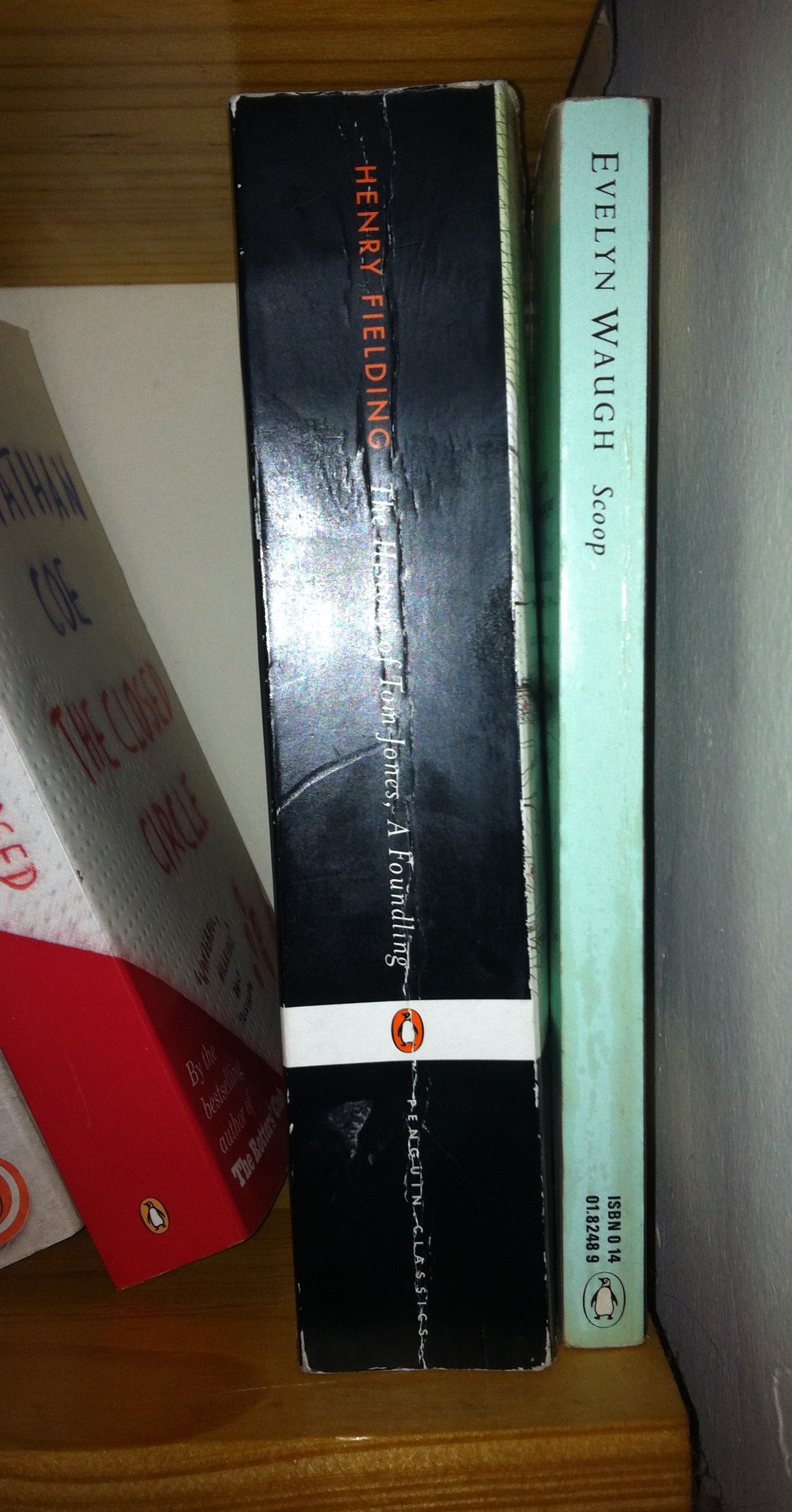
Firstly, The History of Tom Jones, A Foundling, by Henry Fielding (1749, my copy Penguin 1999).  Written at the time when the novel as a form was just beginning, you can sense Fielding having a great time playing around with the lack of established rules – there a lots of direct addresses to the readers, often at tangents to the plot, including précis to each chapter such as “Chapter XII: containing what the Reader, may, perhaps, expect to find in it” and “Chapter I: containing little or nothing”. The book is a huge one: 346,747 words, according to Wikipedia, so I won’t attempt anything other than the very basic outline of the plot: Tom Jones is found abandoned in Squire Allworthy’s bed as a baby.  The Squire raises him as a son, and Tom falls in love with his neighbour, the beautiful and virtuous (of course) Sophia.  He has a nemesis, Bilfil (nephew to Squire Allworthy), whose machinations lead to Tom being banished from the house.  He takes to the road, and Sophia, who loves him, runs away to find him.  Adventures, trials and tribulations abound…

The Victorians reacted against the libertinism of the eighteenth century, but I think this liberal morality means the novels of the time are great fun.  Tom Jones is picaresque, and as such Tom doesn’t always behave well, but it’s always believable and funny, and what makes it so endearing is that he really tries to be the hero of this novel. For example, when he hears the screams of a woman in a wood, he runs to her rescue.  Except he half slides down a hill in a not-very-heroic manner, beats the man attacking her, and then rather than cover over the exposed woman, enjoys gazing at her breasts. The lady recovers sufficiently to flirt with him, and declines his offer of a coat:

“Thus our Heroe and the redeemed Lady walked in the same Manner as Orpheus and Eurydice marched heretofore.  But tho’ I cannot believe that Jones was designedly tempted by his Fair One to look behind him, yet as she frequently wanted his Assistance to help her over Stiles, and had besides many Trips and other Accidents, he was often obliged to turn about.”

Needless to say, this being the eighteenth century, they end up acting on their inclinations…

Tom Jones is a classic that perhaps isn’t as well read as some of the novels that followed, their way opened by Fielding’s inventive work.  I think that’s a shame.  It’s funny, it has plenty to say, and although it’s satirical it’s not overly moral, so if you’ve been put off the classics by the heavily moral tone of the Victorians (or Fielding’s contemporary, Samuel Richardson) then Fielding could be the author for you.  And although Tom Jones is long, it’s not nearly as long & impenetrable as other eighteenth century classics like Tristram Shandy and Clarissa. As a free download, you won’t even have to wrestle with an unwieldy paper tome, so there’s no reason to be anything other than content: “a blessing greater than riches; and he to whom that is given need ask no more.”

My second choice, Scoop by Evelyn Waugh, runs to a modest 222 pages in my edition (Penguin, 1938; my copy much later but no date given) so if you can’t face the girth of Tom Jones, maybe this will appeal more. Scoop is Waugh’s satire on the newspaper business, and the integrity (or lack thereof) of an industry looking for a story at any cost is thoroughly lampooned.

William Boot writes countryside columns for the Daily Beast.  The newspaper’s owner, Lord Copper, mistakes him for the novelist John Boot, who wants to leave the country, and so sends him to be a war correspondent in Ishmaelia, a (fictional) country on the verge of civil war.  The whole experience is disastrous for Boot, but he does manage a scoop, and so is proclaimed a wild success.  The novel is full of Waugh’s witty turns of phrase (Boot is served at one point by a page “with a face of ageless evil”)and eccentric characters, who ask questions like: “Why should I go to Viola Chasm’s Distressed Area; did she come to my Model Madhouse?” If you enjoyed Vile Bodies, this style will be familiar to you, but here the humour is employed to expose the faults inherent in the Press rather than the Bright Young Things of the interwar years. Waugh is scathing about the process of news journalism as a whole: “News is what a chap who doesn’t care much about anything wants to read.  And its only news until he’s read it.  After that it’s dead.” The facts of the war are unimportant to the journalists, as Boot is instructed at one point: “From your point of view it will be quite simple.  Lord Copper only wants Patriot victories and both sides call themselves patriots, and of course both sides will claim all the victories.”

I don’t know a lot about journalism today but I suspect Scoop hasn’t dated too badly, and therefore the satire stands up as well today as it ever did.  One thing which doesn’t stand up & which I found shocking is the horrifically racist language used through the book.  It’s not in abundance, but there’s enough of it there for me to feel the need to warn you.  Ishmaelia is set in Africa, and the language used by the white journalists to describe the country’s inhabitants is derogatory and hugely offensive – it is probably also, I fear, an accurate portrayal of attitudes at the time.  I would still recommend Scoop as a novel, but I wish I’d known about this facet of the story before I went in, as I would have felt better prepared to manage it.

Here are the books presented in classical style, on a bookshelf!
Image

“I’m frightened of eggs” (Alfred Hitchcock)

This weekend has been the long Easter weekend in the UK.  I appreciate not everyone’s Christian (myself included) or that even if you are you might not necessarily celebrate Easter now but in May instead, or not at all.  So I don’t want to bang on about the festival itself at any great length, but I did use it as a starting point for this week’s choices.  I chose a book with references to bunnies in the title, and one about life & death, seeing as how its Easter and springtime, season of renewal.  Two ways to celebrate Easter with no associated risk of adult-onset diabetes (unless of course you tuck into chocolate eggs & simnel cake while reading them, behaviour which I couldn’t possibly endorse…)

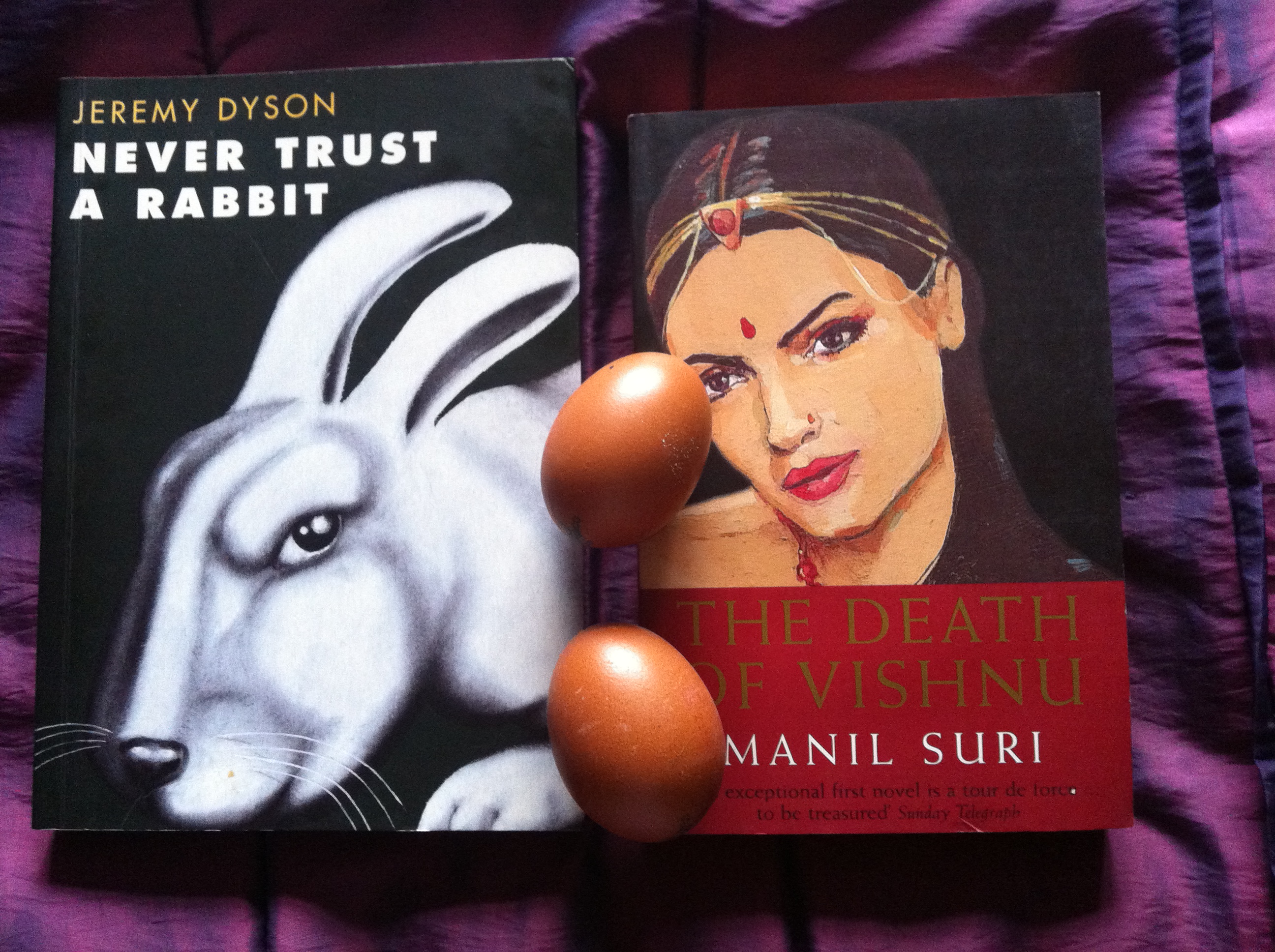
Firstly, Never Trust a Rabbit by Jeremy Dyson (Duck editions, 2000).  Dyson is one of the comedy quartet The League of Gentlemen.  I’m not sure how much success they had outside of the UK, so do forgive me if I’m about to tell you what you already know.  The League made three TV series set in the fictional village of Royston Vasey, where three of the four writers played various bizarre residents of the village (Dyson doesn’t enjoy appearing on screen).  They also made a feature film (The League of Gentlemen’s Apocalypse), in which they played themselves, and Michael Sheen played the role of Dyson.  The reason I mention the TV series is that is if you’re familiar with it, you’ll already have an idea of what to expect: the village production of The Sound of Music as directed by Dario Argento.  The book contains twelve short stories which present familiar situations but unnerve the reader as it gradually emerges that the reality we are dealing with is not exactly what we think we know.  My favourite was probably City Deep, set on the London Underground. It’s an environment I have to deal with regularly but that I try to avoid wherever possible, as I hate the idea of being trapped in a crowd in a tunnel underground.  Dyson perfectly captured the stifling, detached reality that the Tube offers and took it a step further, with a ghoulish, terrifying denouement that to a reluctant tube-user like myself seemed at once outrageous and entirely believable (the dark, hidden truth that I suspected was always there). But the stories aren’t resolutely parochial.  The longest story, The Engine of Desire, takes in several locations worldwide, as the sinister Jack Sleighmaker travels the globe to track down whatever item his extremely wealthy clients desire, by any means necessary.  Sleighmaker is an utterly reprehensible human being and his client is the equally despicable Prince Bandar, but Dyson’s writing is so well-paced and compelling that you find yourself reading on despite not rooting for any of the characters. I read this story in bed and found it so creepy I had to watch clips of kittens falling off things on YouTube before I could go to sleep.  The twelve stories in the collection are all equally strong, there are no weak links; they are also varied enough from one another to keep you entertained while still working together as a collection. (As a P.S to this, another member of The League is Mark Gatiss, whose novels about the gentleman spy Lucifer Box I discuss in the post “Having your book turned into a movie is like seeing your oxen turned into bouillon cubes” on 14 November 2012).

Secondly, The Death of Vishnu by Manil Suri. This novel tells the story of Vishnu, an odd-job man in a residential block, who sleeps on the landing, and now lies dying the same place.  An author’s note at the start of the novel tells you this is based on a true story: while the characters that surround Vishnu are fictional, Vishnu’s name, occupation, and the manner of his death are all true.  I’m still not sure how I feel about this: whether it seems cruel and uncaring, or whether as a Westerner I’m too used to seeing death made taboo, institutionalised and tucked away out of sight so we don’t have to deal with it or our own mortality, and to let a man die where he chooses, the place where he has always lived in full sight, is an acceptance of the process we all face.  The novel doesn’t offer easy answers, it instead presents things as they are and encourages us to recognise a common humanity, in its many guises.  Take the opening line: “Not wanting to arouse Vishnu in case he hadn’t died yet, Mrs Asrani tiptoed down to the third step above the landing on which he lived, teakettle in hand.” On the one hand this shows consideration, on the other, Mrs Asrani doesn’t want to wake Vishnu up because she doesn’t want to deal with him.  Things are not clearly defined in the novel, the characters are all flawed (Vishnu is an alcoholic who is bribed into doing his work by the residents) but they are fully drawn and entirely believable.  We learn about the residents of the block and their various intrigues, and about Vishnu himself as the ordinary events of the day mingle with his reminiscences about his life.  It seems apt to include his memory of Holi, as last week was Holi week:

“The light shines through the landing window. It plays on Vishnu’s face. It passes through his closed eyelids and whispers to him in red.  The red is everywhere, blanketing the ground, coloring the breeze.  It must be the red of Holi. He is nine, hiding behind a tree, fistfuls of red powder in each hand.”

The Death of Vishnu is beautifully written but in a simple style that allows the characters to breathe and readers to find their own way amongst them.

Here are the books with some non-chocolate eggs, so if you share Hitchcock’s phobia look away now:

Image

“It’s always funny until someone gets hurt. Then it’s just hilarious.” (Bill Hicks)

I try to post once a week, and failed totally to do so last week.  This means the post I planned on funny books, to coincide with Comic Relief , was oh-so-topical last week but now is about as current as Christmas.  What the hell, I won’t let my ineptitude deter me from my course.  I’ve written in a previous post about my friend H insisting on lending me light reads, this week I’m going to look at two more books H hopes will encourage me to relinquish my default solemnity and embrace the sunny side of life (particularly difficult here in the UK at the moment as Spring refuses to be sprung and it’s snowing. There’s even talk of a white Easter, which is so unnecessary). I’m concerned this post is self-defeating, because humour is so personal that whether or not I found something funny is really irrelevant as to whether anyone else finds it funny, but let’s crash onwards, and hopefully I’ll be able to give you an idea of whether you want to read the novels or not.  Probably I should stop thinking about it all so seriously!

Firstly Small World by David Lodge (1984, Penguin).  H lent this to me because I am one of those nerds unable to function in the real world so I keep holing up in universities, refusing to leave until I develop book-fanciers lung (which is a disease I think I’ve just invented) from hanging out in libraries the entire time. Well, everyone needs a life plan….  So, Small World is set amongst academia, and mainly derives its humour from its portrayal of vain, self-serving academics competing with each other for a Chair of literary criticism post that only exists virtually – they don’t have to do any work for it, deliver lectures, or even use an office.  This forms the background to series of conferences where the cast of characters intermingle, bitch, gossip and have sex with one another. The nearest character to a hero is Persse McGarrigle, a ridiculously idealistic post-graduate who has spent too much time in books and too little in the real world (I obviously have no idea what that’s like). His thesis is on Shakespeare’s influence on Eliot, then on a whim he tells his fellow academics that its actually about Eliot’s influence on Shakespeare, a preposterous notion which rather than ridiculing, they all get terribly excited about. And so the foibles of contemporary academia are astutely satirised.  I say contemporary because although it was written in 1984, the following sentence convinced me of its relevance:

“How gratifying to encounter, in the dreary desert of contemporary criticism, an exponent of that noble tradition of humane learning, of robust common sense and simple enjoyment of great books.”

Unlike references to long-deceased shop chains like Rumbelows and Sketchleys, and Persse being completely confused as to what a karaoke bar is, this part of the book doesn’t seem to have dated at all.  Much as I enjoy my study (and therefore keep returning to it), many is the time I’ve sat in tutorials wishing I could just state that I liked something, without placing it in its post-modern, post-feminist, post-post-post framework to deconstruct its meaning to the point where you start to doubt your own sanity and whether you even know what a book is.

I have to admit I didn’t love Small World, I thought it was clever rather than funny, and it didn’t really engage me, but if you are involved in any sort of academia I’m sure you will recognise the characters and university politics and derive a few wry smiles of recognition at the very least.

But as I planned for the blog to be celebratory rather critical (and keep getting knocked off this course by the books H lends me, I may have to stop reading them, or at least stop blogging about them) I would like to balance this out by flagging up that David Lodge is an insightful critic as well as a novelist, and I highly recommend his The Art of Fiction. Each chapter takes a topic around creating fiction and uses an example as a discussion point, for example Defamiliarisation in Charlotte Bronte, Intertextuality in Conrad, and so on.  It’s really accessible, readable way of beginning to explore ideas, written in a non-pretentious way that his characters in Small World would be incapable of.

But The Art of Fiction is not fiction itself, and so I return to my second choice of novel, The Eyre Affair by Jasper Fforde (Hodder & Stoughton 2001). This was Fforde’s first novel featuring his heroine detective, Thursday Next.  If you think that’s a bad name pun, here are a few more: Millon De Floss; Jack Schitt; Landen Parke-Laine (a British monopoly pun “land on Park Lane” which perhaps doesn’t translate as well as the others) and many more.  As the pun Millon De Floss shows, this is a silly, fun book for literature lovers.  The Eyre of the title is Jane, and in an alternative 1985, Thursday has to defeat the evil Acheron Hades (great name) who is taking first editions of books and removing characters from them, causing all subsequent copies of the story to change.  Thursday pursues him into Jane Eyre (literally, she enters the story), where she has to stop him wiping out the heroine of one of her favourite novels without changing the story herself.  Things don’t go exactly to plan, but then Jane Eyre in Thursday’s world doesn’t have the ending we know and love….

The story is great fun, and if you love literature there are plenty of jokes to enjoy.  Thursday works as a literary detective, and this is a world where literature is taken very seriously. Teenagers swop Fielding cards:

““I’ll swop you one Sophia for an Amelia.”

“Piss off!” replied his friend indignantly.  “If you want Sophia you’re going to have to give me an Allworthy plus a Tom Jones, as well as the Amelia!”

His friend, realising the rarity of a Sophia, reluctantly agreed.”

The literary dedication of the populace continues into adulthood, such as when the Baconians, a group concerned with proving Shakespeare didn’t write Shakespeare, have their meeting fire-bombed by the radical splinter group, the New Marlovians.

The idea of characters being kidnapped from fiction works really well, as Fforde is able to use examples of characters that are abandoned by their authors to support the premise.  For example, Christopher Sly, the drunkard from the start of The Taming of the Shrew, has been found “wandering in a confused state just outside Warwick”.  He did disappear from the play, so maybe he was kidnapped in this world also?!

There is a feel of The Hitchhikers Guide to the Galaxy about The Eyre Affair and if you enjoy Douglas Adams I think you’ll enjoy this. It’s very clever but it’s not out to prove its own cleverness, and while it could have done with a slightly more heavy-handed editor in places, The Eyre Affair is a pacey, joyous tale about what happens when characters really come alive. And if H is reading this: success!  It made me laugh, my friend.

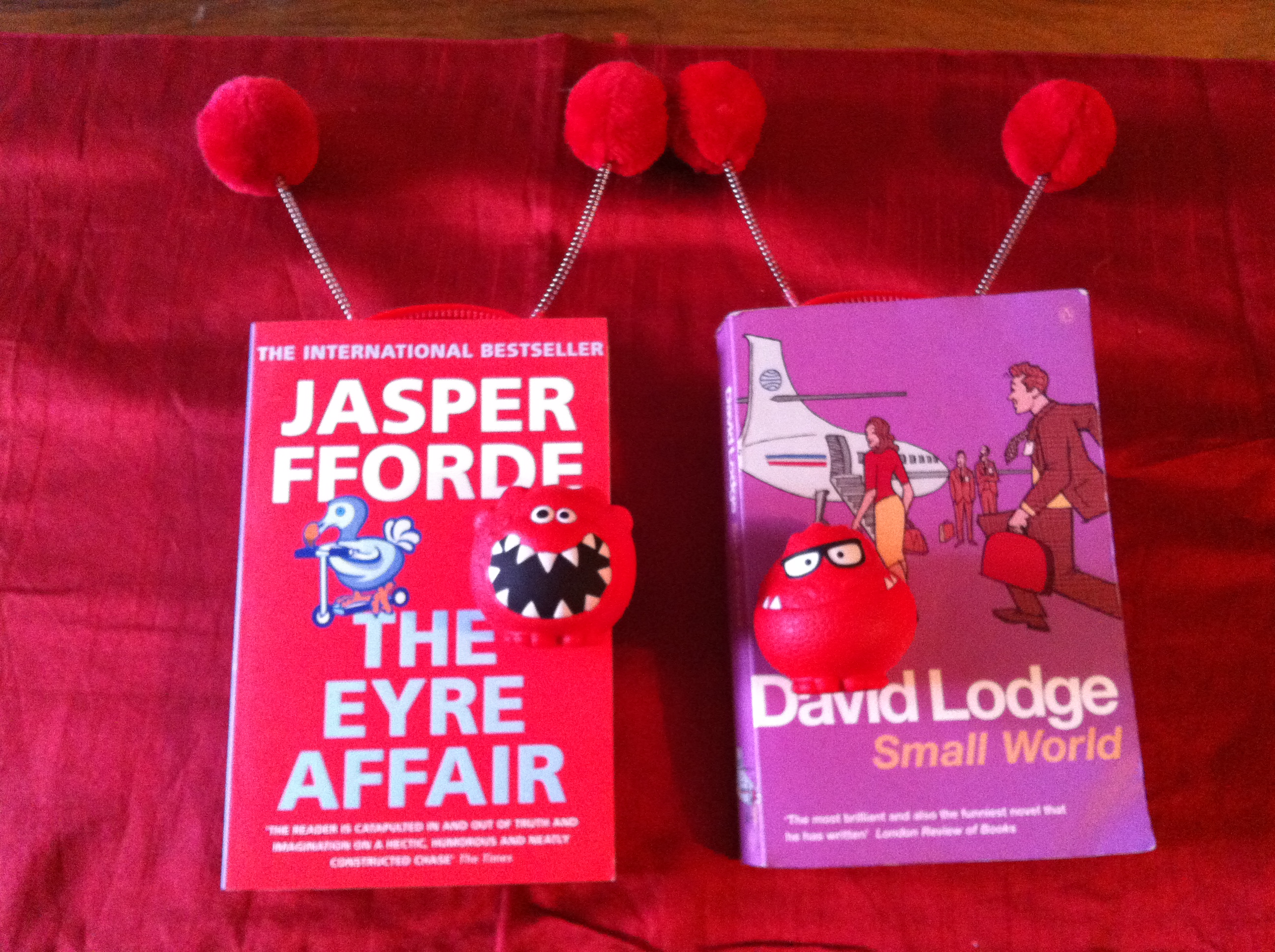
Here are the books doing their bit for Comic Relief by donning this year’s deelyboppers and red noses:

Image

“All women become like their mothers. That is their tragedy. No man does. That’s his.” (Oscar Wilde)

I inherited all the great loves of my life from my mother: literature, the theatre, film, Islay single malt whisky, and cheese that will blow out your nasal passages from 50 metres. We don’t agree on everything: Kris Kristofferson remains an enduring source of contention (me: total  1970s love god, have you seen A Star is Born? She: eyes are too small. Neither of us is willing to back down.) These enormous differences aside, we get on pretty well, and so Mother’s Day is a source of celebration in my family.  In the UK Mother’s Day is 10 March (for once I’ve managed to post on time, in fact a day early as tomorrow will be spent cooking up a feast for the family), so to any of you who aren’t from the UK, Ireland or Nigeria (ie where Mother’s Day is the 4th Sunday in Lent), I apologise and ask that you view this as a postponed/pre-emptive post depending on when Mother’s Day occurs for you. I’ve chosen one book written about a mother from the point of view of a child, and one written from a mother to her child.  Both merge fiction with biography and contain significant sadness, but both are about the triumph of the human spirit. Well, mother-child relationships can be among the most complex…

Firstly, a novel that my English teacher at school thought was very nearly perfectly written: Oranges Are Not the Only Fruit by Jeanette Winterson (1985, my copy Vintage, 1991).  Oranges tells the story of Jeanette, who grows up in an evangelical household in the north of England.  Her mother is a strong, dominant and domineering woman who initially believes Jeanette will help her in her idiosyncratic crusade against sin.  As Jeanette gets older, she realises she is attracted to women, and acts on this.  Her refusal to subdue who she is to the will of her mother leads to a failed religious intervention (almost exorcism) and eventually a breakdown in their relationship.  If this sounds utterly heavy and depressing, let me assure you it’s not.  Humour runs throughout the whole of Oranges, a gentle prodding at the absurdity of life:

““You can always tell a good woman by her sandwiches,” declared Pastor Finch.

My mother blushed.

Then he turned to me and said, “How old are you, little girl?”

“Seven.” I replied.

“Ah, seven,” he muttered. “How blessed, the seven days of creation, the seven branched candlestick, the seven seals.”

(Seven seals? I had not yet reached the Revelation in my directed reading, and I thought he meant some Old Testament amphibians I had overlooked….)

…”Yes,” he went on, “how blessed,” then his brow clouded. “But how cursed.” At this word his fist hit the table and catapulted a cheese sandwich into the collection bag;”

The narrative is interspersed with a fairytale that echoes the main narrative. This serves to broaden the perspective away from its immediate setting, and emphasise that while it is a unique story that is being told, it is also something familiar to us all, a fable.  We may not all be northern English, evangelical Christian and gay, but, in the words of the author:

“Everyone, at some time in their life, must choose whether to stay with a ready-made world that may be safe but is also limiting, or to push forward, often past the frontiers of commonsense, into a personal place, unknown and untried.”

Oranges is fantastically well written (when the author was just 24) and succeeds in being challenging and complex, but also easy to read and reassuring.  The language is poetic and exacting but never overblown:

“We lived in a town stolen from the valleys, a huddled place full of chimneys and little shops and back-to-back houses with no gardens. The hills surrounded us, and our own swept out into the Pennines, broken now and again with a farm or a relic from the war. There used to be a lot of old tanks but the council took them away.”

Oranges is one of my favourite books by one of my favourite authors and so of course, I highly recommend it.  The author was asked if it was autobiographical.  Her answer: “No not at all and yes of course.”  For those of you who enjoy it, I also recommend Why Be Happy when you Could Be Normal?,  Jeanette Winterson’s autobiography, (the title taken from a question her mother asked her when she came out) which shows the story behind Oranges, and also beyond it.

Secondly, Paula by Isabel Allende (1994, my copy Flamingo, 1995 trans. Margaret Sayers Peden). Tragically, in 1991, Isabel Allende’s 28 year old daughter Paula fell into a coma caused by porphyria, and died in 1992 having never recovered. Paula is the story Allende writes for her daughter as she waits for her in the hospital, bringing her novelist’s sensibilities to the story of her family’s life:

“Listen, Paula. I am going to tell you a story, so that when you wake up you will not feel so lost. The legend of our family begins at the end of the last century, when a robust Basque sailor disembarked on the coast of Chile with his mother’s reliquary strung around his neck and his head swimming with plans for greatness.”

Those of you who enjoy Allende’s fiction will find the same style here, and some very recognisable characters from The House of the Spirits. Allende writes vividly and with love of and for her family past and present.

“[Your grandmother] was drinking cheap pisco, and hiding the bottles in strategic places.  You Paula, who loved her with infinite compassion, discovered the hiding places one by one and without a word carried off the empty bottles and buried them amongst the dahlias in the garden.”

“Celia and Nicolas have asked me to come home to California for the arrival of their baby in May. They want me to take part in the birth of my granddaughter; they say after so many months of being exposed to death, pain, farewells, and tears, it will be a celebration to welcome this infant as her head thrusts into life. If the visions I had in dreams come true, as they have in other times, she will be a dark-haired, likeable little girl , with a will of her own. You must get better soon, Paula, so you can go home with me and be Andrea’s godmother.”

Time is not linear or earthbound in Paula, as the family’s past, present and spirits all exist in a mother’s story, evoked in a hospital room. The final third of the book sees Allende stop talking to Paula and instead speak to the reader, as she loses hope that her daughter will recover.   However, the death of her daughter is not an irretrievable loss for Allende who has an acute awareness of the afterlife and sees her family around her whether they are alive or dead.

“She died in my arms, surrounded by her family, the thoughts of those absent, and the spirits of her ancestors who had come to her aid. She died with the same perfect grace that characterised all the acts of her life.”

Paula is a hugely affecting narrative of one of the hardest experiences a mother can live through, but ultimately the enormity of the familial love that surrounds Paula is the strongest force, and this makes it a great Mother’s Day read.

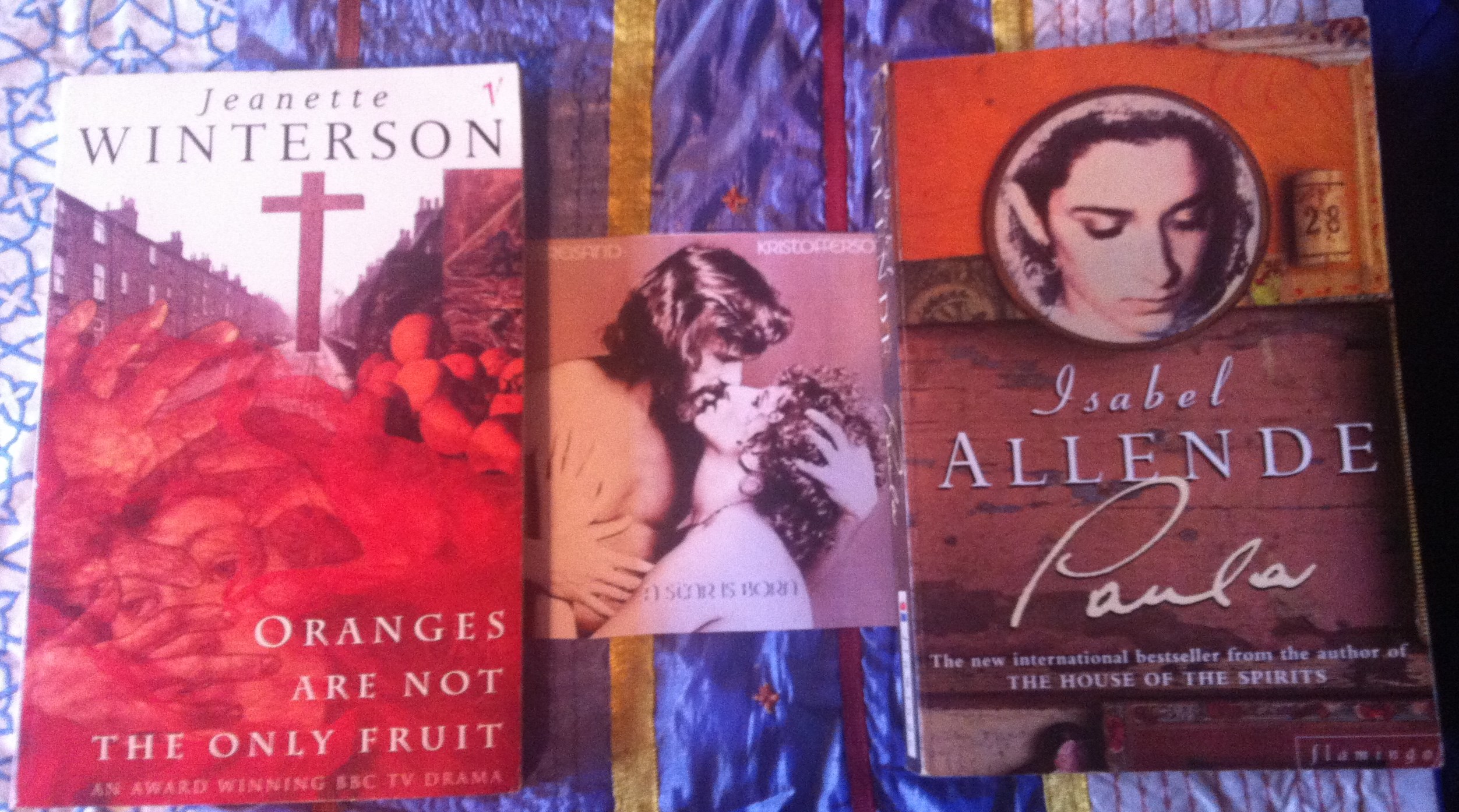
Here are the books alongside the gorgeous Kris.  To my mother I say, Happy Mother’s Day, Maman, and I hope titling this post with a quote from your beloved Oscar compensates for my insistence on presence of Mr Kristofferson.  And yes, I am planning a substantial cheese plate for the meal tomorrow, don’t worry….

Image

“We look before and after, and pine for what is not” (Percy Bysshe Shelley)

My lovely friend H feels I take life too seriously & this is reflected in my choice of reading matter.  As such, she keeps lending me light reads in the hope that I’ll chill out & stop living my life like I’m a some sort of doomed Hardy heroine (which I dispute: I harbour no plans to start bedding down at Stonehenge.  Far too cold, I prefer central heating. Probably just as well as they’ve restricted access to the monument now.) But because she is a good friend & I love her (and she’s probably right in general), I read the books she gives me.  This week it was Death Comes to Pemberley by PD James (Faber & Faber, 2011), so I decided to write about it here, making the theme of the post prequels and sequels.

Death Comes to Pemberley is a sequel to Pride and Prejudice, set 6 years after the end of Austen’s novel, where Darcy & Elizabeth are happily married with 2 sons. I’m not a big crime reader, so I hadn’t read any PD James before, but I know crime aficionados who highly rate her.  To me the crime element of this novel was its weakest link – the plot was very slight and there’s no detective work as such, the crime is solved as the murderer confesses.  But I never wanted to blog about books in a critiquing way, so I’ll stop and look at what is to celebrate, as I planned.  James has great fun with the concept of a sequel to Pride and Prejudice, with comments on the backstory like: “If this were fiction, could even the most brilliant novelist contrive to make credible so short a period in which pride had been subdued and prejudice overcome?” (Answer: Yes).  She also explains potential problems in the original, like why Darcy’s first proposal and following letter were so rude (he was trying to make Elizabeth hate him so he wouldn’t have to deal with his attraction to her).  Whether or not you like this explanation depends on how you’ve read the original, and while it’s a shame to pad out the room for interpretation which helps readers feel a sense of ownership over a novel, James is as entitled to her view as anyone else. She is obviously a huge fan of Austen and characters from Emma also make an appearance thorough a verbal report: a child is adopted by Mrs Harriet Martin nee Smith, friend of Mrs Knightley.

Part of modern scholarship on Austen is to look at what is hidden in her work: the slavery hinted at in Mansfield Park, for example. Writing from a 21st century perspective, James can make explicit certain factors like feminism and the Napoleonic War which readers today may pick up on but are only shadows in Austen’s works:

“We have entered the nineteenth century; we do not need to be a disciple of Mrs Wollstonecraft to feel that women should not be denied a voice in matters that concern them.  It is some centuries since we accepted that a woman has a soul. Is it not time that we accepted that she also has a mind?”

“The war with France, declared the previous May, was already producing unrest and poverty; the cost of bread had risen and the harvest was poor. Darcy was much engaged in the relief of his tenants ..”

In this way James’ novel offers a chance to view well-known characters in more well-rounded way, taking into account their social and political circumstances in a wider perspective, beyond that of the Regency marriage market.  However, and I realise this is an obvious point so I won’t linger on it, PD James is not Jane Austen, and as such the novel reads a bit flat.  The effervescent wit is gone and there’s not really anything to replace it.

It was a brave decision that James made with Death Comes to Pemberley, as writing a sequel to Pride and Prejudice is really a thankless task.  Austen and her characters are so greatly loved I doubt any author other than Austen herself could do them justice.  While placing them in genre fiction like crime is probably a good idea so that its clear you’re working within conventions other than those of the original novel, I can’t help feeling that Death Comes to Pemberley may prove disappointing for both crime fans and Austen fans.

For the prequel part of this post I’ve chosen probably the most well-known of all prequels: Wide Sargasso Sea by Jean Rhys (1966, my copy Penguin 1993). Wide Sargasso Sea looks at the events that occurred prior to Jane Eyre, and how Rochester’s first wife became the madwoman in the attic. Rochester marries the Creole heiress Antoinette Cosway in the Carribean.  There is a strong sexual attraction between them as Rochester describes:

“Only the sun was there to keep us company. We shut him out. And why not? Very soon she was as eager for what’s called loving as I was – more lost and drowned afterwards.”

But this is not enough to cover the differences between them “It was all very brightly coloured, very strange, but it meant nothing to me. Nor did she, the girl I was to marry.” and the cracks in their marriage soon start to appear, with distrust, jealousy and violence on both sides.  The result of this we already know…

What happens to Antoinette is a commentary on both men’s exertion of power over women, and the coloniser’s power over the colonised.  Rhys takes the “other” of Jane Eyre and gives her a voice, placing us alongside Antoinette and showed how flawed and racist notions of “other” are.  Rochester, the rich white Englishman, seeks to control Antoinette and does so by renaming her and confining her – the parallels with slavery are clear.  As a woman, she is also subjugated by a society that is on Rochester’s side:

“When a man don’t love you, more you try, more he hate you, man like that…”

“I cannot go…I am not rich now, I have no money of my own at all, everything I had belongs to him…that is English law”

However, by giving the narrative voice to Rochester as well as Antoinette, Rhys ensures a balance to Wide Sargasso Sea that means you can’t write it off as limited perspective polemic. It has had a huge influence on how Jane Eyre is read, and I think this is because it is so sensitive and subtle a reading and portrayal of the characters.  Rhys succeeds in creating a backstory that is wholly believable and recasts the frames of reference through which Jane Eyre is viewed, without ever undermining the original work.  This can be seen in interpretations such as the BBC’s 2006 version of Jane Eyre which emphasised Bertha’s (as she is then named) sexuality, associated her with the colour red as in Wide Sargasso Sea, and had her played by the beautiful Claudia Coulter to make Rochester’s physical attraction to her easy to understand (the BBC also filmed a version of Wide Sargasso Sea the same year). The fact that Sandra Gilbert and Susan Gubar’s behemoth of feminist literary criticism took the title The Madwoman in the Attic (1979, Yale University Press) shows how the character of Bertha (and characters like her) are being reassessed, and I think it’s reasonable to assume Wide Sargasso Sea played no small part in that.  Unlike Death Comes to Pemberley, Wide Sargasso Sea stands alone as a great novel, and simultaneously hugely enhances reading the source work.  I recommend the latter unreservedly, and the former as a point of interest and a quick, throwaway read.

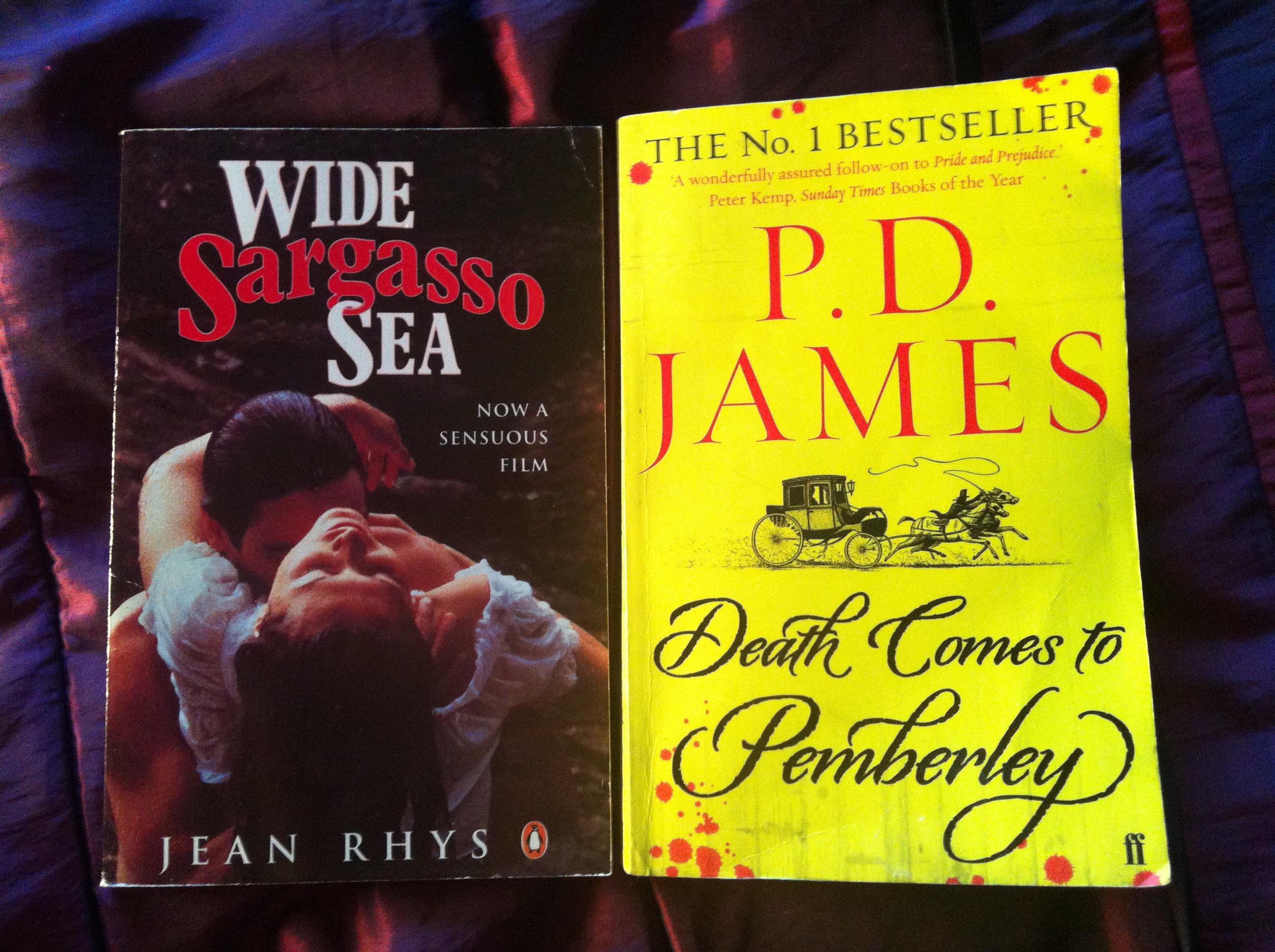
I was wondering how to photograph the books in a way that represented the theme, then as I looked at the covers I realised they sort of represented a before and after already – la petite mort followed, inevitably, by le grande mort.  What a depressing note to end on – I think H has got her work cut out…….

Image

“Take a good book to bed with you – books do not snore.” (Thea Dorn)

A couple of weeks ago I read an interview with Ricky Gervais in which he explained that, despite his partner being a novelist, he had only read one book, The Catcher in the Rye.  This got me thinking, if as a bibliophile you meet a bibliophobe, and they ask you for a recommendation, where would you even begin?  Of course, the answer is to go with what you know they’re interested in: the fantasy-lover starts with Tolkien, a seasoned traveller with the literature of a land they love, the feminist with Jong (who’s funny as well, I can’t help thinking it’s probably a good idea to go for funny when dipping a toe in the waters of literature, humour so often makes things seem accessible).  That’s the thing – you want it to be accessible.  Because why haven’t they discovered the joy of reading?  (And I really think this is something anyone can experience). Probably they’ve been given the wrong things to read (stuff they’re not interested in), or taught badly, and told there is “good” and “bad” literature.  I can’t stand this type of snobbery.  If you like it, then it’s worth reading. At the same time, you’d want to give your eager bibliophobe something you felt was well written enough to open their eyes to what books can offer.  Somewhere between the two extremes of rending your garments, wailing “I can’t believe you’ve never read Proust!” and half-heartedly tossing the latest celebrity embryo’s autobiography in their direction is probably the ground you want to occupy. So…we’re looking for something well written but accessible, funny but thought provoking, something that you can almost guarantee they’ll like as it speaks to everyone…I’ve got it.  The answer’s staring me in the face.  It’s The Catcher in the Rye.

OK – Salinger seems to have ensured this is my shortest post ever.  But I’ll go on to discuss two more books anyway.  I’m not suggesting these are where everyone should start, or that these are the greatest books ever written, because I don’t want to get into that “Oh, you simply must read…” snobbery that this theme dangerously skirts around.  I’ve chosen them because they both have something in common with The Catcher in the Rye, and they’re both books that I know people who aren’t big readers have read and enjoyed.

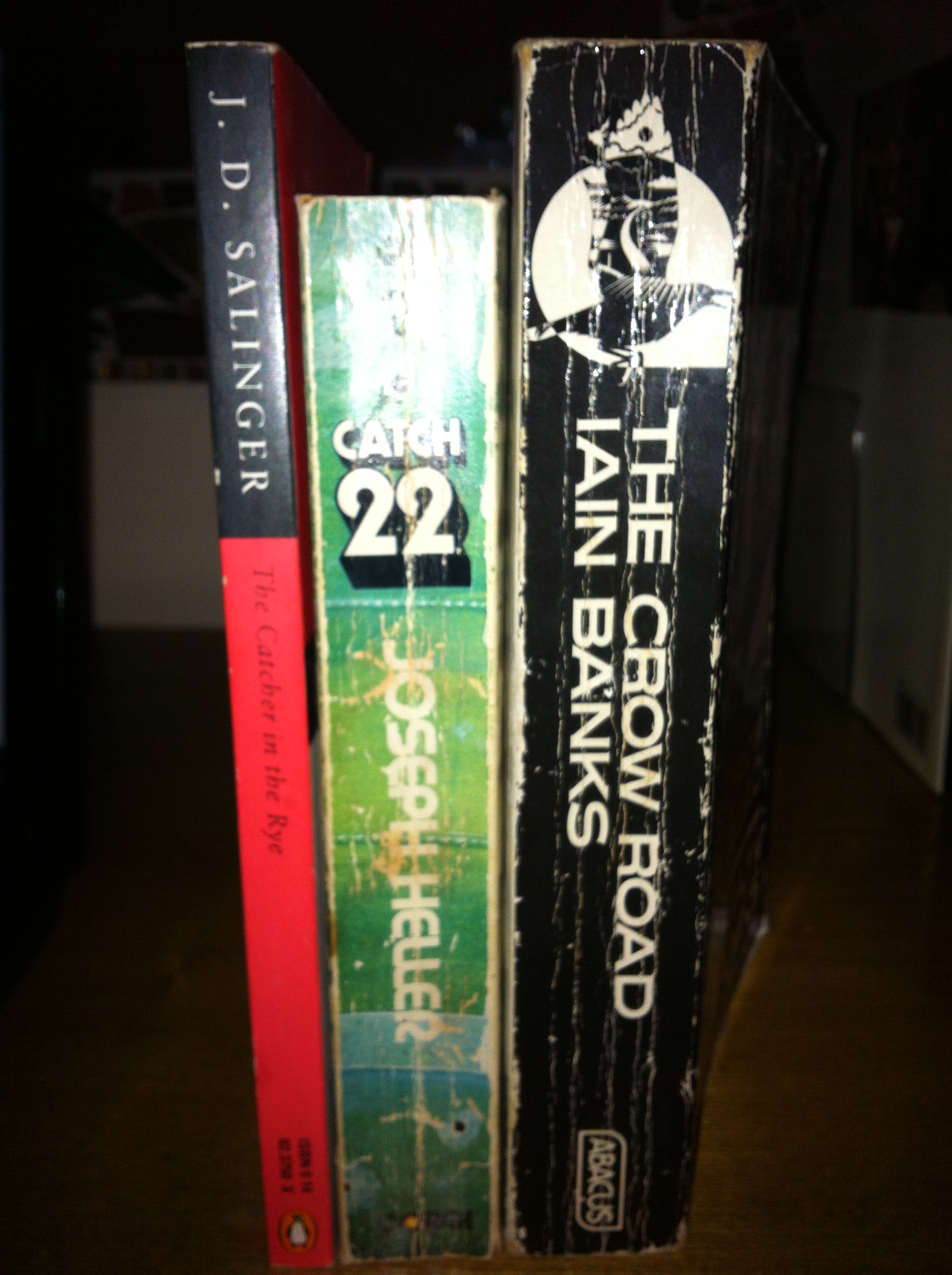
Firstly, Catch-22 by Joseph Heller (1961, my copy Corgi, 1974):

Well written?   Accessible?

I think the fact that the concept of a Catch-22 situation is so understood and constantly referred to (to such an extent that I don’t feel the need to define it when writing this) shows how brilliantly Heller has captured something people identify with and find meaningful.  The wide range of readers shows its accessibility, the pervasiveness of the concept shows how smart it is.

Funny?

So funny – you have to read this novel.  It’s silly: one of the characters is called Major Major Major Major.  It’s dry: “What the hell kind of a name is Yossarian?” Lieutenant Scheisskopf had the facts at his fingertips.  “It’s Yossarian’s name, sir.” It’s scathing: “The enemy,” retorted Yossarian with weighted precision, “is anybody who’s going to get you killed, no matter which side he’s on, and that includes Colonel Cathcart. And don’t you forget that, because the longer you remember it, the longer you might live.”

Thought-provoking?

OK – here’s the definition: “Orr would be crazy to fly more missions and sane if he didn’t, but if he was sane, he had to fly them. If he flew them, he was crazy and didn’t have to; but if he didn’t want to, he was sane and had to. Yossarian was moved very deeply by the absolute simplicity of this clause of Catch-22 and let out a respectful whistle.”

It’s hugely thought-provoking about the madness of war, the impartial cruelty of bureaucracy, the struggle of an individual against power structures that try to oppress…about so many things, and sadly it hasn’t dated.

Things in common with The Catcher in the Rye – Written around the same time but published 10 years apart (as Heller spent seven years writing the novel) both consider themes of alienation within and cynicism about contemporary Western society. Both made Time’s list of the 100 best modern English-language novels ; both were rated by Modern Library as amongst the 100 best English-language novels of the 20th century. Apparently it’s sold 10 million copies. Surely Time, Modern Library and 10 million people can’t all be wrong? I can’t help thinking Yossarian would snort with derision in answer to that question…

Secondly, The Crow Road by Iain Banks (1992, Abacus, my copy 1996):

Well written? Accessible?

Iain Banks is great at creating highly readable, plot-driven narratives that you can fly through. At the same time, this means it’s easy to overlook how beautifully he writes, without superfluity:

“Pencil-thin and nearly as leaden, the tall and still dramatically black-haired Mr Blawke was dressed somewhere in the high nines, sporting a dark grey double-breasted suit over a memorable purple waistcoat that took its inspiration from what looked like Mandelbrot but might more charitably have been Paisley.  A glittering gold fob watch the size of a small frying pan was anchored in the shallows of one waistcoat pocket by a bulk-carrier grade chain. Mr Blawke always reminded me of a heron; I’m not sure why.  Something to do with the sense of rapacious stillness perhaps, and also the aura of one who knows that time is on his side.”

“The rain fell with that impression of gentle remorselessness west coast rain sometimes appears to possess when it has already been raining for some days and might well go on raining for several days more.  It dissolved the sky-line, obliterated the view of the distant trees, and continually roughed the flat surface of the loch with a thousand tiny impacts each moment, every spreading circle intersecting, interfering and disappearing in the noise and clutter of their successors.  It sounded most loud as it pattered on the hoods of their jackets.

“Ken, are sure fish are going to bite in this weather?””

Funny?

Hopefully that’s apparent already.  There’s also no better example than the opening line, see below.

Thought-provoking?

Not in the way that The Catcher in the Rye and Catch-22 are, perhaps.  Those are novels that use their outrage to force the reader to confront uncomfortable truths about the world we live in.  The Crow Road doesn’t have this driving force, but as the narrator, Prentice, tries to find out what happened to his Uncle Rory who disappeared without a trace, he exposes the fault lines that run through the family.  While most families may not have such dramatic occurrences within them as those in The Crow Road, it does have something to say about how those we are nearest to are also those it can be hardest to communicate with, and that the ones we love the most can be the ones we hurt the most.

Things in common with The Catcher in the Rye – Fantastic opening line: “It was the day my grandmother exploded.” Tell me you don’t want to keep reading after that?  And brilliantly, it distils into a few words so much about the story that will follow: it will be about family and death, it will be unnerving, absurd and funny.

I hope that whether you are a bibliophile or bibliophobe (probably the former as you’re reading this in the first place), I’ve convinced you to give these novels a try.

Sadly, reading brilliantly inventive fiction is no guarantee that you will become brilliantly inventive yourself.  I couldn’t think of a unique way of presenting these books, so here they are, unadorned, nothing phony – I hope Holden Caulfield would approve.

Image

“One can no more approach people without love than one can approach bees without care. Such is the quality of bees” (Leo Tolstoy)

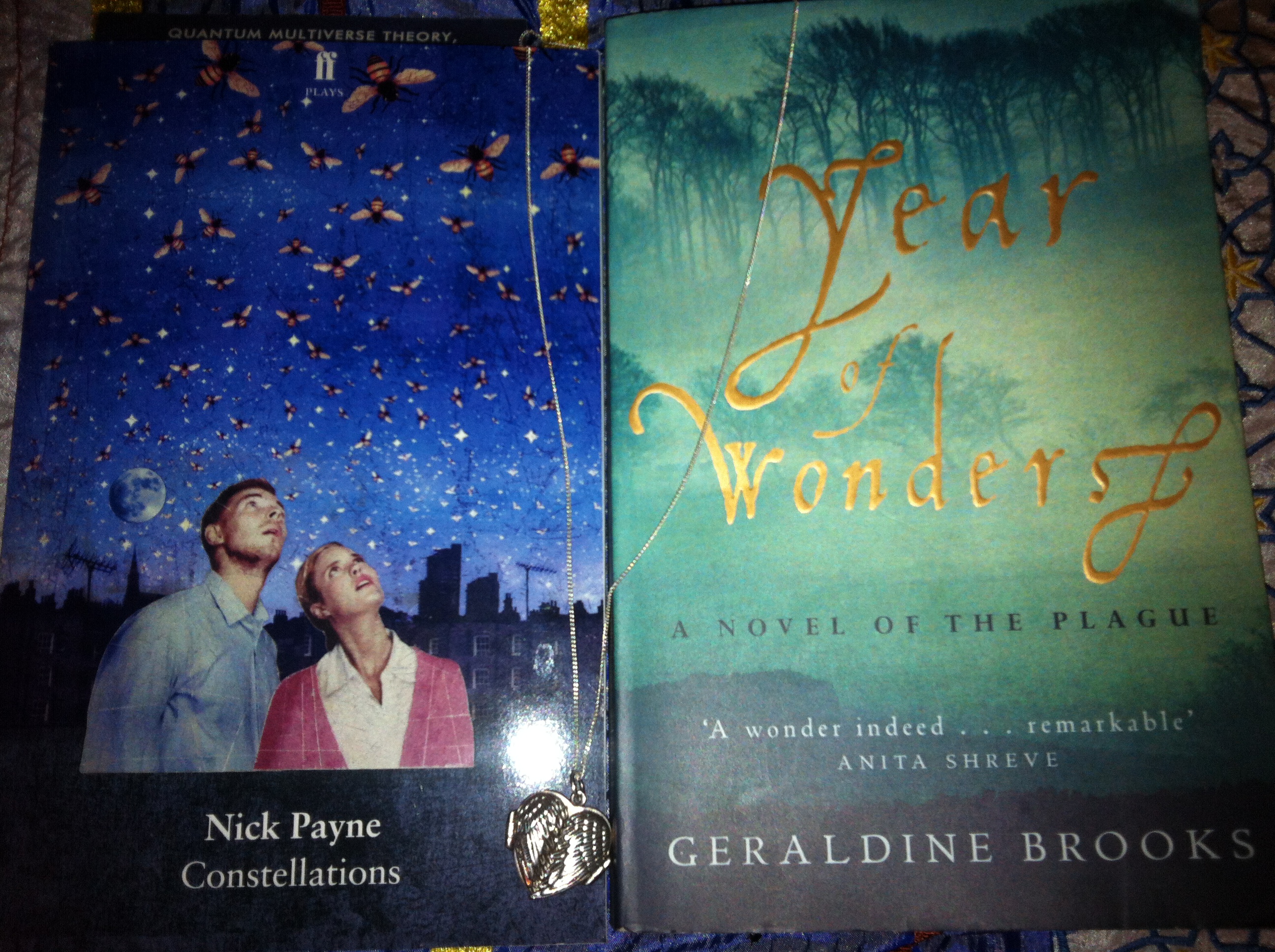
Happy Valentine’s Day!  I’m late as usual, but I hope you spent the day feeling loved/with loved ones, whether it was with a romantic partner, friends, family or simply re-reading David Gandy by Dolce and Gabanna (don’t judge me).  For those of you feeling a bit unloved, may I suggest a dog? There are loads that need rescuing, and they will provide unconditional adoration and support.  Picking up excrement in public with a hand clothed in a plastic bag is a small price to pay in return (note: this only applies to dogs.  If a human being offers you adoration in return for picking up their poo, it’s totally not worth it.  Unless you enjoy that sort of thing, in which case, Congrats! You’ve found your soulmate). Anyhow, in much the same way that this post seems to have been hijacked by doggy-do, Valentine’s Day has been hijacked by romance.  According to the ever-reliable Wikipedia, as well as being the patron saint of affianced couples, happy marriages and love, St Valentine is also the saint for bee keepers, plague, epilepsy and against fainting (it’s about time someone took a stand against impromptu unconsciousness).  So for this Valentine’s post I’m going to look at a play featuring a bee-keeper and a novel about the plague – who needs love?  (Not me, I’ve got David Gandy by Dolce and Gabanna).

Firstly, Constellations by Nick Payne (Faber & Faber 2012).  I know reading a play is secondary to seeing it performed, and also that sometimes reading plays can feel secondary to reading a novel, a form written to be read.  But I think it’s worth doing.  Theatre can be prohibitively expensive, and depends on you being able to see the performance within a set period at a location you can reach.  These factors can mean you never make it to the show.  Reading the playtext enables engagement with the art (sorry, I couldn’t think how else to phrase that, I know it sounds affected, sorry, sorry) even if you never set foot in the theatre.  I saw Constellations performed, and it was astounding.  Reading the playtext doesn’t give you Rafe Spall’s and Sally Hawkins’ brilliant comic timing and emotionally nuanced performances, nor does it show you Tom Scutt’s beautiful design.  But it does give you the characters, the plot, the language.

Marianne and Roland meet and fall in love.  They meet and never see each other again.  They meet and date.  It goes well, it goes badly. They split up.  They stay together.  Roland keeps bees and sells honey.  Marianne is a theoretical early universe cosmologist.  Which is handy, as she can explain multiverse theory as we watch all the possibilities of their relationship played out across multiple universes:

“In the quantum multiverse, every choice, every decision you’ve ever and never made exists in an unimaginably vast ensemble of parallel universes”

Scenes are played out with minute changes and big changes, and the skill of Nick Payne’s writing ensures this stays fresh.  The layering of scenes on top of each other means we end up with a great depth of understanding of the characters, seeing how the same person can react differently given only slight changes in circumstance.  It does mean however, that it’s difficult to give you a quote from the play, as the dialogue really gains meaning within the set of scenes and the play as a whole.  What I’ll give you, as it’s Valentine’s day, is part of Roland’s proposal speech (that’s not a spoiler, as its only one of the many possible outcomes…)

“…in a strange sort of way I’m jealous of the humble honey bee and their quiet elegance. If only our existence were that simple. If only we could understand why it is that we’re here and what it is that we’re meant to spend our lives doing. I am uncertain when it comes to a great many things. But there is now one thing that I am defiantly certain of….Marianne Aubele, will you marry me?”

Yes, Constellations is romantic.  But looking at all the possible outcomes means it is resolutely realistic as well, despite the unreality of watching a multiverse romance from our monoverse (is that a word?) perspective.  Throughout the different multiverses one event recurs again and again, unchanging.  This underpins all the variations and creates a dramatic tension, pulling the characters towards a single conclusion.  Even if you don’t usually read plays, I highly recommend you give the inventive and thought-provoking Constellations a shot (in at least this one of the many multiverses, you’ve got all the others in which to totally ignore me…)

Secondly, Year of Wonders by Geraldine Brooks (4th estate, 2001).  Based on the true story of the village of Eyam, it tells the story of a village that chose to quarantine itself from the outside world in 1666 when plague struck.  The narrator of the story is Anna, a young woman who loses her family and watches the village assaulted in body, mind and spirit, as the disease and its consequences takes its toll.  Everyday life in extraordinary circumstances is sensitively described, such as when Anna starts acting a midwife for the village:

“Randoll burst through the blanket-door when he heard his lusty son, and his big miner’s hand fluttered like a moth from the damp head of the babe to his wife’s flushed cheek and back again, as if he didn’t know which of them he most wanted to touch… We laughed. And, for an hour, in that season of death, we celebrated a life…But even in the midst of that joy, I knew that I would have to leave the babe nursing at his mother’s breast and return to my own cottage, silent and empty, where the only sound that would greet me would be the phantom echoes of my own boys’ infant cries.”

At the time of the plague, Britain was caught between an age of religion and an age of science, and the villagers struggle between these two forces as they try to find an explanation for what they endure.  In that year witchcraft, madness and illicit passions stalk the village while wild justice is meted out.  By the time the year ends, every inhabitant of the village is hugely, irrevocably changed.  But in the midst of the tragedies, there are miracles.

Geraldine Brooks never lets her research get in the way of the story as you sometimes find with historical novels, and the balance between historical detail and narrative drive creates a novel that is both vivid and gripping.

Bees and bubonic plague – feel the love, people……….

Image

“It is the test of a novel writer’s art that he conceal his snake-in-the-grass; but the reader may be sure that it is always there.” (Anthony Trollope)

Happy Chinese New Year!  This year is the Year of the Snake, so I chose a snake related quote to start, and had originally planned to take a snakey, not-too-obvious look at literature for Chinese New Year, but sadly my brain failed me.  So I’ve gone the more obvious route of choosing two authors of Chinese origin; there are two great novels and I hope you like them.  (I had intended to be much more timely and publish this post on 10 February, but with a belly full of celebratory Peking duck and seafood noodles working their soporific effect, I failed in this also.  So far it’s fair to say that the year of the snake is not off to a flying start with me).

Firstly, A Concise Chinese-English Dictionary for Lovers by Xiaolu Guo (Vintage 2007).  The female protagonist of the novel, Z (because the Brits can’t pronounce Zhuang), arrives in London speaking minimal English.  Over the course of a year in which she has a relationship with an older British man, she learns the language and some life lessons.  The novel is divided up into months, charting Z’s year, and each section has chapter headings of words and definitions that Z learns as she masters the English language.  For example:

“Confusion

Confuse v mix up; perplex; disconcert; make unclear

English food very confusing. They eating and drinking strange things. I think even Confucius have great confusion if he studying English.

….I confusing again when I look at whipped cream on little blackboard. What is that mean? How people whip cream? I see a poster somewhere near Chinatown. On poster naked woman wears only leather boots and leather pants and she whipping naked man kneeling down under legs.  So a English chef also whipping in kitchen?”

This fresh take on the English language makes for a really entertaining read.  Obviously the image of some sort of BDSM kitchen in a café offering afternoon tea is funny, but it also makes you consider why we use the words we use, and the way language can seem arbitrary.  Certainly she highlights oddities like:

“why there two go for one sentence? Why not enough to say one go to go?…”I go” is enough expressing “I am going to go…”Really.”

She’s right – why do we say “go” twice?  And language snobs take note, language is not set down in golden, irrefutable, unchanging rules :

“One thing, even Shakespeare write bad English.  For example, he says “where go thou?” If I speak like that Miss Margaret will tell me wrongly.”

While exploring language in a truly inventive way, Guo has done a great job of creating a distinct character’s voice, and not just because she starts off in stilted English and becomes more fluent throughout the year (by the end of the book Z writes: “I take the snowdrops. I gaze at the flowers in my hand. So delicate, they are already wilting in the heat of my palm.”)  It’s because Z is forceful, unique and engaging person who you really feel you know by the time you turn the last page.

For the second book I thought I’d look at Sour Sweet by Timothy Mo (Abacus 1982). The voice in this novel is very different to Z’s.  Guo’s novel is written in the first person, a very forthright engagement with the reader including direct questions. Sour Sweet is written in the third person and takes a broad look at the Chinese community in 1960s London through the Chen family and the Triads.  When these two “families” intersect, tragedy ensues.  The third person narrative allows for an ironic distance, but simultaneously you really feel for the characters.  When Chen meets the Triads to ask for a loan he constantly tops up the tea they aren’t drinking and fears his fruit offering is damaged:

“He noticed his best shoes had become quite sodden with tea. He exclaimed and moved away, seeing that the fruit in the bags had indeed been squashed and, as he had feared, there were greasy-looking patches on the brown paper.  The bags were already starting disintegrate.  Perhaps this was why they had rejected his offering.”

This passage demonstrates so much about the novel as a whole: the insight into a culture and power that operates across countries, the pathos of every day life, the humour of every day life.  Small tragedies that can escalate.  Failures to communicate even when you speak the same language.

And I suppose the idea of communication is what unites these novels as well as their consideration of Chinese cultures.  Both highlight the inadequacies of language, and the inadequacies of language users, as we try to reach out to others through imperfect means. Both are funny, both are sad.  Sour Sweet indeed.

Here are the books with a laden plate of what I know, from having read these novels, is wholly inauthentic  Chinese food.  (Which looks awful – I’m clearly not cut out to be a food blogger). But it was delicious.  I wish I could tell you that the picture represents all the Chinese food I ate that night, but that would be so very untrue…

Image

“Anyone who doesn’t take truth seriously in small matters cannot be trusted in large ones either.” (Albert Einstein)

Two days ago I went to a talk at the London Review Bookshop entitled The Real Jane Austen: A Life in Small Things with Paula Byrne and John Mullan. These two authors have both recently published works on Austen, and realised that they shared common ground in their consideration of the treatment of “small things” in her work, hence the joint talk.  I hadn’t read either of their books, but if they are as lively, learned and accessible in print as they are in person, and you are interested in Jane Austen, I would hazard a guess that seeking out their work would be time well spent.

So this got me thinking about the treatment of small things in literature and I came home to peruse my bookshelves and decide on which books to discuss in this post. I was struck by how many were suitable, how many look at the small things in our lives.  I suppose novels lend themselves to this – it is an intimate form, taking us inside people’s heads, but via our own internal voice.  The gap between ourselves and the story becomes almost imperceptible. Novels can detail the minutiae of life, and I often think that is where the intimacy is.  You know a person well when you know the small things.  A writer who knew the value of small things is oddly, a writer whose most famous work was epic.  James Joyce, author of Ulysses, used to document what he called epiphanies, to use in his work.  What exactly constitutes an epiphany and how to define it is a matter of debate, but I don’t think it matters that we can’t exactly say what they are. In Stephen Hero (an unpublished precursor to A Portrait of the Artist as a Young Man) Joyce defines epiphanies as “the most delicate and evanescent of moments”. Not all of his recorded epiphanies survive, but an oft-quoted one is as follows:

“The Young Lady-(drawling discreetly) … 0, yes … I was … at the … cha … pel …

The Young Gentleman- (inaudibly) … I … (again inaudibly) … I …

The Young Lady-(softly) … 0 … but you’re … ve … ry … wick … ed .”

The meaning that Joyce found in this delicate, evanescent moment cannot be known for sure, but the epiphanies show us that this great writer took small matters seriously and sought out their truth.

If you’ve given Ulysses a bash & given up, you are far from alone.  I only know one person who’s finished it.  But don’t let that put you off Joyce entirely.  Dubliners is a collection of 15 stories set in the Irish capital and is far more accessible than Ulysses.  Deceptively so, as the more you look into the stories the more complex and multi-layered they reveal themselves to be, a bit like the small things in life that we actually attach great meaning to. But the stories can be read easily and a lot gained from doing so, without even exploring their complexities.  They are written in groups of ages, starting off with tales of childhood, then young adulthood, progressing to the final story, The Dead. Eveline is the fourth story, (from the young adult group) and begins:

“She sat at the window watching the evening invade the avenue.  Her head was leaned against the window curtains and in her nostrils was the odour of dusty cretonne.  She was tired.”

In these opening three sentences Joyce evokes so much about Eveline’s situation through the small things: exactly why she is tired, why the curtains are dusty, and why she is looking out into the city become more apparent throughout the story, and these small things have a cumulative meaning of great significance.  But Joyce never explicitly states the epiphanies of his stories, leaving it instead for the reader to extract meaning.  The stories are determinedly small (like Austen’s “two inches of ivory”) but at the same time, by allowing readers to decide for themselves, Joyce ensures they are also limitless.

I saw Annie Proulx interviewed once and she said the short story was her favourite form as every word counts. Joyce described the style of Dubliners as one of “scrupulous meanness”, and he famously spent days constructing sentences: “the right words in the right order” (how did Ulysses ever get finished?), making every word count.  I think this is what makes him both the perfect observer and constructor of small things.

In keeping with the theme of this post, I’m only discussing one book this time.  There didn’t seem to be another one as perfect for this theme as Dubliners, so I decided it was clear I should keep the post a small thing in itself.  (There were lots of contenders though; I’ll have to work out how to squeeze them into another theme). And rather than a photo, this time I’ll leave you with a question raised in this video of one of the greatest moments in one of the greatest sitcoms: are small things really small, or just far away……?

“We can be heroes, just for one day” (David Bowie)

This year is the bicentenary of Jane Austen’s “own darling child”, Pride and Prejudice.   This has led to a flurry of promotion and events created around, above & beyond this much neglected classic –barely read, rarely adapted and little known, it’s great that so much interest is being focussed at Austen’s most obscure novel…  I jest of course, and while any attention directed towards books and reading is a positive thing, it’s not like P&P needs any marketing; a certain wet shirt ensured this perennially popular classic was seared into the consciousness of a whole new generation of TV viewers and subsequent readers. Plus there’s the whole Pride and Prejudice and Zombie Ghost Vampires or whatever it’s called.  So I thought this was an apt time to dedicate a post to unsung heroes: books/characters/authors which for whatever reason haven’t garnered as much attention as they might.

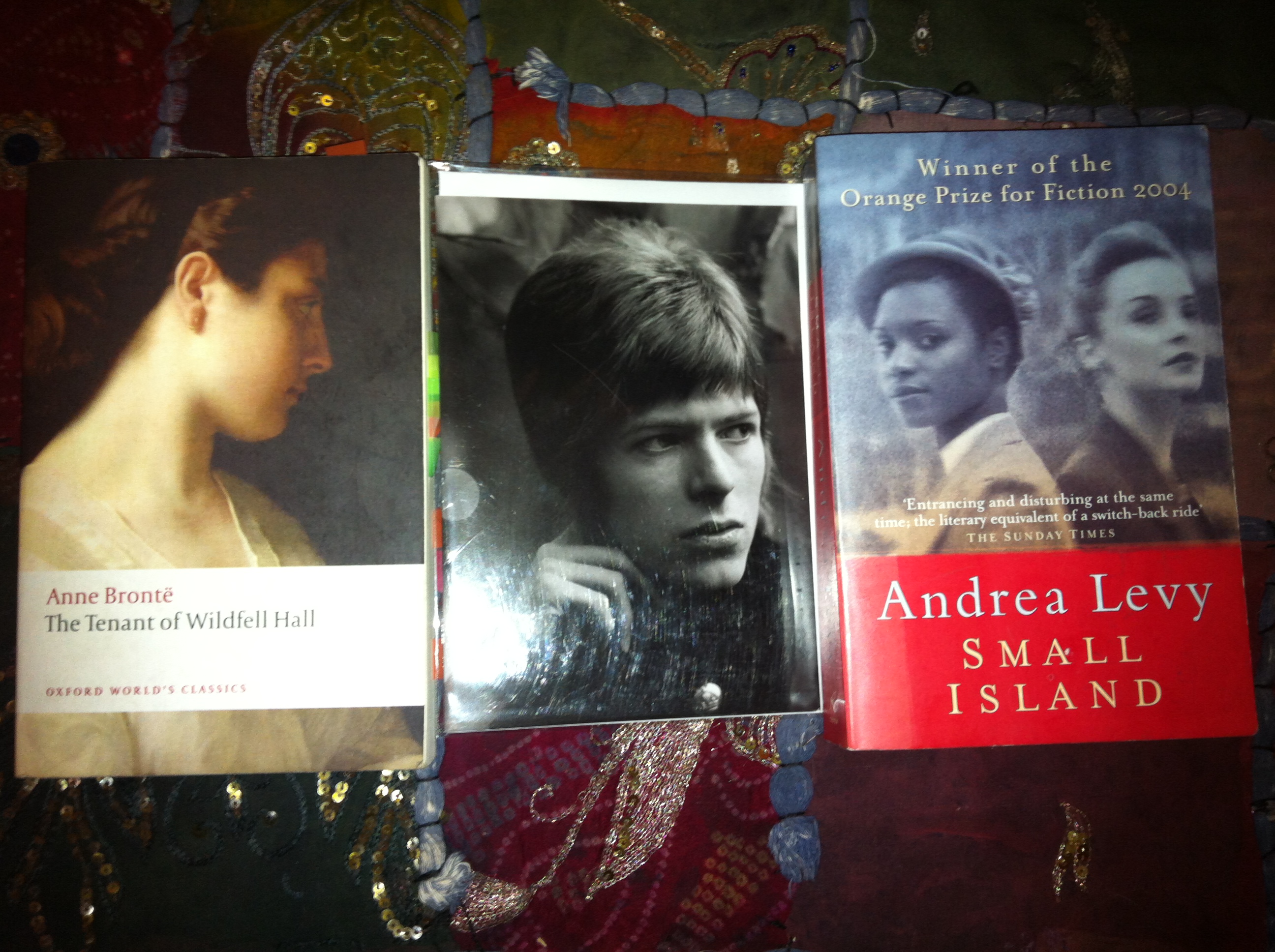
Firstly, Anne Bronte, particularly The Tenant of Wildfell Hall (published 1848, my edition 2008 Oxford World’s Classics).  The least known and least read of the Bronte sisters, I think the inevitable lumping together of her with Charlotte and Emily does her no favours.  She is a very different writer, with little of the gothic, romantic sensibilities of her sisters.  Anne actually sits more comfortably amongst the Victorian realist fiction of writers like Eliot and Gaskell, and in that way was a much more modern writer than Charlotte and Emily.  The Tenant of Wildfell Hall takes on some pretty major issues that Victorian Britain would have preferred to have ignored: alcoholism, domestic abuse, the complete lack of legal rights for women, the damaging effects of believing boys & girls should be educated differently, single parenthood.  Unsurprisingly, it was perceived as scandalous on its publication in 1848 and torn apart by those guardians of good taste, the critics.

Helen, a young widow, arrives in the town of Linden-Car with her young son, and attracts the attention of a farmer, Gilbert Markham.  He pursues her despite the fact that she is extremely spiky (proof that you don’t have to be a giggling hair-flicking moron to get your man/woman/whoever you fancy) and she eventually gives him her diary to read, which details her young adulthood in Regency England, an experience a million miles away from Austen’s Regency romance. Helen had married the charming Arthur Huntingdon, who turns out to be an alcoholic, abusive, unfaithful rake (unfortunately those gorgeous breeches and big white shirts can only cover so much).  When Helen sees the effect this profligate behaviour is having on her young son she flees.  Back in the present day of the novel, she learns that Huntingdon is dying, and returns to him.  I don’t think it’s a massive SPOILER to say he dies, allowing Helen and Markham to live happily ever after. This really isn’t a fairytale romance, though.

From the start Helen struggles to maintain a sense of herself as an individual, and her own integrity. Two years into the marriage, she realises the love of a good woman has not rescued him, and “how much of my higher and better self is indeed unmarried” – a scandalous thought for Victorian Britain but a reality for many couples who would be educated separately in different disciplines, barely know each other before marriage and then find they had no common language.  Jane Eyre and Wuthering Heights are high gothic romance, and while Tenant features a woman alone in a huge house in desolate surroundings, (fierce winds and thorny trees abound) it is more interested in the harsh realities of being married to the wrong man when “the ‘romance’ of our attachment is worn away”.  As Huntingdon’s alcoholism escalates so does his abuse of Helen, and she is left in a situation where legally she cannot divorce her husband (although he can her) and her child would be left with his wholly unsuitable father as guardian. He can beat her legally, and all her wealth is judged to belong to him.  Tenant is utterly damning of this situation, and if you’ll permit me the anachronistic term, Helen’s bid for freedom and a life on her own terms makes her a feminist icon.  Once she achieves her freedom she doesn’t become a simpering Victorian “angel in the home” but ultimately drives her second marriage when she passes Markham a winter rose: “Look Gilbert, it is still as fresh and blooming as a flower can be, with the cold snow even now on its petals.  Will you have it?” The subtext is clear: Helen is no young blushing virgin, a romance heroine, but an experienced woman, choosing to marry for love (and presumably, sexual attraction) though she need not because she is financially independent.  Anne Bronte gives us a much more complex heroine than those wailing women running around on moors (just kidding, JE and WH fans).

So why are Anne Bronte and Helen unsung heroes?  There are difficulties with the book: Anne Bronte was clearly still learning her craft (but, I would argue, so was Emily) and it is flawed.  The separate voices in the book aren’t distinct, and don’t always ring true in terms of how people speak.  Emily was much better at this, and Charlotte was much more skilled in the craft of novel writing.  Helen is a character with a highly developed sense of right and wrong, and this sometimes proves tricky for readers now, in that a character entrenched in Victorian morality can seemly judgemental to the point of priggishness.  But it would take a heart of stone not to root for this brave, resolute and strong woman, and I urge you to give Tenant a go.  The legal and educational situation may have changed but the story of a struggle for individual fulfilment against societal pressures remains timeless.  And there’s a bit of romance too.

Incidentally, for those of you who enjoyed the BBC adaptation of P&P, they also did a very decent version of Tenant just a year later; Tara FitzGerald portrayed Helen, with Toby Stephens as Markham and Rupert Graves as Huntingdon (the first two of whom acted together again a decade later in the BBC’s Jane Eyre, fact fans), a gorgeous and hugely talented cast who did the characters great justice (dir. Mike Barker).

Secondly, I thought I’d look at a portrayal of an everyman hero, the type of person who is unsung in life, if not in the novel.  The sub-theme of this post is clearly men called Gilbert, as I’ve chosen Gilbert Joseph from Andrea Levy’s Small Island (2004, Review Books).  Andrea Levy is not an unsung author, thankfully, as she’s brilliant and fully deserves the recognition she receives.  Small Island won the Orange Prize for Fiction in 2004, proving that sometimes these awards panels actually get it right.

It’s really hard to give a plot summary of the book without giving away some major spoilers, so I’ll avoid it all together.  Purposely vague description to follow: the book looks at post-war Britain, and the experiences of interconnected characters following the migration to Britain by people from Caribbean.  Queenie rents out her rooms to the new arrivals and encounters racism by association; Gilbert and Hortense are married immigrants, and quickly realise their experience is not going to be the one they were promised before they left Jamaica.  The three of them, and Queenie’s husband Bernard, take turns to tell the story, having chapters to themselves at a time.  The book is divided into Before and 1948, showing how the events of the war have far-reaching consequences on a personal level, not just national and political.

The character of Gilbert demonstrates that heroism is something that is not just found in extreme actions and extreme circumstances, such as war, but in the quiet, unassuming actions of the everyday.  He finds himself in a cold, unwelcoming country, miles away from home, part of a nation that has used him as a soldier and then abandoned him, with a wife who looks down on him and where he is subjected to racism daily.  And within these awful circumstances Gilbert doesn’t get ground down, and he doesn’t get bitter.  Instead at the end of the novel he does something selfless and noble, and utterly believeable, and he also stands up for himself:

“You know what your trouble is, man?” he said.  “Your white skin.  You think it makes you better than me.  You think it gives you the right to lord it over a black man.  But you know what it make you?  You wan’ know what your white skin make you man?  It make you white.  That is all, man.  White.  No better, no worse than me – just white.”

I can’t fully explain what makes Gilbert such a hero without ruining the story for you, but I highly recommend this readable, insightful novel and if you read it I’m sure you’ll agree with me.  Gilbert shows the greatness of ordinary people – we all know a Gilbert, and the least he deserves is to be recognised as a hero, which within the pages of Small Island, he is.

Here are the books alongside a hero of mine, David Bowie, who provided the title of this post.  Like P&P, he also celebrated an anniversary this month (66th birthday on 8 January): see, there is a method buried somewhere amongst these rambling posts, I promise……

Image