“You think your pain and your heartbreak are unprecedented in the history of the world, but then you read.” (James Baldwin)

Trigger warning: mention of rape, domestic violence, racist violence

I was delighted when Go Tell It on the Mountain was selected for today’s review-a-long, as it has sat in my TBR for ages. I also really enjoyed October’s Vanity Fair review-a-long, and I fell in love with James Baldwin’s writing when I read Giovanni’s Room for the 1956 Club, back in October 2020.

Despite these various motivators, I was still worried I wouldn’t manage to join in, as my reading is slowly improving but still very poor, and my blogging is essentially non-existent. However, Go Tell It on the Mountain (1953) proved a good choice, as despite being a really tough read in terms of subject matter, it’s only 256 pages in my edition, can be read in an afternoon, and is full of Baldwin’s lyrical beauty.
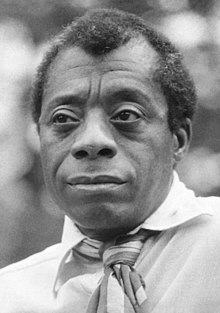
Photo by Allan Warren, courtesy Wikimedia Commons

The remaining obstacle is that it feels impossible to write about Go Tell It on the Mountain. It’s such a richly complex book and tackles such enormous themes, that I’m not even going to manage to approach doing it justice. So what follows is a few random thoughts 😊

The novel opens:

“Everyone had always said that John would be a preacher when he grew up, just like his father. It had been said so often that John, without ever thinking about it, had come to believe it himself. Not until the morning of his fourteenth birthday did he really begin to think about it, and by then it was already too late.”

John’s father Gabriel Grimes preaches at the Temple of the Fire Baptized, a Pentecostal storefront church in Harlem. John is ambivalent about religion, finding it restrictive and acutely aware of the temptations all around him;

“For John excelled in school, though not, like Elisha, in mathematics or basketball, and it was said that he had a Great Future. He might become a Great Leader of His People. John was not much interested in his people and still less in leading them anywhere, but the phrase so often repeated rose in his mind like a great brass gate, opening outward for him on a world where people did not live in the darkness of his father’s house, did not pray to Jesus in the darkness of his father’s church, where he would eat good food, and wear fine clothes, and go to the movies as often as he wished.”

However, he does have faith. We follow John throughout his birthday as goes to the cinema and enjoys Central Park, but also attends church:

“The Sunday morning service began when Brother Elisha sat down at the piano and raised a song. This moment and this music had been with John, so it seemed, since he had first drawn breath.”

Aged fourteen, John is still finding out who he is. This is bound up in religion and church, but also in his academic accomplishments which mark him out at school and within his family; and his rejection of his father as a masculine role model who demonstrates violence and hypocrisy, beating his family often.

“His father’s arm, rising and falling, might make him cry, and that voice might cause him to tremble; yet his father could never be entirely the victor, for John cherished something that his father could not reach. It was his hatred and his intelligence that he cherished, the one feeding the other.”

In the second part of the novel the prayers of John’s father, mother and aunt are powerfully explored. I don’t want to say too much about the plot here, as the characterisations first introduced through John’s point of view are so sensitively deepened through this second part, including that of his abusive father (who remains wholly unlikeable, but a fully realised character). As a reader I enjoyed watching these complex adults emerge without any foreknowledge.

John’s parents are the first generation since emancipation, and the trauma of slavery is just within lived experience, as GTIOTM is set in 1935. The depictions of racism, every day and institutional, are enraging.

“She looked out into the quiet, sunny streets, and for the first time in her life, she hated it all—the white city, the white world. She could not, that day, think of one decent white person in the whole world. She sat there, and she hoped that one day God, with tortures inconceivable, would grind them utterly into humility, and make them know that black boys and black girls, whom they treated with such condescension, such disdain, and such good humor, had hearts like human beings, too, more human hearts than theirs.”

Through John’s aunt Florence and his mother Elizabeth, Baldwin explores the additional patriarchal oppression women have to contend with. Florence’s academia is ignored to prioritise Gabriel’s, despite her desire for learning and his total disregard for it. Pregnancy outside of wedlock is left for the women to deal with. A woman who is gang-raped by white men is outcast:

“No man would approach her in honor because she was a living reproach”

There is a lot of compassion throughout the novel for female experience. With everyone there is a sense of things unspoken, in contrast to the vocal exuberance of preaching, and this is particularly true for the female characters.

“And he knew again that she was not saying everything she meant; in a kind of secret language she was telling him today something that he must remember and understand tomorrow. He watched her face, his heart swollen with love for her and with an anguish, not yet his own, that he did not understand and that frightened him.”

The final part of the novel follows John experiencing vivid religious visions, but I felt the ending was ambiguous, undermining the fervour. Baldwin demonstrates that human experience is subject to unpredictable forces, both internal and external, and I felt any certainty John believed in one day could be undone tomorrow. (For one thing, John doesn’t seem to acknowledge sexual attraction to Elisha, though as readers it seems to be there.)

As I mentioned at the beginning. I’ve found Go Tell It on the Mountain almost impossible to write about. I hope these few thoughts and extensive quotes have given some sense of it though! Baldwin is such gorgeous writer even with such harrowing subject matters: skilled but approachable, angry and compassionate, humane and unsentimental.

Now to dig If Beale Street Could Talk out of the TBR…

I’ll add in links to the other bloggers taking part today as I find them. Early signs are I’m out on a limb with this one, so please do check out the other reviews 🙂 :

Fiction Fan

Katrina

Rose

Kelly

“All is vanity, nothing is fair.” (William Makepeace Thackeray)

Despite the fact that Fiction Fan announced today’s Vanity Fair review-a-long back in June, I have of course ended up writing this right up to the wire. Ah well, ‘twas ever such. Or certainly has been for the last few years on my faltering blog…

It’s probably a good thing though, as my usual verbose, stream-of-barely-conscious style is likely to have been even worse as I try to work out what on earth I could say about this enormous tome, such a well-known classic novel that despite having not read it before or seen any adaptations, I already knew the plot and lead characters.

So I’ve decided to focus just on one element of the novel: satire. Although published in 1847-8, Thackeray set Vanity Fair earlier, during the Napoleonic Wars, enabling him to point out to society how appalling and self-serving everyone is, without alienating his readers. Clever Thackeray.

Thackeray proclaims that Vanity Fair is “a novel without a hero”, and by the end of the novel, he has so thoroughly painted a picture of a materialist, corrupt, self-serving and shallow society, that heroism seems nigh on impossible. What we do have is the main protagonist of Becky Sharp:

“Miss Rebecca was not, then, in the least kind or placable. All the world used her ill, said this young misanthropist, and we may be pretty certain that persons whom all the world treats ill, deserve entirely the treatment they get. The world is a looking-glass, and gives back to every man the reflection of his own face.”

But if all this is sounding pretty grim, it really isn’t. I enjoy satire, particularly that of the century preceding Vanity Fair, but it can often leave rather a bitter taste. Thackeray largely avoids this because firstly, he seems to quite enjoy his characters, and secondly, he doesn’t aim for the moralistic teaching of some satirists. He never suggests there is a way for this world to be other than it is. Which is bleak, but also stops the tone being too heavy.

He also doesn’t make the reader feel too implicated. Regency England is even further removed from us than the original readers, and in setting it amongst the upper classes, he skewers a stratum of society very few inhabit.

“The whole baronetage, peerage, commonage of England, did not contain a more cunning, mean, selfish, foolish, disreputable old man. That blood-red hand of Sir Pitt Crawley’s would be in anybody’s pocket except his own; and it is with grief and pain, that, as admirers of the British aristocracy, we find ourselves obliged to admit the existence of so many ill qualities in a person whose name is in Debrett.”

So while amoral Becky climbs from very humble origins, as the daughter of an opera singer and a artist, by any means necessary with no concern for anyone other than herself, we can sit back feeling pretty smug, yes? Well, no. Thackeray positions the reader very cleverly by making Becky the most entertaining and compelling character. I certainly felt the novel was pointing out very clearly what it meant that I would rather hear about Becky and all her conniving, that about simple, kind Amelia (Emmy) or upright Captain Dobbin.

I didn’t like Becky, but I enjoyed her. While she could be spiteful and a bully to Amelia:

Women only know how to wound so. There is a poison on the tips of their little shafts, which stings a thousand times more than a man’s blunter weapon. Our poor Emmy, who had never hated, never sneered all her life, was powerless in the hands of her remorseless little enemy.

She also used all the vanities and weaknesses of not very pleasant people against them, was clever and entertaining, and was out to ensure her position and security in a world where everything was stacked against her. I would far rather hear about Becky than Emmy, who spent her time simpering over her repulsive husband, spoiling her revolting child, and crying whenever she wasn’t otherwise engaged.

“In two days he has adopted a slightly imperious air and patronizing manner. He was born to command, his mother thinks, as his father was before him.”

I’m not sure we’re supposed to think Emmy particularly misguided here. Thackeray is pretty scathing about those in charge. Those with privilege are those who lead, and there is nothing in their personal qualities to suggest this is wise. Sadly this has not dated.

Always to be right, always to trample forward, and never to doubt, are not these the great qualities with which dullness takes the lead in the world?

Thackeray exposes how these weaknesses of the ruling classes are indulged in a way that poorer members of society are not:

When we read that a noble nobleman has left for the Continent, or that another noble nobleman has an execution in his house—and that one or other owes six or seven millions, the defeat seems glorious even, and we respect the victim in the vastness of his ruin. But who pities a poor barber who can’t get his money for powdering the footmen’s heads; or a poor carpenter who has ruined himself by fixing up ornaments and pavilions for my lady’s dejeuner; or the poor devil of a tailor whom the steward patronizes, and who has pledged all he is worth, and more, to get the liveries ready, which my lord has done him the honour to bespeak? When the great house tumbles down, these miserable wretches fall under it unnoticed.”

Certainly along with the bullying, it was the financial exploitation of her staff that made Becky most problematic and unlikeable for me. However,  it’s very clear that Becky’s options, and Amelia’s, are limited and I thought Thackeray was surprisingly sympathetic to the position of women in society.

Although frequently compared to War and Peace, the writer Vanity Fair most put me in mind of was Jean Rhys. I think both she and Thackeray agree that morals are a privilege of the comfortably off, and those with choices (mainly men).

“And who knows but Rebecca was right in her speculations—and that it was only a question of money and fortune which made the difference between her and an honest woman? If you take temptations into account, who is to say that he is better than his neighbour? A comfortable career of prosperity, if it does not make people honest, at least keeps them so.”

I really enjoyed the humour and social commentary of Vanity Fair and I’m so glad today’s reviewathon prompted me to finally take it off the shelf. For those of you thinking about giving it a go, I should warn you that there are racist portrayals of some characters and countries primarily at the beginning, but these are thankfully short-lived and Thackeray doesn’t seem to be asserting that whites hold any kind of moral authority.

Frankness and kindness like Amelia’s were likely to touch even such a hardened little reprobate as Becky. She returned Emmy’s caresses and kind speeches with something very like gratitude, and an emotion which, if it was not lasting, for a moment was almost genuine. 

I’m not sure who else is taking part but I’ll add links to the other bloggers posting today as I find them 😊

Fiction Fan’s review

Rose Reads Novels

Jane at Just Reading a Book

LouLouReads

Sandra at A Corner of Cornwall

To end, for some reason I’ve been thinking a lot about Stevie Nicks lately. So I’ve decided to shoehorn her into this post by claiming that at the start of Vanity Fair, Becky and Amelia are almost definitely – ahem – on the edge of seventeen… (#sorrynotsorry)