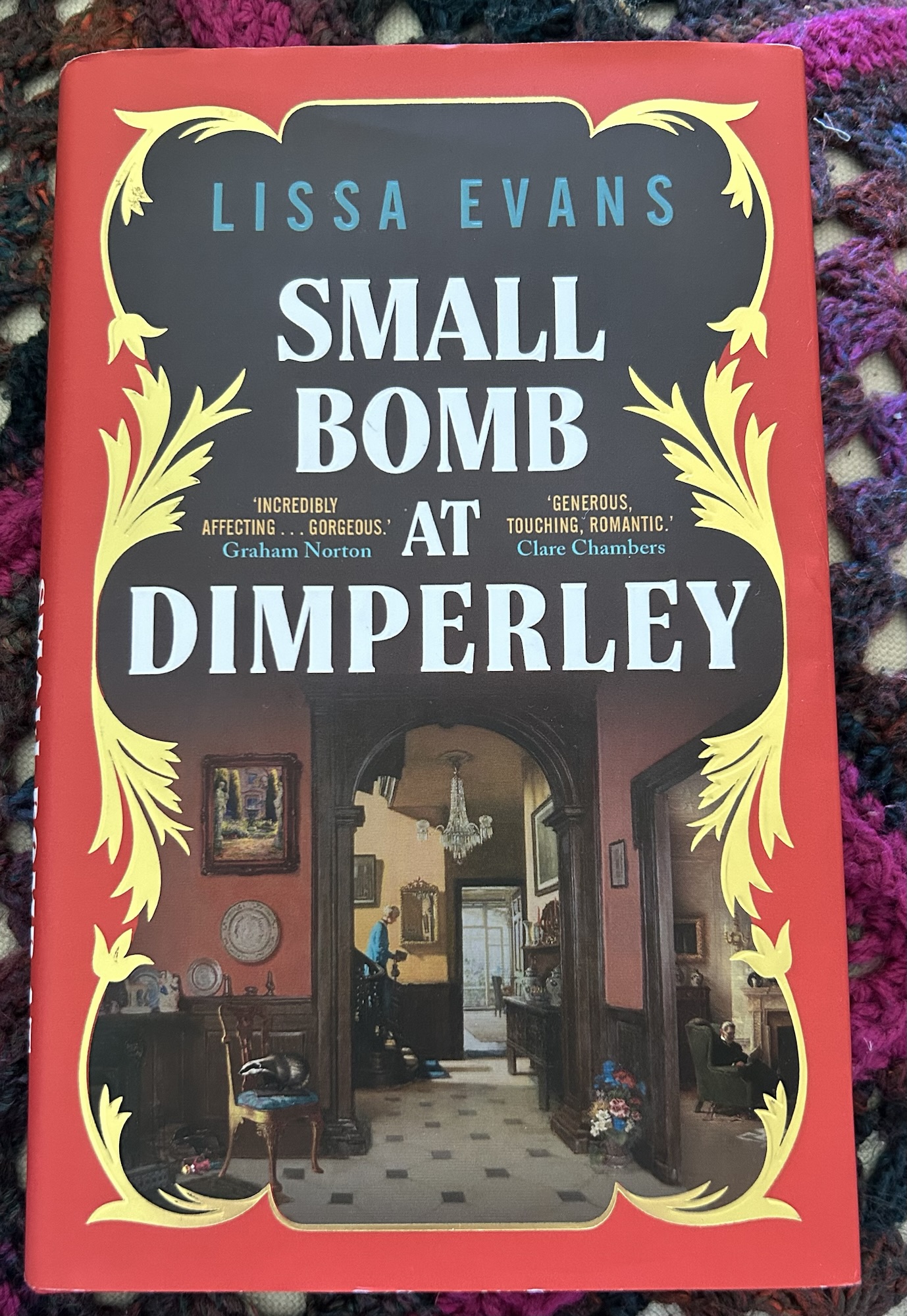
I feel like it wasn’t so long ago I read and enjoyed Old Baggage by Lissa Evans (2018), but as I blogged about it I can see it was six years ago! Where does the time go…? Anyway, it was Susan’s enticing review of Small Bomb at Dimperley (2024) which reminded me that I really should pick up Evans again, and as it turned out, now was exactly the right time.
Set immediately after World War II, the titular country pile is falling down around its much-reduced inhabitants’ ears. Home of the “lesser nobility” Vere-Thissets, their wastrel heir Felix has died in the war and they are awaiting the return of his diffident brother Valentine to take up the reins.
Dowager Lady Irene Vere-Thisset is struggling with post-war societal changes, including:
“A farmer named Jeffries who habitually spoke to Irene with familiarity which suggested they’d first met when queuing at a whelk stall and who had actually clapped her on the back last year when she had been presenting the trophy for best heifer at the county fair.”
During the war the house had been a maternity hospital, and Mrs Zena Baxter has stayed on, with her now two-year-old daughter Allison:
“It was quite galling to be forced to admire a piece of shrapnel that had somehow landed in Addenham churchyard and which was kept in a velvet-lined box as if it were a saint’s jawbone, when she herself had been dug out of the basement shelter of Hackney Young Women’s Hostel five hours after the building had suffered a direct hit.”
Zena is organised and capable, which is just what Dimperley needs, the only other remaining staff being Hersey who arrived at age fifteen and is now fighting off retirement. Zena has ended up as secretary to Alaric Vere-Thisset, as he writes an interminable history of the family despite the fact that:
“no Vere-Thisset had ever raised an army, or invented anything, or written a proper book, or endowed an institution, or even become a Member of Parliament.”
Meanwhile, Felix’s widow Barbara is struggling to get to know her daughters after they have been in the US for several years, escaping the conflict. Poor Barbara is physically defeated by much of everyday life, and has been left to undertake many of the noblesse oblige responsibilities without acknowledgement or thanks.
No-one thinks Valentine can make a go of running this money-pit, including Valentine:
“Lacking in either personal magnetism or the sort of skills that were needed for the forging and maintenance of useful connections. He was, as his father had noted, a poor rider, a below-average shot, an indifferent golfer and rather unfortunately ‘the image of my Uncle Fenwick’, though Irene had been unable to confirm the latter since every picture of Uncle Fenwick had been removed from the family album after the incident”
But what has been overlooked is that none of these attributes actually matter. Personal magnetism and charm are vastly overrated qualities, and what Valentine lacks in these he makes up for in decency, hard work and humility. He’s also likely dyslexic, and this alongside being forced to write with his non-dominant right hand at school means he is consistently underestimated.
We follow the family as Valentine and Zena try to take Dimperley by the scruff of the neck, and all of them attempt to work out a place for themselves in the ever-shifting new world of Labour governments, working women and – horror of horrors – an expanding National Trust (!)
Small Bomb at Dimperley wears its research lightly, so you never get an info-dump but rather a believably evoked sense of the immediate postwar period. What is foregrounded is the characters, and they are all wonderful. The more eccentrically comic Alaric and Barbara are never condescended to – their behaviour is laughed at but never they themselves. They are treated with insight and compassion, as is Lady Irene despite her clinging to archaic attitudes. The depth of characterisation creates flawed, believable people who I really invested in.
Small Bomb at Dimperley demonstrates how everyone deserves to find their place of repose – somewhere to be cared for, to love and to be loved. It shows how this occurs in a variety of ways and is not the preserve of the glamorous or the charismatic. Evans is so good at creating engaging circumstances and people who she treats with such humanity, humour and warmth.
“You couldn’t give half the population a gun and send them away for five years and then expect their slippers still to fit when they came home.”
It’s been a while since I ended with an 80s tune, so here’s a song about a more modest abode than Dimperley:
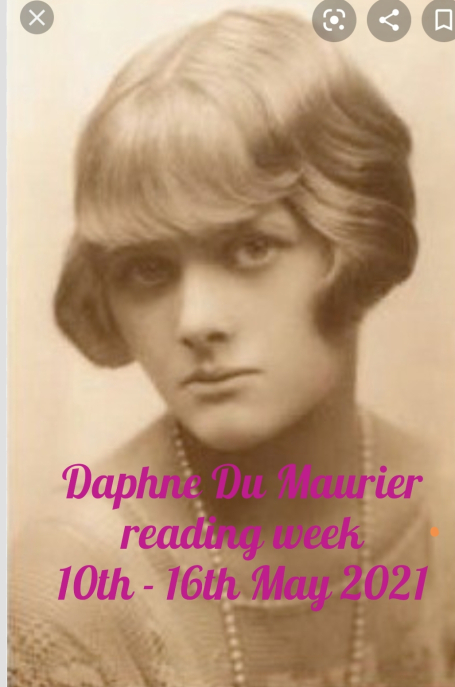
I was disappointed to miss posting for Ali’s annual Daphne du Maurier Reading Week this year, due to the demands of blogging on novellas every day for a month, so once that madness was over I thought I would enjoy a visit to this ever-readable author.
(Also, thank you to everyone who commented on which Big Massive Tome I should pick up after so many novellas. Bleak House was far and away the winner, so I’m embarking on Dickensian legal wrangling next 😊)
Apparently DDM said that Frenchman’s Creek (1941) was the only romantic novel she wrote. This meant I went into it expecting a similar experience to when I read Jamaica Inn, that is: enjoying it but wishing I had read it as a teenager. Now I’m older I’m more inclined towards the psychological darkness of My Cousin Rachel and her frankly terrifying short stories.
However, these expectations were confounded. Frenchman’s Creek can definitely be read as a romance: a young beautiful noblewoman leaves her stifling court life and starts running around the Cornish coast with a sexy French pirate. But I thought there were some much more interesting themes being explored in this novel too.
Dona St Columb is married to the ineffectual Harry, and is part of the indulgent court of Charles II. After a particular prank that she regrets, she leaves London and makes her way to Harry’s country pile in Cornwall.
“The sense of futility had been growing upon her for many months, nagging at her now and again like dormant toothache, but it had taken Friday night to arouse in her that full sense of self-loathing an exasperation, and because of Friday night she was jolting backwards and forwards now in this damnable coach, bound on a ridiculous journey to a house she had seen once in her life and knew nothing about, carrying with her, in anger and irritation, the two surprised children and their reluctant nurse.”
Once there, her pompous neighbour lets her know that dangers lurk amongst the beautiful countryside and coast, in the form of a successful pirate from Brittany.
“‘No lives have been lost as yet, and none of our women have been taken,’ said Godolphin stiffly, ‘but as this fellow is a Frenchman we all realise that it is only a question of time before something dastardly occurs.’”
Throughout the novel anyone expressing xenophobia is shown to be monumentally stupid, which is not always what I expect in novels of this period and it was certainly refreshing.
It isn’t long before Dona crosses paths with the captain of La Mouette, Jean Benoit Aubréy. Undoubtedly his portrait is romantic: he sketches birds, reads poetry, and of course is extremely handsome. Dona finds she has much in common with Jean Benoit, namely the search for an authentic life and personal freedom. As his loyal man William explains:
“’Approve and disapprove are two words that are not in my vocabulary, my lady. Piracy suits my master, and that is all there is to it. His ship is his Kingdom, he comes and goes as he pleases, and no man can command him. He is a law unto himself.’”
Dona longs for something similar, but it is clearly demonstrated how limited she is due to being a woman. She has to meet the expectations of domestic roles, and also of her class. It is the insistence of her male neighbours that brings Harry to Cornwall, and his mendacious friend Rockingham, who poses a real threat to Dona.
Du Maurier expertly builds the tension as a trap is laid for the pirate, and he takes phenomenal risks to outmanoeuvre his enemies. Frenchman’s Creek is real page-turner, but it is also a believable exploration of a woman’s search for meaning and personal agency in her life. Her romantic partner is fully portrayed but not overly dwelt upon – this is Dona’s story and the romantic relationship is one that brings her back to herself:
“She felt, in a sense, like someone who had fallen under a spell, under some strange enchantment, because this sensation of quietude was foreign to her, who had lived hitherto in a turmoil of sound and movement. And yet at the same time the spell awoke echoes within her that she recognised, as though she had come to a place she had known always, and deeply desired, but had lost, through her own carelessness, or through circumstances, or the blunting of her own perception.”
Du Maurier really is so good at what she does. In Frenchman’s Creek she creates a compelling adventure alongside some lovely evocations of the natural world while highlighting the enduring challenges of the expectations placed on women. Dona’s quest for a life that will enable a fulfilling expression of self remains as relevant and compelling as ever.
“Much will be forgotten then, perhaps, the sound of the tide on the mud flats, the dark sky, the dark water, the shiver of the trees behind us and the shadows they cast before them, and the smell of the young bracken and the moss. Even the things we said will be forgotten, the touch of hands, the warmth, the loveliness, but never the peace that we have given to each other, never the stillness and the silence.”
I wanted to end with a trailer for the 1944 film adaptation with Joan Fontaine, but alas I couldn’t find it anywhere. So here is a clip from the 1998 BBC adaptation, which for reasons best known to itself has moved the story to the time of the Glorious Revolution and completely invented a scene. Has anyone seen this version? It doesn’t look very enticing but I do think Tara Fitzgerald is a good actor:
This is my contribution to Ali’s Daphne du Maurier reading week, and much to my own amazement I’ve managed to post on time – hooray! I really enjoyed taking part in 2019 and reading du Maurier’s creepy, unsettling short stories. This time I’ve plumped for two of her most famous novels which I’ve never got round to reading, despite enjoying Rebecca as a teenager.
Firstly, Jamaica Inn (1936), a gothic period drama set in the 1820s. Mary Yellan is 23 when her mother dies, leaving her orphaned and having to live with her Aunt Patience, who is married to Joss Merlyn, landlord of the eponymous coaching inn. Mary would like to live alone and run her own farm, which is clearly a ridiculous notion:
“‘A girl can’t live alone, Mary, without she goes queer in the head, or comes to evil. It’s either one or the other. Have you forgotten poor Sue, who walked the churchyard at midnight with the full moon, and called upon the lover she had never had? And there was one maid, before you were born, left an orphan at sixteen. She ran away to Falmouth and went with the sailors.’”
So off she treks to a “wild and lonely spot” 12 miles outside Bodmin in Cornwall. Du Maurier does a great job of creating gothic unease, both in the scenery and the relationships within Mary’s family.
“To the west of Jamaica high tors raised their heads ; some were smooth like downland, and the grass shone yellow under the fitful winter sun; but others were sinister and austere, their peaks crowned with granite and great slabs of stone. Now and again the sun was obscured by cloud, and long shadows fled over the moors, like fingers. Colour came in patches; sometimes the hills were purple, ink-stained and mottled, and then a feeble ray of sun would come from a wisp of cloud, and one hill would be golden-brown while his neighbour still languished in the dark. The scene was never once the same, for it would be the glory of high noon to the east, with the moor as motionless as desert sand; and away to the westward arctic winter fell upon the hills, brought by a jagged cloud shaped like a highwayman’s cloak, that scattered hail and snow and a sharp spittle rain on to the granite tors.”
Joss is violent and binges on alcohol, and Mary’s Aunt Patience is completely destroyed by her marriage. She serves a useful dramatic purpose, providing the reason that morally upright Mary doesn’t report her uncle when it emerges that he makes his money through wrecking: luring ships onto rocks, murdering the sailors and stealing the loot.
“And, although there should be a world of difference between the smile of a man and the bared fangs of a wolf, with Joss Merlyn they were one and the same.”
The portrayals of the criminals in Jamaica Inn are dated, with more than a hint of ableism and classism. But Joss Merlyn is slightly more complex, and there is a sense of the pain he has experienced in his life that has led to him becoming the man he is. By enduring her life at Jamaica Inn, Mary meets her uncle’s brother Jem, and romance ensues:
“He was no more than a common horse-thief, a dishonest scoundrel, when all was said and done[…] Because he had a disarming smile and his voice was not unpleasing, she had been ready to believe in him”
What follows is a well-paced tale of Mary being drawn into her uncle’s life of crime far more than she would like, yet also feeling increasingly alienated from the good people of the town. It was this latter aspect that interested me most. What du Maurier seemed to be exploring was how a woman finds her own way in the world, and how the easiest path may not be the truest one.
“There would never be a gentle season here, thought Mary;”
Through the course of the novel Mary learns that a gentle season may not be what she wants; that her authentic life is one not led within the heart of society. Ultimately she’s quite a tough heroine, and she forges her own path.
At first I wasn’t sure Jamaica Inn was really for me: it seemed a bit formulaic and I’m not really one for gothic romance – usually the men are abhorrent, violence is indulged and somehow supposed to be attractive. Yet Jem could be gentle with Mary and they actually had a laugh together which is not very gothic at all. Sexual attraction is also dealt with frankly, and although it is a romantic tale (a young pretty girl wandering on the wild moors, a ruggedly handsome lover…) in some ways romance is given short shrift:
“There was precious little romance in nature, and she would not look for it in her own life. She had seen the girls at home walk with the village lads; and there would be a holding of hands, and blushing and confusion, and long-drawn sighs, and a gazing at the moonlight on the water […] They would look at the stars and the moon, or the darning sunset if it was summer weather, and Mary, coming out of the cow-shed, wiped the sweat from her face with dripping hands, and thought of the new-born calf she had left beside its mother. She looked after the departing couple, and smiled, and shrugged her shoulders, and, going into the kitchen, she told her mother there would be a wedding in Helford before the month was past.”
I wish I’d read Jamaica Inn after Rebecca in my teens, I probably would have loved it then. Reading it at 44 means it will probably not be amongst my favourite du Maurier – I didn’t find as much to admire as I did with her short stories – but I thought she put an interesting heroine amongst the romantic tropes and her descriptions of the natural world are stunning. She also succeeded in writing a page-turning ripping yarn, and sometimes that is exactly what is needed when you pick up a novel.
The BBC adapted Jamaica Inn in 2014. I watched it, but the main thing I remember is everyone complaining about the mumbling:
Secondly, My Cousin Rachel (1951) which I thought was excellent. Du Maurier’s voice felt more individual in this and I wondered if in the intervening 15 years she had become more confident in her craft. The story and characterisation seemed more complex too.
It opens with a fairly graphic description of a hanged man that I could have done without, but it serves well in introducing the narrator Philip, orphaned and subsequently raised by his cousin Ambrose, a misogynist landowner, adored by Philip despite his uncompromising ways.
Du Maurier foreshadows the events of the story, and also it’s ambiguity:
“No one will ever guess the burden of blame I carry on my shoulders; nor will they know that every day, haunted still by doubt, I ask myself a question which I cannot answer. Was Rachel innocent or guilty?”
Ambrose in middle-age takes his winters abroad, for the sake of his chest. There he meets the titular distant relative, and they marry. Philip is perturbed by this, but not nearly as much as he is when Ambrose’s letters become infrequent, scribbled and paranoid:
“For God’s sake come to me quickly. She has done for me at last, Rachel my torment. If you delay, it may be too late. Ambrose.”
Philip hastens to Italy, only to find Ambrose died three weeks previously and his wife has disappeared. When he returns to England and finds Rachel is due to visit he is determined to expose her for the villain she is. This resolve lasts, ooh, about five minutes:
“I was glad I had the bowl of my pipe to hold, and the stem to bite upon; it made me feel more like myself and less like a sleep-walker, muddled by a dream. There were things I should be doing, things I should be saying, and here was I sitting like a fool before the fire, unable to collect my thoughts or my impressions. The day, so long-drawn-out and anxious, was now over, and I could not for the life of me decide whether it had turned to my advantage or gone against me.”
The local people are equally charmed by Rachel’s beauty and wit. Philip’s friend Louise, the daughter of his guardian, points out Rachel is beautiful – something Philip has not mentioned. The skirting around his attraction for Rachel exposes him as an unreliable narrator, insofar as we would all be unreliable narrators of our own lives:
““How simple it must be for a woman of the world, like Mrs Ashley, to twist a young man like yourself around her finger,” said Louise.
I turned on my heel and left the room. I could have struck her.”
What follows is what du Maurier seems so expert at: building an atmosphere of tense unease, where the truth of a situation remains determinedly obscure. Philip is naïve, but are the more sceptical viewpoints of his friends and advisors any more valid?
“Here I was, twenty-four, and apart from the conventional years at Harrow and Oxford I knew nothing of the world but my own five hundred acres. When a person like my cousin Rachel moved from one place to another, left one home for a second, and then a third; married once, then twice, how did it feel? Did she shut the past behind her like a door and never think of it again, or was she beset with memories from day to day?”
Whether Rachel is conniving and manipulative is difficult to ascertain and this works so well in sustaining tension throughout. It also enables du Maurier to demonstrate how a beautiful woman with very few rights in law is subject to the fantasies and whims of men who hold the power. Rachel remains unknown to the reader because she remains unknown to Philip, and yet he professes he loves her.
Philip is not likeable – he is callow, arrogant, and violent. But he is somewhat sympathetic as he knows so little of life, floundering around in situations he doesn’t understand and is painfully ill-equipped to manage. Ultimately it is this quality that provides the persistent mystery of My Cousin Rachel, a mystery we must all find our own answer to:
“The point is, life has to be endured, and lived. But how to live it is the problem.”
My Cousin Rachel was adapted most recently on film in 2017. I’ve not seen it but it’s certainly beautifully shot if this trailer is anything to go by:
PS Happy birthday Daphne, born on this day in 1907, and to #DDMreadingweek host Ali – have a wonderful day!
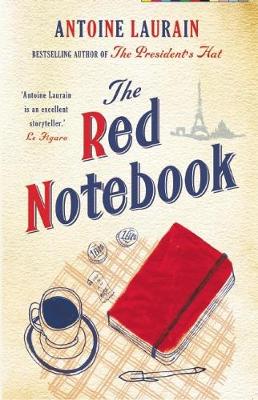
The Red Notebook – Antoine Laurain (2014, trans. Emily Boyce and Jane Aitken 2015) 159 pages
The Red Notebook walks a very thin line and I suspect for some readers it will have crossed that line, from whimsical romance at a distance, to creepy stalker tale. Looking at goodreads most seem to have gone for the former, and that’s how I read it too, but I’m not entirely unsympathetic to the latter view.
Anyway, I’ll put my psychological reservations to one side and let you know about a charming novella that conjures Paris beautifully, features a cameo from Patrick Modiano, and plays into that old romantic trope of lovers that are destined for one another.
Laure is a widow in her 40s who mugged for her mauve handbag and ends up in hospital in a coma. Bookseller Laurent – similar name, similar age to Laure – finds her bag after the mugger has dumped it having removed ID, purse and mobile phone. He tries to hand it in but police bureaucracy means he ends up holding on to it, trying to piece together the owner from its contents:
“a little fawn and violet leather bag containing make-up and accessories, including a large brush whose softness he tested against his cheek. A gold lighter, a black Montblanc ballpoint (perhaps the one used to jot down her thoughts in the notebook), a packet of licorice sweets…a small bottle of Evian, a hairclip with a blue flower on it, and a pair of red plastic dice.”
The titular notebook is part of the contents, and it is a diary which Laurent reads to try and find clues to who Laure is:
“I’m scared of red ants.
And of logging on to my bank account and clicking ‘current balance’.
I’m scared when the telephone rings first thing in the morning.
And of getting the Metro when its packed.
I’m scared of time passing.
I’m scared of electric fans, but I know why.”
Laurent has some success in piecing together Laure’s life, and in the process we learn about them both. Laurent has a teenage daughter who is brattish but loving, and a girlfriend to whom he’s not entirely committed. He likes his job and he’s interested in literature.
He’s also increasingly interested in Laure and a sequence of events lead to him collecting her dry cleaning and cat-sitting for her (!) It was at this point I thought things had gone too far, but then Laurain manages to tip the balance of power in a believable turn of events that meant the story kept me on side.
If you’re in the mood for some escapism across the channel and some gentle romance, then The Red Notebook could be just the ticket.
This post contains strong language and adult content. If you’re not an adult, or if you are and you find such things offensive, please don’t read on. Now to the post!
FINALS ARE OVER! FINALS ARE OVER! Oh, the sweet, sweet relief. I feel like this:
The week before I felt like this:
Unfortunately, during exams I felt like this:
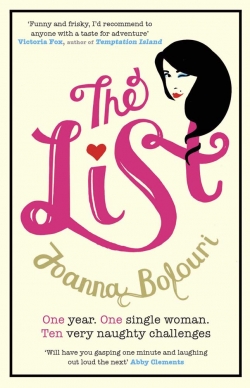
Six exams in eight days is not the worst finals schedule, but it was more than enough for me. Well-meaning souls kept telling me it was a marathon, not a sprint. I don’t run marathons. I don’t sprint. I prefer to lie on my bed with some drool coming out of my mouth as I read books & watch films. That drool is liquid contentment, people. Anyway, as this wittering and reliance on GIFs is ably demonstrating, I think my brain has now dribbled out of my ears, possibly never to return. And now FINALS ARE OVER (sorry, but I can never say that phrase enough) what is a bibliophile to do? Well, I decided to read a book highly recommended by Charl over at Miscrawl, The List by Joanna Bolouri.
I don’t normally read light comic novels, they’re generally not my cup of tea. However, after weeks, nay months, of ploughing through some seriously heavy literature, I wanted something fun. And The List certainly delivered on that, but that’s not why I decided to write about it here. The reason was that I think The List offers something unfortunately all-too-rare in fiction: a recogniseably authentic female voice. And that voice is sweary:
“Back to work today, and I had a mountain of emails to go through…Two of the emails were from Alex, who obviously didn’t know I was on holiday, and I deleted them without reading, otherwise I’d be tempted to reply ‘GET IT RIGHT UP YOU FUCKFACE’ in 72pt comic sans.”
We’ve all had emails like that.
Phoebe Henderson breaks up with her horrible boyfriend (the aforementioned Alex), and eschewing the usual New Year’s resolutions to get fit/lose weight blah blah she makes a list of 10 things she’d like to do in bed but has never had the nerve to try. The novel takes the form of her diary over the year as she tries out these activities, some successful, some not, with a variety of people, some nice and gorgeous, some most definitely not.
Bolouri achieves quite something with Phoebe: a slightly messed up, slightly neurotic character who, rather than getting frustrated with and wanting to shake vigorously by the shoulders, I wholly recognised and wanted to take for a drink. She’s good company. She hates her job, hates her flat, loves her friends, is in her 30s and hasn’t quite got it all figured out yet. Who the hell has? Oh Phoebe, let’s get smashed on cheap cocktails, buy a dirty burger from a botulism-on-wheels van on the way home and wake up the next morning with mouths that feel like Satan’s armpit, wondering why we’re still doing this after all these years. I love you.
Some of the list opens Phoebe’s eyes to sexual adventure, some of it leaves her feeling a bit meh. None of it leaves her feeling worthless or degraded. This is a woman embracing her sexuality and feeling empowered by it. In that way the novel has something to say, and it’s made more powerful by the fact that it’s funny and entertaining, yet not entirely escapist. Phoebe doesn’t have a perfect body & a perfect life, and not everything goes to plan, like her first attempt at talking dirty:
“I walked out of my room, naked, to get some water and he followed me in to the kitchen where we did it over the worktops. I was unsettled for a second when I found myself face down in toast crumbs, but then he started whispering delicious obscenities in my ear. I tried to return the favour but failed miserably: “Fucking prick.”
“What?”
“Erm, nothing. Carry on.””
I love this: the banal detail of the toast crumbs, the epic fail on dirty talk. It’s funny, and oh-so-believeable. Balouri shows how fantasy and reality don’t match up, and it’s OK because reality can be funnier and more exciting than fantasy anyway.
I normally write on two books per post, but I’m only doing one this week, because FINALS ARE OVER (I don’t know if I’ve mentioned that?) and my stamina for rational thought and writing in continuous prose is severely depleted. I’m off to replenish with rioja and a bag of chips. I don’t care if it is 10am – don’t judge me. All rules are off because FINALS ARE OVER!





 madame bibi lophile recommends