Deadly Autumn Harvest – Tony Mott (transl. Marina Sofia) Blog Tour

When I took part in a blog tour for Corylus Books earlier in the year, it was for a novella, which helpfully chimed with my Novella a Day in May reading. The bookish stars have aligned again for my taking part in a Corylus Books blog tour, as Deadly Autumn Harvest (2020) by Romanian author Tony Mott fits perfectly with my plans for #WITMonth reading, translated as it is by lovely blogger Marina Sofia (2023).
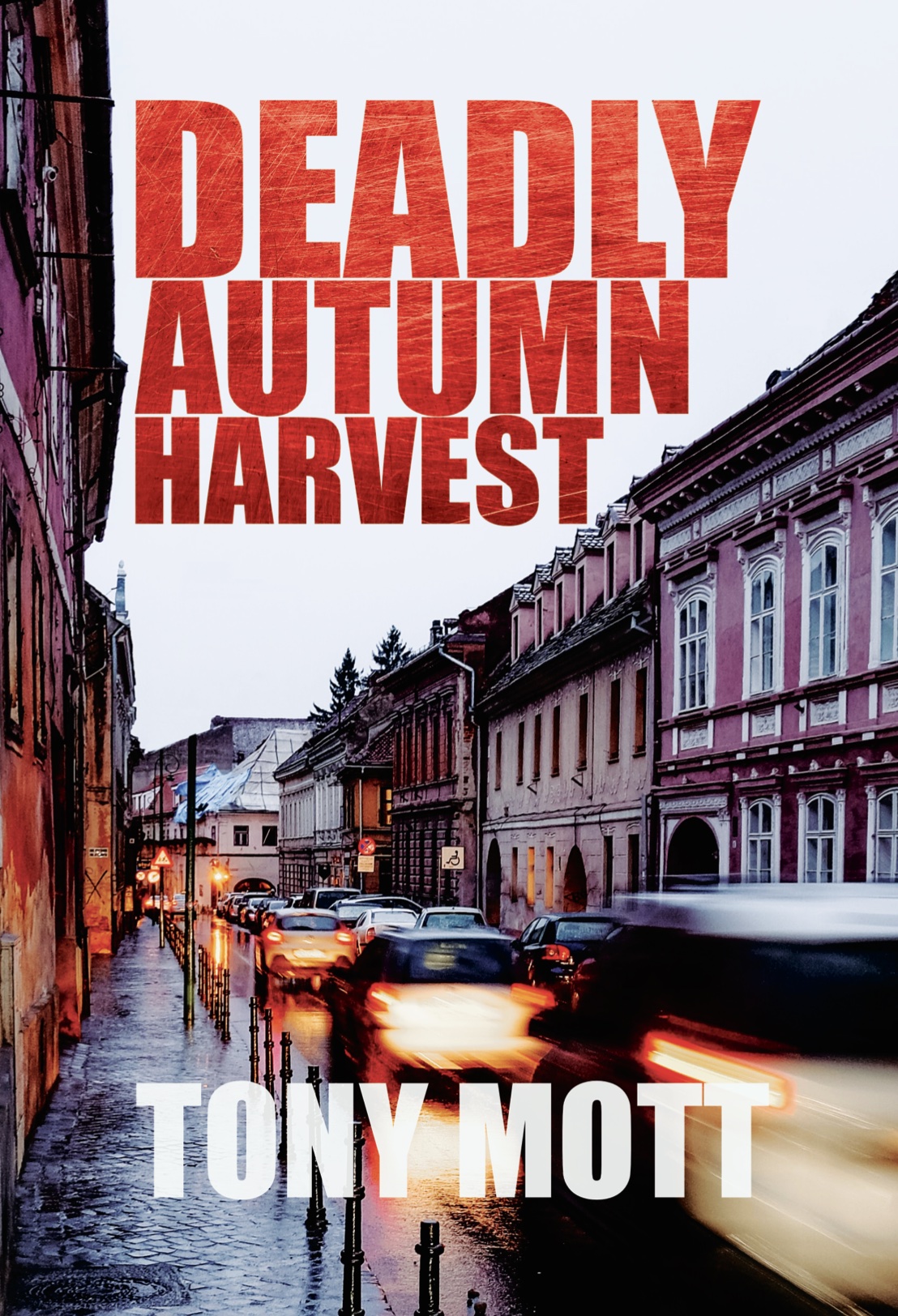
Here is the blurb from Corylus Books:

“A series of bizarre murders rocks the beautiful Carpathian town of Braşov. At first there’s nothing obvious that links what look like random killings. With the police still smarting from the scandal of having failed to act in a previous case of a serial kidnapper and killer, they bring in forensic pathologist Gigi Alexa to figure out if several murderers are at work – or if they have another serial killer on their hands. Ambitious, tough, and not one to suffer fools gladly, Gigi fights to be taken seriously in a society that maintains old-fashioned attitudes to the roles of women. She and the police team struggle to establish a pattern, especially when resources are diverted to investigating a possible terrorist plot. With the clock ticking, Gigi stumbles across what looks to be a far-fetched theory – just as she realises that she could be on the murderer’s to-kill list.”

I don’t read much contemporary crime because I don’t want to read about women being killed in various gruesome ways. I’m relieved to say I thought Deadly Autumn Harvest got the balance right between giving enough detail so that the horrors were realised, but with nothing being gratuitous. There was a responsibility in how the victims were portrayed, so you got a sense of them as people and the injustice in how their lives ended.

Forensic pathologist Gigi Alexa is an intriguing figure too. Cascading curly blonde hair and resolutely dressed in bright colours, I thought she was an idiosyncratic and believable investigator, good at her job and super-committed, yet not entirely detached:

“Usually, by the time she got to see the bodies, they had been drained of any semblance of life or a back story, they were mere puzzles to be solved. But today it had all been a little too close for comfort.”

She’s also a scientist who is not above a bit of superstition:

“Three bad omens. She counted them. First, she stumbled over her slippers as she got out of bed, so she went to the bathroom in her bare feet. Then she stepped into the sand that Morty had scattered from his litter tray. Thirdly, once she got into the kitchen, her coffee machine refused to get going so she would have to boil up Greek coffee instead. Three signs of bad luck on a Tuesday – no doubt more would follow.”

As Gigi and her team investigate the murders, she has to contend with various frustrations in the male-dominated environment. She’s not surrounded by idiots though. I liked her relationship with her boss CI Matei, and Emil, her colleague in pathology. There was also some humour (alongside remembrance of previous toxicity) in the reappearance of her impeccably turned-out ex, Superintendent Vlad Tomescu. (Slight spoiler, skip the next sentence and quote if you don’t want to know!) Gigi becomes single during the novel and her sardonic reflections on this state also lightened the tone:

“She didn’t miss him at all. It would be a while yet before she started missing the warmth of someone to curl up with in bed. Maybe during the winter. Except maybe by then she would have invested in an electric blanket.”

The mystery is very well-paced and the novel isn’t overlong at just 225 pages. We are there at the moment of the killings at various points, before we are returned Gigi and her team’s investigation. Although I’d be amazed if anyone guesses the connection before Gigi, we’re given a fair chance to guess the perpetrator. I’d like to proclaim I worked out who did it, but I suspected absolutely everyone at some point 😀

Deadly Autumn Harvest is a quick, compelling read with a truly chilling murderer pursued by a team of believable, well-rounded investigators.  

Finally I should just say that Deadly Autumn Harvest definitely made me want to visit Braşov! I’ve never been, it sounds absolutely beautiful and with Gigi and her team on the case there won’t be any serial killers left to spoil my holiday – perfect.

Here are the stops from the rest of the tour, so do check out how other bloggers got on with Deadly Autumn Harvest:
“Killing Me Softly” (Roberta Flack)

Hello bookish blogosphere! I’ve been away for what feels like a long time. June and July were a big pile of pants and I needed a step back from things. I want to say thank you to the lovely bloggers who contacted me to ask if I was OK, when I really wasn’t. Your kindness genuinely meant a lot.

I’ve only just started reading again after about six long weeks of being unable to digest a single written word. Some very strange things have happened to my reading; I couldn’t deal with fiction for a while so I finally got round to reading some of the biographies that have languished in my TBR for aeons. Then having got back to fiction I’ve started with a subject about as far from my usual fare as its possible to be: serial killers. Except neither novel is really about serial killers…

Firstly, My Sister the Serial Killer by Oyinkan Braithwaite (2017). This made quite a splash when it came out and I remember large, eye-catching posters on the tube, back when commuting was a thing. It’s a quick read and it was that reason that made me pick up this debut, thinking it was a good way to try and get back into reading.

My logic worked well, and I whizzed through this tale of a murderous sibling, narrated by Korede, a young successful nurse whose talent for cleaning comes in handy when helping her sister Ayoola cover up her deeds.

The novel starts in media res as Ayoola contacts Korede to ask for help having killed her third boyfriend in self-defence. Ayoola is completely oblivious to the seriousness of her crimes and seems to feel no remorse. Although Korede loyally helps her, she is beginning to have doubts as to the nature of Ayoola’s self-defence.

“ ‘Do you not realise the gravity of what you have done? Are you enjoying this?’ I grab a tissue and hand it to her, then take some for myself.

Her eyes go dark and she begins to twirl her dreadlocks.

‘These days you look at me like I’m a monster.’ Her voice is so low, I can barely hear her.

‘I don’t think you’re – ‘

‘This is victim shaming you know.’”

The novel isn’t graphic and the details of the killings are not dwelt on – thankfully, if you’re as squeamish as me. Instead what Braithwaite explores is a complex relationship between sisters and the impact of patriarchal systems on young women. It’s set in Nigeria but the themes certainly resonated with me as a UK reader.

Korede and Ayoola grew up with a violent father and it his weapon that Ayoola uses:

“ ‘The knife is important to me Korede. It is all I have left of him.’

Perhaps if it were someone else at the receiving end of this show of sentimentality, her words would hold some weight. But she cannot fool me.”

No-one questions Ayoola because she is beautiful, no-one pays attention to Korede because she is average looking. Both women suffer under a society that commodifies women, even though Korede is successful in her career as a nurse and Ayoola is a talented clothes designer.

A doctor where Korede works, Tade, seems to be decent but even he follows the predictable path of not noticing what Korede can offer and falling for Ayoola’s looks, projecting his fantasies onto her.

“ ‘She is beautiful and perfect. I never wanted to be with someone this much.’

I rub my forehead with my fingers. He fails to point out the fact that she laughs at the silliest things and never holds a grudge. He doesn’t mention how quick she is to cheat at games or that she can hemstitch a skirt without looking at her fingers. He doesn’t know her best features or her…darkest secrets. And he doesn’t seem to care.”

Ayoola dating Tade adds tension to the narrative – will she try to kill him? Will Korede try to save the man she has feelings for? Who will succeed?

Sometimes satire can leave a bitter taste, but MSTSK avoids this with it’s dry humour and lack of preachiness. It doesn’t attempt crass psychology as to why both women are as they are, it simply presents their lives and upbringing and leaves the reader to draw their own conclusions. This light touch means it raises serious issues about contemporary society without losing sight of characters or plot. An impressive debut.

Secondly, Sword by Bogdan Teodorescu (2008, trans. Marina Sofia 2020) which was sent to me by the lovely Marina Sofia who blogs over at Finding Time to Write. She has translated this novel under Corylus Books, the publishing house which she has founded with three others.

MSTSK used a serial killer to satirise patriarchal systems, and Sword uses it in a similar way to satirise political systems. Set in Romania, it forms another stop on my Around the World in 80 Books Reading Challenge, hosted by Hard Book Habit who sadly don’t seem to be blogging any more.

Someone is killing Roma people in Bucharest using the titular weapon. There is no apparent motive – except presumably a racist one – and the murders have a competence to them which means the police investigation has very little to go on. This isn’t a police procedural though, and very little of the story is given over to the murders themselves (again, thankfully…) aside from the first. Instead Teodorescu uses the murders to explore the power systems in place in Romania and how this exposes the weaknesses and motivations of those within.

If that sounds dry, it really isn’t. The story whips along and the portrayals of power players feel authentic (Teodorescu is a political analyst). Early on, the petty concerns of Istrate, Head of Comms and Press Relations at the Presidential Office, demonstrate the disregard that the deaths receive. He only likes the social side and travel associated with his job, and the President hates him and so has set up another press office.

“He was briefly tempted to write a report complaining about the lack of professionalism in his team. Instead of getting reports about major problems, the international situation, global crises that could destabilise the Balkan region, an in-depth political analysis, he had to put up with silly homicide stories! He gave up reading the press summary, but resolved to complain about it the next time he met the President.”

The government is concerned, but only in trying to balance appealing to those who might welcome vigilante justice represented by Sword (as the press have nicknamed the killer) because he only kills criminals, and how it will look internationally that they haven’t caught him. The advice given to the Minister of the Interior suggests how to manage the situation in a pre-election year:

“A few heads rolling at all levels in the police force should demonstrate the government is taking things seriously. Admittedly, it also demonstrates how incompetent the police are, but no-one worries about that too much.”

Despite such machinations, the murders continue to rack up and tensions in the country between various groups escalate. The context of Romania finding its place in international capitalist systems after the fall of communism is evoked well but it doesn’t take much imagination – if any – to see parallels across different political systems. I felt this could just as easily be Westminster. There’s something depressingly universal about someone with integrity being forced aside for political expediency:

“ ‘It’s not anger. It’s profound sadness. Because you’ve proven to me yet again that it’s not good enough to be qualified, professional, well-intentioned and to work your socks off… it still won’t get you the respect you deserve.’”

Sword is incisive and uncompromising in its portrayal of corruption and the powerless victims of such systems, but its not depressing. Instead I found it a compelling read and I’d definitely be interested to read more by this author.

Writing this post was difficult as I’m so out of practice, but to end it’s business as usual with an obvious late twentieth century pop choice 😀