“Procrastinate now, don’t put it off.” (Ellen DeGeneres)

The Guardian newspaper has a series it runs on Saturdays, called The Q&A, short interviews with celebrities.  One of the regular questions is: “What is the trait you most deplore in yourself?”  I don’t even have to pause for thought to answer this one.  Having lived with myself all these years there are plenty of things I deplore in myself, but far and away is my enormous capacity for procrastination.  Since I’ve started this blog, my procrastination has developed two-fold: I use the blog to procrastinate from whatever else I’m meant to be doing, and the blog also provides something else I procrastinate over.  Let’s just say there’s some reading for next term not getting done right now, and certain members of my household facilitate my procrastination by indulging their favourite pastime of sitting on my laptop – how can I possibly work in these conditions?

Image

If you are fellow procrastinator, take heart from the fact that you are in great company.  Famous procrastinators include Leonardo da Vinci, Douglas Adams, Franz Kafka and Samuel Taylor Coleridge. The last of these is who I turn to now, with The Rime of the Ancient Mariner.  You can read the full poem here. This famous long poem tells the story of a mariner cursed after he shoots an albatross that had brought a warm wind to his ship:

And I had done a hellish thing,

And it would work ’em woe:

For all averred, I had killed the bird

That made the breeze to blow.

Ah wretch! said they, the bird to slay,

That made the breeze to blow!

As a result of his actions, he has to wear the albatross around his neck (hence the phrase for a guilty burden) and the ship is taken into new waters by vengeful spirits where the crew begin to die.

Day after day, day after day,

We stuck, nor breath nor motion;

As idle as a painted ship

Upon a painted ocean.


Water, water, every where,

And all the boards did shrink;

Water, water, every where,

Nor any drop to drink.


The very deep did rot: O Christ!

That ever this should be!

Yea, slimy things did crawl with legs

Upon the slimy sea.


About, about, in reel and rout

The death-fires danced at night;

The water, like a witch’s oils,

Burnt green, and blue and white.

As these lines show, there is an eerie, hallucinatory quality to the imagery that really evokes a feeling of desolation and disquiet on a vast expanse of ocean. The atmosphere of the poem is deeply unsettling.

When the mariner begins to appreciate the natural life around him, he prays, and the albatross falls from his neck, lifting the curse.

Beyond the shadow of the ship,

I watched the water-snakes:

They moved in tracks of shining white,

And when they reared, the elfish light

Fell off in hoary flakes.


Within the shadow of the ship

I watched their rich attire:

Blue, glossy green, and velvet black,

They coiled and swam; and every track

Was a flash of golden fire.


O happy living things! no tongue

Their beauty might declare:

A spring of love gushed from my heart,

And I blessèd them unaware:

Sure my kind saint took pity on me,

And I blessed them unaware.


The self-same moment I could pray;

And from my neck so free

The Albatross fell off, and sank

Like lead into the sea.

However, the Mariner is left to wander the earth, telling his story. It is not a comfortable resolution, and apparently Coleridge was in some sort of spiritual crisis when he wrote this poem.  But although it’s an uncomfortable read, it’s also Coleridge at his best, and the imagery is beautiful and arresting.  Definitely worth a read, and as a procrastination tool it should use up about an hour.

Secondly, back to the twenty-first century with Where’d You Go, Bernadette by Maria Semple. Semple used to write for various television shows, including one of my all-time favourites, Arrested Development, so I approached this novel with high hopes.  I wasn’t let down.   The novel is funny, but not at the expense of the characters.  Semple manages to create people you really care about, even as you laugh at their foibles and delusions.  I chose it for this post because Bernadette is an architect who hasn’t created anything in years.  The novel is told from the point of view of her adoring 15-year-old daughter Bee, but also multiple viewpoints as we read letters, emails, notes and even a transcript of a TED talk.  Bernadette lives with her husband and daughter in a crumbling building:

“All day and night it cracks and groans, like it’s trying to get comfortable but can’t, which I’m sure has everything to do with the huge amount of water it absorbs any time it rains.  It’s happened before that a door all of a sudden won’t open because the house has settled around it.”

“I knew our blackberry vines were buckling the library floor and causing weird lumps in the carpet and shattering basement windows. But I had a smile on my face, because while I slept, there was a force protecting me.”

Bernadette hates living in Seattle, “this Canada-close sinkhole they call the Emerald city”.  She responds with antagonism bordering on aggression to the parents at Bee’s school who try and get her involved in the “community”.  Then one day she disappears.  As Bee tries to put together what’s happened and find her idiosyncratic, forceful mother, the various characters emerge through Bee’s impression of them and their own words in the various transcripts that make up the novel. They are all flawed, funny, recognisable and likeable.  Even the character I most wanted to throttle redeemed herself in the end.

Although it’s Bee looking for her mother, the title is Where’d You Go, Bernadette, not Where’d You Go, Mom.  Ultimately the novel is about Bernadette’s search for herself, because, as a friend of hers points out: “If you don’t create, Bernadette, you will become a menace to society”.  And funny though Bernadette’s menace is, you’re rooting for this eccentric and engaging character to find her way back to working again. Where’d You Go, Bernadette is a reassuring, feel-good novel about how we’re all trying to get through life and not lose ourselves along the way.

Normally I end with a photo of the books, but I thought it was apt to the theme of procrastination not to get round to it.  Instead here is Tim from The Office exploring his favourite way to procrastinate, by torturing Gareth:
“The world is governed by very different personages from what is imagined by those who are not behind the scenes.” (Benjamin Disraeli)

This week I’ve been thinking about what goes on behind the scenes of things.  There’s been the Edward Snowden/Stephen Lawrence bugging stories running on in the press, and on a much lighter note I’ve been watching Scandal (about a political fixer), which has replaced a certain epic fantasy drama as my conflicted- inner-monologue programme of choice. My conflicted-inner-monologue goes thusly: “Why am I watching this?  Its fluffy drivel…I’m not watching this…I have to wait how long for the next episode?” ad infinitum until the end of the series, followed by googling to see what happens in the next series & how long I’ll have to wait before its screened.  Anyway, my psychological torments aside, I’ve branched out a bit this week by making a diary one of the choices, rather than sticking purely to fiction.  Jeanette Winterson once said: “There’s no such thing as autobiography, there’s only art and lies” so I think a diary fits into this category and isn’t so out of place in a blog about fiction. Both the diary and the novel are told from the point of view of someone in the background of another’s fame, bound up in their domestic life and the intimacy that necessarily entails; behind the scenes of their public life.

Firstly, sister of William Wordsworth, Dorothy Wordsworth’s The Grasmere Journal (my copy Oxford World’s Classics, 2002).  William and Dorothy were separated as children but once reunited as adults they lived together in the Lake District, even after his marriage, until her death.  They were incredibly close (weirdly close, rumours of incest continue to this day) and she is thought to have been his muse.  Coleridge and De Quincey both rated her writing and her intellect.  Certainly Dorothy had a big influence on her brother’s writing; she was his scribe, as Wordsworth became ill in the through the physical act of writing, so it’s not too much of a stretch to assert that if it wasn’t for her we probably wouldn’t have Worsdworth’s poems, either in terms of their inspiration or the words on the page. The diary details the minutiae of their life together, but she writes very little about what she feels, only what she sees.  While at times this can make the writing a bit limited, at other times her powerful observations are beautiful, as this famous passage from “Thursday 15th April 1802” shows:

“When we were in the woods beyond Gowbarrow Park we saw a few daffodils close to the water-side. We fancied that the sea had floated the seeds ashore, and that the little colony had so sprung up. But as we went along there were more and yet more; and at last, under the boughs of the trees, we saw that there was a long belt of them along the shore, about the breadth of a country turnpike road. I never saw daffodils so beautiful. They grew among the mossy stones about and above them; some rested their heads upon these stones, as on a pillow, for weariness; and the rest tossed and reeled and danced, and seemed as if they verily laughed with the wind, that blew upon them over the lake; they looked so gay, ever glancing, ever changing. This wind blew directly over the lake to them. There was here and there a little knot, and a few stragglers higher up; but they were so few as not to disturb the simplicity, unity, and life of that one busy highway.”

Guess which monumentally famous poem that inspired?  Yup, if it wasn’t for Dorothy, Wordsworth would never have “wandered lonely as a cloud”. Some of you may think that’s no bad thing, and I have to confess I would be amongst you – I am really not one for the Romantic poets at all.  But even if you don’t like the poetry, Dorothy’s diary is still worth a look as firstly, it’s not Romantic poetry so it’s very different, and secondly, she’s a brilliant nature writer.  She has great feeling for the Lake District, and if you’ve ever been there you’ll find yourself transported back through her writing.  Here she is writing not about the Lakes, but on a rare trip away (to Calais, to see Wordsworth’s French mistress and his daughter), gazing back towards England:

“We had delightful walks after the heat of the day was passed away – seeing far off in the west the coast of England like a cloud crested with Dover castle, which was but like the summit of the cloud – the evening star and the glory of the sky. The reflections in the water were more beautiful than the sky itself, purple waves brighter than precious stones, for ever melting away upon the sands. The fort, a wooden building, at the entrance of the harbour at Calais, when the evening twilight was coming on, and we could not see anything of the building but its shape, which was far more distinct than in perfect daylight, seemed to be reared upon pillars of ebony, between which pillars the sea was seen in the most beautiful colours that can be conceived. Nothing in romance was ever half so beautiful.”

Finally, she’s worth reading for the small domestic scenes that remind us all that even great poets have to eat.  “I went and sate with W & walked backwards and forwards in the Orchard till dinner time – he read me his poem.  I broiled beefsteaks.”  I love that – the orchard, the declaiming of poetry, all very idyllic and impressive, followed by the mundane detail of what happened next.  Poetry, then beefsteaks.  It’s not just Wordsworth we see in this light.  On “Monday Morning 1 September 1800” Dorothy documents “I broiled Coleridge a mutton chop which he ate in bed.” Another time she has letters from the great poet and mutton chop consumer: “very melancholy letters, he had been very ill in his bowels”.  (I’m not a doctor but I’d suggest being a massive opium addict is not the best for one’s melancholia or one’s bowels).   There’s plenty to Dorothy’s short journals, and while the feeling of getting behind the scenes of Wordsworth and Coleridge’s poetry is enticing, her writing stands on its own as an intriguing observation of the natural world and early nineteenth century domestic life. 

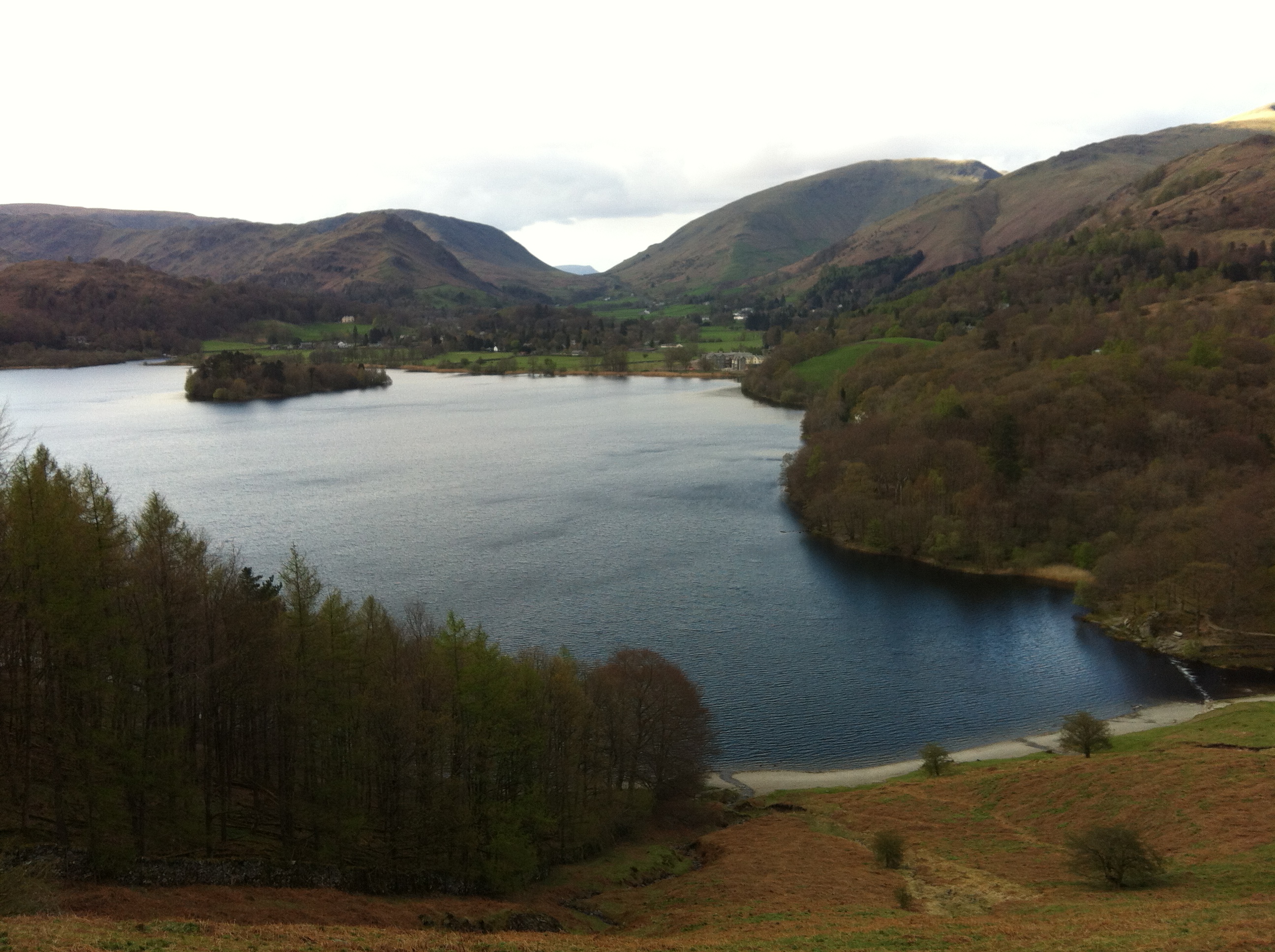
Before I discuss the second book here’s a picture of the Lake District (or at least one lake in the district) to keep you going.  This is a long post, I’m sorry…

Image

Secondly, The Life and Opinions of Maf the Dog and of his Friend Marilyn Monroe by Andrew O’Hagan (Faber & Faber, 2010).  Yes, it’s a well-known and much debated story told from the point of view of a dog.  If that sounds like a premise that would make you want to poke your own eyes out, stay with me.  It’s not a novel I would have read either, except it’s by Andrew O’Hagan, who is a terrific writer, and who dealt with the dark side of fame and its repercussions on the famous so brilliantly in his 2003 novel Personality. If you thought the dog thing sounded like quite a fun and original way of telling the story, well, you were right, and I shouldn’t be so jaded and blinkered. Maf (there’s no way I’m writing that title out in full again)tells the story of Marilyn’s last few years through the eyes of her Bichon Maltese dog, Mafia Honey, given to her by Frank Sinatra.  Except it sort of doesn’t.  Marilyn was placed under intense scrutiny and yet still remained an enigma, and Maf doesn’t seek to change this.  By the end of the novel she is still a mystery, O’Hagan doesn’t have a “Marilyn theory” to put forward.  Instead, through Maf, we take a look at Hollywood, and to wider extent the USA, on the brink of change, as the Golden Age of the 1950s fades and the momentum for immense change in the 1960s builds.

“There was a neon halo over Times Square.  The puddles were lighted pink and the bulbs made a cartoon beauty of Midtown, pulling shadows and poor men out of the alleys…bright commerce took advantage of the dark, the changes in colour feeling like events…in the middle of all those twinkles, you might wonder if people even had a chance of spending their lives wisely.”

It’s a comedy in the main though, and there’s plenty of whimsy which plays with the unusual point of view but never overdoes it:

“We usually hate cats, not for the typical reasons, but because they show an exclusive preference for poetry over prose.  No cat ever spoke for long in the warmth of good prose.  A dog’s biggest talent, though, is for absorbing everything of interest – we absorb the best of what is known to our owners and we retain the thoughts of those we meet.”

This psychic device means Maf is able to speak with knowledge on a wide range topics, particularly philosophy.  Apparently most dogs are socialists, and Maf particularly loves Trotsky.  This I felt was the weakness of the novel; Maf is an engaging and unique voice, but a little pompous.  Generally this doesn’t stop him from being likeable, but at times I felt the philosophising and intellectual name-dropping could have done with a more heavy-handed edit.  Still, the descriptions of Marilyn are sympathetic and delicate:

“She found it hard. Many of the old bids for independence had fallen short.  She was tired.  When she hugged me, her comforter, her guardian, I felt a weight of disappointment about her, as if the stands she had taken in life, and in love, had only revealed her personal shortcomings and the impossibility of respect.”

While Marilyn struggles, Maf is her constant companion and goes everywhere wither, meaning we learn about Sinatra’s temper tantrums, JFK’s shoes, George Cukor’s interior design…  When he accompanies her to Lee Strasberg’s famous actor’s studio to learn about method acting, Maf takes on board all the techniques:

“I reached inwards. All the way in.  I recalled some humiliation I once suffered at the hands of Evelyn Waugh and a croquet ball.  I must have been the merest puppy and was pootling on the lawn […] Evelyn was making a point, a facetious point, naturally, about the ugliness of George Eliot, and when I tried to correct him along Latin principles he knocked a croquet ball across the lawn at vicious speed and it struck me in the centre of my infant forehead…I used it to deepen my performance on the table at the back of Jack’s Bar.”

The great Strasberg takes notice and asks someone to fetch the dog some water.  A method acting dog – brilliant.  Along the way there are other light comic touches – rats with Brooklyn accents, an Old English Sheepdog who speaks like Boris Johnson (only more coherent), the fact that Lady from Lady and the Tramp is the dog of his dreams, and he congratulates himself on seeing beyond her typecasting as the love interest: “If only she had met me things would be different.” Over the years many people seem to have felt that way about tragic Marilyn, but she wasn’t saved, and the book isn’t so funny as to downplay this part of the story.  Marilyn comes across as vulnerable and damaged, and her little dog, like so many others around her, can only watch her self-destruct.  Maf is an original take on a behind the scenes story, one that respectfully leaves the same questions unanswered as to why Marilyn’s life ended the way it did.

Originally I planned to write “the scenes” on a piece of paper and photograph the books behind it (fnar fnar) but I decided against this marvellous visual pun and instead opted to photograph them with a picture of the peerless Sir Humphrey Appleby (Sir Nigel Hawthorne) from Yes Minister/Yes Prime Minister, master manipulator of behind the scenes political power wielding: 

Image