Happy 2016! How are your New Year’s resolutions going? I excelled myself this time around, by abandoning mine before I’d even begun. My internal monologue went thusly:
“I’m going to not buy any more books until I’ve read all those I already own.
… except playtexts (they’re so small they barely count).
…and Persephones.
…and green Viragos.
…and anything else that I really, really want.”
*Sigh* Useless. Even Paul Newman has lost all faith in me.

OK, so that was just an excuse to put a picture of Paul Newman in the post and if we’ve learnt one thing, it’s that I am incapable of exercising any sort of self-control, especially regarding books and gifs, and cheese, and single malts, and watching inane detective shows, and…..
So if you are a fellow willpower-free zone, I have an answer for you. Surround yourself with people who are worse than you in some way, and you’ll realise you’re not so bad after all. Now is not the time for aspirations, it is a time for resignation and another fistful of chocolates 🙂 This week I thought I’d look at anti-heroes, and two characters who will make you feel like the most virtuous person alive.
Firstly, Tom Ripley in The Talented Mr Ripley by Patricia Highsmith (1955).

Matt Damon as Tom Ripley in the 1999 film
Tom Ripley is approached by the father of an acquaintance in a bar, who has mistaken him for a decent human being:
“Judging [Tom] from that night, Charley could have told Mr Greenleaf that he was intelligent, level-headed, scrupulously honest, and very willing to do a favour. It was a slight error.”
An understatement to say the least. Tom agrees to go to Europe to try and persuade the prodigal son, Dickie Greenleaf, to return home and join the family business, not for any altruistic reason but because he’s worried a petty scam he’s been running is catching up with him. Dickie is a golden boy, rich, idle and good-looking :
“Tom could not help feeling that Richard was not very intelligent, or else he loved to be photographed and he thought he looked best with his mouth spread from ear to ear, which was not very intelligent of him, either.”
Tom becomes obsessed with Dickie, wanting to be all that he is and have all he has:
“Possessions reminded him that he existed, and made him enjoy his existence. It was as simple as that. And wasn’t that worth something? He existed.”
Tom’s slippery notion of himself, identity and existence is the driving force of the novel as he dissolves the boundaries between him and Dickie, eventually *SPOILER* killing him and stealing his identity. The remainder of the novel sees him dodging authorities and Dickie’s friends, spinning lies and manipulating everyone in his path: “He was himself and yet not himself. He felt blameless and free, despite the fact that he consciously controlled every move he made.”
Tom is a sociopath of course, and the real strength of the novel lies in the study of his character rather than the thriller elements, well done as they are. It is Tom’s character that spawned four sequels and really gets under your skin; as a reader I felt drawn in by him, creating a weird ambivalence through empathy and disgust. Tom is a powerful but sad character – he knows something is missing in him, something that makes him entirely alone:
“It struck Tom like a horrible truth, true for all time, true for the people he had known in the past and for those he would know in the future: each had stood and would stand before him, and he would know time and time again that he would never know them and the worst was that there would always be the illusion, for a time, that he did know them, that he and they were in complete harmony and were alike.”
The Anthony Minghella film adaptation of The Talented Mr Ripley is widely known, but I also recommend a French adaptation from 1960, Plein Soleil starring an unnervingly beautiful Alain Delon as Ripley:
Secondly, Joe Lampton in Room at the Top by John Braine (1957).
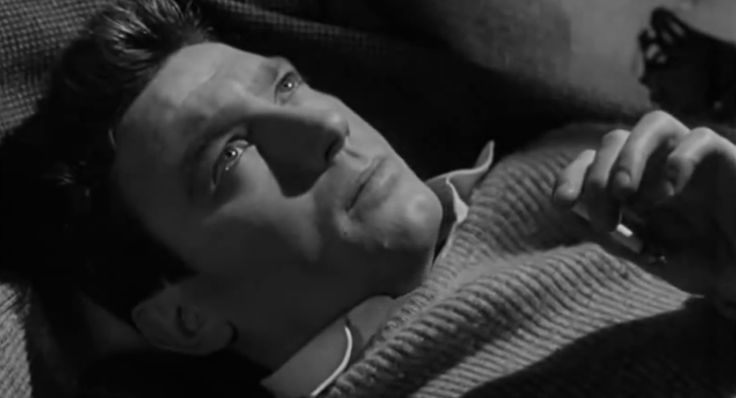
Laurence Harvey as Joe Lampton in the 1959 film
I expected this story of social climbing to have dated but surprisingly, it wasn’t so. The references to northern mill towns being a hive of industry is sadly past and the rigid social classes, worry over a relationship’s ten year age gap and Joe’s lover’s concern that she is ancient at the ripe old age of 34, seem less relevant. However, as a portrayal of greed for material acquisition and the mistaking of such as being a purposeful life, Room at the Top is as incisive as ever.
Joe leaves the poverty of his home town of Dufton to move to the more prosperous Warley:
“I was going to the Top, into a world that even from my first glimpses filled me with excitement: big houses with drives and orchards and manicured hedges, a prepatory school to which the boys would soon return from adventures in Brittany and Brazil and India or at the very least an old castle in Cornwall, expensive cars – Bentleys, Lagondas, Daimlers, Jaguars –parked everywhere as a kind of ostentatious litter as if the district had dropped them at random as evidences of its wealth”
Joe rooms at the top of one of the large houses, takes a job at the local town hall, but has ambitions far beyond his current circumstances:
“I saw myself, compared with him, as the Town Hall Clerk, the subordinate pen-pusher…I wanted an Aston-Martin, I wanted a three-guinea linen shirt, I wanted a girl with a Riviera suntan – these were my rights, I felt, a signed and sealed legacy.”
Joe joins the local am-dram society and is drawn to young, rich Susan: “I’ll marry her if I have to put her in the family way to do it. I’ll make her daddy give me a damned good job. I’ll never count pennies again.” Thus begins a double life, one where he is with Susan, determinedly climbing the slippery pole, “I was manoeuvring for position all the time, noting the effect of each word; and it seemed to devalue everything I said” and one where he is with Alice, his older lover, able to be authentically himself.
Joe is an intriguing character, utterly reprehensible in his machinations but painfully self-aware and never self-justifying: he wants what he wants and he sets out to get it. There is no sense that he is any better or any worse than those who surround him, and so Room at the Top, while an intimate portrait of one man, is also a damning portrait of post-war society. I didn’t wholly dislike Joe, but Braine doesn’t shy away from the emotional fall-out of using people in this way and we are not expected to excuse Joe’s behaviour.
“I felt choked with my own selfishness as nasty as catarrh; there was nothing in my heart to match the lovely sweep of the moor and the sense of infinite space behind it and a million extra stars above.”
Joe’s punishment is a terrible one: he gets everything he wants.
Room at the Top was a huge success and quickly adapted into a similarly successful film with Simone Signoret winning an Oscar for her portrayal of Alice:
So take it from me, Tom Ripley and Joe Lampton: even if you’ve failed in all your New Year resolutions, you’re doing OK 🙂
 madame bibi lophile recommends