“Have you practised swooning?” (Ruby Ferguson, Apricot Sky)

This is my contribution to Dean Street December, a month-long celebration of this wonderful indie publisher, hosted by Liz at Adventures in Reading, Running and Working from Home.

Dean Street Press’ imprint Furrowed Middlebrow focuses on early and mid-twentieth century women writers, and it’s from this collection that I’ve chosen my read, Apricot Sky by Ruby Ferguson (1952 – please note for Simon and Kaggsy’s 1952 Club running next year!)

I must confess that rather than a DSP edition, my copy is a nice little hardback I found in my local charity shop, inscribed with the author’s love to Flossie and John 😊 I picked up her later novel The Leopard’s Coast at the same time, also given with the author’s love, so I wonder if Flossie and John lived near me and their books have been cleared out…?
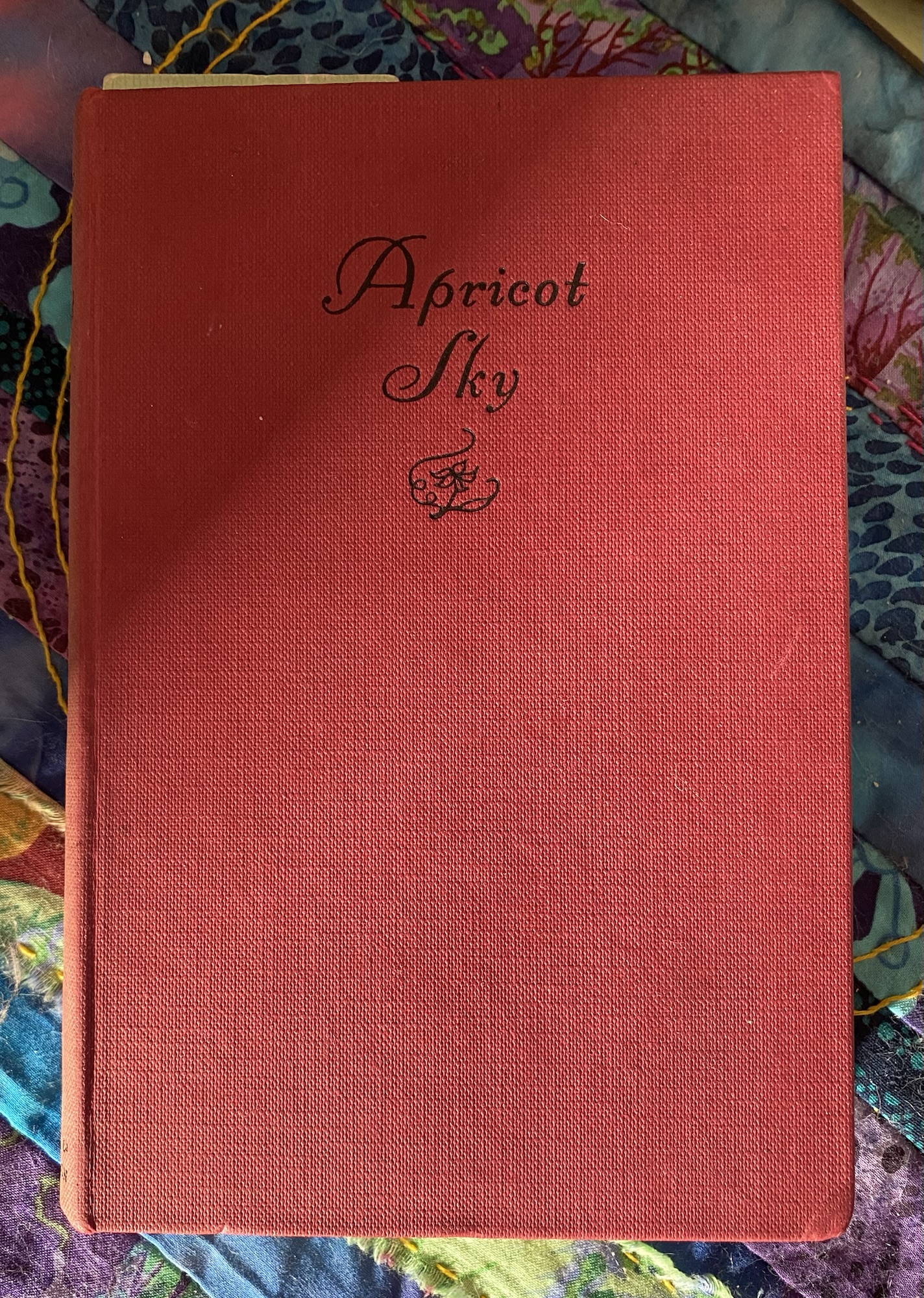
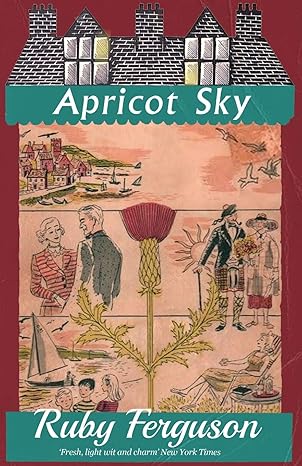
Aside from the Jill pony books I read as a child, I only knew Ruby Ferguson from Lady Rose and Mrs Memmary  (1937) republished by Persephone Books. But I’d enjoyed that so much that I felt confident enough to swoop up the two books when I saw them; and what a total joy Apricot Sky turned out to be.

Set in 1948 in the Highlands of Scotland, the story follows the MacAlvey family through the events of one summer. A descriptive passage on the first page sets the tone:

“The charm of islands which changed their colour every few minutes, of lilac peaks smudged on the farthest horizon, of white-capped waves on windy days, of distant steamers chugging romantically on their ways, of little boats with faded brown sails scudding before the breeze, of sudden storms pouring fiercely across the terrific expanse of sky and water, of thousands of seabirds planing and diving, of floods of sunshine scattering millions of diamonds upon the rippling waves, all this made-up the view about which the MacAlvey’s visitors had so much to say while the MacAlvey’s themselves listened indulgently and with inward amusement.”

The MacAlvey’s are a nice family living a life not without trials but without any great drama, comfortably well-off and settled.

“Kilchro House was noted for its hospitality. It was a gay house where a gay family gave charming entertainment and never tried to descend into banality by prattling about themselves.”

The MacAlvey’s younger daughter Raine is due to marry Ian, brother of the Laird of Larrich. This is the thread which runs through the novel, as the wedding gathers apace for the September ceremony.

Raine’s older sister Cleo is back from three years in America, everyone expecting her much changed, but her heart stayed with her Highland home, and Neil, the Laird. Whenever she sees him she becomes utterly tongue-tied, and feels entirely inadequate alongside the charms of Inga Duthie, a sophisticated widow who is new to the area.

“Cleo MacAlvey could think of no worse desolation than that those she liked should not like her. She was a great deal more diffident than her sister Raine, who barged through life without caring whether people liked her or not, and was about as introverted as a fox-terrier puppy.”

Alongside these adult concerns are the younger children, left to their own devices. Primrose, Gavin, and Archie were orphaned by the war and live with their grandparents. The whole summer stretches before them:

“At Strogue there was no promenade and no cinema or skating-rink and only about three shops, and you couldn’t move without getting yourself in a mess with tar and fish and stuff left about, but everything you did there was full of exhilaration and had a way of turning out quite otherwise than you expected.”

They love boats and beaches and being out of doors. The only blight on their idyll is distant cousins Elinore and Cecil who come to stay for a few weeks. They are refined and self-contained, and in the case of Elinore, an unmitigated snob.

The children’s adventures are reminiscent of the Famous Five: there are islands, swimming and a big focus on picnics. There is post-war rationing to contend with, but it is seemingly straightforward to overcome – they frequently manage sweets, pies, jam, sandwiches and fizzy drinks.

For the adults, the trials are tedious houseguests in the shape of Dr and Mrs Leigh, and the appalling Trina, married to their son James. Mrs MacAlvey loves having guests though, and loves her family and her garden. Her part of the world gives her all she needs and she feels no desire to venture any further:

“She found herself unable to picture it, for she had never been to England, and always thought of it as being full of successful people living in Georgian houses.”

Despite being so rooted in her domestic life, she remains blissfully unaware of what her grandchildren get up to all day, and how tortured poor Cleo is by her unspoken love for Neil:

“Nobody talked about their feelings at Kilchro House, it was considered one stage worse than talking about your inside.”

I thoroughly enjoyed my summer with the MacAlvey family in a beautifully evoked part of the world, far away from chilly London. The stakes were soothingly low, and the humour was gentle. Any drama was short-lived, and things worked out exactly as they should.

If you are looking for a warm-hearted, escapist read, Apricot Sky will serve you well.

“‘All right,’ said Raine, holding out a ten-shilling note. ‘I’ll try anything once, even altering the course of history.’”

“A Persephone cover is a guarantee of good reading.” (Nicola Beauman, founder of Persephone Books)

After a month of daily posting about novellas I was planning at least a week’s break from blogging, but I couldn’t resist joining in with Jessie at Dwell in Possibility’s Persephone Readathon. Here are two short Persephones that just missed out on being part of Novella in Day in May as they were over 200 pages (but not by much).

Firstly, Lady Rose and Mrs Memmary by Ruby Ferguson (1937) which is Persephone No.53.

This is the story of a young Scottish heiress from childhood to young adulthood, framed by the visit of three tourists to the estate of Keepsfield.

“This transition to the atmosphere of another world is bewildering to modern personalities. The three strangers were conscious of a nakedness of spirit that made them uneasy spectators of a grandeur which was more than material. The old caretaker had slipped into the background, as caretakers do.”

The caretaker, Mrs Memmary, has been on the estate since she was a girl, and she tells one of the Tourists, Mrs Dacre, the story of Lady Rose. Rose is a child filled with joy, and a passionate attachment to her homeland, so far so that she names her kitten after a mighty clansman:

“Rose went out onto the sun-drenched west terrace, cuddling Rob Roy, who by now wore a small pink silk handkerchief round his head to protect him from the sun.”

She is a debutante and presented to the Queen, who takes a shine to her. It is at this moment, stepping into society for the first time, that she realises what her wealth and position truly mean:

“She was important? She, Rose Targenet aged eighteen, who had done so little but rejoice in the beauty and happiness of life. Of course her importance was not her own quality; it was because of her Papa.”

However, while she is important, she has no power. This is Victorian Scotland, and she must make a good match, securing the future of her lands and providing a male heir. We know that she managed this, as Mrs Memmary tells the tourists early on that all the splendour they see in the home is entailed to the heir, and Lady Rose is seeking a rich tenant to help pay for the upkeep of the estate.

The Victorian marriage market is poked gentle fun at during this overheard conversation between Rose’s mother and a family friend, regarding the Poet Laureate:

“If poor Alfred must write about what he calls love, he might at least explain that it is an emotion to be openly enjoyed by the middle classes.”

Although Lady Rose and Mrs Memmary could be seen as a light novel, it actually has serious points to make about the role and rights of women in the period. (It was written in in the 1930s and was apparently a great favourite of the Queen Mother, which I find fascinating. Makes me see her in a whole new light.)

Rose ends up in a loveless marriage to someone who is not horrible, but just completely cold and repressed:

“She had cried on her bed all the afternoon, realizing bitterly that in 1874 married women had no rights, even if they were countesses. She didn’t cry now, for she had the children, and in any case crying did no good after 10 years.”

Meanwhile, her friend Susan is in no better position having avoided marriage altogether:

“But what have I got? Just a piece of needlework and two disappointed elderly minded parents, and all the time in the world on my hands. If I had my way women would be free to do the same things as men; come and go as they wished, and read and talk, and be doctors and lawyers and financiers, and Members of Parliament, and newspaper writers, Wouldn’t that be wonderful?”

So what happens? We know Lady Rose is a strong character who at times is willing to defy authority, and we know she has been abroad for a long time. Mrs Dacre isn’t at all happy with what Mrs Memmary tells her:

 “ ‘You mean – that was the end of Lady Rose’s story? It seems a vague, disappointing ending.’

‘Vague?’ The old woman thought for a moment and said, ‘But in real life things go like that. Our stories have no ending. We come into the light for a little while, and then we move away into the shadows and nobody sees us anymore. It is better that way.’”

A good point, but Mrs Memmary has held something back. I don’t think I’m a great genius in guessing what it was in Chapter 2, but this didn’t spoil my enjoyment of the novel at all. I promise you it’s not a vague, disappointing ending.

Lady Rose and Mrs Memmary is in some ways a romantic novel: the country house and Scotland are both described with ravishing beauty, and it is a novel about being true to yourself and following your heart. But Ferguson also doesn’t shy away from portraying the price that is paid for these things, suggesting the price may be worth it but it can also be a high one.

Secondly, Daddy’s Gone A-Hunting by Penelope Mortimer (1958) which is Persephone No.77. Ruth Whiting lives in a commuter town with her husband Rex. Their two sons are away at boarding school and their daughter – whose conception necessitated their marriage – is studying at Oxford. Ruth is not happy:

“In all the years of her marriage, a long war in which attack, if not happening, was always imminent, she had learned an expert cunning. The way to avoid being hurt, to dodge unhappiness, was to run away. Feelings of guilt and cowardice presented no problems that couldn’t be overcome by dreams, by games, by the gentle sound of her own voice advising and rebuking her as she went about the house.”

Rex and Ruth aren’t together very much – he has a flat in London during the week and comes home at weekends.

“For Rex and herself there was no longer any hope or possibility of change; there was no longer any choice to be made. They lay, fully grown, capable of every crime and every greatness, paralysed by triviality.”

Mortimer’s unflinching eye and scathing attitude is cast wider than the intricacies of marriage; it also takes in the other couples in the area:

“The relationships between the men are based on an understanding of success. Admiration is general, affection not uncommon. Even pity is known. The women have no such understanding. Like little icebergs, each keeps a bright and shining face above water; below the surface, submerged in fathoms of leisure, each keeps her own isolated personality. Some are happy, some poisoned with boredom; some drink too much and below the demarcation line are slightly crazy; some love their husbands and some are dying from a lack of love; a few have talent, useless to them as a paralysed limb.”

Ruth seems on the verge, if not in the midst of, a breakdown. She is struggling to get out of bed and Rex engages a housekeeper/nurse.  However, what begins as a dissection of suburban 1950s marriage develops into something more political when Ruth’s daughter Angela tells her she is pregnant. The father, fellow student Tony, is selfish and callow:

“It was obviously not going to be necessary to impress on him the seriousness of the situation. He looked like a curate settling down to discuss dry rot in the organ loft.”

So Angela, unlike her mother, does not want to tie herself into marriage to an unsuitable man for the sake of an unwanted baby. The rest of the novel follows the hoops both Ruth and Angela have to jump through in order to secure an abortion. (This  particularly resonated at the time I read it given the recent vote in Ireland). What Mortimer demonstrates is the ways in which women’s lives are circumscribed and the huge fallout this can have: on mental health, physical health, participation in society, participation in our own lives.  Although she is acerbic, and undoubtedly it is a resounding cry for women’s rights to be acknowledged and given their due importance, I think above all, Daddy’s Gone A-Hunting is a plea for kindness.

“He would probably go through his entire life imagining that he was real; but not one person would owe him gratitude, remember his comfort.”

To end, I said when Novella a Day in May was over I’d go back to shoehorning late 20th century pop tunes into posts at every opportunity. So here we go, a 1980s celebration of those beautiful Persephone covers: