“Never despise the translator. He’s the mailman of human civilization.”(Alexander Pushkin)

This week I thought I’d use Kaggsy and Lizzy’s #ReadIndies event to focus on one indie publisher, and finally get to four books that have long been languishing in the TBR. Pushkin Press “publish some of the twentieth century’s most widely acclaimed and brilliant authors” and they are one of my favourite indies, ever-reliable. Which hasn’t stopped four from their Collection series remaining unread by me for far too long!

Today I’m starting with The Buddha’s Return by Gaito Gazdanov (1949-50, transl. Bryan Karetnyk 2014). Gazdanov was a Russian writer exiled in France and this short novel, described by the publishers as “part detective novel, part philosophical thriller, and part love story” is set in Paris, as much as it is set anywhere – reality is not a consistent concept in this story at all.

The narrator is a student who is experiencing prolonged periods of hallucinations. He tells us from the start that he is an unreliable storyteller:

“Nowhere was there any logical pattern in this, and the shifting chaos clearly failed to present even a remote semblance of any harmonious order. And so, accordingly, at that point in my life, which was marked by the constant attendance of chaos, my inner existence acquired an equally false unwavering character.”

We slide back and forth between a recognisable reality of his poverty-stricken life in Paris and his disturbing, disorienting visions, without always knowing which is which. Early on in the novel he falls to his death from a sheer mountainside, later he is arrested and interrogated by the Central State. The government’s accusations of treason are entirely surreal and illogical, yet this is also what makes them horribly believable.

There is political commentary running through the novel, but the kaleidoscopic nature of the narrative means it is not a sustained satire on any particular country, ruler or party, but rather a wider condemnation:

“The ignorant, villainous tyrants who so often ruled the world, and the inevitable and loathsome apocalyptic devastation apparently inherent in every era of human history.”

Around halfway through, more of a plot emerges as Pavel Alexandrovich, an older man whom the student befriended, is murdered and his golden statuette of Buddha stolen. As the last person to see Alexandrovich alive, the student falls under suspicion. The real-life interrogation by the investigators has shades of the surreal fantasy interrogation by the Central State:

“If we can find the statuette, you’ll be free to return home and continue your research on the Thirty Years War, the notes on which we found in your room. I must say, however, that I completely disagree with your conclusions, and in particular your appraisal of Richelieu.”

As that quote shows, there is humour in The Buddha’s Return and this lightens a tale which has a lot of dark elements: visceral war scenes, squalor, and of course murder.

Apparently, The Buddha’s Return was originally published in instalments and I can see it would work well in this format. I enjoyed it but for me the more plot-driven second half arrived at just the right time, when I’d started to feel it was losing momentum. As it was I enjoyed this consistently surprising tale which still had enough recognisable humanity in it to be involving, and I’d be keen to read more by Gazdanov.

“I have a suspicion that you just dreamt the whole thing up. It’s because you read too much, eat too little and spare hardly any thought for the most important thing at your age: love.”

“There are no ordinary cats.” (Colette)

Mallika at Literary Potpourri’s wonderful event  Reading the Meow has been running all week, do check out all the great posts prompted by our feline friends! Here is my post just in time…

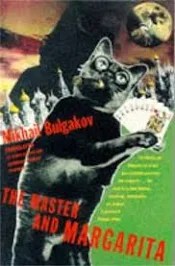
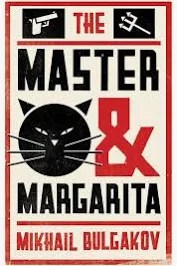
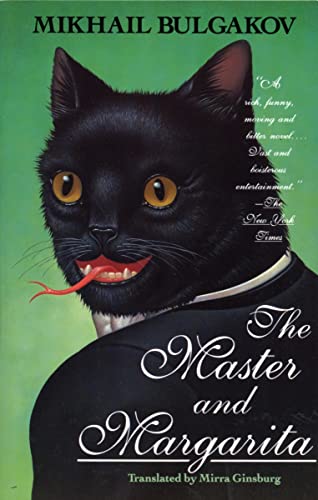
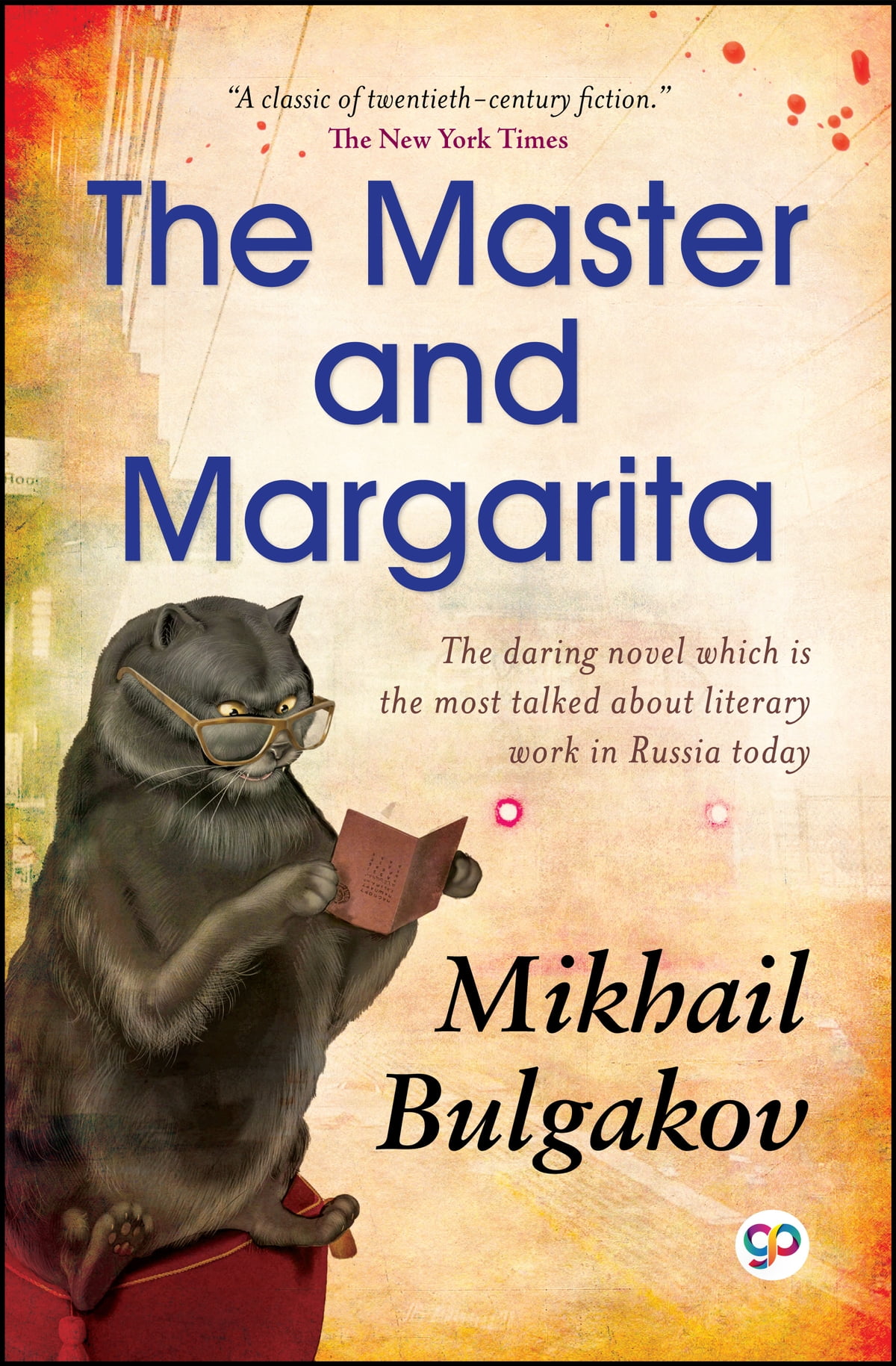
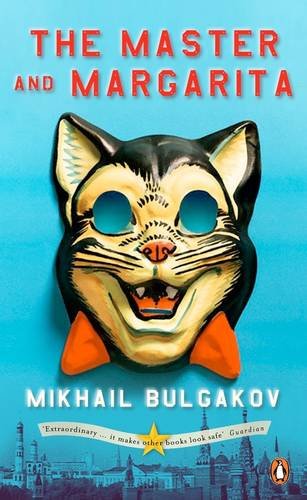
I’m grateful to Reading the Meow for finally getting me to pick up The Master and Margarita by Mikhail Bulgakov (finished in 1940, published in 1966) which is part of my Le Monde’s 100 Books of the Century Reading Challenge and has been languishing in my TBR for years. Although not ostensibly a book about cats, one does feature prominently as these various edition covers will attest:

The reason it had lain unread for so long was because I’m (aptly) a big scaredy-cat. I was really intimidated by this classic of twentieth-century fiction and I thought it would be far too complex and clever for me to understand. Which as it turned out, was broadly correct. I’m sure I didn’t pick up all the allusions and references, even with the notes in the back of my edition to help me (Alma Classics, trans. Hugh Aplin 2020 – I definitely recommend this edition and translation).  However, I still found it very readable and a lot to enjoy, especially regarding Behemoth, the character that meant I was reading it this week particularly.

The Devil arrives in 1930s Moscow as a Professor Woland, along with his entourage: red headed, bizarrely dressed Korovyev; sinister vampiric Azazello; beautiful Hella; and Behemoth, an enormous cat that walks on his hindlegs, talks, drinks vodka and plays chess.

The proceed to wreak havoc for three days in a series of carnivalesque scenes, using the greed and corruption of people against them.  It’s absolute chaos and carnage, but brilliantly Bulgakov shows that the devil doesn’t have to push very hard for all this to occur.

At the start of the novel, Woland predicts the shocking and absurd death of Berlioz, head of Massolit, a literary organisation. Once people hear of his death, this description of a barrage of statements in order to get Berlioz’s apartment is a good example of how Bulgakov balances social realism, satire, the comic and the desperate throughout:

“In them were included entreaties, threats, slanders, denunciations, promises to carry out refurbishment at people’s own expense, references to unbearably crowded conditions and the impossibility of living in the same apartment as villains. Among other things, there was a description, stunning in its artistic power, of the theft of some ravioli, which had been stuffed directly into a jacket pocket, in apartment No.31, two vows to commit suicide and one confession to a secret pregnancy.”

Meanwhile, Margarita, beautiful and unhappily married, is distressed because her lover, The Master, has committed himself to an institution and renounced his writing.

This is interspersed with the story of Pontius Pilate and Yeshua (Jesus), with the two stories echoing one another, and it emerges that this was the novel The Master was writing.

It is through the titular characters that Bulgakov prevents his satire becoming too bitter and alienating. Their devotion to each other and Margarita’s belief in The Master’s work is truly touching.

I don’t really want to say too much more as The Master and Margarita is such a complex, riotous piece of work that I think the more I try and pin it down the more I’ll tie myself in knots! It tackles the biggest of big themes; religion, state oppression, the role of art, love, faith, good and evil, how to live… It is a deeply serious work that isn’t afraid to be comical too.

But as this post is prompted by Behemoth, here is my favourite scene with him, getting ready for Satan’s Grand Ball on Good Friday and trying to distract from the fact that he is losing at chess:

“Standing on his hind legs and covered in dust, the cat was meanwhile bowing in greeting before Margarita. Around the cat’s neck there was now a white dress tie, done up in a bow, and on his chest a ladies mother-of-pearl opera glass on a strap. In addition, the cat’s whiskers were gilt.

‘Now what’s all this?’ exclaimed Woland. ‘Why have you gilded your whiskers? And why the devil do you need a tie if you’ve got no trousers on?’

‘A cat isn’t meant to wear trousers, Messire,’ replied the cat with great dignity. ‘Perhaps you’ll require me to don boots as well? Only in fairy tales is there a puss in boots, Messire. But have you ever seen anyone at a ball without a tie? I don’t intend to find myself in a comical situation and risk being thrown out on my ear! Everyone adorns himself in whatever way he can. Consider what has been said to apply to the opera glasses too, Messire!’

‘But the whiskers?’

‘I don’t understand why,’ retorted the cat drily, ‘When shaving today Azazello and Korovyev could sprinkle themselves with white powder – and in what way it’s better than the gold? I’ve powdered my whiskers, that’s all!’

[…]

‘Oh, the rogue, the rogue,’ said Woland shaking his head, ‘every time he’s in a hopeless position in the game he starts talking to distract you, like the very worst charlatan on the bridge. Sit down immediately and stop this verbal diarrhoea.’

‘I will sit down,’ replied the cat sitting down, ‘but I must object with regards your final point. My speeches are by no means diarrhoea, and you’re so good as to express yourself in the presence of a lady, but a series of soundly packaged syllogisms which would be appreciated on their merits by such connoisseurs as Sextus Empiricus, Martianus Capella even, who knows, Aristotle himself.’

‘The kings in check,’ said Woland.

‘As you will, as you will,’ responded the cat, and began looking at the board through the opera glass.”

I think overall I probably admire The Master and Margarita more than love it, and I enjoyed Bulgakov’s A Country Doctor’s Notebook more. But there is so much in this extraordinary, unique novel that will stay with me, and I’m sure it will reward repeat readings too.

To end, I tried to get my two moggies to pose with the book. With typical cattitude, they flatly refused 😀  So it’s back to 80s pop videos:

“Just try new things. Don’t be afraid. Step out of your comfort zones and soar, all right?” (Michelle Obama)

A little while ago I went to see Edward St Aubyn interviewed and he was every bit as witty and compelling as I’d hoped. He mentioned that he finds dialogue the easiest part of writing, and an audience member asked him if he’d consider writing a play. St Aubyn said he didn’t really enjoy theatre (something along the lines of “I always seem to be in the middle of row M”) but that playwriting might be a bit of a holiday from novel writing, which I’m sure must have pissed off any playwrights in the audience sweating blood and ink over their drama.

Also, for any fellow Patrick Melrose series fans, and I know we are a precious bunch who don’t want to see TV mess up such novelistic perfection, he said he’d been on set to see the production that’s being made with Benedict Cumberbatch and he was very happy with it.

So, a long preamble to say that this is why I decided to look at playwrights writing prose this week.

Firstly, Samuel Beckett’s First Love and Other Novellas (1954-73, trans. Samuel Beckett and Richard Seaver) which I would argue aren’t novellas at all, they are all short stories (there are 4 stories in the collection and the 2 longest are only just over 20 pages). Pedantry aside, I would say if you like Beckett’s dramas you’ll like his short stories. It’s all here: existential crisis, bleak absurdism, humour and despair.

In The End, the first-person narrator is down on his luck, clothed in badly fitting clothes that ‘they’ have given him from a dead man, having burnt his (presumably to avoid disease). He eventually finds lodgings, but is turfed out and returns to an itinerant life:

“One day I witnessed a strange scene. Normally I didn’t see a great deal. I didn’t hear a great deal either. I didn’t pay attention. Strictly speaking I wasn’t there. Strictly speaking I believe I’ve never been anywhere. But that day I must have come back.”

Pretty Beckettian, no? I know he’s not for everyone, but what I like about Beckett is that all the absurdism and word-play is not an intellectual exercise only, but is underpinned by a great humanity and acute awareness of suffering which makes his work bleakly beautiful:

“The memory came faint and cold of the story I might have told, a story in the likeness of my life, I mean without the courage to end or the strength to go on.”

The idea of choosing the story we tell is continued in the next two stories, The Expelled where the narrator, having taken us through a day in his life concludes:

“I don’t know why I told this story. I could just as well have told another. Perhaps some other time I’ll be able to tell another. Living souls, you will see how alike they are.”

And also in The Calmative, where the narrator tells himself a story to assuage the fear of death:

“So I’ll tell myself a story. I’ll try and tell myself another story, to try and calm myself, and its there I feel I’ll be old, old, even older than the day I fell, calling for help and it came. Or is it possible that in this story I have come back to life, after my death? No, it’s not like me to come back to life, after my death.”

The final, titular story is needless to say, not a rose-tinted view of innocence and longing.

“I didn’t understand women at that period. I still don’t for that matter. Nor men either. Nor animals either. What I understand best, which is not saying much, are my pains. I think them through daily, it doesn’t take long, thought  moves so fast, but they are not only in my thought, not all.”

So, business as usual for Beckett despite the change in the form from drama 😀 If you’re not sure about Beckett but want to give him a go, you could do worse than start here; you’ll get a good flavour without having to pay extortionate theatre ticket prices only to find yourself stuck in the middle of row M.

Obligatory picture of Beckett’s amazing face:

Samuel_Beckett,_Pic,_1

Secondly, About Love and Other Stories by Anton Chekhov (trans. Rosamund Bartlett, OUP 2004). I’m being a bit cheeky claiming Chekhov primarily as a playwright for the purposes of this blog post, given that the back of my edition of these stories has a quote from Raymond Carver proclaiming Chekhov “the greatest short story writer who has ever lived”.

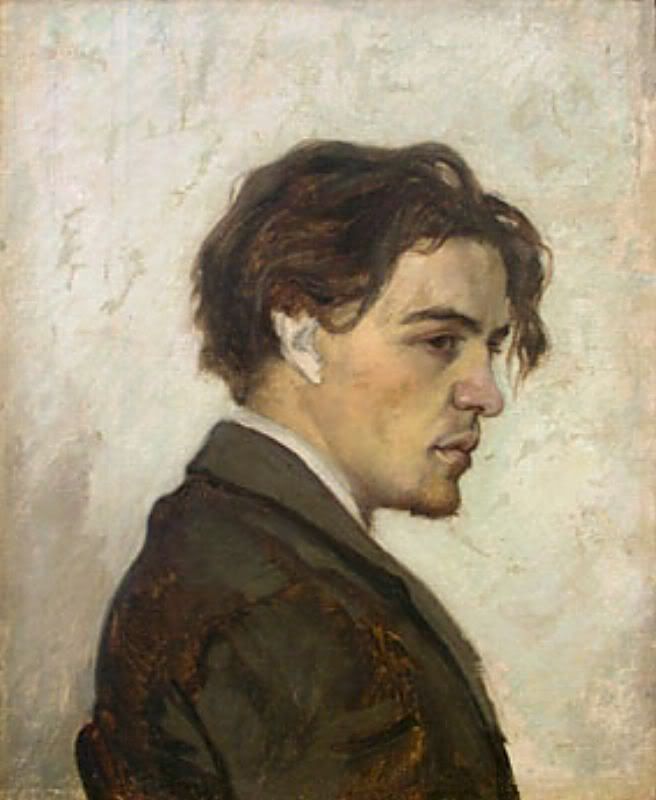
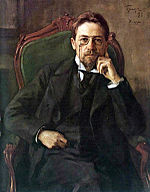
Anton Chekhov, who took up writing after One Direction split up

Having read this collection, I would say he really is a master. Beautiful writing, not a word out of place (as you’d expect given the famous ‘gun’ instruction regarding not having any superfluous detail) and he is able to take the miniature and make it epic. In The Lady with the Little Dog, Chekhov takes a well-worn story of a bounder seducing an unhappy woman and turns it into a tragedy, without it ever becoming sentimental or overblown.

“She pressed his hand and started walking down the stairs, looking back at him  all the time, and you could see from her eyes that she really was not happy. Gurov stood for a while, listening, and then when everything had gone quiet he looked for his coat-peg and left the theatre.”

It is the story not of a great love affair, but a love that sneaks up on two people who were not looking for it and how it seems to bring nothing but misery, but with an ever-present promise of unrealised happiness.

The stories are ambitious in theme and they are truly profound, but that doesn’t mean they are without humour. Rothschild’s Violin begins:

The town was very small – worse than a village really – and the people who lived in it were mostly old folk who died so rarely it was quite annoying.”

Yakov is the unfortunate coffin maker in this healthy town and he is grumpy and horrible to his wife. When his wife dies, he expresses his unexpected feelings through his violin playing, to great effect:

“Rothschild listened intently, standing to one side, his arms folded on his chest. The frightened, confused expression on his face gradually changed to one of grief and suffering. He rolled his eyes, as if experiencing exquisite pain”

A story about the universality of pain and the expression of feeling beyond words is explored with a lightness of touch that almost borders magic realism. Chekhov writes with such subtlety and never patronises the reader.

It’s really hard to write about Chekhov’s short stories. They are so rich, so full of telling detail and so beautifully evoked that I have not done any justice to them here. I only hope that I’ve convinced you to pick up one of his short story collections and read the treasures for yourself.

To end, following my last post’s comment by Lucy, a festive video of 2 men stepping out of their comfort zones and looking slightly baffled about it all (“I’m David Bowie, I live down the road” 😀 ):