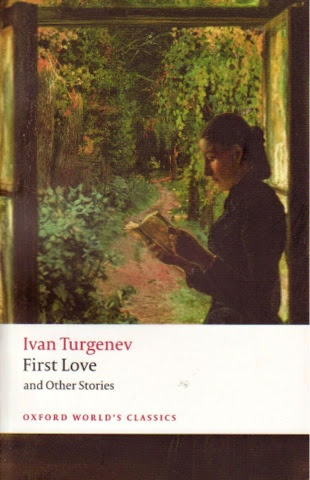
First Love – Ivan Turgenev (1860, trans. Isiah Berlin, 1950) 106 pages
This short tale of thwarted first love, told by a man, Vladimir Petrovich, looking back on the summer of 1833 when he was 16, manages to be both moving and funny. I felt for the pain of the young boy, whilst simultaneously rolling my eyes at the self-importance of teenagers (a bit how I feel watching Romeo and Juliet these days – kids!)
A young man is on the brink of adulthood, having just said goodbye to is tutor, when Princess Zasyekin moves in next door. The princess is uncouth and her house shabby:
“She took snuff as noisily as ever, and fidgeted and turned about on her chair as much as before. It never seemed to have entered her head that she was a princess.”
However, her daughter Zinaida is beautiful and poised, and has suitors in abundance. She teases them all, keeping them in a state of anticipation whilst remaining just out of reach. The young Petrovich is no different:
“But through the tears and the melancholy, inspired by the music of the verse or the beauty of the evening, there always rose upwards, like the grasses of early spring, shoots of happy feeling, of young and surging life.”
Yet there is always the sense that things are happening with Zinaida that our protagonist is too green to recognise. She seems genuinely fond of him and at one point even tells him so after he nearly breaks his neck jumping from a high wall (told you – kids!) yet there is something worldly and slightly damaged about her which Petrovich cannot begin to understand.
“My arms were smarting from the nettles, my back ached, my head swam, but at that moment I experienced a sense of bliss such as I never again felt in the whole of my life. It flowed like a delicious pain through all my limbs and finally resolved itself in rapturous leaps and cries. Yes, indeed, I was still a child.”
First Love reminded me of The Go-Between and Great Expectations whilst being resolutely its own tale. In a short space it conveys a detailed, effective portrait of the awakening of a young person to both the love and corruption that the adult world has to offer.
A little while ago I went to see Edward St Aubyn interviewed and he was every bit as witty and compelling as I’d hoped. He mentioned that he finds dialogue the easiest part of writing, and an audience member asked him if he’d consider writing a play. St Aubyn said he didn’t really enjoy theatre (something along the lines of “I always seem to be in the middle of row M”) but that playwriting might be a bit of a holiday from novel writing, which I’m sure must have pissed off any playwrights in the audience sweating blood and ink over their drama.
Also, for any fellow Patrick Melrose series fans, and I know we are a precious bunch who don’t want to see TV mess up such novelistic perfection, he said he’d been on set to see the production that’s being made with Benedict Cumberbatch and he was very happy with it.
So, a long preamble to say that this is why I decided to look at playwrights writing prose this week.
Firstly, Samuel Beckett’s First Love and Other Novellas (1954-73, trans. Samuel Beckett and Richard Seaver) which I would argue aren’t novellas at all, they are all short stories (there are 4 stories in the collection and the 2 longest are only just over 20 pages). Pedantry aside, I would say if you like Beckett’s dramas you’ll like his short stories. It’s all here: existential crisis, bleak absurdism, humour and despair.
In The End, the first-person narrator is down on his luck, clothed in badly fitting clothes that ‘they’ have given him from a dead man, having burnt his (presumably to avoid disease). He eventually finds lodgings, but is turfed out and returns to an itinerant life:
“One day I witnessed a strange scene. Normally I didn’t see a great deal. I didn’t hear a great deal either. I didn’t pay attention. Strictly speaking I wasn’t there. Strictly speaking I believe I’ve never been anywhere. But that day I must have come back.”
Pretty Beckettian, no? I know he’s not for everyone, but what I like about Beckett is that all the absurdism and word-play is not an intellectual exercise only, but is underpinned by a great humanity and acute awareness of suffering which makes his work bleakly beautiful:
“The memory came faint and cold of the story I might have told, a story in the likeness of my life, I mean without the courage to end or the strength to go on.”
The idea of choosing the story we tell is continued in the next two stories, The Expelled where the narrator, having taken us through a day in his life concludes:
“I don’t know why I told this story. I could just as well have told another. Perhaps some other time I’ll be able to tell another. Living souls, you will see how alike they are.”
And also in The Calmative, where the narrator tells himself a story to assuage the fear of death:
“So I’ll tell myself a story. I’ll try and tell myself another story, to try and calm myself, and its there I feel I’ll be old, old, even older than the day I fell, calling for help and it came. Or is it possible that in this story I have come back to life, after my death? No, it’s not like me to come back to life, after my death.”
The final, titular story is needless to say, not a rose-tinted view of innocence and longing.
“I didn’t understand women at that period. I still don’t for that matter. Nor men either. Nor animals either. What I understand best, which is not saying much, are my pains. I think them through daily, it doesn’t take long, thought moves so fast, but they are not only in my thought, not all.”
So, business as usual for Beckett despite the change in the form from drama 😀 If you’re not sure about Beckett but want to give him a go, you could do worse than start here; you’ll get a good flavour without having to pay extortionate theatre ticket prices only to find yourself stuck in the middle of row M.
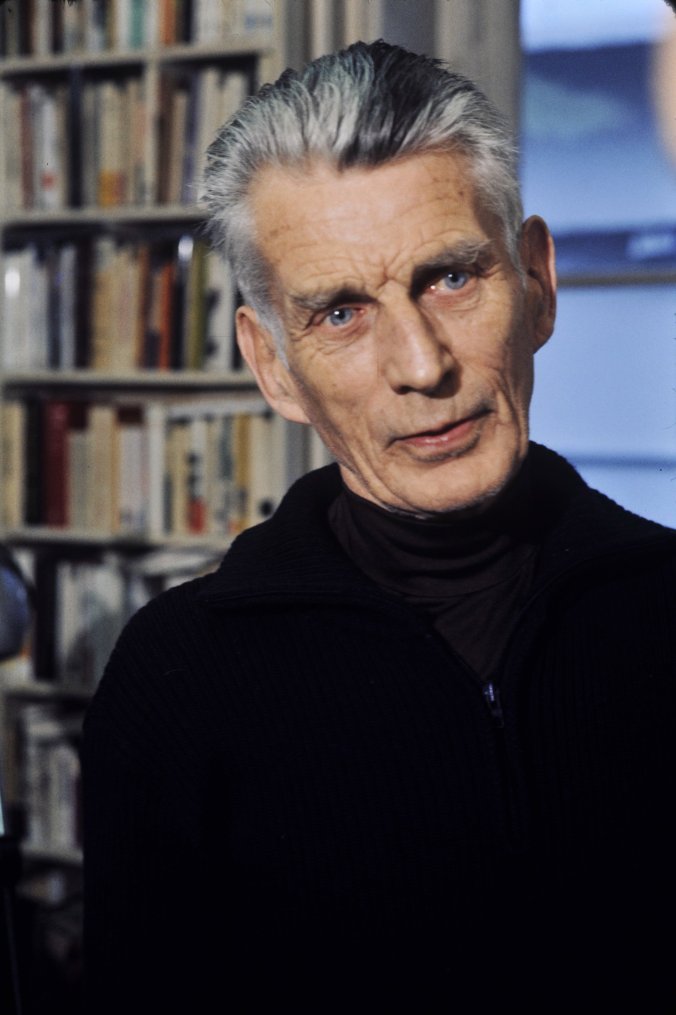
Obligatory picture of Beckett’s amazing face:
Secondly, About Love and Other Stories by Anton Chekhov (trans. Rosamund Bartlett, OUP 2004). I’m being a bit cheeky claiming Chekhov primarily as a playwright for the purposes of this blog post, given that the back of my edition of these stories has a quote from Raymond Carver proclaiming Chekhov “the greatest short story writer who has ever lived”.
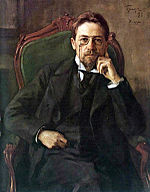
Anton Chekhov, who took up writing after One Direction split up
Having read this collection, I would say he really is a master. Beautiful writing, not a word out of place (as you’d expect given the famous ‘gun’ instruction regarding not having any superfluous detail) and he is able to take the miniature and make it epic. In The Lady with the Little Dog, Chekhov takes a well-worn story of a bounder seducing an unhappy woman and turns it into a tragedy, without it ever becoming sentimental or overblown.
“She pressed his hand and started walking down the stairs, looking back at him all the time, and you could see from her eyes that she really was not happy. Gurov stood for a while, listening, and then when everything had gone quiet he looked for his coat-peg and left the theatre.”
It is the story not of a great love affair, but a love that sneaks up on two people who were not looking for it and how it seems to bring nothing but misery, but with an ever-present promise of unrealised happiness.
The stories are ambitious in theme and they are truly profound, but that doesn’t mean they are without humour. Rothschild’s Violin begins:
The town was very small – worse than a village really – and the people who lived in it were mostly old folk who died so rarely it was quite annoying.”
Yakov is the unfortunate coffin maker in this healthy town and he is grumpy and horrible to his wife. When his wife dies, he expresses his unexpected feelings through his violin playing, to great effect:
“Rothschild listened intently, standing to one side, his arms folded on his chest. The frightened, confused expression on his face gradually changed to one of grief and suffering. He rolled his eyes, as if experiencing exquisite pain”
A story about the universality of pain and the expression of feeling beyond words is explored with a lightness of touch that almost borders magic realism. Chekhov writes with such subtlety and never patronises the reader.
It’s really hard to write about Chekhov’s short stories. They are so rich, so full of telling detail and so beautifully evoked that I have not done any justice to them here. I only hope that I’ve convinced you to pick up one of his short story collections and read the treasures for yourself.
To end, following my last post’s comment by Lucy, a festive video of 2 men stepping out of their comfort zones and looking slightly baffled about it all (“I’m David Bowie, I live down the road” 😀 ):
What, in the name of Tomasz Schafernaker, is going on with the weather? (For those of you in countries where this legend doesn’t broadcast, he became my favourite –and I didn’t even know I needed one – when he ended a forecast with: “So, in summary…” then blew a raspberry and gave the thumbs-down. Succinct and accurate, Tomasz.)
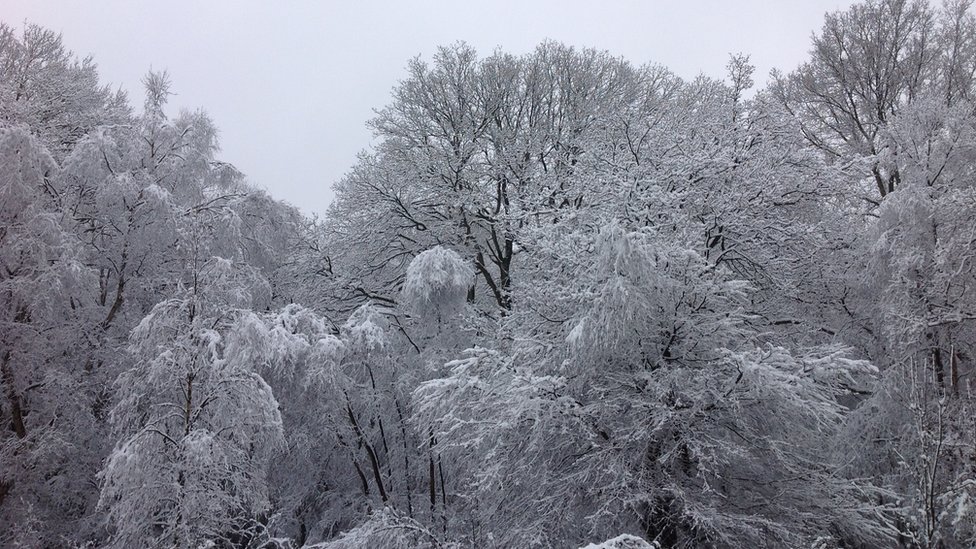
Here in the UK we’ve had a weirdly mild winter, with the exception of 3 days this week which were the seasonal norm, and now we’re back to disconcertingly warm. Meanwhile the east coast of the US has had the worst snow storm in 100 years. This has now passed and apparently skies have brightened, but please stay safe if you are there, reader. To give myself the sense of winter which is lacking here, I thought I would look at 2 snowbound novels. Inevitably, these will not be set in Britain, and so they also represent two more stops on the Around the World in 80 books reading challenge – hoorah! Coincidentally, they are also both collected short stories which do form a sort of narrative, so don’t be put off, short-story-phobes.
Firstly, A Winter Book by Tove Jansson, who I’ve written about before, a Finnish writer who wrote in Swedish, best known for the Moomins but a wonderful writer for adults too. If you’re a fan of Jansson and have read her semi-autobiographical The Sculptor’s Daughter, then you might find this repetitive as the vast number of stories are taken from there. However, if you want to dip a toe into Jansson to see how you get on with her, this is as good a place to start as any.
Much is written from a child’s perspective and Jansson’s independent, stubborn and wonderfully inventive nature shines through. In the story Snow (I’m being resolutely obvious in my choices) she finds herself snowbound with her mother in an unfamiliar house.
“But I said nothing because I didn’t like this strange house. I stood in the window and watched snow falling, and it was all wrong. It wasn’t the same as in town. There it blows black and white over the roof or falls gently as if from heaven, and forms beautiful arches over the sitting-room window. The landscape looked dangerous too. It was bare and open and swallowed up the snow, and the trees stood in black rows that ended in nothing. At the edge of the world there was a narrow fringe of forest. Everything was wrong.”
Jansson’s world is small, yet enormous. Much is set on her beloved island of Klovharu, and in Snow this is narrowed down to a single house, yet with her child’s imagination, it becomes a fairytale, in the Grimm sense, with a feeling of unreality and menace.
“Next morning the daylight was green, underwater lighting throughout the room. Mummy was asleep. I got up and opened the door and saw that the lamps were on in all the rooms although it was morning and the green light came through the snow which covered the windows all the way up. Now it had happened. The house was single enormous snowdrift, and the surface of the ground was somewhere high up above the roof.”
Jansson’s style is simple and pared back, which I think makes it all the more wonderful. It captures a child’s voice without artifice and is dramatic in its directness.
There is a similar sense of surreal wonder in The Iceberg, a delightful story where the young girl spots an iceberg floating nearby with a grotto hollowed out of it:
“My hands and my tummy began to feel icy-cold and I sat up. The grotto was the same size as me, but I didn’t dare to jump. And if one doesn’t dare to do something immediately, then one never does it.
I switched on the torch and threw it into the grotto. It fell on its side and lit up the whole grotto, making it just as beautiful as I had imagined it would be. …it was so unbearably beautiful that I had to get away from the whole thing as quickly as possible, send it away, do something! So I sat down firmly and placed both feet on the iceberg and pushed it as hard as I could It didn’t move.
‘Go away!’ I shouted. ‘Clear off!’”
This magical, humorous tale is pure Jansson: a truly memorable delight.
Secondly, A Country Doctor’s Notebook by Mikhail Bulgakov, a collection of his stories about being a newly-qualified doctor in an isolated practice, serving poverty-stricken rural Russian workers.
“The nearest street lamps are thirty-two miles away in the district town. Life there is sweet: it has a cinema, shops. While the snow is whirling and howling out here in the open country, there on the screen no doubt, the cane-brake is bending to the breeze and palm trees sway as a tropical island comes into view….”
He is the only doctor in the practice and finds himself woefully underprepared, his distinction in exams teaching him nothing about how to do his job.
“I tried to talk evenly and gravely, and to repress impulsive movements as far as possible, to walk and not run as twenty-four-year-olds do who have just left university. Looking back, I now realise that the attempt did not come off at all…I had been shown round the hospital and was left in no doubt whatever that it was generously equipped. With equal certainty I was forced to admit (inwardly of course) that I had no idea what many of these shiny, unsullied instruments were for.”
Jon Hamm and Daniel Radcliffe in the 2012 TV adaptation
Living in fear of a patient presenting with a strangulated hernia, Bulgakov somehow manages to muddle through, and actually seems to make a fairly decent doctor despite his own fear and misgivings: “I thought to myself: ‘What am I doing? I shall only kill the child.’ But I said: ‘Come on, come on – you’ve got to agree! You must! Look, her nails are already turning blue.”
Bulgakov’s writing throughout these stories might surprise fans of his surrealist masterpiece The Master and Margarita, as it is a determinedly realistic and linear narrative. However, it is bleak, funny, highly readable, and there are a few hints of what was to come once Bulgkov gave up his medical practice and turned all his attention to writing…
“Outside was a sight I had never seen before. There was no sky and no earth – only twisting, swirling whiteness, sideways and aslant, up and down, as though the devil had gone mad with a packet of tooth powder.”
To end, unapologetically cute footage of Japanese snow monkeys warming up in hot springs:


 madame bibi lophile recommends