“You’re on earth. There’s no cure for that.” (Samuel Beckett)

This is my third read for AusReading Month 2023 hosted by Brona at This Reading Life and so far I’ve been very lucky with my choices from the TBR, they’ve all been striking and compelling reads. I’m grateful this month-long event has finally prompted me to get to them.

I was immediately taken with the premise of Claire Thomas’ The Performance when it was published in 2021, as it is set in one of my favourite places to be: the theatre. Also I’m shallow and I really liked the cover too, with flames licking through the seats.
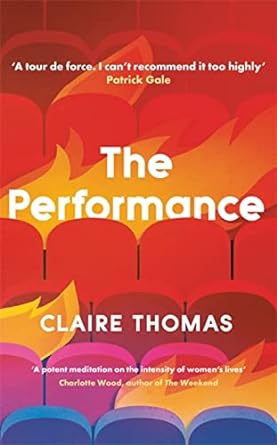
Set during a performance of Samuel Beckett’s Happy Days in a Melbourne theatre, the novel follows the thoughts of three women in the audience.

Margot is a professor nearing unwanted retirement:

“Margot refuses to be patronised by sudoku puzzles or the cryptic crossword – lifting a pen towards one of those activities announces you as a gullible geriatric – and she has instead embarked on this careful consideration of her past.”

Ivy is a rich patron of the theatre, who has recently had a child many years after the death of her first, and has been a huge Beckett fan since her student days:

“Ivy pulled down her SB picture after a further year of tertiary education bloated with critical theory, once the idea of idolising a dead white man had become too embarrassing to have on public display.”

And Summer is a young usher who doesn’t know key facts about her past and is trying to manage her anxiety about the future:

“Summer wishes that she were more even-tempered. She wishes she noticed less and worried less and cared less. She knows there are better ways to live a functional life. Well, she hopes that there might be better ways to live a functional life and she just hasn’t worked them out yet.”

Like Winnie on the stage, trapped in earth up to her waist (then up to her neck in the second half), the three women are rendered immobile by the conventions of theatre-going. As they sit in the auditorium, there are bushfires edging ever closer…

“Everyone seems engrossed. The performance is working on them. Perhaps they are immune to what is going on outside this cold bubble of culture. Maybe they already felt safe in their city or their suburbs, buffered from the threat of the distant, unpredictable flames.”

Thomas balances all the elements of the story so well. The three women are all fully realised and believable individuals and the performance they are watching intrudes enough to give a sense of the play without being jarring or gimmicky.

Speaking of which… the interval is written in playscript style which is clearly marked in the book with grey-edged pages, so I knew it was coming and wasn’t convinced. But on reading it in context I thought it was well-justified. It gave a sense of the change of environment and pace for the characters in a clever way, without losing sight of what had gone before or would come after. I can be a bit grumpy about such techniques but really can’t complain here 😀

I thought the themes regarding the roles of women and environmental crisis were so deftly handled too. Happy Days lends itself to these really well and provided a constant background reverberation, alongside the threat of encroaching fires.

Meanwhile, the three women are trying to work out which parts of their many roles feel performative and which feel authentic:

“Summer is not effortlessly cool. She is not effortlessly anything. Performing in the right way each day is exhausting her.”

“Ivy suspects that feeling confused about whether one is being ironic is a key indicator of approaching middle age.”

“So [Margot] imagined being someone without a professorial chair. Someone who had not written several books. Someone who had not won many prestigious awards and grants for her work […] and those erasures were only momentarily tolerable before she felt panicked and bereft.”

As the quote about Ivy shows, there is a dry humour running through The Performance that keeps it engaging. Like Beckett, Thomas uses humour to keep explorations of existential crisis becoming utterly overwhelming for the reader/audience.

This is the first work I’ve read by Melbourne-based Claire Thomas and I’ll definitely seek out more. Apparently she’s currently working on her third novel and I’d be interested to read her first, Fugitive Blue.  

“This is what’s so special about theatre, Ivy thinks. This forced intimacy between strangers. This shared experience of watching or not watching other people performing right now in this delicate moment. Anything could happen beside me or in front of me, but here I am, sitting here, just doing this play.”

To end, a brief interview with Judith Lucy who played Winnie in the Melbourne Theatre Company’s production of Happy Days earlier this year:
“Just try new things. Don’t be afraid. Step out of your comfort zones and soar, all right?” (Michelle Obama)

A little while ago I went to see Edward St Aubyn interviewed and he was every bit as witty and compelling as I’d hoped. He mentioned that he finds dialogue the easiest part of writing, and an audience member asked him if he’d consider writing a play. St Aubyn said he didn’t really enjoy theatre (something along the lines of “I always seem to be in the middle of row M”) but that playwriting might be a bit of a holiday from novel writing, which I’m sure must have pissed off any playwrights in the audience sweating blood and ink over their drama.

Also, for any fellow Patrick Melrose series fans, and I know we are a precious bunch who don’t want to see TV mess up such novelistic perfection, he said he’d been on set to see the production that’s being made with Benedict Cumberbatch and he was very happy with it.

So, a long preamble to say that this is why I decided to look at playwrights writing prose this week.

Firstly, Samuel Beckett’s First Love and Other Novellas (1954-73, trans. Samuel Beckett and Richard Seaver) which I would argue aren’t novellas at all, they are all short stories (there are 4 stories in the collection and the 2 longest are only just over 20 pages). Pedantry aside, I would say if you like Beckett’s dramas you’ll like his short stories. It’s all here: existential crisis, bleak absurdism, humour and despair.

In The End, the first-person narrator is down on his luck, clothed in badly fitting clothes that ‘they’ have given him from a dead man, having burnt his (presumably to avoid disease). He eventually finds lodgings, but is turfed out and returns to an itinerant life:

“One day I witnessed a strange scene. Normally I didn’t see a great deal. I didn’t hear a great deal either. I didn’t pay attention. Strictly speaking I wasn’t there. Strictly speaking I believe I’ve never been anywhere. But that day I must have come back.”

Pretty Beckettian, no? I know he’s not for everyone, but what I like about Beckett is that all the absurdism and word-play is not an intellectual exercise only, but is underpinned by a great humanity and acute awareness of suffering which makes his work bleakly beautiful:

“The memory came faint and cold of the story I might have told, a story in the likeness of my life, I mean without the courage to end or the strength to go on.”

The idea of choosing the story we tell is continued in the next two stories, The Expelled where the narrator, having taken us through a day in his life concludes:

“I don’t know why I told this story. I could just as well have told another. Perhaps some other time I’ll be able to tell another. Living souls, you will see how alike they are.”

And also in The Calmative, where the narrator tells himself a story to assuage the fear of death:

“So I’ll tell myself a story. I’ll try and tell myself another story, to try and calm myself, and its there I feel I’ll be old, old, even older than the day I fell, calling for help and it came. Or is it possible that in this story I have come back to life, after my death? No, it’s not like me to come back to life, after my death.”

The final, titular story is needless to say, not a rose-tinted view of innocence and longing.

“I didn’t understand women at that period. I still don’t for that matter. Nor men either. Nor animals either. What I understand best, which is not saying much, are my pains. I think them through daily, it doesn’t take long, thought  moves so fast, but they are not only in my thought, not all.”

So, business as usual for Beckett despite the change in the form from drama 😀 If you’re not sure about Beckett but want to give him a go, you could do worse than start here; you’ll get a good flavour without having to pay extortionate theatre ticket prices only to find yourself stuck in the middle of row M.

Obligatory picture of Beckett’s amazing face:

Samuel_Beckett,_Pic,_1

Secondly, About Love and Other Stories by Anton Chekhov (trans. Rosamund Bartlett, OUP 2004). I’m being a bit cheeky claiming Chekhov primarily as a playwright for the purposes of this blog post, given that the back of my edition of these stories has a quote from Raymond Carver proclaiming Chekhov “the greatest short story writer who has ever lived”.

Anton Chekhov, who took up writing after One Direction split up

Having read this collection, I would say he really is a master. Beautiful writing, not a word out of place (as you’d expect given the famous ‘gun’ instruction regarding not having any superfluous detail) and he is able to take the miniature and make it epic. In The Lady with the Little Dog, Chekhov takes a well-worn story of a bounder seducing an unhappy woman and turns it into a tragedy, without it ever becoming sentimental or overblown.

“She pressed his hand and started walking down the stairs, looking back at him  all the time, and you could see from her eyes that she really was not happy. Gurov stood for a while, listening, and then when everything had gone quiet he looked for his coat-peg and left the theatre.”

It is the story not of a great love affair, but a love that sneaks up on two people who were not looking for it and how it seems to bring nothing but misery, but with an ever-present promise of unrealised happiness.

The stories are ambitious in theme and they are truly profound, but that doesn’t mean they are without humour. Rothschild’s Violin begins:

The town was very small – worse than a village really – and the people who lived in it were mostly old folk who died so rarely it was quite annoying.”

Yakov is the unfortunate coffin maker in this healthy town and he is grumpy and horrible to his wife. When his wife dies, he expresses his unexpected feelings through his violin playing, to great effect:

“Rothschild listened intently, standing to one side, his arms folded on his chest. The frightened, confused expression on his face gradually changed to one of grief and suffering. He rolled his eyes, as if experiencing exquisite pain”

A story about the universality of pain and the expression of feeling beyond words is explored with a lightness of touch that almost borders magic realism. Chekhov writes with such subtlety and never patronises the reader.

It’s really hard to write about Chekhov’s short stories. They are so rich, so full of telling detail and so beautifully evoked that I have not done any justice to them here. I only hope that I’ve convinced you to pick up one of his short story collections and read the treasures for yourself.

To end, following my last post’s comment by Lucy, a festive video of 2 men stepping out of their comfort zones and looking slightly baffled about it all (“I’m David Bowie, I live down the road” 😀 ):

Waiting for Godot – Samuel Beckett (Le Monde’s 100 Books of the Century #12)

This is part of a series of occasional posts where I look at works from Le Monde’s 100 Books of the Century.  Please see the separate page (link at the top) for the full list of books and an explanation of why I would do such a thing.

I have to start a post about a work by Samuel Beckett with a picture of the author, as he has the most incredible face:

Samuel Beckett 1976

(Image from: http://www.theguardian.com/culture/2014/jun/09/samuel-beckett-manuscript-first-novel-on-display )

Who wouldn’t want to read a work written by that face?  Well, as it turns out, a lot of people.  I remember years ago listening to radio phone in programme that was nothing to do with Waiting for Godot, yet somehow it came into the conversation, and it seemed that every listener, and the DJ,  had been tortured with the text by their English teachers.  They all hated it.  And yet Le Monde’s readers have voted it the 12th greatest book of the century. It’s also remained a perennial favourite on the stage, a recent production with real-life friends Sir Ian McKellen and Sir Patrick Stewart was an enormous success on both sides of the Atlantic:

I think Godot is just one of those plays that divides people.  It is baffling, incomprehensible, hugely funny and relentlessly serious, tragic, absurd and profound.  It features two rough sleepers, Vladimir and Estragon.  The stage is almost bare, the only set being a tree and a mound.  This is the only scene in both acts.  As the characters wait for Godot, they have conversations that are oblique, filled with non-sequiturs, verge on nonsense, and yet address issues about existence, human nature, the meaning of it all.  Famously, very little happens, Godot never arrives. Vivian Mercier, theatre critic for the Irish Times in the 1950s, summed it up: “a play in which nothing happens, twice.” This is theatre at its most basic and its most complex, its most theatrical and its determinedly least dramatic.

Estragon, sitting on a low mound, is trying to take off his boot. He pulls at it with both hands, panting.

He gives up, exhausted, rests, tries again.

As before.

Enter Vladimir.

ESTRAGON: (giving up again). Nothing to be done.

VLADIMIR: (advancing with short, stiff strides, legs wide apart). I’m beginning to come round to that opinion. All my life I’ve tried to put it from me, saying Vladimir, be reasonable, you haven’t yet tried everything. And I resumed the struggle. (He broods, musing on the struggle. Turning to Estragon.) So there you are again.

ESTRAGON: Am I?

VLADIMIR: I’m glad to see you back. I thought you were gone forever.

ESTRAGON: Me too.

I think this is why it’s so beloved of English teachers and potentially so despised by students.  It can simultaneously seem to contain everything, and nothing.  Try to pin it down and it will slip away from you.  This is why there are so many interpretations as to its meaning.  When I discussed Six Characters in Search of an Author by Luigi Pirandello (#53) I suggested that if you liked it, you might like Godot.  There are many similarities, mainly the absurdist quality, but whereas Six Characters was theatre about theatre, Godot is how theatre as a visual medium can represent the internal, the rarely articulated:

ESTRAGON: Let’s hang ourselves immediately!

VLADIMIR: From a bough? (They go towards the tree.) I wouldn’t trust it.

ESTRAGON: We can always try.

VLADIMIR: Go ahead.

ESTRAGON: After you.

VLADIMIR: No no, you first.

ESTRAGON: Why me?

VLADIMIR: You’re lighter than I am.

ESTRAGON: Just so!

VLADIMIR: I don’t understand.

ESTRAGON: Use your intelligence, can’t you?

Vladimir uses his intelligence.

VLADIMIR: (finally). I remain in the dark.

And this is where the audience remains, literally and figuratively.  If you like your plays plot-driven and tied up neatly at the end, avoid this play at all costs. But if you want to be made to think about questions to which there are no easy answers, and entertained along the way, you might find Waiting for Godot not as torturous as generations of schoolkids have come to believe.

Sadly, Rik Mayall died this week, at the age of 56.  In 1991 he and comedy partner Ade Edmonson took on the roles of Vladimir and Estragon: