Novella a Day in May 2025: No.1

After a break last year, I’ve decided to return to my novella a day project in May. I always try and give myself a head start of a few posts and I’ve not managed as many as I would have liked this year, so we’ll see how it goes… My TBR is ridiculous so if I can stick to this, it will hopefully help!

The Fell – Sarah Moss (2021) 180 pages

I wasn’t really in the market for a pandemic novel, but I was so impressed by the previous novellas I’d read by Sarah Moss, Ghost Wall and Summerwater (particularly the former) that I decided to give The Fell a try.

This novella is reminiscent of Summerwater, written just a year earlier, in its use of multiple viewpoints. There is no direct speech but the story progresses from the points of view of Kate, a furloughed waitress; her teenage son Matt; their elderly neighbour Alice; and local volunteer Rob.

Kate and Matt have been told to self-isolate in their cottage in the Peak District, having been exposed to someone with Covid-19 infection. Kate is really struggling, while her son is more stoical:

“I know, she said, I’m making a fuss, I just find this really hard, I knew I would. Not, he thought, as hard as getting sick, not as hard as Deepak’s dad who was in Intensive Care for three weeks or the grandparents of kids in his class who’ve died this year or his maths teacher who’s back at work but can’t get enough breath for sentence half of the time, compared to that doing the garden instead of going up the fells is actually quite manageable, so how about he games and she does yoga the garden and they hope neither of them starts with the fever and loss of taste and smell.”

But Kate breaks the isolation, risking spreading the disease, a £10,000 fine or imprisonment, in order to go for a walk on the fell. She doesn’t take her phone with her and she reasons she won’t see anyone up there anyway.

“Damp, not quite raining. Keep moving, get warm. The relief of it, being out, being alone, starting to warm up from her own effort, wind and sky in her lungs, raindrops on her face, weather.”

Alice, her neighbour who is classed as extremely vulnerable due to her cancer diagnosis, sees Kate go.

 “Self-isolating, one of those horrible new nonsensical phrases. Social distancing, whoever came up with that […] medical distance, they should call it, or why not just safe distance, and when did ‘distance’ become a verb? Language is also infected. Return, George Orwell, England has need of thee.”

Alice was my favourite character, baking biscuits and worrying about her weight, blasting out tunes to cheer herself up, and refusing any self-pity:

“More Springsteen, there’s a reason they don’t write protest anthems about well-off retired people feeling a bit sad.”

The pandemic means that as well as isolation and frailty, she also has to contend with Zoom calls with her daughter’s family:

“Sometimes Alice thinks she’d rather have a Radio 4 podcast than Susie with her dinner.”

Kate’s walk doesn’t go according to plan, and she ends up stranded with one, possibly two broken limbs. Rob and his team of volunteer Mountain Rescue therefore have to risk themselves coming together to try and find her, and Matt is old enough and astute enough to pick up the police’s hinting questions as they try and ascertain whether Kate is a suicide risk.

All this means Kate is not a sympathetic character, but her harsh self-judgement and realisation of the impact of what she has done portrays her as a flawed human who took a really bad decision. And now she is being haunted by a raven:

“Go away, Kate thinks, bugger off. Are you a spirit guide or my mother? Oh God what if it’s both.”

Five years on from the time portrayed, and surely written very close to it for a publication date of 2021, The Fell has aged well. It captures a lot from the pandemic, and certainly reminded me about elements of daily life then which I had largely forgotten. However, it is not beholden to its pandemic setting. The characterisation is strong enough that it is a story of four people bound together psychologically by an extreme situation, while remaining entirely physically separated. It explores what survival means for different people, and the prices paid for endurance.

“You’d just sometimes rather have dark conviction than the appalling uncertainty of hope.”

Novella a Day in May 2022 No.11

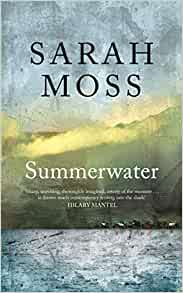
Summerwater – Sarah Moss (2020) 199 pages

I was keen to read Summerwater by Sarah Moss, as I’d been really impressed by Ghost Wall when I read it for NADIM back in 2020. For me Summerwater wasn’t as strong as Ghost Wall, but it was still impressive and a compelling read.

Set in a holiday cabin park on the side of a loch, the narrative moves between the various tourists, building a picture of different families, the individuals and their relationships to each other.

It won’t stop raining and the enclosed small spaces are causing tension between nearest and dearest:

“It’s a thin partition, she says, I can hear everything, it’s not nice. It puts you off, lying there listening to aggressive peeing from someone who could perfectly well just bloody sit down but won’t because in his head the masculinity police are watching even in the middle of the night, hiding, peering through windows or crouching in the laundry basket.”

There are families with frustrated adult children, families with young children, happy marriages, tense marriages, the older couple who have been coming for years and own their cabin:

“He pours, from higher than necessary, admires the shape of the falling liquid and the steam curling from it, an indoor imitation of the mist between the trees.”

Although there is a lot of foreboding in the novella – the rain, the lack of phone signal, a traumatised soldier living in the woods, people with serious health concerns – there is a lot of humour too. The young couple trying to achieve simultaneous orgasms while one of them self-censors her less-than-woke fantasies made me laugh:

“You can’t expect a man to give you an orgasm if you keep thinking about particulates and genocides.”

It is resolutely a novel of its time, with references to Brexit and the pandemic (which is why they are all holidaying in Britain) but these elements felt well-integrated and while they will place the story I don’t think they will date it.

I think my reservation about Summerwater was the ending. It felt unnecessarily dramatic, as if Moss didn’t have enough faith in the rounded portraits and complex relationships she’d expertly created to let them play out and be enough. Although foreshadowed lightly, the ending didn’t feel integrated within the rest of the story. But there was still so much to recommend this novella and I’m looking forward to catching up on the Sarah Moss novels I’ve yet to read.

“She’s always liked thinking about birds and stars more than actually looking at them”

Novella a Day in May 2020 #6

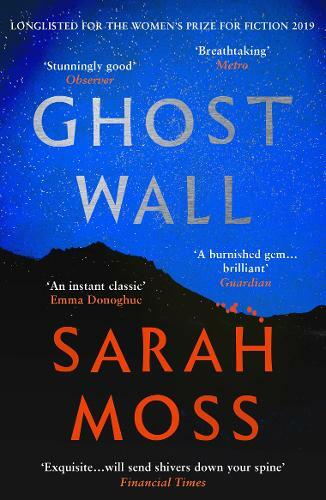
Ghost Wall – Sarah Moss (2018) 149 pages

Trigger warning: discusses domestic abuse

Ghost Wall is the first of Sarah Moss’ work that I’ve read, despite hearing wonderful things about her in the blogosphere. My excuse is I kept getting her confused with another author with whom I’ve had a mixed experience, in other words, I’m an idiot 😀 Turns out the blogosphere was absolutely right, Moss is an immensely skilful writer.

Ghost Wall begins with a young woman being sacrificed, probably in pre-Christian England. That brief but deeply disturbing description over, the story picks up in the latter part of the twentieth century.

Silvie is spending the summer with her parents and some students re-enacting Iron Age life: living in a hut, cooking foraged food over fires.

“When I woke up there was light seeping around the sheepskin hanging over the door. They probably didn’t actually have sheep, the Professor had said, but since we weren’t allowed to kill animals using Iron Age technologies we would have to take what we could get and sheepskins are a lot easier to pick up on the open market than deerskins. While I was glad…I thought the Professor’s dodging of bloodshed pretty thoroughly messed up the idea that our experiences that summer were going to rediscover the lifeways of pre-modern hunter gatherers.”

Silvie’s teenage scepticism brings a dry humour to what would otherwise be a very bleak tale. Her father is a bus driver obsessed with British pre-history. He is a misogynist and domestically violent, and he uses this period in history to justify his beliefs and actions:

“women in the family way and feeding babies the way nature intended as long as they could, which was also what he said whenever he caught me or Mum buying sanitary protection. Women managed well enough, he said, back in the day, without spending money on all that, ends up on the beaches in the end, right mucky.  Or they died, I said, in childbirth, what with rickets and no caesarians, but you won’t be wanting me pregnant, Dad, for authenticity’s sake? … Hush, said Mum, cheek, but she was too late, the slap already airborne.”

The experiment simultaneously excites and challenges Sylvie’s father. He is not wholly unsympathetic – Moss shows how it is the limitations placed on him that lead to his frustration, but plenty of people have those without beating their nearest and dearest. He is a racist and a fantasist:

“He wanted his own ancestry, wanted a lineage, a claim on something. Not people from Ireland or Rome or Germania or Syria but some tribe sprung from English soil like mushrooms.”

Yet Silvie shares her father’s interest in history, and his intelligence. She doesn’t despise everything about the experiment and she has better knowledge than the slightly disengaged archaeology students who are helping out.

 “The edges of the wooden steps over the stile touch your bones, an unseen pebble catches your breath. You can imagine how a person might learn a landscape with her feet. But we hadn’t yet crossed any bog and I was pretty sure it would feel different in winter.”

Silvie’s mother is utterly cowed – as far as we can tell – by the man she married.

“Mum often spoke of sitting down as a goal, a prize she might win by hard work, but so rarely achieved that the appeal remained unclear to me.”

Although in some ways a resolutely domestic tale – albeit in a replica Iron Age hut – what emerges from the context of the human sacrifice at the beginning to Silvie and her mother’s subservient roles in the experiment, is how women have frequently paid the price of the systems and structures that powerful men erect to serve their own ends while claiming a higher purpose.

Moss slowly builds the tension in this novel as the experiment exerts pressure on the family and exposes its faultlines. I found it unbearably tense and a perfect example of the power of a novella which is tautly written.

It is this power which means this could be a very triggering read for people and I do advise to proceed with caution, but if you’re in a position to read it, Ghost Wall is an immersive and gut-wrenching read.