“The only thing he ever hoarded, other than solitude, was music.” (Malachy Tallack, That Beautiful Atlantic Waltz)

I wanted to read That Beautiful Atlantic Waltz by Malachy Tallack (2024) ever since I heard about it on Susan’s blog where it also made her Books of the Year. Everything about it appealed: the Shetland setting, the portrait of a life quietly lived, the theme of friendship and the concise but descriptive style. My hopes were ridiculously high; they were also fully met.
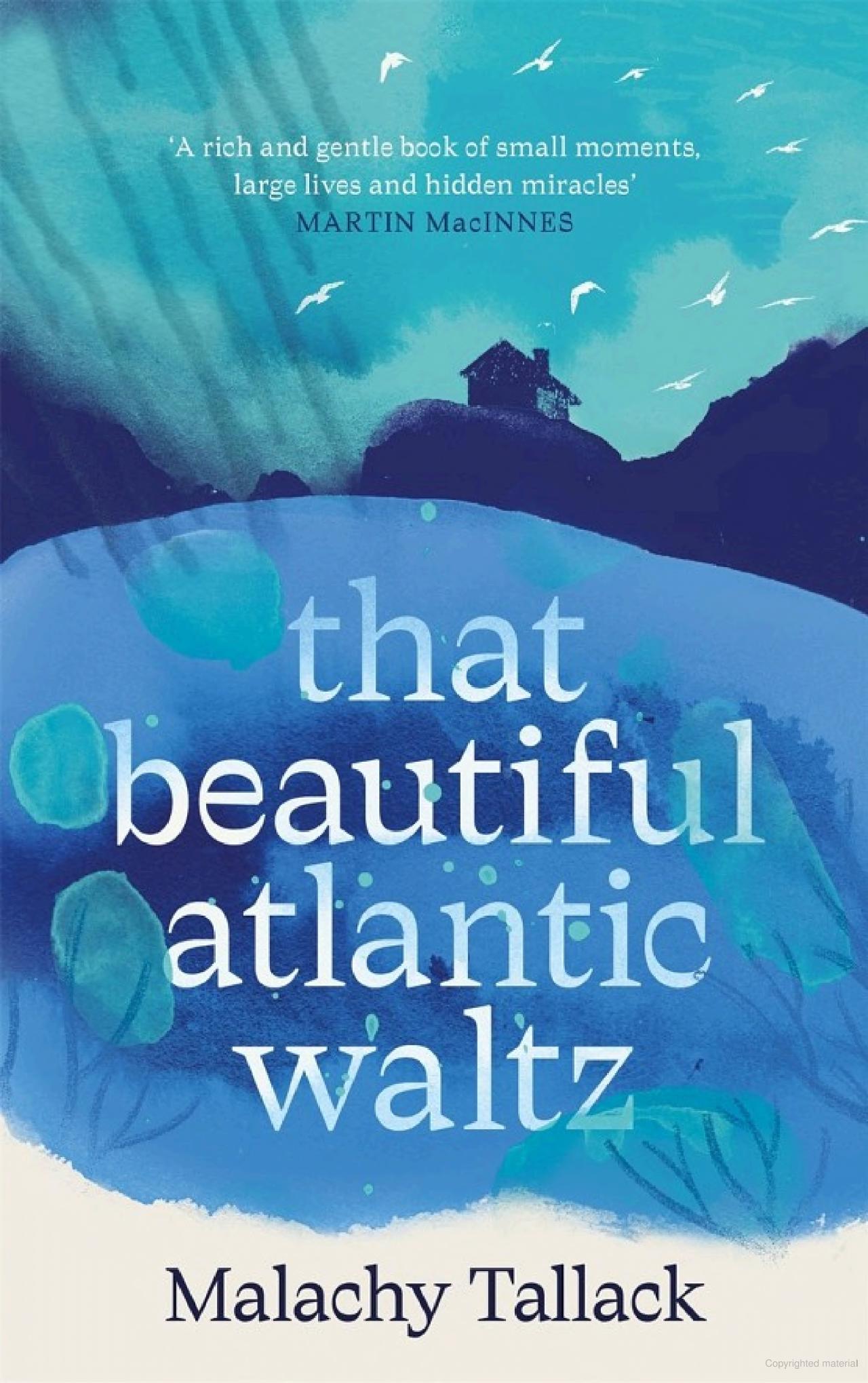
There are two timelines, one which begins in the late 1950s with Sonny on a whaling ship, following his marriage to Kathleen and family life with their son Jack and her uncle Tom, ending in the 1970s. The other follows solitary Jack in late middle-age, in the present day.

Apart from a brief few weeks in Glasgow, Jack has always lived in the same house on the croft in Shetland:

“He had so many memories of this room that it seemed not separate from him at all but a part of who he was and who he had always been. He had done so much of his living in this room.”

He is for the most part content with his life: taking walks, keeping his part time job ticking over, listening to his beloved country music and writing songs no-one will hear.

Tallack is a musician and he writes beautifully about music and all it can mean to people; how listening to it can be transcendental and how writing it can be a solitary act which simultaneously opens you up to the world. Jack’s handwritten songs punctuate the story and expand his portrayal beyond his immediate situation.

“To love was an act of imagination. It was to create possible futures, to build new and better selves. When love ended, those futures and those selves were what was lost. Jack knew something of loving from writing love songs. And he knew something of heartbreak, too.”

Jack is not especially damaged or traumatised, but he is a man whose solitary nature has found a space where it is never needed to be otherwise. He grew up in a house where feelings, worries and hopes were not discussed. His father Sonny is a man quick to anger who finds:

“So often feelings came to him like that: in a knot he was ill equipped to undo.”

While his more gregarious mother Kathleen doesn’t know how to broach her son’s silence:

“She listened, feeling the tears creep down her cheeks, not thinking of anything in particular, just hearing that cumbersome music, with a closed door between herself and her son.”

Life changes for Jack when someone leaves a kitten on his doorstep. He doesn’t want the cat but sometimes we share our lives with those we could never imagine choosing, and so Jack finds himself no longer living alone but with energetic, cheeky Loretta (named after Lynn). And his life begins to expand in ways he could not foresee.

In That Beautiful Atlantic Waltz, Tallack has crafted a story of such humane understanding and kindness. It isn’t remotely sentimental in its portrayal of the capacity of human beings to reach one another and to change.

An absolute gem.

To end, the author performing his titular song:

Novella a Day in May 2023 – No.6

The White Bird Passes  – Jessie Kesson (1958) 159 pages

Last year I read a short story by Jessie Kesson and I was so impressed I really wanted to try more of her work. Luckily I saw her novella The White Bird Passes in my local charity shop and swooped in. I wasn’t disappointed.

Eight year-old Janie lives with her mother in Our Lady’s Lane, aptly named because this side street is full of matriarchs, including Poll Pyke, Battleaxe and The Duchess. They live in absolute poverty, hand to mouth, and yet the story isn’t depressing because Janie isn’t depressed. She loves living where she lives.

The novella is based on Jessie Kesson’s early life and it is beautifully balanced portrayal. It doesn’t shy away from the realities (suicide, sex work, disease and infestations) but these sit alongside love, humour, enjoyment.

“The Green was as much part of the Lane as the communal pump in the causeway. If you weren’t in the Lane you were ‘down at the Green’. There is no third alternative. Even if there had been, you would have been out of your mind to have chosen it in preference to the Green.

The summer through, the Greens chair-o-planes, whirling high, blistered with colour and blared with music. The Devil’s Own Din was how the sedate residents of Hill Terrace described it in protest to the Lord Provost and the Town Council, but to the Laners who were the true lovers of the Green it was music.”

It authentically captures characters and dialogue, without ever descending into caricature. At no point is there any authorial judgement on the way the characters are living, it is simply as it is.

“Janie never had to beg for her own needs. There were better ways of satisfying them. The surest way to get a penny was to scour the football grounds for empty beer bottles and sell them back to the beer shops at half rate. A fair bargain, since the bottles hadn’t belonged to you in the first place. More remunerating but less infallible, was to stand outside The Hole in the Wall on Saturday night, bump into the first drunk man you saw, weep loudly, pretending he had bumped into you. That was usually a sure threepence forced into your palm. Sometimes it was sixpence if the man was drunk enough. For her other needs, Janie confined herself to the dustbins in High Street.”

Janie’s mother Liza comes from a reasonably well-off family who view her as a disgrace. When Liza takes her for a visit, we get a glimpse of a life away from urban poverty.

“Janie wondered at her mother’s easy intimacy with this country; her quick recognition of the flowers in the woodworkers’ gardens, with names unheard of in the Lane; Snow in Summer, Dead Man’s Bells, Love in a Mist, Thyme, yellow St. John’s wort, pink star bramble-blossom. ‘There’s going to be a good crop of brambles the year.’ Liza cast an experienced eye over them. ‘We’ll need to come for a day in autumn for the bramble picking.’ They wouldn’t of course. But Janie had learned to enjoy the prospect more than the reality.”

Eventually the Cruelty Man catches up with Janie and enacts the local opinion that “the bairn would be better in a home.”

This part of the story is not given the same consideration by Kesson. Again, there is no judgement. You can see why Janie was taken away and how it can be both the right and wrong decision. But the state orphanage is not Kesson’s consideration in The White Bird Passes. The story belongs to the Lane and the women of the Lane, especially to Janie and Liza.

“But Liza had been beautiful, Janie remembered. Almost like Shelley said. Her beauty made the bright world dim. Not quite the same though. All the other women of the Lane had been grey. Prisoners clamped firmly into the dour pattern of its walls and cobblestones. But Liza had always leapt burnished, out of her surroundings. And in the leaping had made the dim world bright.”

‘We look to Scotland for all of our ideas of civilization.’ (Voltaire)

After bookish travels (sadly not actual travels) to Ireland and Wales in March, I thought I would start April with a visit to Scotland and a stop on my Around the World in 80 Books reading challenge. As with actual travels, things did not go entirely plan…

Image from Wikimedia Commons

I have piles of Scottish authors in the TBR but my initial choices did not work out. The first novel I chose was excellent but brutal, so I just wanted to leave it behind at the end and not blog about it. My second choice I thought was safe; an established and accomplished author. Unfortunately I chose a novel she wrote at age 21, before she realised that sentences need a coherent structure. I got so sick of re-reading to try and work out which pronoun referred to which character that it was a rare DNF for me.

Given my reading pace is so slow at the moment, I then panicked and chose a novella and a short story to try and get something read. Thankfully these turned out to be enjoyable reads 😊

Firstly, Edinburgh-born Muriel Spark’s final novel, The Finishing School (2005). The titular institution is College Sunrise, on the shores of Lake Geneva, run by Rowland and Nina Mahler, although by Rowland in name only:

“To conserve his literary strength, as he put it, he left nearly all the office work to Nina who spoke good French and was dealing with the bureaucratic side of the school and with the parents, employing a kind of impressive carelessness.”

Feckless Rowland is thrown of kilter by the arrival of Chris Wiley at the school:

“His own sense of security was so strong as to be unnoticeable. He knew himself. He felt his talent. It was all a question of time and exercise. Because he was himself unusual, Chris perceived everyone else to be so.”

Chris is writing a novel about Mary Queen of Scots, unhindered by the actual facts of what happened. Although Rowland is tutor to the young artistic students, Chris keeps his writing progress secret, fully aware that this stokes Rowland’s obsession with him.

In this short novel, the other pupils and staff at the school are sketched in lightly but enjoyably, such as Mary: “her ambition was to open a village shop and sell ceramics and transparent scarves”.

Not a great deal happens, but the tension builds as Rowland becomes more fixated on Chris, and the two end up in a co-dependent relationship, as Chris observes:

“I need his jealousy. His intense jealousy. I can’t work without it.”

This being Spark, I couldn’t guess which way the novel would end as she mixes the very dark with a lightness of touch:

“ ‘Too much individualism,’ thought Rowland. ‘He is impeding me. I wish he could peacefully die in his sleep.’”

I wouldn’t say The Finishing School was Spark at the height of her powers – I found it a diverting read and an enjoyable one, but for me, Spark at her best is breath-taking, almost shocking. If you’re already a fan, there’s still much to enjoy here though. The askance view of human relationships, the morbid alongside the comic, the skewering of pretentious writers, and the arresting non-sequiturs.

Secondly, Until Such Times by Inverness-born writer Jessie Kesson (1985), which I had as part of the anthology Infinite Riches: Virago Modern Classics Short Stories (ed. Lynn Knight, 1993). It was a pretty good match for Spark although I didn’t plan it as such, with some darkly comic characterisation and a very unnerving ending.

The bairn is taken to live with her Grandmother and Aunt Edith:

“But you weren’t here to stay forever! Your Aunt Ailsa had promised you that. You was only here to stay… ‘Until Such Times’, Aunt Ailsa had said on the day she took you to Grandmother’s house…”

We join her with the house in a vague state of uproar trying to prepare for a visit from Aunt Millie and Cousin Alice. There is a suggestion that the visitors are respectable and admirable, whereas the bairn and Aunt Ailsa are somehow disreputable.

The narrative moves back and forth, showing the reader more than the bairn understands about her family situation and expertly drawing the dynamics between Grandmother, Aunt and child. The tension for a child living in a strict household and the manipulations and judgements of the Aunt (who is somehow unwell but never quite clear how; she is referred to by an old-fashioned term no longer used) was so well evoked.

At only 11 pages long, Kesson shows all that can be achieved in a short story: well-drawn characters, social commentary, narrative tension and a recognisable world. The final sentence was a perfect ending. I thought Until Such Times was really impressive and I’ll definitely look out for more of Kesson’s work.

To end, a Scottish treat for my mother, who is a big fan:

Novella a Day in May 2019 #25

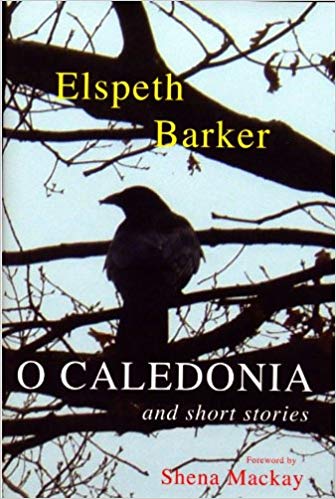
Following on from yesterday’s post about Anita Brookner who began her career as a novelist at 53, today I’m looking at another late debut writer; Elspeth Barker wrote this gothic novella at the age of 51. It concerns a teenager though: 16-year-old Janet has been found dead at the bottom of the stairs, dressed in her mother’s black lace evening dress, mourned only by her pet jackdaw who then kills itself, and her siblings. The novella then goes back in time over Janet’s life, but this is less a murder mystery and more of a character study.

Janet is an awkward child. She gets angry. She’s socially ill at ease. She has frizzy, unmanageable hair. She gets car sick. She irritates her parents. She reads a lot and is more clever than her classmates ,which causes distance. She is miserable and life is unfair. Her family don’t fit in where they are.

“Anger and outrage welled within her: she would speak the truth. ‘It was because of the witch. I wanted them to see if the witch was there,’ she wailed. ‘Don’t talk such nonsense; you know as well as I do that witches are only in fairy stories; and you read too many of those if you’d like my opinion.’ The mothers exchanged satisfied glances: they all thought Vera went too far in her choice of children’s reading; and she smoked cigarettes and wore slacks.”

Soon, however, they inherit an ancient, crumbling pile in the far north of Scotland, and Janet loves it:

“Auchnasaugh, the field of sighing, took its name from the winds which lamented around it almost all the year, sometimes moaning softly, filtered through swathes of pine groves, more often malign, shrieking over battlements and booming down the chimneys”

“She had no fear of its lofty shadowed rooms, its dim stone passages, its turrets and towers and dank subterranean chambers, dripping with Verdigris and haven to rats.”

It also has her eccentric aunt Lila, who wafts around dressed in black collecting fungi and incurring the wrath of Janet’s mother Vera; Jim, a taciturn odd-job man skulks around the place.

“It was a rigorous life, but for Janet it was softened by the landscape, by reading, and by animals whom she found it possible to love without qualification. People seemed to her flawed and cruel.”

So although Janet finds solace, she is still an outsider. Very much a loner and isolated at her boarding school. We follow her through the years and what emerges is a young life of a deeply awkward, lonely girl.

“What use was it to be racked by pain for animals and the general woes of the world when she was unmoved by the sorrows of people she knew?”

O Caledonia is thoroughly gothic so you need a pretty strong stomach at times – something I don’t have, particularly around animals. But it’s superbly written, startling and atmospheric.

Overall, I was left with a feeling of sadness. Janet has a lonely life and then before she’s had a chance to carve out anything better for herself, she is killed. O Caledonia really gets under your skin.

“There are two seasons in Scotland: June and winter.” (Billy Connolly)

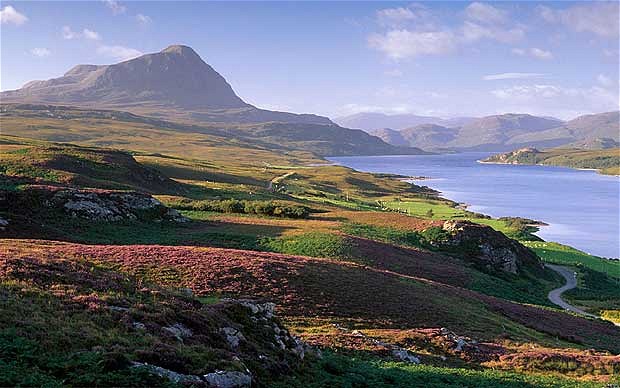
If you live in the UK, the news has been dominated by one story for weeks: the Scottish referendum.  On 18 September the Scottish people voted in favour of staying the union, but this wasn’t a vote for the status quo, and as such the news coverage continues, assessing the changes that are needed.  Prompted by this current affairs Caledonian focus, I thought I’d look at work by Scottish writers who engage with ideas of land and home, and how complex those fundamentals can be.

scot-benhope_1919346b

(Image from: http://www.telegraph.co.uk/travel/your-travels/8572241/Scotland-readers-tips-recommendations-and-travel-advice.html)

Firstly, a Booker-nominated debut novel, Our Fathers by Andrew O’Hagan (Faber & Faber, 1999).  This was a lesson to me to persevere with books, sometimes it pays off.  At first I found the story of male familial relationships utterly depressing:

“My father found it easy to hate his father; he had much more ease, in that sorry business, than his own son would ever have.”

The reason I stuck it out was because I’d read other novels by O’Hagan and I knew what a beautiful and sensitive writer he is.  Our Fathers is narrated by Jamie, son of Robert, grandson of Hugh.  The lives of the family are imbedded in the landscape of Glasgow, a landscape that Hugh is determined to change:

 “For years the city vibrated to the sound of diggers and pneumatic drills. Old powdery tenements fell to the ground. Whole townships cleared away.  It became part of the noise of Glasgow…there were half-chewed buildings on every street”

As an adult Jamie returns to Glasgow to visit the dying Hugh, from Liverpool where he has been trying to forget the past.  As Jamie returns to Scotland, he feels his way amongst the people, places and language that are at once entirely familiar and entirely apart:

 “The men at his table had similar faces.  Red and watery-eyed. All the trace of former good looks upon them. …The air was filled with their smoky laughter and the sound of the jukebox. Music, laughter, the shadows of words.”

 “‘Are the spirits high?’ I asked. And then all of a sudden I felt how foreign that phrase would sound… ‘Can he… can he thole the pain?’”

And what made Our Fathers initially so depressing for me was what made it ultimately so rewarding.  Out of pain, abuse, mistakes, recriminations and hardship comes forgiveness, wisdom, kindness and redemption:

 “I stood beside him, and listened to his life, and I held his hand, and I finally grew up”

It was an incredibly moving book, finely observed and insightful regarding the delicate meaning in moments that can barely be articulated.

Secondly, a poem by Kathleen Jamie, Here Lies Our Land.

Here lies our land: every airt

Beneath swift clouds, glad glints of sun,

Belonging to none but itself.


We are mere transients, who sing

Its westlin’ winds and fernie braes,

Northern lights and siller tides,


Small folk playing our part.

‘Come all ye’, the country says,

You win me, who take me most to heart.

It’s a short poem, and so I don’t want to analyse it to death, but I will just say I think the way Jamie creates a gentle, reflective tone through metre and language captures something fundamental and enduring; its language like the land she speaks of. You can read Kathleen Jamie’s thoughts on the poem and her writing process here.

To end, a man who shares my view on what Scotland’s finest export is (not counting Sean Connery):

https://www.youtube.com/watch?v=-XepXmESQ4k