As the title of Claudine in Paris (Claudine à Paris trans. Antonia White, 1958) suggests, Claudine has left Montigny for the capital. She is recovering from a severe illness which has seen her long hair chopped off due to matting, and she is finding it hard to adjust to her new looks and new home:
“I can’t conceive that people live in Paris for pleasure, of their own free will, but I do begin to understand that one can get interested in what goes on inside these huge six-surveyed boxes”
Some things haven’t changed: she and her father are still bonded by affection but talk at cross-purposes:
“No doubt he neglects Moliere as not being sufficiently concerned with slugs”
Claudine could be annoying: she’s precocious and pretty self-obsessed in the way teenagers can be, but I still liked her. She’s funny, she’s witty, and she’s aware of her own shortcomings:
“Claudine, old thing, will you never cure yourself of that itch to meddle in things that don’t concern you, that rather despicable little wish to show you’re artful and knowledgeable and understand heaps of things beyond your age? This urge to astonish people, this crave to disturb people’s peace of mind and upset too-placid lives will play you a nasty trick one of these days.”
Claudine finds her claims of broadminded libertarianism butting against her experience in Paris. Although she is fine with her cousin being gay, she is shocked to find an old school friend with very few prospects deciding to be kept by her old, overweight ‘uncle’.
“In your heart of hearts Claudine, you’re nothing but a common everyday decent girl.”
This short novel follows Claudine getting to know her extended family, gaining in confidence as she negotiates the city, and working out who she is growing into. It’s an affectionate portrait of someone on the brink of adulthood, showing how its possible to be childlike and a knowing adult at the same time, moving between the two in an instant.
Claudine falls in love in Paris, with someone who, as a reader, I thought wholly unsuitable. Was I right? Tomorrow I’ll let you know when I look at Claudine Married…
Today is Margery Sharp’s birthday, which I know thanks to Jane from Beyond Eden Rock; I’ve joined in the celebrations with Jane the last few years and I find starting the year with Margery is a sound way to begin if ever there was one 😊
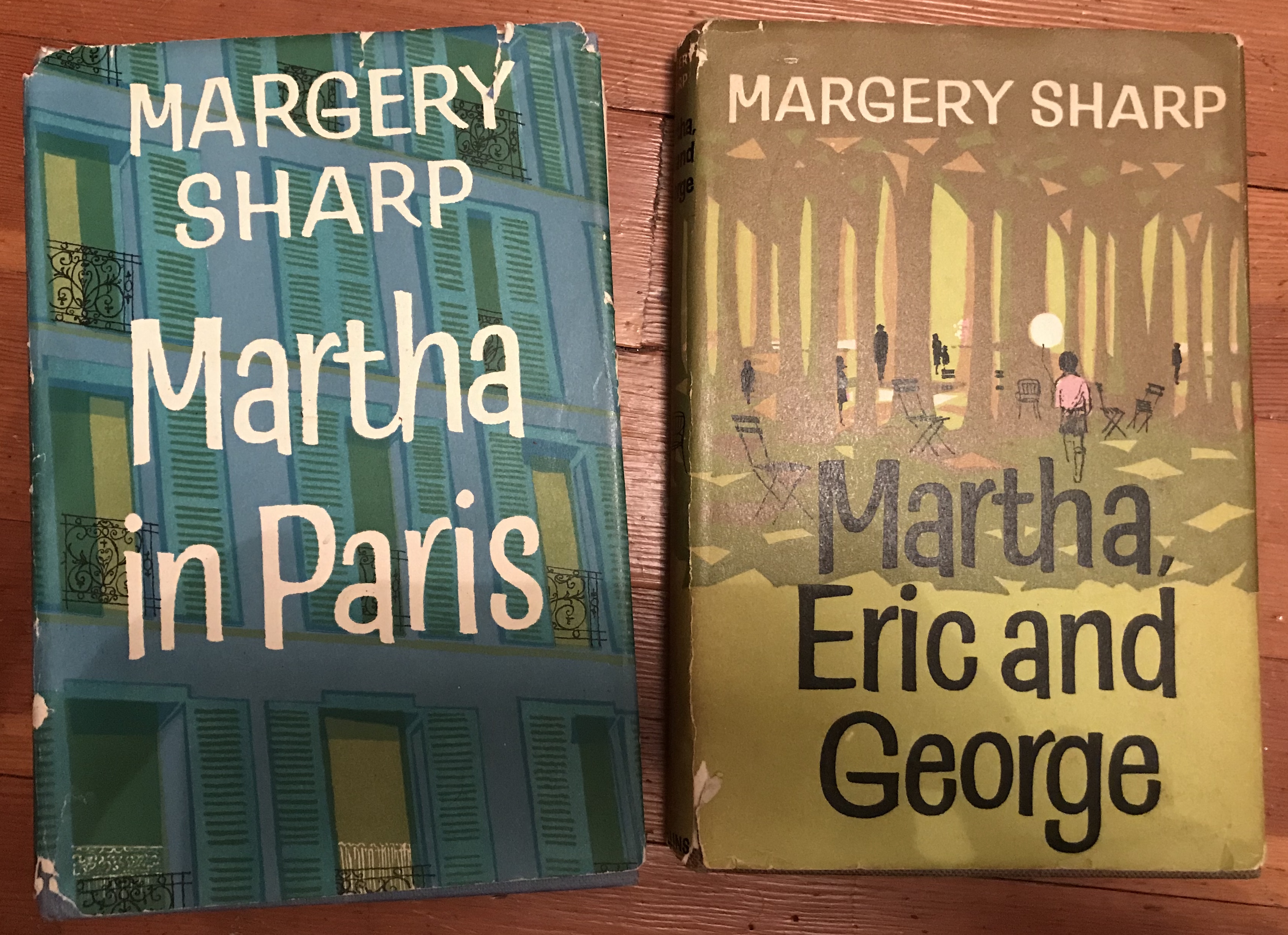
Two years ago I looked at The Eye of Love, which introduced the character of Martha, a strong-willed, self-possessed child. Sharp continues Martha’s story in two sequels, which I thought I’d look at today. These short novels work well individually but also when read together, as I did, the second giving more satisfying conclusion to the story.
Firstly, Martha in Paris (1962) which sees Martha aged 18, pursuing her art under the patronage of her childhood friend Mr Joyce, who recognises her for the genius she is and the future star she will become. He feels that to develop as an artist, she must go to Paris. Martha isn’t keen on Paris, but the prospect of staying forever with her sweet-natured Aunt Dolores means she agrees to go:
“Contrary to Mr Joyce’s prophesy, she learned to speak practically no French at all. She learnt to understand it; but […]it wasn’t as though she had anything she particularly wanted to say. The power of expressing thoughts, or emotions, was unnecessary to her; and not to be able to answer questions a positive advantage.”
Martha is still very much the stolid child we met in The Eye of Love. She is single-minded and focussed entirely on her work. She has feelings for a few people but they are deeply buried, clear-sighted and unsentimental. She is inexpressive because in the main other people are of no real consequence to her; she is indifferent to them and so has no need to seek an understanding with them.
She seems an unlikely candidate for love, but fellow Brit, bank clerk Eric Taylor falls for Martha. Or rather, he falls for who he thinks Martha is: a shy, self-effacing virgin like himself. Martha doesn’t deliberately mislead him, because she doesn’t really bother with him at all.
“Eric Taylor, in love, still wasn’t ready to make love. He felt himself he hadn’t yet quite got the hang…a parting pressure of the hand was the most he attempted; which upon Martha, who had a grip like a navvy’s, left no impression at all.”
Despite these inauspicious circumstances, their relationship develops because Martha is drawn to visit Eric and his mother at their flat, due to the prospect of nice bath. Now onto huge SPOILERS – if you don’t want to know, you’ll need to skip to the end of the post.
Inevitably, these two naïve people end up in a predictable fix: Martha gets pregnant. She carries on going to art class and doing well; she is overweight and wears baggy smocks so her pregnancy is easy to hide. She also decides that although she enjoys sex, she loves her work more, and so she is done with that side of life.
“It was time for Martha to gather her forces. No prospect had ever appalled her more, not even that of painting Christmas cards at Richmond, than this loyally-offered prospect of honourable matrimony.”
Martha is not an easily likeable character, as she disregards almost everyone she encounters. However, she never does this out of cruelty and never intends to hurt anyone. If you like Saga Noren from The Bridge (which I do), you’ll like Martha.
Some things have dated in Martha in Paris: a rather flippant treatment of the prospect of rape and a horrible racist phrase used in passing by one character. But in its treatment of sexual politics and gender roles it is remarkably progressive for its time. Martha is shown to find joy in sex without love. She is also shown to prioritise her career over all else. Sharp suggests that Martha behaves as men have done for centuries, and asks if we judge her harshly, are we doing so because she is a woman who resolutely fails to fulfil traditional gender roles?
Sharp continues to expand on the theme of gender expectations in the sequel Martha, Eric and George (1964); as a comic writer she does this explicitly but with wit so it’s never didactic.
“Young men are not accustomed to being loved and left, abandoned to bear alone the consequences of their folly, just as if they were young women.”
But this is exactly what happens to Eric Taylor. Martha leaves the baby with him and his mother to be raised, while she returns to England to focus on her painting.
“No dashing hussar abandoning a village maiden could have behaved more cavalierly. Not that Martha was in any other sense dashing, far from it; her outstanding characteristic was rather a blunt stolidity which only Eric in his innocence could have seen as virginal shyness.”
His mother, as Martha foresaw, embraces this new challenge to become a doting grandmother. She also revels in her status as rescuer of a poor abandoned baby.
“There were no such compensations for Eric. For once, it was the man who paid.”
Martha meanwhile, has become a hugely successful artist. Events conspire to send her back to Paris ten years after she left her son on the Taylors doorstep. She has no plans to see Eric or her son ever again, but of course things work out otherwise. George has grown up very much like his mother in temperament: self-possessed and single-minded. Martha has no maternal feelings whatsoever.
“She desired neither husband nor lover, nor to be admired, nor to make other women envious. All she wanted was to be unencumbered.”
What will happen to this disparate trio? I think Sharp is brilliant at endings: things work out well, without diminishing the characters or retreating into sentimentality. Martha, Eric and George was no exception to this.
To end, a sentiment with which Martha would certainly not agree:
My lovely friend H feels I take life too seriously & this is reflected in my choice of reading matter. As such, she keeps lending me light reads in the hope that I’ll chill out & stop living my life like I’m a some sort of doomed Hardy heroine (which I dispute: I harbour no plans to start bedding down at Stonehenge. Far too cold, I prefer central heating. Probably just as well as they’ve restricted access to the monument now.) But because she is a good friend & I love her (and she’s probably right in general), I read the books she gives me. This week it was Death Comes to Pemberley by PD James (Faber & Faber, 2011), so I decided to write about it here, making the theme of the post prequels and sequels.
Death Comes to Pemberley is a sequel to Pride and Prejudice, set 6 years after the end of Austen’s novel, where Darcy & Elizabeth are happily married with 2 sons. I’m not a big crime reader, so I hadn’t read any PD James before, but I know crime aficionados who highly rate her. To me the crime element of this novel was its weakest link – the plot was very slight and there’s no detective work as such, the crime is solved as the murderer confesses. But I never wanted to blog about books in a critiquing way, so I’ll stop and look at what is to celebrate, as I planned. James has great fun with the concept of a sequel to Pride and Prejudice, with comments on the backstory like: “If this were fiction, could even the most brilliant novelist contrive to make credible so short a period in which pride had been subdued and prejudice overcome?” (Answer: Yes). She also explains potential problems in the original, like why Darcy’s first proposal and following letter were so rude (he was trying to make Elizabeth hate him so he wouldn’t have to deal with his attraction to her). Whether or not you like this explanation depends on how you’ve read the original, and while it’s a shame to pad out the room for interpretation which helps readers feel a sense of ownership over a novel, James is as entitled to her view as anyone else. She is obviously a huge fan of Austen and characters from Emma also make an appearance thorough a verbal report: a child is adopted by Mrs Harriet Martin nee Smith, friend of Mrs Knightley.
Part of modern scholarship on Austen is to look at what is hidden in her work: the slavery hinted at in Mansfield Park, for example. Writing from a 21st century perspective, James can make explicit certain factors like feminism and the Napoleonic War which readers today may pick up on but are only shadows in Austen’s works:
“We have entered the nineteenth century; we do not need to be a disciple of Mrs Wollstonecraft to feel that women should not be denied a voice in matters that concern them. It is some centuries since we accepted that a woman has a soul. Is it not time that we accepted that she also has a mind?”
“The war with France, declared the previous May, was already producing unrest and poverty; the cost of bread had risen and the harvest was poor. Darcy was much engaged in the relief of his tenants ..”
In this way James’ novel offers a chance to view well-known characters in more well-rounded way, taking into account their social and political circumstances in a wider perspective, beyond that of the Regency marriage market. However, and I realise this is an obvious point so I won’t linger on it, PD James is not Jane Austen, and as such the novel reads a bit flat. The effervescent wit is gone and there’s not really anything to replace it.
It was a brave decision that James made with Death Comes to Pemberley, as writing a sequel to Pride and Prejudice is really a thankless task. Austen and her characters are so greatly loved I doubt any author other than Austen herself could do them justice. While placing them in genre fiction like crime is probably a good idea so that its clear you’re working within conventions other than those of the original novel, I can’t help feeling that Death Comes to Pemberley may prove disappointing for both crime fans and Austen fans.
For the prequel part of this post I’ve chosen probably the most well-known of all prequels: Wide Sargasso Sea by Jean Rhys (1966, my copy Penguin 1993). Wide Sargasso Sea looks at the events that occurred prior to Jane Eyre, and how Rochester’s first wife became the madwoman in the attic. Rochester marries the Creole heiress Antoinette Cosway in the Carribean. There is a strong sexual attraction between them as Rochester describes:
“Only the sun was there to keep us company. We shut him out. And why not? Very soon she was as eager for what’s called loving as I was – more lost and drowned afterwards.”
But this is not enough to cover the differences between them “It was all very brightly coloured, very strange, but it meant nothing to me. Nor did she, the girl I was to marry.” and the cracks in their marriage soon start to appear, with distrust, jealousy and violence on both sides. The result of this we already know…
What happens to Antoinette is a commentary on both men’s exertion of power over women, and the coloniser’s power over the colonised. Rhys takes the “other” of Jane Eyre and gives her a voice, placing us alongside Antoinette and showed how flawed and racist notions of “other” are. Rochester, the rich white Englishman, seeks to control Antoinette and does so by renaming her and confining her – the parallels with slavery are clear. As a woman, she is also subjugated by a society that is on Rochester’s side:
“When a man don’t love you, more you try, more he hate you, man like that…”
“I cannot go…I am not rich now, I have no money of my own at all, everything I had belongs to him…that is English law”
However, by giving the narrative voice to Rochester as well as Antoinette, Rhys ensures a balance to Wide Sargasso Sea that means you can’t write it off as limited perspective polemic. It has had a huge influence on how Jane Eyre is read, and I think this is because it is so sensitive and subtle a reading and portrayal of the characters. Rhys succeeds in creating a backstory that is wholly believable and recasts the frames of reference through which Jane Eyre is viewed, without ever undermining the original work. This can be seen in interpretations such as the BBC’s 2006 version of Jane Eyre which emphasised Bertha’s (as she is then named) sexuality, associated her with the colour red as in Wide Sargasso Sea, and had her played by the beautiful Claudia Coulter to make Rochester’s physical attraction to her easy to understand (the BBC also filmed a version of Wide SargassoSea the same year). The fact that Sandra Gilbert and Susan Gubar’s behemoth of feminist literary criticism took the title The Madwoman in the Attic (1979, Yale University Press) shows how the character of Bertha (and characters like her) are being reassessed, and I think it’s reasonable to assume Wide Sargasso Sea played no small part in that. Unlike Death Comes to Pemberley, Wide Sargasso Sea stands alone as a great novel, and simultaneously hugely enhances reading the source work. I recommend the latter unreservedly, and the former as a point of interest and a quick, throwaway read.
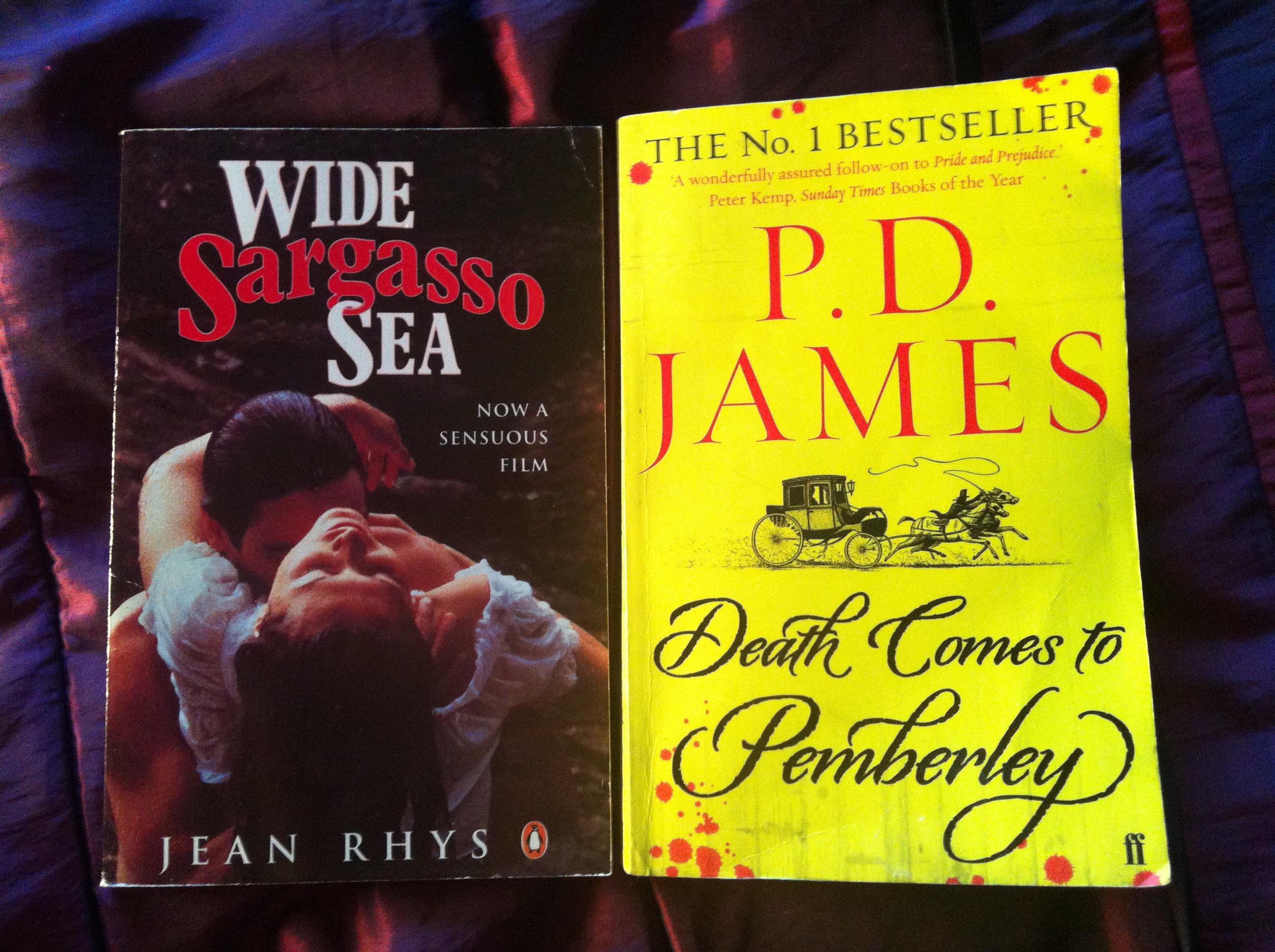
I was wondering how to photograph the books in a way that represented the theme, then as I looked at the covers I realised they sort of represented a before and after already – la petite mort followed, inevitably, by le grande mort. What a depressing note to end on – I think H has got her work cut out…….

 madame bibi lophile recommends