As a companion piece to my last post about marriage, I thought I would look this week at portrayals of honeymoons. Originally I planned to include On Chesil Beach by Ian McEwan but I ran out of time & wanted to re-read it in order to do it justice, as I remember it being very moving. So please don’t let my inadequacy prevent you from checking it out if you haven’t read it 😉 Onwards to honeymoon stories I’ve read more recently!
All the ‘honeymoon’ pictures I googled made me want to vomit, so here’s a Weimaraner puppy instead
Firstly, Orkney by Amy Sackville (2013), which is an eerie, claustrophobic tale of a honeymoon taken on a remote Scottish island. Richard is a professor of English literature who is entranced by literary sirens and by his silver-haired wife, forty years younger than he, strange and unknowable:
“She is a tiny, perfect, whittled trinket found bedded in the sand, carved patiently, for comfort; she is a spined and spiky urchin with an inside smooth as polished stone, as marble; she is frond of pallid wrack, a coral swaying in the current, anchored to the sea-bed; she is an oyster, choking on grit, clutching her pearl to her.”
The unnamed wife is obsessed with the sea, taking long, lone walks by day and having water-filled nightmares by night:
And as she dreams her submarine dreams I lie beside her, a whale’s carcass, a wrecked ship, a vast ribcage in the dark blue deep; and she is a tiny luminescent silver fish, picking me clean, in and out of all that’s left of me, bare bones long since freed of flesh and rigging.”
Each chapter covers a day of their honeymoon, told from Richard’s perspective. This is not a plot-driven story as very little happens, in some ways it is quite a slight tale, but I found Sackville’s beautiful writing made it compelling and carried me along. The atmosphere gradually becomes more uncanny, with a sense that is not just Richard’s wife who is unknown, but that there are no certainties at all:
“An overcast, lowering sky this morning; the clouds have clotted through the night. Something gathering, brooding, out on the sea. A darkness spreading. The edges of my wife blur against the sky.”
Orkney is short novel about the stories we tell ourselves and each other, how we understand the world, and how what is real and unreal is not always clearly delineated:
“He tells her tales of the finfolk and selkies. Nothing can replace those first tales, which have coloured the cast of her thought, which have filled her nights with the sea, which are at least as real to her as anything she’s learned of the world since.”
Secondly, the short story Here We Are by Dorothy Parker (1931). A young couple are on a train, having been married “exactly two hours and twenty-six minutes”. Most of the story is dialogue, and they come across as so terribly young and naïve.
“He sat down, leaning back against the bristled green plush, in the seat opposite the girl in beige. She looked as new as a peeled egg. Her hat, her fur, her frock, her gloves were glossy and stiff with novelty.”
They sit and talk about the day, the wedding, those they know, and bicker about silly things: hats, mainly.
“‘Hell, honey lamb, this is our honeymoon. What’s the matter?’
‘I don’t know,’ she said. ‘We used to squabble a lot when we were going out together and then engaged and everything, but I thought everything would be so different as soon as you were married. And now I feel sort of strange and everything. I feel so sort of alone.’”
Of course, what they are not saying is that the train is speeding them towards a hotel room, and they are terrified about what is going to happen once they are alone together. The story is a masterclass in ‘show, don’t tell’ writing. Parker’s trademark acerbic wit is not to the fore – the story is gently funny, and I felt sorry for this unknowing couple marrying in such a different age, and desperately hoped it would work out for them.
This is part of a series of occasional posts where I look at works from Le Monde’s 100 Books of the Century. Please see the separate page (link at the top) for the full list of books and an explanation of why I would do such a thing.
When I first started this challenge, I thought it would never be complete as I have commitment issues Wikipedia told me that Tendrils of the Vine had never been translated. Yesterday in my favourite charity bookshop (handily located across the road from my flat, so I don’t have to stagger far with my heavy loads/nightmarishly located across the road from my flat – if you had a problem with drug addiction you wouldn’t live opposite a crack den) I picked up a huge volume of The Collected Stories of Colette for £3.50, and was very excited to see Tendrils of the Vine translated within it (by Herma Briffault – and I see Wiki no longer makes its fallacious claim).
In fact , Tendrils of the Vine, proclaimed A Fable in the title, is only 1000 words long and I may have been able to struggle through with my appalling French. The difficulty is, being only 1000 words long, I really can’t say too much about it without spoilers, so this will be an uncharacteristically short post from me 🙂
The story begins in typical fable fashion, describing how the nightingale got his song:
“While he slept, the vine’s gimlet feelers – those imperious and clinging tendrils whose sharp taste, like that of fresh sorrel, acts a stimulant and slakes the thirst, began to grow so thickly during the night that the bird woke up to find himself bound fast, his feet hobbled in strong withes, his wings powerless…”
The nightingale escapes, and sings relentlessly to keep himself awake through the Spring, thereby avoiding the terrors of the vine. I can’t say much more, except Colette then expands this into a truly creepy and oppressive tale. The fact that she does this in 1000 words within a pastoral fabulistic setting makes it like a short, sharp punch to the sternum. What a writer – I’m looking forward to reading the rest of my newly-acquired tome.
Colette, who when she wasn’t writing, sat around being awesome
Gong Hei Fat Choi! Happy New Year of the Fire Monkey! To celebrate the start of the Lunar New Year I thought I would look at writers from cultures and countries outside of China that also widely celebrate this event: a Hong-Kong born writer’s Philippines-set novel, and a Japanese writer, as the interwebs tell me Japan celebrates both the Gregorian and Lunar new years. These will also be two more stops on my Around the World in 80 Books Reading Challenge, hosted by Hard Book Habit.
Fire Monkey – this is going to be your year, my simian friend
Firstly, Brownout on Breadfruit Boulevard by Timothy Mo (1995). I picked this up because it was enthusiastically recommended in a lecture I attended on post-colonial literature. Brownout is set primarily in the Philippines, in the fictional city of Gobernador de Leon, where Victoria Init, admirer of Imelda Marcos, strives to extend her congressman husband’s power.
“Rubbish carts too dilapidated to carry the neat and frugal household wastes of Osaka had come from Japan; schoolbuses no longer fit to carry Korean children from Seoul; traffic lights , too laconic to blink longer at the soldierly traffic in Wellington would glare defeasance implacably red-eyed at the escaped lunatics behind the steering wheels of the Gobernador de Leon jeepneys. Traffic was absurdly heavy…you would stay in the same place a maximum of five minute before creeping on again…So what if it was only inches? Advance was cumulative; the achievement slow but palpable. In short, at the end of it you had made progress. Progress was Victoria Init’s idol. She would sacrifice everything and everyone at the feet of that stern shibboleth”
The second part of the novel deals with a conference of academics coming to the city, through which Mo is able to extend the portrait of corruption flourishing in the face of lazy indifference and self-interest far beyond the politicking Inits and a toothless journalist named Boyet. The visiting intellectuals have no understanding, wrapped up as they are in their own tiny worlds. Some are overtly derogatory to other cultures, others restraining themselves to sweeping racism:
“Filipinos don’t actually have a colonial chip on their shoulder…The ordinary pinoy likes America and Americans, in fact there’s nothing he’d like better than to be one. And as for the language of the oppressor issue, Holy Moses, they grow up speaking English. It’s as natural to them as…”
I think it speaks volumes that the sentence is unfinished by the speaker. As a satire Brownout doesn’t entirely work – there’s not really a character to care about, to anchor the narrative to or throw the corruption into sharp relief. It’s a novel filled with characters, a broad portrait that for me could have done with being a little deeper. However, Mo is a highly skilled writer and, as my lecturer suggested, Brownout is certainly interesting from a post-colonial point of view. It didn’t wholly capture me but I enjoyed it enough that it makes it onto this blog, where I only write about books I recommend.
Secondly, The Diving Pool by prolific Japanese writer Yoko Ogawa (trans. Stephen Snyder), a collection of three stories written in a beautiful, spare style. In the deeply unsettling titular story a young girl falls in love with her foster brother:
“Sometimes I wish I could describe how wonderful I feel in those few seconds from time he spreads his arms above his head, as if trying to grab hold of something, to the instant he vanishes into the water. But I never can find the right words. Perhaps it’s because he’s falling through time, to a place where words can never reach.”
The narrator lives with a large extended family where she is the only biological child.
“I can never hear the words ‘family’ and ‘home’ without feeling that they sound strange, never simply hear them and let them go. When I stop to examine them, though, the words seem hollow, seem to rattle at my feet like empty cans.”
It’s quite a feat that for a precise, beautifully eloquent writer such as Ogawa, she makes what is left unsaid and unacknowledged the dominant theme of the collection. The girl in The Diving Pool carries out horrible acts of cruelty without really knowing why; in Pregnancy Diary, a young woman is mesmerised and yet alienated by her sister’s pregnancy:
“I wonder how she broke the news to her husband. I don’t really know what they talk about when I’m not around. In fact, I don’t really understand couples at all. They seem like some sort inexplicable gaseous body to me – a shapeless, colourless, unintelligible thing trapped in a laboratory beaker.”
Again, the narrator does not behave well, indeed, behaves in a shocking way, with quiet malice. The inarticulate nature of the narrators makes their behaviour all the more unsettling, as it is presented through simple statements of fact, unadorned and unjustified.
In the final story, Dormitory, a young woman returns to the dorm building she stayed in as a student:
“I would hear it for the briefest moment whenever my thoughts returned to the dormitory. The world in my head would become white, like a wide, snow-covered plain, and from somewhere high up in the sky, the faint vibration began…I never knew how to describe it. Still, from time to time I attempted analogies: the icy murmur of a fountain in winter when a coin sinks to the bottom; the quaking of the fluid in the inner ear as you get off a merry-go-round; the sound of night passing through the palm of your hand still gripping the phone after your lover hangs up…”
Ogawa is a stunning writer, and in this final story, rather than a psychologically disturbed protagonist, she unsettles the reader by leading them down a well-worn narrative route, before abruptly destabilising it with a surreal and astonishing final image. Highly recommended.
Dear reader, it’s been so long. Let’s just say working pretty much full-time while studying for my Masters as a full time student basically leaves time for oooh, nothing else at all. My brain is close to exploding with all I’m trying to cram into it. Put it this way: I’ve lost all capacity for nouns. I can’t remember the name of anyone or anything. Apparently this is a sign of dementia starting. I’m trying to be positive and think it’s just a sign of my impending breakdown.
Anyhoo, it’s March now, and so I’ve decided that Spring has officially sprung. I’m sick of winter, and although it’s cold and grey in old London town today, we’ve had at least 3 days where it’s been sunny & bright & I’ve had to remove my jacket as I’m too warm. There are daffodils, so it’s Spring, people! Annoyingly, with this seasonal transformation comes exhortations from women’s magazines to transform your body into something called ‘bikini-ready’ or similar. Ugh. As a bibliophile I thought rather than attempting transformation, I would read about instead. Read about it seated in my favourite chair eating chocolate/cheese/chocolate topped with cheese while refusing to wear a bikini.
Firstly, possibly the most famous transformation story of all, The Strange Case of Dr Jekyll and Mr Hyde by Robert Louis Stevenson (1886). This is such a well-known story that I won’t bother outlining the plot. Just in case you need a reminder though, here’s a visual summary from the 1931 film:
Dr Jekyll observes:
“It was on the moral side, and in my own person, that I learned to recognise the thorough and primitive duality of man; I saw that, of the two natures that contended in the field of my consciousness, even if I could rightly be said to be either, it was only because I was radically both”
His potion suppresses his duality and lets forth the base Mr Hyde:
“He is not easy to describe. There is something wrong with his appearance; something displeasing, something downright detestable. I never saw a man I so disliked, and yet I scarce know why. He must be deformed somewhere; he gives a strong feeling of deformity, although I couldn’t specify the point. He’s an extraordinary-looking man, and yet I really can name nothing out of the way. No, sir; I can make no hand of it; I can’t describe him.”
The novella is not the most accomplished piece of writing but there are some well crafted passages:
“It was a fine, clear, January day, wet under foot where the frost had melted, but cloudless overhead; and the Regent’s Park was full of winter chirrupings and sweet with spring odours. I sat in the sun on a bench; the animal within me licking the chops of memory; the spiritual side a little drowsed, promising subsequent penitence, but not yet moved to begin.”
When originally published, this Victorian novella no doubt spoke to anxiety about sexual drives which may have faded somewhat, but the metaphor still lends itself to inner turmoil and guilt, when Hyde is figured as “the ghost of some old sin, the cancer of some concealed disgrace”; or the personality change associated with drug/alcohol addiction, as Hyde has “the body of a self-destroyer”; or various dissociative/psychotic psychological disorders. I think what makes this story so famous and enduring is that it captures an anxiety about who we are, and of what we are capable. The terror of The Strange Case of Dr Jekyll and Mr Hyde is not in Hyde himself, but in the unsettling notion that Hyde is not strange, but in fact common to us all.
Secondly, a chance for me to indulge my on-going obsession with Angela Carter, and discuss ‘The Tiger’s Bride’ from The Bloody Chamber. This collection of stories saw Carter reworking fairytales; an obvious choice for this post as the genre is filled with transformations – beasts into princes, wolves into grandmothers, wicked step-mothers into witches. In ‘The Tiger’s Bride’ narrator’s father stakes her in a game of cards, only to lose.
“I watched with the furious cynicism peculiar to women whom circumstances force mutely to witness folly, while my father, fired in his desperation by more and yet more draughts of the firewater they call ‘grappa’, rids himself of the last scraps of my inheritance. When we left Russia, we owned black earth, blue forest with bear and wild boar, serfs, cornfields, farmyards, my beloved horses, white nights of cool summer, the fireworks of the northern lights. What a burden all those possessions must have been to him, because he laughs as if with glee as he beggars himself; he is in such a passion to donate all to The Beast.”
The Beast is the name given to the Lord of the manor, a man who smells of:
“potent a reek of purplish civet at such close quarters in so small a room. He must bathe himself in scent, soak his shirts and underlinen in it; what can he smell of, that needs so much camouflage?”
The narrator moves into his lair:
“A profound sense of strangeness slowly began to possess me. I knew my two companions were not, in any way, as other men, the simian retainer and the master for whom he spoke, the one with clawed fore-paws who was in a plot with the witches who let the winds out of their knotted handkerchiefs up towards the Finnish border. I knew they lived according to a different logic than I had done until my father abandoned me to the wild beasts by his human carelessness…I was a young girl, a virgin, and therefore men denied me rationality just as they denied it to all those who were not exactly like themselves, in all their unreason.”
This Angela Carter, and so things do not play out as tradition would dictate: there is no helpless heroine surrendering herself to a man in this tale:
“I squatted on the wet straw and stretched out my hand. I was now within the field of force of his golden eyes. He growled at the back of his throat, lowered his head, sank on to his forepaws, snarled, showed me his red gullet, his yellow teeth. I never moved. He snuffed the air, as if to smell my fear; he could not.
Slowly, slowly he began to drag his heavy, gleaming weight across the floor towards me.”
The transformation in the tale is two-sided and empowering. It is everything you would expect from Carter: weird, surprising, audacious, and above all skilfully written with beautiful, concise prose.
To end, a warning from The Librarians that you should never wish your life would transform to a fairytale:
December is a month of magic – at least, that’s how I choose to see it, rather than a month of biting winds, zero natural light, and weeping over the expanding credit card bills and waistlines that mark the holiday season. No, it is a time of magic – fairies sit on top of trees, reindeer fly and strangers somehow shoot down chimneys and creep into kids bedrooms without being put on a register. In honour of this time I thought I’d look at literature around fairies.
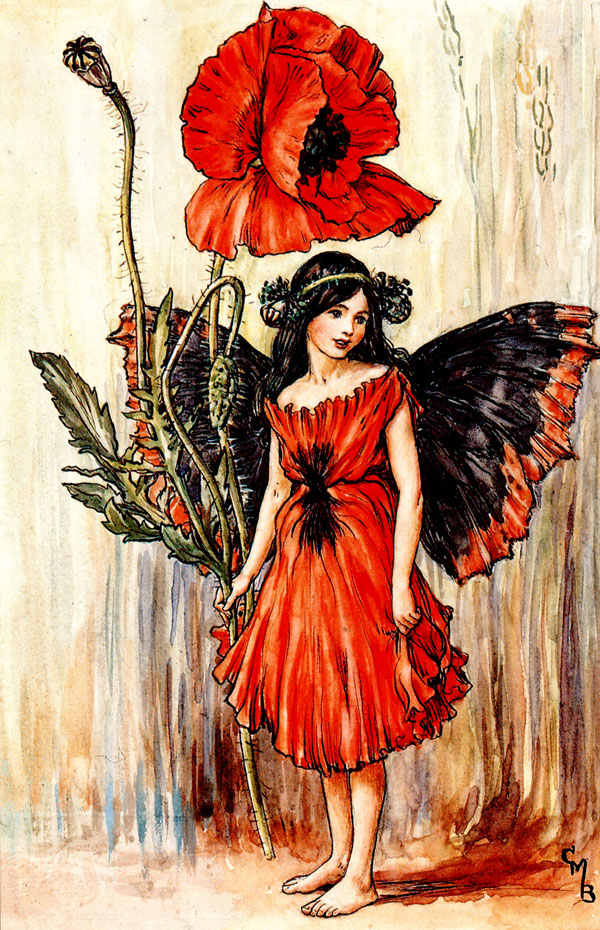
When I was growing up I loved the delicate drawings of Cicely Mary Barker’s Flower Fairies; the Poppy Fairy was my favourite because she looked a bit naughty. I’m not sure what that says about me as a child….
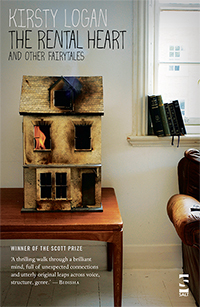
Firstly, The Rental Heart and Other Fairytales by Kirsty Logan (Salt Publishing, 2014). I picked this up after reading Naomi’s review on her The Writes of Women blog. It was every bit as good as Naomi suggested. The twenty stories in this volume are united by fairytale themes, but also explorations of sexuality, gender, love and desire that demonstrate how the extraordinary can promote new ways of understanding the everyday.
Logan plays with animating the inanimate and mechanising the organic to destabilise notions of identity. So The Rental Heart sees a woman protect herself from heart-break, leasing mechanised versions of the muscle which she renews as needed. In Origami Rebecca constructs herself a paper lover; in Coin Operated Boys, Elodie rejects “Imperfect. Awkward. Repulsive…” human suitors for the titular machines, responding to their “calm, clean angles”, cool touch, and eyes “flat as a pond in summer”. In this way Logan shows how desire is manifold and defies easy categorisation, while exploring how we seek to control desire, and how denial of our humanity can lead to detachment from ourselves and others.
Extraordinarily, Logan’s startling use of images throughout her stories did not cause me to detach, but rather reveals new ways of perceiving that truly resonate. Choosing any page at random would give me a quote for this post, Logan is truly that good.
From Bibliophagy: “Standing pigeon-toed and bruise-kneed in the light from the fridge, his neck finally stops twitching. The words are waiting, cold as milk….He turns away so the moon is hidden behind next door’s chimney. He lifts the words. He shudders to think how smooth the vowels will feel along his oesophagus. He swallows.”
From The Gracekeeper: “The widow thanked me afterwards with her damp swollen hands too tight on my wrists, speaking in fummels and haffs as if she could not get enough breath. Her wedding ring dug into her finger, making the flesh bulge out at either side, and I wondered whether she would wear it until it engulfed: her own secret totem”
In stories such as Witch, Logan challenges the heteronormativity and misogyny inherent in so many fairytales, when the young woman wandering in the forest decides to stay put:
“She was honey on my tongue. She was the poison apple, the kiss that would wake me. When she finally slid inside me, I knew the end of my story. I never wanted to leave my bitch goddess warrior queen. I knew what happily ever after was, and I wanted to be a wicked witch too.”
I’m so excited about Kirsty Logan after reading this collection, and eagerly await her first novel, published next year.
Secondly, it’s impossible to write a post about fairytales without mentioning Angela Carter. She edited two volumes of the Virago Press’ books of fairytales, as well as writing her own short story collection along this theme, The Bloody Chamber (Gollancz,1979). Carter’s stories are creepy and unsettling re-tellings of well-known tales, pulling the dark undercurrents of the fables to the fore. Snow White is rewritten in The Snow Child as an incestuous tale of necrophilia, played out between a battling couple:
“Then the girl began to melt. Soon there was nothing left of her but a feather a bird might have dropped; a bloodstain, like the trace of a fox’s kill on the snow; and the rose she had pulled off the bush.”
In The Werewolf Little Red Riding Hood is far from helpless victim: “The child had a scabby coat of sheepskin to keep out the cold, she knew the forest too well to fear it but she must always be on her guard. When she heard that freezing howl of a wolf, she dropped her gifts, seized her knife and turned on the beast.
It was a huge one, with red eyes and running, grizzled chops; any but a mountaineer’s child would have died of fright at the sight of it. It went for her throat, as wolves do, but she made a great swipe at it with her father’s knife and slashed off its right forepaw.
The wolf let out a gulp, almost a sob, when it saw what had happened to it; wolves are less brave than they seem.”
The Bloody Chamber prompts a reconsideration of familiar tales that we imbue from childhood. Carter is an intellectual force, funny and challenging; I was left thinking about these stories long after I’d read them.
Happy (belated) Valentine’s Day! In my post for Valentine’s Day last year (which was also late…) I pointed out that St Valentine is the patron saint for bee keepers, plague, epilepsy and against fainting, as well as for lovers. Last year I wrote on bee-keeping and plague but this year I’m going to be more romantic and tell you about the man in my life. He’s always been there, but these last few weeks it’s like I’m seeing him with new eyes; now I’m obsessed and we spend hours together every day. The title quote may have given it away: he’s Cary Grant.
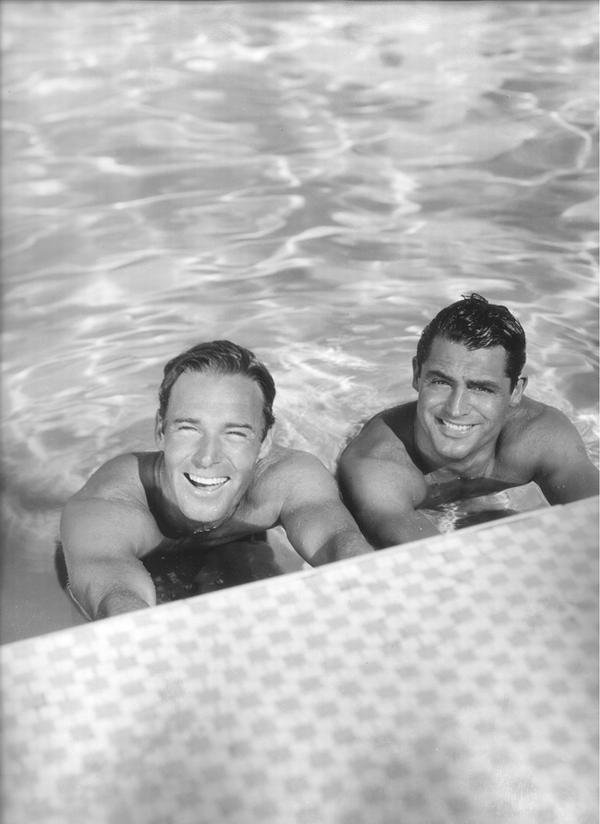
Let me explain. For my last paper before finals (FINALS! I’ve just broken out in a cold sweat….) we were given some optional papers to choose from, and I chose Film Criticism. We’ve been looking at Hollywood Golden Age, a genre Cary Grant sits astride like a tanned, debonair, mid-Atlantic-accented colossus. Having watched soooooo many of films again (and again, and again) I have a new-found appreciation for this actor with his exquisite comic timing. It’s not that I didn’t like him before, I just took him for (ahem) granted. This is how good he is: I had to analyse a scene from a film, and I chose something from Bringing Up Baby. It was 3 minutes 39 seconds long. I spent an entire day watching and re-watching the scene. Think about how many 3 minutes and 39 seconds there are in a day. That’s how many times I watched it. At the end of the day I was still laughing at his performance. The man is a genius. In the spirit of Valentine’s Day here he is with long-term boyfriend totally-platonic-friend-who-he-just-happened-to-live-with-for-twelve-years, Randolph Scott.
What a ridiculously good looking pair. Anyway, I thought for this post I would look at two of his favourite novels. According to IMDB he was a voracious reader. Do you think I can find out what he liked to read? Google, thou hast failed me. (Probably now I’ll be told that it’s really well-known that he loved Moby Dick or something, but I couldn’t find it). So instead I’ve chosen a James Bond novel as apparently the character was partly modelled on him and he was considered for the role in Dr No, and a short story by a writer who like Archie Leach was famous under a pseudonym.
Firstly, Casino Royale by Ian Fleming (1953). I’ll be honest, I went into this novel with very low expectations. Even the most avid Fleming fan will tell you that some of the novels are absolute bilge; apparently the quality of the Bond novels varies widely. This was the first Bond novel written and the first one I’d read, and I was pleasantly surprised. OK, Fleming isn’t a grand literary genius, but I doubt he ever proclaimed himself as such. Casino Royale is a decently written spy story. It’s quite different to the film, although similarities remain. I was expecting a flashy, superficial story but it’s a bit more reflective than that. It opens:
“The scent and smoke and sweat of a casino are nauseating at three in the morning. Then the soul-erosion produced by high gambling – a compost of greed and fear and nervous tension – becomes unbearable and the senses awake and revolt from it.”
Bond has been sent to Royale-le-Eaux to take down a Russian spy, Le Chiffre, by bankrupting him at gambling. This being the Cold War, of course the baddies are Russian, and there’s also the rather sinister SMERSH, a Russian covert group whose name means “death to spies” lurking in the background. That’s the very simple premise of the story. Along the way there are lingering descriptions of clothes, cars and food (Fleming was clearly something of a gourmand), but the presentation of Bond is more complex than I was expecting. I don’t think the reader is supposed to wholly like him or trust him:
“His last action was to slip his right hand under the pillow until it rested under the butt of the .38 Colt […] Then he slept, with the warmth and humour of his eyes extinguished, his features relapsed into a taciturn mask, ironical, brutal and cold.”
Bond is more human than in the films (he vomits in the gory aftermath of an explosion). He’s also damaged and flawed, more in keeping with the later filmic representations. Very much of its time, however, is the misogyny:
“These blithering women who thought they could do a man’s work. Why the hell couldn’t they stay at home and mind their pots and pans and stick to their frocks and gossip and leave men’s work to the men.”
As well as this general sexism, there’s also a worryingly easy conflation of sex with violence:
“Bond saw luck as a woman, to be softly wooed or brutally ravaged, never pandered to or pursued.”
Truly obnoxious and offensive. But in Fleming’s defence I would say that he seems more emotionally intelligent than his protagonist and we’re not supposed to see Bond as a role model in this sense. There’s also a good dose of humour in the novel which encourages us not to take Bond entirely as seriously as he takes himself:
“Englishmen are so odd. They are like a nest of Chinese boxes. It takes a very long time to get to the centre of them. When one gets there the result is unrewarding, but the process is instructive and entertaining.”
So, Casino Royale was better than I expected. It’s attitudes to women and Eastern Europeans are dated and offensive but as I said, I don’t get the sense the novel fully endorsed the attitude of its protagonist. It’s a quick, light read (although the descriptions of gambling dragged a bit in places) and for me it was good introduction to the Bond novels.
Secondly, The Celebrated Jumping Frog of Calaveras County (1867) by Mark Twain. What an irresistible title. Twain was a fairly prolific short story writer, but this was only the second one he wrote. You can read the full text of it here. It really is a very short tale, and shows how much can be done in so limited a space by an accomplished writer. It opens:
In compliance with the request of a friend of mine, who wrote me from the East, I called on good-natured, garrulous old Simon Wheeler, and inquired after my friend’s friend, Leonidas W. Smiley, as requested to do, and I hereunto append the result. I have a lurking suspicion that Leonidas W. Smiley is a myth; that my friend never knew such a personage; and that he only conjectured that, if I asked old Wheeler about him, it would remind him of his infamous Jim Smiley, and he would go to work and bore me nearly to death with some infernal reminiscence of him as long and tedious as it should be useless to me. If that was the design, it certainly succeeded.
As you can see, Twain’s humour is at the forefront (if you hadn’t already guessed by the title) and the mix of the ridiculous (“Leonidas W Smiley is a myth”) and the dry (“as long and tedious as it should be useless”) makes the story hugely entertaining. It’s certainly a confident writer who tells a tale he says will be tedious, and Twain does this not once but twice: “Simon Wheeler backed me into a corner and blockaded me there with his chair, and then sat me down and reeled off the monotonous narrative which follows this paragraph.” Simon Wheeler’s story of a gambling addict (Jim Smiley) who will bet on anything is directly reported, and he has one of the distinctive Southern voices Twain is so famed for, such as when he’s recounting how Jim trains the titular frog:
“He ketched a frog one day, and took him home, and said he cal’klated to edercate him; and so he never done nothing for three months but set in his back yard and learn that frog to jump. And you bet you he did learn him, too. He’d give him a little punch behind, and the next minute you’d see that frog whirling in the air like a doughnut see him turn one summerset, or may be a couple, if he got a good start, and come down flat-footed and all right, like a cat.”
There are some lovely touches in this story. I particularly liked the line: “Smiley said all a frog wanted was education” and the fact that the frog is endowed with the decidedly un-froggy full name of “Dan’l Webster”.A quick read that children and adults will enjoy.
To end, here is a clip from The Philadelphia Story, and just possibly the most charming 3 minutes and 46 seconds ever committed to celluloid. Apparently the bit where Cary Grant says “excuse me” was ad-libbed & that’s why he & James Stewart are trying not to laugh. Enjoy!
Today marks a year since my first blog post. During the year I’ve got so much more out of blogging than I ever thought possible, and that is due in no small part to my fellow bloggers, you gorgeous bunch. So I thought it would be apt to commemorate my first year by looking at a piece of writing by another WordPress blogger.
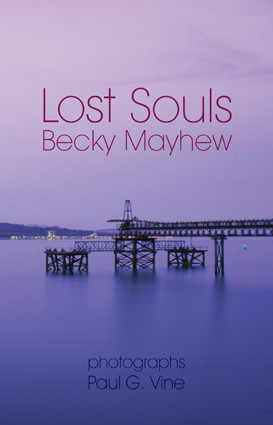
Becky Mayhew blogs at Becky Says Things. Her blog is funny, insightful and truly original. Do check it out, I promise you will be better for it as Becky points and laughs at the absurdities of life, and has something interesting to say about it all too. In 2011, Becky had a collection of short stories published by the lovely Treehouse Press, Lost Souls. It is collection of three stories, “Shelves”, “Ramona” and “Roses”.
“Shelves” is told to us by a librarian, whose sexual encounters are intertwined with her job and the reading matter of her partners. So she sleeps with the “insipid, vole-like” Geoffrey when he takes on board her suggestion to abandon John Grisham for Jane Austen, and later, after Wuthering Heights:
“I think the dynamic impression of hot-blooded Heathcliff had gone to his head a little, as he had the audacity to suggest we go back to mine. I conceded, and took him round the corner along the twelve houses to my flat, almost entirely for my own personal interest in what a week of Heathcliff does to a man; as it turned out, less than I hoped.”
As the passage above shows, there’s a wry, dry humour running through the tale, and the librarian’s voice is strong and distinctive. There are some beautiful images and Becky has an original turn of phrase:
“His eyes slid like oil over titles, one black eyebrow raised; occasionally he paused to finger a book spine or to bend to a lower shelf, and then he moved on, disappearing and reappearing in and out of bookcases like a thief.”
Fellow bibliophiles, didn’t we always know that libraries are hotbeds of sexual tension?
The narrator of “Ramona” is a middle-aged teacher, struggling to assert herself in all aspects of her life. I know enough teachers to know the description of how “it is depressing trying to teach a class of idiots who are far more interested in their social and sexual status than in how Margaret Atwood develops her characters” rings true. The narrator’s interest in one of her pupils, Ramona Manson, is slightly baffling to her, as Ramona “is not charming, she is not beautiful, she is not even particularly threatening”, and yet, she goes through life with an ease the narrator cannot achieve, and with a sense of authority that continually evades the older woman. The plot of “Ramona” is a simple one, and yet through this largely unremarkable time the fracture lines in the teacher’s life become fully exposed. The story is an artfully constructed portrait of an ordinary life teetering on the edge.
I loved the first line of the final story, “Roses”: “There he is, inside a flaming scarlet halo.” It’s a perfect example of what is to come – a beautifully written, unnerving, and insidiously violent tale. Unlike the other two stories, “Roses” is told in the third person, from the point of view of Elizabeth, a florist and fantasist, for whom the flowers are people:
“The bamboo chuckles raspingly under its breath. The lilies poke out their tongues; the sunflowers nod on their aching necks, shoulders shaking with weary laughter…”
Elizabeth spends her day obsessed with a man who uses the coffee shop opposite her florists:
“Sometimes she can feel him, in the long stretches when she is alone with her flowers; she can feel a presence, a warmth about her, as though he is sitting right there beside her, breathing her perfumed air. Their worlds beautifully interlaced like the coiling infinity of an open rose.”
That last sentence is such perfectly balanced writing: an image of originality and meaning without any pretension or heavy-handedness. I don’t want to say too much more about “Roses” as it would give the plot away, but the final page of this book, containing the last four short paragraphs of this story, was breathtakingly well-written. The images are startling and evocative, and I absolutely loved this story. Becky has blogged in the past about her tendency to procrastinate. I can only hope she is more successful than me at beating this behaviour, because I want to read more of her work very soon…
On their website, Treehouse Press say “we want our books to be unique and beautiful objects, a thing you’d want to hold in your hand, and also for the writing and the artwork to engage you”. Hopefully I’ve convinced you of the engaging quality of Becky’s writing. In the book the stories are alongside the haunting images of Paul G. Vine’s photographs, certainly making it a lovely object. You can buy Lost Souls direct from the publisher at http://www.treehousepress.co.uk/products/lost-souls , so if you’d like to get Becky’s book can I enter a plea that you buy it there and not from a certain tax-avoiding multi-national company?
My mother was telling me this week that she has had a lot of ideas for short stories come to her, and was asking me for collections of short stories to read to update herself with the form. It was a coincidence as I’d just finished reading Miranda July’s No-one Belongs Here More than You (Canongate, 2007) which is a highly readable collection of odd, unsettling stories that were both challenging and compassionate. So there’s my first recommendation. I’ve talked about short story collections in other posts: James Joyce’s Dubliners, Jeremy Dyson’s Never Trust a Rabbit, but I thought I’d write a post specifically around this type of fiction, as according to Truman Capote, the short story is “the most difficult and disciplining form of prose writing”. Good luck Maman!
Firstly, Sea Monster Tattoo and Other Stories by Ruth Thomas (1997, Polygon). This was Ruth Thomas’ debut, and it is a confident and varied collection of stories, some of which are only a few pages. “In Love” is one such story, an entire love affair described over 2 and half sides. Thomas is such an accomplished writer than the brevity doesn’t result in a lack of depth. Rather, she is able to create a sense of things distilled to their essence, but lightly, looking at the meaning of everyday occurrences. Sometimes her imagery is startling:
“In February her flatmate said, “I can’t stand the strain,” and moved out. Everything had ice on it, even eyelashes.”
This almost seems like a non-sequitur, then the meaning hits you, all the more forcefully for allowing the reader to connect the dots. Some of the stories read like that as a whole; Thomas takes snapshots of lives and then leaves you to find the meaning in the picture. The title story tells the tale of a group of girls travelling in southern Europe. Rather than a time of youthful exuberance, it’s an experience of dreary surroundings and small niggles. As the narrator feels distanced from her companions, we are brought alongside her thoughts:
“I’m thinking of the last time I was on a ferry, in Scotland. It was cold then too, at a strange time in the morning; I had got off some coach, woken up from some strange dream, and I think there were also sheep in a lorry. But I was much younger, travelling with my family. When we got on board there was a fruit machine and decks of cards sticky with beer. The crossing took over four hours. My mother tried to get me to sleep on an orange plastic sofa in the lounge but I just sat and stared out of the window at the sea , which was dark and wide and smooth as chocolate.”
The stories in Sea Monster Tattoo are full of such small observances, both of surroundings and of people. Through these details, Thomas shows great empathy and understanding, and just how much a short narrative can express.
Secondly, Here’s Your Hat What’s Your Hurry by Elizabeth McCracken (1993, Turtle Bay Books). Again, this was a writer’s debut, but I confess I read it after I’d read her first novel, The Giant’s House, because I’d loved it so much. I wasn’t disappointed. The things I’d loved about the novel: inventiveness, compassion, quirkiness, are all present in McCracken’s short fiction. In “It’s Bad Luck to Die”, a woman tells of her love for her tattoo artist husband. She’s six feet tall:
“Years later he told me how he was bowled over by all those square inches of skin, how I was so big and still not fat. “I fell for you right away,” he said.
[…] but he didn’t give me my first tattoo till a year later, the day after we were married: a little butterfly pooled in the small of my back. Five years later, he began referring to it as his “early work,” even though he’d been tattooing for twenty-five years before he met me. That didn’’t rankle me as much as you might think – I liked being his early body of work, work-in-progress, future. That little butterfly sat by itself for a while, but in five years time Tiny flooded it with other designs: carnations, an apple, a bomber plane, his initials.”
The tattoos are a living part of her, she almost expects to prick herself on a rose etched on her body. In the course of 22 pages McCracken portrays this couple and their method of communication that no-one around them understands with such delicate sensitivity that I was really moved by the story; I found the final line brought tears to my eyes. Proof that in the right writer’s hands, you don’t need a whole novel.
In the title story, McCracken’s offbeat humour is at the fore, with a tale of Aunt Helen Beck, who claims to be peoples’ aunt even though they don’t know her, and in this way travels around the country taking advantage of their hospitality. She is a forceful presence:
They went around back and walked into a bright kitchen, full of the sorts of long skinny plants Aunt Helen Beck had always distrusted: they looked like they wanted to ruffle your hair or sample your cooking. The boy followed them into the house…
“So,” she said. “what’s your name?”
“Mercury,” he said.
“I beg your pardon?”
Ford shrugged. “His mother likes planets.”
“I like vegetables,” said Aunt Helen Beck, “but I wouldn’t name my child Rutabaga.”
Aunt Helen Beck isn’t quite as morally upright and conservative as she likes to convey, and she and Mercury bond in what is a truly touching, unlikely friendship. I think this is McCracken’s great strength: her characters are always unusual but not self-consciously quirky, and her writing reminds us of all the ways human beings can reach out to each other across seeming differences.
Both these collections contain lots of little gems, great stories by accomplished writers with distinctive voices.
Here are the books with a pea, and any princess who’s had a sleepless night can attest to how powerful this small thing can be:
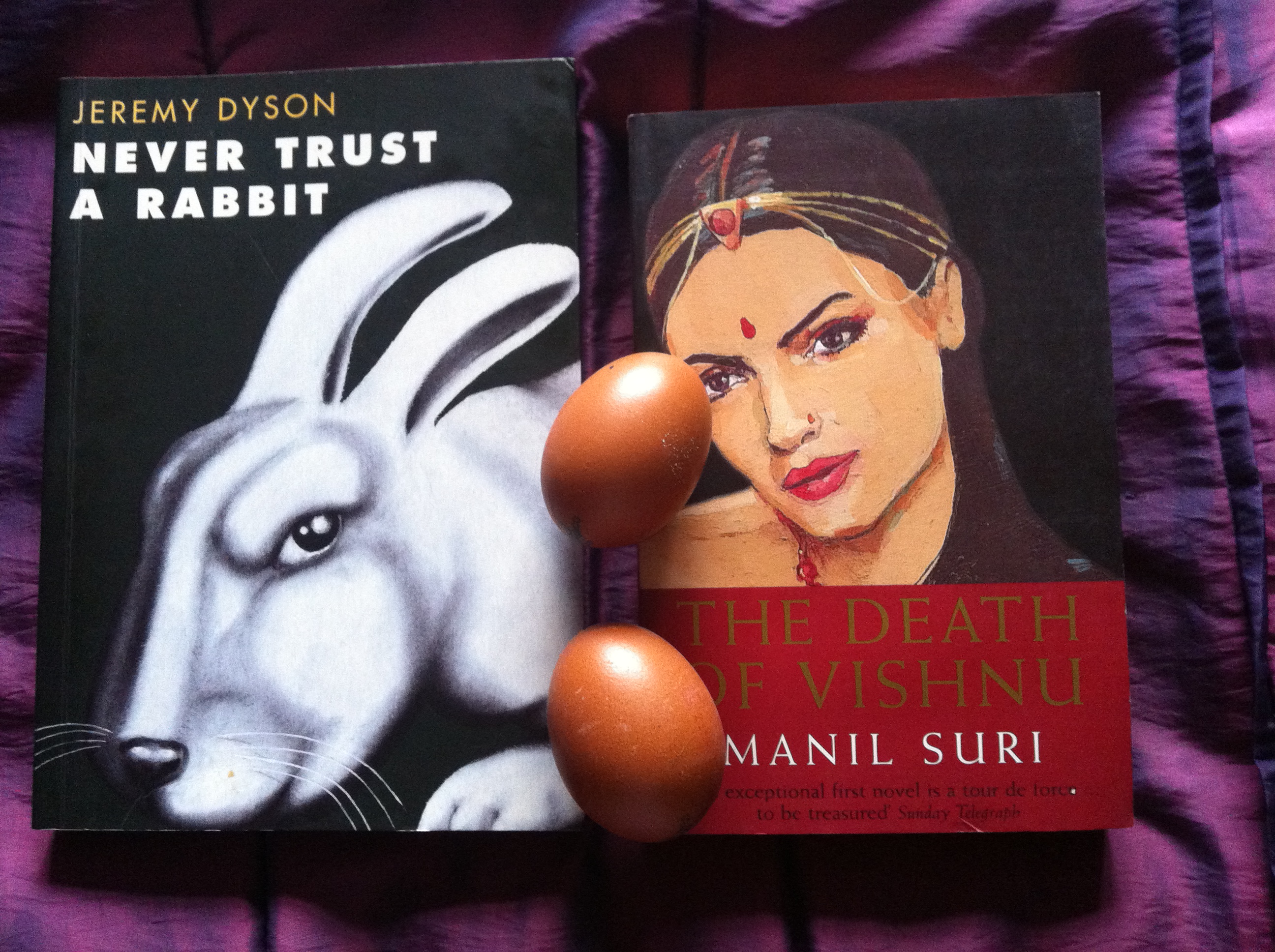
This weekend has been the long Easter weekend in the UK. I appreciate not everyone’s Christian (myself included) or that even if you are you might not necessarily celebrate Easter now but in May instead, or not at all. So I don’t want to bang on about the festival itself at any great length, but I did use it as a starting point for this week’s choices. I chose a book with references to bunnies in the title, and one about life & death, seeing as how its Easter and springtime, season of renewal. Two ways to celebrate Easter with no associated risk of adult-onset diabetes (unless of course you tuck into chocolate eggs & simnel cake while reading them, behaviour which I couldn’t possibly endorse…)
Firstly, Never Trust a Rabbit by Jeremy Dyson (Duck editions, 2000). Dyson is one of the comedy quartet The League of Gentlemen. I’m not sure how much success they had outside of the UK, so do forgive me if I’m about to tell you what you already know. The League made three TV series set in the fictional village of Royston Vasey, where three of the four writers played various bizarre residents of the village (Dyson doesn’t enjoy appearing on screen). They also made a feature film (The League of Gentlemen’s Apocalypse), in which they played themselves, and Michael Sheen played the role of Dyson. The reason I mention the TV series is that is if you’re familiar with it, you’ll already have an idea of what to expect: the village production of The Sound of Music as directed by Dario Argento. The book contains twelve short stories which present familiar situations but unnerve the reader as it gradually emerges that the reality we are dealing with is not exactly what we think we know. My favourite was probably City Deep, set on the London Underground. It’s an environment I have to deal with regularly but that I try to avoid wherever possible, as I hate the idea of being trapped in a crowd in a tunnel underground. Dyson perfectly captured the stifling, detached reality that the Tube offers and took it a step further, with a ghoulish, terrifying denouement that to a reluctant tube-user like myself seemed at once outrageous and entirely believable (the dark, hidden truth that I suspected was always there). But the stories aren’t resolutely parochial. The longest story, The Engine of Desire, takes in several locations worldwide, as the sinister Jack Sleighmaker travels the globe to track down whatever item his extremely wealthy clients desire, by any means necessary. Sleighmaker is an utterly reprehensible human being and his client is the equally despicable Prince Bandar, but Dyson’s writing is so well-paced and compelling that you find yourself reading on despite not rooting for any of the characters. I read this story in bed and found it so creepy I had to watch clips of kittens falling off things on YouTube before I could go to sleep. The twelve stories in the collection are all equally strong, there are no weak links; they are also varied enough from one another to keep you entertained while still working together as a collection. (As a P.S to this, another member of The League is Mark Gatiss, whose novels about the gentleman spy Lucifer Box I discuss in the post “Having your book turned into a movie is like seeing your oxen turned into bouillon cubes” on 14 November 2012).
Secondly, The Death of Vishnu by Manil Suri. This novel tells the story of Vishnu, an odd-job man in a residential block, who sleeps on the landing, and now lies dying the same place. An author’s note at the start of the novel tells you this is based on a true story: while the characters that surround Vishnu are fictional, Vishnu’s name, occupation, and the manner of his death are all true. I’m still not sure how I feel about this: whether it seems cruel and uncaring, or whether as a Westerner I’m too used to seeing death made taboo, institutionalised and tucked away out of sight so we don’t have to deal with it or our own mortality, and to let a man die where he chooses, the place where he has always lived in full sight, is an acceptance of the process we all face. The novel doesn’t offer easy answers, it instead presents things as they are and encourages us to recognise a common humanity, in its many guises. Take the opening line: “Not wanting to arouse Vishnu in case he hadn’t died yet, Mrs Asrani tiptoed down to the third step above the landing on which he lived, teakettle in hand.” On the one hand this shows consideration, on the other, Mrs Asrani doesn’t want to wake Vishnu up because she doesn’t want to deal with him. Things are not clearly defined in the novel, the characters are all flawed (Vishnu is an alcoholic who is bribed into doing his work by the residents) but they are fully drawn and entirely believable. We learn about the residents of the block and their various intrigues, and about Vishnu himself as the ordinary events of the day mingle with his reminiscences about his life. It seems apt to include his memory of Holi, as last week was Holi week:
“The light shines through the landing window. It plays on Vishnu’s face. It passes through his closed eyelids and whispers to him in red. The red is everywhere, blanketing the ground, coloring the breeze. It must be the red of Holi. He is nine, hiding behind a tree, fistfuls of red powder in each hand.”
The Death of Vishnu is beautifully written but in a simple style that allows the characters to breathe and readers to find their own way amongst them.
Here are the books with some non-chocolate eggs, so if you share Hitchcock’s phobia look away now:
Two days ago I went to a talk at the London Review Bookshop entitled The Real Jane Austen: A Life in Small Things with Paula Byrne and John Mullan.These two authors have both recently published works on Austen, and realised that they shared common ground in their consideration of the treatment of “small things” in her work, hence the joint talk. I hadn’t read either of their books, but if they are as lively, learned and accessible in print as they are in person, and you are interested in Jane Austen, I would hazard a guess that seeking out their work would be time well spent.
So this got me thinking about the treatment of small things in literature and I came home to peruse my bookshelves and decide on which books to discuss in this post. I was struck by how many were suitable, how many look at the small things in our lives. I suppose novels lend themselves to this – it is an intimate form, taking us inside people’s heads, but via our own internal voice. The gap between ourselves and the story becomes almost imperceptible. Novels can detail the minutiae of life, and I often think that is where the intimacy is. You know a person well when you know the small things. A writer who knew the value of small things is oddly, a writer whose most famous work was epic. James Joyce, author of Ulysses, used to document what he called epiphanies, to use in his work. What exactly constitutes an epiphany and how to define it is a matter of debate, but I don’t think it matters that we can’t exactly say what they are. In Stephen Hero (an unpublished precursor to A Portrait of the Artist as a Young Man) Joyce defines epiphanies as “the most delicate and evanescent of moments”. Not all of his recorded epiphanies survive, but an oft-quoted one is as follows:
“The Young Lady-(drawling discreetly) … 0, yes … I was … at the … cha … pel …
The Young Gentleman- (inaudibly) … I … (again inaudibly) … I …
The Young Lady-(softly) … 0 … but you’re … ve … ry … wick … ed .”
The meaning that Joyce found in this delicate, evanescent moment cannot be known for sure, but the epiphanies show us that this great writer took small matters seriously and sought out their truth.
If you’ve given Ulysses a bash & given up, you are far from alone. I only know one person who’s finished it. But don’t let that put you off Joyce entirely. Dubliners is a collection of 15 stories set in the Irish capital and is far more accessible than Ulysses. Deceptively so, as the more you look into the stories the more complex and multi-layered they reveal themselves to be, a bit like the small things in life that we actually attach great meaning to. But the stories can be read easily and a lot gained from doing so, without even exploring their complexities. They are written in groups of ages, starting off with tales of childhood, then young adulthood, progressing to the final story, The Dead. Eveline is the fourth story, (from the young adult group) and begins:
“She sat at the window watching the evening invade the avenue. Her head was leaned against the window curtains and in her nostrils was the odour of dusty cretonne. She was tired.”
In these opening three sentences Joyce evokes so much about Eveline’s situation through the small things: exactly why she is tired, why the curtains are dusty, and why she is looking out into the city become more apparent throughout the story, and these small things have a cumulative meaning of great significance. But Joyce never explicitly states the epiphanies of his stories, leaving it instead for the reader to extract meaning. The stories are determinedly small (like Austen’s “two inches of ivory”) but at the same time, by allowing readers to decide for themselves, Joyce ensures they are also limitless.
I saw Annie Proulx interviewed once and she said the short story was her favourite form as every word counts. Joyce described the style of Dubliners as one of “scrupulous meanness”, and he famously spent days constructing sentences: “the right words in the right order” (how did Ulysses ever get finished?), making every word count. I think this is what makes him both the perfect observer and constructor of small things.
In keeping with the theme of this post, I’m only discussing one book this time. There didn’t seem to be another one as perfect for this theme as Dubliners, so I decided it was clear I should keep the post a small thing in itself. (There were lots of contenders though; I’ll have to work out how to squeeze them into another theme). And rather than a photo, this time I’ll leave you with a question raised in this video of one of the greatest moments in one of the greatest sitcoms: are small things really small, or just far away……?






 madame bibi lophile recommends