“I have a great deal of difficulty in beginning to write my portion of these pages, for I know I am not clever.” (Esther Summerson in Bleak House)

I’m not a fan of Dickens. I don’t like his caricatured villains, I don’t like his insipid virgin heroines, I don’t like his sentimentality. This may explain why it’s taken me thirty years to open the copy of Bleak House given to me as a teenager by my mother, as it’s one of her favourite novels. It begins:

“London. Michaelmas term lately over, and the Lord Chancellor sitting in Lincoln’s Inn Hall. Implacable November weather. As much mud in the streets as if the waters had but newly retired from the face of the earth, and it would not be wonderful to meet a Megalosaurus, forty feet long or so, waddling like an elephantine lizard up Holborn Hill. Smoke lowering down from chimney-pots, making a soft black drizzle, with flakes of soot in it as big as full-grown snowflakes—gone into mourning, one might imagine, for the death of the sun. Dogs, undistinguishable in mire. Horses, scarcely better; splashed to their very blinkers. Foot passengers, jostling one another’s umbrellas in a general infection of ill temper, and losing their foot-hold at street-corners, where tens of thousands of other foot passengers have been slipping and sliding since the day broke (if this day ever broke), adding new deposits to the crust upon crust of mud, sticking at those points tenaciously to the pavement, and accumulating at compound interest.”

And that’s how long it took me to absolutely love Bleak House. Which just goes to show that as always, my mother knows best 😀 (as do the bloggers who recommended I choose this as my tome reading after a month of novellas – many thanks!)
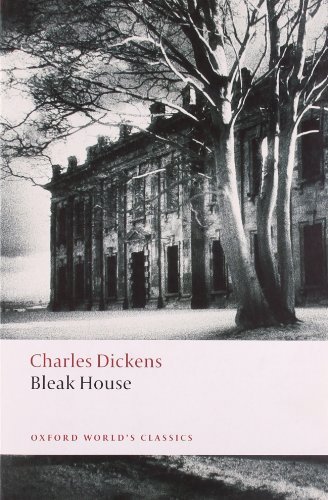
Bleak House follows the fortunes of three young people caught up in a long-running legal wrangle:

“Jarndyce and Jarndyce drones on. This scarecrow of a suit has, in course of time, become so complicated that no man alive knows what it means. The parties to it understand it least, but it has been observed that no two Chancery lawyers can talk about it for five minutes without coming to a total disagreement as to all the premises. Innumerable children have been born into the cause; innumerable young people have married into it; innumerable old people have died out of it.”

Esther Summerson, Ada Clare and Richard Carstone find themselves under the guardianship of John Jarndyce, a benevolent older distant relation of the latter two. Ada and Richard fall in love, but it is Esther rather than the young lovers who is the focus, her first-person narration alternating with that of an omniscient narrator.

She is from a mysterious background, not knowing who her parents are and raised by an abusive godmother. “Your mother, Esther, is your disgrace, and you were hers”. Esther is a Victorian heroine though, so rather than becoming defensive or angry, she decides she will:

“strive as I grew up to be industrious, contented, and kind-hearted and to do some good to some one, and win some love to myself if I could. I hope it is not self-indulgent to shed these tears as I think of it. I am very thankful, I am very cheerful, but I cannot quite help their coming to my eyes.”

Although tediously self-deprecating at times, generally I found Esther really likable. Her narrative is can be witty and some of her portraits of others almost sharp, so I did wonder if the reader wasn’t supposed to take her modest protestations entirely at face value, at least not consistently.

The omniscient narrator widens the tale to explain the various legal dealings of Chancery Lane and all its hangers-on, alongside the situation of the Dedlock family:

“there is no end to the Dedlocks, whose family greatness seems to consist in their never having done anything to distinguish themselves for seven hundred years.”

The current incumbent Sir Leicester Dedlock does little to change this history of his family as he “is generally in a complacent state, and rarely bored. When he has nothing else to do, he can always contemplate his own greatness. It is a considerable advantage to a man to have so inexhaustible a subject. After reading his letters, he leans back in his corner of the carriage and generally reviews his importance to society.”

He is devoted to his beautiful, fashionable, remote wife Honoria, who the reader quickly realises has A Big Secret in Her Past. Hmm, based on what we know of the other characters so far, what on earth could it be…?  

It’s not hard to guess what it is as the clues are laid on pretty thickly, and I thought the imagery when Esther first sees Lady Dedlock was so striking:

“It was easy to know that the ceremonious, gouty, grey-haired gentleman, the only other occupant of the great pew, was Sir Leicester Dedlock, and that the lady was Lady Dedlock. But why her face should be, in a confused way, like a broken glass to me, in which I saw scraps of old remembrances, and why I should be so fluttered and troubled (for I was still) by having casually met her eyes, I could not think.”

Dickens weaves together the various strands of the story, the main plots and all the subplots with brilliant dexterity. Sometimes with these big Victorian baggy monsters (to steal a phrase from Henry James) the stories can flag a bit, as the authors are trying to keep them going for a number of episodes in the serial. I really didn’t feel this with Bleak House. The story kept driving forward and all the various plots came together so cleverly, contriving to make a well-paced page-turner.

What really struck me about Bleak House though, is that it is a story of great compassion. Of course I knew Dickens had a strong social conscience and his work has a social message to it. But Bleak House demonstrated a degree of understanding and sympathy that I wasn’t expecting. Unmarried mothers, those struggling with addictions, human weakness and vulnerability – none are judged. Those who are judged are the ones who seek to profit from such.

Which brings me on to Mr Tulkinghorn… I said at the beginning I’m not usually keen on Dickens’ villains, finding them too caricatured. The lawyer Tulkinghorn was medacious, conniving, cold as ice, completely believable and completely terrifying. Truly villainous.

Although there are romantic elements to Bleak House, it is not an overly romantic tale. It is a novel much more concerned with the fall-out on the vulnerable members of society from immovable and self-serving institutions. Perhaps the main way in which the novel has dated is an engagement that seemed highly questionable to me, but as it remains chaste and ultimately everyone comes to their senses, it didn’t overly offend my modern sensibilities 😀

If I’ve made Bleak House sound a heavy read though, I’ve done it a disservice. I found it very often funny, whether satirically critiquing the legal system or broader nonsense like Mrs Guppy trying to throw John Jarndyce out of his own home and resisting all attempts to explain the illogicality of such a move. It has its sad moments too, and is genuinely moving in places.

And just in case a Victorian novel may seem to have no relevance to our modern world, I leave you with this exchange between Esther and Miss Flite:

“I said it was not the custom in England to confer titles on men distinguished by peaceful services, however good and great, unless occasionally when they consisted of the accumulation of some very large amount of money.

“Why, good gracious,” said Miss Flite, “how can you say that? Surely you know, my dear, that all the greatest ornaments of England in knowledge, imagination, active humanity, and improvement of every sort are added to its nobility! Look round you, my dear, and consider. YOU must be rambling a little now, I think, if you don’t know that this is the great reason why titles will always last in the land!”

I am afraid she believed what she said, for there were moments when she was very mad indeed.”

This is an excessively long post and I’ve barely scratched the surface of Bleak House. But in summary: funny, sad, socially engaged, well-paced, emotionally affecting, entertaining, original. An absolute masterpiece.

To end, I remember watching the BBC adaptation of Bleak House when it came out and thinking it very well done. Now I’ve read the book I might go for a rewatch, as I don’t remember it that well and it does look entertaining (especially Charles Dance as Tulkinghorn):

Novella a Day in May 2020 #27

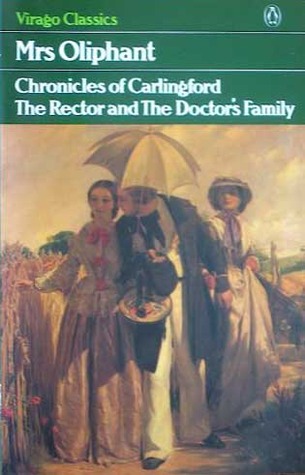
The Doctor’s Family – Margaret Oliphant (1863) 153 pages

Halfway through the final week of NADIM 2020 and for the first time this month it’s feeling do-able! I don’t want to tempt fate (especially as I’m changing broadband providers this week) but I’m hopeful I might actually complete a novella for every day…

After the brutality of First Love yesterday, I thought I’d take refuge in Victorian gentility. Also, I thought it would make a change from my resolutely twentieth and twenty-first century choices this month. The Doctor’s Family takes place in the fictional town of Carlingford, a setting Margaret Oliphant revisited in four subsequent novels as well as the short story The Rector, which was included in my Virago edition.

Dr Edward Rider has come to Carlingford after his wastrel brother Fred caused him to lose his practice elsewhere. He lives:

“in the new quarter of Carlingford; had he aimed at a reputation in society he could not have done a more foolish thing; but such was not his leading motive. The young man, being but young, aimed at practice.”

Unfortunately Fred has followed him to Carlingford where he does very little except smoke pungent pipes and go out to waste money. However, Oliphant doesn’t paint Fred as evil (to my twenty-first century eyes he sounded depressed) and she doesn’t paint Dr Rider as wholly virtuous. He can be short-tempered and dismissive to his patients, more than once he takes out his anger on his horse (thankfully not dwelt on in detail but still repulsive), and he doesn’t have high ideals about his vocation, though he is a reasonable doctor. In other words, the brothers are flawed human beings each muddling through, and bound by a “strange interlacement of loathing and affection”.

His family suddenly enlarges in a way Dr Rider did not expect, when Fred’s wife, children and sister-in-law all – never alluded to by Fred – arrive from Australia. They rent a house on the outskirts of town and Dr Rider visits initially out of a sense of duty more than any affection, as Susan, Fred’s wife is petty and spiteful, and his children are feral. His sister-in-law Nettie, on the other hand, is capable and practical, and essentially runs their entire lives for them.

Again, the characterisation here is subtle. Nettie isn’t one of Dickens’ holier-than-thou self-sacrificing virgins. Rather she is a determined, independent young woman who sees what needs to be done and does it. Oliphant makes it clear that Nettie gains from the situation, that it suits her.

“Those brilliant, resolute, obstinate eyes, always with the smile of youth, incredulous of evil, lurking in them, upon her bewildered advisor. ‘I am living as I like to live.’”

Short-tempered Dr Rider develops feelings for Nettie and can’t understand how she puts up with her selfish, demanding, draining family. She is less judgemental than he is:

“She knew their faults without loving them less, or feeling it possible that faults could make any difference to those bonds of nature.”

But while the family seem settled in their slightly unconventional ways, events will conspire to change things irrevocably.

This is the first time I’ve read Margaret Oliphant and I enjoyed her immensely. I liked her flawed characters and her resistance to showing situations as morally black-and-white, which can sometimes be the case in Victorian fiction (and I’m a big fan of the period and the women writers). I read The Rector as well (but I’ve not discussed it here as it’s not a novella) and found that story lighter and wittier than The Doctor’s Family. Both together mean I’d be interested to see how Oliphant developed the inhabitants of Carlingford in later novels.

If you like Victorian social realism but can’t face the hefty tomes that genre often involves, if you like Elizabeth Gaskell’s Cranford, or if you sometimes wish George Eliot wasn’t so heavily intellectual, then a trip to Carlingford will be just perfect for you.

There are no great surprises for the reader in The Doctor’s Family; things work out exactly as you’d expect. But that is no criticism and especially in these uncertain times, it’s a perfect example of the solace to be found in reading.

“War is Peace” (George Orwell, 1984)

Of course, Orwell’s doublethink, whereby directly contradictory political messages obfuscate any sort of truth, looks completely ridiculous in this day and age…

giphy-10

(Miss you, Carrie)

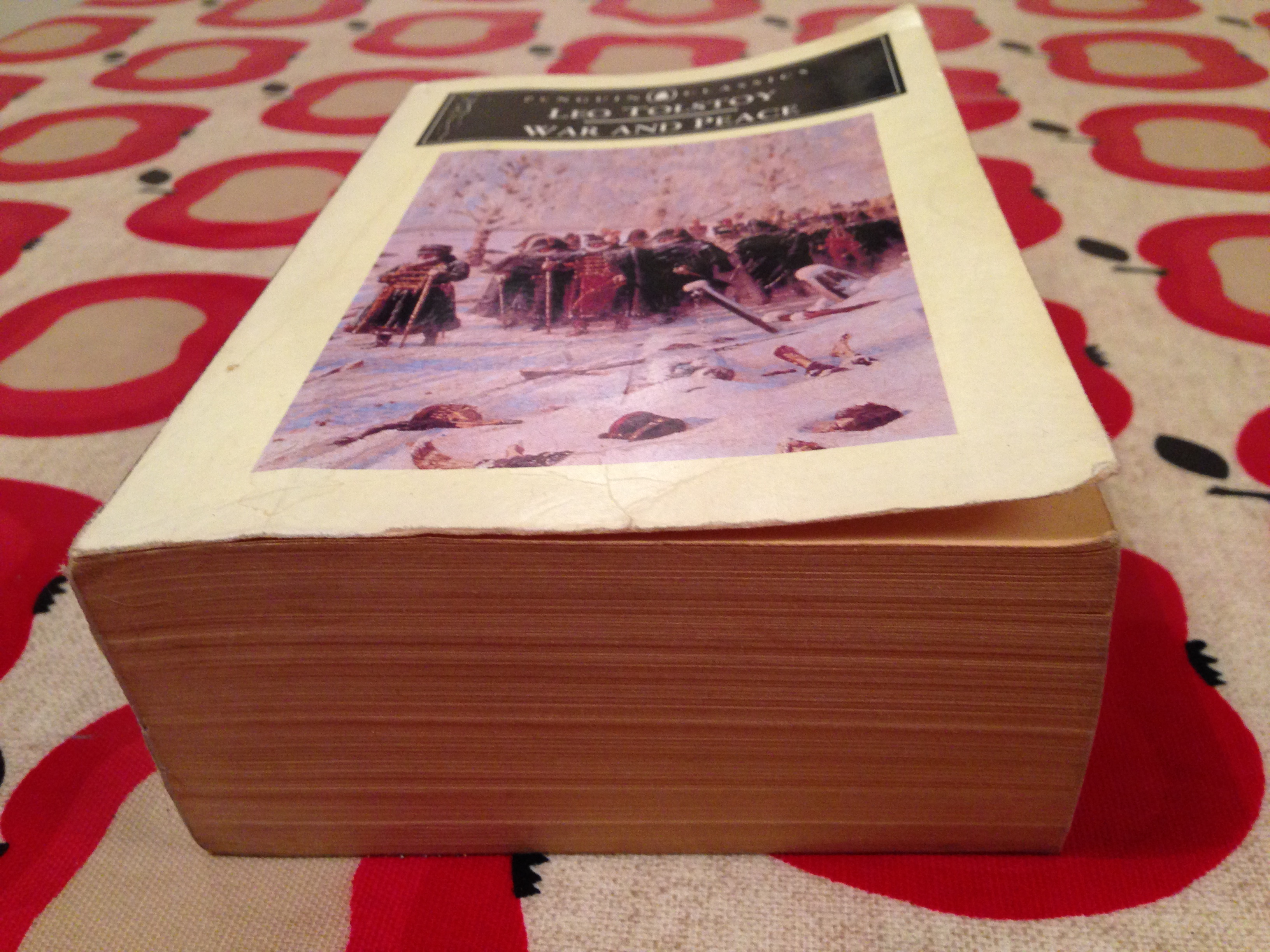
A slight departure this week Reader, as rather than two books linked by a theme, for this post its one book only. One novel which is the size of 4 novels and has tested my aversion to e-books to the extreme, as lugging it around town on my commute and various evenings out has seen my back reach a place that even the most experienced osteopath would baulk at.  Look at the size of this beast:

img_0840

It is of course, War and Peace by Leo Tolstoy (1865-8) and for once a new year’s resolution fulfilled, as I decided 2017 was going to be the year. Such an epic stretches my limited reviewing capabilities so instead I present my War and Peace reading diary.  Thrills! Spills! Intrigue! Romance! Or none of the above and instead one bibliophile risking permanent musculo-skeletal damage in the name of experiencing a cornerstone of classic literature – you decide! (Warning: this post is nearly as long as the Russian epic itself, my apologies Reader, I think Tolstoy is catching…)

Day 1

I planned to start reading War and Peace 6 days ago. One day I’ll be a disciplined person. Or possibly not.

There are 1444 pages in my Penguin edition (trans. Rosemary Edmonds, 1962-3, revised 1978). There’s a list of principal characters, which I thought was helpful until Wiki informed me that there are nearly 600 characters in this novel. The list names a full 26. What have I taken on?

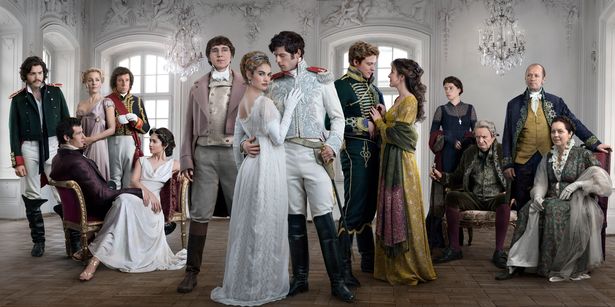
As a further incentive to get this read I decide to reward completion with the BBC adaptation which everyone seemed to rate so highly:

js79326775

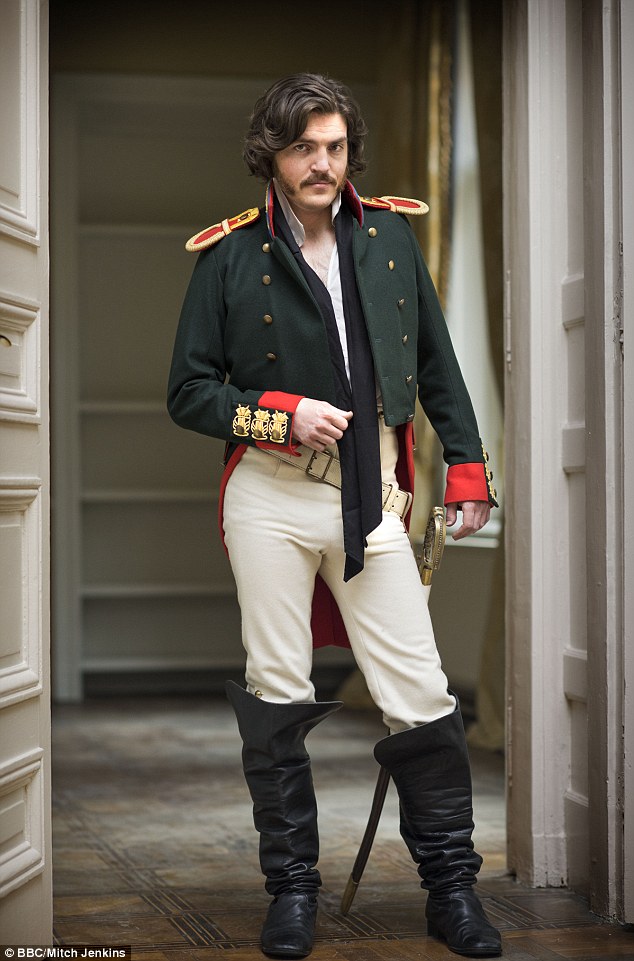
Or more specifically, I choose to reward myself with this (shameless objectification alert):

The foil blanket awaiting the end of this marathon….

The foil blanket awaiting the end of this marathon….

Images from here and here

Day one and so far I’m finding Tolstoy enjoyably cynical (so long as I forget he was horrible to his wife IRL):

“Never, never marry my dear fellow. This is my advice to you – don’t marry until you can say to yourself that you have done all you are capable of doing, and until you cease to love the woman of your choice and see her plainly, as she really is; or else you will be making a cruel and irreparable mistake. Marry when you are old and good for nothing. Otherwise everything that is fine and noble in you will be thrown away.”

And also a rival to Austen in the bitchy social commentary stakes:

They wept because they were friends, and because they were warm hearted, and because they – friends from childhood – should have to think about anything so sordid as money, and because their youth was over…But the tears of both were sweet to them.”

Both good things.

Pages read: 65 (pathetic) Pages remaining: 1379

Day 2

It’s predictably British and trite to moan about the patronymic system in Russian novels so I won’t mention the fact that I’m struggling with the fact that everyone seems to have 27 names. Instead I’ll restrict myself to sharing my frustration that three – three! –  principal characters are called Nikolai and the narrator refers to ‘the princess’ when there’s more than one princess in the room.

These quibbles aside – I’m hooked. War and Peace is completely brilliant.

Total pages read: 204 (better) Pages remaining: 1240

Days 3 – 5

War and Peace should come with a health warning: will induce antisocial behaviour. I’m really annoyed that social engagements arranged BWP (Before War and Peace) are taking me away from my reading time. I look up at the end of my commute disappointed that no-one around me looks even vaguely Cossack-like and apparently we’re no longer at war with Napoleon.

The peace sections are full of astute observations about socially mannered manipulations:

 “Weierother met all objections with a firm and contemptuous smile that was evidently prepared beforehand against any piece of criticism, whatever it might be.”

We’re also getting more into the psychology of soldiering and war, which is bleak and depressing, such as Andrei’s attitude to his loved ones:

“ ‘All the same, the only thing I love and prize is triumph over all of them. I care for nothing but this mysterious power and glory which I seem to feel in the haze that hangs above my head’ ”

Tolstoy is astonishing. Maybe no-one mentions his wit because his psychological insights are so devastating.

Total pages read: 404 (rubbish – stupid social life) Pages remaining: 1040

Day 6 – 7

Is it wrong that manipulative, destructive, serial seducer Dolokhov is my favourite character? (Answer: yes.) I know I should prefer sweet Pierre: “Moscow gave him the sensation of peace and warmth that one has in an old and dirty dressing gown”

or noble Andrei “the chief reason for his wanting to weep was a sudden acute sense of the terrible contrast between something infinitely great and illimitable existing within him and the narrow material something which he, even she, was.”

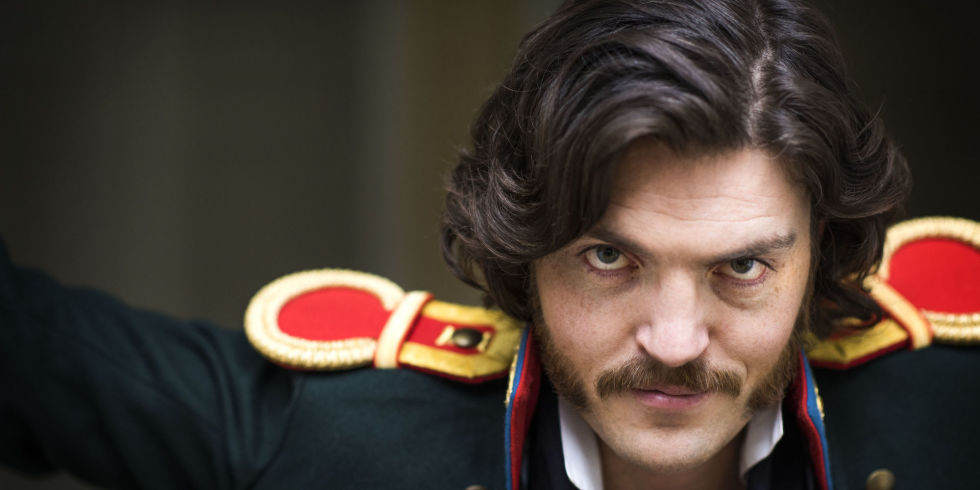
But who are they to this one-man dirty bomb blasting his way through the drawing rooms of Moscow? I wonder who plays him in the BBC adaptation?

I doff my hat to you, BBC casting director.

I doff my hat to you, BBC casting director.

Image from here

Bitchy social commentary of the day: “He believed that just as a duck is so created that it must live in water, so he was created by God for the purpose of spending thirty thousand roubles a year and occupying the highest pinnacle of society. He was so firmly grounded in this opinion that others, looking at him, were persuaded of it too, and refused him neither the exalted position in society nor the money, which he borrowed right and left with no notion of ever repaying it.”

Total pages read: 702 Pages remaining: 742 (managed to catch up to my goal of 100 pages a day). Nearly halfway!

Day 8

War! What is it good for?

“The forces of Western Europe crossed the frontiers of Russia, and war began: in other words, an event took place to counter all the laws of human reason and human nature. Millions of men perpetuated against one another such innumerable crimes, deceptions, treacheries, robberies, forgeries, issues of false monies, depredations, incendiarisms and murders as the annals of all the courts of justice in the world could not muster in the course of whole centuries, but which those who committed them did not at the time regards as crimes.”

Absolutely nothing. Say it again, y’all.

Total pages read: 864 Pages remaining: 580

Day 9

The serious tone continues, with the bitchy social commentary sadly no more, but it does sharpen the focus on the horrors of war and the psychological fallout on the characters.

 “behind the veil of smoke the sun still stood high, and in front… a turmoil still seethed in the smoke, and the thunder of canon and musketry, far from slackening, grew louder and more desperate, like a man who puts all his remaining strength into one final cry”

A man sat next to me on my commute today sporting an enormous white beard and a Cossack hat. He has no idea how happy he made me.

Total pages read: 1006 Pages remaining: 438

Day 10 -11

The final stretch! I can’t say too much about what I’m reading for fear of spoilers.

Instead I’ll just say that I’ll be sorry to see it go, and frankly, I wonder if Tolstoy could have made it a bit longer.

Although I do think most editors today would try and dissuade authors from ending a 1400+ page novel with an abandonment of all narrative for a 40 page philosophical discussion on the nature of power and freewill…

Total pages read: 1444 Pages remaining: none!

So that’s me done, and I can’t quite believe it. There will be no stopping me now from reading other epics which have lain languishing in my TBR. Next: Ulysses! Infinite Jest! The Count of Monte Cristo! A different translation of War and Peace! I think I need a little lie down…

“Now is the accepted time to make your regular annual good resolutions. Next week you can begin paving hell with them as usual.” (Mark Twain)

Happy 2016! How are your New Year’s resolutions going? I excelled myself this time around, by abandoning mine before I’d even begun.  My internal monologue went thusly:

“I’m going to not buy any more books until I’ve read all those I already own.

… except playtexts (they’re so small they barely count).

…and Persephones.

…and green Viragos.

…and anything else that I really, really want.”

*Sigh* Useless. Even Paul Newman has lost all faith in me.

GIF-give-up-look-down-Paul-Newman-resigned-sad-GIF

OK, so that was just an excuse to put a picture of Paul Newman in the post and if we’ve learnt one thing, it’s that I am incapable of exercising any sort of self-control, especially regarding books and gifs, and cheese, and single malts, and watching inane  detective shows, and…..

So if you are a fellow willpower-free zone, I have an answer for you. Surround yourself with people who are worse than you in some way, and you’ll realise you’re not so bad after all. Now is not the time for aspirations, it is a time for resignation and another fistful of chocolates 🙂  This week I thought I’d look at anti-heroes, and two characters who will make you feel like the most virtuous person alive.

Firstly, Tom Ripley in The Talented Mr Ripley by Patricia Highsmith (1955).

Matt Damon as Tom Ripley in the 1999 film

Matt Damon as Tom Ripley in the 1999 film

 Tom Ripley is approached by the father of an acquaintance in a bar, who has mistaken him for a decent human being:

“Judging [Tom] from that night, Charley could have told Mr Greenleaf that he was intelligent, level-headed, scrupulously honest, and very willing to do a favour. It was a slight error.”

An understatement to say the least. Tom agrees to go to Europe to try and persuade the prodigal son, Dickie Greenleaf, to return home and join the family business, not for any altruistic reason but because he’s worried a petty scam he’s been running is catching up with him. Dickie is a golden boy, rich, idle and good-looking :

“Tom could not help feeling that Richard was not very intelligent, or else he loved to be photographed and he thought he looked best with his mouth spread from ear to ear, which was not very intelligent of him, either.”

Tom becomes obsessed with Dickie, wanting to be all that he is and have all he has:

“Possessions reminded him that he existed, and made him enjoy his existence. It was as simple as that. And wasn’t that worth something? He existed.”

Tom’s slippery notion of himself, identity and existence is the driving force of the novel as he dissolves the boundaries between him and Dickie, eventually *SPOILER* killing him and stealing his identity.  The remainder of the novel sees him dodging authorities and Dickie’s friends, spinning lies and manipulating everyone in his path: “He was himself and yet not himself. He felt blameless and free, despite the fact that he consciously controlled every move he made.”

Tom is a sociopath of course, and the real strength of the novel lies in the study of his character rather than the thriller elements, well done as they are.  It is Tom’s character that spawned four sequels and really gets under your skin; as a reader I felt drawn in by him, creating a weird ambivalence through empathy and disgust.  Tom is a powerful but sad character – he knows something is missing in him, something that makes him entirely alone:

“It struck Tom like a horrible truth, true for all time, true for the people he had known in the past and for those he would know in the future: each had stood and would stand before him, and he would know time and time again that he would never know them and the worst was that there would always be the illusion, for a time, that he did know them, that he and they were in complete harmony and were alike.”

The Anthony Minghella film adaptation of The Talented Mr Ripley is widely known, but I also recommend a French adaptation from 1960, Plein Soleil starring an unnervingly beautiful Alain Delon as Ripley:

Secondly, Joe Lampton in Room at the Top by John Braine (1957).

Laurence Harvey as Joe Lampton in the 1959 film

Laurence Harvey as Joe Lampton in the 1959 film

I expected this story of social climbing to have dated but surprisingly, it wasn’t so. The references to northern mill towns being a hive of industry is sadly past and the rigid social classes, worry over a relationship’s ten year age gap and Joe’s lover’s concern that she is ancient at the ripe old age of 34, seem less relevant. However, as a portrayal of greed for material acquisition and the mistaking of such as being a purposeful life, Room at the Top is as incisive as ever.

Joe leaves the poverty of his home town of Dufton to move to the more prosperous Warley:

“I was going to the Top, into a world that even from my first glimpses filled me with excitement: big houses with drives and orchards and manicured hedges, a prepatory school to which the boys would soon return from adventures in Brittany and Brazil and India or at the very least an old castle in Cornwall, expensive cars – Bentleys, Lagondas, Daimlers, Jaguars –parked everywhere as a kind of ostentatious litter as if the district had dropped them at random as evidences of its wealth”

Joe rooms at the top of one of the large houses, takes a job at the local town hall, but has ambitions far beyond his current circumstances:

“I saw myself, compared with him, as the Town Hall Clerk, the subordinate pen-pusher…I wanted an Aston-Martin, I wanted a three-guinea linen shirt, I wanted a girl with a Riviera suntan – these were my rights, I felt, a signed and sealed legacy.”

Joe joins the local am-dram society and is drawn to young, rich Susan: “I’ll marry her if I have to put her in the family way to do it. I’ll make her daddy give me a damned good job. I’ll never count pennies again.” Thus begins a double life, one where he is with Susan, determinedly climbing the slippery pole, “I was manoeuvring for position all the time, noting the effect of each word; and it seemed to devalue everything I said” and one where he is with Alice, his older lover, able to be authentically himself.

Joe is an intriguing character, utterly reprehensible in his machinations but painfully self-aware and never self-justifying: he wants what he wants and he sets out to get it. There is no sense that he is any better or any worse than those who surround him, and so Room at the Top, while an intimate portrait of one man, is also a damning portrait of post-war society.  I didn’t wholly dislike Joe, but  Braine doesn’t shy away from the emotional fall-out of using people in this way and we are not expected to excuse Joe’s behaviour.

 “I felt choked with my own selfishness as nasty as catarrh; there was nothing in my heart to match the lovely sweep of the moor and the sense of infinite space behind it and a million extra stars above.”

Joe’s punishment is a terrible one: he gets everything he wants.

Room at the Top was a huge success and quickly adapted into a similarly successful film with Simone Signoret winning an Oscar for her portrayal of Alice:

https://www.youtube.com/watch?v=EH8mKDs2Q1Y

So take it from me, Tom Ripley and Joe Lampton: even if you’ve failed in all your New Year resolutions, you’re doing OK 🙂