Novella a Day in May 2023 – No.20

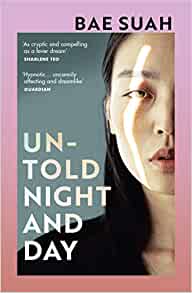
Untold Night and Day – Bae Suah (2013 trans. Deborah Smith 2020) 152 pages

When I see writing described as dreamlike, I often think of highly metaphorical language, perhaps with a heavy emphasis on sensory experience, and with an unreal quality. Untold Night and Day is definitely dreamlike, but not quite in the ways I’ve described.

It initially seems very much grounded in everyday experiences. Where it becomes dreamlike is that it follows its own logic, jumping about with recurring motifs, in a way that makes sense within itself but becomes more disconcerting the more you consider it.

“A man carrying a kitten in a birdcage pressed himself against the opposite wall of the alley to avoid her car. He was a preacher, a well-known figure in this alley; he went around surreptitiously stuffing pieces of paper bearing Bible verses into people’s pockets, so he’d been mistaken for a pickpocket and arrested more than once. While she waited for the lights to change at the end of the alley, the woman driving the green car took her hand off the wheel and raised a bottle of water to her lips. Still with the phone to her ear. Against the regular growl of the engine, the hum of the air conditioning.”

These images and characters recur throughout the novella, each time with their context slightly shifted. There are other repeated motifs, including to The Blind Owl, a deeply disturbing novella which I read back in 2019. The shifting repetitions unsettle the story but also ground it in its own world.

Ayami is a former actor who works at an audio theatre. We join her at the end of her last shift, in the oppressive heat of Seoul, where through the night she and her boss search for their missing friend Yeoni. The following day, she shows round a German writer who never wanted to be in Korea in the first place.

The two times echo each other and almost merge, but whenever the narrative almost seems on the verge of entirely disintegrating, it holds on to that interior logic and somehow pulls you along, trying to work out what is happening and where Yeoni could be.

“That was the secret of night and day existing simultaneously. Ayami discovered this through a single movement, bending down to pick up the pebble. And, remembering this simultaneous existence more vividly than she remembered herself, became unable to remember anything else.”

I realise this may be an entirely unhelpful review as I’ve not really said very much! But hopefully I’ve given a sense of why this novella is hard to describe and hard to review. I enjoyed it, but definitely not one to read when you’re in the mood for a linear plot and all questions answered at the end…

“I have to record whatever comes into my head in the same place it happens. Things occur to me as images, and as forms, not as words arranged into sentences. The images quickly dissipate after the moment’s passed, and once that happens there’s no way for me to capture them in language.”
Novella a Day in May 2023 – No.3

Lemon – Kwon Yeo-sun (2019 trans. Janet Hong Higgins  2021) 147 pages

I thought the cover of Lemon was absolutely perfect. The simple image of an absent woman suspended in sky strikingly captures the unsettling quality of this story about a murdered young woman.

Lemon is not a whodunit, although I think that central question is answered obliquely. There is no satisfying resolution with all the ends tide up neatly – that is not what this novella is about. Rather, it is about people struggling to find a way through life when it has been touched by a violent crime. It is about how to try and find peace when there are no easy answers.

The murder of 19-year-old Kim Hae-on in 2002 shocks the local community. The killer is not found, despite two local boys being suspected. Predictable tabloid sensationalism means it becomes known as the High School Beauty Murder, as Kim Hae-on was strikingly beautiful and somewhat unknowable. Yet beyond the cliches lies a life taken and a grieving family.

The various chapters in Lemon have different narrators between 2002 and 2019. It begins with Hae-on’s younger sister Da-on, struggling to understand who she is in the wake of her sister’s killing.

“Does this mean I’m still not free? That I’m not free, not one iota, from those smooth, fair, irrelevant details from 16 years ago, those endless memories of my sister’s loveliness, which had made me undergo plastic surgery, turning my own face into a crude patchwork of her features?”

We gain perspective on Da-on from the memories of a classmate, Sanghui:

“Da-on, the younger sister, was the one who looked after Hae-on, as one would after a little sister. She’d stop her big sister on the street before they reached the school gate and then circle her examining the front and back of her uniform to make sure nothing was out of place.”

[..]

“Then you could witness the older sister fleeing gracefully down the hall or across the school field with her long lithe limbs, while the younger one raced shrieking after her, like some wild animal. They seem never failed to give both teachers and students a good laugh. That was Da-on’s gift. She had a lively, bubbly kind of warmth that could pull Hae-ons devastating, otherworldly, even glacial, beauty into our reality, dissolving it in laughter.”

We learn later on that there was a clear reason for this protectiveness. Hae-on seemed unaware of the modesty expected in society and could forget to wear underwear, sitting in a way that exposed this. Da-on would try to ensure this didn’t happen but the external misreading of this behaviour probably played a part in her sister’s disappearance. There is never any sense of victim-blaming from any of the narrators in Lemon, with one exception and the reader is clearly not expected to align with those views.

More details of the day of the murder emerge through the shifting views, bound up in the lives that continued beyond. There is real sadness here, particularly in the grief of Hae-on’s immediate family and also for Han Manu, one of the suspects.

There is a haunting quality in Lemon. It is never so crass as to make the murder of a young woman anything other than it is; it is not gory entertainment nor is it made easier through a suggestion of any sort of metaphysicality. But by capturing the  fallout of the violence onto the everyday lives of those who knew Hae-on, Kwon Yeo-sun expertly demonstrates the ongoing destructiveness of a life taken.

“It will go on endlessly, until the end of Da-on’s life, or maybe beyond that. Not being able to put an end to an incident so horrific – I couldn’t begin to imagine that kind of weight on her life.”

Novella a Day in May 2023 – No.2

Winter in Sokcho – Elisa Shua Dusapin (2016 trans. Aneesa Abbas Higgins  2020) 154 pages

Day 2 and I’m delighted that yesterday Simon at Stuck in a Book posted that he’ll be joining me with his #ABookaDayinMay, surely adding many more titles to my TBR mountain 🙂

The narrative voice in Winter in Sokcho is an intriguing one: detached yet painfully intimate, ambiguous yet pragmatically clear. A nameless young woman records what happens to her, but it is up to the reader to decipher the meaning.

She works in a hotel in out of season Sokcho, a coastal tourist town sixty kilometres south of the border with North Korea. It is not a glamorous hotel even in peak season:

“Orange and green corridors, lit by blueish light bulbs. Old Park hadn’t moved on from the days after the war, when guests were lured like squids to their nets, dazzled by strings of blinking lights.”

“I loved this coastline, scarred as it was by the line of electrified barbed wire fencing along the shore.”

A guest arrives at the hotel, a French graphic novelist named Kerrand. Slowly he and the woman form a bond that is never quite articulated. It could be sexual. It could be father/daughter (her absent father is French too). He wants her to show him the area as she knows it, but it is a flawed premise from the start:

“He’d never understand what Sokcho was like. You had to be born here, live through the winters. The smells, the octopus. The isolation.”

The isolation both geographical and individual lends the story a bleakness that verges on Gothic, despite all the neon lights. A trip to the border is downright eerie; the other guest in the hotel is permanently swathed in bandages as she recovers from cosmetic surgery.

The pressures on women and their appearance bear heavily on the narrator. Her mother chastises her for eating too little, and she seems to have body dysmorphia/an eating disorder. Her boyfriend leaves for Seoul for a modelling career, casually accepting he’ll undertake facial surgery if that is what is needed for work, and urging her to do the same.

Like so much else in her life, she seems to feel somewhat detached from her boyfriend. There is a sense of everything in her life being a step removed. She has no friends, her mother is suffocating yet pitable and distances with her need to be carefully managed. The narrator speaks with Kerrand in English despite her French being more fluent.  

As her involvement with Kerrand grows, she feels an ambivalence around his drawings of women, which never make it into his published work:

“In bed later, I heard the pen scratching. I pinned myself against the thin wall. An gnawing sound,  irritating. Working its way under my skin. Stopping and starting. I pictured Kerrand, his fingers scurrying like spiders legs, his eyes travelling up, scrutinising the model, looking down at the paper again, looking back up to make sure his pen conveyed the truth of his vision, to keep her from vanishing while he traced the lines.”

This ambivalence moves towards an ending that is wholly ambiguous. It could be read several ways and I remain unsure as to what I think happened. This isn’t remotely unsatisfying but entirely apt. Winter in Sokcho is a compelling exploration of the unknown: in ourselves, in others, and in the forces of history we all live with. How we reconcile ourselves to this is for the individual to discover. I think the narrator did find a way, I’m just not sure what it was…

“You may have had your wars, I’m sure there are scars on your beaches, but that’s all in the past. Our beaches are still waiting for the end of a war that’s been going on for so long people have stopped believing it’s real. They build hotels, put up neon signs, but it’s all fake, we’re on a knife-edge, it could all give way at any moment.”