My last post was about a romantically-involved couple for Valentine’s Day; this week I thought I’d look at a single person status much distrusted throughout literature: that of the spinster. Both my spinsters are inhabitants of beautiful Bristol, which I’d like to claim was down to well thought-through post-planning on my part, but was actually a total coincidence.

My first choice is the wonderful Miss Mole, titular heroine of the 1930 novel by EH Young. Hannah is in her late thirties, alone and shabby and the envy of no-one, yet she is a robust character who finds ways to survive and even enjoy life.
“She judged herself by the shadow she chose to project for her own pleasure and it was her business in life – and one in which she usually failed – to make other people accept her creation. Yes, she failed, she failed! They would not look at the beautiful, the valuable Hannah Mole: they saw the substance and disapproved of it and she did not blame them: it was what she would have done herself and in the one case where she had concentrated on the fine shadow presented to her, she had been mistaken.”
She is not delusional, rather she refuses to see herself as others see her -and why should she?
“This capacity for waiting and believing that the good things were surely approaching had served Hannah very well through a life which most people would have found dull and disappointing. She refused to see it so: it would have been treachery to herself. Her life was almost her only possession and she was as tender with it as a mother”
There is a strong streak of mischief in Hannah Mole too, and she enjoys teasing her well-to-do cousin Lilla, who finds her a job as a housekeeper to the reverend Robert Corder and his daughters Ethel and Ruth. This is not a remotely romantic set-up though. Corder is good at his job but he is also vain and self-centred, and enjoys his position in society because it means few people challenge him. Hannah sees him unblinkingly, and he does not like her.
“it would have horrified him to learn that he could not judge a clever or plain woman fairly. A clever one challenged him to combat in which he might not be the victor and a plain one roused in him a primitive antagonism. In failing to please him, a woman virtually denied her sex and became offensive to those instincts which he did his best to ignore.”
Hannah decides to improve things for his unhappy daughters, and feels a bond with his dead wife as she sets out to do so. She will manage things successfully, but in her own inimitable way:
“Hannah was not scrupulous about truth. She was not convinced of its positive value as human beings knew it, she considered it a limiting and an embarrassing convention.”
Hannah is realistic, but also hopeful and not remotely self-pitying. We also learn early on that she is brave, rescuing a suicidal man by smashing a window. She and a fellow tenant in her boarding house, Mr Blenkinsop, conspire to improve things for the man’s family, despite appearing to communicate at cross-purposes a great deal of the time. As she makes things work out for those around her, I really wanted things to work out for Hannah too, despite a shadow from her past looming – I think I viewed her with more compassion than she allowed herself:
“The desires, the energy, the gaiety were there, but they were ruled by an ironic conception of herself”
I really enjoyed spending time with Miss Mole. It’s a gentle novel, but it also doesn’t hide away from the realities of life for single women who are no longer young and without much money in the first half of the twentieth century, and how a judgemental society limits their choices.
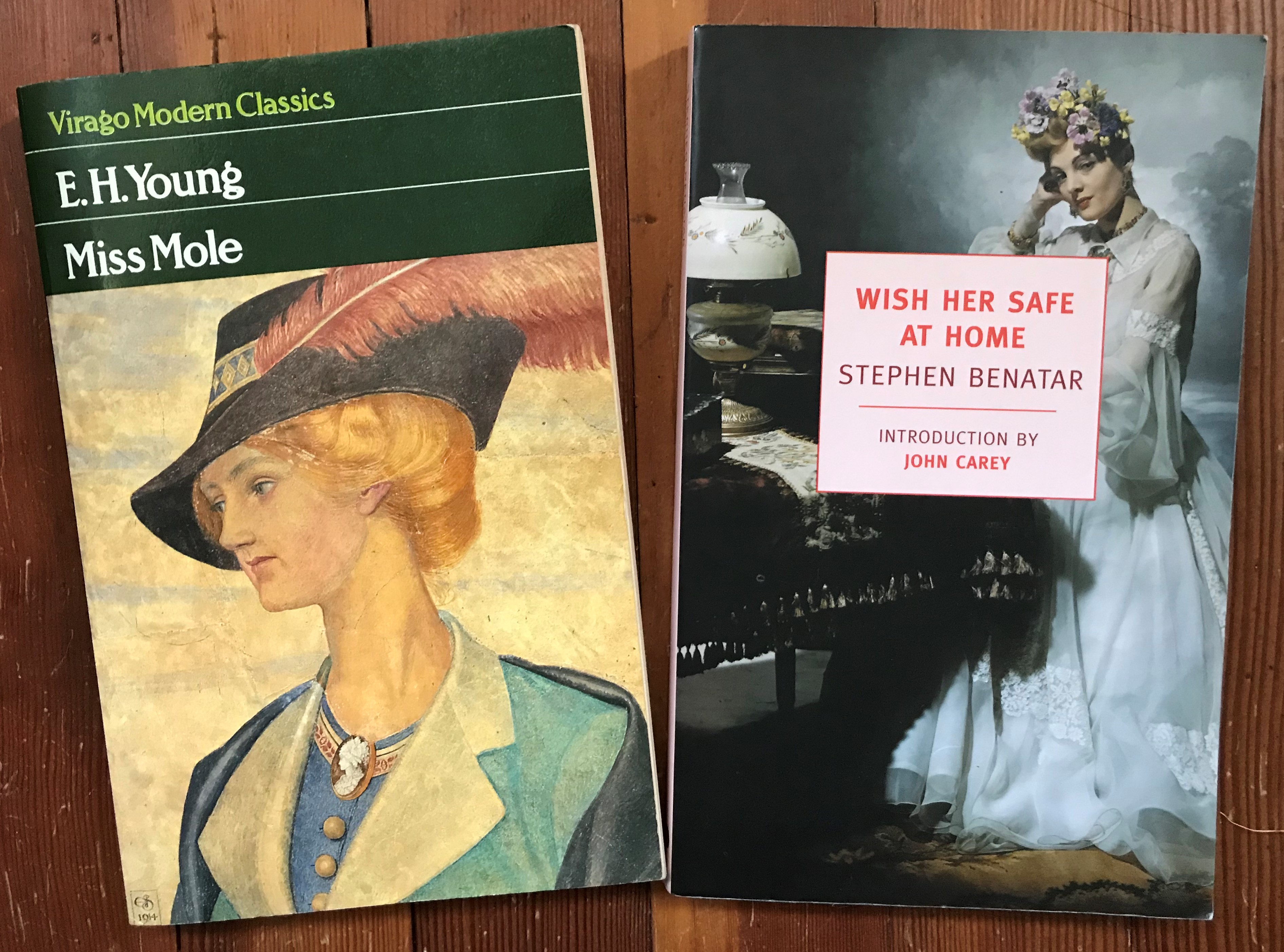
Secondly, a spinster who would probably have done better without much money, Rachel Waring in Wish Her Safe at Home by Stephen Benatar (1982). Rachel is in her late 40s with a boring job and a flatshare in London. Then her Great Aunt Alicia dies and leaves her a house in Bristol, and everything changes.
“And the hitherto dull, diffident, middle-aged woman who said to the taxi driver ‘Paddington please,’ felt in some respects more like a girl of seventeen setting out for exotic climes”
Rachel moves into the house and is determined to make the best of this fresh start:
“I had often discovered the secret of happiness: courage on one occasion, acceptance on another, gratitude on a third. But this time there was rightness to it – certainty, simplicity – which in the past mightn’t have seemed quite so all-embracing. Gaiety, I told myself. Vivacity. Positive thinking. I could have cheered.”
Gradually however, this vivacity spills over into something more. She becomes obsessed with the slave trade reformer Horatio Gavin who lived in her house centuries ago. She sees a portrait in a shop she believes to be him:
“I saw the portrait in the window.
I laughed out loud. I laughed right there, standing on the pavement, a spontaneous burst of laughter that was partly the effect of my ecstatic recognition of him and partly an aid to his more sober recognition of me”
Wish Her Safe At Home details Rachel’s descent into serious mental illness. It is brilliantly done. Rachel begins as eccentric and gradually becomes truly unwell. The description of seeing the portrait is a perfect example. Most of us at some point have lost our filter in public: suddenly laughing at something remembered, or saying something out loud which we didn’t mean to. There are often experiences that we believe to be serendipitous for one reason or another. But Rachel suddenly takes this experience a step further in believing the portrait recognises her.
A novel from the first-person perspective of someone who is losing their mind is a tough read. I found it really got under my skin, more than any novel I’ve read in a long time. The first-person perspective also works brilliantly in positioning the reader in a place not exactly like Rachel’s, but certainly confused and paranoid on her behalf. There is a young couple, Roger and Celia who seem to like Rachel – why? Are they after her house? Do they feel sorry for her? Are they playing her from the start? Are they completely oblivious? Rachel’s unreliable narration means we cannot be sure.
“I don’t know when the following dialogue took place. Somehow it seems cut adrift from time, like a rowboat quietly loosened from its moorings, while its occupant, entranced, oblivious to each hill or field or willow tree upon her way lies whitely gleaming in her rose embroidered silk, trailing a graceful hand and sweetly carolling beneath a canopy of green”
That passage is meant to be overblown: Rachel is such a desperate character. Her delusions are romantic and an attempt to grasp a life so far half-lived, before it is too late. There’s nothing vindictive or cruel in her, and she is so incredibly vulnerable.
“Sometimes I felt utterly convinced I had been singled out for glory.
But not always. Far more often I felt I simply didn’t stand a chance”
I’ve not remotely done justice to the power, skill and subtlety of Wish Her Safe At Home. All I can say is: read it.
To end, the trailer for the film that apparently inspired Wish Her Safe at Home. The Ghost and Mrs Muir has had a special place in my heart since childhood. In all the times I’ve seen it, it’s never occurred to me that Mrs Muir is mentally ill. Wish Her Safe at Home has made me question everything…
 madame bibi lophile recommends