This is my second contribution to AusReading Month 2023 hosted by Brona at This Reading Life.
Trigger warning: mentions physical and psychogical violence; domestic violence and gaslighting.

I absolutely loved Evie Wyld’s first two novels, After the Fire, A Still Small Voice (which was set in Queensland) and All the Birds, Singing (which was set in Scotland and Australia and won the Miles Franklin Award). Despite this I was slow to pick up her third novel The Bass Rock (2020) which won the Stella Prize in 2021, so I’m really glad this reading event finally prompted me to get to it. Evie Wyld was born in London and lives there now, after growing up on her grandparents’ farm in New South Wales; her wiki entry describes her as an Anglo-Australian author.
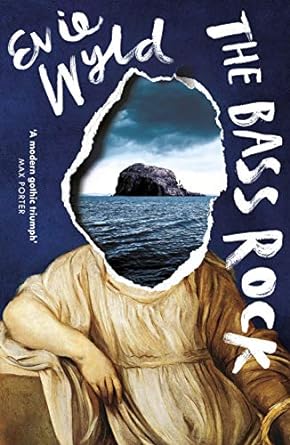
The Bass Rock is mainly set in North Berwick in Scotland, the titular rock being in Firth of Forth (there’s a great picture of the Bass Rock accompanying this Guardian review here), and across three different timelines. My heart always sinks at multiple timeline novels – usually one of the strands is far more compelling than the rest and I find myself whizzing through sections to get back to the one I’m enjoying most. But Wyld balanced all her elements expertly: formally through structure, and informally as they echoed one another while maintaining coherent yet distinct voices.
The contemporary strand is told in the first person by Viv. She is feeling entirely adrift after the death of her father and has had to spend some time as an inpatient being treated for her mental health. Now she is occupied trying to catalogue the possessions of her grandmother and great-aunt, with limited success.
“If I eat the cruciferous vegetables and cream the disgusting leg I would feel better and I would look better and I would be better. I scratch my leg through my tights until I feel the satisfactory glow of broken skin.”
In the second strand, we meet Ruth who, in the aftermath of the Second World War, has married Patrick. He is a widower with two young sons, Michael and Christopher, and has moved Ruth .to North Berwick. She is trying to find her place there, somewhat hindered by the fact that Patrick is barely ever at home. Instead, Ruth’s mainstay is her housekeeper Betty.
Finally, there is a strand told in the first person from the point of view of an eighteenth-century young man, about a woman called Sarah fleeing towards North Berwick after she is accused of witchcraft. This I thought was the least compelling narrative, but I think that was a deliberate choice. The Bass Rock is not about what men think. It is about what they do, and how too often that can involve violence towards women.
The Bass Rock really got under my skin. Its themes are domestic violence, societal violence, gaslighting and abuse. Through the different stories of these women across the ages, Wyld demonstrates how society both implicitly and explicitly condones and perpetrates this.
As Betty summarises to Ruth: “‘Men do these things and then they take on with their lives as though it’s all part and parcel.’ She placed the knife back on the table, laced her small fingers together and caged them over her knee.”
Or as Ruth’s sister Alice pragmatically observes: “’And in order to be able to enjoy your life there are certain things that one has to accept. It’s not being deluded, I won’t have that – it’s seeing things for what they really are, and buggering on until eventually the penny drops and you find yourself living a very fruitful life partly with them but partly with yourself. And the great thing is, they almost always die first.’”
Undoubtedly this novel is a tough read. I think what Wyld did brilliantly was show the insidious, everyday nature of so much abuse and how it is sustained. There is a particularly terrifying scene – ordinary, familial – demonstrating how ‘reasonable’ abusive men collude together to protect their own interests as part of the power structures that serve them so well, and fail women and children.
Wyld makes a great case for trusting your gut: Viv and her sister are on a train, pursued by a violent ex, they know they need to do something – move, pull the cord – but somehow remain frozen. Ruth knows Patrick is gaslighting her but somehow is persuaded to ignore what she fundamentally feels, both about her own situation and that of her step-sons.
But there is humour here too, mainly through Viv:
“I’m a little embarrassed by the assortment of snacks I bought during the day – honeyed almonds and wasabi peas. They are in bowls and I think it looks like I’m throwing some do, rather than persuading a homeless sex worker to stay with me because there might be a ghost.”
Yes, there is a supernatural element to The Bass Rock but it is a constant background murmur, rather than direct plot point, so don’t let that put you off if you are not keen on ghost stories. Looking on goodreads, those who came to The Bass Rock for a gothic tale were disappointed, and I do think it’s poor marketing to label it as such. There are gothic elements, and a tv adaptation could definitely choose to shoot it in such a way, but I would argue it’s not a thoroughly gothic novel. The ghost – if there is one – forms part of the wider theme of going with what you know rather than with what others try to persuade you to believe.
The Bass Rock is incredibly accomplished and I didn’t feel its themes ever overwhelmed story or characterisation. Recently I read a short story by one of my favourite writers on a similar subject, and was disappointed. In that instance I felt the characters were only there to enact the wider argument – both they and the plot felt flimsy. But here I found the characters and the plot compelling, with the wider themes making it an immensely powerful read.
There’s a five minute interview with Evie Wyld talking about The Bass Rock and visiting the location here
“As they crossed the June and reached the peak, the bay became visible, with the Bass Rock looming behind it. On clear days with the low tide it appeared so close that it might have beached itself on the sand, as if it were unmoored and went where it pleased.”
To end, an 80s song as usual, and I thought I’d choose rock with a heavy bass, because I have no shame when it comes to silly puns 😀 Classic song though…


 madame bibi lophile recommends