“I am always late on principle.” (Oscar Wilde)

After getting off to a pretty good start with my Women in Translation Month reading, I stalled badly with my final post. Although I read these two novels during August, writing about them in time for WIT Month 2021 (hosted by Meytal at Biblio) proved an insurmountable task. I still hope one day to get my blogging back on track but clearly August 2021 was not where this miracle was going to occur!
So here we are in September and I’m revisting two authors I’ve enjoyed in the past. When I decided to write on them initially I didn’t consider any connected themes, but there are some: ideas of home, otherness, what it means to live among a community, unlikely friendships, coming to terms with aging.

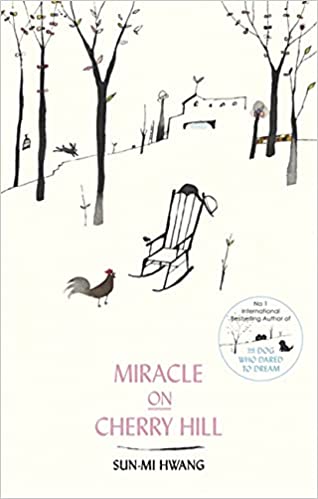
Firstly, Miracle on Cherry Hill by Sun-Mi Hwang (2019, trans. Chi-Young Kim 2019).  I enjoyed the simplicity of The Hen Who Dreamed She Could Fly and found it very moving, so I was looking forward to this. I also thought – rightly – that it shouldn’t be too traumatic, given I’m a delicate flower at the moment.  Like The Hen… this is a quick read with no great surprises, but that’s not a criticism, as it still offers a rich story with fully realised characters.

Miracle on Cherry Hill sees successful business leader Kang Dae-su move back to his childhood home town having been diagnosed with a brain tumour (named Sir Lump). He plans to hole up in a huge, fenced-off house, away from any company to see out his days.

“Cherry Hill was an outdated name. New apartment buildings had uprooted nearly every last cherry tree around it, like insects gnawing through greenery. Only one old original house remained in this neighbourhood, near the bus stop, because the woods surrounded it and the owner was stubborn. He also owned all the land surrounding the house, At least, that’s what they said – nobody had ever laid eyes on the owner.”

Things don’t go quite according to Kang’s plan. For a start, the townspeople have used his property while he has been absent. The children play hide-and-seek in the grounds, an elderly woman with dementia grows vegetables, her granddaughter Yuri exercises her puppy and collects hens eggs.

“How dare Sir Lump pity him? He heard something coasting along with the wind, something like humming. Kang remained on his back. If he concerned himself with every singing animal or person who was evidently trespassing on his property the tumour would swell and burst from sheer irritation.”

Despite Kang’s irritation, a series of comic events demonstrate it’s better to share his garden for continued use by the town. What’s more, he even invites people in, recognising troubled youngster Sanghun would benefit from being employed to mow his lawns.

As Kang begrudgingly becomes involved in the life of the town and the people who live there, he becomes reconciled to his past, and the pain from childhood he has been holding onto begins to heal.

“Each of these new discoveries left him with a refreshing sensation, as if a cold drop of water was falling into the depths of his heart. These feelings had to be carefully swallowed down.”

Miracle on Cherry Hill is a sweet tale, but not sentimental as it tackles some difficult issues. It’s fabulistic but also recognisably real. It’s poignant and playful, and as someone who loves a redemption story I found it charming.
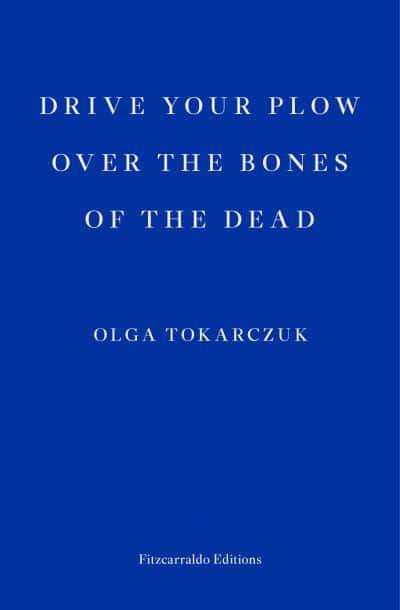
Secondly, Drive Your Plow Over the Bones of the Dead by Olga Tokarczuk (2009 trans. Antonia Lloyd-Jones 2018) which was a highly anticipated read for me, having loved Flights. For some reason I didn’t count that read on my Around the World in 80 Books Reading Challenge, so Drive Your Plow… has formed my Poland visit.

This is a very different reading experience to Flights, which was fragmentary and mixed different genres. In contrast, Drive Your Plow… is more linear and plot-driven. However, it is still a complex novel that resists easy categorisation. I really loved it.

Janina Duszejko is a middle-aged woman with mysterious ailments, who hates her name and lives alone in a remote part of Poland:

“All you can see on the map is a road and a few houses. It’s always windy here, as waves of air come pouring across the mountains from west to east from the Czech Republic. In winter the wind becomes violent and shrill, howling in the chimneys. In summer it scatters amongst the leaves and rustles – it’s never quiet here.”

This harsh and isolated landscape suits Janina, as she is viewed as eccentric and regards people warily. When she engages in company, it is in her own way:

“What a lack of imagination it is to have official first names and surnames. No one ever remembers them, they’re so divorced from the Person, and so banal they don’t remind us of them at all…That’s why I try my best never to use first names or surnames, but prefer epithets that come to mind of their own accord the first time I see the Person.”

Janina is a fan of Blake and this is reflected not only in the title of he novel and the epigraphs, but also her Fondness for Capitalising for Emphasis, which I thought a nice touch and added to the sense of her unique voice.

At the start of the novel, Janina is disturbed by her neighbour Oddball, who asks her to come with him to check on another neighbour, Big Foot. He is dead, having choked on a bone. Janina doesn’t grieve for him as he was part of the local hunting club, and she much prefers animals to humans. Sadly her “Little Girls” – her two dogs – have disappeared.

As other members of the hunting club die – all local powerful men, all seemingly pretty unpleasant – Janina shares her theory with the police that animals are taking their revenge for the cruelties enacted upon them. This theory is supported by her astrological studies, and is completely ignored by the authorities:

“Once we have reached a certain age, it’s hard to be reconciled to the fact that people are always going to be impatient with us.”

The mystery of the deaths of the men isn’t the heart of the novel though. Although the blurb on mine describes it as ‘an existential thriller’ I wouldn’t even go that far.  For me the driving force of the story is the character of Janina and how she exposes attitudes to women, to aging; the power of the patriarchy, of money; and the disregard of anyone who is inconvenient to conventional society. She does this simply by existing and narrating how people respond to her.

I should warn readers here that the novel does describe cruelty to animals. Because Janina is appalled by it, the scenes are never dwelt on, but they are important to the story. This can make it a tough read but that is precisely the point – to question the horrors of how animals are treated. Drive Your Plow… was adapted into a film called Spoor in 2017 and I was going to end with the trailer, but even then there are some pretty grim scenes so I opted not to.

Drive Your Plow… raises important, complex themes through the voice of a truly memorable narrator. There is a dry humour running through the novel, but it also doesn’t pull its punches. The landscape is beautifully evoked and the characterisation compassionate. It will stay with me for a long time.

“As I gazed at the black and white landscape of the Plateau, I realised that sorrow is an important word for defining the world. It lies at the foundations of everything, it is the fifth element, the quintessence.”

To end, a song about a town community:

“I go six of one and half a dozen of the other, but no-one remembers me saying that when I did, back in 2003.” (Richard Ayoade)

August is Women in Translation month, hosted by Meytal at Biblibio. I’ve been faithfully reading translated fiction throughout the month but I have failed miserably at blogging about any of it. Usually when bloggers disappear for a bit they’ve gone on holiday/fallen in love/started a new job. I have no such exciting excuses – I’m at the same job, feeling bitter about a lack of holiday & the nearest I’ve got to romance is shamelessly objectifying Tom Burke in the new Cormoran Strike adaptations on the BBC:

In a bid to catch up, here is a quick summary of the 6 novels I’ve read in translation, all quite short but all punching well above their weight in terms of powerful, affecting stories. They also include 2 more stops (France & Greece) on my much neglected Around the World in 80 Books Reading Challenge hosted by Hard Book Habit.

Colette – The Other One (1929, trans. from French by Elizabeth Tait & Roger Senhouse 1960)

Given I’m such a Francophile, it came as a great surprise to me that I hadn’t yet visited France as part of #AW80Books so I’ve rectified the situation with Colette’s tale of infidelity and complex family dynamics over the course of a summer in a villa in France.

Fanny is married to Farou, and awaits his return in a villa where she lives with her stepson Jean and companion Jane, with whom Jean is in love. Fanny subsequently comes to realise that Jane is one of Farou’s many extra-marital dalliances.

It’s a slim novel (157 pages in my edition) and in a sense very little happens. What The Other One offers is a beautifully written, subtle exploration of the psychological complexities that exist between people who are inextricably bound up in one another’s lives, with all the love and pain that can entail.

“Fanny turned on Jane her Paris smile, well made-up and full-lipped, and Jane, whose fair hair lit up a corner of the room, was instantly extinguished.”

Marguerite Duras – La Douleur (1985, trans. from French by Barbara Bray 1986)

I’m overcompensating now by staying France, with Duras’ typical mix of autobiography and fiction, regarding her war experiences. At the start of La Douleur she writes that the work is based on diaries she discovered which she doesn’t remember writing. The six stories/diaries move back and forth across the period of the war and create the sense of a fragmented narrative which explores the desolation and destruction of war and the impossibility of telling a tale of such insurmountable human loss in only one way. I found it incredibly powerful.

“Suddenly freedom is bitter. I’ve just come to know the total loss of hope and the emptiness that follows; you don’t remember, it creates no memory. I think I feel a slight regret at having failed to die while still living. But go on walking, I move from the street to the sidewalk, then back into the street. I walk, my feet walk.”

Sun-Mi Hwang – The Hen Who Dreamed She Could Fly (2000, trans. from Korean Chi-Young Kim 2013)

This is the story of a hen named Sprout. She decides she wants more from life than laying eggs to be taken away: she wants to live in the wild and raise a chick.

This fable is incredibly clever, in that you can read it to a child but there is plenty for adults here too. It’s a story written with great lightness of touch, and as such the lessons it teaches are various, depending on what you find in it. It could be about (for starters): going your own way in life, questioning authority, facing fears, attitudes to immigrants, the value of empathy, adoptive families, familial love, finding freedom…

“Sprout was the best name in the world. A sprout grew into a leaf and embraced the wind and the sun before falling and rotting and turning into mulch for bringing fragrant flowers into bloom. Sprout wanted to do something with her life, just like the sprouts on the acacia tree. That was why she’d named herself after them. Nobody called her Sprout, and she knew her life wasn’t like a sprout’s, but still the name made her feel good. It was her secret.”

The edition by Oneworld books also features lovely illustrations by Nomoco, worth seeking out.

Penelope S Delta – A Tale Without a Name (1911, trans. from Greek by Mika Provata-Carlone 2013)

Another fable, and another lovely edition from Pushkin Press whose description explains that this is ‘one of Greece’s best loved stories.’ It tells of an indulgent arrogant king who takes his nation into ruin and the son and daughter who bring it back to prosperity under a policy of meaningful employment for the greater good.

“Time always passes. But if you consume yourself in idle things you waste it; whereas if you do work that has a purpose, you make good use of time.”

It’s also a militaristic tale – much emphasis on vanquishing enemies and building armies – but ultimately it is about social responsibility. I don’t think it’s a stretch to see it as deeply political: Delta’s father was a mayor who narrowly avoided execution, her diplomat lover was assassinated and she killed herself the day the Nazis reached Athens. A Tale Without a Name presents complex political ideas in a deceptively simple style.

Han Kang – Human Acts (2014, trans. Deborah Smith 2016)

This novel caused me to deviate from a wholly WITMonth August, as I was so upset by it that I had to read a British Library Crime Classic to recover. I approached it wholly ignorant of the political turmoil that South Korea had experienced in the 1980s. Kang pitches us into the student uprising in Gwangju in 1980. It begins with a boy searching for the body of his friend amongst the piles of corpses that a brutal regime creates.

“Why would you sing the national anthem for people who’d been killed by soldiers? Why cover the coffin in the Taegukgi? As though it wasn’t the nation itself that murdered them.”

Human Acts follows various people all connected to the uprising, and Kang absolutely does not pull her punches. What the piles of bodies mean in human terms is explored fully both in terms of the emotional ramifications and the hard reality of how to deal with so many bodies. It’s a novel that deals with extreme brutality in sensitive, subtle prose.

“Their faces had been covered in white paint, erased. I swiftly shrank back. Necks tipped back, those dazzling white faces were angled towards the thicket. Staring out into the empty air, their features a perfect blank.”

The novel contains scenes of torture that are hard to bear, but never gratuitous. In the final part of the novel, Kang explains her own links to the story, and how this is not quite fiction. It’s astonishing that someone personally affected by the tragedy can write something so carefully constructed, but this is what she has achieved. The story is crafted but absolutely unflinching in looking at atrocities inflicted by governments and their devastating fallout.

“She had no faith in humanity. The look in someone’s eyes, the beliefs they espoused, the eloquence with which they did so, were, she knew, no guarantee of anything. She knew the only life left to her was one hemmed in by niggling doubts and cold questions.”

Elena Ferrante – The Lost Daughter (2006, trans. from Italian Ann Goldstein 2007)

Finally, I’m a bit undecided about the Neapolitan quartet and feel slightly baffled as to why its garnered quite so much praise, but I did enjoy this novella from Ferrante and those who love the quartet will find much that is familiar here: a flawed female narrator, conflicts with loved ones, a sense of violence close to the surface.

Leda takes a holiday alone in southern Italy. She is disturbed by a loud extended Neapolitan family and a certain event draws her into their sphere. During the course of the holiday she reflects on her life and the repercussions of the choices she has taken, on herself, her marriage and her daughters.

“My daughters make a constant effort to be the reverse of me. They are clever, they are competent, their father is starting them out on his path. Determined and terrified, they advance like whirlwinds through the world, they will manage better than us, their parents.”

Leda isn’t likeable but the narrative is compelling and pulls you along to deliver a short sharp shock.

As regular readers will know, I need no encouragement to indulge in an 80s pop video. Here’s one that was a massive hit in the original German and in English translation. It’s about nuclear war; of course we have no worries about such an event now…

https://www.youtube.com/watch?v=Lur-SGl3uw8