“A great doctor must have a huge heart and a distended aorta through which pumps a vast lake of compassion and human kindness.” (Adam Kay)

I really want to increase my blogging in 2023 – as I’m an incredibly strong-willed person who always achieves any goal they set, I have absolutely no doubt I will achieve this aim 😀

Anyway, the wonderful reading events that take place are always an incentive to help me on my way, and in January Annabel runs her enticing Nordic FINDS month.
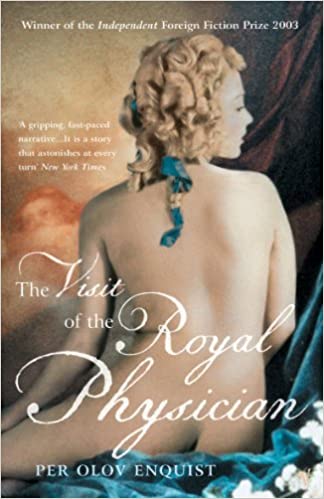
This meant that I have finally pulled a book from the TBR that has been languishing there for years: The Visit of the Royal Physician by Swedish author Per Olov Enquist (1999 trans. Tiina Nunnally 2001). A historical novel set in the 18th-century Danish courts, it tells the story of King Christian VII’s mental ill health, his marriage to Caroline Mathilde (sister to George III) and her affair with the titular German doctor, Johann Friedrich Struensee.

TVOTRP is hugely lauded, winning the August prize and the Independent Foreign Fiction Prize. This meant I went in with unfairly high expectations and at first I wasn’t sure this novel was for me. I suppose TVOTRP would be classed as a documentary novel, and initially I found this style distancing. However, by the end I was very much involved in this sad tale of people sacrificed to political power struggles where there is no room for humanity.
Even if the historical events are unfamiliar, the reader knows it will end with the execution of Struensee, as this is where the novel begins. We’re then taken back to his arrival at court, a man of the Enlightenment, viewed with some degree of suspicion by those resistant to change.

King Frederik V dies in his forties, and there is a vivid scene of him on his deathbed with his son, being abusive until the end. Christian is sixteen when he becomes King Christian VII and he is already struggling to comprehend reality.

“Christian explained, in a stubborn attempt to make sense of things, that he understood the court to be a theatre, that he had to learn his lines, and that he would be punished if he didn’t know them by heart.”

But was he one person or two?”

Enquist demonstrates so clearly that it would be some sort miracle if Christian managed to stay well in the environment of the court. He is not only abused by his family but by the courtiers; he is physically and mentally tortured.

Caroline Mathilde is 15 when they marry.

“Afterwards everyone agreed that it was unfortunate that she did indeed have talents. If the proper assessment had been made from the outset, namely that she possessed some talents, then the entire catastrophe might have been averted.

But no one could have predicted this.”

These teenagers are not expected to rule Denmark. They are expected to be figureheads and provide heirs, and not get in the way of the power-hungry politicians that surround them. When Struensee arrives in court, he poses a huge threat despite not appearing to want power at all. Firstly, he genuinely cares about Christian:

“It was understood that something had happened. The German doctor with the blonde hair, the quick but wary smile and the kindly eyes, had become somebody. Since he had no title and could not be placed within a precise hierarchy, this caused uneasiness.

Attempts were made to decipher him. He was not easy to decipher. He was friendly, discreet, and refused to make use of his power, or at least what was considered to be power.

People didn’t understand him.”

Secondly, he is a man of the Enlightenment, deeply threatening to Puritan courtiers like the advisor Guldberg, who is slowly growing his influence. Thirdly, he sleeps with the Queen:

“Christian, Caroline Mathilde, Struensee. Those three.

They seem to be observing each other with curiosity and suspicion. The court observed them too. As they observed the court. Everyone seemed to be waiting.”

The tension builds as the reader knows this situation will absolutely not be tolerated. And it seems such a travesty. The King is happy and cared for; the Queen is happy and fulfilled; the person taking decisions on behalf of the ruler is progressive, liberal, and trying to improve the situation of the masses. Why not let it continue?

Struensee is not naïve and he is filled with a sense of foreboding. Meanwhile, Caroline Mathilde seems to believe they can outwit the malevolent forces that are closing in…

“Her analysis surprised him.

He thought that her extremely lucid, extremely brutal view of the mechanisms of power had been born at the English court. No, she told him, I lived in a cloister. Then where had she learned all this? She was not one of those that Brandt, with some scorn, used to call ‘the female schemers’.

Struensee understood that she saw a different kind of pattern to his.”

The style of TVOTRP is really interesting. As I mentioned earlier, it’s a documentary style, but with an omniscient narrator so there is space given to the feelings and motivations of all the characters. The sentences are generally choppy, but often also poetic. Enquist balances these opposing approaches expertly. I never quite got past that initial distance I felt and so this stopped me absolutely loving the novel, but I did think it was an excellent and compassionate exploration of the pressures of public life and the dangers for those trying to change entrenched power structures.

Although not a depressing novel, it did seem desperately sad, for all concerned.

“The revolution that Struensee initiated was quickly stopped. It took only a few weeks for everything to revert to the way it was before, or to even earlier times. It was as if his 632 decrees, issued during the two years known as the ‘Struensee era’ were paper swallows, some which landed, while others were still hovering low over the surface of the field and hadn’t yet managed to alight on the Danish landscape.”

To end, I saw A Royal Affair (which tells the same story but isn’t an adaptation of this novel) when it came out in 2012. I don’t remember much of it now but I do remember enjoying it and thinking all three leads were excellent. From this trailer I would say Christian is portrayed less sympathetically than Enquist saw him, but it definitely looks worth a re-watch:

“He that loves reading has everything within his reach.” (William Godwin)

Let’s ignore the sexism of the title quote and focus on the sentiment (especially as Godwin was married to Mary Wollstonecraft who I like to think told him off for any gender assumptions) 🙂  I was prompted to think along these lines a few weeks ago when I watched the moving and joyous BBC4 documentary B is for Book.

I don’t generally write about children’s or YA fiction, but I felt quite inspired by the documentary showing the jubilant discovery and magic of the written word.  My Le Monde’s 100 Books of the Century Reading Challenge has some kids books on it, so this week I’m channelling my inner child (not that difficult, tbh)

You-hear-screaming-crying-next-room-brace-yourself-whats-come

Firstly, The Little Prince by Antoine de Saint-Exupéry (1943), ranked number 4 on Le Monde’s list; it is the most translated French book and the fourth most translated book worldwide. And how is this for a CV: Wiki describes Antoine de Saint-Exupéry  as “writer, poet, aristocrat, journalist, and pioneering aviator”. I feel so inadequate.

The Little Prince is narrated by an aviator who crashes in the desert, where he meets a visiting alien prince. The prince is from a planet where he lives alone, and which is so small that the sun is always setting:

“For as everyone knows, when it is noon in the United States the sun is setting over France. If you could get to France in a twinkling, you could watch the sunset right now. Unfortunately France is rather too far away. But on your tiny planet, little prince, you only had to move your chair a few steps. You could watch night fall whenever you liked.

‘One day,’ you said, ‘I watched the sunset forty-three times!’

And a little later you added:

‘You know, when one is that sad, one can get to love the sunset.’

‘Were you that sad, then, on the day of forty-three sunsets?’

But the prince made no answer.”

This melancholy tinge continues throughout the tale. The prince is a sad character and remains mysterious to the aviator.  It is a children’s book though, and has some lovely touches to stir the imagination:

“On the morning of his departure he set his planet in good order. He carefully swept out his active volcanoes. He had two active volcanoes – which were very useful for heating up breakfast in the morning.”

The prince describes his travels, in which he has met six adults, also living alone on isolated tiny planets: a king (who rules over no-one), a vain man, an alcoholic, a businessman (who wants to own the stars), a lamplighter (who constantly lights a lamp for no purpose) and a cartographer (who has never been anywhere). Thus the story is a critique of adults placing meaning in acquisition and status rather than in emotional connection and adventure. The aviator is an adult himself but does not hold adults in high regard:

“Grownups love figures. When you describe a new friend to them, they never ask about important things. They never say: ‘What’s his voice like? What are his favourite games? Does he collect butterflies?’ Instead they demand ‘How old is he? How many brothers has he? How much does he weigh? How much does his father earn?’ Only then do they feel he know him.”

The Little Prince is a sweet, sad tale, one which will appeal to children for the  adventure and imaginative leaps, but also has a great deal to offer adults, as a fable regarding a search for meaning in the world.

“You can only see things clearly with your heart. What is essential is invisible to the eye.”

It is also illustrated with gorgeous watercolours by the author (yet another string to his bow):

the-little-prince-best-quotes-cover-800x469

Image from here

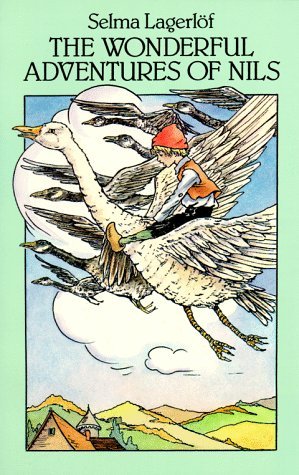
Secondly, The Wonderful Adventures of Nils by Selma Lagerlöf (1906–1907), number 68 on Le Monde’s list. This classic of Swedish literature has been immortalised on stamps, on currency, and Lagerlöf won the Nobel Prize for Literature.

771287

Nils is a self-centred, lazy, cruel ungrateful boy. Bunking off church to stay at home, he gets on the wrong side of an elf. Everyone knows you don’t mess with elves, Nils.  Of course the elf wreaks his revenge:

“For in the glass he saw plainly a little, little creature who was dressed in a hood and leather breeches.

“Why, that one is dressed exactly like me!” said the boy, clasping his hands in astonishment. And then he saw that the thing in the mirror did the same thing. Thereupon he began to pull his hair and pinch his arms and swing round; and instantly he did the same thing after him; he, who was seen in the mirror.

The boy ran around the glass several times, to see if there wasn’t a little man hidden behind it, but he found no one there, and then he began to shake with terror. For now he understood that the elf had bewitched him, and that the creature whose image he saw in the glass was – himself.”

Nils’ family goose, who has the excellent appellation of Morten Goosey-Gander, decides to follow a flock of wild geese on their migration to Lapland and Nils tags along, riding on Goosey-Gander’s back. As an elf, Nils finds he can understand animals’ speech, and learns to be kind rather than torture them.

“The wild geese challenged the white goosey-gander to take part in all kinds of sports. They had swimming races, running races, and flying races with him. The big tame one did his level best to hold his own, but the clever wild geese beat him every time. All the while, the boy sat on the goosey-gander’s back and encouraged him, and he had as much fun as the rest.”

Lagerlöf was commissioned to write this by the National Teachers Association, so in the course of reading about Nils’ journey, you learn about wildlife and Swedish geography: win/win.

“Just as the first spring showers pattered against the ground, there arose such shouts of joy from all the small birds in groves and pastures that the whole air rang with them, and the boy leaped high where he sat. ‘Now we’ll have rain. Rain gives us spring; spring gives us flowers and green leaves; green leaves and flowers give us worms and insects; worms and insects give us food; and plentiful, and good food is the best thing there is,’ sang the birds.”

He didn’t know exactly where on earth he was: if he was in Skåne, in Småland, or in Blekinge. But just before reaching the swamp, he had glimpsed a large village, and thither he directed his steps. Nor was it long before he discovered a road. Soon he was in the village street, which was long, and had trees on both sides, and was bordered with garden after garden. The boy had come to one of the big cathedral towns, which are so common on the uplands, but can hardly be seen at all down in the plain.”

Nils’ wonderful adventures also include seeing off his arch-nemesis Smirre Fox and learning to think of others rather than being such a deeply unpleasant person.  For a book with such a didactic purpose, it really doesn’t read as instructive and moralistic. The Wonderful Adventures of Nils is written with a real lightness of touch and is great fun.

To end, a taster of my favourite book from when I was a child:

“Brevity is the soul of lingerie.” (Dorothy Parker)

Apparently you can have too much of a good thing.  This is not something I’ve experienced myself, but as it seems to be a truth universally acknowledged, I’ll go with it.  So even if you are an inveterate bibliophile there can be times when humungous, bicep-busting books can be off-putting, particularly if like me, you’re a non-Kindle using commuter.  You don’t want to be lugging The Count of Monte Cristo onto the train (or so my osteopath insists).  This week I thought I’d look at books that are small and perfectly formed: 1 novella and 1 short story collection that are little gems.

Firstly, Fair Play by Tove Jansson (1989 my edition trans. Thomas Teal 2007, 127 pages). Jansson is most famous for creating those weird hippo/mouse hybrid creatures the Moomins:

https://www.youtube.com/watch?v=CdyG97Zgguw

Recently I kept reading about how good her writing for adults is, so when I saw Fair Play in a bookshop I decided it was A Sign.  A Sign for me to spend money, which admittedly is what every bookshop says to me.  But Fair Play was worth every penny.  It is a beautifully observed, delicate portrait of two artistic women sharing a life together.  Jonna is a visual artist, Mari a writer:

“They never asked, “Were you able to work today?” Maybe they had, twenty or thirty years earlier, but they’d gradually learned not to.  There are empty spaces that must be respected  – those often long periods when a person can’t see the pictures or find the words and needs to be left alone.”

This is what Fair Play captures so well, the unspoken subtleties that exist in a long-term relationship, with the person you know better than anyone.  With a restrained lightness of touch, Jansson presents moments in time between the two women,  detailing events that seem simultaneously fleeting yet loaded with meaning.

“They hadn’t noticed the fog moving off….suddenly the sea was open and blue and they found themselves a long way out toward Estonia.  Jonna started the motor.  They came back to the island from a totally new direction, and it didn’t look the same.”

The novel has no ostensible plot, and there is no sense of time – each chapter could occur chronologically, or could be moving back and forth across the trajectory of their long relationship.  It doesn’t matter.  You finish the novel with the feeling of being allowed glimpses into two unique, intertwined lives, while understanding how we all essentially remain unknown.

“It’s gone so quiet,” Jonna said. “What did you think? Wasn’t that a good storm?”

“Very good,” Mari said. “The best we’ve had.”

Jansson’s writing is stark, yet beautiful. I will definitely be seeking out more by this writer.

Secondly, The Madman of Freedom Square by Hassan Blasim (2009, Comma Press, trans. Jonathan Wright, 90 pages). The cover of this collection includes a quote from The Guardian, proclaiming Blasim “perhaps the best writer of Arabic fiction alive”. Like Fair Play, this was the first time I’d read this author, and it seems like such an oversight as he has so much to say that is important.  Blasim is a deeply political writer, by which I mean not that he is polemical, but that he is engaged with how literature works within a wider society:

“Because literature in this country is literature that goes through phases. Since the fall of Saddam Hussein there have been incessant calls for writing to be intelligible, realistic, factual and pragmatic.  They are lamenting readers that don’t exist. They claim the writers of the past made the readers defect, whereas in fact for hundreds of years there were no readers in the broad sense of the word.  There were only hungry people, killers, illiterates, soldiers, villagers, people who prayed, people who were lost and people who were oppressed. Our writers seem to have grown tired of writing for each other.” (‘The Market of Stories’)

Blasim’s stories detail lives caught up in war: illegal immigrants, hostage experiences, propaganda- makers, asylum-seekers.  He is acutely aware of how stories are manipulated in this media-saturated world, and how there can be many truths held within the one story:

“This story took place in darkness and if I were destined to write it again, I would record only the cries of terror which rang out at the time and the other mysterious noises that accompanied the massacre. A major part of the story would make a good experimental radio piece.” (‘The Truck to Berlin’)

The short stories in The Madman of Freedom Square are all the more powerful for their brevity: there is a sense that in such unstable times, words are a luxury, and every one must count.  Certainly Blasim’s words count; his stories are powerful, extraordinary, bleakly funny on occasion, and deeply moving.

Back to frivolity: to end, a reminder that smaller is sometimes better (although frankly, when it comes to cookies, I’m still not entirely convinced…)