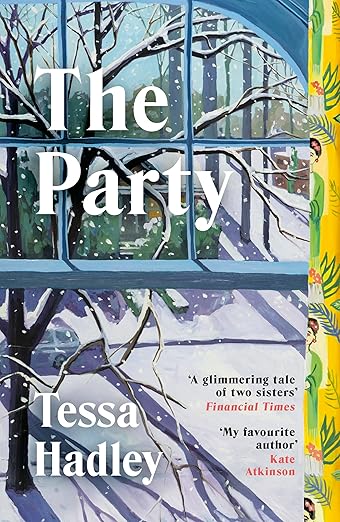
New Year’s Eve seemed a good time to post on The Party, a novella by Tessa Hadley (2024). And a book is about as near as I plan to get to a party on this day 😀
Tessa Hadley is a great writer, and every time I read her I wonder why I’m not a completist for her books. Now, there’s a New Year’s resolution I could actually fulfil!
The Party is only 115 pages, but fully realised due to the astute observation I associate with Hadley. It follows sisters Moira and Evelyn, students living in Bristol, as they navigate young adulthood in the 1970s.
“Anything could happen between now and tomorrow. Evelyn couldn’t believe her luck, that she was going to an actual party – and not just any dull ordinary party but this wild one with her sister’s friends, in half-derelict old pub with a terrible reputation, hanging over the black water in the city docks.”
The Party brilliantly captures a time when young people are trying on who they are, desperate to spread their wings and flourish into something unfamiliar, desperate to stay in the safety of their childhood bedrooms.
“She longed for and feared the moment when she would shed her thick winter coat and reveal herself. To tell the truth she feared everything: part of her wanted to get straight back on the 28 bus and go home.”
The sisters are close in age but not emotionally, as Moira holds herself deliberately apart:
“Moira had made such efforts to transform herself, when they moved down to Bristol, into this controlled, poised young woman. Yet some essence of the fierce bold child persisted in her, and had been diverted into new channels, sexual and personal.”
The titular gathering is both exciting and disappointing. They meet Paul and Sinden, from another world in terms of experience, class and money. Neither of the sisters like these men or finds them attractive, yet a couple of days later when Sinden invites them to Paul’s house, they go.
“Having made a bet with herself – not just for this evening, but for life – on her looks and her wits, she mustn’t falter or look down, she had to carry her performance through.”
There is no nostalgia for youth in The Party, it’s too real. Yet there is compassion, and a tender realisation of coming-of-age from the narrator that the characters don’t recognise, however much they long for it.
“To lose herself properly in a book she had to be crumpled and snug, oblivious of her appearance, scrunched up in an armchair with her shoes off and her legs tucked under her. When she was really reading, she forgot who she was.”
To end, a suitably bittersweet song about people and home changing, but from a band who seem like they know how to enjoy a party:
A couple of weeks ago the news reported it was the busiest day for holiday getaways. And just in case there was any doubt that this was a British news story, it was delivered by a reporter standing next to a motorway, framed within a narrative context of extreme traffic jams, while the traffic behind her was disappointingly free-flowing. Brilliant. It’s the first bit of news that raised a smile from me after Brexit.
Sadly, my finances are as dire as ever so I will have to leave the joys of non-existent traffic jams to more solvent souls. Instead I looked to my TBR for some suitably summery titles and came up with two that by coincidence are both short story collections. So not quite the traditional holiday doorstop reading matter, but highly recommended nonetheless.
Firstly, Sunstroke by Tessa Hadley (2007), whose stories explore desire in various guises, showing how it is both extraordinary and everyday. The titular story looks at old friends Rachel and Janie, married with kids, committed to their lives yet willing to risk it all for a moment’s sexual excitement:
“Neither is exactly unhappy, but what has built up in them instead is a sense of surplus, of life unlived. Somewhere else, while they are absorbed in pushchairs and fish fingers and wiping bottoms, there must be another world of intense experiences for grown-ups.”
Hadley is very good at placing dramatic tension within these ordinary domestic details. Her settings and characters are wholly recogniseable, and it is this that makes her writing challenging: you can’t step away from it as something outside your experience. So even if you’ve never had an affair with your lecturer, tracked down the older woman who got away, or recreated the sexual betrayals of your parents within your own love life, as the protagonists of Hadley’s short stories have, it is difficult to claim that these experiences are entirely alien. Is it out of character behaviour, or is it that someone’s character is sublimated beneath the ordinary? Hadley questions how secure anything is, how sure we can be of the foundations of our lives, when in a moment, something can happen to change the narrative we’ve constructed:
“Even if we were good, if we were perfectly and completely chaste, we can’t control what happen in our imagination. So being good might only be another kind of lie.”
Hadley is a highly skilled writer. Often I found myself on finishing the stories thinking “Oh, that’s clever.” The collection works as a whole and the individual stories are exactly what the genre should be: powerful, contained, strengthened rather than weakened by their limited words. She’s also great at effective turns of phrase:
“For a moment he was sure she could smell something on him, see something of the dazzle that was clinging to him, dripping off him, flashing round in his veins. But he saw her deliberately tidy that intimation away, out of consciousness. This was her husband, the man she knew. He was a physics teacher and competition-standard chess player, wasn’t he?”
Duran Duran taking a formal approach to their barging holiday along Birmingham’s canal system
Secondly, The Shell Collector by Anthony Doerr (2002), written 12 years before the Pulitzer prize-winning All the Light We Cannot See. Having read this collection, I don’t think it’s too much to say the Pulitzer potential was already evident – this is a brilliantly written collection of stories, spanning several countries: Kenya, Liberia, the US, Finland, Tanzania. In the titular story, a young boy loses his sight and discovers the love of his life:
“‘That’s a mouse cowry,’ the doctor said. ‘A lovely find. It has brown spots, and darker stripes at its base, like tiger stripes. You can’t see it, can you?’
But he could. He’d never seen anything so clearly in his life. His fingers caressed the shell, flipped and rotated it. He had never felt anything so smooth – had never imagined something could possess such deep polish. He asked, nearly whispering: ‘Who made this?’ The shell was still in his hand, a week later, when his father pried it out, complaining of the stink.”
As an adult, his quiet life collecting on the coast is disturbed by people wanting him to sting them with cone shells, convinced it will cure their various ills. It is a melancholy tale, about a search for meaning in the world, about loneliness and grief. Ultimately though, it is about resilience and love.
“He took the cone shell and flung it, as far as he could, back into he lagoon. He would not poison them. It felt wonderful to make a decision like this. He wished he had more shells to hurl back into the sea, more poisons to rid himself of.”
All eight stories in this collection are beautifully written; wise and moving. Even in such company, one of the stories which stood out for me was The Caretaker, about a Liberian refugee. Joseph Saleeby is not a particularly likable man when we first meet him: selfish, spoilt and making a living illegally. Then war breaks out, and he suffers horribly. He arrives in the US to claim refuge, deeply traumatised. When the bodies of six whales are washed ashore, he takes their hearts and buries them on the estate where he is caretaker:
“He fills the hole, and as he leaves it, a mound of earth and muscle, stark amid a thicket of salmonberry with the trunks of spruce falling back all around it… he feels removed from himself, as though his body were a clumsy tool needed only a little longer. He parks in the yard and falls into bed, gore-soaked and unwashed, the door to the apartment open, the hearts of all six whales wrapped in the earth, slowly cooling. He thinks: I have never been so tired. He thinks: at least I have buried something.”
He starts growing fruit and vegetables on the plot of land and befriends the unhappy daughter of the owners. Things do not go well for Joseph as people don’t realise how mentally fragile he is, but his friendship with Belle endures:
“The girl saws a wedge from one of the halves. The flesh is wet and shining and Joseph cannot believe the colour – it is as if the melon carried light within it. They each lift a chunk of it to their lips and eat. It seems to him that he can taste the forest, the trees, the storms of the winter and the size of the whales, the stars and the wind. A tiny gob of melon slides down Belle’s chin.”
Doerr writes with delicacy but without sentimentality. His view is penetrating and unblinking, but compassionate. Just devastating.
To end, summer = Pimms, and this advert = another chance to acknowledge the enduring genius of Adam Ant:
Usually I try and pick books that explore a similar theme in different ways, but this week the choices aren’t linked thematically in any way except how they came into my life. Both were given to me as gifts recently and I enjoyed them both, but couldn’t think what else to pair them with for a post. Then I realised that for me they were sort of tied together, and this was a good enough (flimsy, lazy, what you will) reason for them to occupy the same post. It’s unusual for friends to by me books – I think one sight of my overflowing bookshelves sends them scurrying to the nearest smellies store for presents, in the mistaken belief that any book they buy me I will have already read/somehow owned for years even if it’s just released/view with barely disguised contempt. I’ve recently put the kibosh on toiletries by developing mad allergies, cause unknown, that make me look like Father Bigley (as my ever-sympathetic brother pointed out, for all you Father Ted fans out there) so this may explain the sudden enthusiasm for printed matter amongst my cohorts. Either that, or I’ve finally taken control of my body odour, negating the need for bags of stuff from L’Occitane. Whatever the reason, two of my friends did sterling work with these recent offerings.
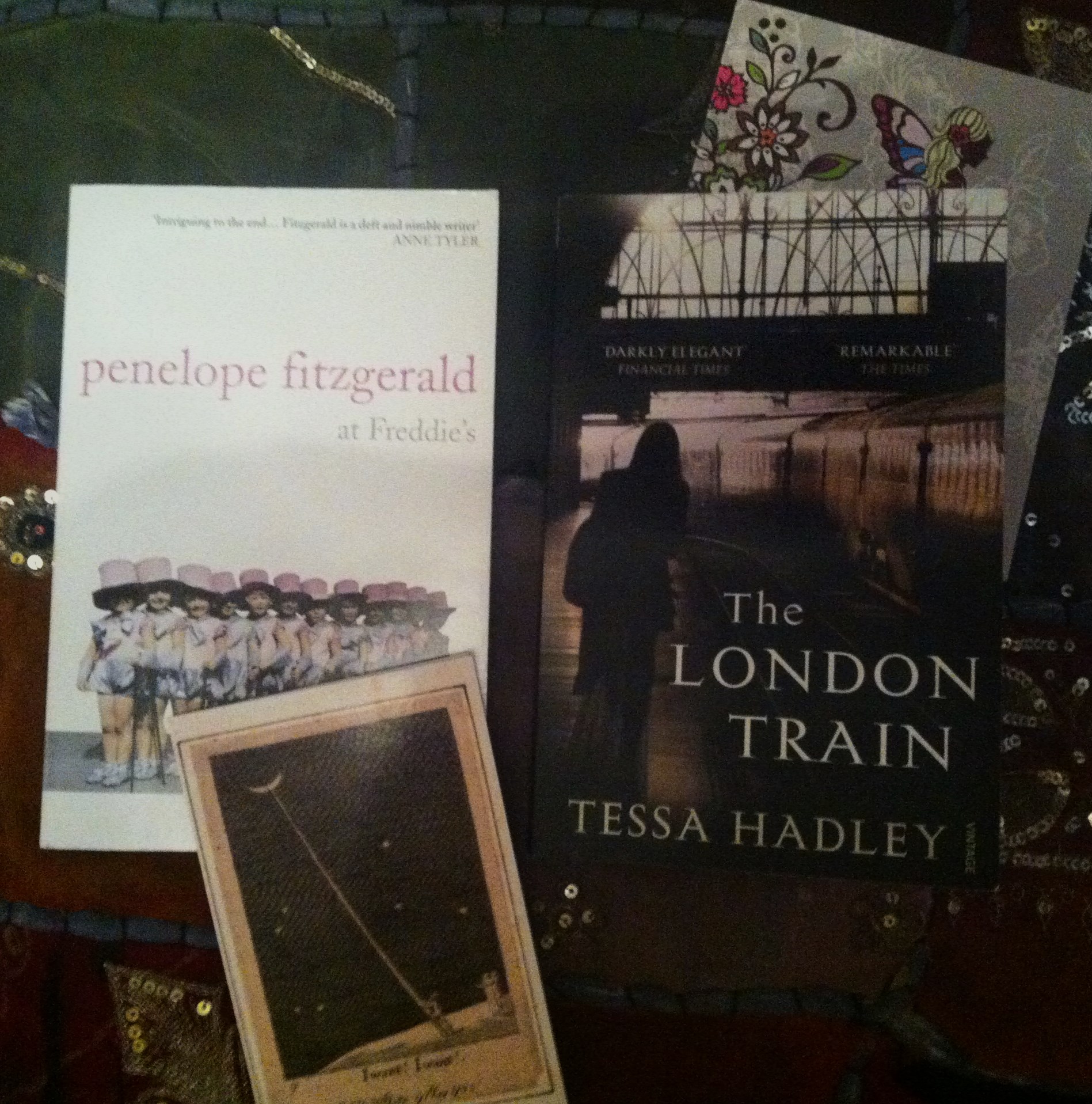
Firstly, At Freddies by Penelope Fitzgerald(1982, my copy 2003, Flamingo), given to me by my lovely friend C, who is an academic mega-brain, filled with boundless enthusiasm for literature, and despite these gifts and being quite beautiful as well, carries it all with such an unassuming genuine pleasantness as to make her completely likeable. She can now add gift-giving to her long list of talents. C chose this for me because firstly, she’d read and enjoyed it, and secondly because it concerns the theatre, which is one of my great loves. But although it does have a dry, knowing humour about the theatre, At Freddies is much more about being a child in an adults world, about school and those teachers whose main qualification is their force of personality, and about trying to find your place in the world, which is after all, a stage (at least according to one highly regarded writer). Freddie runs a dilapidated stage school for children in 1960s Covent Garden. There is no money but somehow she keeps it all hanging together by being someone who everyone knows, and who no-one can refuse.
“Insane directors, perverted columnists cold as a fish, bankrupt promoters, players incapable from drink, have all forgiven each other and been forgiven, and will be, until the last theatre goes dark, because they loved the profession. And of Freddie – making a large assumption – they said: her heart is in it.”
There is a lot of humour in this book, the precocious kids who are manipulative and knowing, but still just children, are hilarious.
“You saved me Miss Wentworth…I’d be out of work, I’d never get work again, if you hadn’t spoken to Mr Lightfoot…I owe everything to you…”
Freddie paid no attention whatsoever.
….Mattie, with an expression of deep malignance, departed.
“He’s acting,” said Miss Blewett.
“Worse than that,” said Freddie. “He’s acting being a child actor.”
Apparently Penelope Fitzgerald did teach at a theatrical school for a time, and some of her portrayals of theatrical professionals are drily presented, such as the director who wants to “underline Shakespeare’s concepts in the way he’d do it himself if he were here” – apparently this means having young boys played by very old men, and everyone on stage except the person going mad acting a breakdown while the character experiencing it remains stock still. Not sure that’s quite what Shakespeare had in mind… All this mayhem revolves around Freddie who remains resolute but ultimately enigmatic. No-one quite knows her background, motivation or purpose, except to keep going. When one of the teachers finds her collapsed, he reflects “No, she won’t die…She won’t change her habits so easily.”At Freddie’s is a short novel (230 pages my edition), highly readable and very enjoyable, but also unnerving and thought-provoking, as much about what isn’t said as what is. I highly recommend it.
Secondly, The London Train by Tessa Hadley (2011, Vintage) given to me by my also very lovely friend K, who is as creative as she is kind as she is gorgeous. I’ve got to stop hanging round with such thoroughly brilliant women, it only highlights my own shortcomings (except when it comes to choosing friends, which I am inordinately talented at). K chose this for me because again, she’d read and enjoyed it, and secondly, because it was set partly in London, another of my great loves. See what thoughtful friends I have? The London Train is a book of two halves. In the first half, Paul is looking for his missing daughter, Pia, who he finds living in north London with her slightly controlling boyfriend and his sister. In the second half, Cora is travelling in the opposite direction, back to Wales, to escape a failing marriage. I enjoyed Tessa Hadley’s first novel, Accidents in the Home, a great deal but I hadn’t kept up with her writing since, and The London Train made me regret this, as she writes with such sparse beauty:
“He wished he could remember better those passages in The Aeneid where Anchises in the Underworld explains to his son how the dead are gradually cleansed in the afterlife of all the thick filth and encrusting shadows that have accumulated through their mortal involvement, their living; when after aeons they are restored to pure spirit, they long, they eagerly aspire, to return to life and the world and begin again. Paul thought that there was no contemporary language adequate to describe the blow of his mother’s vanishing. A past in which a language of such dignity as Virgil’s was possible seemed to him itself sometimes only a dream.”
Hadley is also brilliant at capturing small moments, both between people and within individuals:
“Her speech wasn’t slurred, but aggressive, some layer of concealment had been stripped from between them. Where their feet bruised it, the grass sent up its yearning green smell, tugging at his emotions.”
“In the library Cora sometimes felt as if she had fallen to the bottom of a deep well. It wasn’t an unpleasant feeling. She hadn’t known there could be a job like this, pressing so weightlessly on the inner self, allowing so much space for daydreaming.”
This great skill, at pinpointing the significance of moments that are barely tangible, make Hadley’s writing both incisive and sympathetic. The London Train is about the journeys we take both physically and psychologically, and how we construct notions of home, sometimes in the entirely wrong places. I’ll be seeking out the novels by Hadley that I haven’t read as a matter of urgency.
Here are the books alongside the cards which accompanied them – thanks again, C&K!

 madame bibi lophile recommends