“People were capable of being many things at once.” (Sarah Gilmartin, Service)

I was a bit wary approaching Service by Sarah Gilmartin (2023) as I’d not long finished an issue-driven novel which I thought never quite managed to create characters who existed believably beyond the issue itself. Service has been described as a #MeToo novel, looking as it does at sexual assault and the structures that enable predators to not only get away with it, but thrive. However, when I saw it in my much-beloved charity bookshop during Cathy’s Reading Ireland Month it seemed perfect timing, and I also remembered that Susan had rated it.

The story is told from the point of view of three characters in alternating chapters.

Hannah, now in her thirties and selling her home as she and her husband divorce, looking back on time when she was a student and a waitress at T, a swanky restaurant reaping the rewards of boomtime Dublin;

“And there was Daniel, of course, we all loved Daniel. The skill, the swagger, the hair, even the naff red bandana that he sometimes wore during prep. We were in awe of him, of the fact that he didn’t seem to care about anything except the food. Serious cooking and good times, that was the dream we sold at T, over and over again.”

Daniel, the celebrity chef who oversaw T, now accused on Facebook of rape by an employee and facing criminal trial;

“Tomorrow the farce begins in earnest. Tomorrow I’ll see that ungrateful wench in person for the first time since she sat at her computer and pressed destroy.”

And his wife Julie, there throughout it all and trying to keep a home running for their teenage sons.

“I knew that you were not the kind of man who would come in the door of an evening and ask about your family. You were too full of your own stories, your voice set to megaphone inside your head, while the rest of us whispered asides. I knew this and I still said yes.”

This isn’t a he said/she said thriller – the way the stories and voices are presented it’s clear that Daniel did it. I thought this was a clever decision, as it frees Gilmartin instead to really focus on the characters’ lives within the various systems of enablement surrounding Daniel. He doesn’t see himself as a predator: why would he, when he is venerated – his toxic, controlling behaviour lauded?

“In that long, hot room that was fuelled by aggression and banter and occasional lines of speed, everything was sexualized.”

Daniel’s narrative is unreliable of course, and Gilmartin cleverly presents it in a way that the reader isn’t sure if he believes it himself. Is he consciously lying, or does he not recognise his actions as rape? He’s deluded enough to think all women want him really, and whether they say ‘no’ to him is a matter of indifference – like everything else they say. In a misogynistic culture where women are commodified and discardable the minute they reach thirty, their careers in front-of-house dependent not on skills or talent but on the approval of the straight-male gaze, where his own wife refers to ‘sluts’, he probably sees what he does as his entitlement.

I’ve seen some readers saying they vacillated with regard to the characters, but this wasn’t my experience with Hannah or Daniel. Where I did change somewhat was with Julie. I found her internalised misogyny infuriating, along with her astounding naivete that somehow a man who has plenty of women willing to sleep with him would therefore not assault anyone.

“How did I not know my husband was a predator? Somehow, I have no answer, beyond some ferocious thought, that all these years have meant nothing, marriage to mirage.”

“How do you weigh up the infinite exhibits of a decades-long marriage?”

But ultimately I saw her as a victim in the situation too, and it is Julie who pinpoints a fundamental societal attitude, so long ingrained, which silences women:

“I always had that ability, learned at such a young age – not to make a scene, not to dramatise, not to look for attention. Only the wrong kind of girls looked for attention.”

There is real tension in Hannah’s narrative as you know what is going to happen while desperately wishing it wouldn’t, and I thought the scene was handled sensitively and entirely non-gratuitously. The immediate fallout and enduring trauma are both believably portrayed.

When I initially read Service, I wondered if a limitation was the voices not being overly distinct from one another, but now, a few days on, I find Daniel’s voice has really stayed with me, the insidious toad (except I quite like toads). So unfortunately through not being able to shake him off I’ve realised my mini-criticism was mistaken!

The ending offered some hope while not being entirely unrealistic which I appreciated, not needing unrelenting bleak narratives right now. In an Author’s Note, Gilmartin explains that the barriers in the current legal system mean that the trial in the book would be unlikely to even occur in real life.

A girl like you.

It could be said in many different ways.”

“One of the luckiest things that can happen to you in life is, I think, to have a happy childhood.” (Agatha Christie)

My Name is Leon by Kit de Waal was published to great acclaim in 2016, and it was one of those books I kept meaning to read but putting off. I thought the story of a boy in the 1980s care system, trying to be reunited with his baby brother who has been adopted, would be unbearably sad.

Kit de Waal grew up in Birmingham with an Irish mother and father from St Kitts, and she holds dual Irish/British citizenship. So I decided that this year’s Reading Ireland 2024 aka the Begorrathon, hosted by Cathy at 746 Books was the time to finally get to it, and I’m so glad I did!

At the start of the novel Leon is almost nine years old and living with his mum Carol, with his father absent in prison. Carol’s just had a baby, Jake, who has blonde hair and blue eyes, unlike Leon who is mixed race. Leon is devoted to his younger sibling, and tries to take care of him as best he can.

“After a few weeks, Carol says Leon can’t go to school because it’s too wet and rainy. That means Leon can play all day and put the television on and make toast if he’s hungry. Carol leaves him in charge when she goes to the phone box and when she comes back she’s out of breath and asks him if the baby’s alright. Leon would never let anything happen to the baby so she worries for nothing.”

A child’s point of view is hard to get right but I thought de Waal created a really authentic voice for Leon (if you look at her Wiki page you’ll see her lifetime of experience that led to her writing this novel.) Leon is old beyond his years, but there is still so much he doesn’t understand.

“He hopes that Jake won’t grow up to be like his dad and say dangerous things in a quiet voice. Leon only smiled because it was polite. If the man comes back, Leon won’t smile a second time. He will be on his guard and he’ll protect Carol and Jake and then he won’t get shouted out.”

Carol has a complete breakdown, and so Leon and his brother are put into foster care, a situation Leon is familiar with.

“Social workers have two pretend faces, Pretend Happy and Pretend Sad. They’re not supposed to get angry so they make angry into sad. This time, they’re pretending to care about him and Jake and his mum.”

Maureen is the experienced carer who takes them both in and I thought she was a wonderful creation. Loving and caring, tough and optimistic. She’s flawed but she gets the important things – authentic, deep care for a child – right.

“He’s heard Maureen swearing loads of times, like when she called Margaret Thatcher a bloody cow because of the miners. And once she said Margaret Thatcher could kiss her arse and Leon laughed and got caught earwigging. Maureen says that if he keeps listening to people’s private conversations his ears will shrivel into prunes and drop off. Leon always checks his ears at night just in case.”

When a couple adopt Jake, we witness Leon’s heart shattering. Maureen objects to the siblings being split up, but the decision by social services is that it is better to have one child adopted – the blonde-haired, blue-eyed baby – than none at all. And in case this seems like a period piece, just a few years ago, a social worker told someone I know that children aged over seven and in care were ‘on the scrap heap’ because the majority only want to adopt babies.

“Maureen wipes Leon’s face with the corner of her dressing gown but because it’s made of the same silky stuff as the cushions his face is still wet and begins to itch.

‘You will be alright, Leon. You will be alright.’

Leon uses the tea towel again because it’s better for tears.”

The rest of the novel sees Leon plotting to reunite his family. This involves stealing money and stockpiling supplies. He’s confused, troubled, and furious. He’s intelligent, kind and vulnerable.

At the same time, he has many adults who care for him. Maureen and her purple-haired sister Sylvia; The Zebra his social worker “but out of all the social workers he’s ever had, she looks at him the most. And when he looks away, she stops speaking until he turns round.” When he discovers the local allotments, he makes friends with further adults. Tufty provides a black male role model, and there is also Mr Devlin, an Irish man whose traumatic past the reader picks up more quickly than Leon.

de Waal balances this story perfectly. The urban setting (which some readers on goodreads have assumed is London but I definitely thought was Birmingham, including the Handsworth riots), is evoked with authentic 1980s details including Curly Wurlys and BMXs. The realities of Leon’s life, racism, and police brutality are not shied away from, but they are shown to sit alongside kindness, compassion and selflessness.

“Leon eats his toast sitting on the carpet by the patio doors. It’s supposed to be summertime but the sky is the same colour as the garden slabs, dull and grey, like the road to school, the cut-through to the precinct or the dirty lane between the tower blocks and maisonettes.”

All the adults in Leon’s young life are flawed, but none are judged harshly. Carol is shown to be extremely unwell. The social workers take damaging decisions but it’s not through disregard of the children. Those who care for Leon make mistakes and struggle to take care of themselves at times, while providing love and respite for a young person with the odds stacked against him.

My Name is Leon is a story of someone learning how to mend a broken heart at an age when you really wish they had no idea of such pain. It’s a story of resilience and all that human beings can give one another, despite our myriad imperfections. I shoudn’t have left it lingering in the TBR for so long.

To end, the trailer for the BBC adaptation of My Name is Leon, which I’ll try and find to watch now. The cast looks stellar – Lenny Henry (who narrated the audiobook and bought the rights), Christopher Eccleston and the peerless Monica Dolan alongside Cole Martin in his first acting role as Leon:

“I must love a loathed enemy.” (Romeo and Juliet, Act 1 Scene V)

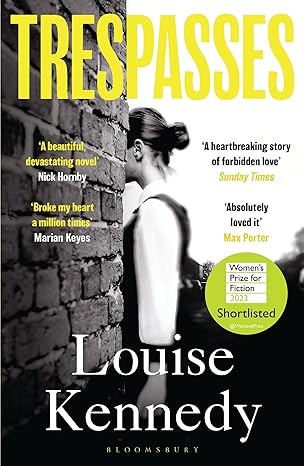
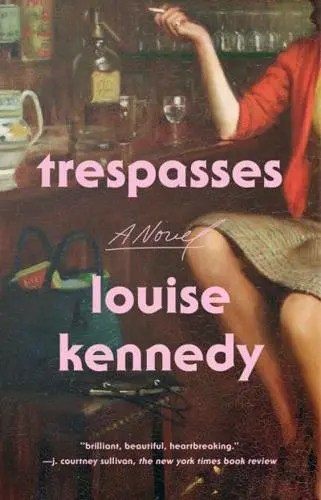
I’m not sure there’s much I can add to the cacophony of praise that Trespasses by Louise Kennedy (2022) has garnered. In fact I did consider not writing a post at all. But in the end because it moved me so much I thought I’d jot a few thoughts down as part of Reading Ireland 2024 aka the Begorrathon, hosted by Cathy at 746 Books. It’s also a stop on my Around the World in 80 Books reading challenge.

A summary of the plot doesn’t do this finely-crafted tale justice.

Cushla Lavery is a Catholic teacher, twenty-four years old and working at a school in a garrison town in 1970s Northern Ireland. She also helps out at her family’s pub, which is where she meets Michael Agnew – around twice her age, Protestant, and married. The attraction is instant and mutual.

“Countless times she had replayed the evening in her head, searching for the word or gesture or pronunciation that had repelled him, that had shown she was too young, too unsophisticated, too Catholic. It seemed piteous now that she had opened her college Irish books at Penny’s messy, elegant table, desperate to impress him. Perhaps she had been too obviously besotted with him.”

They know they have to keep their relationship secret. At the height of the Troubles, they are different religions and Michael already attracts attention through his work as a barrister defending those accused of killing members of the Royal Ulster Constabulary (RUC).

This is a time when politics and violence are woven through the daily lives of people in an immediate way. Cushla has to tread carefully around British soldiers in the pub, the threat of their brutality insidious and palpable. On the way to a party with her colleague and friend Gerry, they are stopped at an army checkpoint. At the flat where Cushla and Michael meet, she tells him not to sit with the lights on and curtains open, and her trepidation is not only due to their forbidden relationship…

Meanwhile, other aspects of life don’t stop. Her grieving mother Gina is self-medicating with gin. A boy in Cushla’s class, Davy McGeown, is bullied because he is from a mixed-marriage family and he ‘smells’ – his mother can’t hang the washing out because the neighbours throw dog dirt at it. His vulnerability is noticed by the priest Father Slattery, who everyone knows shouldn’t be left alone with children.

“Michael said there were all kinds of families. Cushla’s was an unhappy one. What was his like?”

The strain of daily life, living under the misuse of power both political and religious, is brilliantly realised. The narrative is incredibly tense, and the 1970s details are vivid.

The contrast of these tensions with the tender love between Cushla and Michael is subtly portrayed and never jars. Their relationship is believable, and while Michael is known to be “Fond of the women, by all accounts. Sure he’d charm the knickers off you.” he never seems creepy. Cushla is young but not naïve. They know what they have is unlikely to end well and yet they cling to it, the human need for love asserting itself over all that would seek to subdue it.

“She was overcome with a feeling of utter defeat. She wanted to lie on her bed and sleep, but had been unable to say no to him. It wasn’t because he had been kind to her. It was because each time she saw him she was afraid it would be the last time.”

It was the resilience Kennedy portrays which ultimately I found so moving. Not only with Cushla and Michael but in those that surround them, and particularly with Davy McGeown, a bright child caught up in a situation he barely comprehends.

“Booby trap. Incendiary device. Gelignite. Nitroglycerine. Petrol bomb. Rubber bullets. Saracen. Internment. The Special Powers Act. Vanguard. The vocabulary of a seven-year-old child now.”

Kennedy is not remotely sentimental but she is compassionate. She doesn’t judge people or the situation. Through creating recognisable, fully realised characters struggling to live the best way they can, Trespasses is a stunning exploration of the endurance of human spirit.

“For the umpteenth time Cushla wished her parents had called her Anne or Margaret or Rose – not Mary, with its connotations of Marian shrines and rosaries – any name that didn’t mark her out as so obviously a Catholic. She felt guilty for the thought which, she realised, also marked her as a Catholic.”

“Students, eh? Love ’em or hate ’em, you can’t hit them with a shovel!” (Terry Pratchett, Making Money)

Despite being woefully slow in my blogging, I’ve managed a second post for Reading Ireland Month hosted by Cathy at 746 books and Niall at Raging Fluff. Sláinte!

ireland-month

I’ve picked two novels linked by undergraduate protagonists – one a classic of Irish literature which is on Cathy’s 100 Irish Novels list, the other a little-known first novel by an author who has gone on to huge success.

youngones372_52

Ah, those heady student days…

Image from here

Firstly, the classic At Swim-Two-Birds by Flann O’Brien (1939). The unnamed narrator is in many ways a typical student:

“Whether in or out, I always kept the door of my bedroom locked. This made my movements a matter of some secrecy and enabled me to spend an inclement day in bed without disturbing my uncle’s assumption that I had gone to the College to attend to my studies.  A contemplative life has always been suitable to my disposition.”

His dissolution is perhaps a bit more extreme than most students however:

“It was in the New Year, in February, I think, that I discovered my person was verminous.”

Yuck. Gradually clues emerge that this student may be more literate than he first appears, such as how he describes his friend offering to buy him a drink:

“I rejoined that if his finances warranted such generosity, I would raise no objection, but that I (for my part) was no Rockefeller, thus utilising a figure of speech to convey the poverty of my circumstances.

Name of figure of speech: Synedoche (or Autonomasia)

The three of us walked slowly down to Grogan’s…”

The splintering of the narrative with the definition also hints at what is to come, as soon the story begins to be invaded by other stories the student is writing: about a devil Pooka and a fairy in his pocket; about Furriskey, born a fully grown man; a Western; versions of Irish folklore.  All the narratives start to reflect and echo each other, eventually they overlap and boundaries break down.  In other words, this is classic modernist brilliance, layering up myth and meta-narratives to create something astonishing. If you want to read Ulysses but you’re not sure you’re up to the task, At Swim-Two-Birds could be a good gateway novel 🙂 As Dylan Thomas said:

“This is just the book to give your sister if she’s a loud, dirty, boozy girl.”

In other words, if she’s a student.

Secondly, Stir Fry by Emma Donoghue (1994), who would go on to have enormous success with Room sixteen years later. This is the sort of first novel that doesn’t seem to be published as much now – perfectly decent efforts of thinly disguised biography whereby an author gets to grip with their craft. I’ve no actual facts to back up my theory, but it seems that while more and more books are published, first novels now have to have a huge wow factor – not necessarily a bad thing, but there’s an awful lot of truly dreadful writing being published because it will make money, while these better written but modest efforts flounder. I hope potentially good novelists are not being put off: hang in there budding writers!

Anyway, back to Stir Fry. Maria is seventeen and leaves her rural home to start university in Dublin.

“Dirty blue clouds were scudding over slate roofs. A good cold smell in the air and the whiff of turf smoke as she turned the corner made her think of home. The dusk lasted much longer in the country; nothing to get in the way she supposed. In Dublin there was only half an hour of grey, then the street lamps blinked on and all the shoppers hustled home in the dark.”

She is remarkably naïve, even given her young age, and takes forever to realise that her two flatmates are in a same-sex relationship:

“Now suddenly here were two friends of hers kissing on the table she ate at every night. Rapt faces and library books and garlic, how bizarre.”

She considers moving out, which may seem ridiculous, but Maria’s world sees discussions like this occur in all earnestness:

“‘Look, they’re both very nice. And they wear skirts sometimes too.’

‘Oh, I know,’ said Yvonne wisely, ‘but they’d have to, wouldn’t they, as cover?’”

What follows is a sweet story of Maria coming to realise who she is and what she wants. The characters are all very believable and they and Dublin are drawn with real affection. Stir Fry is a quick read, a bildungsroman in which nothing and everything happens. It doesn’t contain the brilliance Donoghue displayed with Room, but it still made me think it’s a pity we don’t see these types of first novels much anymore.

To end, an Irish band that first came to prominence when I was student – this song was played at many a sticky-floored student club back in my day:

“Being Irish, I always had this love of words.” (Kenneth Branagh)

Happy St Patrick’s Day! To celebrate this day, and to participate in Reading Ireland Month hosted by Cathy at 746 books and Niall at Raging Fluff , I’ve picked one novel from my TBR mountain which was also on Cathy’s 100 Irish Novels list and a poem by one of my favourite contemporary Irish poets . This will also be one more stop on my Around the World in 80 Books Reading Challenge, hosted by Hard Book Habit.

ireland-month

Firstly, The Sea, The Sea by Iris Murdoch which won the Booker in 1978. This was recommended to me by my sixth form English tutor, which means it’s been on my TBR for *cough* 20 years *cough*.  Oh dear. I got there eventually.  Charles Arrowby, theatre director, decides to retire to the coast:

“The sea is golden, speckled with white points of light, lapping with a sort of mechanical self-satisfaction under a pale green sky. How huge it is, how empty, this great space for which I have been longing all my life.”

Arrowby is vain, arrogant, solipsistic, self-aggrandizing… He views himself as some sort of Prospero figure:

Caspar_David_Friedrich_-_Wanderer_above_the_sea_of_fog

Image from here

But of course he isn’t a magician, he has no more power than anyone else.  The titular force of nature that surrounds him acts as a reminder of this, indifferent and formidable.

 “the sea was a glassy slightly heaving plain, moving slowly past me, and as if it were shrugging reflectively as it absent-mindedly supported its devotee”

It isn’t long before his self-induced exile starts to unravel. He starts to have hallucinations about sea monsters and within this unstable psychology is the constant background obsession with his teenage love, Hartley. By odd coincidence, she now lives in the same village with her husband, and all of Arrowby’s delusions become focused on her, as he is unable to conceive of anything that won’t fit in with his own needs:

 “I reviewed the evidence and I had very little doubt about what it pointed to. Hartley loved me and had long regretted losing me. How could she not?”

The Sea, The Sea is an extremely clever novel, carefully balancing Arrowby’s delusions on a precipice between comedy and terror:

“ ‘There’s an eternal bond between us, you know there is, it’s the clearest thing in the world, clearer than Jesus. I want you to be my wife at last, I want you to rest in me. I want to look out for you forever, until I drop dead.’

‘I wish I could drop dead.’

‘Oh shut up –‘ “

I was never sure which way it would go, how violently it would all unravel, or whether it would resolve in a subdued, sad way. Arrowby’s quiet, introspective (possible spy) cousin is the voice of reason, resolutely ignored:

“You’ve built a cage of needs and installed her in an empty space in the middle. The strong feelings are all around her – vanity, jealousy, revenge, your love for your youth – they aren’t focused on her, they don’t touch her. She seems to be their prisoner, but really you don’t harm her at all. You are using her image, a doll, a simulacrum, it’s an exorcism.”

The Sea, The Sea is a novel that tackles major themes: the nature of love, the meanings we attach to our lives, how we decide what is real when we can only view from our own perspective, how we recognise what really matters. Arrowby’s narcissism is contemptible, but the skill of Murdoch’s writing shows him as an everyman (despite his belief in his own extraordinariness) and places us in a position where to judge him harshly is to judge ourselves:

“Time, like the sea, unties all knots.  Judgements on people are never final, they emerge from summings up which at once suggest the need for reconsideration. Human arrangements are nothing but loose ends and hazy reckoning, whatever art may pretend in order to console us.”

Images from here and here

Secondly, Why Brownlee Left by Paul Muldoon, the titular poem from his 1980 collection.  Muldoon’s poems can be difficult to comprehend and contain head-scratchingly obscure references, but he is also humorous and playful, and takes such clear joy in language that I think any new collection from him is cause for excitement. The poem I’ve chosen is one of his most accessible but still leaves plenty of space for the reader to decide on meaning; it contains Muldoon’s gentle humour, and it’s all tied together with expert use of rhythm and echoing half-rhyme – I hope you like it 🙂

Why Brownlee left, and where he went,

Is a mystery even now.

For if a man should have been content

It was him; two acres of barley,

One of potatoes, four bullocks,

A milker, a slated farmhouse.

He was last seen going out to plough

On a March morning, bright and early.


By noon Brownlee was famous;

They had found all abandoned, with

The last rig unbroken, his pair of black

Horses, like man and wife,

Shifting their weight from foot to

Foot, and gazing into the future.

Do join in with Reading Ireland month aka the Begorrathon, and if you’re not a Luddite like me you can also check out their Facebook page 🙂

To end, as I read a review of a new Phil Lynott biography over the weekend, here are Thin Lizzy singing their version of a traditional Irish song: