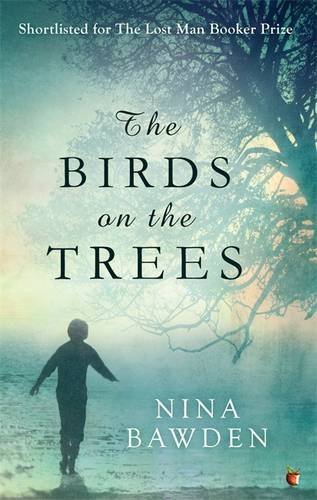
The Birds on the Trees – Nina Bawden (1970) 196 pages
The Birds on the Trees was sent to me a long while ago now, by the lovely Ali at heavanali. Ali’s a great advocate for Bawden’s writing and it was her enthusiasm that got me picking up one of my favourite childhood authors again as an adult. I’ve really enjoyed the Bawden I’ve read so far and The Birds on the Trees was no exception.
The story concerns the very ordinary middle-class Flowers family and what happens when the eldest son Toby experiences mental health problems.
He is kicked out of school for smoking drugs and returns home refusing to follow his parents wishes to attend a crammer in order to sit his Oxford entrance exam. His hair needs a cut and he’s not washing. He’s spending a lot of time dressed in a burnouse. His parents Maggie and Charles are at a complete loss as to what to do.
“Now, for the first time (their first, real crisis?) he saw what drove her was something more like fear: she raced through life as over marshy ground, fearing to stand still in case she sank in quagmire.”
This all sounds pretty mild but we never really find out what’s going on with Toby. He’s diagnosed with schizophrenia but this is questioned by a family friend and doctor, who thinks Toby has drug-induced psychosis. In a prologue we see Toby as a small child telling neighbours he’s been abandoned by his parents at Christmas, that they don’t feed him, and then later that his parents are dead. Clearly something’s wrong, but Bawden never offers trite answers as to what that might be – was Toby always unwell? Was he neglected in some way?
Very little of Toby’s speech – and never his thoughts – are provided to the reader. The Birds on the Trees is a study of a family under immense strain, but the family member who’s instigated the crisis remains remote. This is a masterstroke as it keeps us in a similar position to his family: at a loss as to why things are unravelling so considerably.
One of the rare times we hear from Toby is when he’s trying to impress potential girlfriend Hermia, and the fantasy, arrogance and pretension of what he says just brought home his youth to me:
“‘I have left school. But I haven’t made up my mind. Eventually, I expect, I shall go into something interesting and creative, like publishing or films. Or perhaps the theatre, though the standard’s so terrifying low at the moment, one would have to be careful. I mean, it would be so easy to write a play just for commercial success, one would have to watch out that one wasn’t corrupted.”
The family are distant from each other, but in a very ordinary way. Maggie and Charles take their frustrations out on each other, middle child Lucy starts stealing and youngest Greg is convinced he’s adopted. At one point Lucy attacks her aunt with grape scissors, which I again thought hinted at something deeper troubling this family, but it’s not clear. Maggie’s mother can’t see what all the fuss is about:
“ ‘I never heard of such a thing,’ Sara Evans said. ‘Taking a boy to a psychiatrist because he refuses to have his haircut!’”
I really enjoyed the portraits of the rest of the Flowers family, which were so well-observed, both psychologically – as I would expect from Bawden – and physically:
“The skin on his face was loose and baggy: he was always folding and pleating it as if it was an ill-fitting garment he happened to be wearing.”
Toby deteriorates and although fears about heroin addiction prove ill-founded, he cannot get out of bed. He is hospitalised and treated with ECT, which would be practically unheard of now. Although the treatment of Toby has dated, and to some extent the attitudes of the family, I thought this novel hadn’t dated nearly as badly as it could have done. This is because Bawden is so good at characterisation and so psychologically astute that the examination of these people under pressure, both individually and as a family, remains fresh.
I read a review from when The Birds on the Trees was nominated for the Lost Man Booker Prize that criticised the novel for being too optimistic in its ending. Maybe I’m just a miserable so-and-so but I didn’t think it was that optimistic. I thought it was one character allowing a brief moment of hope, when the reader knows things are unlikely to get any easier…
“How could you ever really understand why people behaved as they did? Oh, you could guess…but it was like trying to find your way through some intricate underworld of caverns and passages by the light of one flickering match!”
 madame bibi lophile recommends