This is the second of two posts where I catch up on the reading I did, but the blogging I failed to do, for the wonderful Persephone Readathon hosted by Jessie at Dwell in Possibility. Thankfully Jessie said I could post late, so here it is, a month overdue *shameface*. Both my choices are short story collections, which I find really hard to write about so apologies in advance for not doing either of these wonderful books any justice whatsoever.
Firstly, Good Evening, Mrs Craven: The Wartime Stories of Mollie Panter-Downes by (unsurprisingly) Mollie Panter-Downes which is Persephone No.8. It features 21 stories which Panter-Downes wrote for The New Yorker between 1939 and 1944.
I wish I had picked up this collection when I had my reading slump, it would have been perfect. The pithy, concise portraits are a quick read, highly entertaining and insightful. Panter-Downes shows how human foibles don’t just disappear at the onset of war. The stories are amusing but never seek to trivialise the conflict. Rather they show how domestic life is driven by huge national change and small personality traits.
Meeting at the Pringles captures the organisation of women who find their raison d’etre during wars, and find themselves “happier, as a matter of fact, than they had been for the last twenty-one years” as they arrange a bandage-knitting party for the Red Cross. Similarly, an elderly Major in It’s the Real Thing This Time is overjoyed at the thought of conflict “[looking] up for the falling body of a German soldier like a lover watching for a sign from a stubbornly closed window”
Family life continues, but is subject to greater pressures than ever. Mrs Ramsay’s War sees a young mother taking in evacuees and being shocked by the realities of motherhood for the first time:
“On the afternoon the nurse went out, the harsher facts of infant life were concealed from her by the nursery maid, who let her have fun pretending to fool around with two little dears who were always perfectly dry, perfectly sweet-smelling, and done up in pretty organdie tied with ribbons.”
Her naivety is subject to the onslaught of the Clark family, and she can’t close her eyes to other, less agreeable, lives any longer:
“there didn’t seem to be a disinfectant invented that could drown the Clark smell of grinding, abject poverty, very different from the decent, cottagey variety with a red geranium on the window sill, which had been the worst Mrs Fletcher had encountered up to now.”
In As the Fruitful Vine another young mother, this one expectant, rues the fact that she has fallen pregnant during a time of international conflict: “In her mother’s day a pregnant woman spent a good deal of time on a sofa, thinking beautiful thoughts and resolutely avoiding unpleasant ones; people took care not to speak of anything shocking or violent in front of her”
All these small events will lead to irrevocable societal changes. This is perhaps most apparent in Cut Down the Trees where an elderly retainer is deeply disturbed by the changes being wrought on a country house: “the conspiracy against Dossie’s way of life, which they called a war and which had taken first the manservants and then the girls one by one, which had stopped the central heating, made a jungle of the borders and a pasture of the lawns, marooned the two old women in a gradually decaying house with forty Canadians, and made Mrs Walsingham stop dressing for dinner.”
Good Evening Mrs Craven is a wonderful collection of highly entertaining stories, showing what went on at home – what women, the very young and the very old got up to – while the soldiers were away. It’s a brilliant work, and if you think you don’t like short stories but want to give them another chance, I would say this is a perfect place to start.
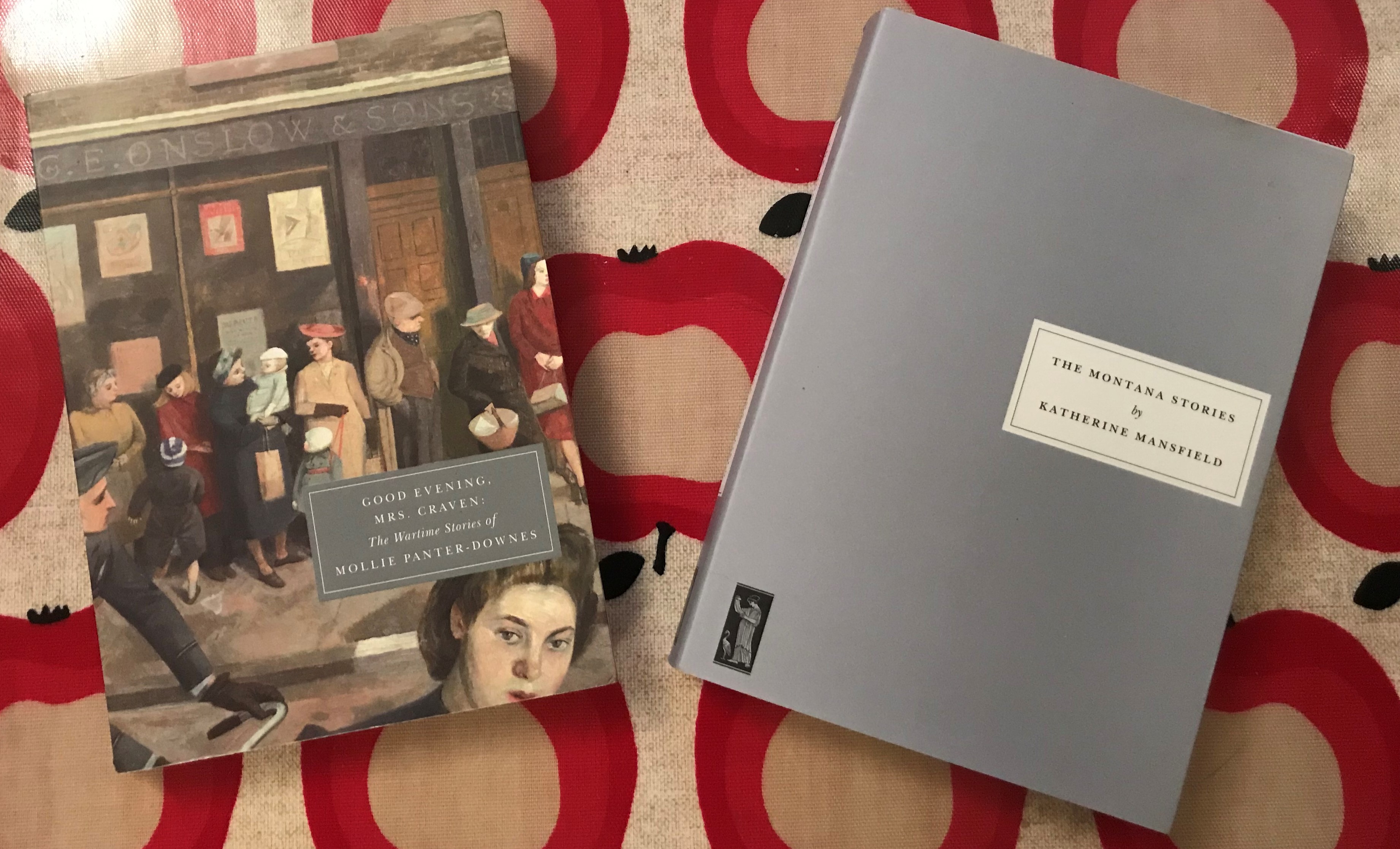
Secondly, The Montana Stories by Katherine Mansfield, which is Persephone No.25. This remarkable collection contains everything Mansfield wrote between July 1921 and her death in January 1923, while she was being treated at the Chalet des Sapins in Montana, Switzerland, for the tuberculosis which would ultimately kill her.
The stories in this collection are of various length, some unfinished but still an enjoyable read. Unusually, they are collected chronologically, which is highly effective here, giving a sense of Mansfield’s preoccupations and creative focus in her final years. I’m just going to pick two which really stood out for me, though the whole collection is a strong one.
In Marriage a la Mode, a young couple find themselves in bewildering conflict, as Isabel is influenced by modern-thinking friends and William can’t work out how on earth to reach her. He’s unsure what toys to buy his children:
“ ‘It’s so important,’ the new Isabel explained, ‘that they should like the right things from the very beginning. It saves so much time later on. Really, if the poor pets have to spend their infant years staring at these horrors, one can imagine them growing up and asking to be taken to the Royal Academy.’
And she spoke as though a visit to the Royal Academy was certain immediate death to anyone…
‘Well, I don’t know,’ said William slowly. ‘When I was their age I used to go to bed hugging an old towel with a knot in it.’
The new Isabel looked at him, her eyes narrowed, her lips apart.
‘Dear William! I’m sure you did!’ She laughed in the new way.”
The story ends with Isabel doing something incredibly cruel. Yet I felt sorry for her and for William. Isabel isn’t happy but is looking for fulfilment amongst vacuous people and missing what is truly important. William is baffled and desperate. A sad story, all the more so for portraying its tragedy as so small and everyday, yet devastating.
In The Garden Party, the Sheridans are a well-off family planning the titular event when they learn a working-class neighbour has been killed. Their daughter Laura wants to cancel the party while the rest of her family find this ridiculous.
“They were mean little dwellings painted a chocolate brown. In the garden patches there was nothing but cabbage stalks, sick hens and tomato cans. The very smoke coming out of their chimneys was poverty-stricken. Little rags and shreds of smoke, so unlike the great silvery plumes that uncurled from the Sheridans’ chimneys […]
‘And just think what the band would sound like to that poor woman,’ said Laura.
‘Oh, Laura!’ Jose began to be seriously annoyed. ‘If you’re going to stop a band playing every time someone has an accident, you’ll lead a very strenuous life.’”
The story is about beginning to forge your own way beyond all that is familiar; it is also about deciding what is truly important. Mansfield writes with wisdom and insight, and a deceptively light touch. She’s masterful at the short story form and her stories absolutely stay with you.
To end, some highly impressive mascara-wearing and a song which tells a short story:
 madame bibi lophile recommends