“Words burst forth, recognised at last, while underneath other silences start to form.” (Annie Ernaux, The Years)

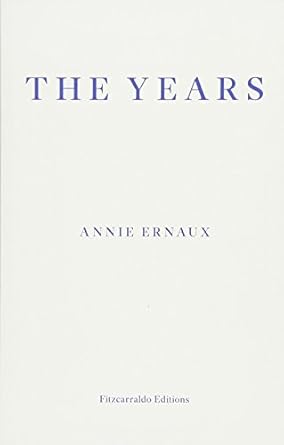
#ReadIndies is running all month hosted by Kaggsy and Lizzy and it has meant I’ve finally got to a book that I’ve been meaning to read for ages: The Years by Annie Ernaux (2008, transl. Alison L. Strayer 2018) published by Fitzcarraldo Editions.
A further incentive was that I really want to see the theatre adaptation which is currently running, and now I’ve read the book I have bought my ticket 😊

The Years is a book which deliberately avoids categorisation. Told in chronological order from 1941 to 2006 but in a fragmentary style, it is a memoir/autobiography/autofiction where Ernaux never uses the first person. She refers to ‘she’ for the more personal memories triggered by photographic images, and ‘we’ for considerations of the society and cultural influences experienced by ‘she’ at the time.

Growing up, she is aware of the poverty of her family, and dreams of escape. Ernaux captures so well the confusion of trying to find an authentic escape, trying to determine what she truly wants, alongside what advertising tells her she wants:

“Meanwhile, as we waited to be old enough to wear Rouge Baiser lipstick and perfume by Bourjois with a j as in joy, we collected plastic animals hidden in bags of coffee, and from Menier chocolate wrappers, Fables of La Fontaine stamps that we swapped with friends at break time.”

“It seems to her that education is more than just a way to escape poverty. It is a weapon of choice against stagnation in a kind of feminine condition that arouses her pity, the tendency to lose oneself in a man.”

There are strong feminist themes running throughout The Years, as she grows up on the brink of societal change. At the start:

“Nothing, not intelligence, education, or beauty mattered as much as a girl’s sexual reputation, that is, her value on the marriage market, which mothers scrupulously monitored as their mothers had done before them.”

Yet the 1960s are on their way… Ernaux pulls no punches in detailing the tyranny of menstrual cycles, and of “kitchen table abortions” before the contraceptive pill arrives and pregnancy terminations are legalised.

“Between the freedom of Bardot, the taunting of boys who claimed that virginity was bad for the health, and the dictates of Church and parents, we were left with no choices at all.”

The Years is lightened by humour too, such as this wry observation regarding her young feminist:

“Two future goals coexist inside her: (1) to be thin and blonde, (2) to be free, autonomous, and useful to the world. She dreams of herself as Mylène Demongeot and Simone de Beauvoir.”

The Years is a powerful evocation of a woman’s life at a specific time. Ernaux demonstrates so clearly how lives are bound up with the culture and the wider political forces in which they take place. It is impossible to consider the life in The Years without considering France in the same period. Yet this is an observation which occurs as she looks back, not at the time:

“Between what happens in the world and what happens to her, there is no point of convergence. They are two parallel series: one abstract, all information no sooner received them forgotten, the other all static shots.”

But as she grows older:

“What is most changed in her is the perception of time and her own location within it.”

And yet,plus ca change plus c’est la même chose, as Ernaux notes consumerism and its false promises endure:

“More than a sense of possession it was this feeling people sought on the shelves of Zara and H&M, instantly granted upon acquiring things, a supplement of being.”

The fragmentary style in The Years is perfect example of an experimental style being grounded by the story it wishes to tell, rather than being employed just for the sake of being different or to demonstrate the author’s cleverness. It conveys the experience of memory as well as the memories themselves. As a reader you are drawn into the layering of images, feelings and experiences in such a direct and immersive way, with all the intimacy of a first-person narrative despite the fact that Ernaux never articulates ‘I’.

“Everything will be erased in a second. The dictionary of words amassed between cradle and death bed, eliminated. All there will be is silence and no words to say it. Nothing will come out of the open mouth, neither I nor me. Language will continue to put the world into words. In conversation around a holiday table, we will be nothing but a first name, increasingly faceless, until we vanish into the vast anonymity of a distant generation.”

“It was an uncertain Spring.” (Virginia Woolf, The Years)

This is my final post for the brilliant1937 Club, which has been running all week and hosted by Kaggsy at Kaggsy’s Bookish Ramblings and Simon at Stuck in a Book. In the end I did stick to my planned reads for the week:

Apparently Leonard Woolf thought The Years the poorest of Virginia’s novels, but it was also far and away her best-selling work. So I was intrigued to know how I’d find it…

The titular years of this novel are 1880;1891;1907;1908;1910; 1911;1913;1914;1917;1918; and the Present Day. And so Woolf covers the end of the Victorian era to World War I and beyond, through the lens of the middle-class Pargiter family. Except for 1880, she portrays one day in their lives, some with significant events, others very ordinary.

In 1880, Rose Pargiter, mother to young adults Eleanor, Morris and Edward, teenagers Milly and Delia, and pre-teens Martin and Rose, is in bed in their London townhouse, dying from a long illness. Woolf captures the conflicted feelings and strain for the family around this time, particularly for Delia:

“She longed for her to die. There she was – soft, decayed but everlasting, lying in the cleft of the pillows, an obstacle, a prevention, an impediment to all life. She tried to whip up some feeling of affection, of pity. For instance, that summer, she told herself, at Sidmouth, when she called me up the garden steps…But the scene melted as she tried to look at it.”

Over in Oxford where Edward is studying, their cousin Kitty is trying to find a role for herself and struggling against the constraints of late Victorian womanhood:

“”When I was your age,” Miss Craddock continued, remembering her rôle as teacher, “I would have given my eyes to have the opportunities you have, to meet the people you meet; to know the people you know.”

“Old Chuffy?” said Kitty, remembering Miss Craddock’s profound admiration for that light of learning.

“You irreverent girl!” Miss Craddock expostulated. “The greatest historian of his age!”

“Well, he doesn’t talk history to me,” said Kitty, remembering the damp feel of a heavy hand on her knee.”

Each time Woolf jumps forward, she trusts the reader to keep up and doesn’t get bogged down by lots of explanation or exposition. We are given a snapshot the characters, whoever she is focussed on, and we fill in the gaps to a greater or lesser extent.

There are phrases and echoes across the different sections, tying them all together and giving a coherence to what could have been a more fragmentary, less satisfying novel. I also liked the repeated motif of starting each section with a birds-eye view of the time of year. I was particularly fond of this opening to 1908:

“It was March and the wind was blowing. But it was not “blowing.” It was scraping, scourging. It was so cruel. So unbecoming. Not merely did it bleach faces and raise red spots on noses; it tweaked up skirts; showed stout legs; made trousers reveal skeleton shins. There was no roundness, no fruit in it. Rather it was like the curve of a scythe which cuts, not corn, usefully; but destroys, revelling in sheer sterility. With one blast it blew out colour – even a Rembrandt in the National Gallery, even a solid ruby in a Bond Street window: one blast and they were gone. Had it any breeding place it was in the Isle of Dogs among tin cans lying beside a workhouse drab on the banks of a polluted city.”

As the above shows, Woolf grounds her tale in a recognisable topography and as always I found her descriptions of London detailed and realistic, and of Oxford too, even all these years later.

Alongside these recognisable realities, there was also plenty to enjoy regarding Woolf’s unique and arresting descriptive powers. I’m a big fan of Woolf and I just love her way of capturing inner moments, especially unreal, discombobulating moments, such as Eleanor at a dinner party during an air raid:

A little blur had come round the edges of things. It was the wine; it was the war. Things seemed to have lost their skins; to be freed from some surface hardness; even the chair with gilt claws, at which she was looking, seemed porous; it seemed to radiate out some warmth, some glamour, as she looked at it.”

Woolf brings all the characters together in the final section for a party given by Delia. She emphasises the fallacy of a reunion by highlighting the aloneness felt by many of the family. North, son of Morris, is back after many years abroad and feels detached from everything. His sister Peggy is somewhat bitter and frustrated. She tries to get Eleanor to talk about the Pargiters childhood, but Eleanor is much more interested in life now.

“That was odd, it was the second time that evening that somebody had talked about her life. And I haven’t got one, she thought. Oughtn’t a life to be something you could handle and produce? – a life of seventy odd years. But I’ve only the present moment, she thought. Here she was alive, now, listening to the fox-trot. […] Yes, things came back to her. A long strip of life lay behind her. Edward crying, Mrs. Levy talking; snow falling; a sunflower with a crack in it; the yellow omnibus trotting along the Bayswater Road. And I thought to myself, I’m the youngest person in this omnibus; now I’m the oldest…Millions of things came back to her. Atoms danced apart and massed themselves. But how did they compose what people called a life?”

There isn’t a plot so much in The Years, only as much as there are plots to any life. Woolf captures times and places for a particular family without trying to drive the novel unrealistically. Yet The Years is still a pacy read, the driving forces being the times that are lived through and the human will to carry on.  

To end, some footage of 1930s London, although I doubt Virginia ever got herself caught up with rush hour workers: