Troubling Love – Elena Ferrante (1992 trans. Anne Goldstein 2006) 139 pages
Although the popularity of Elena Ferrante’s Neapolitan quartet baffled me a bit, I had better luck with her stand-alone novella The Lost Daughter. This meant I was keen to try Troubling Love, and having finished it I did think that maybe I should give the quartet another try…
Delia’s mother Amalia has died in odd circumstances – drowned, found wearing only her bra, a glamourous one that Delia thinks it out of keeping with her mother’s style. As she returns home to Naples from Rome for the funeral, Delia finds herself reflecting on her past and trying to piece together what happened with her mother, both then and more recently.
“The streets of topographic memory seemed to me unstable, like a carbonated drink that, if shaken, bubbles up and overflows. I felt the city coming apart in the heat, in the dusty grey light, and I went over in my mind the story of childhood and adolescence that impelled me to wander along the Veterinaria to the Botanic Gardens, or over the cobbles of the market of Sant’Antonio Abate, which were always damp and strewn with rotting vegetables.”
Delia reflects on her childhood and her abusive father, who possessively and violently guarded his attractive wife. Delia’s memories of her painful home life are conflicted and contradictory. She despises her father but also harbours a lot of anger and resentment towards her mother.
“We, on the other hand, thought that our father, because of everything he did to her, should leave the house one morning and be burned to death or crushed or drowned. We thought it and hated her, because she was the linchpin of these thoughts.”
The past and present become overlaid as Delia visits her (still violent) father and meets a childhood friend she hasn’t seen in years. She chases a man through the streets thinking he has the answers as to what her mother was doing before she died. As she explores further, memory and identity become confused and less clearly delineated.
“Sometimes that place, which belonged to a less reliable memory, consisted of a dimly lighted staircase and a wrought-iron banister. At other times it was a patch of light striped by bars and covered by a fine screen, which I observed crouching underground, in the company of a child named Antonio, who held me tightly by the hand. The sounds that accompanied it, like the soundtrack of a film, were pure commotion, sudden banging, as of things formerly in order that abruptly collapse.”
Troubling Love isn’t so much a mystery story as an exploration of grief, memory, identity, and the slippery nature of all of these things. It doesn’t offer easy answers. It looks at how so much of this is bound up with family, and how this can be difficult to reconcile.
“Childhood is a tissue of lies that endure in the past tense: at least, mine was like that.”
Troubling Love was adapted to film in 1995. I’ve not seen it, but the trailer looks faithful:
Sphinx – Anne Garréta (2015, trans.Emma Ramadan 2015) 121 pages
Sphinx is a novella which details a young protagonist falling in love with A***. Anne Garréta is a member of the OuLiPo and the particular constraint that she writes to in Sphinx is for both for lover and beloved to be genderless.
The narrator is taken to a club on Place Pigalle where they immediately fall for the charms of the dancer A***. Garréta evokes a seedy and glamorous nightlife that is both enticing and repellent:
“The wheezing of the ceiling fan, the rumble from the nearby stage, the sight of the red velvet sofa covered in holes, burned through buy cigarettes, and the feeling of exile between blue walls defiled with the imprints of dirty hands, brought me all the closer to that single, splenetic feeling so difficult to define: melancholia. I relished it to the point of drunkenness.”
Sphinx is a love story which I felt engages the mind rather than the emotions of the reader. This is because the narrator – although currently working as a DJ – is an academic and seems to approach documenting affairs of the heart in the same way as they would writing a research paper.
“I can’t define A*** as being anything other than both frivolous and serious, residing in the subtle dimension of presence without insistence.”
This includes some overblown, tortured sentences at times:
“Is there anything more vertiginous than gustative reminiscence?”
In her fascinating translators note at the end of the novella, Emma Ramadan explains how the constraints around gender (which is much more demanding for a French writer than an English-language writer) means that this tone needs to be adopted, and then:
“It becomes part of the narrator’s identity – he or she is a rather pretentious bourgeois(e) scholar who does not shy away from praising his or her own intelligence”
So although not overt, there is a thread of humour running through Sphinx, whereby we are not supposed to take the narrator nearly as seriously as they take themselves. And it is a novella that is definitely all about the narrator, not about A***. While limiting the characterisation of A*** serves the constraints around which Sphinx is written, it also succeeds in capturing the self-obsession that can be projected onto a supposed loved one.
“Perhaps I had only ever delighted in my own suffering, which I considered the purification of passions that, deep down I judged as absurd.”
Although Sphinx made me think more than it made me feel, and generally I hope for a reading experience that does both, I did find myself drawn into the narrator’s story, in spite of their distancing voice. I also thought the night-time scene was captured beautifully.
“I was about to turn 23, and for the three years the night crowd had passed before my eyes, I had seen reputations be made and dismantled. I had seen temporary passions transport places and individuals to the apex, and then, burning what they had once adored, those notorious night owls who make up the club scene would abandon them for no apparent reason for other idols destined for glory just as brief.”
Madame Verona Comes Down the Hill – Dimitri Verhulst (2006 trans. David Colmer 2009) 145 pages
Madame Verona Comes Down the Hill has been on my radar since Kate’s review four years ago – I’m slow but I get there in the end, hopefully 😉
It’s a fable, but a recognisably real one. The titular beauty lives with her husband “in a house that could have been lifted from a biscuit tin” on top of a hill on the outskirts of the remote town of Oucwègne, where there has only been one female baby in recent generations.
When her husband dies, the townsfolk – including the vet who doubles as the town doctor, the man who pays his local shop tab in full after decades, overseen by a cow who is mayor – expect Madame Verona to leave. Instead she stays, mourning her husband, waiting out her time and growing old with her memories.
“the trees had their rings; Madame Verona did not begrudge her skin its wrinkles, the signature of all her days.”
Until one snowy day, she burns the last of the logs her husband cut for her and descends the hill into the town, knowing she will not have the strength to return.
“She is counting on strength of will to die today”
Madame Verona Comes Down the Hill has its share of whimsy but it also has a spikiness to it and it isn’t remotely sentimental. It’s about the different ways we live alongside grief, and how a life with a lot of sadness does not mean a life of misery.
“The one characteristic element with which she would summarise her eighty-two years of existence was that dogs had always sought out her company.”
Love – Hanne Ørstavik (1997, trans. Martin Aitken, 2018) 136 pages
It’s been six years since I read Hanne Ørstavik’s powerful novella The Blue Room and I had high expectations when I picked up Love from one of my favourite publishers AndOtherStories.
Like The Blue Room, Love features a dysfunctional parent/child relationship, although not one as determinedly destructive as Johanne and her mother in The Blue Room. Whereas that was suffocating and controlling, Jon and his mother Vibeke are almost at the opposite extreme with a child at risk of neglect.
I don’t have kids but I would say that having your eight year-old son roam the snowy streets in northern Norway alone in the depths of the night with no gloves on, while you prevaricate over whether to sleep with a man who picked you up at a funfair, is probably not the best parenting style…
Jon is waiting for his mother Vibeke to return from work. Tomorrow is his birthday and he believes she is going to bake him a cake.
“And then she comes, and he recognises the sound in an instant; he hears it with his tummy, it’s my tummy that remembers the sound, not me, he thinks to himself.”
Although in the same house and having dinner together, they’re not overly communicative. Vibeke has a shower and makes herself look good should she bump into her attractive work colleague in town. Jon leaves the house, returns again, then leaves again, with Vibeke only vaguely conscious of his whereabouts.
The town is far north and it has been snowing. Jon wanders the dark streets:
“Sounds become weightless in the cold. Everything does. As if he were a bubble of air himself, ready at any moment to float into the sky and vanish into the firmament.”
Meanwhile Vibeke has found the library closed, so she wanders round the newly arrived fairground. An attractive fairground worker picks her up and takes her back to his caravan.
“She feels like they share something now. It feels like pushing a boat from the shore, the moment the boat comes free of the sand and floats, floats on the water.”
We know Vibeke had Jon when she was young and that it has been the two of them for a while. However, Vibeke seems pretty oblivious not only to the safety of her son but to the feelings and motivations of other people. Despite being attracted to one another, the situation between Vibeke and the man never really takes off. She keeps holding back because she thinks that talking too much has hampered previous relationships.
“My mistake is to think too much when I talk, it slows everything down, repartee just isn’t there for me.”
However, there comes a point where you do actually have to communicate in some way. When they go to a bar and he chats to the barmaid, then disappears back inside leaving Vibeke in the car outside, she thinks:
“Maybe he’s working on keeping a hold on himself, and the control he thereby achieves is something he needs to cling to.”
Um, no. He’s just lost interest and moved onto the next pretty and more available girl.
Meanwhile Jon has spent some time with a schoolfriend (whose parents are happy to have him leave and wander back home alone at midnight) and ends up getting into a stranger’s car, which at least offsets hypothermia for a while.
Although remarkably self-possessed and bright, Jon is clearly suffering from his mother’s lack of care. He is trying to stop himself blinking and people comment it.
“He wishes no one noticed and that what was wrong with him was under his clothes or inside him.”
Throughout, he clings to the idea that Vibeke is at home baking him a birthday cake which I found completely heart-breaking.
The narrative of Love alternates between Vibeke and Jon almost paragraph by paragraph. This isn’t nearly as confusing as it sounds, it works well as the two of them have evenings that echo and reflect each other in surprising ways. They also both put themselves in risky situations and the story is tense and very believable. It’s a novella that creeps under your skin and stays there.
“She wishes she could read all the time, sitting in bed with the duvet pulled up, with coffee, lots of cigarettes and a warm nightdress on.”
Sweet Days of Discipline – Fleur Jaeggy (1989, trans. Tim Parks, 1991) 101 pages
Sweet Days of Discipline is told in a straightforward, clear style, as is evident from its opening line:
“At fourteen I was a boarder at a school in the Appenzell.”
The narrator is a loner at her 1950’s boarding school, full of the confusing, contradictory desires of someone on the brink of adulthood.
“I ate an apple and walked. I was looking for solitude, and perhaps the absolute. But I envied the world.”
She has to sleep in the part of the school for younger girls as there isn’t room for her. Her mother is in Brazil, her father is disinterested. She gets up at 5am every day to take long solitary walks. Then Frédérique, a banker’s daughter, arrives into this isolated and lonely life. Frédérique has a remote, unknowable quality. She is a nihilist and the narrator vows to dominate her:
“I still thought that to get something you had to go straight for your goal, whereas it’s only distractions, uncertainty, distance that bring us closer to our targets, and then it is the target that strikes us.”
The story isn’t overtly sexual and the sado-masochism is burgeoning, implicit rather than explicit. The narrator is scarcely aware of the sexual drives that surround her “passione” for Frédérique. It’s a psychologically complex and unarticulated morass of feeling, and it stays that way as she looks back from adulthood.
“Even now, I can’t bring myself to say I was in love with Frédérique, it’s such an easy thing to say.”
Frédérique remains mysterious and unknowable. She has a quality which sets her apart from her peers, which is both compelling and disturbing.
“She already knew everything, from the generations that came before her. She had something the others didn’t have; all I could do was justify her talent as a gift passed on from the dead.”
Although the narrator is looking back, Sweet Days of Discipline is not remotely sentimental. It has a brittle clarity which means that although very little happens, reading it is an immersive experience.
“And perhaps they were the best years, I thought. Those years of discipline. There was a kind of elation, faint but constant throughout all those years of discipline, the sweet days of discipline.”
The Bathroom – Jean-Philippe Toussaint (1985, trans. Nancy Amphoux & Paul De Angelis 1990) 102 pages
A young man decides he’s going to stay in his bathtub. Thankfully, his long-suffering girlfriend Edmondsson is happy to fund this indolent lifestyle. He leaves on occasion to talk to his decorators (who aren’t decorating as Edmondsson is vacillating between white and beige paint) and sit in the kitchen. Otherwise, he’s back in the bath:
“A friend of my parents was passing through Paris and came to see me. From him I learned it was raining. Stretching out an arm toward the washbasin, I suggested he take a towel […] I didn’t know what he wanted from me. When the silence had begun to seem permanent, he began to tell me about his latest professional activities, explaining that the difficulties he had to contend with were insurmountable since they were linked to incompatibilities of temperament among persons at the same hierarchical level.”
The novella is in three sections, each paragraph numbered. This unusual structure isn’t as irritating as it should be. It somehow emphasises the banality of his existence without becoming banal itself.
In the middle section, the narrator heads to Venice. In this beautiful and historic city, he mainly stays in his hotel room, taking up darts:
“When I played darts I was calm and relaxed. Little by little, emptiness would creep over me and I would steep myself in it”
We’ve seen that he can be socially awkward, guiding people into the toilet when showing them round the flat, mildly insulting the previous tenants, but later in the novella it seems this behaviour could be deliberate:
“I left the hotel and, in the street, asked a running man the way to the Post Office. I’ve always enjoyed asking people in a hurry for information.”
In the third section he heads back to Paris although I lived in hope Edmondsson was finally sick of him.
Apparently Touissaint is a fan of Beckett and The Bathroom definitely has the feel of Beckett: nihilistic, unreal verging on surreal, contained environments, experimental forms. It echoes itself and takes the reader in disorienting circles.
“Immobility is not absence of movement but absence of any prospect of movement.”
Not a novel for when you want a ripping yarn, but an interesting quick read.
“I would ask her to console me. Softly, she would ask, Console you for what? Console me, I would say”
Maigret Mystified – Georges Simenon (1932, trans. Jean Stewart 1964) 139 pages
This is the first Maigret I’ve read, despite Simenon being such a prolific writer and despite my love of golden age detective fiction. I picked it up in a pleasingly battered old green Penguin edition and I enjoyed it greatly. I’m sure it won’t be the last time I accompany the insightful French detective in his ruminations 😊
This may well be the shortest post I ever write, given that it’s about a novella and a mystery, so I want to avoid spoilers!
Maigret is called to the scene of a murder in an office of a pharmaceutical company, Doctor Rivière’s Serums. Monsieur Couchet, the owner, has been shot dead. The mystifying element is that he was also robbed of 360,000 francs, but his chair was jammed against the safe. So did he face his murderous thief? Or did he not know of the theft? Did the same person carry out both crimes?
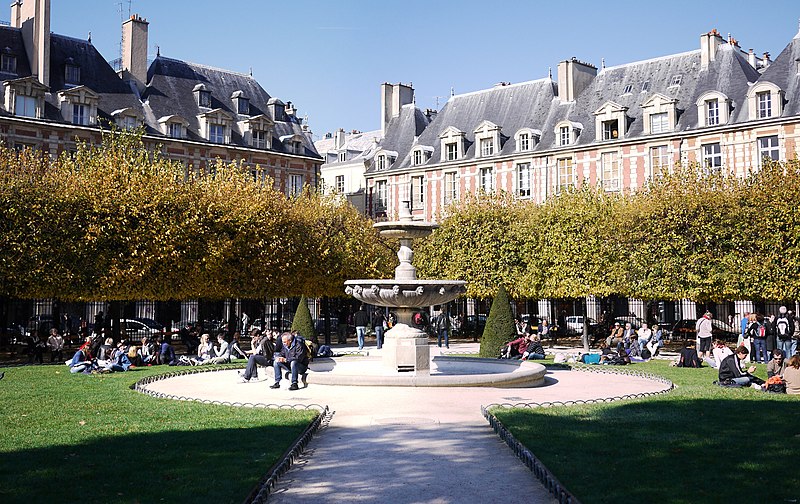
As the office is adjacent to a block of flats, Maigret must interview possible witnesses from the various homes in Place des Vosges.
There is the concierge who called the police; Madame Martin who seems to torture her husbands with their failure to live up to her expectations (the first of whom was the murdered man, their son now self-medicates with ether and lives close by); Mathilde who eavesdrops on everyone; new parents the de Sant-Marcs…
There are also the lovers of the victim to contend with: his second wife and his girlfriend Nine, a cabaret dancer, the portrayal of whom is pleasingly non-judgemental.
I suspect this isn’t the greatest Maigret offering, but it is a quick, entertaining and atmospheric read. I also found it a welcome antidote to the overly convoluted plot lines of many contemporary detective dramas – much as I enjoy those, it was a nice change to just see Maigret get on with it, in no time at all.
“ ‘You old rascal, Couchet!’
The words had sprung to his lips as if Couchet had been an old friend. And he felt this impression so strongly that he could not realise he had only seen him dead.”
A previous English title used for this mystery was The Shadow in the Courtyard, which to me is a much better. After all, at 139 pages, Maigret isn’t mystified for long…
“It was ten o’clock at night. The iron gates of the garden were shut, the Place des Vosges deserted, with gleaming car tracks on the asphalt and the unbroken murmur of the fountains, the leafless trees and the monotonous outline of identical roofs silhouetted against the sky.”
To end, this year sees a cinematic outing for Maigret:
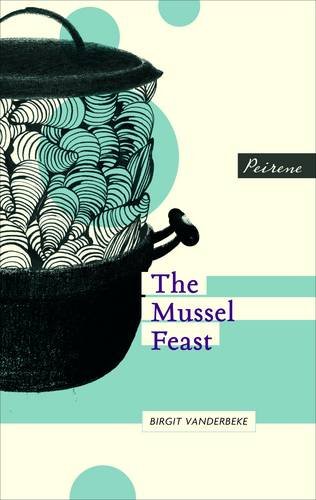
Peirene Press are one of my favourite publishers, with a focus on European contemporary novellas which so far have given me some wonderful reading experiences. The Mussel Feast is no exception, as it carefully and precisely builds a picture of a family tyrannised by the father, over the course of one evening.
Narrated by the teenage daughter of the family as she prepares the titular celebratory meal alongside her mother and brother, they await the return of their father who has bagged a promotion. The daughter doesn’t much like mussels, but it is how the family traditionally celebrates.
“Anyway, the noise came from the pot and as I glanced over I couldn’t help looking at the clock, too: it said three minutes past six. And at that moment my mood changed abruptly. I stared at the noisy pot […] it was a distinctly strange noise, which made me feel creepy; we were already twitchy and nervous, and now there was this noise.”
The father is late back, and the narrator reflects on what is happening that evening and on what has gone before:
“He couldn’t stand my mother’s knackered face, and so she switched to her after-work face, which she would paint on quickly in the bathroom at half-past five, before my father came home. But this after-work face only lasted for an hour and needed reapplying.”
Everyone in the family remains unnamed, fitting with thesense that they are all trying to fulfil a role for the father and that who they actually are is of secondary importance:
“We all had to switch for my father, to become a proper family as he called it, because he hadn’t had a family, but he had developed the most detailed notion of what a proper family should be like, and he could be extremely sensitive if you undermined these notions.”
The father is a deeply inadequate man, ashamed of his past in the GDR, and trying to convince his family of his superiority. His children don’t conform to gender stereotypes which annoys him. His wife isn’t pretty enough by his standards. The fact that he squanders their money and is fairly useless all round, is by-the-by:
“My mother earned money and did menial work, boiling the nappies in a huge pot, and cooking and shopping and children, all of which drove him nuts; my father was not cut out for such trivial jobs , and back then we would have frozen if my mother hadn’t lugged sacks of coal.”
By the time the following passage came I already had a clear idea of what was going on in this family, but I still found the matter-of-fact tone in describing such abuse truly shocking:
“He was extremely assured in his taste; he didn’t like his taste being questioned. I couldn’t bear the wall unit, as I told them that evening, due to my head having been smashed against it on a number of occasions.”
The tension in the novella builds expertly as, like the family, we wait for the father to return. The ending is ambiguous, but we know there are huge ramifications, because at the start of the novella the narrator tells us:
“what came in the wake of our abortive feast was so monumental that none of us have got over it yet”
Birgit Vanderbeke wrote this just before the fall of the Berlin Wall because “I wanted to understand how revolutions start.” In The Mussel Feast, it is a long time coming and also a matter of a few moments:
“Suddenly I no longer wanted him to come home, […] Mum looked at me, not as horrified as I’d expected, but with her head to one side, and then she smiled and said, well, we’ll see, and she didn’t sound as if she’d find it surprising or even terrible if he didn’t come home.”
The Mussel Feast has become a set text in Germany and deservedly so – the domestic setting is completely compelling but also has wider resonance which it carries lightly, the metaphorical never undermining the portrayal of abuse.
It’s always with some trepidation that I start a Novella a Day in May project. Last year I couldn’t face it at all (pandemic testing my resilience, work pressure, cat deaths taking a toll – even so I know I’ve been very lucky). But I seem to be able to read more now, so fingers crossed…
Also, I never run NADIM as an event because I never thought anyone else would want to undertake such a task, but I’m delighted that this year I will be joined by Simon at Stuck in a Book! So do join us for lots of novella love 😊
Away we go!
Without Blood – Alessandro Baricco (2002, trans. Ann Goldstein 2004) 87 pages
Without Blood is a short, sharp shock. It opens with a brutal, bloody and deadly attack on Nina’s family when she is a small child.
Men arrive at the remote farmhouse where she lives with her father and brother. Her father helps her to hide in the cellar, but she hears them accuse him of the torture of prisoners during the (unnamed) war.
“Nina closed her eyes. She flattened herself against the blanket, and curled up even tighter, pulling her knees to her chest. She liked to be in that position. She felt the earth, cool, under her side, protecting her – it would not betray her. And she felt her own curled up body, folded around itself like a shell.”
Her brother fires a gun at the men and is killed. One of the soldiers, a young man called Tito, sees Nina under the trapdoor and keeps quiet. Nina is taken in by a local man who then bets her away at cards when she is a teenager. Adult Nina devotes herself to revenging the death of her family.
Barrico raises a lot of big questions in this novella but wisely doesn’t attempt to find answers. The nature and purpose of war; who is guilty and to what extent; the brutalisation of humans; the justification and consequences of violence; revenge versus redemption…
“There were a lot of things we had to destroy in order to build what we wanted, there was no other way, we had to be able to suffer and to inflict suffering – whoever could endure more pain would win, you cannot dream of a better world and think it will be delivered just because you ask for it.”
When Nina finds Tito fifty-two years later, it is not easy to predict what will happen. They have both been irrevocably changed by the events of that night, events which have overshadowed the rest of their lives and bound them together throughout their separation.
“The man thought the way she spoke was strange. As if it was a gesture she wasn’t used to.”
It is a quick read in length but Without Blood invites longer consideration.
This is a contribution to the wonderful #ReadIndies2 events hosted by Kaggsy and Lizzy.
The two books for this post were buried in my TBR, so I’ve put them together as they are linked by the theme of friendship.
Firstly, Butterflies in November by Auður Ava Ólafsdóttir (2004 trans. Brian FitzGibbon 2013) published by Pushkin Press (which I thought was an indie, then panicked that it had been bought by Penguin, but which Lizzy has helpfully reassured me is definitely an indie!)
I really enjoyed Miss Iceland by this author so I was looking forward to this. Like Miss Iceland, this novel has a central female protagonist whose voice is bone dry, determinedly going her own way.
At the start of the novel, the unnamed narrator returns home to her husband after a meeting with her lover, one of her translation clients as she speaks 11 languages. She doesn’t seem especially attached to either man:
“After we had slept together for the first time, he looked surprised when I handed him the bill with the VAT clearly highlighted.”
Her husband announces he is leaving, to be with his pregnant girlfriend. This doesn’t seem like any great loss, given that as he’s going, he details her failure to live up to his ideals of womanhood:
“‘The amount of times I’ve prayed to God to ask him to make you buy a skirt suit.’
‘Wouldn’t it have been simpler just to ask me?’”
She moves to a new apartment but her wet blanket husband keeps turning up, so she starts daydreaming of foreign travel somewhere warm. However, her best friend Auður is pregnant with twins, and needs to stay in hospital for the late stages of the pregnancy. This means she finds herself driving round the Icelandic ring road which circles the whole island, with Auður’s son Tumi:
“a deaf four-year-old clairvoyant boy with poor eyesight and one leg three centimetres shorter than the other, which makes him limp when he is only wearing his socks.”
There seems little worry that Tumi will miss any education, as his teacher demonstrates ableism, gender stereotyping and racism, all within a remarkably short conversation.
The plan is to travel east to a prefab cottage that she won in a lottery for the Association for the Deaf. This involves her returning homewards, and we get glimpses of her past which may explain some of her detachment, although things are never fully explained.
What follows is a road trip story – funded by her and Tumi winning another lottery, which they split 50/50 – whereby the two meet a variety of characters. My personal favourite was the Estonian choir who kept turning up. There are also some lovers, as predicted by a clairvoyant at the start of the novel:
“three men in your life over a distance of 300 kilometres, three dead animals, three minor accidents or mishaps, although you aren’t necessarily directly involved in them, animals will be maimed, but the men and women will survive. However, it is clear three animals will die before you meet the man of your life.”
The animals: suffice to say there were passages I had to skip. But skipping those didn’t detract from the overall story at all so I would still recommend this novel, even if you share my sensitivities.
Tumi is a sweet, self-possessed boy “He always stands at the back of the group, avoiding conflict.” and I thought his relationship with the narrator was nicely evoked without sentimentalism.
Looking on goodreads, the reviews for this are a very mixed bag. My tolerance from whimsy is pretty high and I don’t mind things left unexplained, so I enjoyed this novel, and I do really like Ólafsdóttir’s detached female voices.
“A relationship for me is all about the right body and the right smell, the home is a shell for the body, not a place for exchanging existential views and having discussions. Even though you still have to load the washing machine and cook for the body.”
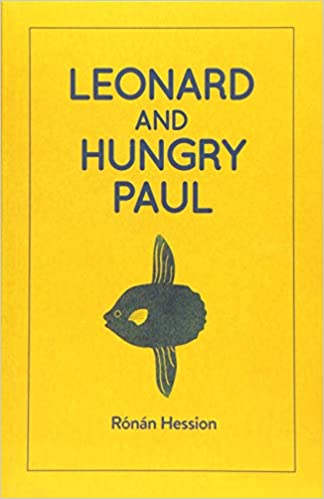
Secondly, Leonard and Hungry Paul by Rónán Hession published by Bluemoose Books, an independent publisher based in Hebden Bridge, whose manifesto explains “At Bluemoose our aim is to publish cracking stories that engage and inspire.”
I tried to read L&HP back in the summer and totally failed, but it had a lot of positive reviews in the blogosphere and so I gave it another shot. Now my reading is recovering somewhat I zipped through it with ease, so I’m sure my earlier troubles were indicative of my reading slump and not Hession’s writing.
The titular friends are men around their mid-thirties, who are easily overlooked. Leonard is grieving his mother, who he lived with in the family home until she died, never moving out because they got on well and there was no reason to. I found this relationship very touching. So often parent/child relationships are dramatized as being full of unspoken judgements and resentments, and it was a pleasant change to see someone who loved his parent, but also liked and respected them.
“Had he the courage, Leonard would have spoken up and said that his mother looked after everyone in her life as though they were her garden birds: that is to say, with unconditional pleasure and generosity.”
Leonard’s grief is of the quiet, ordinary kind where you still get up and go to work every day, carrying a deep sadness with you. In other words, the type pretty much everyone experiences.
“Leonard took off his noise-cancelling society-repelling headphones and went to the kitchenette for a mid-morning cup, even though he always disliked the awkward wait for the water to boil and the prospect of kettle-related time-killing small talk.”
I am with you Leonard.
Hungry Paul – whose attributive adjective is never explained – still lives at home with his parents, happy to bumble along, working as a casual postman and seeing Leonard regularly for their boardgame nights.
“He had no interest in, or capacity for, mental chatter. He had no internal narrator. When he saw a dog he just saw a dog, without his mind adding that it should be on a lead or that its tongue was hanging out like a rasher.”
Paul’s quiet stillness comes into its own when his mother insists he join her as a volunteer hospital visitor. While his extrovert mother chats away happily with one patient, Paul becomes the only one another patient will tolerate “He sat there calmly, simply sharing the moment with the woman.”
Not very much happens in L&HP but there is enough plot to pull the reader along. Paul’s sister Grace is getting married; Leonard begins a tentative romance; Hungry Paul enters a competition at the Chamber of Commerce. Really though, the novel isn’t so much about what happens as providing a glimpse into ordinary, quiet lives, and showing how they are worthy of attention:
“Their friendship was not just one of convenience between two quiet, solitary men with few other options, it was a pact. A pact to resist the vortex of busyness and insensitivity that had engulfed the rest of the world. It was a pact of simplicity, which stood against the forces of competitiveness and noise.”
I found L&HP to be a paean to the kindness and the gentleness found in the everyday small gesture:
“She was a person for whom kindness was a very ordinary thing, who believed that the only acceptable excuse for not having a bird feeder in the back garden was that you had one in the front garden”
(Or in my case, because you live in a London flat and the management company have banned them because the rats feast on them ☹)
It’s not an overly worthy novel though, there is plenty of humour. No-one is put down, but the absurdities of people are gently ribbed, such as Leonard’s colleague “Okey dokey. This will take just one minutiae. Take a load off, compadre,’ said Greg, unable to complete one conventional sentence.”
As an introvert who despairs at the relentless noise of modern life (why do shops think blaring out music will entice you to spend more time and money there? Why are cinema volumes now kept at ear-bleeding decibel levels?!) and who firmly believes in the meaning of the everyday, I was definitely the target audience for L&HP. If this sounds like you too, then I think you’ll enjoy this novel.
“We live in an age of cacophony. Everyone talking and thinking out loud, with no space or oxygen left for quiet statements and silence.”
To end, one of the best TV theme songs ever, all about being a friend:






 madame bibi lophile recommends
