Novella a Day in May 2025: No.23

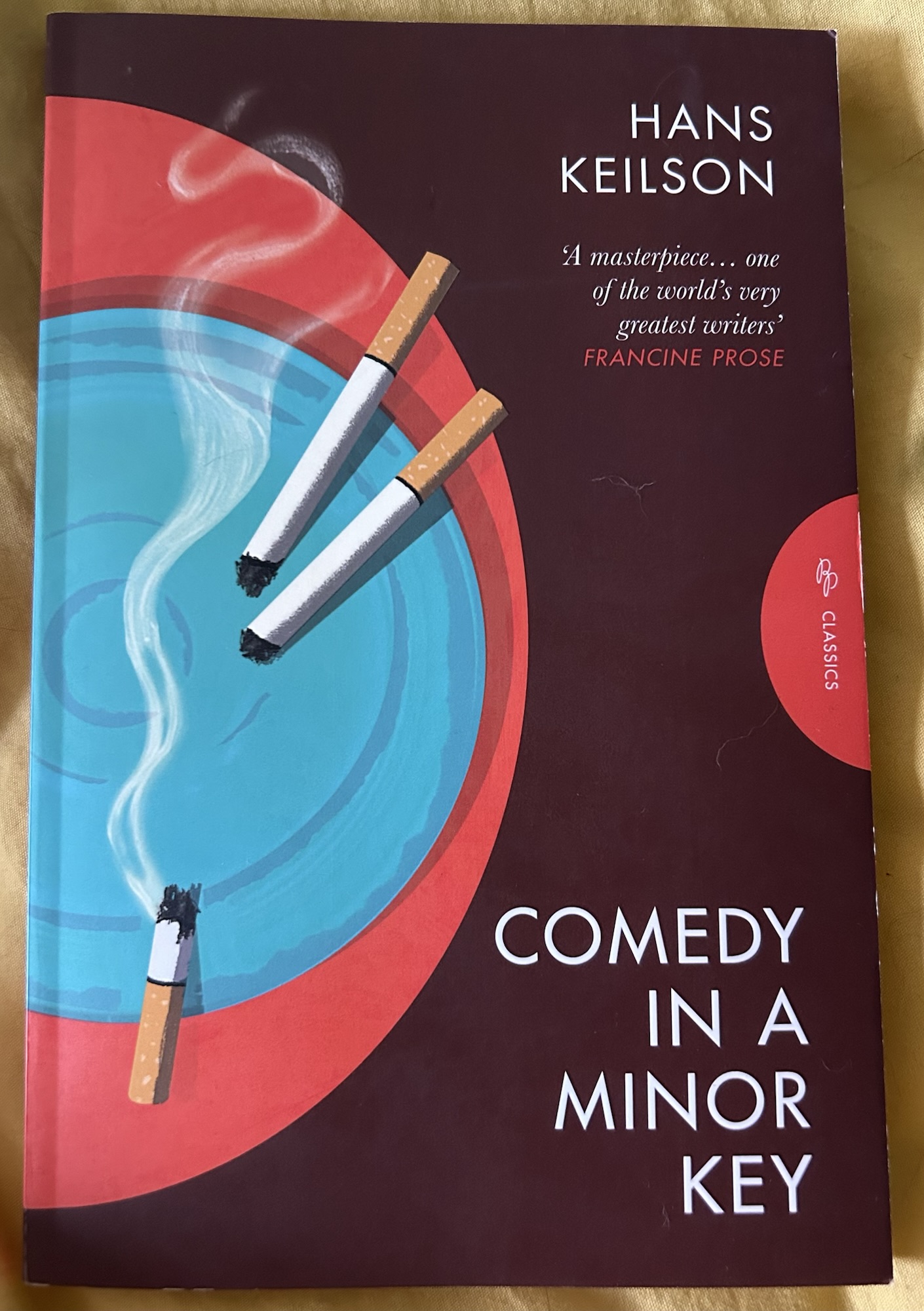
Comedy in a Minor Key – Hans Keilson (1947, transl. Damion Searls, 2024) 108 pages

Yesterday I posted on a German novella written just before the war, and today I’m looking a novella written just after the war but set during those years.

Hans Keilson was a remarkable man. His wiki page opens:

“German-Dutch novelist, poet, psychoanalyst and child psychologist. He was best known for his novels set during the Second World War, during which he was an active member of the Dutch resistance.

Keilson, having worked with traumatized orphans, mainly wrote about traumas induced by the war.”

Both his parents died in Auschwitz and Keilson had to go into hiding with a married couple for part of the war. In Comedy in a Minor Key, he explores this set-up, albeit primarily from the point of view of the couple.

Wim and Marie are a young Dutch couple who are approached to take someone into hiding in their house. Nico is older than them and the three of them live in restricted secrecy.

“The beginning was always exciting, no matter how many times a person had already lived through it.”

Wim and Marie are determined that no-one else will know about Nico. This doesn’t last long as they tell people, and others know already. For almost a year, the three of them live together in awkward domesticity.

What Keilson captures so well is the complexity of feelings around this living arrangement. So Nico isn’t unreservedly grateful; he’s also angry and scared and frustrated:

“Safe? Protected? Since they had taken him in? No, no, he was being unfair. But their house, their home, there things – their world – how it all had attracted him and soothed him at first. And now: how vain, how inflated, how worthless! For he measured things now with the cosmic measure, which gripped him tight and shook him back and forth. What trust in each other? What danger? And what a gulf between people! Consolation! Consolation?… was there any such thing?”

And for Wim and Marie there is bravery and kindness and also some vanity:

“You don’t get the chance to save someone every day. This unacknowledged thought had often helped them carry on when, a little depressed and full of doubt, they thought they couldn’t bear this complicated situation any longer and their courage failed them.”

The three of them muddle along together, and I found this description of their nightly snack and coffee very touching:

“There was gratitude in this habit, and a little tiredness, from the night to come that they were about to enter alone or as a pair, and a furtive, sad happiness in the smiling, incomprehensible futility.

But these scenes occur in flashback, as the novella opens with Nico having died of pneumonia, and Wim and Marie faced with what on earth to do now.

“How the neighbours and everyone on the street would look when he suddenly walked out of their house and strolled up and down the street with them. It would give them a little sense of satisfaction, and everyone who makes a sacrifice needs a little sense of satisfaction. And then you’d feel that you, you personally, even only just a little bit, had won the war.

It had all gone up in smoke. It wasn’t even a dream anymore. None of the three of them had any luck. But really, him least of all.

Poor Nico!”

Keilson never laughs at Nico’s death. What Comedy in a Minor Key shows is the enormity wartime in a domestic setting and how the mundane and silly can endure in the worst of circumstances. It shows how ordinary people can be so brave and also a little bit self-serving. It shows how the inbuilt hopes of a large gesture towards saving a life are entirely undermined when the person dies anyway.

I didn’t find this novella laugh-out-loud funny and I don’t think that’s what the title refers to. Rather I think the comedy refers to the ultimately comedic undermining of best intentions being a resistance in itself, as the war fails to destroy the ridiculous.

“Behind her curiosity there was a burning pain that cried out for more consolation than it was possible to give.”

Novella a Day in May 2025: No.22

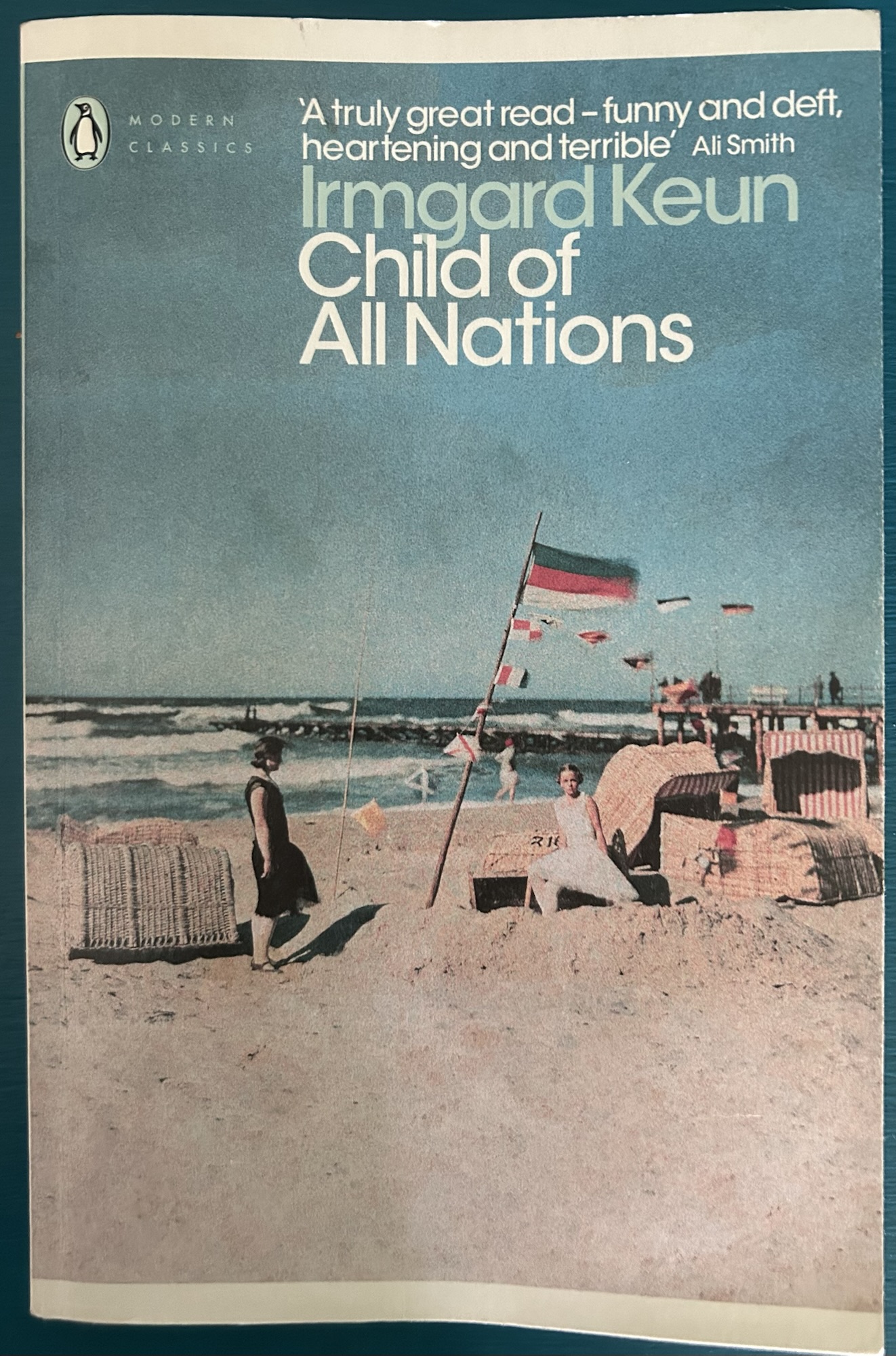
Child of All Nations – Irmgard Keun (1938 transl. Michael Hofmann 2008) 183 pages

I’m sticking with a child’s perspective with today’s novella, by an author I’ve been meaning to read for so long. Child of All Nations by Irmgard Keun is told from the point of view of nine-year-old Kully as she and her parents ricochet around immediate pre-war Europe.

“We left Germany when my father couldn’t stand it anymore, because he writes books and articles for newspapers. We emigrated to find freedom. We’re never going to go back to Germany. Anyway, we don’t need to, because the world is a very big place.”

There’s no doubt that Kully’s father is an important and talented writer, as we see from the responses he gets from other adults. However, he is also self-centred, feckless, and disregards his wife and child to the point of cruelty.

“Sometimes my father loves us, and sometimes he doesn’t. When he doesn’t, we can’t do anything about it, my mother and me. Nothing is any good when he doesn’t love us. Then we’re not allowed to cry in his presence or laugh, mustn’t give him anything, or take anything from him either. Any steps we might take only have the effect of delaying even more the time when he will love us again. Because he always comes back to us.”

From my twenty-first century perspective, they’d be better off without this man and his relentless need for the stimulation of the new, spendthrift ways and constant affairs with other women.

“I look a lot like my mother, only she has bluer eyes than me, and bigger legs, and she’s bigger all round. She wears her hair combed back, and in a knot at the back of her head. My hair is short and unruly. My mother’s much prettier than I am, but I don’t cry so much.”

However, the child’s perspective is so clever in the characterisation of the father, because he is never demonised. Thus, trailing round various countries; being abandoned as surety in various hotels and restaurants; and dragged into his schemes to get loans on promises of work which never appears; are not judged, because Kully just accepts things as they are.

He is also complicated in that his uselessness with money comes from a total material disregard. So while he gambles and drinks away their money, he also gives a lot of it away to people in a worse position than he is. This behaviour, and his writing, shows a compassion for others which unfortunately doesn’t extend to those closest to him.

My father often tells fibs to get a bit of peace and quiet… Sometimes, though, he performs miracles and everything he says comes true.”

What Keun also does well is presenting Kully’s voice directly, so that while it is unmediated and so distinct, adult readers are still able to pick out where she echoing what adults have said to her:

“We only eat once a day, because that’s cheaper, and it’s perfectly adequate. I’m always hungry anyway, even if I eat seven times a day.”

You just know that an adult, most likely her father, has told her that one meal is “perfectly adequate”.

Written in 1938, the shadow of war looms large. Unsurprisingly, Kully only just grasps some of it and her naivete is heartbreaking:

“I’m not afraid, because I’ve got my mother with me, the waiter who brings us our breakfast in the morning has said he’s not afraid either, and there isn’t going to be any war. And if there is, and we’re put in a camp, then he will continue to bring us our meals.”

What is apparent to the reader now, too, is that some of the countries Kully’s family head to as places of safety are not going to remain as such.

There’s a heartbreaking scene where just briefly, Kully’s mother gets what she wants: a small place with a kitchen where she can cook her own food. But inevitably, Kully’s father is bored within days and it is all taken away again.

What Kully recognises, which her father fails to understand, is that constant movement does not automatically mean freedom:

“Because we never have any money, we feel imprisoned by any hotel in any city, and from the very first day we think of our liberation.”

Child of All Nations documents an episodic, transitory life and the lack of plot is reflective of this, with the novella form suiting the story well. Kully’s voice was so clear from the first page and she remains resilient and with astonishing equanimity to the end. Knowing that the Europe in which Kully moves was about to change beyond all recognition gives it an extra resonance, and I think Keun already knew this too.

So, my first Keun read was a success, and I’m keen to read more!

Novella a Day in Day 2025: No.19

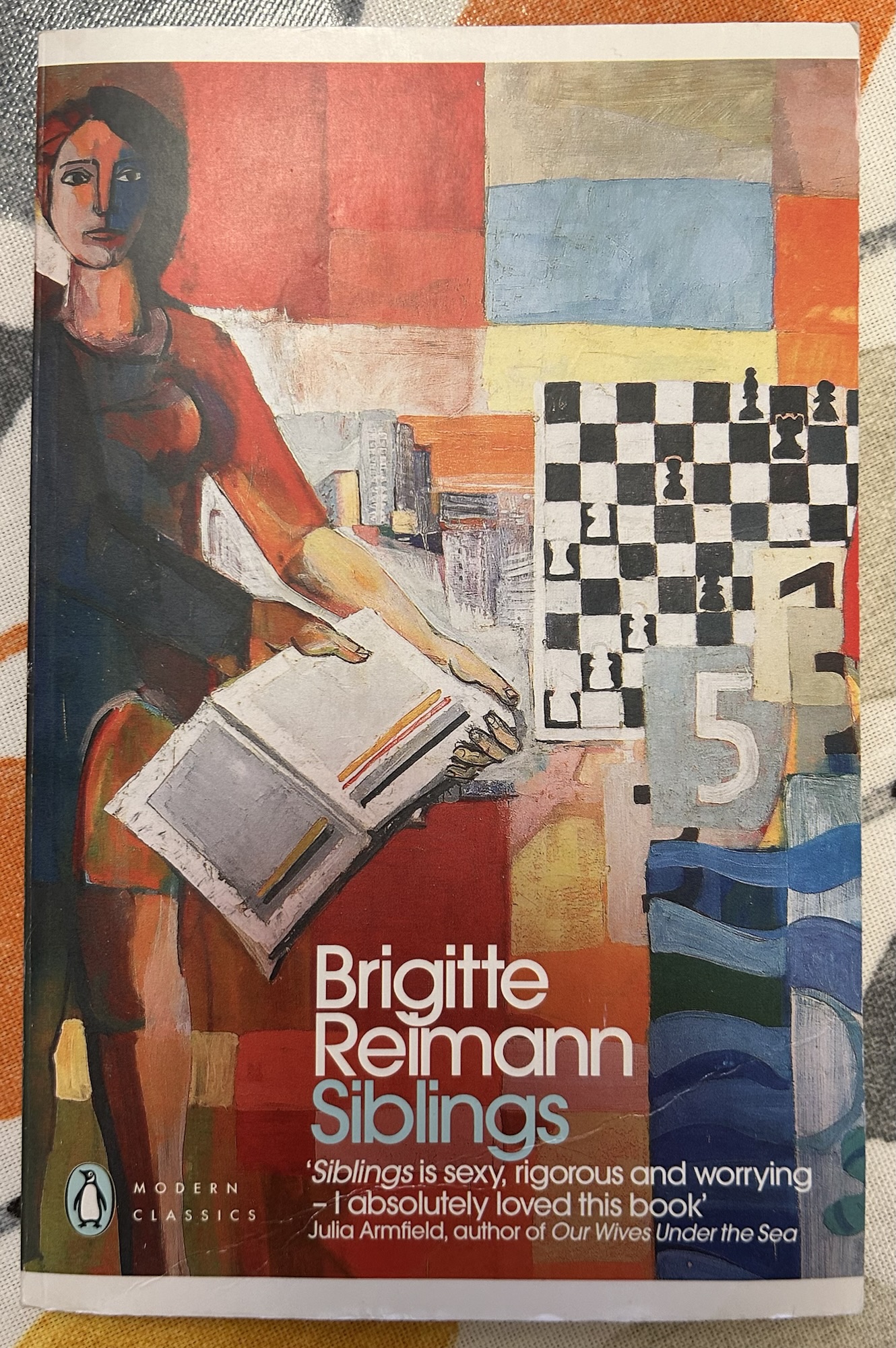
Siblings – Brigitte Reimann (1963, transl. Lucy Jones 2023) 129 pages

Summarising Siblings makes it sound incredibly clunky. A brother and sister living in the GDR find themselves separated ideologically as one of them wants to leave for the West. However, Brigitte Reimann’s writing is so skilled that the relationship between the siblings is rounded. The novella never feels like a construct in order to explore two forms of government in opposition to one another.

We know from the start that there has been some sort of significant betrayal. It opens:

“As I walked to the door, everything in me was spinning.

He said, ‘I won’t forget this.’ He was standing very straight and not moving in the middle of the room. He said in a cold, dry voice, ‘I’ll never forgive you.’”

The story is told from the point of view of Elisabeth (Betsy/Lise) and each chapter opens with the current situation (1960, prior to the Berlin Wall being built) before looking back in time. We learn of her close relationship with her brother Uli.

“I trusted him in every way and was vain enough to think I knew everything or almost everything he thought and planned. But in truth, back then, which was only the day before yesterday, I didn’t have a clue about the person closest to me.”

They are young people from a previously privileged family (who voted for Hitler), although they no longer have access to their industrialist family’s assets or wealth. Elisabeth is an artist and has a job working in an industrial plant painting the workers and teaching, which she enjoys despite the frustrations of dealing with colleagues and pressures from the Stasi.

“As soon as I’ve warmed myself in the lap of my family for a few days, I feel homesick for its adventurous, daring atmosphere; and for the sight of the huge, white and yellow excavators; for the mountains of sand blown haphazardly by the wind, under which lies the dark brown, damp coal seam; and for the drivers up in their peaceful cabins, shields lowered, patiently shovelling tonnes of earth…”

Uli is an engineer but he is unable to get a job due to being blacklisted by association with a professor who defected, despite him knowing nothing about the defection. Unlike Elisabeth and her boyfriend Joachim who works for the Party, Uli struggles with the immense bureaucracy and lack of choices he has in the GDR.

The siblings’ brother Konrad went to the West with his wife, and Elisabeth sees this as a huge betrayal, despising the materialism she feels drove the decision.  He was part of Hitler Youth, while Elisabeth and Uli were both small children during the war. Hence her feelings about the West and her immediate family are bound up with and complicated by Germany’s recent past.

A further complication is that Elisabeth and Uli have stayed close throughout their lives and she describes Uli romantically, dwelling on his handsomeness and appealing qualities more than on those of Joachim. I found her response in this way to her brother odd and unnerving, but I don’t know if that is a cultural difference or a deliberate decision by Reimann to make the siblings’ bond overly intense.

Uli tries to explain to Elisabeth the difference between him and Konrad; why he needs to leave, despite still believing in socialism:

“‘Before I’m ground to pieces here,’ he added, not quite as loudly, not quite as confidently. ‘I’ll always stand up for the public ownership of industry over there.’

‘Even in your shipyard?’

‘Even in my shipyard.’ He paused then smiled uncertainly.

‘How come your shipyard?’ I said quickly. ‘You’ll have to stop using communist phrases, you know.’”

Having Uli still believe in the system of government but finding himself unable to live under it complicates the opposing views of the siblings and exposes the layers of experiences which can lead to vastly different life decisions.

Another clever decision is to not paint the GDR as a bleak wasteland. As well as Elisabeth’s romantic view of the plant, the natural environment is beautifully evoked:

“The morning sun had moved on, and the sky stood flat and pale blue above the trees lining the avenue; from the kitchen window, above the cottages, I could see stables and small courtyards nestling closely together in this bucolic area of town. Raindrops sparkled on the walnut tree branches and the tips of its leaves in the slanting sunshine.”

The narrative circles back to end where it began, perhaps indicating the circular nature of the political arguments that neither Uli or Elisabeth will win. By the time we return, the reader is fully aware of the various ambivalent, contradictory bonds which tie Elisabeth and Uli. Siblings is a heartbreaking portrait of how wider political pressures can fracture the closest of relationships, irretrievably.

“‘I can’t explain anything to you,’ he said after a while. ‘Because our views on freedom, among other things, are too far apart.’”

Novella a Day in May 2025: No.16

Tokyo Express – Seichō Matsumoto (1958 transl. Jesse Kirkwood 2022) 149 pages

Tokyo Express is very much a howdunit and whydunit, as the whodunnit is seemingly fairly obvious from the start. This was my first time reading crime master Seichō Matsumoto and I was hugely impressed.

A young couple are found dead on Kashii beach near a shrine, having drunk cyanide. The local Fukuoka police are quick to decide a double suicide. There is nothing to suggest otherwise, but one of the team, Torigai Jūtarō, a long-standing and rather dishevelled detective, isn’t so sure.

“His overcoat was as battered as the clothes beneath it, his face unshaven, and his tie twisted and worn.”

Reminiscent of Lieutenant Columbo (whom he predates), Torigai is sharp-minded and unegotistical too. He starts trying to unravel how the couple came to be on the beach at that time. The young woman called Toki is dressed in a kimono and was a waitress at a restaurant in Akasaka; the man in Western clothes was Kenichi Sayama, an employee at Ministry X, currently under investigation for corruption. They were witnessed getting on the titular train by two of Toki’s colleagues, and it seems pretty clear that their bearing witness was engineered by a businessman called Tatsuo Yasuda.

Quicky Torigai establishes that a lot rests on that train journey and the timings of what happened when. He’s also baffled by a receipt from the buffet car found on Sayama’s body which recorded a food order for just one person.

“A scene formed in Torigai’s mind: the dark silhouette of a man, silently and briskly leading a woman to the beach, and the woman saying: What a lonely place.”

When Kiichi Mihara turns up from Tokyo, an outwardly very different detective takes over. The case is attracting attention due to the corruption in the Ministry, and Mihara works for the Second Division which investigates white collar crime.

“There was something in his cordial tone that reminded Torigai of an insurance salesman.”

The two investigators agree that the deaths are suspicious, and they also realise Yasuda is likely involved. However, trying to crack his alibi about where he was and when proves extremely difficult.

“Yasuda was always consulting the railway timetable. Did that perhaps mean he knew it secrets? In any case, his familiarity with the train times had to signify something. What if Yasuda’s entire alibi was built on it?”

This is one of the most procedural of police procedurals I’ve ever read. Everything hinges on the tight timing of trains, ferries and planes (a premise that would not remotely work in the UK as it depends on all the transport running to time, which as Magnus Mills pointed in out in my earlier read this month, will never occur). Torigai fades into the background, as Mihara tries to pick it all apart but keeps hitting brick walls.

“That crack in the wall had been nothing but a mirage. Mihara felt crushed. He held his head in his hands and, for a moment, could only stare at the piece of paper in front of him.”

I knew a bit about Tokyo Express before reading it, including that all the timings are based on the actual timetables of the time in the novel, and I wondered if it would be impossible to follow/bogged down in the logistics. But Seichō Matsumoto does a great job of carrying the reader along and there’s even a few surprises in store. The relationship between the two detectives is warm and endearing. I don’t know if they appeared in his subsequent novels, but even if not, I’d be keen to read more by this author.

“Mihara liked to ride the trams of Tokyo. Often, he would board without a specific destination in mind. Odd as it might seem, whenever he was at a loss for ideas, he would simply sit on the tram and allow his thoughts to roam. The tram’s steady trundle, its gentle swaying, induced in him an almost euphoric state of contemplation.”

Novella a Day in May 2025: No.10

Marzahn, Mon Amour – Katja Oskamp (2019, transl. Jo Heinrich 2022) 141 pages

Marzahn, Mon Amour is a novella I’d been meaning to read for a while and I’m delighted to have finally got to it. Based on the author’s experience of retraining as a chiropodist in her middle-age, it is essentially a series of character sketches of her clients.

Initially her training is a struggle and she’s unsure of her new career:

“We had reached a low point, at people’s feet, and even there we were failing.”

“From writer to chiropodist – what a spectacular come down. I had forgotten how much people, the looks on their faces and their well-meant advice, got on my nerves.”

But on qualifying she gets a job in a salon in the titular area of Berlin, and begins to find her vocation:

“As always, the weather here in Marzahn, once the biggest expense of plattenbau prefab tower blocks in the former East Germany, seems more intense than in the centre. The seasons have more of a smell about them.”

Her boss is Tiffy “a grandmother, albeit a non-practising one”; Flocke is the chaotic nail technician. The chapters take the names of her clients, and Oskamp expertly captures a sense of the person in very few words:

Herr Paulke: “whenever I laughed at something that Herr Paulke said in his matter-of-fact way, emotion almost imperceptibly flashed across his face, a mix of incredulity, pride and shame. He was no longer used to anyone paying him any attention.”

The Mon Amour affection the author feels for her clients shines through. Often these are elderly people, disregarded by society, and Oskamp gets to know them over a period of months and even years. The act of caring for their feet is intimate, especially for those who may now be alone and not have much gentleness in their lives.

They all have stories to tell, such as Gerlinde Bonkat, who arrived as a refugee:

“She formulates crystal clear, quotable sentences and speaks an accentless German, with a faintly Nordic hint to its melody.”

Which isn’t to say Oskamp likes all her clients. Herr Pietsch is a former government worker who fails to realise his days of power are over: “All your life you’ve mistaken your position for your personality.” And there’s a disturbing portrait of a mother and daughter who visit where there is a query of elder abuse.

But generally Marzahn, Mon Amour is a gentle read.

“Frau Frenzel is seventy years old. She views the world with a cheerful contempt and won’t let anything or anyone spoil her mood. She reminds me of a hedgehog, with her nose perkily pointing upwards, lively button eyes and grey spiked mullet straight out of the 80s […] Amy, with whom Frau Frenzel shares her life, is a short haired dachshund.”

A lovely read and a wonderful tribute to the writer’s clients.

Novella a Day in May 2025: No.4

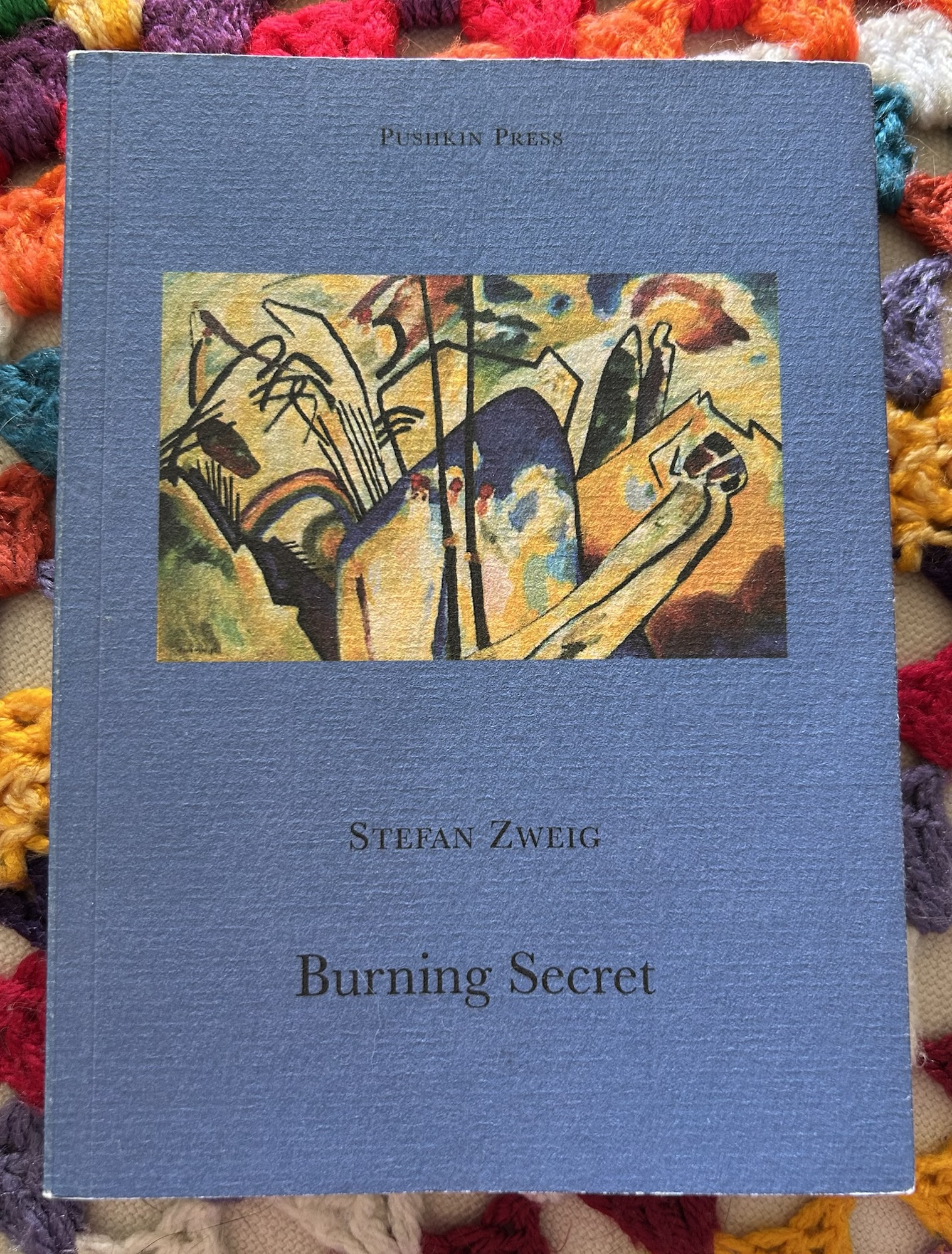
Burning Secret – Stefan Zweig (1913, transl. Anthea Bell 2008) 117 pages

Stefan Zweig is such an exquisitely tender writer. His precise, compassionate observations are deep with humane understanding. It makes him a perfect novella writer.

Burning Secret has a very simple structure. Edgar is twelve years old and recuperating from an illness in the spa town of Semmering. He is lonely and disregarded, bored and unnurtured.

“His face was not unattractive, but still unformed; The struggle between man and boy seemed only just about to begin, and his features were not yet kneaded into shape, no distinct lines had emerged, it was merely a face of mingled pallor and uncertainty.”

Unfortunately for Edgar, the Baron, an irredeemable cad and bounder, arrives in Semmering.

 “He felt no inclination to be alone and avoided it as far as possible; he didn’t really want to become any better acquainted with himself. He knew that, if he was to show his talents to best advantage, he needed to strike sparks off other people to fan the flames of warmth and exuberance in his heart. On his own he was frosty, no use to himself at all, like a match left lying in its box.”

This vacuous young man plans on whiling away his time in a meaningless love affair, and his sights soon settle on Edgar’s mother. As she is initially resistant to his charms, he callously decides to leverage Edgar in order to win favour.

“The Baron easily won his confidence. Just half-an-hour, and he had that hot and restless heart in his hands. It is so extraordinarily easy to deceive children, unsuspecting creatures whose affections are so seldom sought.”

Poor Edgar. He falls hook, line and sinker.

“A great, unused capacity for emotion had been lying in wait, and now it raced with outstretched arms towards the first person who seemed to deserve it. Edgar lay in the dark, happy and bewildered, he wanted to laugh and couldn’t help crying.”

For the Baron it is all a game. He has no feelings for Edgar or his mother, the latter only prey with which to amuse himself. He views her ruthlessly, identifying her snobbery and pretentions and knowing how to exploit these by emphasising his nobility. He gives no consideration to her marriage or vulnerabilities as a woman who will be judged much more harshly than he if they have an affair.

What he doesn’t reckon on is Edgar’s dawning, imperfect realisation, and the fury of a hurt child. What follows is a coming-of-age story where the lessons are learned through emotional brutality.

And yet, the resolution is hopeful, and without bitterness. It feels realistic and reflective, not undermining what has gone before but demonstrating human endurance too.

In less subtle hands Burning Secret could be sentimental and mawkish. With Stefan Zweig, it is emotionally devastating.

“He didn’t understand anything at all about life, not now he knew that the words which he thought had reality behind them were just bright bubbles, swelling with air and then bursting, leaving nothing behind.”

“Two English meals a day would have done for me.” (Antal Szerb, The Pendragon Legend)

This month I started off my reading for Kaggsy and Lizzy’s #ReadIndies event with an author that the event had led me to discover last year: Gertrude Trevelyan. So it seemed apt to end this month’s reading with another author #ReadIndies had introduced me to last year: Antal Szerb. In 2024 reading Love in Bottle in February led to Journey by Moonlight for the 1937 Club in April. This time I’m looking at The Pendragon Legend (1934, transl. Len Rix 2006) which is published by the always reliable Pushkin Press.

The Pendragon Legend is Szerb’s first novel, and utterly bonkers. As I was reading it I remembered why I had enjoyed my previous Szerb reads so much: his wit, fun, intelligence without superiority, gentle ribbing without malice, make him such a joy.

The narrator Janos Bátky is a young scholar who spends his time hanging around the British Library Reading Room. Luckily for him, he has no need for money:

“My nature is to spend years amassing the material for a great work and, when everything is at last ready, I lock it away in a desk drawer and start something new.”

His current interest is Rosicrucians: “Nothing interests me more than the way people relate emotionally to the abstract.”  This ancient secretive organisation’s interests include: “Changing base metals into gold, deliberately prolonging the life of the body, the ability to see things at a distance, and a kabbalistic system for solving all mysteries.”

This leads to him being introduced to the Earl of Gwynedd who invites Janos to stay at Pendragon Castle and make use of his library. Janos heads off to Wales with some acquaintances in tow, unheeding the warnings of a mysterious telephone call… (why do people never heed mysterious telephonic warnings??)

Shortly into his stay there are both earthly concerns when bullets are stolen from his gun and metaphysical concerns where he seems to be haunted:

“Just to be clear on this: not for a moment did I think it could be any sort of ghostly apparition. While it is a fact that English castles are swarming with ghosts, they are visible only to natives – certainly not to anyone from Budapest.”

(This isn’t the only time Janos confuses England and Wales, despite the fact he encounters similar ignorance when people insist he must be German and that Hungary doesn’t exist: “’Come off it. Those places were made up by Shakespeare.’”)

There are femme fatales, reluctant heroes, knowing castle staff… my favourite character was the capable and blunt Lene Kretsch:

“This was how our friendship began: I set myself on fire and she put me out. I’d been sitting by the hearth with The Times. I’ve never been able to handle English newspapers – apparently one has to be born with the knack of folding these productions into the microscopic dimensions achieved by the natives – and, as I flicked a page over, the entire room filled with newsprint.”

And so The Pendragon Legend is a mystery, a thriller, a Gothic ghost story, a fable, and with the arrival of the Earl’s niece Cynthia, a romance, despite Janos’ callowness:

“I can never feel much attraction to a woman whom I consider clever – it feels too much like courting a man.”  

Maybe Cynthia has more tolerance for him as she comes from a family where: “At most, the Pendragons tolerate women within the limits of marriage, and even then without much enthusiasm.”

Szerb satirises romance along with all the other tropes and genres he employs, but always with affection and never with any disdain. Somehow Janos and assorted friends bumble their way through the mystery, despite the poisonings, blackmail and hauntings which dog their steps.

My one reservation is that it became a bit too esoteric towards the end, but this is a matter of personal taste and feels a bit mean-spirited in the face of such an affectionate and fun tale.

If you fancy a pacy, ridiculous, learned adventure, The Pendragon Legend is for you.

“I was filled with the tenderness I always feel – and which nothing can match – when I encounter so many books together. At moments like these I long to wallow, to bathe in them, to savour their wonderful, dusty, old-book odours, to inhale them through my very pores.”

“I’ve always looked at myself from above, as pleased as an omniscient narrator.” (Empar Moliner, Beloved)

Trigger warning: mentions childhood sexual abuse

This is my contribution to the wonderful Novellas in November 2024 hosted by Cathy at 746 Books and Beck at Bookish Beck.

I heard about Beloved by Empar Moliner (transl. Laura McGloughlin 2024) through Stu at Winston’s Dad’s blog. I was immediately tempted and it seemed a good choice for my resolution to buy a book a month from an indie press/bookshop. The lovely 3TimesRebel Press even included a tote bag 😊

The striking cover illustration is by Anna Pont, a Catalan artist. She died from cancer earlier this year and all the proceeds from Beloved are being donated to cancer research.

The paw is courtesy of Fred aka Horatio Velveteen aka Mike Woznicat (as like the comedian Mike Wozniak he has a handsome moustache). Anyway, enough of my blithering about my cat. On with novellas!

Remei is in her early 50s and going through menopause. She is married to a musician ten years younger and at the start of the novella she has a revelation:

“Falling oestrogen, combined with lactose intolerance and loss of near sight, makes me see the world through the light wings of a dragonfly. Because of this I can see, with utter clarity, that my man is going to fall in love with this other woman.”

The novella follows Remei as she works out how she will manage this, as she tries to cope with her bodily changes and memories of a traumatic past at the same time.

She is a witty, forthright, slightly sardonic narrator. I really enjoyed the distinctive voice of this resilient woman.

“I must point out I find modesty overrated: I’m still a good deal. What’s more, until now I’ve performed pre-feminist sexual positions with total dedication and delight.”

Her husband, whom she calls Neptune, is not as clearly drawn. But this is not his story: we are firmly in the first person narration of Remei. She and her husband don’t seem hugely well-suited:

“I like music much more than him and I’m an illustrator. But he likes comics much more than me and he’s a musician.”

“I like everyone, in one way or another. He likes hardly anyone, in one way or another.”

“That’s how we see life too, he and I. Me: everything and right now, so nothing is left over. Him: only what fits, even if what is discarded will rot.”

But she loves him and she loves being a mother to their daughter. Her career is successful, although not quite in the way she planned. However, she is not entirely happy. She self-medicates with alcohol:

“My whole life is a gallop between the pretentious and the epic, depending only on how many drinks I’ve had.”

As she goes for runs with her friends, she reflects on the sexual abuse of her childhood, sanctioned by her family. She is estranged from her brother, after she spoke about what was happening and they were taken into care. Remei seems very much alone, despite all the people that surround her.

She is blisteringly honest about her attitude to her husband and the confusion of feelings as she recognises future events:

“Do I want him to continue to love me as much as ever? Yes. No. I want to float along, no more. I want him to be frozen.”

There is a lot of humour too. Remei never demonises Cris, the young colleague of her husband, but wryly observes her behaviour:

“Punctual, efficient, her ovaries functioning at top speed.”

Beloved shows how control is only sustained through the lightest of ties. Remei is a functional alcoholic who could tip over at any time; she realises her relationship with her daughter is on the brink of change as the latter grows older and more aware; she attempts to control her body with running but aging is relentless; and she takes steps to manoeuvre her husband and Cris in a way that will allow her to cope with the affair, but where will this leave her?

Remei is so flawed, so honest, so tenderly vulnerable and spikily self-sufficient, I was really rooting for her to find a way through all the hurt.

To end, the ever wonderful Tracy Chapman singing about changes in life:

“The story of our lives still isn’t finished, and it never will be.” (Beatriz Bracher, Antonio)

Trigger warning: mentions mental illness and infant death.

Stu over at WinstonsDad’s blog is hosting Spanish Portuguese Lit Month for the whole of July and so this was the perfect opportunity to get to a novella by Brazilian author Beatriz Bracher which had been languishing in the TBR: Antonio (2007, transl. Adam Morris 2021) published by the wonderful Pushkin Press.

I want to start with the disclaimer that I don’t think I’ve really got to grips with Antonio, so this post is just some initial impressions. Although only 187 pages long it is incredibly densely written and it took me a week to read. Admittedly work has been really demanding lately, but usually it still wouldn’t take me that long to read a book of that length.

Also looking online, there are many effusive reviews praising the socio-political commentary of Antonio, which I’m sure I didn’t fully comprehend. I did pick up some, but I’m certain I need to re-read Antonio at some point.

The novella is told through the alternating viewpoints of three people: Raul, Isabel and Haroldo. Their silent interlocutor is Benjamim, who is awaiting the birth of his first child, the titular Antonio. The imminent arrival of his son has prompted Benjamim to probe into his family history in more depth.

“I’d like to think your mother was also a free person, and maybe you can hold onto that thought, instead of clinging to fear and rage.”

Benjamim knows that his father was Teodoro and that his mother was  Elenir.  Elenir had a son with Benjamim’s grandfather Xavier first, who they also called Benjamim and who died very young. The second Benjamim was raised by his father after his mother died in childbirth.  

Raul is his father’s friend, Isabel is his paternal grandmother, and Haroldo was Benjamim’s grandfather’s friend. They all provide histories of Benjamim’s family that echo and contradict each other, and none seem any more reliable or authoritative than any other. Each has their own truth.

The family is well-off and privileged in São Paulo, but their history is a troubled one. Both Xavier and Teodoro had periods of intense mental illness.

For Xavier, this occurred after the death of Benjamim. As Haroldo recalls:

“[Elenir] looked like a bent piece of wood. She didn’t cry. She received each condolence with correct politeness. Xavier was the total opposite: he was in pieces […] I managed to gain entry to that hell three times. The last time, I brought a team of nurses, to drag my friend out of there and take him to a sanatorium.”

Later, Xavier meets and marries Isabel and they raise a family. They are the generation that came of age in the 1950s and 1960s, idealistic and, in Isabel’s case, driven:

“In a family we’re always a me or and I who’s scattered and complex. It’s only at work, especially work that has to do with ideas, but it’s possible to feel ourselves out and let the contours assume the shape.”

Their youngest son Teo rejects the urban privilege he is born into and goes to live in rural Minas. He throws himself into village life but ultimately becomes rudderless and unwell. Isabel reminds Benjamim of his early childhood:

“You’re from this family, so you are this family. Your father wanted to be rid of all that, and shed himself along with it. The history that he crafted for himself in Minas was a non-history. He went too deep. By the time I brought him back, there was nothing left to hold onto, no handle I could use to hoist him back out: only damaged pieces.”

This is one of central themes of Antonio: how to live an authentic and conscious life, but not be overwhelmed by the search for meaning. How to truly find who you are, alongside the demands of daily life. Isabel believes the answer is hard work, but only Big Work. Haroldo points out:

“She raised a bunch of irresponsible ingrates who are incapable of the most basic displays of solidarity, like visiting their dying mother. Isabel cultivated a true horror of responsibility in them, and at the same time overloaded them with the responsibility to be nothing but the best.”

Isabel recognises that privilege brings responsibility, but she also remains an elitist. When she observes: “I never understood any language that wasn’t well spoken Portuguese.” she is being both literal and metaphorical. The family’s wealth isn’t what it once was and she is unhappy at her children’s middle-class existence.

To me Isabel was the strongest of the three narrators and I got a real sense of her. But Raul, living an ordinary life and baffled by what happened to his childhood friend, and the somewhat reprehensible, colourful Haroldo were also distinct characters if not entirely differing voices, and Bracher balances the three viewpoints well.

I’ve focused on some of the ideas rather than the events of Antonio and that is partly because the novella has some graphic scenes in it – of extensive mental breakdown, one of pig-killing and one of caring for a dead body by someone who doesn’t know what they are doing. None of these are gratuitous but they mean Antonio can be very difficult to read in places.

Bracher avoids conclusions about the causes of Xavier and Teo’s ill health and whether there is a genetic component or whether it is the demands of society on the individual. She vividly, sometimes viscerally, evokes the pressures of family and the search for self in late twentieth-century Brazil.

“To live long and stay well, stay away from your relatives.”

“I want to ride my bicycle, I want to ride my bike.” (Queen)

My final novella of May is And the Wind Sees All by Guðmundur Andri Thorsson (2011, transl. Björg Árnadóttir and Andrew Cauthery 2018), published by the ever-reliable Peirene Press.

The entire novel takes place within two minutes: the time it takes Kata, conductor of the village choir, to cycle down the main street of Valeryi in her polka dot dress.

“Everything is singing in the bright light. The sun sings, the sea, fish, telegraph poles, cows, flies, horses, dogs, the old red bicycle Kalli and Sidda gave her. She feels the day will come when her brown hair will once again have its red lustre. Once again her eyes will sparkle. Once again she’ll sing inside herself as she plays the clarinet. Once again there will be life in her existence. Once again she will be loved.”

We don’t find out why Kata has lost her sparkle until towards the end of the novella. In the meantime, as the residents of the northern Icelandic village see her go by, we get glimpses of their lives and a picture of the community.

The chapters are told from different people’s viewpoints but characters recur – as they would in such a small community – along with images and themes, weaving the fragmentary experiences into a whole.

One of the most harrowing stories belongs to Svenni, and yet his chapter begins quite lightly:

“Svenni lives in one of those houses that look like a man with his trousers hitched up far too high – a little house on big foundations.”

We learn that reticent “good bloke” Svenni, a surprise participant in the choir, has traumatic reasons for keeping himself to himself.

There are lighter moments too, such as Lalli the Puffin being so-called because he owns the Puffin restaurant, but also because “he struts and darts his eyes around like an inquisitive puffin. The villagers are all familiar with his distinctive waddle and smile to themselves when they see him.”

And there are moments in between, like the fragile reunion of two middle-aged people who had been teenage lovers back when they “presented their pain to each other” and are now taking a walk.

The coastal Icelandic setting of the fictional village is beautifully evoked throughout:

“The village is not just the movement of the surf and a life of work, the clattering of a motorboat, or dogs that lie in the sun with their heads on their paws. It’s not only the smell of the sea, oil, guano, life and death, the fish and the funny house names. It’s also a chronicle that moves softly through the streets, preserving in elemental image of the village created piece by piece over the course of centuries.”

The back of my copy refers to “relaxing Nordic hygge in a novel” – I disagree. And the Wind Sees All is not a harrowing novel but it’s not escapist either. There are villagers with traumatic pasts, there is self-medicating with alcohol, there is addiction and heartbreak.  There’s also love and friendship. Thorsson shows how these experiences sit amongst a beautiful village, where the community is coming together for a choir concert. It all exists simultaneously, within the two minutes of Kata’s bike ride.